EUROPE
7803 articles
USA
0 articles
DIGITAL
15886 articles (à imprimer)
Partitions Digitales
Partitions à imprimer
15886 partitions trouvées


Piano Solo - Level 2 - Digital Download SKU: A0.1328143 By Steve Stanfill. By William B. Bradbury. Arranged by Steve Stanfill. Chamber,Christian,Praise & Worship,Traditional. Score. 2 pages. Steve Stanfill #916118. Published by Steve Stanfill (A0.1328143). This is an arrangement of the  19th centruy hymn Sweet Hour of Prayer, attributed to William B. Bradbury.  It is suitable for prelude, postlude, or performance in Church services, combining the hymn tune with motifs from Giacomo Meyerbeer's hymn commonly set as Jesus Once of Humble Birth.  Both of these hymns have common usage in Christian congregations today, and will be particularly familiar to members of the Church of Jesus Christ of Latter Day Saints.Performance Practice:  This hymn should not be rushed but shouldn't drag either.  Markings are not included for damper pedal under the assumption that it's use should be rather intuitive given the harmonic rythum of the piece.  Occasional non-harmonic notes (mostly augmented 9ths)  in chords are intentional and should be present but not prominent--there to provide tension and color only.
Sweet Hour of Prayer
Piano seul
Steve Stanfill
$4.99 4.35 € Piano seul PDF SheetMusicPlus

Oboe,Piano - Level 3 - Digital Download SKU: A0.549488 Composed by Felix Mendelssohn (1809 –1847). Arranged by James M. Guthrie, ASCAP. Instructional,Romantic Period,Sacred,Standards. Score and part. 20 pages. Jmsgu3 #3500659. Published by jmsgu3 (A0.549488). Score: 11 pages, solo part: 3 pages, piano part: 5 pages. Duration: 4:20. This is a popular recital piece that would work well also in church or school programs. Mendelssohn Background Felix Mendelssohn (1809 –1847) was, by all means, a German mastermind composer, musician, and orchestra conductor of the Romantic period. Consequently, Mendelssohn composed in the usual forms of the time - symphonies, concertos, oratorios, piano music, and chamber music. To summarize, his most famous works include his music for A Midsummer Night's Dream, the Italian Symphony, the Scottish Symphony, The Hebrides Overture, his later Concerto for Violin & Orchestra, and his Octet for Strings. His most well-known piano pieces, by and large, are the Songs Without Words.  Artistic Standing  Musical tastes change from time to time. Moreover, just such a change occurred in the late 19th and early 20th centuries. This plus rampant antisemitism brought a corresponding amount of undue criticism. Fortunately, however, his artistic inventiveness has indeed been critically re-evaluated. As a result, Mendelssohn is once again among the most prevalent composers of the Romantic era. Early Family Life Mendelssohn was, in fact, born into a prominent Jewish family. His grandfather was, notably, the philosopher Moses Mendelssohn. Felix was, in fact, raised without religion. At the age of seven, he was suddenly baptized as a Reformed Christian. He was, moreover, a child musical prodigy. Nevertheless, his parents did not attempt to exploit his talent. Early Adulthood Mendelssohn was, in general, successful in Germany. He conducted, in particular, a revival of the music of Johann Sebastian Bach, specifically with his presentation of the St Matthew Passion in 1829. Felix was truly in demand throughout Europe as a composer, conductor, and soloist. For example, he visited Britain ten times. There, he premiered, namely, many of his significant works. His taste in music was. To be sure, inventive and well-crafted yet markedly conservative. This conservatism separated him by all means from more audacious musical colleagues like Liszt, Wagner, and Berlioz. Mendelssohn founded the Leipzig Conservatoire which, to clarify, became a defender of this conservative viewpoint. Mature Adulthood Schumann notably wrote that Mendelssohn was the Mozart of the nineteenth century, the most brilliant musician, the one who most clearly sees through the contradictions of the age and for the first time reconciles them. This observation points to a couple of features in particular that illustrate Mendelssohn's works and his artistic procedure. Musical Features In the first place, his musical style was fixed in his systematic mastery of the style of preceding masters. This being said, he certainly recognized and even developed early romanticism from the music of Beethoven and Weber. Secondly, it indicates that Mendelssohn sought to strengthen his inherited musical legacy rather than to exchange it with new forms and styles or replace it with exotic orchestration. Consequently, he diverged his contemporaries in the romantic period, such as Wagner, Berlioz, and Liszt. Mendelssohn revered Liszt's virtuosity at the keyboard but found his music rather insubstantial.
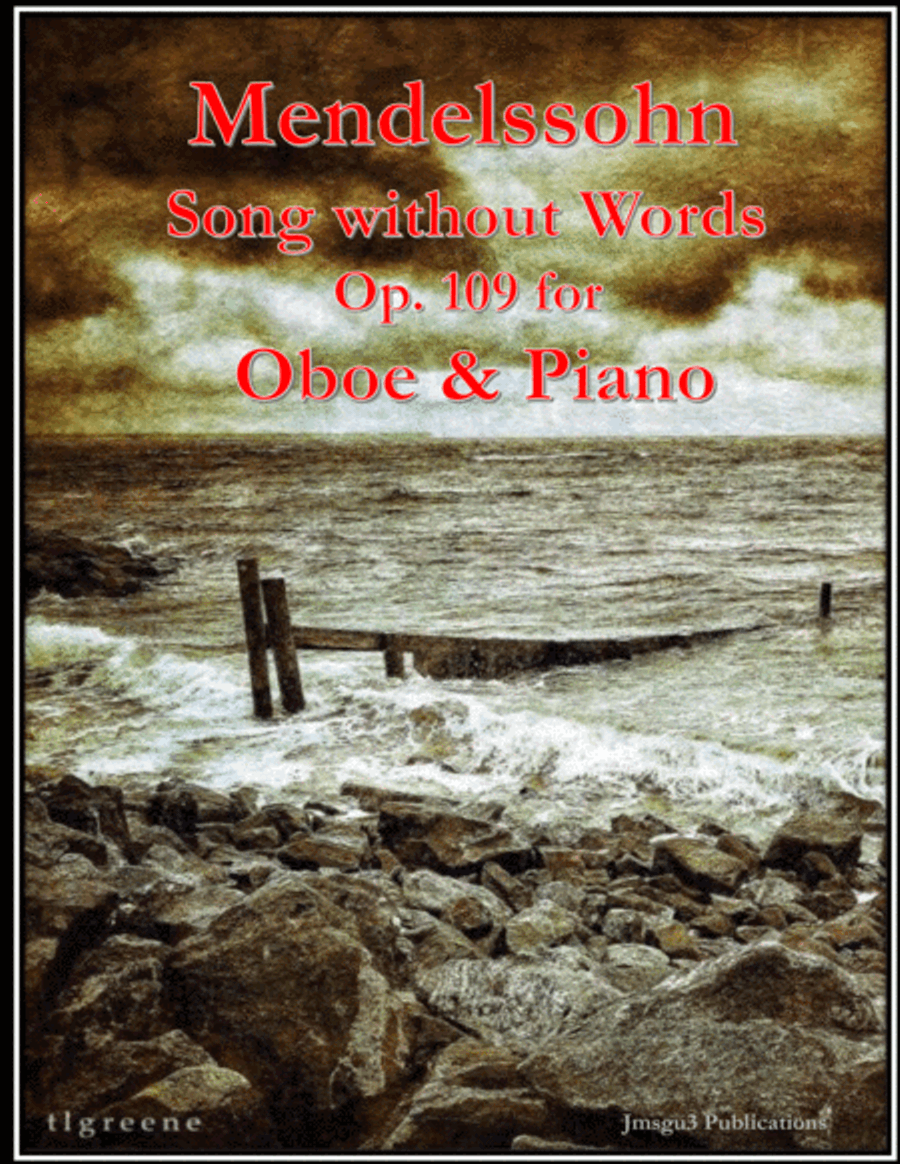
Mendelssohn: Song Without Words Op. 109 for Oboe & Piano
Hautbois, Piano (duo)

$32.95 28.69 € Hautbois, Piano (duo) PDF SheetMusicPlus

Piano,Tuba - Level 3 - Digital Download SKU: A0.1502768 Composed by Maria Theresia von Paradis. Arranged by Harry Walker. Chamber,Classical,Contest,Festival. Score and part. 7 pages. SCORE EDITIONS #1078435. Published by SCORE EDITIONS (A0.1502768). Sicilienne is a charming and melodious piece attributed to Austrian composer Maria Theresia von Paradis, a prominent figure in 18th-century music. Despite debates about its true authorship, the piece remains a beloved masterpiece due to its lyrical simplicity and elegance. This timeless work enchants listeners and performers alike with its pastoral melody and serene lyricism. Sicilienne offers a glimpse into von Paradis's talent and musical sensitivity, maintaining its popularity in concert programs worldwide. Its simple and elegant beauty ensures that it will be cherished for generations to come. In this version, the composition was arranged for Tuba and Piano by Harry Walker.
Sicilienne (Maria-Theresia von Paradis) for Tuba and Piano
Tuba et Piano

$5.99 5.22 € Tuba et Piano PDF SheetMusicPlus

Jazz Ensemble - Digital Download SKU: AX.00-PC-0017135_TN3 3rd Trombone. Composed by Sammy Fain. Arranged by Greg Yasinitsky. Jazz; Swing. Part. 3 pages. Alfred Music - Digital Sheet Music #00-PC-0017135_TN3. Published by Alfred Music - Digital Sheet Music (AX.00-PC-0017135_TN3). UPC: 038081319520.This up-tempo, swinging version of a great standard features trombones on the melody and a written solo for 1st trombone. There is also a prominent saxophone soli, roaring ensemble chorus and a big ending making this chart an ideal closer for festivals and concerts. Lead trumpet range is to A-flat above the staff. Arranger Greg Yasinitsky is consistently an excellent writer and Secret Love is no exception. (4:38)Closer.
Secret Love: 3rd Trombone
Trombone (partie séparée)

$3.00 2.61 € Trombone (partie séparée) PDF SheetMusicPlus

Flute,Piano - Level 3 - Digital Download SKU: A0.549486 Composed by Felix Mendelssohn (1809 –1847). Arranged by James M. Guthrie, ASCAP. Instructional,Romantic Period,Sacred,Standards. Score and part. 20 pages. Jmsgu3 #3500637. Published by jmsgu3 (A0.549486). CONCERT FLUTE & PIANO - Score: 11 pages, solo part: 3 pages, piano part: 5 pages. Duration: 4:20. This is a popular recital piece that would work well also in church or school programs. Mendelssohn Background Felix Mendelssohn (1809 –1847) was, by all means, a German mastermind composer, musician, and orchestra conductor of the Romantic period. Consequently, Mendelssohn composed in the usual forms of the time - symphonies, concertos, oratorios, piano music, and chamber music. To summarize, his most famous works include his music for A Midsummer Night's Dream, the Italian Symphony, the Scottish Symphony, The Hebrides Overture, his later Concerto for Violin & Orchestra, and his Octet for Strings. His most well-known piano pieces, by and large, are the Songs Without Words.  Artistic Standing  Musical tastes change from time to time. Moreover, just such a change occurred in the late 19th and early 20th centuries. This plus rampant antisemitism brought a corresponding amount of undue criticism. Fortunately, however, his artistic inventiveness has indeed been critically re-evaluated. As a result, Mendelssohn is once again among the most prevalent composers of the Romantic era. Early Family Life Mendelssohn was, in fact, born into a prominent Jewish family. His grandfather was, notably, the philosopher Moses Mendelssohn. Felix was, in fact, raised without religion. At the age of seven, he was suddenly baptized as a Reformed Christian. He was, moreover, a child musical prodigy. Nevertheless, his parents did not attempt to exploit his talent. Early Adulthood Mendelssohn was, in general, successful in Germany. He conducted, in particular, a revival of the music of Johann Sebastian Bach, specifically with his presentation of the St Matthew Passion in 1829. Felix was truly in demand throughout Europe as a composer, conductor, and soloist. For example, he visited Britain ten times. There, he premiered, namely, many of his significant works. His taste in music was. To be sure, inventive and well-crafted yet markedly conservative. This conservatism separated him by all means from more audacious musical colleagues like Liszt, Wagner, and Berlioz. Mendelssohn founded the Leipzig Conservatoire which, to clarify, became a defender of this conservative viewpoint. Mature Adulthood Schumann notably wrote that Mendelssohn was the Mozart of the nineteenth century, the most brilliant musician, the one who most clearly sees through the contradictions of the age and for the first time reconciles them. This observation points to a couple of features in particular that illustrate Mendelssohn's works and his artistic procedure. Musical Features In the first place, his musical style was fixed in his systematic mastery of the style of preceding masters. This being said, he certainly recognized and even developed early romanticism from the music of Beethoven and Weber. Secondly, it indicates that Mendelssohn sought to strengthen his inherited musical legacy rather than to exchange it with new forms and styles or replace it with exotic orchestration. Consequently, he diverged his contemporaries in the romantic period, such as Wagner, Berlioz, and Liszt. Mendelssohn revered Liszt's virtuosity at the keyboard but found his music rather insubstantial.
Mendelssohn: Song Without Words Op. 109 for Flute & Piano
Flûte traversière et Piano

$32.95 28.69 € Flûte traversière et Piano PDF SheetMusicPlus

String Quartet String Quartet - Level 2 - Digital Download SKU: A0.1292744 Composed by Dr. John Bull. Arranged by James M.. Guthrie. Chamber,Contest,Early Music,Festival,Historic,Renaissance. 3 pages. Jmsgu3 #883308. Published by jmsgu3 (A0.1292744). John Bull was an English composer, organist, virginalist, and organ builder who lived from 1562/63 to 1628. He was educated as a chorister of the Chapel Royal in London and later became a Doctor of Music at both Oxford and Cambridge Universities. Bull was one of the most famous composers of keyboard music of the early 17th century, and most of his compositions were written for the virginal, a keyboard instrument popular in the Renaissance period. He was known for his outstanding technical ability and keyboard virtuosity, and his music is distinguished by unfailing resourcefulness in devising new musical ideas. Bull's reputation rests on his extensive compositions for virginals and organ, some 150 extant pieces published in Musica Britannica. He was also one of the contributors to Parthenia, a collection of keyboard music published in 1611. Bull wrote an anthem, God the Father, God the Son, for the 1613 wedding of the princess and the Elector Palatine, in addition to his keyboard compositions, verse anthems, canons, and other works. Bull's music ranked among the foremost composers along with Byrd, Gibbons, and Tomkins.John Bull had several contemporaries who were also prominent composers during the Renaissance period. Some of these composers include:William Byrd: Byrd was an English composer and one of the most influential figures in English Renaissance music. He was a contemporary of John Bull and is considered one of the greatest composers of his time. Byrd's compositions include sacred choral music, keyboard works, and consort music.Orlando Gibbons: Gibbons was an English composer and organist who lived during the same period as John Bull. He was known for his sacred choral music, particularly his anthems and verse anthems. Gibbons' compositions are characterized by their expressive harmonies and intricate counterpoint.Thomas Tomkins: Tomkins was another English composer who was active during the same time as John Bull. He was known for his sacred choral music, including anthems and services. Tomkins' compositions are notable for their rich harmonies and expressive melodies.Jan Pieterszoon Sweelinck: Sweelinck was a Dutch composer and organist who was highly regarded during the Renaissance period. He was known for his keyboard music, particularly his variations and fantasias. Sweelinck's compositions had a significant influence on Bull and other composers of the time.These composers, along with John Bull, were influential figures in the development of Renaissance music and significantly contributed to the repertoire of keyboard and choral music during that era.
Bull: A Gigge - Doctor Bull's my selfe for String Quartet - Score Only
Quatuor à cordes: 2 violons, alto, violoncelle

$21.95 19.11 € Quatuor à cordes: 2 violons, alto, violoncelle PDF SheetMusicPlus

String quartet - difficult - Digital Download SKU: S9.Q771471 ‘hana no hanataba’. Composed by Julian Anderson. Downloadable. Duration 23 minutes. Schott Music - Digital #Q771471. Published by Schott Music - Digital (S9.Q771471). My 3rd String Quartet is in six contrasted movements. Certain musical figures recur across the work, but there are few themes as such. The main emphasis is on contrast of mood, texture, harmony, pacing and timing. Unlike many of my works this quartet had no extra-musical inspiration, and in principle should have no subtitle. Certain features already present in my music became more prominent in this new work: modes (limited collections of pitches) have always helped me to focus musical character, but here a sense of key note for each mode became much more pronounced, as did the difference between modes for each section of the work. A sort of hybrid key-system emerged (even with equivalents of major and minor) which is not normal tonality, nor does it aim to imitate it. Unlike tonality this key-system includes noises, extended performance techniques and intervals outside Western tuning as available resources. What I hope it does is to focus the listening experience onto different musical areas, to encourage a sense of both modulation from one area to another and to give the music a sense of goal. No conscious knowledge of this is needed when listening: the music should communicate directly on its own.Here, then, is this collection of six musical colours, related and unrelated, different yet belonging together, variable yet in a set order. Hence the subtitle, chosen both for both its sound and its sense: ‘hana no hanataba’ meaning, in Japanese, ‘bouquet of flowers’.A brief description:1)Moderately fast. Short droplets of sounds gather increasing momentum. 2)Very fast. Canons and bells at different speeds.3)Very slow – fast – very slow – very fast – very slow. The main slow movement and its main scherzo. An emphasis on non-tempered tunings and on inhaling and exhaling waves of sound. The slow sections feature florid melodic writing. In the exuberant scherzo competing duos and trios create imaginary folk music.4)Extremely fast/extremely slow. Open strings and harmonics fuse into a single string instrument – like a sort of large resonating Medieval tromba marina.5)Very fast. A variation on movement 2). Variation, Schoenberg told Cage, is just a sort of repetition ‘with some things changed and others not.’6)Slow - Very Fast - Fast – Slow. The opening calm harmonies and florid melodies evoke movement 3) in different music. The fast part features one overt theme: a fanfare-like call to attention which is subject to extensive development. There is much use of non-Western tuning. At its climax the music freezes into a frieze – a wall of sound standing in front of the audience with increasing obstinacy and certainty as the work grinds towards its cadence.
String Quartet No. 3
Quatuor à cordes: 2 violons, alto, violoncelle

$24.99 21.76 € Quatuor à cordes: 2 violons, alto, violoncelle PDF SheetMusicPlus

B-Flat Trumpet,Piano - Level 3 - Digital Download SKU: A0.1472846 By Nikolay Andreyevich Rimsky-Korsakov. By Nikolay Andreyevich Rimsky-Korsakov. Arranged by Ian Fitze. Contest,Festival,Folk,Instructional,Romantic Period. Score and part. 8 pages. Ian Fitze #1050473. Published by Ian Fitze (A0.1472846). Visit my website at IAN FITZE MUSICAL ARRANGEMENTS for a complete catalogue of my works including FREE DOWNLOADS.This is a moderately challenging piece adapted for instrumental solo with Piano accompaniment. From Wikipedia: The Mazurka (Polish: mazurek) is a Polish musical form based on stylised folk dances in triple meter, usually at a lively tempo, with character defined mostly by the prominent mazur's strong accents unsystematically placed on the second or third beat.Rimsky Korsakoff makes good use of melodies and counter-melodies throughout.A fun piece for both soloist and accompanist to put together.
Mazurka Op. 38 no. 2
Trompette, Piano
Nikolay Andreyevich Rimsky-Korsakov
$1.99 1.73 € Trompette, Piano PDF SheetMusicPlus

Choral Choir (SATB divisi) - Level 3 - Digital Download SKU: A0.1217616 By Karl Kang. By Karl Kang. Arranged by Karl Kang. A Cappella,Christian,Contemporary,Sacred,Traditional. Octavo. 6 pages. Karl kang #814172. Published by karl kang (A0.1217616). Karl Kang, a prominent Catholic composer from Korea, is known for his beautiful compositions such as 'Ave Verum', 'Ave Maria', and 'The Lord Bless You and Keep You'. His latest work, 'Ubi Caritas', is a stunning a cappella chorus set to the lyrics of the Responsories, which begin with Ubi cáritas et amor, Deus ibi est. and are traditionally sung during the foot washing ceremony on Holy Thursday. This lyrical and heartwarming piece is perfect for use in choir concerts, music classes, and as a repertoire of praise songs.Ubi cáritas et amor, Deus ibi est.Congregávit nos in unum Christi amor.Exsultémus et in ipso iucundémur.Timeámus et amémus Deum vivum.Et ex corde diligámus nos sincéro.Ubi cáritas et amor, Deus ibi est.Simul ergo cum in unum congregámur:Ne nos mente dividámur, caveámus.Cessent iúrgia malígna, cessent lites.Et in médio nostri sit Christus Deus.Ubi cáritas et amor, Deus ibi est.Simul quoque cum beátis videámusGloriánter vultum tuum, Christe Deus:Gáudium, quod est imménsum atque probum.Sæcula per infiníta sæculórum. Amen.Where charity and love are, God is there.Christ's love has gathered us into one.Let us rejoice and be pleased in Him.Let us fear, and let us love the living God.And may we love each other with a sincere heart.Where charity and love are, God is there.As we are gathered into one body,Beware, lest we be divided in mind.Let evil impulses stop, let controversy cease,And may Christ our God be in our midst.Where charity and love are, God is there.And may we with the saints also,See Thy face in glory, O Christ our God:The joy that is immense and good,Unto the ages through infinite ages. Amen.
Ubi Caritas (ì°¸ì‚¬ëž‘ì´ ìžˆëŠ” ê³³ì—)
Chorale SATB
Karl Kang
$4.99 4.35 € Chorale SATB PDF SheetMusicPlus

Instrumental Duet Cello,Instrumental Duet,Violin - Level 5 - Digital Download SKU: A0.722628 Composed by Cesar Auguste Franck. Arranged by Randy Calistri-Yeh. Classical,Romantic Period. Score and parts. 11 pages. Custom Chamber Music #5795179. Published by Custom Chamber Music (A0.722628). This is the complete FIRST movement of Franck's Violin Sonata, arranged for violin and cello duet.This movement is about 7.5 minutes long and works very well as a standalone recital piece. The violin part is identical to the original, except for about 20 measures where it also covers some of the piano part. The cello part covers all the critical parts from both hands of the piano; it is just as prominent as the violin part and equally challenging.[NOTE: the 4th movement is available separately as a duet; click on the publisher link above].
Franck Violin Sonata, Mvt. I (violin/cello duet)
Violon, Violoncelle (duo)

$8.99 7.83 € Violon, Violoncelle (duo) PDF SheetMusicPlus

String Quartet String Quartet - Level 3 - Digital Download SKU: A0.515180 Composed by Joseph Lacalle. Arranged by Kenneth Abeling. Film/TV,Latin,Wedding. Score and parts. 17 pages. LINCOLN MUSIC PUBLICATIONS #5020385. Published by LINCOLN MUSIC PUBLICATIONS (A0.515180). Amapola, Music by Spanish American Composer Joseph Lacalle (formerly Jose Maria Lacalle Garcia) and arranged here for Saxophone Quartet. This lovely piece has been recorded by dozens of prominent vocal artists, Operatic to Pop, and instrumentally as well as being featured in several movies. This is moderate level “Tango-ish†arrangements and suitable for general performance and other special events such as Weddings. Playing time 3:20. To view and listen to this piece in its entirety as well hundreds of other arrangement and transcriptions by Kenneth Abeling at the lowest prices available please visit: https://lincolnmusicpublications.com/
Amapola (for Saxophone Quartet SATB or AATB)
Quatuor à cordes: 2 violons, alto, violoncelle

$13.99 12.18 € Quatuor à cordes: 2 violons, alto, violoncelle PDF SheetMusicPlus

Brass Quintet Horn,Trombone,Trumpet,Tuba - Level 3 - Digital Download SKU: A0.1471923 By Emma Louise Ashford. By Emma Louise Ashford. Arranged by Andrew Lamb. 19th Century,Christmas. 26 pages. Andrew Lamb #1049556. Published by Andrew Lamb (A0.1471923). ? Christmas Voices by Emma Louise Ashford - Brass Quintet Arrangement ?Bring the festive spirit to life with this advanced-level Brass Quintet adaptation of Christmas Voices by American composer Emma Louise Ashford! Perfect for Christmas concerts, recitals, and church services.Instrumentation: ? Part 1: Trumpet / Cornet / Flugel in Bb ? Part 2: Trumpet / Cornet / Flugel in Bb ? Part 3: French Horn, Tenor Horn ? Part 4: Euphonium / Baritone / Trombone (Bass Clef and Treble Clef) ? Part 5: Tuba, Eb Bass (Treble Clef), Bb Bass (Treble Clef) This arrangement offers flexible instrumentation options.Level of Difficulty: AdvancedPotential Uses: Ideal for Christmas concerts, recitals, and church services.About the Composer:Emma Louise Ashford (1850–1930) was an American organist, composer, and music editor with over 600 compositions. She contributed significantly to church music and held various prominent positions throughout her career.Please like and subscribe for more videos and music arrangements.
Emma Louise Ashford | Christmas Voices | for Brass Quintet
Quintette de Cuivres: 2 trompettes, Cor, trombone, tuba
Emma Louise Ashford
$10.00 8.71 € Quintette de Cuivres: 2 trompettes, Cor, trombone, tuba PDF SheetMusicPlus

Concert Band - Level 4 - Digital Download SKU: A0.1343777 Composed by Alexander Borodin. Arranged by John Ivor Holland. 19th Century,Broadway,Classical,Contest,Festival,Multicultural,Musical/Show,World. 264 pages. John Ivor Holland #929284. Published by John Ivor Holland (A0.1343777). The Polovtsian Dances form an exotic scene at the end of act 2 of Alexander Borodin's opera 'Prince Igor'. The work remained unfinished when the composer died in 1887, although he had worked on it for more than a decade. A performing version was prepared by Nikolai Rimsky-Korsakov and Alexander Glazunov in 1890. Several other versions, or completions, of the opera have been made. The dances are sometimes performed with chorus and last around 11 minutes. Themes from the Polovtsian Dances have been used widely in popular culture, notably the 1953 musical 'Kismet'; the most prominent example is the popular standard Stranger in Paradise, adapted from the Gliding Dance of the Maidens, which opens this piece. This great piece, a staple of the orchestral repertoire, would form a substantial showpiece in any concert and important solos have been cross-cued for smaller ensembles.
Polovtsian Dances (from the Opera 'Prince Igor')
Orchestre d'harmonie

$69.99 60.95 € Orchestre d'harmonie PDF SheetMusicPlus


Partitions Gratuites
Acheter des Partitions Musicales
Acheter des Partitions Digitales à Imprimer
Acheter des Instruments de Musique

© 2000 - 2026

Accueil - Version intégrale





