EUROPE
53124 articles
USA
0 articles
DIGITAL
26734 articles (à imprimer)
Partitions Digitales
Partitions à imprimer
26734 partitions trouvées


Carcassi,Chopin,Lauro,Schubert Franz,Tárrega : La plus belle musique romantique pour la guitare, Difficile, Vol. 1
Guitare
Téléchargez la tablature et la partition Guitare La plus belle musique romantique pour la …
15.99 € Guitare PDF Tomplay

Albinoni,Bach Johann Sebastian,Caccini,Pachelbel,Vivaldi : La plus belle musique baroque pour la flûte à bec soprano, Facile, Vol. 1
Téléchargez la partition Flûte à bec La plus belle musique baroque pour la flûte à bec sop…
19.99 € PDF Tomplay

Guitar - Advanced - Digital Download SKU: ZZ.DZ-4244 Composed by Konstantin Bliokh. Score. 13 pages. Les Productions d'OZ - Digital #DZ 4244. Published by Les Productions d'OZ - Digital (ZZ.DZ-4244). La Sonate n° 6 Kharkiv pour guitare solo a été composée en 2021, à la fin du confinement lié au COVID-19. Ã? ce moment-là, ma famille et moi étions restés dans notre ville natale de Kharkiv (également connue sous le nom de Kharkov), en Ukraine, pendant près de deux ans. Nous considérions cette période de pandémie comme un désastre, mais nous avons réalisé plus tard que c'était en fait un moment plutôt heureux, car la guerre est arrivée dans notre pays quelques mois plus tard. Depuis 2022, une fraction considérable des 1,5 million de citoyens de Kharkiv ont quitté leur foyer, ceux qui sont restés vivent sous des attaques incessantes de missiles, et beaucoup ont été tués. Je voudrais dédier cette Sonate à la ville frontalière de Kharkiv et, surtout, à ses citoyens souffrant de la guerre.Pourtant, la musique de la Sonate n'a aucun programme spécifique. Ici, je donnerai un bref aperçu de ses principaux éléments de composition pour faciliter les interprétations futures.Les premier et quatrième mouvements de cette Sonate sont basés sur l'interaction entre le principe dodécaphonique et le centre tonal de sol majeur, naturel pour la guitare. En particulier, le premier mouvement est basé sur l'interaction de la triade de sol majeur Solâ??Siâ??Ré des cordes de guitare à vide 2â??3â??4, le motif ascendant 1 impliquant les notes Miâ??Fa#â??Laâ??Do# (à l'origine sur la première corde), et le motif descendant 2 utilisant les notes Miâ??Doâ??Sibâ??La (à l'origine sur la corde de basse 6). Ces éléments se complètent presque pour former douze tons (à l'exception du Fa manquant), et les motifs alternent avec des fragments ostinato où chaque note de la triade de sol majeur est déplacée pas à pas d'un demi-ton vers le haut ou vers le bas.Le deuxième mouvement est un Scherzo impliquant de nombreux demi-tons dans des accords accentués et des passages rapides, ainsi qu'un mouvement mélodique chromatique dans la voix de basse. Il est presque atonal dans certains fragments, mais a un centre tonal global de la mineur.Le troisième mouvement est un Adagio méditatif basé sur un thème composé dans l'échelle hexatonique Réâ??Miâ??Faâ??Sol#â??Laâ??Si et des accords ostinato impliquant les cordes de basse à vide Miâ??Laâ??Ré et le demi-ton Siâ??Do.Enfin, le quatrième mouvement est basé sur le thème dodécaphonique complet composé de deux phrases comprenant les motifs 1 et 2 du premier mouvement : Solâ??Faâ??Sibâ??Labâ??Doâ??Mibâ??Ré et Miâ??Siâ??Do#â??Laâ??Fa#. Ce thème est présenté dans ses formes prime et rétrograde. Il y a des dialogues entre la première corde, les basses et les cordes médianes à vide, similaires au premier mouvement. Ã? son apogée, le thème dodécaphonique est interprété en utilisant le mouvement parallèle de l'accord de sol majeur standard de la guitare avec les cordes médianes à vide sur douze positions.La Sonate a été créée en première et enregistrée (CD Naxos No. 8.574630) par le célèbre guitariste ukrainien Marko Topchii, qui a également vécu et étudié à Kharkiv. Je lui suis extrêmement reconnaissant pour l'interprétation brillante de cette pièce.Je suis très redevable envers Productions d'Oz d'avoir conservé mes notations originales là où celles-ci ne correspondent pas au style de l'éditeur.Sonata No. 6 Kharkiv for guitar solo was composed in 2021, in the end of the COVID-19 lockdown. At that time my family and I were staying in our home city of Kharkiv (also known as Kharkov), Ukraine for almost two years. We considered that pandemic period as a disaster, but later have realized that it actually was a rather happy time, because a war came to our homeland just a few months later. Since 2022 a considerable fraction of the 1.5 millions of Kharkiv citizens have left their homes, those who stayed have been living under ceaseless missile attacks, and many have been killed. I would like to dedicate this Sonata to the frontier city of Kharkiv and, most of all, to its citizens suffering from the war.Yet, the music of the Sonata does not have any specific program. Here I will give a brief overview of its main composition elements to facilitate future interpretations.The first and fourth movements of this Sonata are based on the interplay between the twelve-tone principle and the G-major tonal center, natural for the guitar. Namely, the first movement is based on the interaction of the G-major triad Gâ??Bâ??D of the open guitar strings 2â??3â??4, ascending motif 1 involving the notes Eâ??F#â??Aâ??C# (originally on the first string), and descending motif 2 using the notes E-â??Câ??Bbâ??A- (originally, on the bass string 6). These elements supplement each other to almost make up twelve tones (apart from the missing F), and the motifs alternate with ostinato fragments where each note in the G major triad is step-by-step moved by a semitone up or down.The second movement is a Scherzo involving numerous semitones in accented chords and fast passages, as well as chromatic melodic motion in the bass voice. It is almost atonal in some fragments, but has an overall tonal center of A-minor.The third movement is a meditative Adagio based on a theme composed within hexatonic scale Dâ??Eâ??Fâ??G#â??Aâ??B and ostinato chords involving open bass strings Eâ??Aâ??D and semitone Bâ??C.Finally, the fourth movement is based on the complete twelve-tone theme consisting of two phrases including motifs 1 and 2 from the first movement: Gâ??Fâ??Bbâ??Abâ??Câ??Ebâ??D and Eâ??Bâ??C#â??Aâ??F#. This theme is presented in its prime and retrograde forms. There are dialogues between the first string, basses and open middle strings, similar to the first movement. In the culmination, the twelve-tone theme is performed using the parallel motion of the standard guitar G-major chord with open middle strings across twelve positions.The Sonata was premiered and recorded (CD Naxos No. 8.574630) by the prominent Ukrainian guitarist Marko Topchii who has also lived and studied in Kharkiv. I am extremely grateful to him for the brilliant performance of this piece.I am greatly indebted to Productions dâ??Oz for keeping my original notations in places where these do not conform to the publisherâ??s style.
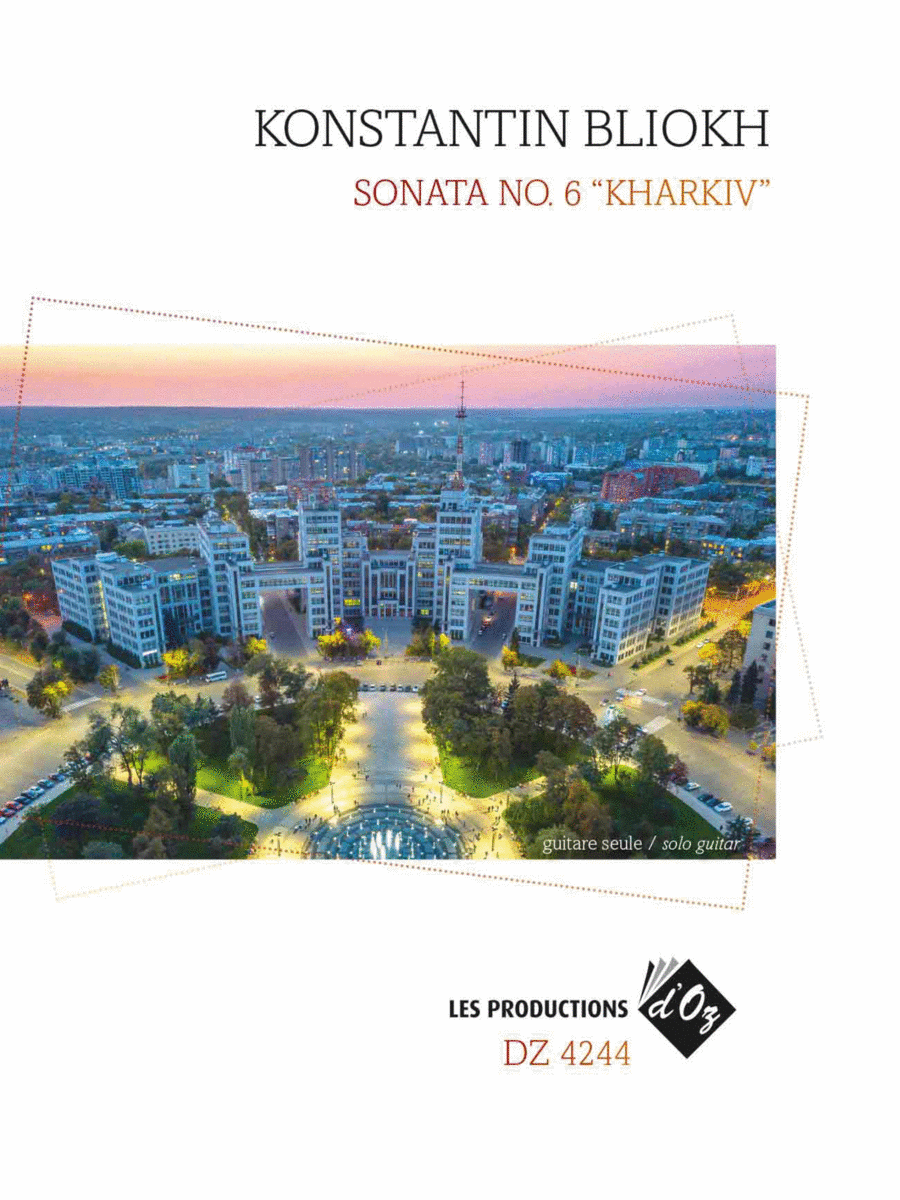
Sonata No. 6 "Kharkiv", Op. 48
Guitare

$7.95 6.91 € Guitare PDF SheetMusicPlus

Bizet,Dvo?ák,Fanny Mendelssohn (Hensel),Schubert Franz,Strauss I : La plus belle musique romantique pour l'alto, Facile, Vol. 2
Alto seul
Téléchargez la partition Alto La plus belle musique romantique pour l'alto, Facile, Vol. 2…
19.99 € Alto seul PDF Tomplay

Mozart : Une Petite Musique de Nuit, K. 525 - I. Allegro (niveau facile, professeur-élève)
Piano seul
Téléchargez la partition Piano Une Petite Musique de Nuit, K. 525 - I. Alleg…
1.99 € Piano seul PDF Tomplay

Instrumental Duet,Piano Instrumental Duet,Piano,Violin - Level 4 - Digital Download SKU: A0.1198683 By Guillaume Turco. By Guillaume Turco. Chamber,Classical,Instructional,Romantic Period. 4 pages. Guillaume Turco #797759. Published by Guillaume Turco (A0.1198683). Arpeggioh-no! Is a challenging but fun étude that focuses on arpeggios and dexterity without compromising musicality. A beautiful way to build skills while creating delightful music. Fill your space with a mix of chords and modulations sometimes classical, sometimes exotic. This is the piano accompaniment for solo Violin. Arpeggioh-no! Est une étude stimulante qui met l'emphase sur les arpèges et la dextérité sans compromettre la musicalité. Une façon agréable de bâtir vos aptitudes tout en faisant de la musique. Remplissez votre espace avec un mélange d'accord et de modulations à caractère parfois classique, parfois exotique. Ceci est l'accompagnement pour piano pour la version pour Violon solo.
Arpeggi-oh no! (piano accompaniment for solo Violin)
Accompagnement Piano
Guillaume Turco
$4.00 3.48 € Accompagnement Piano PDF SheetMusicPlus

Bellini,Schubert François,Smetana,Tchaikovsky,Verdi : La plus belle musique romantique pour la flûte à bec Alto, Débutant, Vol. 1
Téléchargez la partition Flûte à bec La plus belle musique romantique pour la flûte à bec …
19.99 € PDF Tomplay

Albinoni,Bach Johann Sebastian,Caccini,Charpentier,Clarke Jeremiah : La plus belle musique baroque pour le trombone, Difficile, Vol. 1
Trombone
Téléchargez la partition Trombone La plus belle musique baroque pour le trombone, Difficil…
16.99 € Trombone PDF Tomplay

Daquin,Händel,Monteverdi,Purcell,Vivaldi : La plus belle musique baroque pour la clarinette, Très Facile, Vol. 2
Clarinette
Téléchargez la partition Clarinette La plus belle musique baroque pour la clarinette, Très…
15.99 € Clarinette PDF Tomplay

Leopold Mozart : Cahier de musique pour Wolfgang - N° 15 Polonaise
Piano seul
Téléchargez la partition Piano Cahier de musique pour Wolfgang - N° 15 P…
2.99 € Piano seul PDF Tomplay

Concert Band - Level 4 - Digital Download SKU: A0.540710 Composed by Therese Brenet. Contemporary,New Age. Score and parts. 39 pages. Musik Fabrik Music Publishing #62093. Published by Musik Fabrik Music Publishing (A0.540710). The composer writes : This work was premièred on April 27, 2003 at the Eglise Saint-Roch in Paris with the prestigious Orchestre de la Musique de L’Armée de L’Air, under the direction of my friend and colleague, Claude Picheraureau. I have always been fascinated by the beauty of the Cosmos, which has inspired many of my works. Feelings of infinite movement can be expressed musically and it seemed to me that one of the ways to do this was to end this work on a repeated phrase played in a long perdendosi, to give the impression that one is hearing the echoes of the finished phrase as the instruments stop playing. I had just started to write this work when I received a note for the Paris Observatory which gave me the news that the astronomical community had decided to name a newly discovered asteroid for Jean-Pierre Luminet. When I wrote to Jean-Pierre to congratulate him on this honour, reminding him with the Petit Prince that not everyone has their own star, I asked him if he would accept that I name this work for concert band with the full name of his asteroid: 5523 Luminet 1991 PH8. Jean-Pierre accepted my proposition by return letter : ..., not only do I not have any objection, but I would be very honoured. To be in the celestial spheres in the form of a rock and also in the form of music, what more could one ask for? The work is scored for : Piccolo 2 Flûtes/2 Flutes 2 Hautbois/2 Oboes Cor Anglais/English Horn 2 Bassons/2 Bassoons Contrebasson/Contrabassoon Petite Clarinette en Mib/Eb Clarinet 1ers Clarinettes en Sib/1st Bb Clarinets : 2mes Clarinettes en Sib/2nd Bb Clarinets Clarinette Basse/Bass Clarinet 1er Saxophone Alto en Mib/1st Eb Alto Saxophone 2me Saxophone Alto en Mib/2nd Eb Alto Saxophone Saxophone Ténor en Sib/Bb Tenor Saxophone Saxophone Baryton en Mib/Eb Baritone Saxophone 4 Cors en fa/4 F Horns 2 trompettes en Sib/2 Bb Trumpets 2 cornets en Sib/2 Bb Cornets 2 Trombones Ténors/2 Tenor Trombones Trombone Basse/Bass Trombone Euphonium Tuba en Ut/Tuba in C Contrebasse à cordes/String Bass Harpe/Harp Timbales/Tympani Percussion I : Marimba Cloches en Tube/Tubular Bells &wRt Grosse Caisse/Bass Drum = G.C Tambour/Field Drum = Tamb. Percussion II : Jeu de timbres/Glockenspeil = JdT Caisse Claire/Snare Drum = c. cl. Percussion III : Gong 3 cymbales suspendues (aigu, medium, grave)/3 suspended cymbales (high, medium, low) = CSa, CSm, CSg 3 Tamtams (aigu, medium, grave/high, medium, low) = TTA, TTM, TTG Duration : aprox 12 minutes. This item is the full score. The parts are available in three sets (wind parts/brass part/percussion + harp and double bass) and each individual part is also available.
Thérèse Brenet: (5523) Luminet 1991 PH8 for concert band, score
Orchestre d'harmonie

$19.95 17.35 € Orchestre d'harmonie PDF SheetMusicPlus

Piano Solo - Level 5 - Digital Download SKU: A0.534405 Composed by Zvonimir Nagy. Concert,Contemporary,Standards. Score. 28 pages. Musik Fabrik Music Publishing #3459139. Published by Musik Fabrik Music Publishing (A0.534405). A native of Croatia, the American composer Zvonimir Nagy has been the recipient of music honors and awards, most notably the Seattle Symphony Orchestra Composition Prize and Swan Prize in Music Composition. Nagy received a doctor of music composition degree from Northwestern University (USA); he also studied music at Texas Christian University, the école Normale de Musique (France), and the Academy of Music-University of Zagreb (Croatia). Nagy's compositions are inspired by the intersection of music aesthetics and perception. He explores various contexts and critical perspectives that illuminate ideas on music and its impact on the mind. His music is frequently commissioned and performed throughout the United States and Europe. Nagy has taught on the faculties of Northwestern and St. Xavier University in Chicago (USA) and has presented at music conferences, workshops, and colloquia. Currently, he serves as Assistant Professor of Music at Duquesne University in Pittsburgh, Pennsylvania. He is also the Cathedral Organist at St. Joseph Cathedral in Wheeling, West Virginia. Nagy continues to perform as a solo and collaborative organist and pianist.
Zvonimir Nagy: Vestiges for piano
Piano seul

$25.95 22.57 € Piano seul PDF SheetMusicPlus


Partitions Gratuites
Acheter des Partitions Musicales
Acheter des Partitions Digitales à Imprimer
Acheter des Instruments de Musique

© 2000 - 2026

Accueil - Version intégrale





