EUROPE
16296 articles
USA
39686 articles
DIGITAL
133983 articles (à imprimer)
Partitions Digitales
Partitions à imprimer
133983 partitions trouvées


Oboe,Piano - Level 3 - Digital Download SKU: A0.735933 Arranged by Andrew Middleton. Romantic Period. Score and part. 6 pages. Andrew Middleton #5828887. Published by Andrew Middleton (A0.735933). Morning Journals was composed in 1863 by Johann Strauss, as a friendly rival to the composer Jacques Offenbach who composed a waltz around the same time titled Evening Papers. As this is one of Strauss's early waltzes it demonstrates how he developed the waltz style into his later works. This arrangement for oboe and piano is also available for flute, clarinet, saxophone and bassoon too!For more updates on new arrangements follow my Facebook page on https://www.facebook.com/a.middletonmusic/ Or subscribe to my Youtube page at https://www.youtube.com/channel/UCClIYqddA2wMpdaxSq3BKEw?view_as=subscriber
Morning Journals arranged for Oboe & Piano
Hautbois, Piano (duo)

$4.99 4.28 € Hautbois, Piano (duo) PDF SheetMusicPlus

Clarinet,Piano - Level 3 - Digital Download SKU: A0.735934 Arranged by Andrew Middleton. Romantic Period. Score and part. 6 pages. Andrew Middleton #5828889. Published by Andrew Middleton (A0.735934). Morning Journals was composed in 1863 by Johann Strauss, as a friendly rival to the composer Jacques Offenbach who composed a waltz around the same time titled Evening Papers. As this is one of Strauss's early waltzes it demonstrates how he developed the waltz style into his later works. This arrangement for clarinet and piano is also available for flute, oboe, saxophone and bassoon too!For more updates on new arrangements follow my Facebook page on https://www.facebook.com/a.middletonmusic/ Or subscribe to my Youtube page at https://www.youtube.com/channel/UCClIYqddA2wMpdaxSq3BKEw?view_as=subscriber
Morning Journals arranged for Clarinet & Piano
Clarinette et Piano

$4.99 4.28 € Clarinette et Piano PDF SheetMusicPlus

Flute,Piano - Level 3 - Digital Download SKU: A0.735932 Arranged by Andrew Middleton. Romantic Period. Score and part. 6 pages. Andrew Middleton #5828883. Published by Andrew Middleton (A0.735932). Morning Journals was composed in 1863 by Johann Strauss, as a friendly rival to the composer Jacques Offenbach who composed a waltz around the same time titled Evening Papers. As this is one of Strauss's early waltzes it demonstrates how he developed the waltz style into his later works. This arrangement for flute and piano is also available for oboe, clarinet, saxophone and bassoon too!For more updates on new arrangements follow my Facebook page on https://www.facebook.com/a.middletonmusic/  Or subscribe to my Youtube page at https://www.youtube.com/channel/UCClIYqddA2wMpdaxSq3BKEw?view_as=subscriber
Morning Journals arranged for Flute & Piano
Flûte traversière et Piano

$4.99 4.28 € Flûte traversière et Piano PDF SheetMusicPlus

Bassoon,Piano - Level 3 - Digital Download SKU: A0.735936 Arranged by Andrew Middleton. Romantic Period. Score and part. 6 pages. Andrew Middleton #5828897. Published by Andrew Middleton (A0.735936). Morning Journals was composed in 1863 by Johann Strauss, as a friendly rival to the composer Jacques Offenbach who composed a waltz around the same time titled Evening Papers. As this is one of Strauss's early waltzes it demonstrates how he developed the waltz style into his later works. This arrangement for bassoon and piano is also available for flute, oboe, clarinet and saxophone too!For more updates on new arrangements follow my Facebook page on https://www.facebook.com/a.middletonmusic/ Or subscribe to my Youtube page at https://www.youtube.com/channel/UCClIYqddA2wMpdaxSq3BKEw?view_as=subscriber
Morning Journals arranged for Bassoon & Piano
Basson, Piano (duo)

$4.99 4.28 € Basson, Piano (duo) PDF SheetMusicPlus

Piano - Digital Download SKU: LV.17831 Arranged by J. Benedict. Lester S. Levy Collection. 6 pages. Published by Johns Hopkins University Sheridan Libraries (LV.17831). The Gipsy's Warning. A favorite Gallop. Taken from the Opera, arranged for the Piano Forte by J. Benedict. Published [n.d.] by Sam'l Carusi in Baltimore. Composition of sectional with piano instrumentation. About The Lester S. Levy CollectionThe Lester S. Levy Collection of Sheet Music consists of over 29,000 pieces of American popular music. Donated to Johns Hopkins University Sheridan Libraries, the collection's strength is its thorough documentation of nineteenth-century American through popular music. This sheet music has been provided by Project Gado, a San Francisco Bay Area startup whose mission is to digitize and share the world's visual history.WARNING: These titles are provided as historical documents. Language and concepts within reflect the opinions and values of the time and may be offensive to some.
The Gipsy's Warning. A favorite Gallop
Piano seul

$5.99 5.13 € Piano seul PDF SheetMusicPlus

Flute,Piano - Level 1 - Digital Download SKU: A0.548741 By Cat Stevens. By Cat Stevens. Arranged by James M. Guthrie, ASCAP. Rock. Score and part. 11 pages. Jmsgu3 #3415207. Published by jmsgu3 (A0.548741). Very strong arrangement for Easter. Duration: 2:48. 84 ms. Score: 7 pg. Solo part 1 pg. piano part 3 pg. Morning Has Broken is a popular and well-known Christian hymn first published in 1931. It has words by English author Eleanor Farjeon and was inspired by the village of Alfriston in East Sussex, then set to a traditional Scottish Gaelic tune known as Bunessan [1] (it shares this tune with the 19th century Christmas Carol Child in the Manger[2]). It is often sung in children's services and in Funeral services.[3] English pop musician and folk singer Cat Stevens included a version on his 1971 album Teaser and the Firecat. The song became identified with Stevens due to the popularity of this recording. It reached number six on the U.S. Billboard Hot 100, number one on the U.S. easy listening chartin 1972,[4] and number four on the Canadian RPM Magazine charts. The hymn originally appeared in the second edition of Songs of Praise (published in 1931), to the tune Bunessan, composed in the Scottish Islands. In Songs of Praise Discussed, the editor, Percy Dearmer, explains that as there was need for a hymn to give thanks for each day, English poet and children's author Eleanor Farjeon had been asked to make a poem to fit the lovely Scottish tune. A slight variation on the original hymn, also written by Eleanor Farjeon, can be found in the form of a poem contributed to the anthology Children's Bells, under Farjeon's new title, A Morning Song (For the First Day of Spring), published by Oxford University Press in 1957. The song is noted in 9/4 time but with a 3/4 feel. Bunessan had been found in L. McBean's Songs and Hymns of the Gael, published in 1900.[5] Before Farjeon's words, the tune was used as a Christmas carol, which began Child in the manger, Infant of Mary, translated from the Scottish Gaelic lyrics written by Mary MacDonald. The English-language Roman Catholic hymnal also uses the tune for the James Quinn hymns, Christ Be Beside Me and This Day God Gives Me, both of which were adapted from the traditional Irish hymn St. Patrick's Breastplate. Another Christian hymn, Baptized In Water, borrows the tune. -Wikipedia  
Morning Has Broken
Flûte traversière et Piano
Cat Stevens
$47.95 41.1 € Flûte traversière et Piano PDF SheetMusicPlus

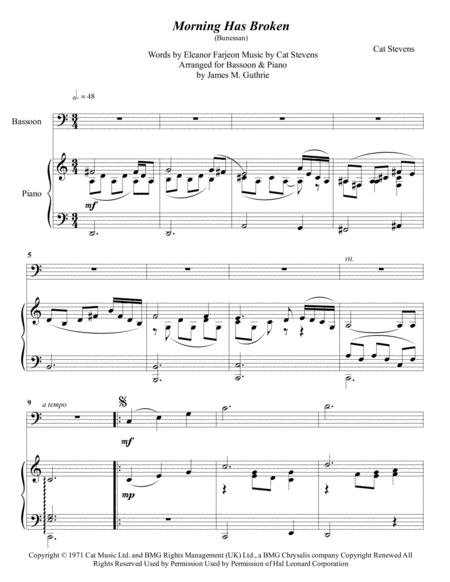
Bassoon,Piano - Level 1 - Digital Download SKU: A0.548736 By Cat Stevens. By Cat Stevens. Arranged by James M. Guthrie, ASCAP. Rock. Score and part. 11 pages. Jmsgu3 #3415199. Published by jmsgu3 (A0.548736). Very strong arrangement for Easter. Duration: 2:48. 84 ms. Score: 7 pg. Solo part 1 pg. piano part 3 pg. Morning Has Broken is a popular and well-known Christian hymn first published in 1931. It has words by English author Eleanor Farjeon and was inspired by the village of Alfriston in East Sussex, then set to a traditional Scottish Gaelic tune known as Bunessan [1] (it shares this tune with the 19th century Christmas Carol Child in the Manger[2]). It is often sung in children's services and in Funeral services.[3] English pop musician and folk singer Cat Stevens included a version on his 1971 album Teaser and the Firecat. The song became identified with Stevens due to the popularity of this recording. It reached number six on the U.S. Billboard Hot 100, number one on the U.S. easy listening chartin 1972,[4] and number four on the Canadian RPM Magazine charts. The hymn originally appeared in the second edition of Songs of Praise (published in 1931), to the tune Bunessan, composed in the Scottish Islands. In Songs of Praise Discussed, the editor, Percy Dearmer, explains that as there was need for a hymn to give thanks for each day, English poet and children's author Eleanor Farjeon had been asked to make a poem to fit the lovely Scottish tune. A slight variation on the original hymn, also written by Eleanor Farjeon, can be found in the form of a poem contributed to the anthology Children's Bells, under Farjeon's new title, A Morning Song (For the First Day of Spring), published by Oxford University Press in 1957. The song is noted in 9/4 time but with a 3/4 feel. Bunessan had been found in L. McBean's Songs and Hymns of the Gael, published in 1900.[5] Before Farjeon's words, the tune was used as a Christmas carol, which began Child in the manger, Infant of Mary, translated from the Scottish Gaelic lyrics written by Mary MacDonald. The English-language Roman Catholic hymnal also uses the tune for the James Quinn hymns, Christ Be Beside Me and This Day God Gives Me, both of which were adapted from the traditional Irish hymn St. Patrick's Breastplate. Another Christian hymn, Baptized In Water, borrows the tune. -Wikipedia  
Morning Has Broken
Basson, Piano (duo)
Cat Stevens
$47.95 41.1 € Basson, Piano (duo) PDF SheetMusicPlus

Piano,Tenor Saxophone - Level 1 - Digital Download SKU: A0.548749 By Cat Stevens. By Cat Stevens. Arranged by James M. Guthrie, ASCAP. Rock. Score and part. 11 pages. Jmsgu3 #3415225. Published by jmsgu3 (A0.548749). Very strong arrangement for Easter. Duration: 2:48. 84 ms. Score: 7 pg. Solo part 1 pg. piano part 3 pg. Morning Has Broken is a popular and well-known Christian hymn first published in 1931. It has words by English author Eleanor Farjeon and was inspired by the village of Alfriston in East Sussex, then set to a traditional Scottish Gaelic tune known as Bunessan [1] (it shares this tune with the 19th century Christmas Carol Child in the Manger[2]). It is often sung in children's services and in Funeral services.[3] English pop musician and folk singer Cat Stevens included a version on his 1971 album Teaser and the Firecat. The song became identified with Stevens due to the popularity of this recording. It reached number six on the U.S. Billboard Hot 100, number one on the U.S. easy listening chartin 1972,[4] and number four on the Canadian RPM Magazine charts. The hymn originally appeared in the second edition of Songs of Praise (published in 1931), to the tune Bunessan, composed in the Scottish Islands. In Songs of Praise Discussed, the editor, Percy Dearmer, explains that as there was need for a hymn to give thanks for each day, English poet and children's author Eleanor Farjeon had been asked to make a poem to fit the lovely Scottish tune. A slight variation on the original hymn, also written by Eleanor Farjeon, can be found in the form of a poem contributed to the anthology Children's Bells, under Farjeon's new title, A Morning Song (For the First Day of Spring), published by Oxford University Press in 1957. The song is noted in 9/4 time but with a 3/4 feel. Bunessan had been found in L. McBean's Songs and Hymns of the Gael, published in 1900.[5] Before Farjeon's words, the tune was used as a Christmas carol, which began Child in the manger, Infant of Mary, translated from the Scottish Gaelic lyrics written by Mary MacDonald. The English-language Roman Catholic hymnal also uses the tune for the James Quinn hymns, Christ Be Beside Me and This Day God Gives Me, both of which were adapted from the traditional Irish hymn St. Patrick's Breastplate. Another Christian hymn, Baptized In Water, borrows the tune. -Wikipedia  

Morning Has Broken
Saxophone Tenor et Piano
Cat Stevens
$47.95 41.1 € Saxophone Tenor et Piano PDF SheetMusicPlus

Cello,Piano,Violin - Level 1 - Digital Download SKU: A0.548744 By Cat Stevens. By Cat Stevens. Arranged by James M. Guthrie. Rock. 14 pages. Jmsgu3 #3415213. Published by jmsgu3 (A0.548744). Very strong arrangement for Easter. Duration: 2:48. 84 ms. Score: 7 pg. Solo part 1 pg. piano part 3 pg. Morning Has Broken is a popular and well-known Christian hymn first published in 1931. It has words by English author Eleanor Farjeon and was inspired by the village of Alfriston in East Sussex, then set to a traditional Scottish Gaelic tune known as Bunessan [1] (it shares this tune with the 19th century Christmas Carol Child in the Manger[2]). It is often sung in children's services and in Funeral services.[3] English pop musician and folk singer Cat Stevens included a version on his 1971 album Teaser and the Firecat. The song became identified with Stevens due to the popularity of this recording. It reached number six on the U.S. Billboard Hot 100, number one on the U.S. easy listening chartin 1972,[4] and number four on the Canadian RPM Magazine charts. The hymn originally appeared in the second edition of Songs of Praise (published in 1931), to the tune Bunessan, composed in the Scottish Islands. In Songs of Praise Discussed, the editor, Percy Dearmer, explains that as there was need for a hymn to give thanks for each day, English poet and children's author Eleanor Farjeon had been asked to make a poem to fit the lovely Scottish tune. A slight variation on the original hymn, also written by Eleanor Farjeon, can be found in the form of a poem contributed to the anthology Children's Bells, under Farjeon's new title, A Morning Song (For the First Day of Spring), published by Oxford University Press in 1957. The song is noted in 9/4 time but with a 3/4 feel. Bunessan had been found in L. McBean's Songs and Hymns of the Gael, published in 1900.[5] Before Farjeon's words, the tune was used as a Christmas carol, which began Child in the manger, Infant of Mary, translated from the Scottish Gaelic lyrics written by Mary MacDonald. The English-language Roman Catholic hymnal also uses the tune for the James Quinn hymns, Christ Be Beside Me and This Day God Gives Me, both of which were adapted from the traditional Irish hymn St. Patrick's Breastplate. Another Christian hymn, Baptized In Water, borrows the tune. -Wikipedia  

Morning Has Broken
Cat Stevens
$52.95 45.38 € PDF SheetMusicPlus

Piano,Trombone - Level 1 - Digital Download SKU: A0.548748 By Cat Stevens. By Cat Stevens. Arranged by James M. Guthrie, ASCAP. Rock. Score and part. 11 pages. Jmsgu3 #3415223. Published by jmsgu3 (A0.548748). Very strong arrangement for Easter. Duration: 2:48. 84 ms. Score: 7 pg. Solo part 1 pg. piano part 3 pg. Morning Has Broken is a popular and well-known Christian hymn first published in 1931. It has words by English author Eleanor Farjeon and was inspired by the village of Alfriston in East Sussex, then set to a traditional Scottish Gaelic tune known as Bunessan [1] (it shares this tune with the 19th century Christmas Carol Child in the Manger[2]). It is often sung in children's services and in Funeral services.[3] English pop musician and folk singer Cat Stevens included a version on his 1971 album Teaser and the Firecat. The song became identified with Stevens due to the popularity of this recording. It reached number six on the U.S. Billboard Hot 100, number one on the U.S. easy listening chartin 1972,[4] and number four on the Canadian RPM Magazine charts. The hymn originally appeared in the second edition of Songs of Praise (published in 1931), to the tune Bunessan, composed in the Scottish Islands. In Songs of Praise Discussed, the editor, Percy Dearmer, explains that as there was need for a hymn to give thanks for each day, English poet and children's author Eleanor Farjeon had been asked to make a poem to fit the lovely Scottish tune. A slight variation on the original hymn, also written by Eleanor Farjeon, can be found in the form of a poem contributed to the anthology Children's Bells, under Farjeon's new title, A Morning Song (For the First Day of Spring), published by Oxford University Press in 1957. The song is noted in 9/4 time but with a 3/4 feel. Bunessan had been found in L. McBean's Songs and Hymns of the Gael, published in 1900.[5] Before Farjeon's words, the tune was used as a Christmas carol, which began Child in the manger, Infant of Mary, translated from the Scottish Gaelic lyrics written by Mary MacDonald. The English-language Roman Catholic hymnal also uses the tune for the James Quinn hymns, Christ Be Beside Me and This Day God Gives Me, both of which were adapted from the traditional Irish hymn St. Patrick's Breastplate. Another Christian hymn, Baptized In Water, borrows the tune. -Wikipedia  

Morning Has Broken
Trombone et Piano
Cat Stevens
$47.95 41.1 € Trombone et Piano PDF SheetMusicPlus

Baritone Horn TC,Euphonium,Piano - Level 1 - Digital Download SKU: A0.552830 By Cat Stevens. By Cat Stevens. Arranged by James M. Guthrie, ASCAP. Rock. Score and part. 11 pages. Jmsgu3 #3415193. Published by jmsgu3 (A0.552830). Very strong arrangement for Easter. Duration: 2:48. 84 ms. Score: 7 pg. Solo part 1 pg. piano part 3 pg. Morning Has Broken is a popular and well-known Christian hymn first published in 1931. It has words by English author Eleanor Farjeon and was inspired by the village of Alfriston in East Sussex, then set to a traditional Scottish Gaelic tune known as Bunessan [1] (it shares this tune with the 19th century Christmas Carol Child in the Manger[2]). It is often sung in children's services and in Funeral services.[3] English pop musician and folk singer Cat Stevens included a version on his 1971 album Teaser and the Firecat. The song became identified with Stevens due to the popularity of this recording. It reached number six on the U.S. Billboard Hot 100, number one on the U.S. easy listening chartin 1972,[4] and number four on the Canadian RPM Magazine charts. The hymn originally appeared in the second edition of Songs of Praise (published in 1931), to the tune Bunessan, composed in the Scottish Islands. In Songs of Praise Discussed, the editor, Percy Dearmer, explains that as there was need for a hymn to give thanks for each day, English poet and children's author Eleanor Farjeon had been asked to make a poem to fit the lovely Scottish tune. A slight variation on the original hymn, also written by Eleanor Farjeon, can be found in the form of a poem contributed to the anthology Children's Bells, under Farjeon's new title, A Morning Song (For the First Day of Spring), published by Oxford University Press in 1957. The song is noted in 9/4 time but with a 3/4 feel. Bunessan had been found in L. McBean's Songs and Hymns of the Gael, published in 1900.[5] Before Farjeon's words, the tune was used as a Christmas carol, which began Child in the manger, Infant of Mary, translated from the Scottish Gaelic lyrics written by Mary MacDonald. The English-language Roman Catholic hymnal also uses the tune for the James Quinn hymns, Christ Be Beside Me and This Day God Gives Me, both of which were adapted from the traditional Irish hymn St. Patrick's Breastplate. Another Christian hymn, Baptized In Water, borrows the tune. -Wikipedia  

Morning Has Broken
Piano Facile
Cat Stevens
$47.95 41.1 € Piano Facile PDF SheetMusicPlus

Flute,Piano - Level 1 - Digital Download SKU: A0.548732 By Cat Stevens. By Cat Stevens. Arranged by James M. Guthrie, ASCAP. Rock. Score and part. 11 pages. Jmsgu3 #3415187. Published by jmsgu3 (A0.548732). Very strong arrangement for Easter. Duration: 2:48. 84 ms. Score: 7 pg. Solo part 1 pg. piano part 3 pg. Morning Has Broken is a popular and well-known Christian hymn first published in 1931. It has words by English author Eleanor Farjeon and was inspired by the village of Alfriston in East Sussex, then set to a traditional Scottish Gaelic tune known as Bunessan [1] (it shares this tune with the 19th century Christmas Carol Child in the Manger[2]). It is often sung in children's services and in Funeral services.[3] English pop musician and folk singer Cat Stevens included a version on his 1971 album Teaser and the Firecat. The song became identified with Stevens due to the popularity of this recording. It reached number six on the U.S. Billboard Hot 100, number one on the U.S. easy listening chartin 1972,[4] and number four on the Canadian RPM Magazine charts. The hymn originally appeared in the second edition of Songs of Praise (published in 1931), to the tune Bunessan, composed in the Scottish Islands. In Songs of Praise Discussed, the editor, Percy Dearmer, explains that as there was need for a hymn to give thanks for each day, English poet and children's author Eleanor Farjeon had been asked to make a poem to fit the lovely Scottish tune. A slight variation on the original hymn, also written by Eleanor Farjeon, can be found in the form of a poem contributed to the anthology Children's Bells, under Farjeon's new title, A Morning Song (For the First Day of Spring), published by Oxford University Press in 1957. The song is noted in 9/4 time but with a 3/4 feel. Bunessan had been found in L. McBean's Songs and Hymns of the Gael, published in 1900.[5] Before Farjeon's words, the tune was used as a Christmas carol, which began Child in the manger, Infant of Mary, translated from the Scottish Gaelic lyrics written by Mary MacDonald. The English-language Roman Catholic hymnal also uses the tune for the James Quinn hymns, Christ Be Beside Me and This Day God Gives Me, both of which were adapted from the traditional Irish hymn St. Patrick's Breastplate. Another Christian hymn, Baptized In Water, borrows the tune. -Wikipedia  

Morning Has Broken
Flûte traversière et Piano
Cat Stevens
$47.95 41.1 € Flûte traversière et Piano PDF SheetMusicPlus


Partitions Gratuites
Acheter des Partitions Musicales
Acheter des Partitions Digitales à Imprimer
Acheter des Instruments de Musique

© 2000 - 2025

Accueil - Version intégrale
