EUROPE
2757 articles
USA
0 articles
DIGITAL
5279 articles (à imprimer)
Partitions Digitales
Partitions à imprimer
5279 partitions trouvées


Voice and piano - Medium - Digital Download SKU: MQ.8492-02E Composed by MeeAe Cecilia Nam and Theodore Gouvy. Instrument part. 4 pages. E. C. Schirmer Music Company - Digital #8492-02E. Published by E. C. Schirmer Music Company - Digital (MQ.8492-02E). French.Gouvy was known for writing some of the most beautiful melodies of the Romantic period. His style is a combination of German forms and an early French romantic harmonic structure. His writing for the piano in the songs is totally unified in mood and description with the voice, just as the piano is in Schubert’s songs. The equal partnership of the vocal line and piano interact closely to bring the poetry vividly into life with unimaginable artistic heights and unbridled passion.This volume includes Gouvy songs set to 18 poems of Philippe Desportes (1546–1606), and 18 poems of Moritz Hartmann (1821–1872). The elements of Romantic love poetry, such as enchanting love and its pain, and the personifying of nature, are fluently described with a great sensitivity in both voice and piano. Gouvy’s melody stir up the imagination because of his special treatment of words through a distinguishable and melodious vocal line, and his story telling and poetic treatment and development of the piano accompaniment. His compositional artistry places him in the upper echelons of art-song composers. One should note that Gouvy had a special fondness for the 16th Century poetry of La Pléiade (a group of Renaissance French poets, led by Pièrre de Ronsard (1524–1585). Desportes was truly the heir to Ronsard; however his work, when compared to that of Ronsard, is filled with greater abstraction and greater fluidity. Desportes seems to avoid any of the passionate anger that is occasionally characteristic of La Pléiade. This may be an indication that Desportes lived in a less distressed time. It also seems necessary to point out that he learned much in his early career by copying and studying the earlier works of La Pléiade. This has led some scholars to label him as a plagiarist, but it is important to realize that all the members of La Pléiade copied from each other when they wished to learn something new, and truly understand the style of the other poets in the group. Gouvy’s only choice of poems from his contemporaries, were the works of Moritz Hartmann (1821–1872), a good friend of Gouvy’s. Much of his poetry was strongly political in support of freedom of the individual. He traveled to Leipzig in 1845, but when the authorities discovered a volume of patriotic poems entitled Kelch und Schwert (Chalice and Sword), he fled to Belgium and France. It is at this time that he possibly met Théodore Gouvy. Eighteen poems of Hartmann were translated from German to French by the French poet, Adolph Larmande, of whom very little is known. Pierre Toussaint Adolphe Larmande seems to have been a rather obscure poet and musician. We know that he taught music theory at the Paris Conservatory at the same time Anton Reicha and Michele Carafa were on the faculty. We also know that in 1847 he married an English woman by the name of Marie Caroline Bradley. There are random documents, such as a Certificate of Arrival in London, England, in 1837, but there are no birth and death dates given, and that includes his obituary notice. Contents:18 Sonnets et Chansons de Desportes pour ténor ou soprano et piano, Op. 45 Six poésies allemandes de Moritz Hartmann pour baryton et piano, Op. 21 Douze poésies allemandes de Moritz Hartmann pour ténor et piano, Op. 26 (Poésies françaises d’Adolphe Larmande).
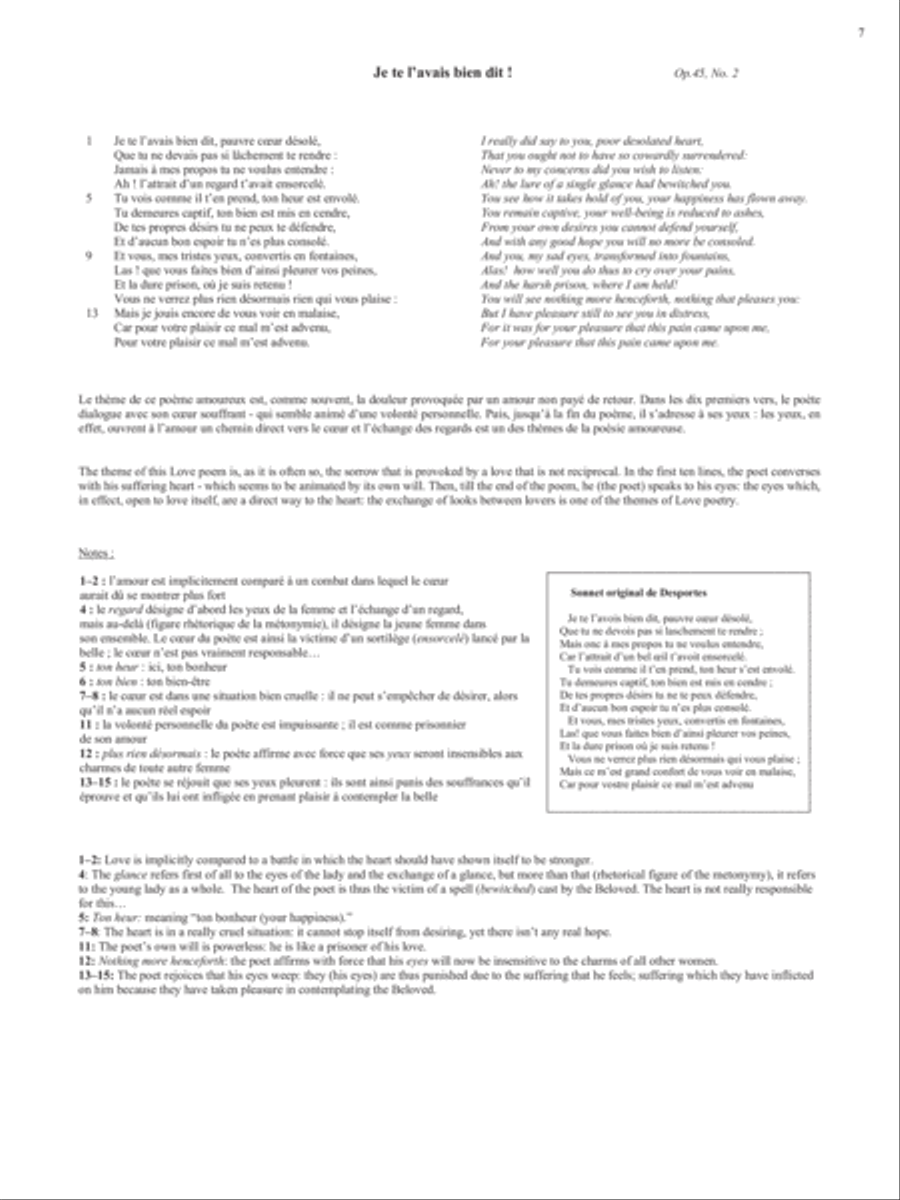
Op. 45, No. 2: Je te l’avais bien dit from Songs of Gouvy, V2 (Downloadable)
Piano, Voix

$3.00 2.6 € Piano, Voix PDF SheetMusicPlus

Voice and piano - Medium - Digital Download SKU: MQ.8492-34E Composed by MeeAe Cecilia Nam and Theodore Gouvy. Instrument part. 8 pages. E. C. Schirmer Music Company - Digital #8492-34E. Published by E. C. Schirmer Music Company - Digital (MQ.8492-34E). French.Gouvy was known for writing some of the most beautiful melodies of the Romantic period. His style is a combination of German forms and an early French romantic harmonic structure. His writing for the piano in the songs is totally unified in mood and description with the voice, just as the piano is in Schubert’s songs. The equal partnership of the vocal line and piano interact closely to bring the poetry vividly into life with unimaginable artistic heights and unbridled passion.This volume includes Gouvy songs set to 18 poems of Philippe Desportes (1546–1606), and 18 poems of Moritz Hartmann (1821–1872). The elements of Romantic love poetry, such as enchanting love and its pain, and the personifying of nature, are fluently described with a great sensitivity in both voice and piano. Gouvy’s melody stir up the imagination because of his special treatment of words through a distinguishable and melodious vocal line, and his story telling and poetic treatment and development of the piano accompaniment. His compositional artistry places him in the upper echelons of art-song composers. One should note that Gouvy had a special fondness for the 16th Century poetry of La Pléiade (a group of Renaissance French poets, led by Pièrre de Ronsard (1524–1585). Desportes was truly the heir to Ronsard; however his work, when compared to that of Ronsard, is filled with greater abstraction and greater fluidity. Desportes seems to avoid any of the passionate anger that is occasionally characteristic of La Pléiade. This may be an indication that Desportes lived in a less distressed time. It also seems necessary to point out that he learned much in his early career by copying and studying the earlier works of La Pléiade. This has led some scholars to label him as a plagiarist, but it is important to realize that all the members of La Pléiade copied from each other when they wished to learn something new, and truly understand the style of the other poets in the group. Gouvy’s only choice of poems from his contemporaries, were the works of Moritz Hartmann (1821–1872), a good friend of Gouvy’s. Much of his poetry was strongly political in support of freedom of the individual. He traveled to Leipzig in 1845, but when the authorities discovered a volume of patriotic poems entitled Kelch und Schwert (Chalice and Sword), he fled to Belgium and France. It is at this time that he possibly met Théodore Gouvy. Eighteen poems of Hartmann were translated from German to French by the French poet, Adolph Larmande, of whom very little is known. Pierre Toussaint Adolphe Larmande seems to have been a rather obscure poet and musician. We know that he taught music theory at the Paris Conservatory at the same time Anton Reicha and Michele Carafa were on the faculty. We also know that in 1847 he married an English woman by the name of Marie Caroline Bradley. There are random documents, such as a Certificate of Arrival in London, England, in 1837, but there are no birth and death dates given, and that includes his obituary notice. Contents:18 Sonnets et Chansons de Desportes pour ténor ou soprano et piano, Op. 45 Six poésies allemandes de Moritz Hartmann pour baryton et piano, Op. 21 Douze poésies allemandes de Moritz Hartmann pour ténor et piano, Op. 26 (Poésies françaises d’Adolphe Larmande).
Op. 1, No. 10: À la gloire, au bonheur! from Songs of Gouvy, V2 (Downloadable)
Piano, Voix

$3.00 2.6 € Piano, Voix PDF SheetMusicPlus

Voice and piano - Medium - Digital Download SKU: MQ.8492-21E Composed by MeeAe Cecilia Nam and Theodore Gouvy. Instrument part. 5 pages. E. C. Schirmer Music Company - Digital #8492-21E. Published by E. C. Schirmer Music Company - Digital (MQ.8492-21E). French.Gouvy was known for writing some of the most beautiful melodies of the Romantic period. His style is a combination of German forms and an early French romantic harmonic structure. His writing for the piano in the songs is totally unified in mood and description with the voice, just as the piano is in Schubert’s songs. The equal partnership of the vocal line and piano interact closely to bring the poetry vividly into life with unimaginable artistic heights and unbridled passion.This volume includes Gouvy songs set to 18 poems of Philippe Desportes (1546–1606), and 18 poems of Moritz Hartmann (1821–1872). The elements of Romantic love poetry, such as enchanting love and its pain, and the personifying of nature, are fluently described with a great sensitivity in both voice and piano. Gouvy’s melody stir up the imagination because of his special treatment of words through a distinguishable and melodious vocal line, and his story telling and poetic treatment and development of the piano accompaniment. His compositional artistry places him in the upper echelons of art-song composers. One should note that Gouvy had a special fondness for the 16th Century poetry of La Pléiade (a group of Renaissance French poets, led by Pièrre de Ronsard (1524–1585). Desportes was truly the heir to Ronsard; however his work, when compared to that of Ronsard, is filled with greater abstraction and greater fluidity. Desportes seems to avoid any of the passionate anger that is occasionally characteristic of La Pléiade. This may be an indication that Desportes lived in a less distressed time. It also seems necessary to point out that he learned much in his early career by copying and studying the earlier works of La Pléiade. This has led some scholars to label him as a plagiarist, but it is important to realize that all the members of La Pléiade copied from each other when they wished to learn something new, and truly understand the style of the other poets in the group. Gouvy’s only choice of poems from his contemporaries, were the works of Moritz Hartmann (1821–1872), a good friend of Gouvy’s. Much of his poetry was strongly political in support of freedom of the individual. He traveled to Leipzig in 1845, but when the authorities discovered a volume of patriotic poems entitled Kelch und Schwert (Chalice and Sword), he fled to Belgium and France. It is at this time that he possibly met Théodore Gouvy. Eighteen poems of Hartmann were translated from German to French by the French poet, Adolph Larmande, of whom very little is known. Pierre Toussaint Adolphe Larmande seems to have been a rather obscure poet and musician. We know that he taught music theory at the Paris Conservatory at the same time Anton Reicha and Michele Carafa were on the faculty. We also know that in 1847 he married an English woman by the name of Marie Caroline Bradley. There are random documents, such as a Certificate of Arrival in London, England, in 1837, but there are no birth and death dates given, and that includes his obituary notice. Contents:18 Sonnets et Chansons de Desportes pour ténor ou soprano et piano, Op. 45 Six poésies allemandes de Moritz Hartmann pour baryton et piano, Op. 21 Douze poésies allemandes de Moritz Hartmann pour ténor et piano, Op. 26 (Poésies françaises d’Adolphe Larmande).

Op. 21, No. 3: Le Matin au bord de la mer from Songs of Gouvy, V2 (Downloadable)
Piano, Voix

$3.00 2.6 € Piano, Voix PDF SheetMusicPlus

Voice and piano - Medium - Digital Download SKU: MQ.8492-32E Composed by MeeAe Cecilia Nam and Theodore Gouvy. Instrument part. 8 pages. E. C. Schirmer Music Company - Digital #8492-32E. Published by E. C. Schirmer Music Company - Digital (MQ.8492-32E). French.Gouvy was known for writing some of the most beautiful melodies of the Romantic period. His style is a combination of German forms and an early French romantic harmonic structure. His writing for the piano in the songs is totally unified in mood and description with the voice, just as the piano is in Schubert’s songs. The equal partnership of the vocal line and piano interact closely to bring the poetry vividly into life with unimaginable artistic heights and unbridled passion.This volume includes Gouvy songs set to 18 poems of Philippe Desportes (1546–1606), and 18 poems of Moritz Hartmann (1821–1872). The elements of Romantic love poetry, such as enchanting love and its pain, and the personifying of nature, are fluently described with a great sensitivity in both voice and piano. Gouvy’s melody stir up the imagination because of his special treatment of words through a distinguishable and melodious vocal line, and his story telling and poetic treatment and development of the piano accompaniment. His compositional artistry places him in the upper echelons of art-song composers. One should note that Gouvy had a special fondness for the 16th Century poetry of La Pléiade (a group of Renaissance French poets, led by Pièrre de Ronsard (1524–1585). Desportes was truly the heir to Ronsard; however his work, when compared to that of Ronsard, is filled with greater abstraction and greater fluidity. Desportes seems to avoid any of the passionate anger that is occasionally characteristic of La Pléiade. This may be an indication that Desportes lived in a less distressed time. It also seems necessary to point out that he learned much in his early career by copying and studying the earlier works of La Pléiade. This has led some scholars to label him as a plagiarist, but it is important to realize that all the members of La Pléiade copied from each other when they wished to learn something new, and truly understand the style of the other poets in the group. Gouvy’s only choice of poems from his contemporaries, were the works of Moritz Hartmann (1821–1872), a good friend of Gouvy’s. Much of his poetry was strongly political in support of freedom of the individual. He traveled to Leipzig in 1845, but when the authorities discovered a volume of patriotic poems entitled Kelch und Schwert (Chalice and Sword), he fled to Belgium and France. It is at this time that he possibly met Théodore Gouvy. Eighteen poems of Hartmann were translated from German to French by the French poet, Adolph Larmande, of whom very little is known. Pierre Toussaint Adolphe Larmande seems to have been a rather obscure poet and musician. We know that he taught music theory at the Paris Conservatory at the same time Anton Reicha and Michele Carafa were on the faculty. We also know that in 1847 he married an English woman by the name of Marie Caroline Bradley. There are random documents, such as a Certificate of Arrival in London, England, in 1837, but there are no birth and death dates given, and that includes his obituary notice. Contents:18 Sonnets et Chansons de Desportes pour ténor ou soprano et piano, Op. 45 Six poésies allemandes de Moritz Hartmann pour baryton et piano, Op. 21 Douze poésies allemandes de Moritz Hartmann pour ténor et piano, Op. 26 (Poésies françaises d’Adolphe Larmande).

Op. 1, No. 8: Illusions perdues from Songs of Gouvy, V2 (Downloadable)
Piano, Voix

$3.00 2.6 € Piano, Voix PDF SheetMusicPlus

Voice and piano - Medium - Digital Download SKU: MQ.8492-11E Composed by MeeAe Cecilia Nam and Theodore Gouvy. Instrument part. 8 pages. E. C. Schirmer Music Company - Digital #8492-11E. Published by E. C. Schirmer Music Company - Digital (MQ.8492-11E). French.Gouvy was known for writing some of the most beautiful melodies of the Romantic period. His style is a combination of German forms and an early French romantic harmonic structure. His writing for the piano in the songs is totally unified in mood and description with the voice, just as the piano is in Schubert’s songs. The equal partnership of the vocal line and piano interact closely to bring the poetry vividly into life with unimaginable artistic heights and unbridled passion.This volume includes Gouvy songs set to 18 poems of Philippe Desportes (1546–1606), and 18 poems of Moritz Hartmann (1821–1872). The elements of Romantic love poetry, such as enchanting love and its pain, and the personifying of nature, are fluently described with a great sensitivity in both voice and piano. Gouvy’s melody stir up the imagination because of his special treatment of words through a distinguishable and melodious vocal line, and his story telling and poetic treatment and development of the piano accompaniment. His compositional artistry places him in the upper echelons of art-song composers. One should note that Gouvy had a special fondness for the 16th Century poetry of La Pléiade (a group of Renaissance French poets, led by Pièrre de Ronsard (1524–1585). Desportes was truly the heir to Ronsard; however his work, when compared to that of Ronsard, is filled with greater abstraction and greater fluidity. Desportes seems to avoid any of the passionate anger that is occasionally characteristic of La Pléiade. This may be an indication that Desportes lived in a less distressed time. It also seems necessary to point out that he learned much in his early career by copying and studying the earlier works of La Pléiade. This has led some scholars to label him as a plagiarist, but it is important to realize that all the members of La Pléiade copied from each other when they wished to learn something new, and truly understand the style of the other poets in the group. Gouvy’s only choice of poems from his contemporaries, were the works of Moritz Hartmann (1821–1872), a good friend of Gouvy’s. Much of his poetry was strongly political in support of freedom of the individual. He traveled to Leipzig in 1845, but when the authorities discovered a volume of patriotic poems entitled Kelch und Schwert (Chalice and Sword), he fled to Belgium and France. It is at this time that he possibly met Théodore Gouvy. Eighteen poems of Hartmann were translated from German to French by the French poet, Adolph Larmande, of whom very little is known. Pierre Toussaint Adolphe Larmande seems to have been a rather obscure poet and musician. We know that he taught music theory at the Paris Conservatory at the same time Anton Reicha and Michele Carafa were on the faculty. We also know that in 1847 he married an English woman by the name of Marie Caroline Bradley. There are random documents, such as a Certificate of Arrival in London, England, in 1837, but there are no birth and death dates given, and that includes his obituary notice. Contents:18 Sonnets et Chansons de Desportes pour ténor ou soprano et piano, Op. 45 Six poésies allemandes de Moritz Hartmann pour baryton et piano, Op. 21 Douze poésies allemandes de Moritz Hartmann pour ténor et piano, Op. 26 (Poésies françaises d’Adolphe Larmande).

Op. 45, No. 11: Rosette from Songs of Gouvy, V2 (Downloadable)
Piano, Voix

$3.00 2.6 € Piano, Voix PDF SheetMusicPlus

Piano,Vocal,Voice - Level 2 - Digital Download SKU: A0.1496482 Composed by Tiffany Prochera. Arranged by Tiffany Prochera. Children,Christmas,Holiday. Score. 79 pages. Swimming Tigress Music #1073003. Published by Swimming Tigress Music (A0.1496482). I Don't Like Winter and Other Songs to Celebrate the Winter Season is a collection of 11 songs for young singers filled with tunes about all aspects of the winter season - from skating alone on the pond in the backyard, picking out presents for siblings,  spending time with the family, embracing the cold, wanting to escape the cold, going to visit Santa for the first time, and being so enthusiastic to celebrate all of the special days that happen at this time of year!This collection was inspired by a voice teacher friend of mine - serendipitously also named Tiffany  :-) -  who was looking for songs about the season that were non-traditional and relatable to a wider range of singers. It's my pleasure to offer up some options!I had so much fun writing these songs and I hope students, teachers, and audiences alike enjoy them just as much! May you laugh as you state your case to go on a winter vacation.  May you cry at the idea of wearing a special hat made with a grandmother's love. May you be left  breathless with joy as you glide on a frozen pond with no one else around.  In addition to all of these brand-spankin' new tunes, I also included the previously-released  Everyone's a Kid at Christmas because, well, it's a hoot!These are crowd pleasers perfect for holiday recitals, and some can be performed in a group as well as solos.A note for teachers: These songs do have varying ranges. I, for the most part, notated them as I conceived of them. But I did my best to provide alternate pitches in case the melody goes a little high or a little low. So, I invite to you peruse a song in it's entirety and see where there may be options even if the designated range may seem a little wide. It is my intention to make these songs as accessible to as many singers as possible.
I Don't LIke Winter and Other Songs to Celebrate the Winter Season
Piano, Voix

$19.99 17.3 € Piano, Voix PDF SheetMusicPlus

Piano Solo - Level 5 - Digital Download SKU: A0.862568 Composed by Michael Bomier. 20th Century,Contemporary,Instructional. Score. 4 pages. Michael Butkus-Bomier #433377. Published by Michael Butkus-Bomier (A0.862568). 2015 Piano Contest This composition is in 7/4 time, but with a naturalistic flow and feeling so that the odd-time is not so odd-sounding. No added accidentals, of course. The tune is played by both hands, with full triadic harmony filling the space. Advanced-ish level due to full chords and 7/4 time signature. Each of the melodies in this series was composed in its entirety before any harmony was considered or written, so that the melody is the primary driver of the structure and flow of every piece. About 4 mins 35 secs. MP3 MIDI audio. MBB.
Melody in Octaves in Eb from 12 Diatonic Melodies
Piano seul

$2.99 2.59 € Piano seul PDF SheetMusicPlus

Double Bass,String Bass Solo - Level 1 - Digital Download SKU: A0.805519 Composed by Laura C. Quijada Ortíz. Concert,Instructional,Standards. Individual part. 13 pages. Laura Quijada #6711755. Published by Laura Quijada (A0.805519). 20 Melodies on two strings at a time, a good complement to beginner bass methods. The finger pattern is kept on the three pair of strings, and the melodies can be started randomly (not necessarily in the order they appear). With the exception of the last one, all the melodies are in 2/4 to facilitate the staff reading at this level. Scales and arpeggios are included to keep up with the instrument's technique. No technique marks (arco, pizzicato), bowings, dynamics or tempi are indicated, leaving this to the teacher's discretion to assign them, as the goal is to have the student play the tunes perfectly at his/her own pace and abilities. This music can also be used for solo recitals. Keys: D Major, A Major, E Major
Two-Strings Melodies for the beginner bassist.
Contre Basse

$8.00 6.92 € Contre Basse PDF SheetMusicPlus

Cello Solo - Level 1 - Digital Download SKU: A0.805516 Composed by Laura C. Quijada Ortíz. Concert,Instructional,Standards. Individual part. 13 pages. Laura Quijada #6711649. Published by Laura Quijada (A0.805516). 20 Melodies on two strings at a time, a good complement to beginner cello methods. The finger pattern is kept on the three pair of strings, and the melodies can be started randomly (not necessarily in the order they appear). With the exception of the last one, all the melodies are in 2/4 to facilitate the staff reading at this level. Scales and arpeggios are included to keep up with the instrument's technique. No technique marks (arco, pizzicato), bowings, dynamics or tempi are indicated, leaving this to the teacher's discretion to assign them, as the goal is to have the cellist play the tunes perfectly at his/her own pace and abilities. This music can also be used for solo recitals. Keys: D Major, A Major, C Major
Two-Strings Melodies for the beginner cellist.
Violoncelle

$8.00 6.92 € Violoncelle PDF SheetMusicPlus

Alto Voice,Vocal Solo - Level 3 - Digital Download SKU: A0.1096313 Composed by David Warin Solomons. 20th Century,Chamber,Classical,Singer/Songwriter. 4 pages. David Warin Solomons #700277. Published by David Warin Solomons (A0.1096313). This manuscript is the origin of the flute and guitar piece To Marie ( https://www.sheetmusicplus.com/title/19984390?aff_id=175705 ). It has not been notated on computer, and not yet recorded, but I present it here just for interest. As you can see, it takes advantage of the many puns available on the French phrase for weeping willow. It is addressed to the poet Marie Keyser. The references to Chatterton, Enderby and Buddenbrooks relate to Marie's studies in German literature, in particular Chatterton's suicide. To Marie Sad soul, why don't you weep in company? Saule pleureur, seule pleureuse Why luxuriate in your nomadic liturgy? Saoule pluvieuse, seule pleureuse. The others do not seek to understand The power that holds you ever banned Sales pleurs de sel pluvieux A unicorn has carried off your innocence Saule pleureur, seule pleureuse But no ambition comes to conquer indigence Saoule pluvieuse, seule pleureuse. So on you wander, homeless poetess, Begging shelter for your misconstrued distress Sales pleurs de sel pluvieux. Hold down a job, my girl, hold down a job from nine to five. Souple leurre s'il le peut To keep you happy, settled and alive Saule pleureur For this short time - day in day out Forget you do not know what life's about Sales pleurs de ciel plus vieux. And then, when evening comes, too tired Saule pleureur, seule pleureuse. Your sad old inspiration all expired Saoule pluvieuse, seule pleureuse. You will cease to understand the power that held you forever banned. Souple leurre s'il le peut. No, in the name of Chatterton and Enderby! For who could wilful poetry's defender be? Long live poor Buddenbrooks and poor Marie With mind or body hopelessly at sea. Saules pleureurs, seuls plus vieux.
To Marie (alto and guitar)
Voix Alto, Piano

$7.00 6.06 € Voix Alto, Piano PDF SheetMusicPlus

Recorder Duet Alto Recorder,Soprano Recorder - Level 2 - Digital Download SKU: A0.1498584 Composed by Johann Sebastian Bach. Arranged by L. Müller. Baroque,Chamber,Classical,Instructional. Score. 9 pages. Müller Publishing company #1074882. Published by Müller Publishing company (A0.1498584). Bourrée - From French Suite No.6, BWV 817 - Duet for Soprano and Alto RecorderExperience the timeless elegance of Johann Sebastian Bach with this beautifully adapted duet of the Bourrée from French Suite No. 6, BWV 817. Arranged by L. Müller, this version for Soprano and Alto recorders brings a new dimension to Bach's classic composition, making it accessible and enjoyable for recorder enthusiasts. Perfect for both practice and performance, this arrangement captures the intricate interplay of melodies that Bach is celebrated for. Whether you are a student, teacher, or performer, this duet offers a delightful challenge and a rewarding musical experience.
Bourrée - From French Suite No.6, BWV 817 - Duet for Soprano and Alto Recorder
2 Flûte à bec (duo)

$4.99 4.32 € 2 Flûte à bec (duo) PDF SheetMusicPlus

Cello,Piano - Level 2 - Digital Download SKU: A0.1263552 Composed by Johann Sebastian Bach. Arranged by André Nusa. Baroque. Score and part. 3 pages. Andre_Nusa #856515. Published by Andre_Nusa (A0.1263552). Indulge in the sublime beauty of Bach's Sarabande No.1 BWV 990 with this exquisite arrangement for cello and piano. Experience the rich and emotive tones of the cello as it brings the melodic lines of this timeless composition to life. The piano provides a harmonious backdrop, supporting and enhancing the violoncello's expressive performance. Whether you're performing on stage or simply enjoying the beauty of this duet in the comfort of your own home, this arrangement will captivate both you and your audience.
Sarabande No.1 BWV 990
Violoncelle, Piano

$4.99 4.32 € Violoncelle, Piano PDF SheetMusicPlus


Partitions Gratuites
Acheter des Partitions Musicales
Acheter des Partitions Digitales à Imprimer
Acheter des Instruments de Musique

© 2000 - 2026

Accueil - Version intégrale


