EUROPE
2757 articles
USA
0 articles
DIGITAL
5279 articles (à imprimer)
Partitions Digitales
Partitions à imprimer
5279 partitions trouvées


Violin Solo - Level 2 - Digital Download SKU: A0.545409 Composed by Cindy Blevins. Instructional. 45 pages. Cindy Blevins #5990201. Published by Cindy Blevins (A0.545409). Please note: sometimes the music samples shown on SMP have issues with musical symbols. Your music will look perfect when you download it. The audio sample is an excerpt from No. 7. It was digitally produced. These 10 violin studies are relatively easy and fun to play. They are not just groups of notes put together. They can mostly be played in first position. There are some bowing and fingering indications where needed. Your download includes the violin studies  and the piano scores.*If you are purchasing this eBook on Sheet Music Plus, you can visit my website to download the free set of play-along mp3s. Visit blevinsmusic.com and find Violin Studies on the navigation menu. This is Book Three of three books of 10 easy, melodic studies. Book One is Item No. S0.839815.   Book Two is Item No. S0.839821.These studies are progressive in nature. Book Three is the most advanced of the three, but still in the easy category. Each study can be played alone, with an accompanist or with the optional piano play-along tracks. The mp3s were recorded in strict time, for ease of playing along. If you play the pieces alone or with a live accompanist, feel free to give them your own interpretations. These studies help you practice your bowing, your rhythm, your note reading, fingering and scale evenness. Playing with the optional accompaniments helps you hear intonation and gives you experience playing in an ensemble, whether your partner is a live accompanist or just your mp3 player.  There are two mp3s available for each study:  1. A piano play-along track in a slower tempo;  2. The same piano play-along track, but more up-tempo, for when you have learned a piece, or want to challenge yourself. Each study includes a piano cue at the beginning, so you know when to start playing if you’re playing with a play-along track or with a pianist. There are tempo guides on each study. These are for those using the play-along recordings. They match the slower tempo and more up-tempo versions of the play-along recordings. You can ignore these tempo guides if you’re not playing with the mp3s. The studies also include a suggested tempo range. Every study can be played faster or slower than indicated, at the discretion of the player.  My website: www.blevinsmusic.com 
Violin Studies, Easy, Melodic, Book Three, 10 Studies
Violon

$9.99 8.65 € Violon PDF SheetMusicPlus

Solo Guitar - Level 3 - Digital Download SKU: A0.742404 Composed by Matteo Carcassi. Arranged by Arte Nova Music Lab. Concert,Romantic Period,Standards,World. Individual part. 3 pages. Arte Nova Music Lab #3007597. Published by Arte Nova Music Lab (A0.742404). Carcassi was born in Florence, Italy, and first studied the piano, but learned guitar when still a child. He quickly gained a reputation as a virtuosoconcert guitarist.He moved to Germany in 1810, gaining almost immediate success. In 1815, he was living in Paris, earning his living as a teacher of both the piano and the guitar. On a concert tour in Germany in 1819, he met his friend Antoine Meissonnier for the first time. Also a famous guitarist, Meissonnier published many of Carcassi's works in his Paris publishing house. For Meissonnier he also arranged a number of popular songs for guitar that were originally written for piano, including works by Théodore Labarre and Loïsa Puget.From 1820 on, Carcassi spent the majority of his time in Paris. In 1823, he performed an extremely successful series of concerts in London that earned him great fame, both as a performing artist and as a teacher. However, in Paris, a long time passed before his talents were truly recognized, partly because of the presence of Ferdinando Carulli.Carcassi was in Germany again during autumn 1824. Afterwards he performed in London, where his reputation now gave him access to more prestigious concert halls. Finally he returned to Paris. For several years, he made concert trips from here to the most important cultural towns of Europe, including London. After a short return to performing in 1836, he quit his concert practice around 1840 and died in Paris in 1853. Taken from https://en.wikipedia.org/wiki/Matteo_Carcassi
Etude No 10 opus 60 for Guitar
Guitare

$5.00 4.33 € Guitare PDF SheetMusicPlus

Choral Choir,Choral,SATB Chorus - Level 3 - Digital Download SKU: A0.1508642 Composed by Martin Valverde. Arranged by Antonio Ramirez. Christian,Praise & Worship,Sacred,Spiritual. 8 pages. Hope Ram #1083907. Published by Hope Ram (A0.1508642). Arreglo para coros con partes para solista y duetos bajo/tenor y tenor/soprano.Acordes incluidos para acompanamiento de piano/teclado. Para misas y celebraciones cristianas.Ideal para coros de Iglesia, y coros de escuelas secundarias, preparatorias y universidades.Tiempo de practica: 2 horas. Preferentemente divididas en 2 sesiones.Sugerencias para ensayos:?- Selecciona solista y duetos primero.?- Aprender cada voz por separado. Asegurate que cada nota es cantada correctamente para asi el ensamble es mas ??facil de juntar. ?- Las armonias son clave para que esta pieza pueda crear el objetivo de sensibilizacion para ambos coro y publico.?- Despues de que cada parte este dominada, continua con sopranos y altos juntos, y luego tenor y bajos juntos.?- Termina practica con todas las voces al mismo tiempo. ?- Practica con la solista y los duetos por separado. ?- Acomoda a los integrantes del coro en forma de media luna. En la primera fila, sopranos, luego altos, tenores y bajos. ??Luego una segunda fila de las misma forma. Y asi sucesivamente. Las sopranos tienen que estar viendo a los bajos ??de frente. De esta manera, todos los integrantes pueden escuchar y disfrutar de la armonia. Duracion de la pieza: 4:52 a velocidad 78 (4/4). Cualquier pregunta o peticion para algun otro arreglo, por favor no dudes en contactarme a mi email: al42609@hotmail.comChoral Arrangement with soloist and bass/tenor y tenor/soprano duets.Chords provided for piano/keyboard accompaniment.For Christian services.Ideal for Church choirs and middle/high school, and college choirs.Practice time: 2 hours. Preferably 2 1-hour practices.Performance practice suggestions:?- Select soloist and duet first.?- Learn each part separately. Make sure all notes are sung correctly so it's easier to practice ensemble.?- Harmonies are key to make this hymn uplifting for both performers and audience.?- Continue learning sopranos and altos together, and then tenor and basses together.?- Finish with all parts together.?- Practice soloist and duets separately.?- Arrange choir in a half moon with sopranos, altos, tenor and basses in the first line. Then second line the same way. ??Sopranos should be facing basses. This way, everybody can listen and enjoy the harmony.Duration of work: 4:52 at tempo 78 (4/4).Any question or arrangement request, please don't hesitate to contact me at email: al42609@hotmail.com.
Nadie Te Ama Como Yo
Chorale SATB

$2.99 2.59 € Chorale SATB PDF SheetMusicPlus

Guitar - Advanced - Digital Download SKU: ZZ.DZ-4244 Composed by Konstantin Bliokh. Score. 13 pages. Les Productions d'OZ - Digital #DZ 4244. Published by Les Productions d'OZ - Digital (ZZ.DZ-4244). La Sonate n° 6 Kharkiv pour guitare solo a été composée en 2021, à la fin du confinement lié au COVID-19. Ã? ce moment-là, ma famille et moi étions restés dans notre ville natale de Kharkiv (également connue sous le nom de Kharkov), en Ukraine, pendant près de deux ans. Nous considérions cette période de pandémie comme un désastre, mais nous avons réalisé plus tard que c'était en fait un moment plutôt heureux, car la guerre est arrivée dans notre pays quelques mois plus tard. Depuis 2022, une fraction considérable des 1,5 million de citoyens de Kharkiv ont quitté leur foyer, ceux qui sont restés vivent sous des attaques incessantes de missiles, et beaucoup ont été tués. Je voudrais dédier cette Sonate à la ville frontalière de Kharkiv et, surtout, à ses citoyens souffrant de la guerre.Pourtant, la musique de la Sonate n'a aucun programme spécifique. Ici, je donnerai un bref aperçu de ses principaux éléments de composition pour faciliter les interprétations futures.Les premier et quatrième mouvements de cette Sonate sont basés sur l'interaction entre le principe dodécaphonique et le centre tonal de sol majeur, naturel pour la guitare. En particulier, le premier mouvement est basé sur l'interaction de la triade de sol majeur Solâ??Siâ??Ré des cordes de guitare à vide 2â??3â??4, le motif ascendant 1 impliquant les notes Miâ??Fa#â??Laâ??Do# (à l'origine sur la première corde), et le motif descendant 2 utilisant les notes Miâ??Doâ??Sibâ??La (à l'origine sur la corde de basse 6). Ces éléments se complètent presque pour former douze tons (à l'exception du Fa manquant), et les motifs alternent avec des fragments ostinato où chaque note de la triade de sol majeur est déplacée pas à pas d'un demi-ton vers le haut ou vers le bas.Le deuxième mouvement est un Scherzo impliquant de nombreux demi-tons dans des accords accentués et des passages rapides, ainsi qu'un mouvement mélodique chromatique dans la voix de basse. Il est presque atonal dans certains fragments, mais a un centre tonal global de la mineur.Le troisième mouvement est un Adagio méditatif basé sur un thème composé dans l'échelle hexatonique Réâ??Miâ??Faâ??Sol#â??Laâ??Si et des accords ostinato impliquant les cordes de basse à vide Miâ??Laâ??Ré et le demi-ton Siâ??Do.Enfin, le quatrième mouvement est basé sur le thème dodécaphonique complet composé de deux phrases comprenant les motifs 1 et 2 du premier mouvement : Solâ??Faâ??Sibâ??Labâ??Doâ??Mibâ??Ré et Miâ??Siâ??Do#â??Laâ??Fa#. Ce thème est présenté dans ses formes prime et rétrograde. Il y a des dialogues entre la première corde, les basses et les cordes médianes à vide, similaires au premier mouvement. Ã? son apogée, le thème dodécaphonique est interprété en utilisant le mouvement parallèle de l'accord de sol majeur standard de la guitare avec les cordes médianes à vide sur douze positions.La Sonate a été créée en première et enregistrée (CD Naxos No. 8.574630) par le célèbre guitariste ukrainien Marko Topchii, qui a également vécu et étudié à Kharkiv. Je lui suis extrêmement reconnaissant pour l'interprétation brillante de cette pièce.Je suis très redevable envers Productions d'Oz d'avoir conservé mes notations originales là où celles-ci ne correspondent pas au style de l'éditeur.Sonata No. 6 Kharkiv for guitar solo was composed in 2021, in the end of the COVID-19 lockdown. At that time my family and I were staying in our home city of Kharkiv (also known as Kharkov), Ukraine for almost two years. We considered that pandemic period as a disaster, but later have realized that it actually was a rather happy time, because a war came to our homeland just a few months later. Since 2022 a considerable fraction of the 1.5 millions of Kharkiv citizens have left their homes, those who stayed have been living under ceaseless missile attacks, and many have been killed. I would like to dedicate this Sonata to the frontier city of Kharkiv and, most of all, to its citizens suffering from the war.Yet, the music of the Sonata does not have any specific program. Here I will give a brief overview of its main composition elements to facilitate future interpretations.The first and fourth movements of this Sonata are based on the interplay between the twelve-tone principle and the G-major tonal center, natural for the guitar. Namely, the first movement is based on the interaction of the G-major triad Gâ??Bâ??D of the open guitar strings 2â??3â??4, ascending motif 1 involving the notes Eâ??F#â??Aâ??C# (originally on the first string), and descending motif 2 using the notes E-â??Câ??Bbâ??A- (originally, on the bass string 6). These elements supplement each other to almost make up twelve tones (apart from the missing F), and the motifs alternate with ostinato fragments where each note in the G major triad is step-by-step moved by a semitone up or down.The second movement is a Scherzo involving numerous semitones in accented chords and fast passages, as well as chromatic melodic motion in the bass voice. It is almost atonal in some fragments, but has an overall tonal center of A-minor.The third movement is a meditative Adagio based on a theme composed within hexatonic scale Dâ??Eâ??Fâ??G#â??Aâ??B and ostinato chords involving open bass strings Eâ??Aâ??D and semitone Bâ??C.Finally, the fourth movement is based on the complete twelve-tone theme consisting of two phrases including motifs 1 and 2 from the first movement: Gâ??Fâ??Bbâ??Abâ??Câ??Ebâ??D and Eâ??Bâ??C#â??Aâ??F#. This theme is presented in its prime and retrograde forms. There are dialogues between the first string, basses and open middle strings, similar to the first movement. In the culmination, the twelve-tone theme is performed using the parallel motion of the standard guitar G-major chord with open middle strings across twelve positions.The Sonata was premiered and recorded (CD Naxos No. 8.574630) by the prominent Ukrainian guitarist Marko Topchii who has also lived and studied in Kharkiv. I am extremely grateful to him for the brilliant performance of this piece.I am greatly indebted to Productions dâ??Oz for keeping my original notations in places where these do not conform to the publisherâ??s style.
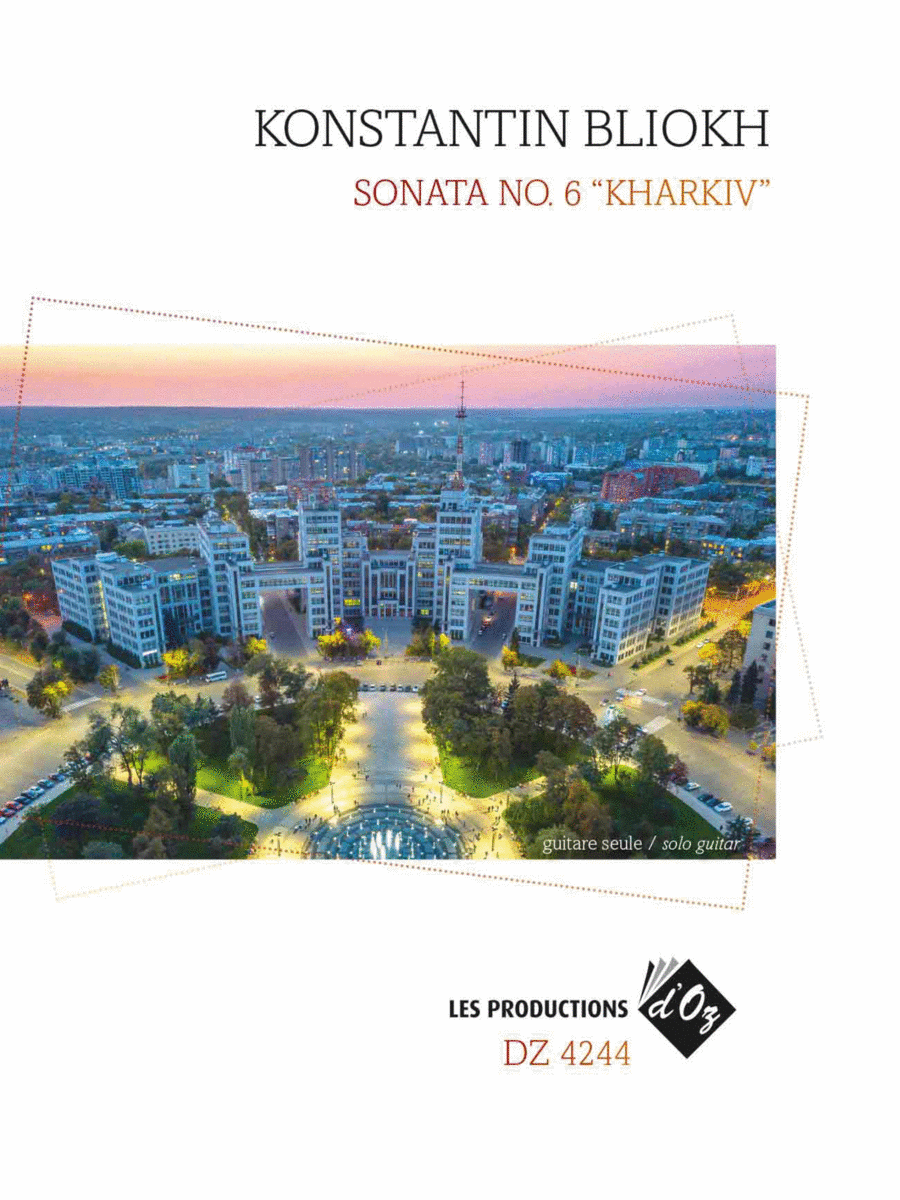
Sonata No. 6 "Kharkiv", Op. 48
Guitare

$7.95 6.88 € Guitare PDF SheetMusicPlus

Voice and piano (2 songs with violoncello; 1 vocal duet) - Medium - Digital Download SKU: MQ.8491-03E Composed by MeeAe Cecilia Nam and Theodore Gouvy. 7 pages. E. C. Schirmer Music Company - Digital #8491-03E. Published by E. C. Schirmer Music Company - Digital (MQ.8491-03E). French.A French composer, Théodore Gouvy (1819-1898) was one of the most significant composers of 19th Century in Europe. The movement of rediscovering his instrumental music has been increasingly successful in Europe since the 1990s, especially following the birth of L’Institut Gouvy in France. However, his solo vocal music has been waiting to be unveiled to the public. Volume One includes 52 songs of Gouvy.Gouvy traveled widely throughout Europe. He was also a lover of nature. Generally, he spent his winters in Leipzig, but in the summertime, he always returned to Hombourg-Haut, France, to stroll through the woods, to hunt, and to relax. Gouvy was fluent in several languages and had a great appreciation of the Renaissance French Poetry of Pierre de Ronsard whose poetry he had set to music. The fifty-two songs in this volume are largely by Ronsard and other Renaissance poets of La Pléiade.Although Ronsard is approximately 300 years older than Gouvy, they both seem to have the same interest in classical literature, though, admittedly, for different reasons. Celebrated by the French and English courts, Ronsard (1525-1585) was the leader of La Pléiade: a group of seven poets (Joachim Du Bellay (1522-1560), Rémy Belleau (1528-1577), Étienne Jodelle (1532-1573), Pontus de Tyard (1521-1603), Jean–Antoine Baïf (1532-1589), and Jean Daurat (1508-1588), who dedicated their efforts to writing poetry in French rather than in Latin (or Greek) as most of the Romantic poets did. They wished to enrich the French language, and establish a new literature which would be the equal of the other literature of their period, and the equal to poets of the past. French Romantic poetry featured the closeness of the poet to nature, and his ability to communicate with nature by personifying (anthropomorphizing) all of nature’s elements: flowers, the planets, the moon, the breeze, and even the sand upon the shore. As a significant melodist, Gouvy’s treatment of the vocal solo line and his treatment and development of the piano accompaniment places him in the upper echelons as a composer of songs. His diverse cultural life led a rich and significant musical life, interacting with his contemporaries who admired his work, and whom Gouvy knew well, such as Liszt, Brahms, Schumann, Mendelssohn, Berlioz and Gounod. Contents:Six Odes de Ronsard pour ténor et piano, Op. 37 (No. 3 et No. 5 avec violoncelle) Neuf Poésies de Ronsard pour soprano ou ténor et piano, Op. 41 Six Poésies de Ronsard pour soprano ou ténor et piano, Op. 42 Quatre Odes de Ronsard pour baryton et piano, Op. 43 Huit Poésies de Ronsard pour ténor ou soprano et piano, Op. 44 Sept Poésies de Ronsard pour ténor ou soprano et piano, Op. 47.
Op. 37, No. 3: Dieu vous gard’, messagers fidèles from Songs of Gouvy, V1 (Downloadable)
Piano, Voix

$3.00 2.6 € Piano, Voix PDF SheetMusicPlus

Piano Solo - Level 1 - Digital Download SKU: A0.1504777 By Erik Satie. By Erik Satie. Arranged by Caracol Tracks. Classical. Score. 8 pages. Caracol Tracks #1080198. Published by Caracol Tracks (A0.1504777). Gymnopédie No. 1 - Easy Piano Step into the serene and meditative world of Erik Satie’s Gymnopédie No. 1 with this simplified arrangement for easy piano. Known for its calm, flowing melody and gentle rhythms, this iconic piece is perfect for beginner and intermediate pianists looking to explore classical music. The easy piano version preserves the timeless beauty and tranquility of the original while making it accessible for those with basic piano skills. Ideal for recitals, personal enjoyment, or expanding your repertoire, this piece will captivate listeners with its peaceful, dreamlike atmosphere.Genre: Classical, Minimalism, Easy PianoDifficulty Level: Beginner, IntermediateInstrument: Piano, KeyboardComposer: Erik SatieKeywords: Easy piano sheet music, Classical piano, Gymnopédie
Gymnopédie No. 1 - Easy Piano
Piano seul
Erik Satie
$8.99 7.78 € Piano seul PDF SheetMusicPlus

Easy Piano - Level 1 - Digital Download SKU: A0.1504778 By Erik Satie. By Erik Satie. Arranged by Caracol Tracks. Classical. Score. 8 pages. Caracol Tracks #1080200. Published by Caracol Tracks (A0.1504778). Gymnopédie No. 1 - Easy Piano w Note NamesStep into the serene and meditative world of Erik Satie’s Gymnopédie No. 1 with this simplified arrangement for easy piano. Known for its calm, flowing melody and gentle rhythms, this iconic piece is perfect for beginner and intermediate pianists looking to explore classical music. The easy piano version preserves the timeless beauty and tranquility of the original while making it accessible for those with basic piano skills. Ideal for recitals, personal enjoyment, or expanding your repertoire, this piece will captivate listeners with its peaceful, dreamlike atmosphere.With pitch names on note heads for ease of sight reading! Suitable for beginners.Genre: Classical, Minimalism, Easy PianoDifficulty Level: Beginner, IntermediateInstrument: Piano, KeyboardComposer: Erik SatieKeywords: Easy piano sheet music, Classical piano, Gymnopédie.
Gymnopédie No. 1 - Easy Piano (with Note Names)
Piano Facile
Erik Satie
$10.99 9.51 € Piano Facile PDF SheetMusicPlus

C Instrument - Digital Download SKU: A0.1259071 Composed by Michal Kleofas Oginski. Arranged by Darek. Classical,Patriotic,Romantic Period,Traditional. Lead Sheet / Fake Book. 2 pages. Darek #852336. Published by Darek (A0.1259071). Polonaise in A Minor (LEAD SHEET) Farewell to the Homeland [Michał Kleofas Ogiński]Simplified arrangement for guitarists of Polonaise in A Minor Farewell to the Homeland (Polonez A-moll „Pozegnanie Ojczyzny†/ Polonez „Pożegnanie Ojczyzny†/ „Les adieux à la Patrie) by Michał Kleofas Ogiński (Michal Kleofas Oginski) on various instruments.  Immerse yourself in the captivating world of the Polonaise in A Minor Farewell to the Homeland by Michal Kleofas Oginski with my extensive collection of sheet music for various instruments. Whether you play the piano, guitar, violin, or any other instrument, I have the perfect arrangement to bring this cherished composition to life. Explore the profound beauty of this remarkable piece, also known as Polonez A-moll Pożegnanie Ojczyzny or Les adieux à la Patrie, through our meticulously transcribed sheet music. Designed to accommodate various instruments, my collection offers an opportunity for musicians of all levels to experience the charm of Oginski's composition. From the delicate melodies to the powerful harmonies, each instrument's part has been thoughtfully arranged to capture the essence of the composition. Whether you're a beginner or an experienced musician, you'll find an arrangement that suits your skill level and allows you to fully express yourself through the music. The Polonaise in A Minor Farewell to the Homeland represents the Romantic era, renowned for its emotional depth and evocative melodies. Transport yourself to this enchanting period of music history and revel in the captivating nuances of Oginski's creation. Positioned strategically for optimal online visibility, my collection caters to musicians seeking diverse sheet music options, regardless of their instrument. Whether you're a pianist, guitarist, violinist, or play another instrument, you'll find a suitable arrangement that aligns with your musical aspirations. Indulge in the universal language of music as you dive into the enchanting melodies of the Polonaise. With our sheet music, you'll have the power to bring this timeless composition to life, adding your personal touch and interpretation to every note. Unlock your musical potential and embark on a transformative journey as you explore the notes, harmonies, and expressive possibilities of the Polonaise in A Minor. No matter which instrument you play, this collection ensures an unforgettable musical experience that resonates with the beauty and passion of Oginski's composition.
Polonaise in A Minor (LEAD SHEET) "Farewell to the Homeland" [Michał Kleofas Ogiński]
Instruments en Do

$3.00 2.6 € Instruments en Do PDF SheetMusicPlus

Full Orchestra - Level 4 - Digital Download SKU: A0.869295 Composed by Thomas Oboe Lee. 20th Century,Baroque,Classical,Contemporary,Romantic Period. Score and parts. 149 pages. Thomas Oboe Lee #431379. Published by Thomas Oboe Lee (A0.869295). Instrumentation: 3222-4231-timp-2perc-hp-chorus-strings Program note:It has been a wonderful two years of thinking, learning and working on my Continental Harmony Project with the Bangor Symphony Orchestra. It is a rare occasion that a composer in the 21st century would receive a commission to write a musical work of such scale: a 40-minute piece for symphony orchestra, 200-plus chorus and a ballet company.   At the Bangor Public Library I found some wonderful evocative 19th century texts for the chorus about the city of Bangor and its environs: the Penobscot River, Mt. Ktaadn, the logging industry, the native American culture, etc.   At times I felt overwhelmed, but most of the times I was exuberant and quite inspired by the music that came forth in the process.   The premiere is less than a month away, and I am looking forward to it. Susan Jonason, Executive Director of the Bangor Symphony, has made the occasion a very public one: a free concert on a Saturday evening! I hope the audience will go home humming the tunes from the work as they walk into the crisp, cool Bangor night.Formally the work is in five movements. The first, third and fifth movements are choral, and the two in between are orchestral.   In the premiere, the Robinson Ballet will dance in the orchestral movements.  The first movement is about the Penobscot River from winter to spring. The melting of the ice is a harbinger of things to come: warmer weather, for instance; but it has also contributed to a lot of flooding in the city of Bangor and its surroundings.The second movement is a waltz, a grand 19th century ballroom waltz for the ladies of the rich lumber barons. They come to the ball showing off their latest hats and gowns from London, Paris and Milan.The third movement is about the woods and the people who work in them. Thoreau’s text about Mt. Ktaadn is full of awesome thoughts about how nature is beautiful, yet unkind to man.   It is followed by a J.G. Whittier lyric entitled The Logger’s Boast. The original song had twenty stanzas to it. I whittled it down to five. I don’t know what the original song sounded like, so I made up my own version of a lumberjack’s drinking song.The fourth movement is a wild, drunken polka. After a long week of working in the woods the lumbermen come back to the city and spend all their earnings on booze, women and gambling. And they dance the night away …The last movement begins with a funeral march for Joe Attien, a native American who was Thoreau’s guide when he came up here in the 1900’s. The work ends with a rousing march, a centennial hymn to the city of Bangor.   God bless our city Bangor, now! On this its birthday morn …NB: The two ballet movements, II. La Valse and IV. Drunken Polka, are optional.
Symphony No. 6 ... The Penobscot River (2004) for chorus and orchestra
Orchestre

$9.99 8.65 € Orchestre PDF SheetMusicPlus

Electric Bass Guitar,Piano Accompaniment - Level 3 - Digital Download SKU: A0.1105110 By David Kai. By David Kai. Arranged by David Kai. Christian,Contemporary. Full Performance. Duration 254. David Kai #708357. Published by David Kai (A0.1105110). A song for Good Friday. Scripture reference: John 15:13. No one has greater love than this, to lay down one’s life for one’s friends. NO GREATER LOVE words and music by David Kai ©1985 A chilly wind blows upon Calvary's hill, the sky is as dark as the night, the sweat and the blood trickle down to the ground, as the townspeople gaze at the sight, And the hands that once held the children near are nailed onto the tree, Why did you have to suffer that for me? They beat him until he could hardly stand, a crown of thorns pierced his head, and all of that time not a single word in his defense he said, And I stood within that angry crowd that jeered along the way, for I helped to put you on the cross that day. CHORUS For the man on the cross filled with sorrow and pain, will bring us to God once again, for no greater love has been shown since that day when the Saviour took our sins away. For all of my life your boundless love I want to get to know, 'though sometimes I've turned my back on you and I’ve heard the rooster crow, but then you've appeared just like a friend to guide my wandering way, no longer on the cross, you're here today. The Light of the World, the Bread of Life, the Son of God, Morning Star, my earthly mind can't comprehend all of the things you are, but even through glass that's dark and dim, my eyes can plainly see, you loved us so much you died to set us free. CHORUS For the man on the cross filled with sorrow and pain, will bring us to God once again, for no greater love has been shown since that day when the Savior took our sins away. No greater love, no there's no greater love, No greater love, no there's no greater love, There's no greater love than to lay down your life for a friend.
No Greater Love
David Kai
$1.99 1.72 € PDF SheetMusicPlus

C Instrument - Digital Download SKU: A0.1259046 Composed by Frederic Chopin. Arranged by Darek. 19th Century,Classical,Romantic Period. Lead Sheet / Fake Book. 1 pages. Darek #852309. Published by Darek (A0.1259046). Nocturne in Eb Major, Op. 9, No. 2 (LEAD SHEET) [Frédéric Chopin]Lead Sheet arrangements of Nocturne in Eb Major, Op. 9, No. 2 by Frédéric Chopin (Frederic Francois Chopin) on various instruments.  I offer a stunning selection of lead sheets for the timeless Nocturne in Eb Major, Op. 9, No. 2 by the legendary composer Frédéric Chopin. If you're looking to explore this masterpiece on your instrument of choice, you've come to the right place. My lead sheets cater to a variety of instruments, allowing musicians of all backgrounds and skill levels to engage with this iconic composition. From piano and guitar to saxophone, trumpet, and more, you'll find the arrangement that suits your instrument and musical style. Unlock the expressive beauty of Chopin's Nocturne as you navigate the enchanting melodies and harmonies meticulously transcribed in my lead sheets. Each note, chord, and phrase is carefully notated, capturing the essence of the original composition. Whether you're a beginner, intermediate, or advanced musician, my lead sheets accommodate various levels of difficulty, ensuring an enjoyable and rewarding experience for all players. Embrace the challenge and embark on a musical journey that will enhance your skills and deepen your understanding of Chopin's artistry. Immerse yourself in the romantic era, where Chopin's Nocturne captivated audiences with its emotional depth and timeless melodies. Experience the magic of this composition, transporting yourself to a bygone era of music and craftsmanship. Positioned as a versatile resource, my lead sheets offer a convenient and accessible way to explore Chopin's Nocturne across a range of instruments. Whether you're seeking to perform solo or collaborate with fellow musicians, these lead sheets provide a solid foundation for creative expression and collaboration. Discover the joy of interpreting Chopin's Nocturne on your instrument, as my lead sheets provide the framework for your musical journey. Dive into the intricacies of the composition, exploring its nuances and bringing your unique interpretation to life. Explore the world of music with my lead sheets for the Nocturne in Eb Major, Op. 9, No. 2. Unleash your creativity, showcase your skills, and let the magic of Chopin's masterpiece resonate through your instrument. Begin your musical adventure today and unlock the limitless possibilities of this timeless composition.
Nocturne in Eb Major, Op. 9, No. 2 (LEAD SHEET) [Frédéric Chopin]
Instruments en Do

$2.00 1.73 € Instruments en Do PDF SheetMusicPlus

String Orchestra - Level 4 - Digital Download SKU: A0.736797 Composed by Johann Anton Filtz. Arranged by P. Wood. Classical. Score and parts. 53 pages. MyMusicScores.com #6307239. Published by MyMusicScores.com (A0.736797). Johann Anton Filtz (1733 - 1760) was just 26 years old when he died! In his short time on earth, he studied law and theology at the University of Ingolstadt, was a cellist in the Mannheimer Hofkapelle and a composer of at least thirty-four symphonies, thirty concertos and several chamber works. Being a member of the Mannheimer Hofkapelle puts Filtz's compositions clear in the Mannheim school along with fellow composers Franz Xaver Richter, Carl Stamitz, Franz Ignaz Beck, Ignaz Fränzl, and Christian Cannabich. His 6 Symphonies Op. 1 are all scored for strings and continuo and consist of three movements - fast - slow- fast. I can't find a recording of Filtz's Symphony Op.1 No.5 in F major or a modern edition of this work. I do hope that you will find this work interesting enough to play and perform. If you do perform it, I would love to hear your recording.
Filtz Symphony in F major Op. 1 No. 5 for String Orchestra
Orchestre à Cordes

$14.99 12.97 € Orchestre à Cordes PDF SheetMusicPlus

String Orchestra - Level 4 - Digital Download SKU: A0.736694 Composed by Johann Anton Filtz. Arranged by Paul Wood. Classical. Score and parts. 44 pages. MyMusicScores.com #1892819. Published by MyMusicScores.com (A0.736694). Johann Anton Filtz (1733 - 1760) was just 26 years old when he died! In his short time on earth, he studied law and theology at the University of Ingolstadt, was a cellist in the Mannheimer Hofkapelle and a composer of at least thirty-four symphonies, thirty concertos and a several chamber works. Being a member of the Mannheimer Hofkapelle puts Filtz's compositions clear in the Mannheim school along with fellow composers Franz Xaver Richter, Carl Stamitz, Franz Ignaz Beck, Ignaz Fränzl, and Christian Cannabich. His 6 Symphonies Op. 1 are all scored for strings and continuo and consist of three movement - fast - slow- fast. I can't find a recording of Filtz's Symphony Op.1 No.5 in F major or a modern edition of this work. I do hope that you will find this work interesting enough to play and perform. If you do perform it, I would love to hear a recording.
Symphony Op. 1 No. 5
Orchestre à Cordes

$9.99 8.65 € Orchestre à Cordes PDF SheetMusicPlus

Chamber Orchestra - Level 3 - Digital Download SKU: A0.550196 Composed by Robert Schumann. Arranged by James M. Guthrie. Holiday,Romantic Period,Standards. 10 pages. Jmsgu3 #4598499. Published by jmsgu3 (A0.550196). Op. 15 No. 7 Träumerei * Daydreaming * мечтательноÑть * αφηÏημάδα * snÄ›ní An unexpected and welcome recital encore.Schumann's Träumerei (Dreaming), Op. 15 No. 7, is a solo piano piece that is part of his Scenes from Childhood (Kinderszenen) set, which was his first attempt at writing a piano solo. The piece is significant for several reasons:Emotional Appeal: Träumerei is considered a masterpiece due to its great emotional appeal, combining both haunting sadness and nostalgic tenderness. This emotional depth has allowed the piece to touch many people's hearts and become a beloved piece of music worldwide.Universal Themes: The piece explores themes of childhood, memories, and feelings from a sentimental adult perspective. These themes are universally cherished and can be appreciated by adults and children.Cultural Impact: Träumerei has been used in various cultural contexts, such as in the 1947 Hollywood film Song of Love and the 1944 German biographical film on Schumann. In Russia, a hummed choral, a cappella version that became known as mourning music, was played annually during the Minute of Silence on Victory Day.Influence on Other Artists: The piece has inspired other artists, such as violinist Fenella Humphreys, who released an arrangement of Träumerei for violin in 2021.Schumann's Träumerei is a significant piece of music due to its emotional appeal, universal themes, cultural impact, and influence on other artists. Its timeless beauty and emotional depth continue to resonate with audiences worldwide.
Schumann: Träumerei Op. 15 No. 7 for Piano Sextet
Orchestre de chambre

$48.95 42.36 € Orchestre de chambre PDF SheetMusicPlus


Partitions Gratuites
Acheter des Partitions Musicales
Acheter des Partitions Digitales à Imprimer
Acheter des Instruments de Musique

© 2000 - 2026

Accueil - Version intégrale





