EUROPE
2896 articles
USA
6353 articles
DIGITAL
2625 articles (à imprimer)
Partitions Digitales
Partitions à imprimer
2625 partitions trouvées


Small Ensemble Alto Voice,Piano Accompaniment,Soprano voice - Level 2 - Digital Download SKU: A0.1513097 Composed by Phillips Brooks and Lewis H Redner. Arranged by Connie Boss. Christian,Christmas. 9 pages. Connie Boss #1087980. Published by Connie Boss (A0.1513097). This version has an optional beginning. I have choir humming for the first three measure. There is a soloist that starts singing after that. The optional part is to not play the piano until half way through the verse. There is accompaniment if you prefer. You can hear on the mp3 how it sounds being a cappella until then. It is for SSAA voices. I have also added additions to each verse that is different than the original with new lyrics and music. It adds a little bit to this iconic song. For any questions or requests, email cdboss@cvalley.netLyrics below:O little town of BethlehemHow still we see Thee lieAbove Thy deep and dreamless sleepThe silent stars go byYet in thy dark streets shinethThe everlasting lightThe hopes and fears of all the yearsAre met in Thee tonightShepherds watching o’re their flocksSaw a light star downThen they noticed that it’s lightLit up a little townFor Christ is born of MaryAnd, gathered all aboveWhile mortals sleep, the angels keepTheir watch of wondering loveO morning stars, togetherProclaim the Holy birthAnd praises sing to God the KingAnd peace to men on earthShepherds followed the bright starAnd they were so amazedPeople gathered all aroundSinging hymns of praiseO Holy Child of BethlehemDescend to us, we prayCast out our sin and enter inBe born for us todayWe hear the Christmas angelsThe great glad tidings tellO come to us, abide with usOur Lord Emmanuel In a stable was a childBorn for all to seeHis mother always by His sideThe newborn Prince of peace O little town of BethlehemHow still we see Thee lieAbove Thy deep and dreamless sleepThe silent stars go by.
O Little Town of Bethlehem traditional SSAA and Piano

$5.99 5.15 € PDF SheetMusicPlus

Alto Voice,Bass Voice,Piano Accompaniment,Soprano voice,Tenor Voice - Level 3 - Digital Download SKU: A0.1318498 Composed by Phillips Brooks and Lewis H Redner. Arranged by Connie Boss. Christian,Christmas,Holiday. 10 pages. Connie Boss #907165. Published by Connie Boss (A0.1318498). This version has an optional beginning. I have choir humming for the first three measure. There is a soloist that starts singing after that. The optional part is to not play the piano until half way through the verse. There is accompaniment if you prefer. You can hear on the mp3 how it sounds being a cappella until then. It is for SATB voices. I have also added additions to each verse that is different than the original with new lyrics and music. It adds a little bit to this iconic song. For any questions or requests, email cdboss@cvalley.netLyrics below:O little town of BethlehemHow still we see Thee lieAbove Thy deep and dreamless sleepThe silent stars go byYet in thy dark streets shinethThe everlasting lightThe hopes and fears of all the yearsAre met in Thee tonight Shepherds watching o’re their flocksSaw a light star downThen they noticed that it’s lightLit up a little townFor Christ is born of MaryAnd, gathered all aboveWhile mortals sleep, the angels keepTheir watch of wondering loveO morning stars, togetherProclaim the Holy birthAnd praises sing to God the KingAnd peace to men on earth Shepherds followed the bright starAnd they were so amazedPeople gathered all aroundSinging hymns of praiseO Holy Child of BethlehemDescend to us, we prayCast out our sin and enter inBe born for us todayWe hear the Christmas angelsThe great glad tidings tellO come to us, abide with usOur Lord Emmanuel In a stable was a childBorn for all to seeHis mother always by His sideThe newborn Prince of peace O little town of BethlehemHow still we see Thee lieAbove Thy deep and dreamless sleepThe silent stars go by.
O Little Town of Bethlehem - SATB and Piano
Chorale SATB

$7.99 6.87 € Chorale SATB PDF SheetMusicPlus

Brass Ensemble - Digital Download SKU: A0.999619 Composed by Peter Benoit. Arranged by Marc Goris. Romantic Period. Score and parts. 15 pages. Brassery Publications #6025981. Published by Brassery Publications (A0.999619). The Duke of Alva's entry into Brussels from The Pacification of Ghent,  duration : 2 min music : Peter Benoit arr. : Marc Goris Peter Benoit composed music based on the historical drama with the title 'De Pacificatie van Gent' by Emiel Van Goethem. Because of the combination of drama and music he defined the piece as a lyrical drama. He completed The Pacification of Ghent on 11 July 1876, the world premiere happening on 3 September at the Ghent Municipal Theatre.   On 8 November 1576 a treaty was proclaimed from the balcony of the city hall in Ghent between the different regions of the southern and the northern Netherlands. This Pacification of Ghent occurred after the revolt against the Spanish occupation of Philip the Second and was the great ideal of William of Orange: he was striving for unity in the seventeen provinces in the Netherlands as well as for freedom of religion. Furthermore the treaty stipulated that the Spanish troops were to be removed from the Netherlands. Although this treaty was observed for only three years, the Pacification was embellished with a mythical aura in the Flanders of the 19th century. King Philip II sent the Duke of Alva to Brussels on 22 August 1567, at the head of a powerful army. On arrival, Alva replaced Margaret of Parma, the sister of the Spanish king, as head of the civil jurisdiction. He decided that the local nobility was in open rebellion against the king and supported the new Protestant teachings, heresy in his view. A few days later, on 5 September 1567, Alva established the Council of Troubles, popularly known in the Netherlands as the Court of Blood, to prosecute those responsible for the riots of 1566, especially those who were deemed heretics. Alba also targeted the local Catholic nobility, who favoured dialogue and opposed outside intervention. Two of the three heads of the Flemish nobility, the Count of Egmont, a Catholic General for Philip II, who had led the cavalry that defeated the French at the Battle of San Quentin, and Philip de Montmorency, Count of Horn, were arrested. The court sentenced both counts to death. The Major of Antwerpen, Anthony van Stralen, Lord of Merksem and Jan van Casembroot were other famous victims of the bloody repression, along with a large group of other heretics. The condemned persons were executed on 5 June 1568 in the Town Hall Square in Brussels. Alva had little confidence in Flemish justice, which he perceived as sympathetic to the defendants, and witnessed the executions in person.
The Duke of Alva's entry into Brussels for brass quintet
Quintette de Cuivres: 2 trompettes, Cor, trombone, tuba

$12.00 10.32 € Quintette de Cuivres: 2 trompettes, Cor, trombone, tuba PDF SheetMusicPlus

Choral Choir (TTBB) - Level 1 - Digital Download SKU: A0.774723 Composed by Traditional. Arranged by Sandra Milliken. Folk,World. Octavo. 13 pages. Sandra Milliken #3863765. Published by Sandra Milliken (A0.774723). Brisbane Ladies, sometimes known as Augathella Station, is an Australian folk song based on an English naval song titled Spanish Ladies. The song probably dates from the time of the War of the First Coalition (1793-96) when the Royal Navy carried supplies to Spain in support of that country’s resistance to revolutionary France. It then probably gained further popularity during the later Peninsular War when British soldiers were transported to Spain to assist rebels fighting against the French occupation by the forces of Napoleon.Spanish Ladies is a tale of British naval personnel sailing north from Spain and along the English Channel to their home port. Due to its popularity, several variants of Spanish Ladies later appeared in various parts of the world. American whalers sang a version called Yankee Whalermen. In Newfoundland it appeared as We’ll Rant and We’ll Roar. Special lyrics were written to the tune for the Bluenose, a famous Canadian sailing ship plying out of Nova Scotia. In Australia, around 1880, another set of lyrics appeared, written by Saul Mendelsohn who was a storekeeper in the small Queensland town of Nanango. Brisbane Ladies tells about the drovers who bring the herds of cattle overland from western Queensland to the markets in Brisbane. There the drovers spend most of their money and time with the ladies before setting out for home in search of the next herd of cattle for market. The places mentioned in Brisbane Ladies are mostly small towns along the stock route that stretched some 750 kilometres north-west of Brisbane towards the small town of Augathella, on the banks of the Warrego River. Augathella, at that time, marked the convergence of three major bullock tracks from Morven, Tambo and Charleville.
Brisbane Ladies (Augathella Station)
Chorale TTBB

$2.20 1.89 € Chorale TTBB PDF SheetMusicPlus

Choral Choir (SATB) - Level 1 - Digital Download SKU: A0.774722 Composed by Traditional. Arranged by Sandra Milliken. Folk,World. Octavo. 16 pages. Sandra Milliken #3863763. Published by Sandra Milliken (A0.774722). Brisbane Ladies, sometimes known as Augathella Station, is an Australian folk song based on an English naval song titled Spanish Ladies. The song probably dates from the time of the War of the First Coalition (1793-96) when the Royal Navy carried supplies to Spain in support of that country’s resistance to revolutionary France. It then probably gained further popularity during the later Peninsular War when British soldiers were transported to Spain to assist rebels fighting against the French occupation by the forces of Napoleon. Spanish Ladies is a tale of British naval personnel sailing north from Spain and along the English Channel to their home port.Due to its popularity, several variants of Spanish Ladies later appeared in various parts of the world. American whalers sang a version called Yankee Whalermen. In Newfoundland it appeared as We’ll Rant and We’ll Roar. Special lyrics were written to the tune for the Bluenose, a famous Canadian sailing ship plying out of Nova Scotia. In Australia, around 1880, another set of lyrics appeared, written by Saul Mendelsohn who was a storekeeper in the small Queensland town of Nanango. Brisbane Ladies tells about the drovers who bring the herds of cattle overland from western Queensland to the markets in Brisbane. There the drovers spend most of their money and time with the ladies before setting out for home in search of the next herd of cattle for market. The places mentioned in Brisbane Ladies are mostly small towns along the stock route that stretched some 750 kilometres north-west of Brisbane towards the small town of Augathella, on the banks of the Warrego River. Augathella, at that time, marked the convergence of three major bullock tracks from Morven, Tambo and Charleville.
Brisbane Ladies (Augathella Station)
Chorale SATB

$2.20 1.89 € Chorale SATB PDF SheetMusicPlus

Guitar,Piano,Vocal,Voice - Level 3 - Digital Download SKU: A0.893864 Composed by David Kai. Celtic,Folk,Pop. Score. 5 pages. David Kai #6100233. Published by David Kai (A0.893864). A song celebrating the people of Gander, Newfoundland & Labrador in Canada who helped close to 7,000 stranded airline passengers after September 11, 2001. The story of Gander and the surrounding towns has been immortalized in the Broadway show, Come From Away. The song is written in a Celtic/Newfoundland style. This song is dedicated to my spouse Marly's parents, Isaac and Sybil who were a part of the crew who helped the plane people in Gander through their involvement in the Anglican church. WHEN THE WORLD DROPS IN TO TOWN     Words and music by David Kai ©2020 On the 11th of September, in a quiet little town In a place that they call Newfoundland, all the planes were coming down Just how many were arriving, it was hard to know or tell In a quiet town in Newfoundland on the day the towers fell.  With ten thousand waiting on the ground, seven thousand on their way The schools and halls and churches were preparing for their stay And not only in Gander, but in places all around ‘Cause you’ve got to pull together when the world drops into town. Chorus: So raise a glass to them, let’s sing a song to cheer For all the workers, cooks and clerks, for all the volunteers Who showed such kindness, who stepped up when chips were down ‘Cause you’ve got to pull together when the world drops into town  All the stores they opened up their doors, the supplies, how fast they flew! Take it all to help the plane people, it’s the least that we can do! Aunt Winnie baked two dozen of her partridgeberry pies She said, I think those plane people will be in for some surprise! So the people were all settled, and much to their delight There were home-cooked meals and showers in homes, even trips to see the sights Though they came from countries ‘round the world, they did seem to all fit in And in kitchen parties here and there, new found friends were being screeched in.  Chorus: Soon the skies, they were reopened, just a week and they were gone Though the planes took off into the skies all the memories lingered on For what they all remember, and what’s talked of to this day Is how townsfolk cared for people who had come from far away.  So let’s sing and let’s be thankful, for each and every one Who showed us how to live together in the year two-thousand one, Let’s celebrate their kindness, for we never will forget, That in Newfoundland a stranger’s just a friend you haven’t met.  Chorus:
When the World Drops In to Town
Piano, Voix et Guitare

$3.00 2.58 € Piano, Voix et Guitare PDF SheetMusicPlus

Mixed Percussion Accordion,Acoustic Guitar,Electric Bass Guitar,Violin - Level 3 - Digital Download SKU: A0.1105258 By David Kai. By David Kai. Arranged by David Kai. Celtic,Country,Folk,Irish. Full Performance. Duration 233. David Kai #708518. Published by David Kai (A0.1105258). A song celebrating the people of Gander, Newfoundland & Labrador in Canada who helped close to 7,000 stranded airline passengers after September 11, 2001. The story of Gander and the surrounding towns has been immortalized in the Broadway show, Come From Away. The song is written in a Celtic/Newfoundland style. This song features the use of an Ugly Stick, a traditional Newfoundland percussion instrument. WHEN THE WORLD DROPS IN TO TOWN Words and music by David Kai ©2020 On the 11th of September, in a quiet little town In a place that they call Newfoundland, all the planes were coming down Just how many were arriving, it was hard to know or tell In a quiet town in Newfoundland on the day the towers fell. With ten thousand waiting on the ground, seven thousand on their way The schools and halls and churches were preparing for their stay And not only in Gander, but in places all around ‘Cause you’ve got to pull together when the world drops into town. Chorus: So raise a glass to them, let’s sing a song to cheer For all the workers, cooks and clerks, for all the volunteers Who showed such kindness, who stepped up when chips were down ‘Cause you’ve got to pull together when the world drops into town All the stores they opened up their doors, the supplies, how fast they flew! “Take it all to help the plane people, it’s the least that we can do!†Aunt Winnie baked two dozen of her partridgeberry pies She said, “I think those plane people will be in for some surprise!†So the people were all settled, and much to their delight There were home-cooked meals and showers in homes, even trips to see the sights Though they came from countries ‘round the world, they did seem to all fit in And in kitchen parties here and there, new found friends were being screeched in. Chorus: Soon the skies, they were reopened, just a week and they were gone Though the planes took off into the skies all the memories lingered on For what they all remember, and what’s talked of to this day Is how townsfolk cared for people who had come from far away. So let’s sing and let’s be thankful, for each and every one Who showed us how to live together in the year two-thousand one, Let’s celebrate their kindness, for we never will forget, That in Newfoundland a stranger’s just a friend you haven’t met. Chorus:.
When the World Drops In to Town
David Kai
$1.99 1.71 € PDF SheetMusicPlus

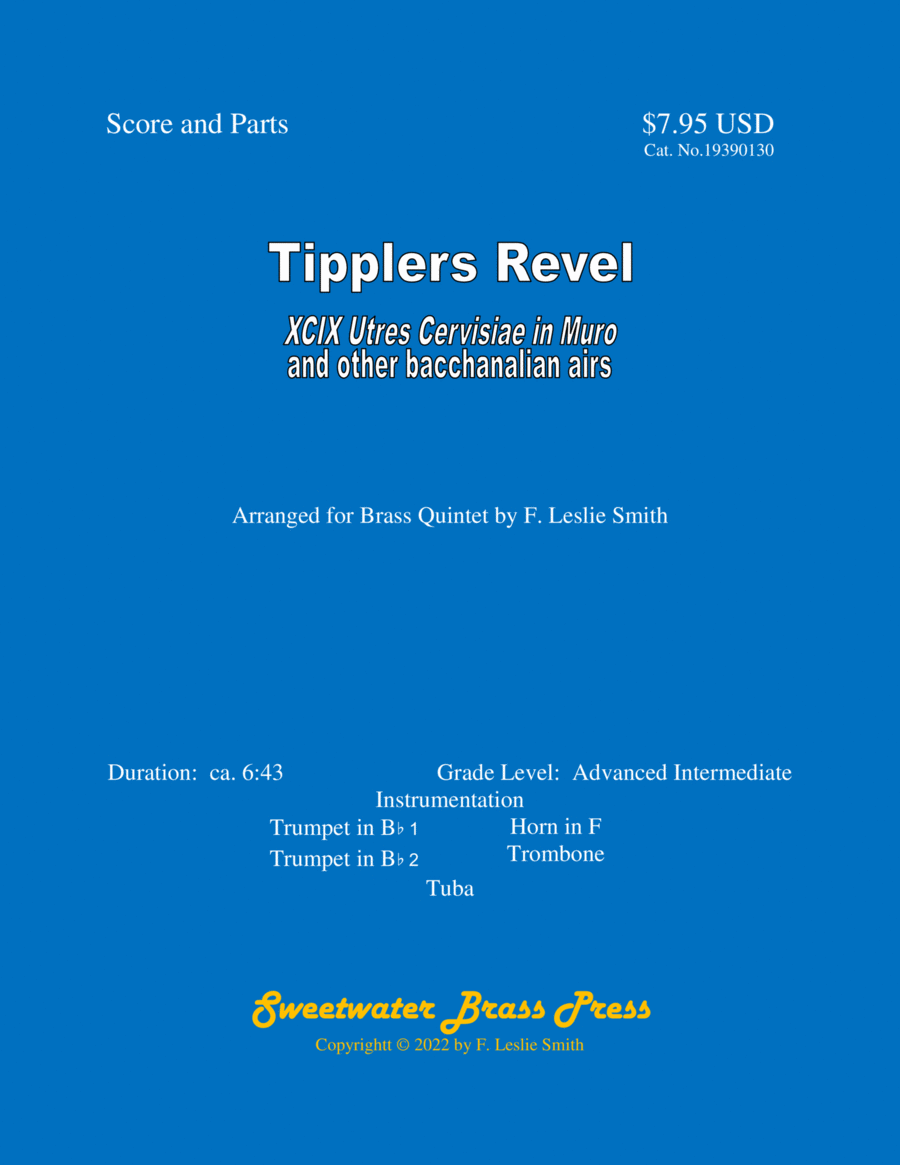
Brass Ensemble - Level 4 - Digital Download SKU: A0.1093770 Composed by F. Leslie Smith. Folk,Holiday,Traditional. Score and parts. 57 pages. Sweetwater Brass Press #697853. Published by Sweetwater Brass Press (A0.1093770).      The dictionary defines revel as “a time or instance of carefree fun.†The verb tipple refers to the imbibing of spirits. A tippler is one who drinks beer, wine, whiskey or other such spirituous liquids. So a tipplers revel would be a gathering of folks who, in the words of Dolly Parton’s “Two Doors Down,†are “laughing and drinking and having a party.†     This Tipplers Revel is a compilation of traditional drinking songs. It begins and ends with that bane of school trips, faculty sponsors, bus drivers and chaperones, “99 Bottles of Beer on the Wall.†And between those two bookends come “Rye Whiskey,†“Little Brown Jug,†“Landlord, Fill the Flowing Bowl,†“Jimmy Crack Corn,†“Beer, Beer, Beer (An Ode to Charlie Mops, The Man Who Invented Beer),†“Hot Time in the Old Town Tonight,†“Wein, Weib und Gesang [Wine, Woman, and Song],†“Drink to Me Only with Thine Eyes,†“There Is a Tavern in the Town,†“Good Night, Ladies,†“How Dry I Am,†and brief quotes from about a half dozen other melodies associated with quaffing.      For the most part, this arrangement’s time signature is 4/4 and should be played at about 120 BPM. There are, however, two sections of 3/4 time, one of which is marked “tempo di valse,†and the opening and ending few measures should be played rather slowly.      The music should be well within the normal range of the group. Possible exceptions: trumpets play their A above the staff a couple of times.      There are quite a few 16th notes in the allegro sections. (And one could make the argument that at least two sections ought to have been written in 6/8 time. But they weren’t.)      Completed in 2022, performance time runs about 6 minutes, 43 seconds. The arranger, Les Smith, will be happy to provide substitute parts (for example, treble clef baritone for trombone) at no charge. He would like to receive your suggestions, comments, corrections and criticisms. For more arrangements by Les, enter Sweetwater Brass Press (without the quotation marks) in the Sheet Music Plus or Sheet Music Direct search box. (Also, purchase of this piece entitles you to your choice of another of his arrangements at no charge; send a copy of your purchase receipt directly to him at lessmith61@bellsouth.net.)  
Tipplers Revel (XCIX Utres Cervisiae in Muro and other bacchanalian airs)
Ensemble de cuivres

$7.95 6.84 € Ensemble de cuivres PDF SheetMusicPlus

Accordion - Digital Download SKU: A0.822592 Composed by Traditional. Arranged by Julia Gordon. Celtic,Folk,World. Score. 5 pages. Julia Gordon #3578371. Published by Julia Gordon (A0.822592). four Scottish airs arranged as a set for accordion THE AULD HOOSEWritten by Carilina Oliphant (Lady Nairne, 1766-1845) this is a nostalgic song about her birthplace in Gask, Perthshire.LOCH LOMONDLoch Lomond, also known as ‘The Bonnie Banks o' Loch Lomond’, is a well-known traditional Scottish song first published in 1841 in 'Vocal Melodies of Scotland'. There are many theories about the meaning of the song, most of which are connected to the Jacobite Uprising of 1745. One interpretation based on the lyrics is that the song is sung by the lover of a captured Jacobite rebel set to be executed in London following a show trial. The heads of the executed rebels were then set upon pikes and exhibited in all of the towns between London and Edinburgh in a procession along the 'high road' (the most important road), while the relatives of the rebels walked back along the 'low road' (the ordinary road travelled by peasants and commoners).COMIN’ THRO’ THE RYEThe lyrics were written in 1782 by Robert Burns (1759–96) who put the words to the melody of the ‘Common' Frae The Town’, a variant of the tune to which 'Auld Lang Syne' is usually sung.THE BLUEBELLS OF SCOTLANDThe Bluebells of Scotland is the usual modern name for a Scottish folk song. It was written by Dora Jordan, an English actress and writer, and first published in 1801.
The Auld Hoose / Loch Lomond / Comin' Thro' The Rye / The Bluebells Of Scotland
Accordéon

$6.50 5.59 € Accordéon PDF SheetMusicPlus

Clarinet Solo - Level 3 - Digital Download SKU: A0.578952 Composed by Traditional. Arranged by David Warin Solomons. 20th Century,Contemporary,Folk,World. Individual part. 8 pages. David Warin Solomons #2063471. Published by David Warin Solomons (A0.578952). Journeymen (young craftsmen) in Germany used to be required by law to go from town to town to practise their skills rather than stay in one town, which gave rise to many songs, of which Es es es und es is the best known - (the words of that song mean it is a hard conclusion but I have to leave this town). These journeys were referred to as Walz so these workers went auf der Walz. The idea of travelling auf der Walz was also taken up in Australia (where they called it on the Waltz or on the Wallaby) and it gave rise to the famous song Waltzing Matilda, although in the Ozzie song the traveller was a swagman rather than a craftsman. So I have called this arrangement On the Wallaby. In neither case was the 3/4 time of the Waltz used although there is probably a connection: I initially tried to create this merged arrangement in 3/4 but it didn't seem to work satisfactorily... So here is a 4/4 waltz based on the two traditional and related songs. The pdf file contains score and parts. The sound sample is an electronic preview.
On the Wallaby (or Auf der Walz) for 2 clarinets
2 Clarinettes (duo)

$7.00 6.02 € 2 Clarinettes (duo) PDF SheetMusicPlus

Instrumental Duet E-Flat Clarinet,Instrumental Duet - Level 3 - Digital Download SKU: A0.578953 Composed by Traditional. Arranged by David Warin Solomons. 20th Century,Contemporary,Folk,World. Score and parts. 8 pages. David Warin Solomons #2063473. Published by David Warin Solomons (A0.578953). Journeymen (young craftsmen) in Germany used to be required by law to go from town to town to practise their skills rather than stay in one town, which gave rise to many songs, of which Es es es und es is the best known - (the words of that song mean it is a hard conclusion but I have to leave this town). These journeys were referred to as Walz so these workers went auf der Walz. The idea of travelling auf der Walz was also taken up in Australia (where they called it on the Waltz or on the Wallaby) and it gave rise to the famous song Waltzing Matilda, although in the Ozzie song the traveller was a swagman rather than a craftsman. So I have called this arrangement On the Wallaby. In neither case was the 3/4 time of the Waltz used although there is probably a connection: I initially tried to create this merged arrangement in 3/4 but it didn't seem to work satisfactorily... So here is a 4/4 waltz based on the two traditional and related songs. The pdf file contains score and parts. The sound sample is an electronic preview.
On the Wallaby (or Auf der Walz) for clarinet and alto clarinet
2 Clarinettes (duo)

$7.00 6.02 € 2 Clarinettes (duo) PDF SheetMusicPlus

Flute Duet Flute - Level 3 - Digital Download SKU: A0.576261 Composed by Traditional. Arranged by David Warin Solomons. Contemporary,Folk,World. Score. 8 pages. David Warin Solomons #12145. Published by David Warin Solomons (A0.576261). Journeymen (young craftsmen) in Germany used to be required by law to go from town to town to practise their skills rather than stay in one town, which gave rise to many songs, of which Es es es und es is the best known - (the words of that song mean it is a hard conclusion but I have to leave this town). These journeys were referred to as Walz so these workers went auf der Walz. The idea of travelling auf der Walz was also taken up in Australia (where they called it on the Waltz or on the Wallaby) and it gave rise to the famous song Waltzing Matilda, although in the Ozzie song the traveller was a swagman rather than a craftsman. So I have called this arrangement On the Wallaby. In neither case was the 3/4 time of the Waltz used although there is probably a connection: I initially tried to create this merged arrangement in 3/4 but it didn't seem to work satisfactorily - indeed my left hand ended firmly stuck down my collar and my right leg twisted round my back - well... sort of! So here is a 4/4 waltz based on the two traditional and related songs.
On the Wallaby (or Auf der Walz) for two flutes
2 Flûtes traversières (duo)

$7.00 6.02 € 2 Flûtes traversières (duo) PDF SheetMusicPlus

Small Ensemble Alto Voice,Soprano voice - Level 2 - Digital Download SKU: A0.1513101 Composed by Phillips Brooks and Lewis H Redner. Arranged by Connie Boss. Christian,Christmas. 6 pages. Connie Boss #1087984. Published by Connie Boss (A0.1513101). This version has an optional beginning. I have choir humming for the first three measure. There is a soloist that starts singing after that. The optional part is to not play the piano until half way through the verse. There is accompaniment if you prefer. . It is for SSAA voices. I have also added additions to each verse that is different than the original with new lyrics and music. It adds a little bit to this iconic song. For any questions or requests, email cdboss@cvalley.netLyrics below:O little town of BethlehemHow still we see Thee lieAbove Thy deep and dreamless sleepThe silent stars go byYet in thy dark streets shinethThe everlasting lightThe hopes and fears of all the yearsAre met in Thee tonightShepherds watching o’re their flocksSaw a light star downThen they noticed that it’s lightLit up a little townFor Christ is born of MaryAnd, gathered all aboveWhile mortals sleep, the angels keepTheir watch of wondering loveO morning stars, togetherProclaim the Holy birthAnd praises sing to God the KingAnd peace to men on earthShepherds followed the bright starAnd they were so amazedPeople gathered all aroundSinging hymns of praiseO Holy Child of BethlehemDescend to us, we prayCast out our sin and enter inBe born for us todayWe hear the Christmas angelsThe great glad tidings tellO come to us, abide with usOur Lord EmmanuelIn a stable was a childBorn for all to seeHis mother always by His sideThe newborn Prince of peaceO little town of BethlehemHow still we see Thee lieAbove Thy deep and dreamless sleepThe silent stars go by.
O Little Town of Bethlehem traditional SSAA A Cappella

$5.99 5.15 € PDF SheetMusicPlus

Solo Guitar - Level 4 - Digital Download SKU: A0.899136 Composed by Alban Berg. Arranged by Rod Whittle. Contemporary. Individual part. 4 pages. Maggie Creek Music #3874083. Published by Maggie Creek Music (A0.899136). For solo classical guitar; 4 pp; first part of 2nd movement of the Lyric SuiteAlban Berg 1885 -1935Berg was a student of Arnold Schoenberg, and came to prominence with compositions using the atonalism of that school. He incorporated chromaticism and an absence of tonality into his compositions with complete facility, if not to public acclaim. His creativity was interrupted by World War 1, during which he served in the Austrian Army. He returned to composition as a champion of modern music, with his opera Wozzeck (1923) bringing both fame and notoriety. He died of blood poisoning in 1935. Over the past century dissonance increased in the compositions of serious music to a point where the semitones had equal value, which is harmonically a kind of wall. Berg was an early innovator. However, if when strictly followed such serialism reaches an ultimate dissonance that effectively sees off melody and harmony as emotional and structural entities, that still leaves elements around form, dynamics and rhythm for the purposes of expression, and these together with adroit note selection prove to be surprisingly potent for articulation and cohesion. The Lyric Suite (1927), which uses Schoenberg's twelve-tone technique, is a case in point. The very name seems incongruous for an atonal work, yet lyric it is, and if the forms used are necessarily masked by the characteristics of serial writing they are not eliminated by them. In this excerpt a rondo form is used with the principle subject repeated on the third page (noted in the score) after a digression to more remote regions than this form usually adopts, due to the atonality.   As well, Berg's writing is rarely purely atonal. In fact the integration of consonant elements are one of the music's most alluring features. It would be so easy, one feels, for melodic material to coagulate the mix, but in his hands the very opposite is generated, an increased clarity of mood. The music remains consistent, as it should, and the incorporation of (often only relatively) thematic material, if often arresting after so much dissonance, doesn't always always mean less intensity or gloom. It is simply effective, either way. Having said all that, it can hardly be denied that the substance of atonality (dissonance, clashing semitones, unharmonic bass) gives it a special suitability to express dark outlooks, and Berg is the author of Wozzeck and Lulu, no downtown musicals. It is hard to determine if Berg chose atonality because it could deliver the angst or because he was bored with obvious forms and romanticism. Probably both.
Excerpt from the Lyric Suite
Guitare

$5.00 4.3 € Guitare PDF SheetMusicPlus


Partitions Gratuites
Acheter des Partitions Musicales
Acheter des Partitions Digitales à Imprimer
Acheter des Instruments de Musique

© 2000 - 2026

Accueil - Version intégrale