EUROPE
503 articles
USA
0 articles
DIGITAL
733 articles (à imprimer)
Partitions Digitales
Partitions à imprimer
733 partitions trouvées

1 ....91 106 121 136 151 ....721

Euphonium,Piano - Level 2 - Digital Download SKU: A0.549852 Composed by Johann Sebastian Bach. Arranged by James M. Guthrie, ASCAP. Baroque,Concert,Easter,Sacred,Standards. Score and part. 12 pages. Jmsgu3 #3555081. Published by jmsgu3 (A0.549852). Wachet auf, ruft uns die Stimme (Awake, the voice is calling us) from Cantata BWV 140. Duration: ca. 4:00, Score: 6 pages, solo part 1 page, piano part: 4 pages. Program this for church services during the Easter season, or as a recital encore.Wachet auf, ruft uns die Stimme (Awake, the Voice is calling us) also known as: Sleepers Awake Bach composed his church cantata Wachet auf (BWV 140) as part of his second annual cantata cycle covering the entire annual church calendar. It is based on the hymn of the same name by Philipp Nicolai (1599). The hymn text covers the readings for the 27th Sunday after Trinity. Bach designed the cantata in seven movements, setting the stanzas in various forms. Among these forms are the chorale fantasia, the chorale prelude, and a four-part chorale. He casts the new lyrics as recitatives – in a manner similar to the opera. Fourth Movement Bach writes the fourth movement, Zion hört die Wächter singen (Zion hears the watchmen singing), in the style of a chorale prelude with the chorale phrases performed as a strict cantus firmus. The phrases seem to enter at times erratically against the famous lyrical melody. The violins play this melody in unison as a foil against the cantus phrases. The violin melody is so independent and complete that when the cantus melody appears it catches the listener at times totally off-guard. Bach later transcribed this movement for organ (BWV 645). This transcription became No. 1 of the Six Schübler Chorales. Bach Overview First of all, Johann Sebastian Bach is maybe the greatest composer in music history. Certainly, he was prolific. As a result, everyone has heard of his works. Furthermore, these works number well over a thousand. It seems like people are probably most familiar with the instrumental works such as the Brandenburg Concertos, and the Goldberg Variations. But, similarly famous are such noteworthy works as the Well-Tempered Clavier, the Musical Offering, and certainly the Art of Fugue. Seems like his most famous vocal works include the most noteworthy Mass in B Minor. Also, most noteworthy, though, are the St. John Passion, and certainly the Christmas Oratorio.  History Bach came from a long line of musicians and above all, composers. Consequently, he, first of all, pursued a career as a church organist. So as a result, he gained employment in various Protestant churches in Germany. For a while, he worked as a court musician in Weimar and Köthen. Here he probably developed his organ style and likewise his chamber music style. Eventually, he, therefore, gained an appointment as Cantor of St. Thomas in Leipzig. Here he worked until difficulties with his employer ultimately drove him away. The King of Poland finally appointed him as court composer.  Style It seems like Bach created a fascinating new international style. He synthesized elements of the most noteworthy European music ideas into his new style. Even more, this new style was probably his synthesis of European musical rhythm and form. Furthermore, he demonstrated a complete mastery of counterpoint and motivic development. His sense of harmonic organization probably propelled him to the top. Revival                 Mendelssohn conducted a Bach revival in the nineteenth century. His effort probably helped to re-familiarize the public with the magnitude of Bach’s works. During this period, scholars published many noteworthy Bach biographies. Moreover, Wolfgang Schmieder published the BWV (Bach Werke Verzeichnis). As a result, this is now the official catalog of his entire artistic output. The BWV number allows us to locate a work in the catalog. Sometimes scholars will simply use an S (Schmieder) as an abbreviation for BWV.  .
Bach: Wachet auf for Baritone Horn & Piano
Euphonium, Piano (duo)

$24.95 21.31 € Euphonium, Piano (duo) PDF SheetMusicPlus

Percussion Ensemble Bells,Cowbell,Cymbals,Drum Set,Marimba,Snare Drum,Tam Tam,Tambourine,Tom Tom,Triangle,Vibraphone,Wind Chimes,Woodblock,Xylophone - Level 4 - Digital Download SKU: A0.1272845 Composed by Drew Morris. 21st Century,Chamber,Contemporary,Contest,Festival. 61 pages. Yellow Envelope Publications #865042. Published by Yellow Envelope Publications (A0.1272845). Fading Away was originally composed for an Indoor Concert Percussion ensemble for use in WGI competitions. It was also later re-arranged into a marching show called “Red Shadowâ€.This piece goes through a few different sections to provide a few different opportunities to learn different musical styles. From bombastic, aggressive, and driving, to melancholy and ballad-like. There is even an opportunity to feature a drum set soloist near the end if you wish, though I’ve also written a soli to be played by the many players in that section if you prefer. Instrumentation14 Players - Glockenspiel, Xylophone(*2), Vibraphone, Marimba (2 players), Chimes, Synthesizer, Sample Trigger Device, Drum Set, Snare Drum, Concert Toms (4), Drum set or Marching Bass Drum (Horizontal), Suspended Cymbal, Ride Cymbal, Splash Cymbal, China Cymbal, Hi-hat, Tambourine, Wood Blocks (4), Cow Bell, Triangle, Wind Chimes, Tam-tam*The Marimba 3 part was originally played on a 2nd Xylophone, but if you have a 2nd marimba available, I would highly encourage you to use that!
Fading Away

$45.00 38.44 € PDF SheetMusicPlus

B-Flat trombone,Piano - Level 5 - Digital Download SKU: A0.1431109 Composed by Keiko Takashima. Classical. Score and part. 35 pages. FOSTERMUSIC.JP Digital Publishing #1011578. Published by FOSTERMUSIC.JP Digital Publishing (A0.1431109). INTRODUCTION Breeze in The Hearts, Bloom in The World is a sonata for trombone and piano commissioned by trombonist Takenori Yoshikawa that premiered at Mr. Yoshikawa's recital in July 2010 with Iku Miwa on piano. Mr. Yoshikawa had requested me to compose a bold and spirited piece, which prompted me to write this sonata with four movements after much deliberation.In the original edition, the burden of the performance was a little too focused on the trombone due to the trombonist's heightened interest in the piece, and as a result, the piece became difficult to play. In this revised edition, I have reworked the balance between the trombone and the piano while preserving the length of the piece so that the music can be performed more effectively.<Performance notes>I. The repetitions of the gentle melody in the introduction should be played in a way that allows it to be heard from far away, while the theme that appears after that should sound majestic and brave.II. Nostalgia - Although this movement is in a minor key, the music seeks to depict a sense of nostalgia instead of sorrow. Despite its slow, triple-time rhythm, please ensure that the music progresses quietly without coming to a halt.III. Serenade - In this movement, the trombone's melody should have a smooth and lively rhythm like the cello in a string ensemble. Articulate the melody beautifully with grace and movement and never allow it to become too heavy.IV. The theme in this movement has a similar feel to that in the first movement, but lighter. Maintain a tempo that is not too fast and keep the music moving. In the coda section from F, the opening section of the first theme makes an appearance from time to time as the piece heads toward the end. Please maintain a constant tempo while articulating the notes in a loud and resonant manner.The piano part contains many sections throughout the entire piece that call for a deep, orchestral sound. The pianist should read these parts carefully from the score while supporting the trombone as much as possible.The word fuka in the Japanese title Fuka Sanrei refer to the flowers that bloom when the wind blows between two people and brings about various encounters between them. I hope that this piece will allow colorful flowers to bloom in the hearts of everyone who performs it and listens to it.March 2023, Keiko TakashimaClick here for other Takashima's works
Breeze in The Hearts, Bloom in The World - Sonata for Trombone and Piano
Trombone et Piano

$49.99 42.7 € Trombone et Piano PDF SheetMusicPlus

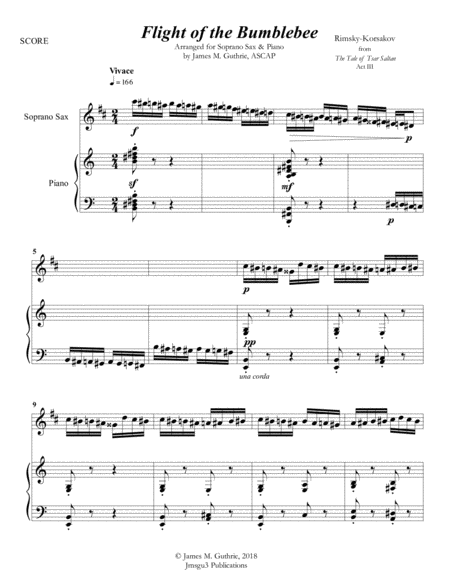
Piano,Soprano Saxophone - Level 5 - Digital Download SKU: A0.549256 Composed by Nikolay Andreyevich Rimsky-Korsakov. Arranged by James M. Guthrie, ASCAP. Instructional,Romantic Period,Standards. Score and part. 15 pages. Jmsgu3 #3473699. Published by jmsgu3 (A0.549256). Flight of the Bumblebee from Korsakov's Tale of Tsar Saltan Score: 9 pages, Solo part: 3 pages, Piano accompaniment part: 3 pages. Duration: ca. 1:15 Amaze your listeners with this short but stunning recital encore! Korsakov: Flight of the Bumblebee Flight of the Bumblebee is, to be sure, an orchestral interlude composed by Nikolai Rimsky-Korsakov for his opera The Tale of Tsar Saltan. Korsakov, of course, intended to musically portray the chaotic flying pattern of a bumblebee. Nowadays, this piece is one of the comparatively more famous classical works because it frequently appears from time to time in popular culture. In the opera, the piece appears notably at the close of Act III, Tableau 1. This is when the magic Swan-Bird, in fact, changes the Prince (the son of the Tsar) into a bee so he can fly away to visit his father. Interestingly, at this point in the drama, his father, in effect, does not know that he is alive.   Korsakov Background Nikolai Rimsky-Korsakov (1844 –1908) was a uniquely famous composer from Russia. He was likewise a member of an infamous assembly of composers called The Five. Korsakov was furthermore an expert in orchestration. His correspondingly most famous orchestral compositions-Capriccio Espagnol, the Russian Easter Festival Overture, and the Scheherazade suite-are important monuments of the standard music repertoire.  Also, comparatively very important are his suites and excerpts from his 15 operas. Korsakov was moreover fond of using Russian folklore and fairy tales in his music, such as Scheherazade.  Nationalistic Style Korsakov believed, similarly to fellow outspoken composer Balakirev, in creating a nationalistic, Russia-centric style of classical music. The new style was in fact called Orientalism. It similarly relied on native Russian materials, exotic scales, and experimental harmonic, melodic and rhythmic procedures. This practice, conversely, ran counter to the developments in Western musical culture. Musical Developments Nevertheless, Korsakov developed an appreciation of Western musical techniques after he became a professor of musical composition, harmony, and orchestration at the Saint Petersburg Conservatory in 1871. Moreover, he undertook a rigorous three-year program of self-education and mastered Western methods, incorporating them in conjunction with the influences of Mikhail Glinka and other members of The Five. His techniques of composition and orchestration were additionally enriched by his exposure to the works of Richard Wagner. Naval Service Korsakov combined his music career accordingly with a career in the Russian military. He was in the first place an officer in the Russian Navy. In due time, he was appointed as a civilian Inspector of Naval Bands. As a result, Korsakov expanded his knowledge of woodwind and brass playing, which in turn heightened his capabilities in orchestration. Legacy Korsakov in due time contributed a significant number of Russian nationalist works. He also prepared, from time to time, compositions by The Five for presentation. This brought their works straightaway into the active classical repertoire as well. He also shaped an entire generation of younger composers during his time as a music educator. Therefore, music historians consider Korsakov as the foremost engineer of what the public considers to be the Russian style of composition. He served, all in all, as a transitional figure between The Five and the classically trained composers who became the norm over time. In addition to the Russians, he forthwith influenced non-Russian composers such as Ravel, Debussy, Dukas, and Respighi.  
Korsakov: Flight of the Bumblebee for Soprano Sax & Piano
Saxophone Soprano et Piano

$32.95 28.15 € Saxophone Soprano et Piano PDF SheetMusicPlus

Alto Saxophone,Piano - Level 5 - Digital Download SKU: A0.549254 Composed by Nikolay Andreyevich Rimsky-Korsakov. Arranged by James M. Guthrie, ASCAP. Instructional,Romantic Period,Standards. Score and part. 15 pages. Jmsgu3 #3473685. Published by jmsgu3 (A0.549254). Flight of the Bumblebee Flight of the Bumblebee is, to be sure, an orchestral interlude composed by Nikolai Rimsky-Korsakov for his opera The Tale of Tsar Saltan. Of course, Korsakov intended to portray a bumblebee's chaotic flying pattern musically. Nowadays, this piece is one of the comparatively more famous classical works because it frequently appears occasionally in popular culture. The piece appears notably in the opera at the close of Act III, Tableau 1. This is when the magic Swan-Bird changes the Prince (the son of the Tsar) into a bee so he can fly away to visit his father. Interestingly, at this point in the drama, his father, in effect, does not know that he is alive. Korsakov Background Nikolai Rimsky-Korsakov (1844 –1908) was a uniquely famous composer from Russia. He was likewise a member of an infamous assembly of composers called The Five. Korsakov was furthermore an expert in orchestration. His correspondingly most famous orchestral compositions- Capriccio Espagnol, the Russian Easter Festival Overture, and the Scheherazade suite- are essential monuments of the standard music repertoire.  Also comparatively very important are his suites and excerpts from his 15 operas. Korsakov used Russian folklore and fairy tales, such as Scheherazade, in his music.  Nationalistic Style Like fellow outspoken composer Balakirev, Korsakov believed in creating a nationalistic, Russia-centric style of classical music. The new style was called Orientalism. It similarly relied on native Russian materials, exotic scales, and experimental harmonic, melodic, and rhythmic procedures. This practice, conversely, ran counter to the developments in Western musical culture. Musical Developments Nevertheless, Korsakov developed an appreciation of Western musical techniques after he became a professor of musical composition, harmony, and orchestration at the Saint Petersburg Conservatory in 1871. Moreover, he undertook a rigorous three-year program of self-education. He mastered Western methods, incorporating them with the influences of Mikhail Glinka and other members of The Five. His techniques of composition and orchestration were additionally enriched by his exposure to the works of Richard Wagner. Naval Service Korsakov combined his music career accordingly with a career in the Russian military. He was in the first place an officer in the Russian Navy. In due time, he was appointed a civilian Inspector of Naval Bands. As a result, Korsakov expanded his knowledge of woodwind and brass playing, which heightened his orchestration capabilities. Legacy In due time, Korsakov contributed a significant number of Russian nationalist works. He also prepared, occasionally, compositions by The Five for presentation. This brought their works straightaway into the active classical repertoire as well. He also shaped an entire generation of younger composers as a music educator. Therefore, music historians consider Korsakov the foremost engineer of what the public considers the Russian composition style. He served as a transitional figure between The Five and the classically trained composers who became the norm over time. In addition to the Russians, he influenced non-Russian composers such as Ravel, Debussy, Dukas, and Respighi.  
Korsakov: Flight of the Bumblebee for Alto Sax & Piano
Saxophone Alto et Piano

$32.95 28.15 € Saxophone Alto et Piano PDF SheetMusicPlus

Baritone Horn TC,Euphonium,Piano - Level 1 - Digital Download SKU: A0.552828 Composed by Franz Schubert. Arranged by James M. Guthrie, ASCAP. Christmas,Easter,Standards. Score and part. 4 pages. Jmsgu3 #3411131. Published by jmsgu3 (A0.552828). A Baritone Horn Christmas/Easter classic! Duration: 4:55 Score: 3 pg. Baritone Horn part: 1 pg. Piano reads from the score. Schubert seems to have composed this piece as a song-setting. This is because he wanted to portray a poignant emotional event from a poem. The poem was Walter Scott's The Lady of the Lake. Consequently, this song became an integral part of Schubert's Song cycle. Therefore the cycle is called: the Lady of the Lake. In the poem, Ellen Douglas is the Lady of the Lake. The lake is probably Loch Katrine in the Scottish Highlands. First of all, Ellen goes with her father to stay in the Goblin's cave. They go because he earlier refused to join in a rebellion against King James. Roderick Dhu, the chief of the rebellious Alpine Clan, marches up the mountain with his army. But before the battle, he, first of all, hears Ellen singing. She is singing a prayer calling for help from the Virgin Mary. Schubert's piece was first performed at the castle of Countess Sophie Weissenwolff in Steyregg, Austria.  Schubert dedicated the arrangement to her, and as a result, she became famous as the lady of the lake.The incipit of Ellen's song is Ave Maria which is Latin for Hail Mary. It seems like this similarity led Schubert to adapt the melody to accommodate the Roman Catholic prayer Ave Maria. Consequently, the Latin version of Ave Maria finally became more famous than the original so that consequently many believe he wrote the Latin version first. Schubert Franz Schubert (1797–1828) was, in fact, a famous Austrian composer. Moreover, he composed during the late Classical and early Romantic periods. Schubert was comparatively prolific. He wrote more than 600 secular vocal works, seven symphonies, and, correspondingly, a massive amount of piano and chamber music. Critics agree, as a matter of fact, that his most famous works include his Piano Quintet in A major, D. 667 (also known as the Trout Quintet), the Symphony No. 8 in B minor, D. 759 (Unfinished Symphony), the last sonatas for piano (D. 958–960), and the song cycles Die schöne Müllerin (D. 795) and Winterreise (D. 911). Education Schubert was furthermore a musical child prodigy. He studied violin with his father as well as piano with his older brother. In addition, when Schubert was eleven he studied at Stadtkonvikt school, where he became familiar with the orchestral music of Haydn, Mozart, and likewise Beethoven. In due time he left school and returned home where he studied to become an educator; nevertheless, he continued studying composition with Antonio Salieri. Performance Eventually, Schubert was admitted to the Gesellschaft der Musikfreunde as a performer. This appointment straightaway established his name in Vienna as a composer and pianist. Finally, he gave his only composition recital in 1828. He died suddenly a few months later probably due to typhoid fever. Legacy Schubert’s music was by and large underappreciated while he was alive. There were all in all only a few enthusiasts in Vienna. After he died, however, interest in his work in fact increased. Felix Mendelssohn, Robert Schumann, Franz Liszt, Johannes Brahms and other famous composers in due time discovered his compositions. Nowadays, historians rank Schubert expressly among the greatest composers of the era, and his music remains in general very popular.
Schubert: Ave Maria for Baritone Horn & Piano

$29.95 25.59 € PDF SheetMusicPlus

Concert Band - Digital Download SKU: AX.00-PC-0001499_WPTN1BC (wp) 1st B-flat Trombone B.C.. Composed by Nicholas Baratta. Instructional. World Part. 3 pages. Alfred Music - Digital Sheet Music #00-PC-0001499_wpTN1BC. Published by Alfred Music - Digital Sheet Music (AX.00-PC-0001499_WPTN1BC). UPC: 038081329475.Travel musically to a land far away. Echoes of Egypt joins five components of this mystical land. The Nile is depicted with African percussion setting the stage for the flow of that historic body of water. The magnificent construction of the pyramids is presented as well as sounds from a sandstorm. The epic work concludes paying homage to the Pharaohs. (6:23)Festival.
Echoes of Egypt: (wp) 1st B-flat Trombone B.C.
Orchestre d'harmonie

$3.00 2.56 € Orchestre d'harmonie PDF SheetMusicPlus

Concert Band - Digital Download SKU: AX.00-PC-0001499_WPTN2TC (wp) 2nd B-flat Trombone T.C.. Composed by Nicholas Baratta. Instructional. World Part. 3 pages. Alfred Music - Digital Sheet Music #00-PC-0001499_wpTN2TC. Published by Alfred Music - Digital Sheet Music (AX.00-PC-0001499_WPTN2TC). UPC: 038081329475.Travel musically to a land far away. Echoes of Egypt joins five components of this mystical land. The Nile is depicted with African percussion setting the stage for the flow of that historic body of water. The magnificent construction of the pyramids is presented as well as sounds from a sandstorm. The epic work concludes paying homage to the Pharaohs. (6:23)Festival.
Echoes of Egypt: (wp) 2nd B-flat Trombone T.C.
Orchestre d'harmonie

$3.00 2.56 € Orchestre d'harmonie PDF SheetMusicPlus

Concert Band - Digital Download SKU: AX.00-PC-0001499_WPTN3BC (wp) 3rd B-flat Trombone B.C.. Composed by Nicholas Baratta. Instructional. World Part. 3 pages. Alfred Music - Digital Sheet Music #00-PC-0001499_wpTN3BC. Published by Alfred Music - Digital Sheet Music (AX.00-PC-0001499_WPTN3BC). UPC: 038081329475.Travel musically to a land far away. Echoes of Egypt joins five components of this mystical land. The Nile is depicted with African percussion setting the stage for the flow of that historic body of water. The magnificent construction of the pyramids is presented as well as sounds from a sandstorm. The epic work concludes paying homage to the Pharaohs. (6:23)Festival.
Echoes of Egypt: (wp) 3rd B-flat Trombone B.C.
Orchestre d'harmonie

$3.00 2.56 € Orchestre d'harmonie PDF SheetMusicPlus


1 ....91 106 121 136 151 ....721


Partitions Gratuites
Acheter des Partitions Musicales
Acheter des Partitions Digitales à Imprimer
Acheter des Instruments de Musique

© 2000 - 2026

Accueil - Version intégrale