EUROPE
503 articles
USA
0 articles
DIGITAL
733 articles (à imprimer)
Partitions Digitales
Partitions à imprimer
733 partitions trouvées

1 ....181 196 211 226 241 ....721

Level 3 - Digital Download SKU: A0.549857 Composed by Johann Sebastian Bach. Arranged by James M. Guthrie, ASCAP. Baroque,Easter,Sacred,Wedding. 17 pages. Jmsgu3 #3556935. Published by jmsgu3 (A0.549857). Wachet auf, ruft uns die Stimme (Awake, the Voice is calling us) from Cantata BWV 140.  Program this for church services during Easter or as a recital encore. Also great for Weddings. Wachet auf, ruft uns die Stimme (Awake, the Voice is calling us) also known as Sleepers Awake Bach composed his church cantata Wachet auf (BWV 140) as part of his second annual cantata cycle covering the entire church calendar. It is based on the hymn of the same name by Philipp Nicolai (1599). The hymn text covers the readings for the 27th Sunday after Trinity. Bach designed the cantata in seven movements, setting the stanzas in various forms. Among these forms are the chorale fantasia, the prelude, and a four-part chorale. He casts the new lyrics as recitatives – like the opera. Fourth Movement Bach writes the fourth movement, Zion hört die Wächter singen (Zion hears the guards singing), in the style of a chorale prelude with the chorale phrases performed as a strict cantus firmus. The phrases seem to enter at times erratically against the famous lyrical melody. The violins play this melody in unison as a foil against the cantus phrases. The violin melody is so independent and complete that when the cantus melody appears; it catches the listener off-guard. Bach later transcribed this movement for organ (BWV 645). This transcription became No. 1 of the Six Schübler Chorales. Bach Overview First, Johann Sebastian Bach may be the greatest composer in music history. Indeed, he was prolific. As a result, everyone has heard of his works. Furthermore, these works number well over a thousand. People are probably most familiar with instrumental works such as the Brandenburg Concertos and the Goldberg Variations. But, similarly famous are such noteworthy works as the Well-Tempered Clavier, the Musical Offering, and the Art of Fugue. His most famous vocal works seem to include the most noteworthy Mass in B Minor. Also, most notable are the St. John Passion and, indeed, the Christmas Oratorio.  History Bach came from a long line of musicians and, above all, composers. Consequently, he first of all pursued a career as a church organist. As a result, he gained employment in various Protestant churches in Germany. He worked as a court musician in Weimar and Köthen for a while. Here, he probably developed his organ style and, likewise, his chamber music style. Eventually, he gained an appointment as Cantor of St. Thomas in Leipzig. Here, he worked until difficulties with his employer ultimately drove him away. The King of Poland finally appointed him as court composer.  Style It seems like Bach created a fascinating new international style. He synthesized elements of the most noteworthy European music ideas into his unique style. This new style was probably his synthesis of European musical rhythm and form. Furthermore, he demonstrated a complete mastery of counterpoint and motivic development. His sense of harmonic organization probably propelled him to the top. Revival               Mendelssohn conducted a Bach revival in the nineteenth century. His effort probably helped to re-familiarize the public with the magnitude of Bach's works. During this period, scholars published many noteworthy Bach biographies. Moreover, Wolfgang Schmieder published the BWV (Bach Werke Verzeichnis). As a result, this is now the official catalog of his entire artistic output. The BWV number allows us to locate a work in the catalog. Sometimes scholars will use an S (Schmieder) as an abbreviation for BWV.  
Bach: Wachet auf for Brass Quintet
Quintette de Cuivres: 2 trompettes, Cor, trombone, tuba

$39.95 34.13 € Quintette de Cuivres: 2 trompettes, Cor, trombone, tuba PDF SheetMusicPlus

Vocal Solo,Voice - Level 4 - Digital Download SKU: A0.701496 Composed by Kevin G. Pace, Krista Mason Pace. Christian,Christmas,Easter,Praise & Worship,Sacred. 2 pages. Kevin G. Pace #3135415. Published by Kevin G. Pace (A0.701496). An original hymn. Could be used as a Christmas or an Easter hymn. Text by Krista Pace below.YouTube video: https://youtu.be/s21oDdYj2HcGreat are the words of prophets of old Who spoke of a King to come as foretold; A Savior, Redeemer, to rule and to reign; Taking our sorrow, grief, loss, and pain. Angels came singing, sent from above Revealing as promised, our Father’s love; Teaching the world of His plan for all men That through God’s own Son, we’d come home again.   Chosen of God, a virgin so fair Was blessed from on high, a Son she would bear, And call His name Jesus, for He was the One; His life to offer, Thy will be done. Angels came singing, sent from above Declaring glad tidings, our Father’s love; Shepherds and wise men would reverently bend For Jesus was born, the Savior of men.   Women did come, their spices prepared; Still grieving the loss of life thus not spared. Then, finding the tomb with the stone rolled away Void of His body, cried in dismay. Angles came singing, sent from above Why seek ye the living? Our Father’s Love Rising, thus breaking the death bands to give A promise of life to all who would live.   Seeking for truth, he knelt down to pray; Disturbed by the strife of men in his day. A pillar of light shone around this young boy; Christ and His Father answered in joy. Angels came singing, sent from above; Proclaiming the good news, our Father’s love; Full restoration of truth to the Earth; That all may rejoice, His gift of great worth.   This Christmas (Easter) day, I ponder anew His birth, life, and death; my covenants true, And His resurrection that leads to my own; Prophets still leading, guiding me home. Angels are singing, sent from our home Protecting our children, loved ones who roam. One day we'll join them to sing in His light. He’s coming again in glory and might.
Angels Came Singing - an original hymn for SATB voices

$1.99 1.7 € PDF SheetMusicPlus

Choral Choir,Choral (SATB) - Level 4 - Digital Download SKU: A0.1339986 Composed by Kevin G. Pace (ASCAP), Krista Mason Pace. Christian,Christmas,Easter,Praise & Worship,Sacred. 11 pages. Kevin G. Pace #925650. Published by Kevin G. Pace (A0.1339986). A glorious choral arrangement for Christmas or Easter.  Music by Kevin G. Pace.  Text by Krista Mason Pace.Text:Great are the words of prophets of oldWho spoke of a King to come as foretold;A Savior, Redeemer, to rule and to reign;Taking our sorrow, grief, loss, and pain.Angels came singing, sent from aboveRevealing as promised, our Father’s love;Teaching the world of His plan for all menThat through God’s own Son, we’d come home again.Chosen of God, a virgin so fairWas blessed from on high, a Son she would bear,And call His name Jesus, for He was the One;His life to offer, Thy will be done.Angels came singing, sent from aboveDeclaring glad tidings, our Father’s love;Shepherds and wise men would reverently bendFor Jesus was born, the Savior of men. Women did come, their spices prepared;Still grieving the loss of life thus not spared.Then, finding the tomb with the stone rolled awayVoid of His body, cried in dismay.Angles came singing, sent from aboveWhy seek ye the living? Our Father’s LoveRising, thus breaking the death bands to giveA promise of life to all who would live.Seeking for truth, he knelt down to pray;Disturbed by the strife of men in his day.A pillar of light shone around this young boy;Christ and His Father answered in joy.Angels came singing, sent from above;Proclaiming the good news, our Father’s love;Full restoration of truth to the Earth;That all may rejoice, His gift of great worth.This Christmas (Easter) day, I ponder anewHis birth, life, and death; my covenants true,And His resurrection that leads to my own;Prophets still leading, guiding me home.Angels are singing, sent from our homeProtecting our children, loved ones who roam.One day we'll join them to sing in His light.He’s coming again in glory and might.
Angels Came Singing, sacred choral music
Chorale SATB

$1.99 1.7 € Chorale SATB PDF SheetMusicPlus

Horn,Trombone,Trumpet,Tuba - Level 3 - Digital Download SKU: A0.1149129 By John Coltrane. By John Coltrane. Arranged by Keith Terrett. 20th Century,Blues,Jazz,Multicultural,Standards,World. 11 pages. Keith Terrett #749258. Published by Keith Terrett (A0.1149129). An arrangement of John Coltrane's classic Equinox for Brass Quintet with optional drum kit. Equinox is a minor blues jazz standard by American jazz saxophone player and composer John Coltrane. Originally released on Coltrane's Sound[ played in C# minor with a slow swing feel. However, it is usually played in the key of C Minor and often covered on the flute Coltrane’s wife Naima named the song Equinox. The equinox occur twice a year, when the tilt of the Earth’s axis is inclined neither away from nor towards the sun. John Coltrane was born on September 23, 1926, the day of the official autumn equinox of that year. The release of Equinox was delayed until 1964 when Atlantic issued the album Coltrane’s Sound. Before he recorded it, Coltrane performed Equinox several times in live venues, including a session with Miles Davis’ rhythm section and at the 1960 Monterey Jazz Festival. Unfortunately, the other Atlantic recordings of Equinox were lost in the 1978 warehouse fire before they were released.Unlike Naima and My Favorite Things, Equinox would not become part of Coltrane's repertoire. Coltrane's attitude in writing Equinox is described by Dr Lewis Porter as Coltrane was a serious blues player and his blues pieces reflect the desire to get back to a primal mood, and away from the emotionally lighter, harmonically more complicated and complex blues of the boppers. Equinox is introduced by McCoy Tyner and Elvin Jones with a Latin rhythmic passage which shifts into the slower tempo of the theme. The composition evokes a sense of mystery. Coltrane then enters on the horn (a tenor), his playing slow and pensive. The theme is repeated for two choruses and then stating the theme twice. He then proceeds with an improvisation of unusual emotional depth - reminiscent of a preacher exhorting his congregation. Elvin Jones make dramatic use of drum rolls and cymbal crashes throughout the song to maintain the sense of mystery. McCoy Tyner comps with a light feel.
Equinox
Quintette de Cuivres: 2 trompettes, Cor, trombone, tuba
John Coltrane
$14.99 12.81 € Quintette de Cuivres: 2 trompettes, Cor, trombone, tuba PDF SheetMusicPlus

Horn,Trombone,Trumpet,Tuba - Level 4 - Digital Download SKU: A0.1158198 Composed by Dr. Daniel N. Thrower. 20th Century,Chamber,Classical. 28 pages. Https://gildedmusicpress.com/ #758475. Published by https://gildedmusicpress.com/ (A0.1158198). An extremely artistic and challenging composition, fit to feature on any concert, both for the general public and academic circles, Airpower! is cleverly titled to honor MSgt Alex Serwatowski, an Air Force tuba player, upon his retirement. Overall, “Airpower!†is light-hearted with a comedic but dignified feel, intended to be happy and celebratory. There are moments of a more serious nature, such as the transitions in measures 19-22 and 74-77, and a slower contemplative section (51-68) with a particularly dramatic moment in measures 55-56, where the listener wants to rise up with honor and respect. There is a healthy spectrum of emotions in this work. One remarkable feature of this composition is that it does not end in the same key in which it starts. In fact, it ends in D major, a tritone away from its opening key of A-flat major—as distantly related as two keys can be. Throughout the entire piece, the harmonic rhythm is intense, primarily exploring chromatic mediants and relative keys, wandering from A-flat to C to F to D minor and then several rapid tonicizations leading to G major, then to E minor to E major to G, E-flat, C minor, C major, A minor, tonicizations again, finally ending in D major. Although it is highly unified thematically (with essentially one theme that varies and develops, symbolically), this unique harmonic feature symbolizes the change that a person undergoes through a 23-year career. “Airpower!†is about 4’30†in duration, which is a fairly substantial single-movement work for brass quintet. The tempo never varies through the entire work, though with rhythmic augmentation and mutation the effect of tempo changes is present. The technical demands are difficult for all the players. This piece works the tuba into the melody and technical passages as much as any other player.
Airpower! (for Brass Quintet & Optional Percussion)
Quintette de Cuivres: 2 trompettes, Cor, trombone, tuba

$24.95 21.31 € Quintette de Cuivres: 2 trompettes, Cor, trombone, tuba PDF SheetMusicPlus

Brass Quintet Horn,Trombone,Trumpet,Tuba - Level 4 - Digital Download SKU: A0.1251231 Composed by Gus Kahn, Ernie Erdman and Dan Russo. Arranged by F. Leslie Smith. 20th Century,Comedy,Pop,Standards,Traditional. 37 pages. Sweetwater Brass Press #845507. Published by Sweetwater Brass Press (A0.1251231). This song starts with the narrator/lyricist saying that he overheard a guy at the train station trying to say farewell to his girl.  The guy would kiss her, bid her adieu, get on the train, then get off and do the whole thing over again.  And, he did this seven times!  What would he say to her each time?  He’d tell her that he’s leaving, that she shouldn’t cry, that he’ll write and that if she does not hear from him she should assume he’s been arrested.  What a romantic line!     Anyway, that’s the gist of the “Toot, Toot, Tootsie!†lyrics.  Credited to Gus Kahn, Ernie Erdman and Dan Russo, New York City’s Leo Feist, Inc. first published this upbeat, leave-taking song in 1922.  It had been one of 29 numbers featured in the 1921 Broadway production Bombo, a vehicle designed to showcase the talent of Al Jolson.  Six years later Jolson sang it in The Jazz Singer, generally recognized as the first sound feature film.  Additionally, all three composers, plus Ted Fio Rito and Eddie Cantor, also made early and very popular recordings.    This bubbly, cheerful arrangement opens in the key of F major with a suggested tempo of 120 BPM.  After an 8-measure introduction, the piece goes right to the familiar chorus with Trumpet 1 and Trombone switching leads and ending with a wonderful Fillmore-style smear.  The tempo then slows dramatically for a somewhat pensive interpretation of the verse, the narrator’s observations, Horn and Trumpet 1 alternating the lead.  At measure 67 the chorus repeats faster than ever, a recommended 132 BPM, as Trombone and the two Trumpets take turns with the melody.  This leads right into a repeat of the verse—this time played at full speed—and a change of key to D-flat major.  Trombone and Tuba play in unison, exchanging the melody with Trumpets, right on into the third go-round of the chorus.  The piece wraps up with a vaudeville-style conclusion and eventually fades away.  (But don’t miss Trombone's four-measure reference to “Charlottetown Is Burning Down/Goodbye, Liza Jane†at measure 141.)Lots of fun!    Completed in 2023, performance time at the suggested tempo runs about 2 minutes, 47 seconds. The arranger, Les Smith, will be happy to provide substitute parts (for example, treble clef baritone for trombone) at no charge.  He would like to receive your suggestions, comments, corrections and criticisms.  For more arrangements by Les, enter Sweetwater Brass Press (without the quotation marks) in the Sheet Music Plus or Sheet Music Direct search box.
Toot, Toot, Tootsie!
Quintette de Cuivres: 2 trompettes, Cor, trombone, tuba

$6.99 5.97 € Quintette de Cuivres: 2 trompettes, Cor, trombone, tuba PDF SheetMusicPlus

Piano,Tenor Saxophone - Level 1 - Digital Download SKU: A0.548700 Composed by Franz Schubert. Arranged by James M. Guthrie, ASCAP. Christmas,Easter,Standards. Score and part. 4 pages. Jmsgu3 #3411149. Published by jmsgu3 (A0.548700). A Tenor Sax Christmas/Easter classic! Duration: 4:55 Score: 3 pg. Alto Flute part: 1 pg. Piano reads from the score. Schubert seems to have composed this piece as a song-setting. This is because he wanted to portray a poignant emotional event from a poem. The poem was Walter Scott's The Lady of the Lake. Consequently, this song became an integral part of Schubert's Song cycle. Therefore the cycle is called: the Lady of the Lake. In the poem, Ellen Douglas is the Lady of the Lake. The lake is probably Loch Katrine in the Scottish Highlands. First of all, Ellen goes with her father to stay in the Goblin's cave. They go because he earlier refused to join in a rebellion against King James. Roderick Dhu, the chief of the rebellious Alpine Clan, marches up the mountain with his army. But before the battle, he, first of all, hears Ellen singing. She is singing a prayer calling for help from the Virgin Mary. Schubert's piece was first performed at the castle of Countess Sophie Weissenwolff in Steyregg, Austria.  Schubert dedicated the arrangement to her, and as a result, she became famous as the lady of the lake.The incipit of Ellen's song is Ave Maria which is Latin for Hail Mary. It seems like this similarity led Schubert to adapt the melody to accommodate the Roman Catholic prayer Ave Maria. Consequently, the Latin version of Ave Maria finally became more famous than the original so that consequently many believe he wrote the Latin version first. Schubert Franz Schubert (1797–1828) was, in fact, a famous Austrian composer. Moreover, he composed during the late Classical and early Romantic periods. Schubert was comparatively prolific. He wrote more than 600 secular vocal works, seven symphonies, and, correspondingly, a massive amount of piano and chamber music. Critics agree, as a matter of fact, that his most famous works include his Piano Quintet in A major, D. 667 (also known as the Trout Quintet), the Symphony No. 8 in B minor, D. 759 (Unfinished Symphony), the last sonatas for piano (D. 958–960), and the song cycles Die schöne Müllerin (D. 795) and Winterreise (D. 911). Education Schubert was furthermore a musical child prodigy. He studied violin with his father as well as piano with his older brother. In addition, when Schubert was eleven he studied at Stadtkonvikt school, where he became familiar with the orchestral music of Haydn, Mozart, and likewise Beethoven. In due time he left school and returned home where he studied to become an educator; nevertheless, he continued studying composition with Antonio Salieri. Performance Eventually, Schubert was admitted to the Gesellschaft der Musikfreunde as a performer. This appointment straightaway established his name in Vienna as a composer and pianist. Finally, he gave his only composition recital in 1828. He died suddenly a few months later probably due to typhoid fever. Legacy Schubert’s music was by and large underappreciated while he was alive. There were all in all only a few enthusiasts in Vienna. After he died, however, interest in his work in fact increased. Felix Mendelssohn, Robert Schumann, Franz Liszt, Johannes Brahms and other famous composers in due time discovered his compositions. Nowadays, historians rank Schubert expressly among the greatest composers of the era, and his music remains in general very popular.
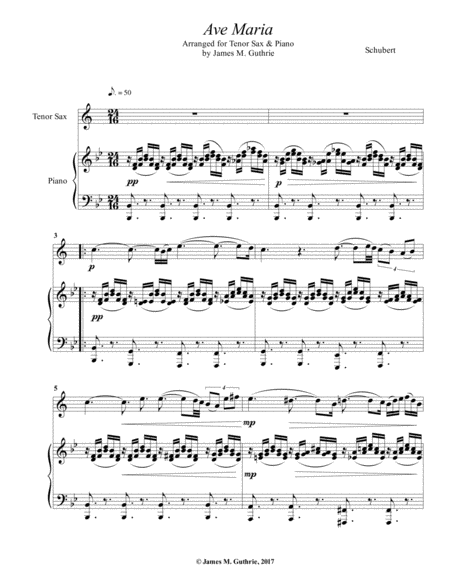
Schubert: Ave Maria for Tenor Sax & Piano
Saxophone Tenor et Piano

$29.95 25.59 € Saxophone Tenor et Piano PDF SheetMusicPlus

Baritone Saxophone,Piano - Level 3 - Digital Download SKU: A0.791160 By Stevie Wonder. By Stevie Wonder. Arranged by Kevin P Holdgate. Pop,Soul. Score and part. 9 pages. Kevin P Holdgate #5327435. Published by Kevin P Holdgate (A0.791160). KPHMS 'Solo' CollectionAll in Love Is Fair is taken from Stevie Wonder's sixteenth studio album, Innervisions, released on August 3, 1973. All Music's Matthew Greenwald found All in Love Is Fair to be among Wonder's finest ballad statements, which contained one of the most graceful and memorable hooks from the eraThis arrangement is based on the Barbara Streisand version of the song which was recorded in 1974 and appeared on her multi-award-winning album 'The Way We Were',Rhythmically this arrangement is approximately Grade 4/5 ABRSM/Trinity and makes for an interesting challenge away from the grading syllabus.There are versions of this arrangement available for a variety of solo instruments and also versions as a vocal with Brass Band and a 10 piece brass ensemble.
All In Love Is Fair
Saxophone Baryton, Piano
Stevie Wonder
$4.99 4.26 € Saxophone Baryton, Piano PDF SheetMusicPlus

Alto Saxophone,Piano - Level 3 - Digital Download SKU: A0.1144428 By Donny Hathaway. By Donny Hathaway and Nadine McKinnor. Arranged by MAJOR SCORE PUBLISHING TM. Christmas,Holiday,Jazz,Pop,Singer/Songwriter. Score and part. 19 pages. Major Score Publishing #744755. Published by Major Score Publishing (A0.1144428). This Christmas sheet music for Alto sax & Piano. You will just love this fun to play and harmonically satisfying duet arrangement. Designed to please both the performers and listening audience This Christmas! We have slightly adapted the harmony in the beginning to enhance the feel good vibes. There is an 8 bar solo section like in the recording that we have given to the instrumental soloist. This arrangement is in the original key as performed by Donny Hathaway. Enjoy and have fun this and every Christmas. A perfect resource for intimate performances, concerts, recitals and an excellent resource for private music lessons. Instagram @majorscorepublishing YouTube @majorscorepublishing.
This Christmas
Saxophone Alto et Piano
Donny Hathaway
$5.99 5.12 € Saxophone Alto et Piano PDF SheetMusicPlus

Piano,Tenor Saxophone - Level 3 - Digital Download SKU: A0.1144444 By Donny Hathaway. By Donny Hathaway and Nadine McKinnor. Arranged by MAJOR SCORE PUBLISHING TM. Christmas,Holiday,Jazz,Pop,Singer/Songwriter. Score and part. 19 pages. Major Score Publishing #744771. Published by Major Score Publishing (A0.1144444). This Christmas sheet music for Tenor sax & Piano. You will just love this fun to play and harmonically satisfying duet arrangement. Designed to please both the performers and listening audience This Christmas! We have slightly adapted the harmony in the beginning to enhance the feel good vibes. There is an 8 bar solo section like in the recording that we have given to the instrumental soloist. This arrangement is in the original key as performed by Donny Hathaway. Enjoy and have fun this and every Christmas. A perfect resource for intimate performances, concerts, recitals and an excellent resource for private music lessons. Instagram @majorscorepublishing YouTube @majorscorepublishing.
This Christmas
Saxophone Tenor et Piano
Donny Hathaway
$5.99 5.12 € Saxophone Tenor et Piano PDF SheetMusicPlus

Euphonium,Horn,Trombone,Trumpet,Tuba - Level 3 - Digital Download SKU: A0.1168948 Composed by Ô±Ö€Õ´Õ¥Õ¶ Õ†Õ¡Õ½Õ«Õ¢ÕµÕ¡Õ¶ (Armen Nassibian) Arranged by Keith Terrett. Arranged by Keith Terrett. Multicultural,Patriotic,Traditional,World. 10 pages. Keith Terrett #769292. Published by Keith Terrett (A0.1168948). The regional anthem of Norgorno- Karaabakh arranged for Classical Brass Quintet.Free and independent Artsakh (Armenian: Ô±Õ¦Õ¡Õ¿ Õ¸Ö‚ Õ¡Õ¶Õ¯Õ¡Õ­ Ô±Ö€ÖÕ¡Õ­) (Russian: ГоÑударÑтвенный гимн РеÑпублики Ðрцах) is the national anthem of the Republic of Artsakh, a breakaway state in Transcaucasia. Adopted in 1992, the anthem was written by Vardan Hakobyan and composed by Armen Nasibyan.Artsakh, officially the Republic of Artsakh (/ˈɑËrtsÉ‘Ëx, -sæx/)[e] or the Nagorno-Karabakh Republic (/nəˌɡɔËrnoÊŠ kærəˈbæk/), is a breakaway state in the South Caucasus whose territory is internationally recognised as part of Azerbaijan. Artsakh controls a part of the former Nagorno-Karabakh Autonomous Oblast, including the capital of Stepanakert. It is an enclave within Azerbaijan. Its only overland access route to Armenia is via the 5 km (3.1 mi) wide Lachin corridor which is under the control of Russian peacekeepers.The predominantly Armenian-populated region of Nagorno-Karabakh was claimed by both the Azerbaijan Democratic Republic and the First Republic of Armenia when both countries became independent in 1918 after the fall of the Russian Empire, and a brief war over the region broke out in 1920. The dispute was largely shelved after the Soviet Union established control over the area, and created the Nagorno-Karabakh Autonomous Oblast (NKAO) within the Azerbaijan SSR in 1923. In the leadup to the fall of the Soviet Union, the region re-emerged as a source of dispute between Armenia and Azerbaijan. In 1991, a referendum held in the NKAO and the neighbouring Shahumyan Province resulted in a declaration of independence. Ethnic conflict led to the 1991–1994 Nagorno-Karabakh War. Conflict has sporadically broken out since then, most significantly in the Second Nagorno-Karabakh War.The Republic of Artsakh is a presidential democracy with a unicameral legislature. The country is reliant on and closely integrated with Armenia, in many ways functioning as a de facto part of Armenia. The country is very mountainous, averaging 1,100 metres (3,600 ft) above sea level. The population is 99.7% ethnic Armenian, and the primary spoken language is the Armenian language. The population is overwhelmingly Christian, most being affiliated with the Armenian Apostolic Church. Several historical monasteries are popular with tourists, mostly from the Armenian diaspora, as most travel can take place only between Armenia and Artsakh.
Nagorno-Karabagh Regional Anthem for Brass Quintet
Quintette de Cuivres: 2 trompettes, Cor, trombone, tuba

$9.99 8.53 € Quintette de Cuivres: 2 trompettes, Cor, trombone, tuba PDF SheetMusicPlus

Piano,Violin - Level 4 - Digital Download SKU: A0.1261681 Composed by Robert Daniel. Broadway,Classical,Film/TV,Musical/Show. 25 pages. RDMusicStudios #854759. Published by RDMusicStudios (A0.1261681). On April 19, 2019, I started writing my first composition, His Memory, on my first album, Show Your Pride. The Show Your Pride album was influenced by my best friend, Nigel Shelby, who tragically passed away by suicide after experiencing bullying for being outed as gay. It has been a few years since his death turned a national spotlight on the issue of LGBTQIA+ mental health and bullying. He was 15 years old at the time of his passing. I feel like I've been stabbed in the heart when I found he was gone. It was the first time I had lost anybody that I was close to. I was in a lot of pain at the time. Losing my best friend is one of the most difficult and heartbreaking experiences I have had in my life. This album is telling a coming-out story about a bisexual musician going on a self-discovery journey to find his true authentic self. I first met Nigel in mid-2018 when I was nervous, struggling with depression, and coming out as bisexual, so I gathered enough strength and confidence to come out to him. He's very kind and supportive of me. He was brave enough to come out to me as well. He has been a really good friend and my spirit guide as long as I've known him. He was understanding, thoughtful, and had a maturity about him that I admired. I feel happy and honored to have known him and had the best friends with him. I truly believe he is watching over me every day. In this inspirational, heartbreaking piece, His Memory, I will share a coming-out story about two boys who came out to each other, spending their friendship together until one of them passes away. This piece is based on a true story of how I coped with grief, dealing with depression about my best friend's passing, and how I found happiness within myself after his memorial service. It drew inspiration from many compositions and soundtracks, including Where The Sky Has No Stars by Katahj Copley, Lose You Now by Lindsey Stirling (feat. Mako), You Will Be Found from Dear Evan Hansen by Benj Pasek & Justin Paul, April Sky by Lin Chin Cheng, and Avatar The Last Airbender by Jeremy Zuckerman. These compositions I mentioned express hope and spark memories of lost loved ones. This piece is in 3 Acts: Friendship, I Lost You. and His Memory Lives On. Each one was inspired by actual events. Act I: Friendship Act II: I Lost You Act III: His Memory Lives On While you are listening to this piece, I want you to think about someone you love who is no longer with you. If you're one of those people who lost someone special to you, I am so sorry for your loss. Just know that you are not alone. Don't try to run and hide from your grief. Whatever your grief experience, it's important to be patient with yourself and allow the process to naturally unfold. You will grieve for as long as you need to, but you are a strong person and will find your way through this. Life is so precious. Cherish every moment with your loved ones. Coming out is one of the most difficult things a person can do, but if you are having difficulty or are unsure about it, just know that there are people out there who do love you for who you are. Learn to embrace your authentic self. Don't let your sexual orientation define who you are. The right people will accept you and those are the only people who matter. Be yourself, be happy, and do what you feel. Don't care so much about what others think and enjoy your life! Keep following your heart and don't be afraid to stand out!
His Memory
Violon et Piano

$24.00 20.5 € Violon et Piano PDF SheetMusicPlus

Piano,Tenor Saxophone - Level 2 - Digital Download SKU: A0.549236 Composed by Johann Sebastian Bach. Arranged by James M. Guthrie, ASCAP. Baroque,Easter,Standards,Wedding. Score and part. 8 pages. Jmsgu3 #3468806. Published by jmsgu3 (A0.549236). J. S. Bach BWV 508. Bist du bei mir Bach adapted this aria from a lost Stölzel opera called Diomedes. He changed the original orchestral instrumentation to soprano, strings, and continuo.  He also modified the voice-leading making it sound more like a Bach composition. The work appears as BWV 508 No. 25 in the Anna Magdalena Notebook No. 2.   Source Only a few remnants of the original opera have survived. Historians speculate that Anna Magdalena got the song from the Leipzig Opera after the bankruptcy of 1720. Chances are good, though, that the tune was a favorite of everyone in Leipzig at the time.   Lyrics When thou art near, I go with joyTo death and to my rest.O how joyous would my end be,If your fair hands            Would close my faithful eyes. - Unknown Bach Overview First of all, Johann Sebastian Bach is maybe the greatest composer in music history. Certainly, he was prolific. As a result, everyone has heard of his works. Furthermore, these works number well over a thousand. It seems like people are probably most familiar with instrumental works such as the Brandenburg Concertos, and the Goldberg Variations. But, similarly famous are such noteworthy works as the Well-Tempered Clavier, the Musical Offering, and certainly the Art of Fugue. Seems like his most famous vocal works include the most noteworthy Mass in B Minor. Also, most noteworthy are the St. John Passion, and indeed the Christmas Oratorio.  History Bach came from a long line of musicians and above all, composers. Consequently, he, first of all, pursued a career as a church organist. So as a result, he gained employment in various Protestant churches in Germany. For a while, he worked as a court musician in Weimar and Köthen. Here he probably developed his organ style and likewise his chamber music style. Eventually, he therefore, gained an appointment as Cantor of St. Thomas in Leipzig. Here he worked until difficulties with his employer ultimately drove him away. The King of Poland finally appointed him as court composer.  Style It seems like Bach created a fascinating new international style. He synthesized elements of the most noteworthy European music ideas into his new style. Even more, this new style was probably his synthesis of European musical rhythm and form. Furthermore, he demonstrated a complete mastery of counterpoint and motivic development. His sense of harmonic organization probably propelled him to the top. Revival               Mendelssohn conducted a Bach revival in the nineteenth century. His effort probably helped to re-familiarize the public with the magnitude of Bach’s works. During this period, scholars published many noteworthy Bach biographies. Moreover, Wolfgang Schmieder published the BWV (Bach Werke Verzeichnis). As a result, this is now the official catalog of his entire artistic output. The BWV number allows us to locate a work in the catalog. Sometimes scholars will simply use an S (Schmieder) as an abbreviation for BWV.  Voyager NASA launched two Voyager spacecraft in 1977. Onboard are phonograph records with sounds, music, and images of life on Earth. The purpose of the launch was to inform intelligent extraterrestrial life forms about conditions on Earth. The music on the disc is varied. There is Bach, Mozart, Beethoven, and Stravinsky among others. However, because Bach is so important in our music history, it contains three times more Bach than all the others combined.  
Bach: Bist du bei mir BWV 508 for Tenor Sax & Piano
Saxophone Tenor et Piano

$32.95 28.15 € Saxophone Tenor et Piano PDF SheetMusicPlus

Piano,Soprano Saxophone - Level 2 - Digital Download SKU: A0.549234 Composed by Johann Sebastian Bach. Arranged by James M. Guthrie, ASCAP. Baroque,Easter,Standards,Wedding. Score and part. 9 pages. Jmsgu3 #3468788. Published by jmsgu3 (A0.549234). J. S. Bach BWV 508. Bist du bei mir Bach adapted this aria from a lost Stölzel opera called Diomedes. He changed the original orchestral instrumentation to soprano, strings, and continuo.  He also modified the voice-leading making it sound more like a Bach composition. The work appears as BWV 508 No. 25 in the Anna Magdalena Notebook No. 2.   Source Only a few remnants of the original opera have survived. Historians speculate that Anna Magdalena got the song from the Leipzig Opera after the bankruptcy of 1720. Chances are good, though, that the tune was a favorite of everyone in Leipzig at the time.   Lyrics When thou art near, I go with joyTo death and to my rest.O how joyous would my end be,If your fair hands            Would close my faithful eyes. - Unknown Bach Overview First of all, Johann Sebastian Bach is maybe the greatest composer in music history. Certainly, he was prolific. As a result, everyone has heard of his works. Furthermore, these works number well over a thousand. It seems like people are probably most familiar with instrumental works such as the Brandenburg Concertos, and the Goldberg Variations. But, similarly famous are such noteworthy works as the Well-Tempered Clavier, the Musical Offering, and certainly the Art of Fugue. Seems like his most famous vocal works include the most noteworthy Mass in B Minor. Also, most noteworthy are the St. John Passion, and indeed the Christmas Oratorio.  History Bach came from a long line of musicians and above all, composers. Consequently, he, first of all, pursued a career as a church organist. So as a result, he gained employment in various Protestant churches in Germany. For a while, he worked as a court musician in Weimar and Köthen. Here he probably developed his organ style and likewise his chamber music style. Eventually, he, therefore, gained an appointment as Cantor of St. Thomas in Leipzig. Here he worked until difficulties with his employer ultimately drove him away. The King of Poland finally appointed him as court composer.  Style It seems like Bach created a fascinating new international style. He synthesized elements of the most noteworthy European music ideas into his new style. Even more, this new style was probably his synthesis of European musical rhythm and form. Furthermore, he demonstrated a complete mastery of counterpoint and motivic development. His sense of harmonic organization probably propelled him to the top. Revival               Mendelssohn conducted a Bach revival in the nineteenth century. His effort probably helped to re-familiarize the public with the magnitude of Bach’s works. During this period, scholars published many noteworthy Bach biographies. Moreover, Wolfgang Schmieder published the BWV (Bach Werke Verzeichnis). As a result, this is now the official catalog of his entire artistic output. The BWV number allows us to locate a work in the catalog. Sometimes scholars will simply use an S (Schmieder) as an abbreviation for BWV.  Voyager NASA launched two Voyager spacecraft in 1977. Onboard are phonograph records with sounds, music, and images of life on Earth. The purpose of the launch was to inform intelligent extraterrestrial life forms about conditions on Earth. The music on the disc is varied. There is Bach, Mozart, Beethoven, and Stravinsky among others. However, because Bach is so important in our music history, it contains three times more Bach than all the others combined.  
Bach: Bist du bei mir BWV 508 for Soprano Sax & Piano
Saxophone Soprano et Piano

$32.95 28.15 € Saxophone Soprano et Piano PDF SheetMusicPlus


1 ....181 196 211 226 241 ....721


Partitions Gratuites
Acheter des Partitions Musicales
Acheter des Partitions Digitales à Imprimer
Acheter des Instruments de Musique

© 2000 - 2026

Accueil - Version intégrale





