EUROPE
503 articles
USA
0 articles
DIGITAL
733 articles (à imprimer)
Partitions Digitales
Partitions à imprimer
733 partitions trouvées

1 ....301 316 331 346 361 ....721

Cello Solo - Level 4 - Digital Download SKU: A0.1018958 Composed by Benjamin Harry Sajo. 20th Century,Contemporary. Individual part. 2 pages. Benjamin Sajo #6078715. Published by Benjamin Sajo (A0.1018958). Programme Notes: This composition was written to be considered for pairing alongside Ludwig van Beethoven’s Symphony #3, the Eroica, but can stand on its own virtues as an intense and slow meditation on heroism. The music is like a boiling pot on the stove that’s just began to overflow its bubbles. The first part of the title, kommos, is a Classical Greek term from Attic dramaturgy, literally meaning striking but specifically referring to beating oneself up during lamentation--ripping at the hair, gouging out the eyes--like Oedipus--slapping the forehead, and other acts amid moments of extreme emotional turmoil. For example, from Aeschylus's play Agamemnon, a character bewails: Apollo, Apollo! God of the Ways, my destroyer! For you have destroyed me-and utterly [...]What is this fresh woe [...]what monstrous, monstrous horror, beyond love's enduring, beyond all remedy? And help stands far away! We can easily imagine physical accompaniment to the script; rather than bottling up the pain, the hero lets it all explosively come out.  â€ƒThe second part of the title, When the world moved on, is an epigraph taken from American author Stephen King’s The Dark Tower epic. The primary setting of the novel, a world similar in many ways to our own, is experiencing a dark age where the glorious past is all but a distant memory and all good things are referred to wistfully as occurring, When the world moved on. Yet, the main protagonist, Roland, the last gunslinger, emphasizes that it is not just a figure of speech, but the literal distances between destinations have increased, the positions of the stars have changed, as well as the occurrence of other unnatural phenomena. The world has become a gulf of isolation from all corners. Taken together, this piece is a lamentation for when the world moved on. Truly completed on Yom Kippur during the Covid-19 Pandemic, being unable to fast or go to synagogue, this is my atonement.About the Composer: Benjamin Sajo (b. 1988) is a Canadian composer of contemporary classical music, as well as an educator. Since developing a fiercely independent creative voice upon the completion of his studies at Western (2010) and McGill Universities (2013), he continues to find inspiration from the intersection of mythology, art, and nature upon the contemporary human experience. In 2019, he released his premiere album of original music, The Great War Sextet: Canadian War Poetry with Trombone & Strings, with support from the Ontario Arts Council. He is a member of SOCAN and the League of Canadian Composers.
Kommos (Lamentation) / "When the World Moved On" - Violoncello
Violoncelle

$3.50 2.99 € Violoncelle PDF SheetMusicPlus

Violin Solo - Level 4 - Digital Download SKU: A0.1018956 Composed by Benjamin Harry Sajo. 20th Century,Contemporary. 2 pages. Benjamin Sajo #6078707. Published by Benjamin Sajo (A0.1018956). Programme Notes: This composition was written to be considered for pairing alongside Ludwig van Beethoven’s Symphony #3, the Eroica, but can stand on its own virtues as an intense and slow meditation on heroism. The music is like a boiling pot on the stove that’s just began to overflow its bubbles. The first part of the title, kommos, is a Classical Greek term from Attic dramaturgy, literally meaning striking but specifically referring to beating oneself up during lamentation--ripping at the hair, gouging out the eyes--like Oedipus--slapping the forehead, and other acts amid moments of extreme emotional turmoil. For example, from Aeschylus's play Agamemnon, a character bewails: Apollo, Apollo! God of the Ways, my destroyer! For you have destroyed me-and utterly [...]What is this fresh woe [...]what monstrous, monstrous horror, beyond love's enduring, beyond all remedy? And help stands far away! We can easily imagine physical accompaniment to the script; rather than bottling up the pain, the hero lets it all explosively come out.  â€ƒThe second part of the title, When the world moved on, is an epigraph taken from American author Stephen King’s The Dark Tower epic. The primary setting of the novel, a world similar in many ways to our own, is experiencing a dark age where the glorious past is all but a distant memory and all good things are referred to wistfully as occurring, When the world moved on. Yet, the main protagonist, Roland, the last gunslinger, emphasizes that it is not just a figure of speech, but the literal distances between destinations have increased, the positions of the stars have changed, as well as the occurrence of other unnatural phenomena. The world has become a gulf of isolation from all corners. Taken together, this piece is a lamentation for when the world moved on. Truly completed on Yom Kippur during the Covid-19 Pandemic, being unable to fast or go to synagogue, this is my atonement.About the Composer: Benjamin Sajo (b. 1988) is a Canadian composer of contemporary classical music, as well as an educator. Since developing a fiercely independent creative voice upon the completion of his studies at Western (2010) and McGill Universities (2013), he continues to find inspiration from the intersection of mythology, art, and nature upon the contemporary human experience. In 2019, he released his premiere album of original music, The Great War Sextet: Canadian War Poetry with Trombone & Strings, with support from the Ontario Arts Council. He is a member of SOCAN and the League of Canadian Composers.
Kommos (Lamentation) / "When the World Moved On" - Violin II
Violon

$3.50 2.99 € Violon PDF SheetMusicPlus

Piano Solo - Level 5 - Digital Download SKU: A0.1213917 By Roy Clark. By Charles Aznavour and Herbert Kretzmer. Arranged by Timothy Stapay. Film/TV,Jazz,Multicultural,Singer/Songwriter,Standards,World. Score. 8 pages. Timothy Stapay #811114. Published by Timothy Stapay (A0.1213917). Yesterday When I was Young is a song composed by Georges Garvarentz and written by Charles Aznavour and released in September 1964.  The original French title translates to Just yesterday or Not so long ago.It is considered one of Aznavour's greatest hits.The English-language lyrics, written by Herbert Kretzmer, tell of someone reflecting on his life, recalling how he had wasted his younger years.Lyrics:[Verse 1]Yesterday when I was youngThe taste of life was sweet as rain upon my tongueI teased at life as if it were a foolish gameThe way the evening breeze may tease a candle flameThe thousand dreams I dreamed, the splendid things I plannedI always built, alas, on weak and shifting sandI lived by night and shunned the naked light of dayAnd only now I see how the years ran away[Verse 2]Yesterday, when I was youngSo many drinking songs were waiting to be sungSo many wayward pleasures lay in store for meAnd so much pain my dazzled eyes refused to seeI ran so fast that time and youth at last ran outI never stopped to think what life was all aboutAnd every conversation I can now recallConcerned itself with me, me and nothing else at all[Verse 3]Yesterday the moon was blueAnd every crazy day brought something new to doI used my magic age as if it were a wandAnd never saw the waste and emptiness beyondThe game of love I played with arrogance and prideAnd every flame I lit too quickly, quickly diedThe friends I made all seemed somehow to drift awayAnd only I am left on stage to end the play[Outro]There are so many songs in me that won't be sungI feel the bitter taste of tears upon my tongueThe time has come for me to pay for yesterdayWhen I was youngYoung, young...
Yesterday, When I Was Young (hier Encore)
Piano seul
Roy Clark
$5.99 5.12 € Piano seul PDF SheetMusicPlus

Brass Ensemble Bass Trombone,Cornet,Horn - Level 3 - Digital Download SKU: A0.1229556 Composed by Giovanni Gabrieli. Arranged by James M. Guthrie, ASCAP. Chamber,Early Music,Renaissance,Traditional,Wedding. 43 pages. Jmsgu3 #825055. Published by jmsgu3 (A0.1229556). Minimum instrumentation: 4 Cornets in Bb, 4 Horns in F, 1 Tenor Trombone & 1 Bass Trombone.InnovationsGabrieli preferred sacred vocal and certainly instrumental music. Hence, he concentrated on music that consequently took advantage of resonance and likewise reverberation for maximum effect. Seems like Gabrieli may have invented dynamics – or was rather the first to indicate them such as in his Sonata Pian’ e Forte. Consequently, he was also a pioneer in spatial techniques. He therefore developed and used very specific notation to indicate instrumentation. Gabrieli experimented with assembling massive instrumental forces into isolated groups separated by space. In this way, he consequently contributed heavily to the Baroque Concertato style.Polychoral WorksGabrieli probably used the layout of the San Marco church for his experiments. This is because he worked there as a musician and composer. Furthermore, the church had two choir lofts facing each other. He certainly used these to create striking spatial effects between instrumental forces. Certainly, many of his works are composed such that a choir or instrumental group could first be heard on one side, then consequently followed by a response from the group on the other side. Sometimes there was probably a third group positioned near the main altar as well.Spatial MusicAbove all, Gabrieli studied carefully detailed groups of instruments and singers. Furthermore, it seems like he created precise directions for instrumentation rather than two groups. The instruments, because they could be appropriately situated, could consequently be heard with perfect clearness at distant locations. As a result, arrangements that seem bizarre on paper, can in contrast sound perfectly in balance.First WorksFinally, Gabrieli published his first motets along with his uncle Andrea's compositions in Concerti (1587). These compositions furthermore indicate considerable usage of dialogue and echo effects. Consequently, here we see low and high choirs with the variance between their ranges indicated by instrumental accompaniment. Seems like Gabrieli’s later motets Sacrae Symphoniae (1597) move away from close antiphony. In contrast, he moves towards not simply echoing the material but developing it through sequential choral entrances. Even more, he takes this procedure to the extreme in the Motet Omnes Gentes. Unlike earlier works, here the instruments are certainly an essential part of the presentation. Also, only parts marked: Capella are supposed to be sung.HomophonyHence, after 1605, Gabrieli moves to a much more homophonic style. He writes sections purely for instruments – which calls Sinfonia – and smaller sections for vocal soloists, accompanied by a basso continuo.
Gabrieli: Canzon per Sonar à 10 Ch. 177 for Brass Choir

$47.95 40.96 € PDF SheetMusicPlus

Bass Clarinet - Digital Download SKU: A0.1070240 Composed by Tito Abeleda. 20th Century,Contemporary,Easter. Full Performance. Duration 403. Visionary Quest Records #4718277. Published by Visionary Quest Records (A0.1070240). E Flat Clarinet Solo, 5 B Flat Clarinets, 2 A Clarinets, 2 Bass Clarinets. Composed by Tito Abeleda (1964 - ). Full Score plus Parts 78 pages. Duration: 6:25. Digital Download PRO: BMI (ISRC: QZDA81912907) Original Sound Recording produced by Visionary Quest Records (www.visionaryquestrecords.com)Your intermediate level to advanced students and even professional musicians should find this to be a welcomed piece to learn and master. It looks deceptively simple but the learning and challenge comes from two smaller sub-ensembles playing together in their own collective units legato con moto while playing together as a whole music ensemble Everyone will enjoy and bathe in the beautiful harmonies that will resonate when the entire music ensemble begins to listen to each while playing together as a group. Your musicians will hone their skills in playing together with just the right balance that this song requires. Your musicians will also hone their skills for subdividing and maintaining an inner beat that is in sync with your conducting because there is no percussion and the notes are freely flowing on and off the down beat yet not sounding heavily syncopated when performed. When will you know when you have achieved the right balance and flow of the music? You will know when, because you will hear it and feel it when it comes into place. But I can help you with all of this with what I have to offer you today. I share with you now Tears from My Eyes: Mourning in the Rain (for Clarinet Choir).Tears from My Eyes music collection is very suitable and moving for funerals, memorials, church, or contemplative settings. Helpful hints: In addition to getting the counts down, even more important is to practice feeling the music collectively together because rigid counting takes away from the flowing emotive nature of the piece. There are actually 3 smaller ensembles within this piece that all three subgroups must musically move together in harmony, rhythm, and balance. When that is achieved, the music and harmonic overtones will be exquisite. The instrumentation is also so important because of the timbre that each instrument contributes to the ensemble. Musicality is key to this piece.This song is the title song on Tito Abeleda's album Mourning in the Rain released on 9/11/2019.Contact info: Tito AbeledaVisionary Quest Recordshttps://www.visionaryquestrecordsEmail: tito@visionaryquestrecords.comFollow Tito on Social Media:Facebook: https://www.facebook.com/titoabeledaTwitter: https://twitter.com/titoabeledaInstagram: https://www.instagram.com/tabeledaYouTube: https://www.youtube.com/c/titoabeledaSpotify: http://bit.ly/TitoAbeleda-on-SpotifyiTunes/Apple Music: http://bit.ly/TitoAbeleda_iTunesPerforming Rights Organization is BMI.com.Customer Service: 800-925-8451
Tears from My Eyes: Mourning in the Rain (For Clarinet Choir)
Ensemble de Clarinettes

$2.99 2.55 € Ensemble de Clarinettes PDF SheetMusicPlus

Brass Ensemble Bass Trombone,Cornet,Horn - Level 3 - Digital Download SKU: A0.1227832 Composed by Giovanni Gabrieli. Arranged by James M. Guthrie, ASCAP. Chamber,Contest,Early Music,Festival,Historic,Renaissance. 72 pages. Jmsgu3 #823794. Published by jmsgu3 (A0.1227832). Minimum instrumentation: 4 Cornets in Bb, 4 Horns in F, 2 Tenor Trombones, and 2 Bass Trombones.InnovationsGabrieli preferred sacred vocal and, indeed, instrumental music. Hence, he concentrated on music that consequently took advantage of resonance and reverberation for maximum effect. Gabrieli may have invented dynamics – or was the first to indicate them, such as in his Sonata Pian' e Forte. Consequently, he was also a pioneer in spatial techniques. He, therefore, developed and used particular notation to indicate instrumentation. Gabrieli experimented with assembling massive instrumental forces into isolated groups separated by space. In this way, he consequently contributed heavily to the Baroque Concertato style.Polychoral WorksGabrieli probably used the layout of the San Marco church for his experiments. This is because he worked there as a musician and composer. Furthermore, the church had two choir lofts facing each other. He indeed used these to create striking spatial effects between instrumental forces. Indeed, many of his works are composed such that a choir or instrumental group could first be heard on one side, followed by a group response. Sometimes, there was probably a third group near the main altar.Spatial MusicAbove all, Gabrieli studied carefully detailed groups of instruments and singers. Furthermore, it seems like he created precise directions for instrumentation rather than two groups. Because they could be appropriately situated, the instruments could consequently be heard with perfect clearness at distant locations. As a result, arrangements that seem bizarre on paper can, in contrast, sound perfectly in balance.First WorksFinally, Gabrieli published his first motets and his uncle Andrea's compositions in Concerti (1587). Furthermore, these compositions indicate considerable usage of dialogue and echo effects. Consequently, here we see low and high choirs with the variance between their ranges characterized by instrumental accompaniment. Gabrieli's later motets Sacrae Symphoniae (1597) seem to move away from close antiphony. In contrast, he moves towards not simply echoing the material but developing it through sequential choral entrances. Even more, he takes this procedure to the extreme in the Motet Omnes Gentes. Unlike earlier works, here, the instruments are an essential part of the presentation—also, only parts marked Capella are supposed to be sung.HomophonyHence, after 1605, Gabrieli moves to a much more homophonic style. He writes sections purely for instruments – called Sinfonia – and smaller sections for vocal soloists, accompanied by a basso continuo. Above all, Gabrieli studied carefully detailed groups of instruments and singers. Furthermore, it seems like he created precise directions for instrumentation rather than two groups. Because they could be appropriately situated, the instruments could consequently be heard with perfect clearness at distant locations. As a result, arrangements that seem bizarre on paper can, in contrast, sound perfectly in balance.
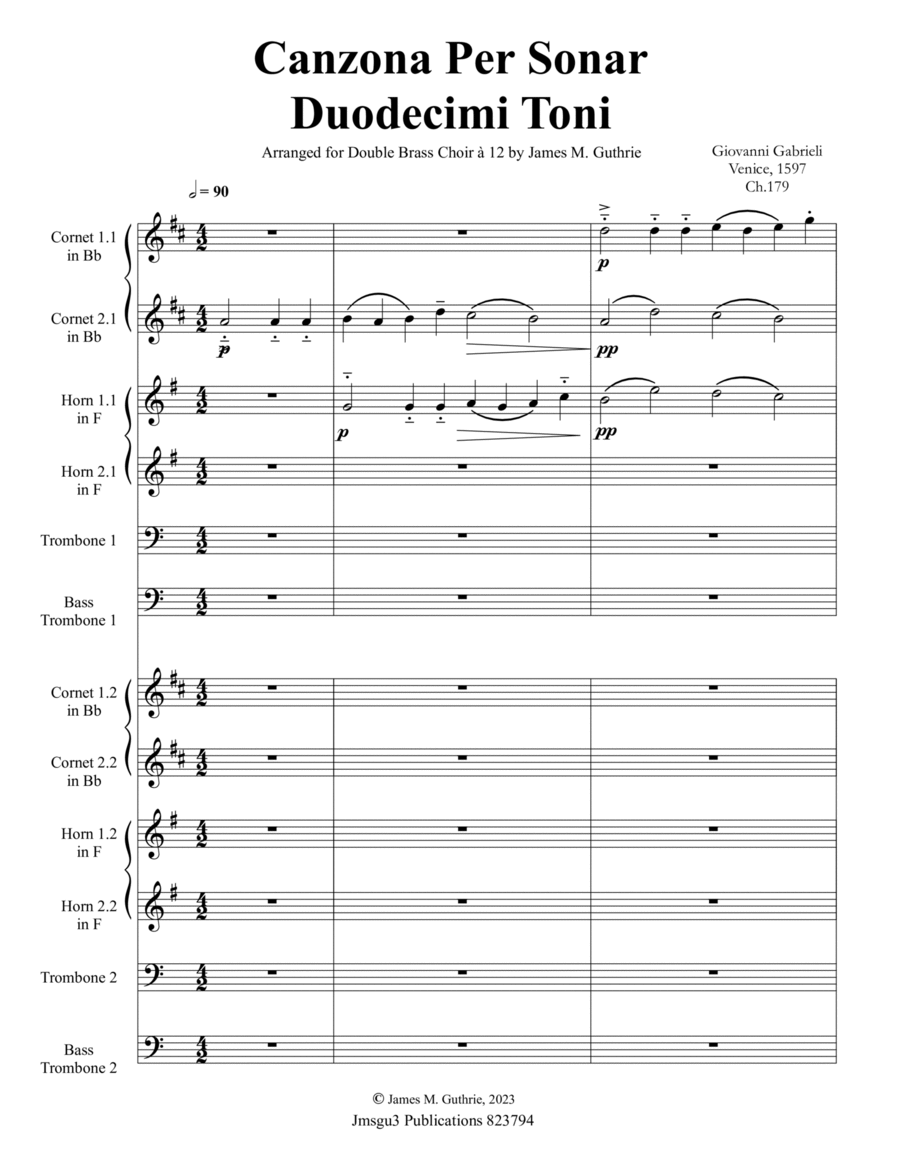
Gabrieli: Canzon per Sonar Ch. 179 for Double Brass Choir à 12

$47.95 40.96 € PDF SheetMusicPlus

Concert Band - Level 5 - Digital Download SKU: A0.1463454 Composed by Franz Liszt. Arranged by Michael Barrera. 19th Century,Classical,Romantic Period. 251 pages. Michael Barrera #1042150. Published by Michael Barrera (A0.1463454). Https://www.michaelbarreraflute.com/shop/p/mephisto-waltz1-band-partsTwo Episodes from Lenau’s Faust | Mephisto Waltz No. 1Program NotesFranz Liszt’s first Mephisto Waltz is a programmatic work based on an episode from Nikolaus Lenau’s 1836 verse drama Faust.  The program note that appears in the original printed score is noted here:There is a wedding feast in progress in the village inn, with music, dancing, carousing.  Mephistopheles and Faust pass by, and Mephistopheles induces Faust to enter and take part in the festivities.  Mephistopheles snatches the fiddle from the hands of a lethargic fiddler and draws from it indescribably seductive and intoxicating strains.  The amorous Faust whirls about with a full-blooded village beauty in a wild dance; they waltz in mad abandon out of the room, into the open, away into the woods.  The sounds of the fiddle grow softer and softer, and the nightingale warbled his love-laden song. Mephisto Waltz No. 1 is paired with a work preceding it, Midnight Procession (Der Nächtliche Zug), however this piece is not as widely performed.  Liszt later transcribed the waltz into a piano duet and a virtuosic solo piano work.  Each of these versions were written around the same time, roughly 1859-62.  The orchestral version also has an alternate ending, which is softer and fades away.  This arrangement features both endings. This work was then followed by three more Mephisto Waltzes.  No. 2 was also written as both an orchestral and piano work, while Nos. 3 and 4 were for piano only.  Of the four, the first is the most popular, although the third is also praised as highly musically. InstrumentationWritten for Wind Ensemble of any size (Number indicates how many parts - some parts include divisi)1 Piccolo (doubles Flute 3)                                              2 Flutes2 Oboes2 Bassoons1 Clarinet (E flat)3 Clarinets (B flat)1 Bass Clarinet (B flat)1 Contrabass Clarinet (B flat)2 Alto Saxophones1 Tenor Saxophone1 Baritone Saxophone3 Trumpets (B flat)4 Horns (F)2 Trombones1 Bass Trombone1 Euphonium1 Tuba1 String BassTimpaniMarimbaCymbalTriangle.
Der Tanz in der Dorfschenke | Mephisto Waltz No. 1 (Set of Parts)
Orchestre d'harmonie

$79.99 68.33 € Orchestre d'harmonie PDF SheetMusicPlus

Concert Band - Level 5 - Digital Download SKU: A0.1463453 Composed by Franz Liszt. Arranged by Michael Barrera. 19th Century,Classical,Romantic Period. 42 pages. Michael Barrera #1042149. Published by Michael Barrera (A0.1463453). Https://www.michaelbarreraflute.com/shop/p/mephisto-waltz1-band-scoreTwo Episodes from Lenau’s Faust | Mephisto Waltz No. 1Program NotesFranz Liszt’s first Mephisto Waltz is a programmatic work based on an episode from Nikolaus Lenau’s 1836 verse drama Faust.  The program note that appears in the original printed score is noted here:There is a wedding feast in progress in the village inn, with music, dancing, carousing.  Mephistopheles and Faust pass by, and Mephistopheles induces Faust to enter and take part in the festivities.  Mephistopheles snatches the fiddle from the hands of a lethargic fiddler and draws from it indescribably seductive and intoxicating strains.  The amorous Faust whirls about with a full-blooded village beauty in a wild dance; they waltz in mad abandon out of the room, into the open, away into the woods.  The sounds of the fiddle grow softer and softer, and the nightingale warbled his love-laden song. Mephisto Waltz No. 1 is paired with a work preceding it, Midnight Procession (Der Nächtliche Zug), however this piece is not as widely performed.  Liszt later transcribed the waltz into a piano duet and a virtuosic solo piano work.  Each of these versions were written around the same time, roughly 1859-62.  The orchestral version also has an alternate ending, which is softer and fades away.  This arrangement features both endings. This work was then followed by three more Mephisto Waltzes.  No. 2 was also written as both an orchestral and piano work, while Nos. 3 and 4 were for piano only.  Of the four, the first is the most popular, although the third is also praised as highly musically. InstrumentationWritten for Wind Ensemble of any size (Number indicates how many parts - some parts include divisi)1 Piccolo (doubles Flute 3)                                              2 Flutes2 Oboes2 Bassoons1 Clarinet (E flat)3 Clarinets (B flat)1 Bass Clarinet (B flat)1 Contrabass Clarinet (B flat)2 Alto Saxophones1 Tenor Saxophone1 Baritone Saxophone3 Trumpets (B flat)4 Horns (F)2 Trombones1 Bass Trombone1 Euphonium1 Tuba1 String BassTimpaniMarimbaCymbalTriangle.
Der Tanz in der Dorfschenke | Mephisto Waltz No. 1 (Score) - Score Only
Orchestre d'harmonie

$29.99 25.62 € Orchestre d'harmonie PDF SheetMusicPlus

Guitar,Piano,Vocal,Voice - Level 4 - Digital Download SKU: A0.1510395 Composed by Bill Gaither and Gloria Gaither. Arranged by Mikhail Rimsky-Korsakov. Christian,Praise & Worship,Religious,Sacred,Spiritual. Score. 32 pages. MRK Studio #1085584. Published by MRK Studio (A0.1510395). Because He Lives is a classic song (hymn) penned by one of the most lauded couples in Christian music, Bill and Gloria Gaither. This song explores how the resurrection of Christ transforms the lives of believers.   At this song's 50th anniversary, in honor of this legacy milestone, Gaither Music Group has initiated a yearlong celebration highlighting numerous performances of the song across many different platforms and genres. First released on October 18, 1971, this song was, and is, one of the most popular songs written by the Gospel Music Hall of Fame members.  “People have asked me, ‘Did you know right away that it was going to be a song that was going to be translated in other languages?’” stated Bill. “When you create a new song—and you write as many as we have–you really don’t know. Many times you write one and you think it is going to be the next ‘Amazing Grace,’ and it just dies a natural death. When we wrote ‘Because He Lives’ I felt like it was a good song, but you only find out how good a song is when people start responding to it, and the more we sang it the more people responded. I’m humbled it has been translated into so many languages and did not foresee that.”, he added.Read more here This song was commissioned by a South African Baritone Soloist, Johann Nefdt, to be performed by a Baritone Soloists, 2 Violins, Piano and Pipe Organ. All parts are included in the sale. This arrangement was produced using Dorico 5..1 & NotePerformer 4.5  My arrangements are custom made for any ensemble required and voiced specifically for their instrumentation. Ergo, feel free to contact me should you require any music arranged for your ensemble. I voice it with the tonal colors of your instrumentation (keeping in mind the strong and weaker musicians) to bring the most out of your performance! The best part is, you get it right here from this music publisher for ease of mind! Enquire here for Arrangements / Composition or Publishing requests.
Because He Lives
Piano, Voix et Guitare

$15.00 12.81 € Piano, Voix et Guitare PDF SheetMusicPlus

Mixed choir (SSSAAATTTBBB) - difficult - Digital Download SKU: S9.Q19671 For mixed choir. Composed by Steve Martland. This edition: choral score. Choral Music of Our Time. Downloadable, Choral score. Duration 23 minutes. Schott Music - Digital #Q19671. Published by Schott Music - Digital (S9.Q19671). English.Sea Songs, commissioned jointly by Ars Nova Copenhagen and Glasgow Concert Halls, is a kind of sequel to Martland's Street Songs (originally written for the Kings Singers and Evelyn Glennie). As with the earlier piece, Martland made use of to the library of the English Folk Song and Dance Society at Cecil Sharp House in north London. I wanted specifically to find texts that were not just the usual nautical heave-ho sort of thing, but instead explored the dangers and hardships still being experienced by sailors as recently as the early 19th century. I was also very happy to see in these texts the sense of camaraderie and mutual support that existed between the sailors. (Steve Martland) Dance to your Daddy sets the scene of a sailor's wife at home, dandling her baby son and singing to him about his daddy away fishing, and about the future. Both the tune and the words come from the Northumberland area around Newcastle. This song is very well known in the UK and gave the title to a famous television series When the boat comes in. Fire Down Below is about the effects of fire - a constant danger on board wooden ships. At the end of this song the words take on an extended meaning: Fire in our hearts for the friends that we love. The Dead Horse is about the initial month of work without pay in which all seamen had to take part. They referred to it as the dead horse - hence the expression to flog a dead horse when something is a waste of time. The seamen resented this unpaid time, and the text expresses their frustrations metaphorically by listing what they would do to the horse! The music's frantic gallop alludes to the horse's desperation. Although The Sea Martyrs presents itself as a ballad, this text has a more literary feel, and unlike the other songs it doesn't include a chorus refrain. It concerns the sailors' lack of pay, the consequences of asking for pay (being hanged!), and the poverty of their families at home. The poem portrays the sailors' deaths as an almost religious sacrifice to help future seamen. At the end of the work, the opening of Dance to your Daddy returns as a kind of descant, sung by an angel calling to the hanged men. © Paul Hillier, 2012.
Sea Songs

$12.99 11.1 € PDF SheetMusicPlus

Brass Ensemble - Level 3 - Digital Download SKU: A0.790937 Composed by Lionel Bart. Arranged by Kevin P Holdgate. Contemporary. Score and parts. 13 pages. Kevin P Holdgate #4320249. Published by Kevin P Holdgate (A0.790937). The Versatile Brass Sextet CollectionSuitable for players of all levels (Includes treble clef parts for trombone and Eb bass plus Eb Horn)Suitable as a light concert item, singalong or as part of a Beer Keller SetOom-Pah-Pah is a lively and somewhat risqué show tune with music and lyrics by Lionel Bart and appearing in the musical Oliver!, when it is sung by Nancy and the crowd at the Three Cripples tavern. The word oom-pah-pah is seemingly used euphemistically to refer to both intoxication and fornication; however, as the song points out, the word's meaning is only as dirty as the listener interprets it. Although not an original music hall song, it recalls that genre well and, in terms of both its tempo and suggestiveness, shares characteristics with such late 19th century songs as Ta-ra-ra Boom-de-ay.In the stage musical, the song opens Act II and does not contribute to the storyline. For the 1968 film version, it was moved to near the end and given a dramatic purpose. Sikes has refused to let Nancy take Oliver out of the pub and, unknown to him, to Mr Brownlow and rescue. He orders Bullseye to guard Oliver while he immerses himself in discussion with Fagin. So Nancy starts the song and gradually works the pub crowd into a raucous singalong, hoping their noise will drown out Bullseye's barking long enough for her to get Oliver away.
Oom-pah-pah
Ensemble de cuivres

$12.99 11.1 € Ensemble de cuivres PDF SheetMusicPlus

Guitar - Level 1 - Digital Download SKU: A0.877942 By Spike Jones/The City Slickers. By Don Gardner. Arranged by Rebecca Bogardus. Christmas. Guitar Tab. 8 pages. Lillwy Publishing #5798453. Published by Lillwy Publishing (A0.877942). This Modern Single is part of the First Position Christmas collection. This collection is a guitar teacher's dream! Each selection in the collection includes the melody of a popular Christmas favorite, each carefully edited for the beginning guitarist. Each song has at least two versions - one with TAB and chords included, and one edited for classically trained guitarists, including fingering suggestions. For rhythmically complex songs, a simplified rhythmic version is also included. Special effort has been put into making the selections as accessible as possible to those in their first year of study, and all of the pieces are exclusively in first position with the exception of All I Want for Christmas, which has a few notes at the very end in second position. There is also a collection of 22 Classic Favorites available both at Sheet Music Plus and www.studiobogardus.com/arrangements. This Modern Single includes a coupon code that can be used on the Classic Favorites collection. Songs in the complete collection (those with asterisks* are Modern Singles and are NOT included in the Classic Favorites collection): Up On the Housetop O Come, All Ye Faithful Away in a Manger The Little Drummer Boy* Good King Wenceslas Jolly Old St. Nicholas We Three Kings We Wish You A Merry Christmas All I Want for Christmas (Is My Two Front Teeth)* Angels We Have Heard On High Blue Christmas* Feliz Navidad* Here Comes Santa Claus* Rudolph the Red-Nosed Reindeer* Silver Bells* The Chipmunk Song* Hark the Herald Angels Sing Jingle Bells O Christmas Tree O Holy Night Let It Snow* Winter Wonderland* Deck the Hall God Rest Ye Merry, Gentlemen O Come, O Come, Emmanuel O Little Town of Bethlehem Frosty the Snowman* Home for the Holidays* Rockin' Around the Christmas Tree* White Christmas* It Came Upon the Midnight Clear Joy to the World Silent Night The First Noel What Child Is This? Christmas Time* Coventry Carol Have Yourself a Merry Little Christmas*  
All I Want For Christmas Is My Two Front Teeth
Guitare notes et tablatures
Spike Jones/The City Slickers
$4.99 4.26 € Guitare notes et tablatures PDF SheetMusicPlus

Piano Trio,String Ensemble - Level 5 - Digital Download SKU: A0.861898 Composed by Mark O'Connor. 20th Century,Contemporary,Folk. Score and parts. 55 pages. Mark O'Connor Musik International #6206157. Published by Mark O'Connor Musik International (A0.861898). Piano Trio No. 1 Poets and Prophets (piano score – piano, vln, cel) MO160APiano Score (parts available)Music by Mark O’Connor51 pages - 29:00 minutes in lengthI. Man In BlackII. The Tennessee TwoIII. My JuneIV. Hello, I’m Johnny CashPiano Trio No. 1 (Poets and Prophets) was composed by Mark O’Connor during the Fall of 2003. The piece was commissioned for the Eroica Trio by a noted patron for music, Kathryn Gould of Palo Alto, California. The world premiere took place at the Montalvo Chamber Music Series in California, March 5th, 2004. In a letter to the members of the trio dated 9/20/03, Mr. O’Connor lays out his plan for the new music.My initial ideas have sort of exploded in to the entire concept of the music with a real impact actually. Now I am piecing together the parts of it and then will eventually work on detail as I get the overall form under wrap. Here is what my inspiration for the music is; Johnny Cash.Johnny was a boyhood hero of mine, I used to sing his songs when I was 8, 9 and 10 years old, and played the guitar like him (sometimes up the fretboard strumming away). My mom used to help me transcribe all the lyrics off the albums, she also thought he hung the moon.                                                                                         As you can imagine, the passing of Cash for me this last week has been emotional. I am at my very best when I compose with my emotions at my sleeve, and guess what, it is time to do the Eroica piece. And I believe I will be able to craft a very unique tribute in to the form of a Piano Trio. There is something that is very fitting in all of this though. Cash was one of the few country music and rockabilly musicians to appeal to all ages, all types of people all the way into the MTV generation which is something that is hard to fathom. That one person can move musical mountains with his charisma and his voice. He sung about the prisons, riding the trains, about killing, and living, about lost love, about the gospel, about the downtrodden and the Native American, and about being stoned. His musical sound was the thing that got everybody though. He developed along with his guitar player Luther Perkins, a new and vibrant way to bring the music out.I also knew Johnny and worked with him, visited him privately at his home. Johnny also appeared on my album called Heroes, where he brought back the great story of the Devil coming down to Georgia to challenge young Johnny for the golden fiddle. My job now is to bridge what I am feeling about my inspiration for Cash, and bring it in to the instruments that I love writing for.I might not have imagined that this Johnny Cash concept would have worked out of hand, if it hadn’t been for your musicianship, insight fullness and graceful approaches in to the details of musical concepts and style. If the piece is good, then I will have no doubt that you will bring it to the forefront so others can grasp the intentions of the work, and in addition for others to enjoy playing it after you have brought it all out in to the open, and gave it a life. Original music printed from the composer’s manuscripts.Music editing, copying and engraving by Mark O’Connorusing Finale on Apple Macintosh 2003 Composed by Mark O’ConnorCan be heard on An American Journey by the Eroica Trio, Angel RecordsMark O’Connor Piano Trio with Soyeon Lee and Soo Bae soon to be released on OMAC Records Catalogue Number MO160A
Piano Trio No. 1 "Poets and Prophets" (piano score - pno, vln, cel)

$22.50 19.22 € PDF SheetMusicPlus


1 ....301 316 331 346 361 ....721


Partitions Gratuites
Acheter des Partitions Musicales
Acheter des Partitions Digitales à Imprimer
Acheter des Instruments de Musique

© 2000 - 2026

Accueil - Version intégrale





