EUROPE
2704 articles
USA
11128 articles
DIGITAL
23366 articles (à imprimer)
Partitions Digitales
Partitions à imprimer
23366 partitions trouvées


Level 4 - Digital Download SKU: A0.1141677 Composed by Alessandro Ignazio Marcello. Arranged by Nelson Ramos. Baroque,Chamber,Classical. 18 pages. Published / Arranged by Nelson Ramos #742036. Published by Published / Arranged by Nelson Ramos (A0.1141677). IMPORTANT: If you want to help me, and instead of buying the arrangement via this platform, which takes 50% comission over the price from the arranger / composer, please contact me via email at nelsonramos@pm.me and I may even make you a discount, since I will receive the value in its entirety.Contact me for the parts PDF, and having been shown proof of acquisition, I will gladly send them.I adapted/arranged this Oboe Concerto, by Alessandro Marcello, for a Mixed Ensemble, with Soprano Saxophone Solo, constituted by Organ, Piano, Soprano and Alto Saxophone, Flute, Clarinet in Bb, Trombone and French Horn, apropos of a small project I used to have with a class at EAB, in Portugal – that explains the unusual orchestration. Inasmuch as there was no tuba, the French Horn part, played by myself, had to play really low notes. If required, separate parts can be sent via email, if shown purchase proof.
Oboe Concerto in Dm - S.Z799 - Score Only

$20.00 16.92 € PDF SheetMusicPlus

Small Ensemble B-Flat instrument,Clarinet,Trumpet - Level 3 - Digital Download SKU: A0.712236 Composed by Watts. Arranged by Sandra Zylstra. Christian,Easter,Sacred. Score and parts. 1 pages. Sandra dee zylstra #3488585. Published by sandra dee zylstra (A0.712236). May I never boast except in the cross of our Lord Jesus Christ (Galatians 6:14). This Bible verse was the basis for this communion song which is used in several denominations. This is an individual instrument part. You can also purchase an arrangement with the piano accompaniment along with the instrumental part.  (Approximately 3 minutes, 4 pages) You can look at other arrangements by Sandra Zylstra on Sheet Music Plus: http://www.sheetmusicplus.com/formats/singles/sandra-zylstra/600092+3001855 and at Piano Pronto: Composers Community https://pianopronto.com/composers-community/sandra-zylstra/ .
When I Survey The Wondrous Cross (treble Bb part only)

$2.00 1.69 € PDF SheetMusicPlus

Small Ensemble - Level 4 - Digital Download SKU: A0.1493835 Composed by Thomas Oboe Lee. 20th Century,21st Century,Chamber,Classical. 33 pages. Thomas Oboe Lee #1070492. Published by Thomas Oboe Lee (A0.1493835). Full score.Program note.  I have always been fascinated with Wagner's song cycle Wesendonck Lieder for soprano and orchestra. Of course, the story behind Wagner and Mathilde Wesendonck was even more intriguing. If you don't know the story then you should look it up. When Nancy Braithwaite informed me recently that I have written nine works for her since 1997, that was the year I wrote Yo Picasso for her and her chamber group The Arto Ensemble. I told her, well, let's make it ten. She said her current group, the Rietveld Ensemble, consists of clarinet, violin, viola and cello. That sounds good, but I also suggested adding a soprano voice. She said, fine. That was when I thought I should write Nancy a song cycle using the same Wesendonck poems that Wagner did for his orchestral cycle. 1. Der Engel ... Moderato 2a. Interlude I ... Moderato 2b. Stehe still! ... Allegro TRIO I 3. Im Treibhaus ... Largo 4a. Interlude II ... Allegro TRIO II 4b. Schmerzen ... Adagio 5. Traüme ... Allegro.
Mathilde Wesendonck (2024) - Score Only

$9.99 8.45 € PDF SheetMusicPlus

String Orchestra - Level 4 - Digital Download SKU: A0.1183533 Composed by Joseph Bologne, Chevalier de St. Georges. Arranged by Robert Debbaut. Classical,Contest,Festival,Historic,Multicultural,World. 43 pages. ROBERT DEBBAUT #783206. Published by ROBERT DEBBAUT (A0.1183533). How is it that one can be born a slave in French colonial Guadeloupe and rise to be among Paris’ musical giants, to become a colonel in the French Army as well as the frequent dinner guest of princes and potentates? The story of Joseph Bologne, Chevalier de Saint-Georges, is surely an interesting one, even the stuff of which movies are made.Joseph Bologne’s father, Georges Bologne de Saint-Georges was a French planter. Saint-Georges was the name of his plantation. He impregnated Anne, the Senegalese slave of his wife, who bore him a son in 1745. Uncharacteristic of many of these sort of relationships he acknowledged the child was his and gave him his family name. When he was seven Bologne’s father took him to Paris for his education, enrolling him in a boarding school. Two years later he and the child’s mother returned to France and set up housekeeping as a family in Paris’ Saint-Germain-des-Prés district.At age thirteen Joseph’s father enrolled him in the Royal Technical Academy of Fencing and Swordsmanship. He quickly became the finest swordsman in the academy, perhaps in all of Paris. Upon graduation he was made an Officer of the King’s Bodyguard and a chevalier (an honorary knighthood). He went on to serve tours of duty in the French Army during the Seven Years War (1756-1763) and later after the French Revolution, where he was Colonel and commander of an all-Black regiment of the Revolutionary Army. All this in spite of the fact that French law forbade him, a man of African heritage, to become a citizen, to retain his father’s royal title of “Gentleman of the King’s Chamber,†or to marry outside his class.There is limited information about Bologne’s musical training, but he was obviously so well-skilled that Italian violinist-composer Antonio Lolli (1725-1802) wrote two violin concertos for him and French composer François-Joseph Gossec (1734-1829) dedicated his set of String Trios, Op. 9 to Bologne. Lolli may have worked with him on violin technique and Gossec composition, but this may be apocryphal. Bologne played in Gossec’s orchestra, and was later both leader and conductor of the group.As a composer Joseph Bologne was quite prolific, composing six operas, fourteen violin concertos, four symphonies concertantes, and numerous chamber works and songs. His Six String Quartets, Op. 1, Nos. 1-6 date from 1770-1771 and were published by the Paris publishing house of Jean-Georges Sieber (1738-1822) in 1773 (There are a total of 18 quartets: Six Quartets “au goût du jour†[up-to-date] from 1779 and the Opus 14 set of six which date from 1785). The Opus 1 quartets are dedicated to Anne Louis Alexandre de Montmorency (1724-1812), 7th Prince of Robeck (Robecq) and Grand Duke of Spain.The Opus 1 quartets all display a similarity to the Italian opera overtures from earlier in the Eighteenth Century (often called “sinfoniaâ€) in that they have an overall “A-B-A†form with the ‘A’ sections being robust allegros and all ‘B’ sections marked “rondo.†As such, in arranging them for string orchestra it seemed quite natural to rename them “overtures.†Certain liberties were taken by the arranger in order to maintain the integrity of the classic Rondo formula. All six have been arranged in this manner for string orchestra. They vary in length from twelve to almost twenty minutes. If you wish to obtain parts, write to debbaut@gmail.com and pay $42 via venmo or $40 via personal check and they will be sent to you in pdf format.
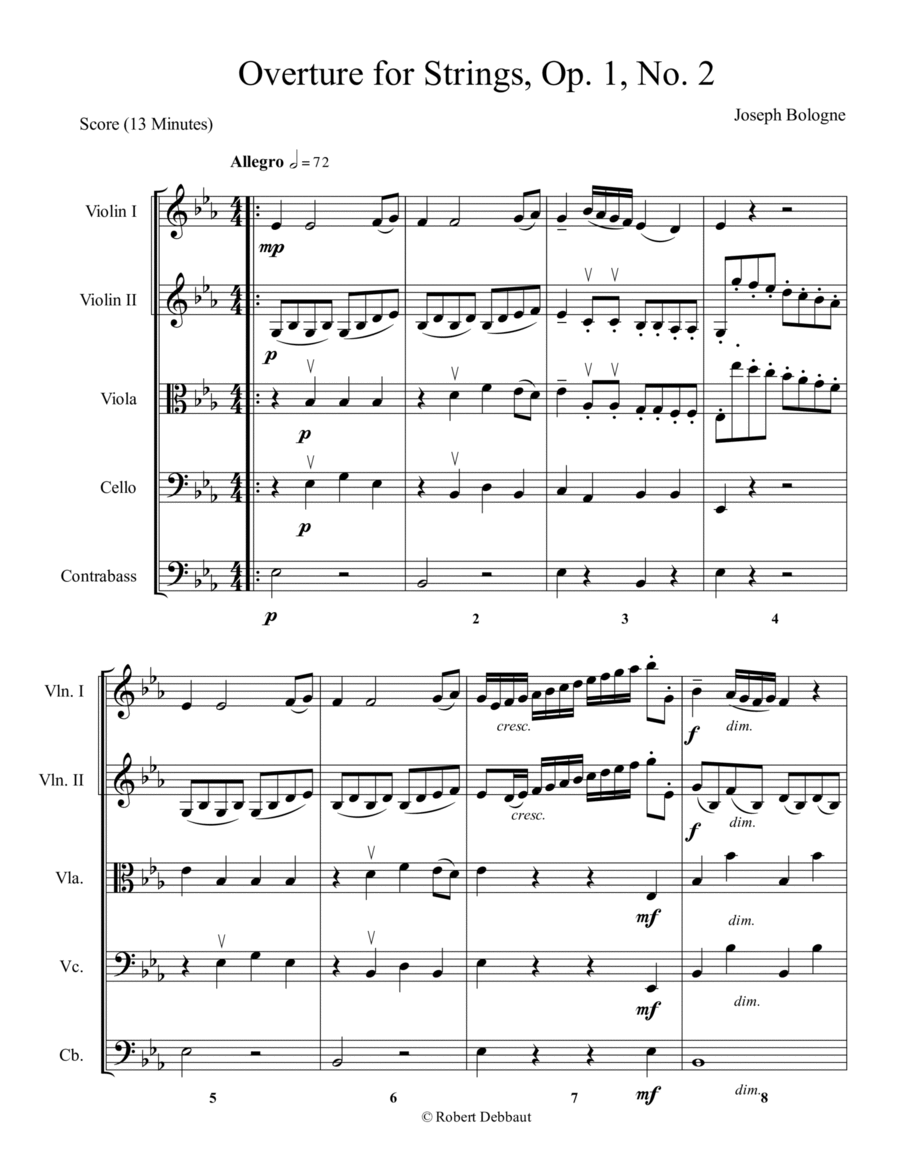
Overture for Strings No. 2 - Score Only
Orchestre à Cordes

$9.99 8.45 € Orchestre à Cordes PDF SheetMusicPlus

String Orchestra - Level 4 - Digital Download SKU: A0.1183535 Composed by Joseph Bologne, Chevalier de St. Georges. Arranged by Robert Debbaut. Classical,Contest,Festival,Historic,Multicultural,World. 34 pages. ROBERT DEBBAUT #783208. Published by ROBERT DEBBAUT (A0.1183535). How is it that one can be born a slave in French colonial Guadeloupe and rise to be among Paris’ musical giants, to become a colonel in the French Army as well as the frequent dinner guest of princes and potentates? The story of Joseph Bologne, Chevalier de Saint-Georges, is surely an interesting one, even the stuff of which movies are made.Joseph Bologne’s father, Georges Bologne de Saint-Georges was a French planter. Saint-Georges was the name of his plantation. He impregnated Anne, the Senegalese slave of his wife, who bore him a son in 1745. Uncharacteristic of many of these sort of relationships he acknowledged the child was his and gave him his family name. When he was seven Bologne’s father took him to Paris for his education, enrolling him in a boarding school. Two years later he and the child’s mother returned to France and set up housekeeping as a family in Paris’ Saint-Germain-des-Prés district.At age thirteen Joseph’s father enrolled him in the Royal Technical Academy of Fencing and Swordsmanship. He quickly became the finest swordsman in the academy, perhaps in all of Paris. Upon graduation he was made an Officer of the King’s Bodyguard and a chevalier (an honorary knighthood). He went on to serve tours of duty in the French Army during the Seven Years War (1756-1763) and later after the French Revolution, where he was Colonel and commander of an all-Black regiment of the Revolutionary Army. All this in spite of the fact that French law forbade him, a man of African heritage, to become a citizen, to retain his father’s royal title of “Gentleman of the King’s Chamber,†or to marry outside his class.There is limited information about Bologne’s musical training, but he was obviously so well-skilled that Italian violinist-composer Antonio Lolli (1725-1802) wrote two violin concertos for him and French composer François-Joseph Gossec (1734-1829) dedicated his set of String Trios, Op. 9 to Bologne. Lolli may have worked with him on violin technique and Gossec composition, but this may be apocryphal. Bologne played in Gossec’s orchestra, and was later both leader and conductor of the group.As a composer Joseph Bologne was quite prolific, composing six operas, fourteen violin concertos, four symphonies concertantes, and numerous chamber works and songs. His Six String Quartets, Op. 1, Nos. 1-6 date from 1770-1771 and were published by the Paris publishing house of Jean-Georges Sieber (1738-1822) in 1773 (There are a total of 18 quartets: Six Quartets “au goût du jour†[up-to-date] from 1779 and the Opus 14 set of six which date from 1785). The Opus 1 quartets are dedicated to Anne Louis Alexandre de Montmorency (1724-1812), 7th Prince of Robeck (Robecq) and Grand Duke of Spain.The Opus 1 quartets all display a similarity to the Italian opera overtures from earlier in the Eighteenth Century (often called “sinfoniaâ€) in that they have an overall “A-B-A†form with the ‘A’ sections being robust allegros and all ‘B’ sections marked “rondo.†As such, in arranging them for string orchestra it seemed quite natural to rename them “overtures.†Certain liberties were taken by the arranger in order to maintain the integrity of the classic Rondo formula. All six have been arranged in this manner for string orchestra. They vary in length from twelve to almost twenty minutes. If you wish to obtain parts, write to debbaut@gmail.com and pay $42 via venmo or $40 via personal check and they will be sent to you in pdf format.
Overture for Strings No. 4 - Score Only
Orchestre à Cordes

$9.99 8.45 € Orchestre à Cordes PDF SheetMusicPlus

Level 4 - Digital Download SKU: A0.1141691 Composed by Johann Sebastian Bach. Arranged by Nelson Ramos. Baroque,Christian,Classical. 47 pages. Published / Arranged by Nelson Ramos #742058. Published by Published / Arranged by Nelson Ramos (A0.1141691). IMPORTANT: If you want to help me, and instead of buying the arrangement via this platform, which takes 50% comission over the price from the arranger / composer, please contact me via email at nelsonramos@pm.me and I may even make you a discount, since I will receive the value in its entirety.Contact me for the parts PDF, and having been shown proof of acquisition, I will gladly send them.I adapted/arranged this Cantata, BWV 29, by Johann Sebastian Bach, for a Mixed Ensemble, with various solos, constituted by Organ, Piano, Soprano and Alto Saxophone, Flute, Clarinet in Bb, Trombone and French Horn, apropos of a small project I used to have with a class at EAB, in Portugal – that explains the unusual orchestration. Inasmuch as there was no tuba, the French Horn part, played by myself, had to play really low notes. It's called «BWV 29 – Compendium» because it's a compendium of all the movements of the Cantata. If required, separate parts can be sent via email, if shown purchase proof. Also, if required, separate movements of the cantata can be sent via email, if shown purchase proof.
BWV 29 – Wir danken dir, Gott, wir danken dir - Score Only

$30.00 25.38 € PDF SheetMusicPlus

Woodwind Ensemble - Level 4 - Digital Download SKU: A0.1115994 By Thomas Graf. By Thomas Graf. Arranged by Thomas Graf. 20th Century,Classical,Jazz. 27 pages. Thomas Graf - the-hit-factory.com #717714. Published by Thomas Graf - the-hit-factory.com (A0.1115994). Fantasy in 3 movements for large wind ensemble, double bass and percussion 1. Deux Caracteres 2. Dialogues 3. Dance de Confusion Confluence is the name of a place in Lyon where 2 rivers flow together: The Saône flows into the - at least in German - female Rhone. In French, however, it flows into DEN Rhone - Le Rhône. This confuses the composer: How do rivers get their gender, are they sometimes male, sometimes female? Is it because of their character, because of the landscape that they flow through? By their water, even by their fish? On the people on their shores? A real confusion ensues. In the subsequent thoughts about music, the composer discovers certain analogies and asks himself the question: does gender-typical music actually exist? Or instruments? Typically male harmonies or rhythms? Or clearly female melodies and the way to interpret? The 3-movement composition is dedicated to this question and meanders like a dance in the bed of the converging streams. Colorful modal harmonies form the bed for wide arcs of melody. A varied, recurring theme sets the direction and creates a bubbling, dancing pull in the direction of the mouth: dancing finale! 1st movement: Deux Characters In the first movement (Andante) the roles are distributed - the Sâone and the Rhône get their performers. A first glance at the ensemble reveals a tendency: woodwinds take on the female lead, the male brass the counterpart. The two drummers each support one of the two poles in solidarity. The assignment may be obvious, but strong doubts remain in the final chord of the first movement. 2. Dialogues: In smaller and larger dialogues, there is a lively exchange and the properties are worked out and further developed. But it is also increasingly being copied and imitated, even maliciously agitated and aped. You try to convince each other, interrupt each other, both sides increasingly flare up, it gets louder and more hectic, louder and louder, too loud, until communication stops: in the end, you just yell at each other! 3. Dance de Confusion The resulting confusion finds a conciliatory end in the third movement of the composition: Let's dance! In the end, the initial confusion turns into a confusion: what belongs together flows and dances together. Composed by: Thomas H. Graf Arranged by: Thomas H. Graf for Woodwind Ensemble Instrumentation:  Full Score Piccolo Flute 1 Flute 2 Oboe 1 Oboe 2 English Horn Clarinet 1 in Bb Clarinet 2 in Bb Bass Clarinet in Bb Bassoon 1 Bassoon 2 Contrabassoon Trumpet 1 in Bb Trumpet 2 in Bb Trumpet 3 in Bb Trombone 1 Trombone 2 Trombone 3 Tuba Contrabass Perc 1 (Snare Drum, Chimes) Perc 2 (Triangle, Cymbals) Any individual arrangement and substitute parts are available on request. Call +49 (0) 172 2515987  E-Mail: info@the-hit-factory.com.  www.the-hit-factory.com facebook: https://www.facebook.com/hitfactorymusic
Conflusion - Suite - Woodwind Ensemble - Score Only
Thomas Graf
$10.00 8.46 € PDF SheetMusicPlus


Partitions Gratuites
Acheter des Partitions Musicales
Acheter des Partitions Digitales à Imprimer
Acheter des Instruments de Musique

© 2000 - 2026

Accueil - Version intégrale





