EUROPE
56 articles
USA
60 articles
DIGITAL
54 articles (à imprimer)
Partitions Digitales
Partitions à imprimer
54 partitions trouvées


Alto Saxophone,Piano - Level 3 - Digital Download SKU: A0.753079 Composed by Traditional. Arranged by Brenda Portman. Christian,Christmas,Classical,Religious,Sacred. Score and part. 9 pages. Brenda Portman #3388829. Published by Brenda Portman (A0.753079). This setting of the Huron Carol (Twas in the Moon of Wintertime), for alto saxophone and piano, was originally a vocal solo but works very nicely as an instrumental solo. Recording is of the vocal version. A beautiful arrangement of a lesser-known Christmas carol, which is a French Canadian melody and is the earliest Christmas carol from North America.Composer website: http://brendaportman.com.
Twas in the Moon of Wintertime/The Huron Carol (alto sax/piano), arr. Brenda Portman
Saxophone Alto et Piano

$4.25 3.63 € Saxophone Alto et Piano PDF SheetMusicPlus

Saxophone Quartet,Woodwind Ensemble Alto Saxophone,Baritone Saxophone,Tenor Saxophone - Level 3 - Digital Download SKU: A0.1508598 By Josh Groban. By Alan Silvestri and Glen Ballard. Arranged by James-Michael Sellers. Christmas,Film/TV,Holiday. 7 pages. JMS Composer #1083859. Published by JMS Composer (A0.1508598). Experience the magic of the holiday season with this enchanting arrangement of Believe from The Polar Express. This beloved song, originally performed by Josh Groban, captures the wonder and joy of Christmas, making it a perfect addition to any repertoire.Bring the spirit of the season to your next performance with this stunning arrangement of Believe. Ideal for holiday concerts, recitals, and special events, this piece will leave a lasting impression on performers and listeners alike. Transform your venue into a winter wonderland and let the music fill the air with hope and wonder.
Believe
Quatuor de Saxophones: 4 saxophones
Josh Groban
$12.99 11.11 € Quatuor de Saxophones: 4 saxophones PDF SheetMusicPlus

Small Ensemble Guitar,High Voice - Level 3 - Digital Download SKU: A0.964298 Composed by Franz Schubert. Arranged by Evans, Jack. Romantic Period. Score and parts. 3 pages. Jack Stanley Evans #5899363. Published by Jack Stanley Evans (A0.964298). Des Baches Weigenlied (The Brook’s Lullaby)This is the final song in Die Schöne Mullerin, and is a lullaby for the travelling miller as he drowns himself in the brook that he followed throughout his journey. The girl he was serenading in Morgengruss did not return his feelings and eventually fell in love with a hunter instead, which is why the miller chooses to commit suicide at the end of the story. Written in strophic form, this song is very repetitive and should be performed in a hypnotic and stately manner, in order to conjure up the image of the gently flowing water rocking the protagonist into an eternal sleep. Des Baches Wiegenlied serves the same role as Der Leiermann, and while they both provide a very bleak conclusion to a song cycle, Des Baches Wiegenlied should create a mood of peaceful sadness and sorrow, rather than the dark desolation of its Winterreise counterpart; it is, after all, a lullaby.This classic Schubert song has been arranged for voice and acoustic guitar in order to provide an alternative accompaniment option for singers who want to perform Schubert’s lieder with guitar instead of piano.
Schubert- Des Baches Wiegenlied for voice and guitar

$5.30 4.53 € PDF SheetMusicPlus

Accordion / piano / bass / guitar / saxophone / clarinet / trumpet / flute / violin - Digital Download SKU: RX.9783980220040 Composed by Andreas Hinterseher. World Music. With Text Language: German. 30 pages. Published by Roba Music Verlag (RX.9783980220040). ISBN 978-3-9802-2004-0.Quadro Nuevo touren seit 1996 durch die Lander der Welt und gaben bereits uber 2500 Konzerte. In dieser Zeit hat das Instrumental-Quartett abseits der gangigen Genre-Schubladen eine ganz eigene Sprache der Tonpoesie entwickelt. Sie ist gepragt von der leidenschaftlichen Liebe zum Instrument und von grosster Spielfreude. Das Geheimnis ist Hingabe: Selten hat man erlebt, dass Musik mit so viel Spannung, Verve und Einfuhlungsvermogen in fremde Kulturen dargeboten wird. Dies ist eine Komposition des Ensemblemitglieds Andreas Hinterseher fur das mehrfach ausgezeichnete Album Tango Bitter Sweet des international erfolgreichen Ensembles. In dieser Gesamtausgabe sind die Noten fur Akkordeon (oder Klavier), Bass, Gitarre und Klarinette (oder andere Instrumente in C, Bb, oder Eb) enthalten.
An einem Winterabend

$13.49 11.54 € PDF SheetMusicPlus

Piano,Tenor Saxophone - Level 1 - Digital Download SKU: A0.548700 Composed by Franz Schubert. Arranged by James M. Guthrie, ASCAP. Christmas,Easter,Standards. Score and part. 4 pages. Jmsgu3 #3411149. Published by jmsgu3 (A0.548700). A Tenor Sax Christmas/Easter classic! Duration: 4:55 Score: 3 pg. Alto Flute part: 1 pg. Piano reads from the score. Schubert seems to have composed this piece as a song-setting. This is because he wanted to portray a poignant emotional event from a poem. The poem was Walter Scott's The Lady of the Lake. Consequently, this song became an integral part of Schubert's Song cycle. Therefore the cycle is called: the Lady of the Lake. In the poem, Ellen Douglas is the Lady of the Lake. The lake is probably Loch Katrine in the Scottish Highlands. First of all, Ellen goes with her father to stay in the Goblin's cave. They go because he earlier refused to join in a rebellion against King James. Roderick Dhu, the chief of the rebellious Alpine Clan, marches up the mountain with his army. But before the battle, he, first of all, hears Ellen singing. She is singing a prayer calling for help from the Virgin Mary. Schubert's piece was first performed at the castle of Countess Sophie Weissenwolff in Steyregg, Austria.  Schubert dedicated the arrangement to her, and as a result, she became famous as the lady of the lake.The incipit of Ellen's song is Ave Maria which is Latin for Hail Mary. It seems like this similarity led Schubert to adapt the melody to accommodate the Roman Catholic prayer Ave Maria. Consequently, the Latin version of Ave Maria finally became more famous than the original so that consequently many believe he wrote the Latin version first. Schubert Franz Schubert (1797–1828) was, in fact, a famous Austrian composer. Moreover, he composed during the late Classical and early Romantic periods. Schubert was comparatively prolific. He wrote more than 600 secular vocal works, seven symphonies, and, correspondingly, a massive amount of piano and chamber music. Critics agree, as a matter of fact, that his most famous works include his Piano Quintet in A major, D. 667 (also known as the Trout Quintet), the Symphony No. 8 in B minor, D. 759 (Unfinished Symphony), the last sonatas for piano (D. 958–960), and the song cycles Die schöne Müllerin (D. 795) and Winterreise (D. 911). Education Schubert was furthermore a musical child prodigy. He studied violin with his father as well as piano with his older brother. In addition, when Schubert was eleven he studied at Stadtkonvikt school, where he became familiar with the orchestral music of Haydn, Mozart, and likewise Beethoven. In due time he left school and returned home where he studied to become an educator; nevertheless, he continued studying composition with Antonio Salieri. Performance Eventually, Schubert was admitted to the Gesellschaft der Musikfreunde as a performer. This appointment straightaway established his name in Vienna as a composer and pianist. Finally, he gave his only composition recital in 1828. He died suddenly a few months later probably due to typhoid fever. Legacy Schubert’s music was by and large underappreciated while he was alive. There were all in all only a few enthusiasts in Vienna. After he died, however, interest in his work in fact increased. Felix Mendelssohn, Robert Schumann, Franz Liszt, Johannes Brahms and other famous composers in due time discovered his compositions. Nowadays, historians rank Schubert expressly among the greatest composers of the era, and his music remains in general very popular.
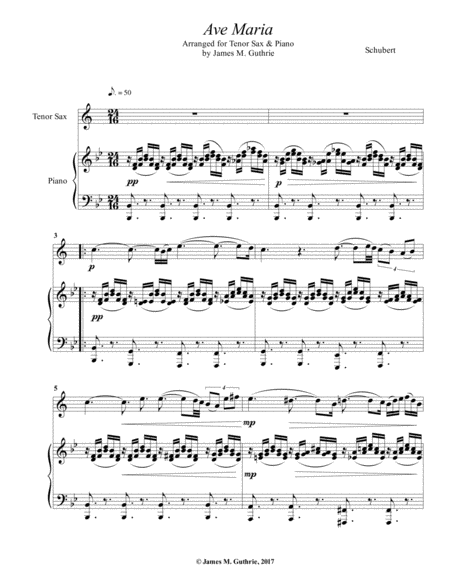
Schubert: Ave Maria for Tenor Sax & Piano
Saxophone Tenor et Piano

$29.95 25.62 € Saxophone Tenor et Piano PDF SheetMusicPlus

Baritone Saxophone,Piano - Level 1 - Digital Download SKU: A0.548692 Composed by Franz Schubert. Arranged by James M. Guthrie, ASCAP. Christmas,Easter,Standards. Score and part. 4 pages. Jmsgu3 #3411133. Published by jmsgu3 (A0.548692). A Baritone Sax Christmas/Easter classic! Duration: 4:55 Score: 3 pg. Baritone Sax part: 1 pg. Piano reads from the score. Schubert seems to have composed this piece as a song-setting. This is because he wanted to portray a poignant emotional event from a poem. The poem was Walter Scott's The Lady of the Lake. Consequently, this song became an integral part of Schubert's Song cycle. Therefore the cycle is called: the Lady of the Lake. In the poem, Ellen Douglas is the Lady of the Lake. The lake is probably Loch Katrine in the Scottish Highlands. First of all, Ellen goes with her father to stay in the Goblin's cave. They go because he earlier refused to join in a rebellion against King James. Roderick Dhu, the chief of the rebellious Alpine Clan, marches up the mountain with his army. But before the battle, he, first of all, hears Ellen singing. She is singing a prayer calling for help from the Virgin Mary. Schubert's piece was first performed at the castle of Countess Sophie Weissenwolff in Steyregg, Austria.  Schubert dedicated the arrangement to her, and as a result, she became famous as the lady of the lake.The incipit of Ellen's song is Ave Maria which is Latin for Hail Mary. It seems like this similarity led Schubert to adapt the melody to accommodate the Roman Catholic prayer Ave Maria. Consequently, the Latin version of Ave Maria finally became more famous than the original so that consequently many believe he wrote the Latin version first. Schubert Franz Schubert (1797–1828) was, in fact, a famous Austrian composer. Moreover, he composed during the late Classical and early Romantic periods. Schubert was comparatively prolific. He wrote more than 600 secular vocal works, seven symphonies, and, correspondingly, a massive amount of piano and chamber music. Critics agree, as a matter of fact, that his most famous works include his Piano Quintet in A major, D. 667 (also known as the Trout Quintet), the Symphony No. 8 in B minor, D. 759 (Unfinished Symphony), the last sonatas for piano (D. 958–960), and the song cycles Die schöne Müllerin (D. 795) and Winterreise (D. 911). Education Schubert was furthermore a musical child prodigy. He studied violin with his father as well as piano with his older brother. In addition, when Schubert was eleven he studied at Stadtkonvikt school, where he became familiar with the orchestral music of Haydn, Mozart, and likewise Beethoven. In due time he left school and returned home where he studied to become an educator; nevertheless, he continued studying composition with Antonio Salieri. Performance Eventually, Schubert was admitted to the Gesellschaft der Musikfreunde as a performer. This appointment straightaway established his name in Vienna as a composer and pianist. Finally, he gave his only composition recital in 1828. He died suddenly a few months later probably due to typhoid fever. Legacy Schubert’s music was by and large underappreciated while he was alive. There were all in all only a few enthusiasts in Vienna. After he died, however, interest in his work in fact increased. Felix Mendelssohn, Robert Schumann, Franz Liszt, Johannes Brahms and other famous composers in due time discovered his compositions. Nowadays, historians rank Schubert expressly among the greatest composers of the era, and his music remains in general very popular.
Schubert: Ave Maria for Baritone Sax & Piano
Saxophone Baryton, Piano

$29.95 25.62 € Saxophone Baryton, Piano PDF SheetMusicPlus


Partitions Gratuites
Acheter des Partitions Musicales
Acheter des Partitions Digitales à Imprimer
Acheter des Instruments de Musique

© 2000 - 2026

Accueil - Version intégrale





