EUROPE
15635 articles
USA
31848 articles
DIGITAL
113633 articles (à imprimer)
Partitions Digitales
Partitions à imprimer
113633 partitions trouvées


Flute Duet Flute - Level 3 - Digital Download SKU: A0.1489818 Composed by Franz Schubert. Arranged by Kan Saito / Japan Duo Notes. 19th Century,Classical,Film/TV,Romantic Period,Standards. Score. 3 pages. Japan Duo Notes #1066691. Published by Japan Duo Notes (A0.1489818). Title: Serenade D. 889 by Franz Schubert – Flute Duet ArrangementDescription:Experience the timeless beauty of Franz Schubert’s Serenade (D. 889) in this elegant flute duet arrangement. Originally composed as a vocal work, Schubert’s Serenade is one of his most beloved melodies, known for its lyrical expressiveness and romantic charm. This arrangement skillfully adapts the vocal lines into a harmonious dialogue between two flutes, capturing the essence of Schubert’s original masterpiece.Key Features:Composer: Franz SchubertArrangement: Flute DuetDifficulty Level: IntermediateFormat: Digital Sheet Music PDFPages: Score: 3 pages This flute duet arrangement of Schubert’s Serenade preserves the song’s rich melodic lines and emotive character, offering flutists an opportunity to explore the depth of Schubert’s romantic style. Ideal for concert performances, recitals, and special occasions, this duet provides a beautiful and touching addition to any flute repertoire.Why Choose This Arrangement?Faithful Adaptation: Maintains the lyrical beauty and romantic warmth of Schubert’s original song, reimagined for two flutes.Perfect for Performances: Suitable for various settings, including recitals, weddings, and intimate concerts.Accessible Yet Expressive: Designed for intermediate flutists, offering a balance of technical ease and musical expression.Enhance your flute repertoire with this stunning arrangement of Schubert’s Serenade (D. 889) for flute duet. It’s an ideal piece for flutists who wish to perform a classic work with both simplicity and emotional depth.Keywords: Franz Schubert, Serenade, D. 889, flute duet, flute sheet music, Schubert arrangements, flute ensemble, intermediate flute music, classical music, concert flute duet, recital music, romantic music , Ständchen.
Serenade D.889 / F. Schubert
2 Flûtes traversières (duo)

$4.99 4.3 € 2 Flûtes traversières (duo) PDF SheetMusicPlus

Woodwind Ensemble,Woodwind Quintet - Level 1 - Digital Download SKU: A0.957290 Composed by Bach, Martin Luther. Arranged by Ander. Baroque,Easter,Renaissance,Sacred,Wedding. 51 pages. Woods Only, Arrangements #6748233. Published by Woods Only, Arrangements (A0.957290). This album contains 5 of Johann Sebastian Bach's most famous and versatile pieces for english horn quintet, all very well suited for the beginners who want to get to know the baroque repertoire. They are also suitable for performances at events such as: weddings, Christian and church ceremonies, Easter, and academic recitals or concerts. They can be used in music institutions and by teachers as repertoire material and study methods, either for performance or instrumental technique. This collection includes a totally free bonus for you to enjoy: Martin Luther's A Mighty Fortress is Our God, a Renaissance sacred song for choir, which has been adapted for this set. You can also buy each one individually by checking right at the end of each description of each work.1: Air on the G String - The original piece is part of Johann Sebastian Bach's Suite No. 3 for orchestra, in D Major, BWV 1068, written for Prince Leopold of Anhalt. The so-called Air on the G String dates from one of these latter employments. In the service of the Prince of Cöthen, Bach composed not only the famous Brandenburg Concertos, but also several orchestral suites, from the third of which comes the Air on the G String. This curious title derives from a later arrangement of this piece for violin solo, in which the melody is played entirely on the lower, higher string of the instrument. ID: S0.11897512: Arioso - The Cantata 156 (BWV 156) was written for the third Sunday after Epiphany in 1729, and was first performed on January 23 of that year. The text is by Picander, one of Bach's favorite librettists. Of the four cantatas written by Bach for the feast, it was the last and only one scored for solo voice. This is a choral cantata, employing a choral melody in several movements. Cantata 156, in fact, employs two different choral melodies and texts in the second and sixth movements. A cantata is a sung symphony consisting of several parts, one of which is the Arioso, which is the initial instrumental part. ID: S0.11899713: Jesu, joy of man's desiring - This is one of Bach's most beautiful cantatas, made famous by the Jesus the Joy of Men chorus. It was originally composed for Advent 1716 in Weimar. Years later, already in Leipzig, Advent was tempus clausum, there was no music in the churches. Bach then reworked it for the Feast of Mary's Visitation. It is the final chorale of the cantata Herz und Mund und Tat und Leben. Although it is the 32nd cantata composed by Bach, of those that have survived, it was given BWV 147 in the complete catalog of his works. ID: S0.11900214: O Jesulein süss, o Jesulein mild - The Jesulein süß, the Jesulein mild is an original traditional German choral melody for voice and continuous bass arranged by Johann Sebastian Bach around 1735. With lyrics by Valentin Thilo, O Jesulein süss is a sacred melody adapted and catalogued as BWV 493. The first translation is by Dirk van Hogendorp, who made it more of a song for the time of suffering. ID: S0.11901435: Minuet in G major - This famous piece has traditionally been attributed to Johann Sebastian Bach, as it appears in the Notebook for Anna Magdalena , a notebook that Bach gave to his wife Anna Magdalena in 1725 and which was to be filled with the favorite selections of Bach family members. However, recent research has concluded that this minuet, sometimes referred to as BWV Anhang 114. was probably composed by Christian Petzold, a German composer and organist contemporary with Bach. ID: S0.1190361Bonuses: A Mighty Fortress is Our God, by Martin Luther - Ein feste Burg ist unser Gott is a hymn written by Martin Luther probably before 1529. The melody was also considered his work for a long time, but it was created at least with the collaboration of Johann Walter. The song is of great symbolic power for Protestant.
5 Famous Songs by Bach for English Horn Quintet
Quintette à Vent: flûte, Hautbois, basson, clarinette, Cor

$39.99 34.42 € Quintette à Vent: flûte, Hautbois, basson, clarinette, Cor PDF SheetMusicPlus

String Ensemble Cello,Double Bass,Viola,Violin - Level 4 - Digital Download SKU: A0.813930 Composed by Peter Ilyich Tchaikovsky. Arranged by Regis Bookshar. Christmas,Instructional,Romantic Period,Standards. Score and parts. 15 pages. Regis Bookshar #6615203. Published by Regis Bookshar (A0.813930). String Octet - Advanced/Intermediate - Digital Download. This marvelous arrangement of the Russian Dance (Trepak), from Peter Ilyich Tchaikovsky's extremely popular, The Nutcracker Suite, would be a fabulous addition to any music library and could be performed for concerts and recitals but would be most appropriate during the Holiday season. This selection has been arranged to keep all of the intensity and excitement of the original composition and is suitable for high school and college students but professional musicians would also enjoy playing this selection. Included are a score and a complete set of parts (15 pages). This selection is one of the many arrangements from The Regis Bookshar Trumpet Ensemble's extensive music library which are being made available for the first time.The Nutcracker is an 1892 two-act ballet with a score by Peter Ilyich Tchaikovsky. It has enjoyed enormous popularity since the late 1960's and is performed by countless ballet companies, primarily during the Christmas season, especially in North America. Tchaikovsky's score has become one of his most famous compositions. Some critics have called it astonishingly rich in detailed inspiration and from beginning to end, beautiful, melodious, original and characteristic. The ballet's first complete performance outside Russia took place in England in 1934. The first complete United States performance was on December 24, 1944, by the San Francisco Ballet. It was such an enormous success that the San Francisco Ballet has presented The Nutcracker every Christmas Eve and throughout the winter season, debuting new productions in 1944, 1954, 1967 and 2004. In Salt Lake City, it has been performed every year since 1963. The New York City Ballet gave its first annual performance in 1954. In addition to annual live stagings of the work, many productions have also been televised or released on home video.The Nutcracker continues to be one of Tchaikovsky's most popular compositions and contains some of his most memorable works. Tchaikovsky made a selection of eight of the numbers from the ballet before the ballet's December 1892 premiere, forming The Nutcracker Suite, Op. 71a, and is intended for concert performance. The suite was first performed, under the composer's direction, on March 19, 1892. The suite became instantly popular with almost every number encored at its premiere.Regis Bookshar thought that it would be wonderful if other instrumentalists could also have the opportunity to play some of these wonderful compositions, originally scored for a full orchestra, and has arranged two of the selections, the popular March and the Russian Dance, one of the character dances, based on the traditional Russian and Ukrainian folk dance, Trepak, for a wide variety of instrumental ensembles. So, in addition to this version of the Russian Dance for a String Octet, consisting of 3 Violins, 2 Violas, 2 Violoncellos and 1 Double Bass, he has made quite a few other arrangements of this selection for various Quintets and Octets and are readily available. If you should decide to purchase this arrangement of the Russian Dance, I would highly encourage you to also consider purchasing the arrangement of the March as well. Scheduling the March followed by the Russian Dance would be a very satisfying addition to any concert or recital. Please take the time to look for other versions of these compositions. You may find something else that might also suit your needs.I would also encourage you to search for other arrangements by Regis Bookshar, as there are numerous selections in a variety of styles, also available for purchase. You may find something else which might interest you. Please continue to check periodically because new arrangements are being added as often as possible. I'm certain that this wonderful arrangement of the Russian Dance from Tchaikovsky's marve.
Russian Dance ("Trepak") (from "The Nutcracker Suite") (F) (String Octet - 3 Violins, 2 Violas, 2 Ce

$16.00 13.77 € PDF SheetMusicPlus

Instrumental Duet,Piano Clarinet,Flute,Instrumental Duet,Piano - Level 4 - Digital Download SKU: A0.1188952 Composed by Brian Chung. Contemporary,Film/TV,Thriller,Traditional. 9 pages. Brian Chung Music #788560. Published by Brian Chung Music (A0.1188952). Floating, Falling, Flying was originally written as trio for Oboe, Violin and Piano (#1284568 on Sheet Music Direct, #A0.1188926 on Sheet Music Plus).  For those who have already purchased that original score, these supplemental parts will make possible the following instrumental combinations:Clarinet (for Oboe) creates a Clarinet/Violin/Piano trio.Clarinet (for Violin) creates an Oboe/Clarinet/Piano trio (heard on sample audio file).Flute (for Violin) creates an Oboe/Flute/Piano trio.The Piano part in the original score is unchanged for all combinations.  For Flute/Clarinet/Piano, please purchase the separate version optimized for that instrumentation (#1288002 on Sheet Music Direct, #A0.1192373 on Sheet Music Plus). Composer's Commentary on YouTube:  https://youtu.be/7Isy0t6VzasSUMMARYHave you ever wondered what happens to balloons when they fly away? Floating, Falling, Flying depicts the odyssey of two balloons who find themselves suddenly and blissfully untethered.  It presents a musical narrative of their unpredictable journey through the skies, back to earth, and, eventually, into the stratosphere. The piece was commissioned by Music Teachers National Association for the 2022 National Conference.  It is a trio for oboe, violin and piano written for students at the intermediate to advanced-intermediate level.  Composed in three contiguous movements, it involves three characters – the balloons (portrayed by the oboe and violin) and the wind (represented by the piano).  In the opening movement (Floating), the balloons escape their moorings and ascend into free space, floating playfully among the clouds with the help of a gentle wind. But, as in life, journeys are not always peaceful.  The second movement (Falling) opens with a hint that something is not quite right.  Undaunted, the balloons continue their carefree ascent amid the ominous signs of an approaching storm.  The wind ultimately asserts its authority, pummeling the balloons back to earth.  As they lie helplessly on the ground, they assess each other’s condition and make feeble attempts to relaunch.  But, without wind, their situation seems hopeless.  In the final movement (Flying), hope is restored as a quiet breeze lifts the intrepid pair back into the air.  They resume their skyward adventure with renewed vigor and joy – dancing through the clouds and, ultimately, out of sight.Floating, Falling, Flying is an exciting and challenging piece for student concerts, recitals and Solo and Ensemble festivals.Brian Chung is a pianist, arranger, composer, conference speaker, former Senior Vice Present of Kawai America Corporation, and author or co-author of four books published by Alfred Music.  He was honored to participate in MTNA’s Collaborative Music Commissioning Project with this composition.
Floating, Falling, Flying (parts for other instrumental combinations)

$6.00 5.16 € PDF SheetMusicPlus

Concert Band - Level 2 - Digital Download SKU: A0.1320252 Composed by Igor Stravinsky. Arranged by L.C. Harnsberger. 20th Century,Classical,Contest,Festival,Film/TV. 32 pages. LCH Music #908765. Published by LCH Music (A0.1320252). The Finale From The Firebird arranged for band (grade 2.5) by L. C. Harnsberger. The ballet “The Firebird,'' originally composed for the Ballets Russes in 1910 by Igor Stravinsky, was a massive success that launched him into international fame. This transcription of the original 1910 version of the score has been expertly arranged for young concert band by L. C. Harnsberger. It includes helpful cues and retains all the drama of the original score. The piece starts with a solo horn (cued in alto saxes) that builds through simple meter changes, and ends with a powerful and legendary final climax. This arrangement is perfect for concerts, festivals, and is an ideal opener or closer for any performance.
Firebird Suite
Orchestre d'harmonie

$69.99 60.25 € Orchestre d'harmonie PDF SheetMusicPlus

Brass Ensemble Horn,Trombone,Trumpet,Tuba - Level 4 - Digital Download SKU: A0.813872 Composed by Peter Ilyich Tchaikovsky. Arranged by Regis Bookshar. Christmas,Instructional,Romantic Period,Standards. Score and parts. 43 pages. Regis Bookshar #6612537. Published by Regis Bookshar (A0.813872). Brass Octet - Advanced/Intermediate - Digital Download. This marvelous arrangement of the March from Peter Ilyich Tchaikovsky's extremely popular, The Nutcracker Suite, would be a fabulous addition to any music library and could be performed for concerts and recitals but would be most appropriate during the Holiday season. This selection has been arranged to keep all of the intensity and excitement of the original composition and is suitable for high school and college students but professional musicians would also enjoy playing this selection. Included are a score and a complete set of parts (43 pages). This selection is one of the many arrangements from The Regis Bookshar Trumpet Ensemble's extensive music library which are being made available for the first time.The Nutcracker is an 1892 two-act ballet with a score by Peter Ilyich Tchaikovsky. It has enjoyed enormous popularity since the late 1960's and is performed by countless ballet companies, primarily during the Christmas season, especially in North America. Tchaikovsky's score has become one of his most famous compositions. Some critics have called it astonishingly rich in detailed inspiration and from beginning to end, beautiful, melodious, original and characteristic. The ballet's first complete performance outside Russia took place in England in 1934. The first complete United States performance was on December 24, 1944, by the San Francisco Ballet. It was such an enormous success that the San Francisco Ballet has presented The Nutcracker every Christmas Eve and throughout the winter season, debuting new productions in 1944, 1954, 1967 and 2004. In Salt Lake City, it has been performed every year since 1963. The New York City Ballet gave its first annual performance in 1954. In addition to annual live stagings of the work, many productions have also been televised or released on home video.The Nutcracker continues to be one of Tchaikovsky's most popular compositions and contains some of his most memorable works. Tchaikovsky made a selection of eight of the numbers from the ballet before the ballet's December 1892 premiere, forming The Nutcracker Suite, Op. 71a, and is intended for concert performance. The suite was first performed, under the composer's direction, on March 19, 1892. The suite became instantly popular with almost every number encored at its premiere.Regis Bookshar thought that it would be wonderful if other instrumentalists could also have the opportunity to play some of these wonderful compositions, originally scored for a full orchestra, and has arranged two of the selections, the popular March and the Russian Dance for a wide variety of instrumental ensembles. So, in addition to this version of the March for a Brass Octet, consisting of 3 Trumpets, 2 French Horns, 2 Trombones and 1 Tuba, he has made quite a few other arrangements of this selection for various Quintets and Octets and are readily available. If you should decide to purchase this arrangement of the March, I would highly encourage you to also consider purchasing the arrangement of the Russian Dance as well. Scheduling the March followed by the Russian Dance would be a very satisfying addition to any concert or recital. Please take the time to look for other versions of these compositions. You may find something else that might also suit your needs.I would also encourage you to search for other arrangements by Regis Bookshar, as there are numerous selections in a variety of styles, also available for purchase. You may find something else which might interest you. Please continue to check periodically because new arrangements are being added as often as possible. I'm certain that this wonderful arrangement of the March from Tchaikovsky's marvelous holiday favorite, The Nutcracker Suite, will continue to entertain both performers and audiences alike for years to come.
March (from "The Nutcracker Suite") (F) (Brass Octet - 3 Trp, 2 Hrn, 2 Trb, 1 Tuba)
Quatuor de Cuivres : 2 trompettes, trombone, tuba

$32.00 27.55 € Quatuor de Cuivres : 2 trompettes, trombone, tuba PDF SheetMusicPlus

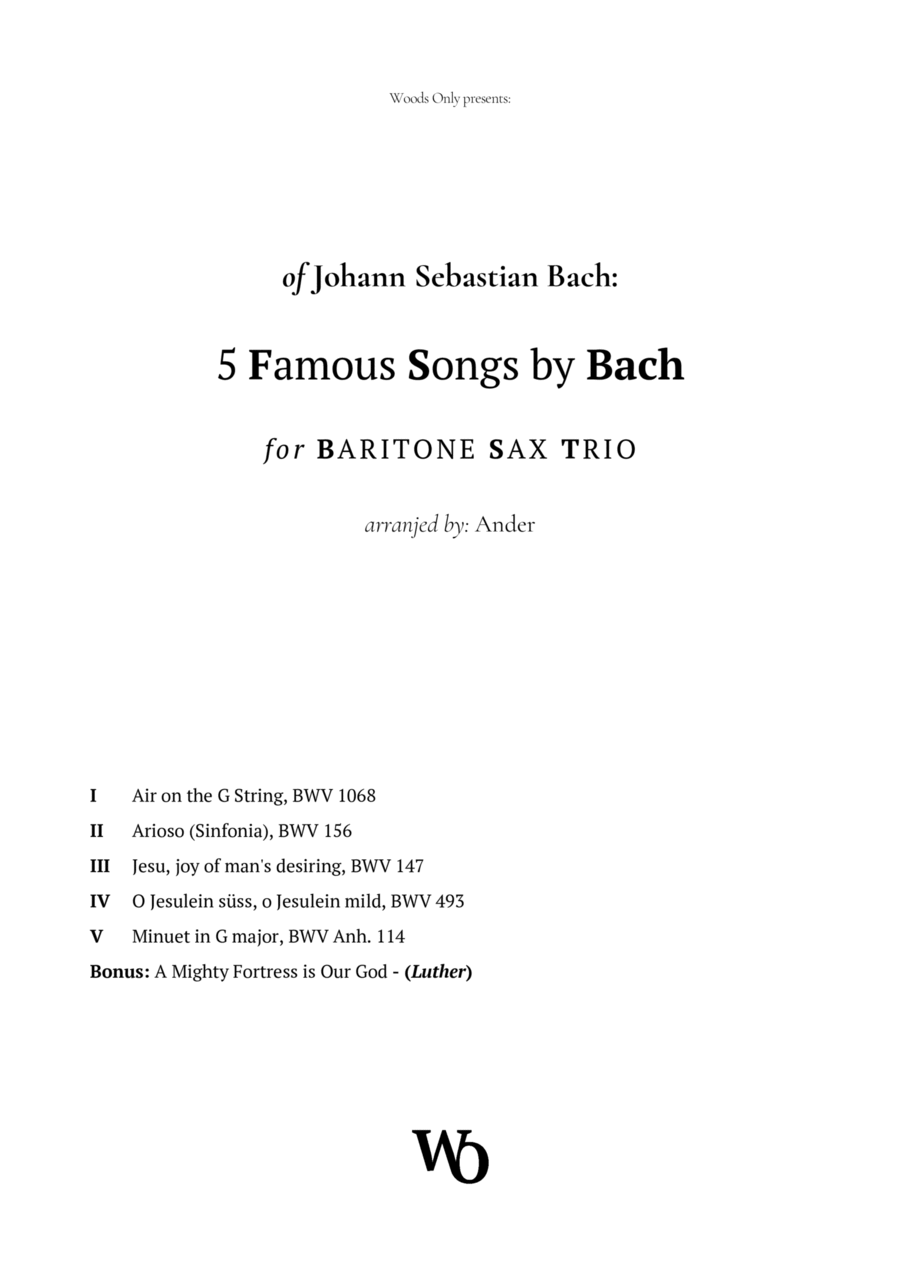
Woodwind Ensemble,Woodwind Quintet Baritone Saxophone - Level 1 - Digital Download SKU: A0.957296 Composed by Bach, Martin Luther. Arranged by Ander. Baroque,Easter,Renaissance,Sacred,Wedding. 51 pages. Woods Only, Arrangements #6748249. Published by Woods Only, Arrangements (A0.957296). This album contains 5 of Johann Sebastian Bach's most famous and versatile pieces for baritone sax quintet, all very well suited for the beginners who want to get to know the baroque repertoire. They are also suitable for performances at events such as: weddings, Christian and church ceremonies, Easter, and academic recitals or concerts. They can be used in music institutions and by teachers as repertoire material and study methods, either for performance or instrumental technique. This collection includes a totally free bonus for you to enjoy: Martin Luther's A Mighty Fortress is Our God, a Renaissance sacred song for choir, which has been adapted for this set. You can also buy each one individually by checking right at the end of each description of each work.1: Air on the G String - The original piece is part of Johann Sebastian Bach's Suite No. 3 for orchestra, in D Major, BWV 1068, written for Prince Leopold of Anhalt. The so-called Air on the G String dates from one of these latter employments. In the service of the Prince of Cöthen, Bach composed not only the famous Brandenburg Concertos, but also several orchestral suites, from the third of which comes the Air on the G String. This curious title derives from a later arrangement of this piece for violin solo, in which the melody is played entirely on the lower, higher string of the instrument. ID: S0.11897772: Arioso - The Cantata 156 (BWV 156) was written for the third Sunday after Epiphany in 1729, and was first performed on January 23 of that year. The text is by Picander, one of Bach's favorite librettists. Of the four cantatas written by Bach for the feast, it was the last and only one scored for solo voice. This is a choral cantata, employing a choral melody in several movements. Cantata 156, in fact, employs two different choral melodies and texts in the second and sixth movements. A cantata is a sung symphony consisting of several parts, one of which is the Arioso, which is the initial instrumental part. ID: S0.11899833: Jesu, joy of man's desiring - This is one of Bach's most beautiful cantatas, made famous by the Jesus the Joy of Men chorus. It was originally composed for Advent 1716 in Weimar. Years later, already in Leipzig, Advent was tempus clausum, there was no music in the churches. Bach then reworked it for the Feast of Mary's Visitation. It is the final chorale of the cantata Herz und Mund und Tat und Leben. Although it is the 32nd cantata composed by Bach, of those that have survived, it was given BWV 147 in the complete catalog of his works. ID: S0.11900374: O Jesulein süss, o Jesulein mild - The Jesulein süß, the Jesulein mild is an original traditional German choral melody for voice and continuous bass arranged by Johann Sebastian Bach around 1735. With lyrics by Valentin Thilo, O Jesulein süss is a sacred melody adapted and catalogued as BWV 493. The first translation is by Dirk van Hogendorp, who made it more of a song for the time of suffering. ID: S0.11901695: Minuet in G major - This famous piece has traditionally been attributed to Johann Sebastian Bach, as it appears in the Notebook for Anna Magdalena , a notebook that Bach gave to his wife Anna Magdalena in 1725 and which was to be filled with the favorite selections of Bach family members. However, recent research has concluded that this minuet, sometimes referred to as BWV Anhang 114. was probably composed by Christian Petzold, a German composer and organist contemporary with Bach. ID: S0.1190375Bonuses: A Mighty Fortress is Our God, by Martin Luther - Ein feste Burg ist unser Gott is a hymn written by Martin Luther probably before 1529. The melody was also considered his work for a long time, but it was created at least with the collaboration of Johann Walter. The song is of great symbolic power for Protestant.
5 Famous Songs by Bach for Baritone Sax Quintet
Quintette de Saxophone: 5 saxophones

$39.99 34.42 € Quintette de Saxophone: 5 saxophones PDF SheetMusicPlus

String Ensemble Viola - Level 4 - Digital Download SKU: A0.813890 Composed by Peter Ilyich Tchaikovsky. Arranged by Regis Bookshar. Christmas,Concert,Instructional,Romantic Period,Standards. Score and parts. 43 pages. Regis Bookshar #6612693. Published by Regis Bookshar (A0.813890). Viola Octet - Advanced/Intermediate - Digital Download. This marvelous arrangement of the March from Peter Ilyich Tchaikovsky's extremely popular, The Nutcracker Suite, would be a fabulous addition to any music library and could be performed for concerts and recitals but would be most appropriate during the Holiday season. This selection has been arranged to keep all of the intensity and excitement of the original composition and is suitable for high school and college students but professional musicians would also enjoy playing this selection. Included are a score and a complete set of parts (43 pages). This selection is one of the many arrangements from The Regis Bookshar Trumpet Ensemble's extensive music library which are being made available for the first time.The Nutcracker is an 1892 two-act ballet with a score by Peter Ilyich Tchaikovsky. It has enjoyed enormous popularity since the late 1960's and is performed by countless ballet companies, primarily during the Christmas season, especially in North America. Tchaikovsky's score has become one of his most famous compositions. Some critics have called it astonishingly rich in detailed inspiration and from beginning to end, beautiful, melodious, original and characteristic. The ballet's first complete performance outside Russia took place in England in 1934. The first complete United States performance was on December 24, 1944, by the San Francisco Ballet. It was such an enormous success that the San Francisco Ballet has presented The Nutcracker every Christmas Eve and throughout the winter season, debuting new productions in 1944, 1954, 1967 and 2004. In Salt Lake City, it has been performed every year since 1963. The New York City Ballet gave its first annual performance in 1954. In addition to annual live stagings of the work, many productions have also been televised or released on home video.The Nutcracker continues to be one of Tchaikovsky's most popular compositions and contains some of his most memorable works. Tchaikovsky made a selection of eight of the numbers from the ballet before the ballet's December 1892 premiere, forming The Nutcracker Suite, Op. 71a, and is intended for concert performance. The suite was first performed, under the composer's direction, on March 19, 1892. The suite became instantly popular with almost every number encored at its premiere.Regis Bookshar thought that it would be wonderful if other instrumentalists could also have the opportunity to play some of these wonderful compositions, originally scored for a full orchestra, and has arranged two of the selections, the popular March and the Russian Dance for a wide variety of instrumental ensembles. So, in addition to this version of the March for a Viola Octet, he has made quite a few other arrangements of this selection for various Quintets and Octets and are readily available. If you should decide to purchase this arrangement of the March, I would highly encourage you to also consider purchasing the arrangement of the Russian Dance as well. Scheduling the March followed by the Russian Dance would be a very satisfying addition to any concert or recital. Please take the time to look for other versions of these compositions. You may find something else that might also suit your needs.I would also encourage you to search for other arrangements by Regis Bookshar, as there are numerous selections in a variety of styles, also available for purchase. You may find something else which might interest you. Please continue to check periodically because new arrangements are being added as often as possible. I'm certain that this wonderful arrangement of the March from Tchaikovsky's marvelous holiday favorite, The Nutcracker Suite, will continue to entertain both performers and audiences alike for years to come.
March (from "The Nutcracker Suite") (F) (Viola Octet)

$32.00 27.55 € PDF SheetMusicPlus

Piano Solo - Level 4 - Digital Download SKU: A0.911583 Composed by Traditional / hymn. Arranged by Masakazu YAMAMOTO. Film/TV,Pop,Spiritual,Standards,Traditional. Score. 3 pages. Motch Music #517612. Published by Motch Music (A0.911583). Arranged for the advanced level. Originally, this song is a hymn, but now it is performed by many artists of various genres. The arrangement carries the gospel vibe with abundant jazz harmonies, so please play it calmly with a sense of prayer. (arr. Masakazu YAMAMOTO)The piece is included in Famous Folk Songs.(Sheet Music Plus / Sheet Music Direct) Works For Piano Original Composition (Sheet Music Plus / Sheet Music Direct)→Music For Children (Sheet Music Plus / Sheet Music Direct) ​Arrangement (Sheet Music Plus / Sheet Music Direct)→Christmas Arrangement (Sheet Music Plus / Sheet Music Direct) Music Analysis (Sheet Music Plus / Sheet Music Direct) ----------------------------------------------------- Motch Music All Sheet Music (Sheet Music Plus / Sheet Music Direct)I have a wide selection of sheet music for various instruments such as piano, ensemble, and concert band. From light and enjoyable pieces to concert-level compositions, we cover a wide range of repertoire. I also provide a rich collection of audio preview.In addition to original compositions and unique arrangements, a lot of text on music analysis is well-received. Please take a look below for more information!Motch Music Web Pagehttps://www.masakazuyamamoto.com/english  
Amazing Grace [Piano solo / advanced]
Piano seul

$5.00 4.3 € Piano seul PDF SheetMusicPlus

String Ensemble Violin - Level 4 - Digital Download SKU: A0.813936 Composed by Peter Ilyich Tchaikovsky. Arranged by Regis Bookshar. Christmas,Concert,Instructional,Romantic Period,Standards. Score and parts. 15 pages. Regis Bookshar #6616013. Published by Regis Bookshar (A0.813936). Violin Octet - Advanced/Intermediate - Digital Download. This marvelous arrangement of the Russian Dance from Peter Ilyich Tchaikovsky's extremely popular, The Nutcracker Suite, would be a fabulous addition to any music library and could be performed for concerts and recitals but would be most appropriate during the Holiday season. This selection has been arranged to keep all of the intensity and excitement of the original composition and is suitable for high school and college students but professional musicians would also enjoy playing this selection. Included are a score and a complete set of parts (15 pages). This selection is one of the many arrangements from The Regis Bookshar Trumpet Ensemble's extensive music library which are being made available for the first time.The Nutcracker is an 1892 two-act ballet with a score by Peter Ilyich Tchaikovsky. It has enjoyed enormous popularity since the late 1960's and is performed by countless ballet companies, primarily during the Christmas season, especially in North America. Tchaikovsky's score has become one of his most famous compositions. Some critics have called it astonishingly rich in detailed inspiration and from beginning to end, beautiful, melodious, original and characteristic. The ballet's first complete performance outside Russia took place in England in 1934. The first complete United States performance was on December 24, 1944, by the San Francisco Ballet. It was such an enormous success that the San Francisco Ballet has presented The Nutcracker every Christmas Eve and throughout the winter season, debuting new productions in 1944, 1954, 1967 and 2004. In Salt Lake City, it has been performed every year since 1963. The New York City Ballet gave its first annual performance in 1954. In addition to annual live stagings of the work, many productions have also been televised or released on home video.The Nutcracker continues to be one of Tchaikovsky's most popular compositions and contains some of his most memorable works. Tchaikovsky made a selection of eight of the numbers from the ballet before the ballet's December 1892 premiere, forming The Nutcracker Suite, Op. 71a, and is intended for concert performance. The suite was first performed, under the composer's direction, on March 19, 1892. The suite became instantly popular with almost every number encored at its premiere.Regis Bookshar thought that it would be wonderful if other instrumentalists could also have the opportunity to play some of these wonderful compositions, originally scored for a full orchestra, and has arranged two of the selections, the popular March and the Russian Dance, one of the character dances, based on the Russian and Ukrainian folk dance, Trepak, for a wide variety of instrumental ensembles. So, in addition to this version of the Russian Dance, for a Violin Octet, he has made quite a few other arrangements of this selection for various Quintets and Octets and are readily available. If you should decide to purchase this arrangement of the Russian Dance, I would highly encourage you to also consider purchasing the arrangement of the March as well. Scheduling the March followed by the Russian Dance would be a very satisfying addition to any concert or recital. Please take the time to look for other versions of these compositions. You may find something else that might also suit your needs.I would also encourage you to search for other arrangements by Regis Bookshar, as there are numerous selections in a variety of styles, also available for purchase. You may find something else which might interest you. Please continue to check periodically because new arrangements are being added as often as possible. I'm certain that this wonderful arrangement of the Russian Dance from Tchaikovsky's marvelous holiday favorite, The Nutcracker Suite, will continue to entertain bot.
Russian Dance ("Trepak") (from "The Nutcracker Suite") (F) (Violin Octet)

$16.00 13.77 € PDF SheetMusicPlus

Saxophone Ensemble,Woodwind Ensemble Alto Saxophone,Baritone Saxophone,Tenor Saxophone - Level 4 - Digital Download SKU: A0.813927 Composed by Peter Ilyich Tchaikovsky. Arranged by Regis Bookshar. Christmas,Instructional,Romantic Period,Standards. 15 pages. Regis Bookshar #6615191. Published by Regis Bookshar (A0.813927). Saxophone Octet - Advanced/Intermediate - Digital Download. This marvelous arrangement of the Russian Dance (Trepak), from Peter Ilyich Tchaikovsky's extremely popular, The Nutcracker Suite, would be a fabulous addition to any music library and could be performed for concerts and recitals but would be most appropriate during the Holiday season. This selection has been arranged to keep all of the intensity and excitement of the original composition and is suitable for high school and college students but professional musicians would also enjoy playing this selection. Included are a score and a complete set of parts (15 pages). This selection is one of the many arrangements from The Regis Bookshar Trumpet Ensemble's extensive music library which are being made available for the first time.The Nutcracker is an 1892 two-act ballet with a score by Peter Ilyich Tchaikovsky. It has enjoyed enormous popularity since the late 1960's and is performed by countless ballet companies, primarily during the Christmas season, especially in North America. Tchaikovsky's score has become one of his most famous compositions. Some critics have called it astonishingly rich in detailed inspiration and from beginning to end, beautiful, melodious, original and characteristic. The ballet's first complete performance outside Russia took place in England in 1934. The first complete United States performance was on December 24, 1944, by the San Francisco Ballet. It was such an enormous success that the San Francisco Ballet has presented The Nutcracker every Christmas Eve and throughout the winter season, debuting new productions in 1944, 1954, 1967 and 2004. In Salt Lake City, it has been performed every year since 1963. The New York City Ballet gave its first annual performance in 1954. In addition to annual live stagings of the work, many productions have also been televised or released on home video.The Nutcracker continues to be one of Tchaikovsky's most popular compositions and contains some of his most memorable works. Tchaikovsky made a selection of eight of the numbers from the ballet before the ballet's December 1892 premiere, forming The Nutcracker Suite, Op. 71a, and is intended for concert performance. The suite was first performed, under the composer's direction, on March 19, 1892. The suite became instantly popular with almost every number encored at its premiere.Regis Bookshar thought that it would be wonderful if other instrumentalists could also have the opportunity to play some of these wonderful compositions, originally scored for a full orchestra, and has arranged two of the selections, the popular March and the Russian Dance, one of the character dances, based on the traditional Russian and Ukrainian folk dance, Trepak, for a wide variety of instrumental ensembles. So, in addition to this version of the Russian Dance for a Saxophone Octet, consisting of 4 Alto Saxophones, 3 Tenor Saxophones and 1 Baritone Saxophone, he has made quite a few other arrangements of this selection for various Quintets and Octets and are readily available. If you should decide to purchase this arrangement of the Russian Dance, I would highly encourage you to also consider purchasing the arrangement of the March as well. Scheduling the March followed by the Russian Dance would be a very satisfying addition to any concert or recital. Please take the time to look for other versions of these compositions. You may find something else that might also suit your needs.I would also encourage you to search for other arrangements by Regis Bookshar, as there are numerous selections in a variety of styles, also available for purchase. You may find something else which might interest you. Please continue to check periodically because new arrangements are being added as often as possible. I'm certain that this wonderful arrangement of the Russian Dance from Tchaikovsky's marve.
Russian Dance ("Trepak") (from "The Nutcracker Suite") (F) (Saxophone Octet - 4 Alto, 3 Tenor 1 Bari
Ensemble de saxophones

$16.00 13.77 € Ensemble de saxophones PDF SheetMusicPlus

String Orchestra - Digital Download SKU: A0.933521 Composed by Ludwig van Beethoven, Cees Nieuwenhuizen. Arranged by Upstream Music. Classical. Score and parts. 18 pages. Upstream Music #6353295. Published by Upstream Music (A0.933521). Both the Adagio molto (Hess 40) and the unfinished, originally intended Fugue date from November, 1817. It was the publisher Tobias Haslinger who requested a prelude and fugue for a publication in line with works published earlier. Beethoven completed the prelude but with the fugue he stopped after merely four bars of music. The short original fugue theme was later inserted into the second part (Molto vivace) of the Ninth Symphony (Opus 125).The prelude (Beethoven did not give any time indication) starts with 37 bars of solemn music followed by 12 bars Allegro. In terms of form, rhythm, and key, this material shows great similarity to the Molto vivace from Opus 125 referred to above. The present version has been arranged for a string orchestra instead of for a string quintet, thus being the first publication which enables it to be performed in its entirety. In order to balance the foundation, I opted for introducing a contrabass part, which largely follows the cello part composed by Beethoven. As regards the phrasing, dynamics, and rests as well as the time indication, this publication follows those in Willy Hess’ publication. So the prescribed time ‘Adagio molto’ is not that of Beethoven himself.The arguments to link the Maestoso to the Fugue in D major (Opus 137) published later are multiple. In the first place, the Fugue also dates from 1817. Secondly, the key is the same as is the number of instruments for a string quintet with two separate alto parts. Not only does the original fugue theme start at the tone a, but the timing too is the same, that is 3/8. So it seems reasonable to assume that Beethoven intended both works as a couple.The abnormal rhythmics of the bars 38 up to and including 49 is remarkable. I have preserved it because the part has been authentically composed by Beethoven, while it did not seem logical to me to have it immediately followed by the Fugue completed by myself. I have composed a number of bars of music based on the beginning of the prelude by way of a smooth transition.In the Fugue, I closely adhere to Beethoven, at the same time introducing a contrabass part here as well, so as to support the cello. At a number of places in the score, Beethoven recorded neither music nor rests. This refers to the bars 5 (second viola and cello), 11, 12, 25 and 26 (first and second violins), 39 to 41 (all parts), 43 and 44 (all parts except the first violin), 45 (first viola) and finally 45 and 46 (second violin). As in Willy Hess’ publication, I have just inserted rests here.
Maestoso and Fugue in D minor for String Orchestra - Based on Ludwig van Beethoven Unv 7 Hess 40 & O
Orchestre à Cordes

$29.00 24.96 € Orchestre à Cordes PDF SheetMusicPlus

Solo Guitar - Level 4 - Digital Download SKU: A0.1261509 Composed by Antonio Jiménez Manjón. Arranged by Rui Namora. 19th Century,Classical,Romantic Period. Individual part. 11 pages. Rui Namora #854571. Published by Rui Namora (A0.1261509). This beautiful étude, originally written for the 11-string guitar (7+4) that Antonio Manjón used, is practically unknown today. Although it was composed as an étude for this instrument, this arrangement for the 6-string guitar doesn't fail to capture its beauty. The 7-string version is faithful to the original, regarding the bass notes. This set includes a new engraving of the original in double staff and both 6 and 7 string guitar standard notation. Antonio Jimenéz Manjón (1866-1919)Antonio Jiménez Manjón was a Spanish guitarist born in 1866 in the Andalusian city of Villacarillo. Blind from an early age, he began his musical career at the age of twelve, performing in Spain and Portugal, where he played for the Portuguese King Fernando II.Soon after, the young Antonio traveled to Paris alone, where he studied violin at the Conservatory while pursuing his guitar career. He was surrounded by musicians such as Gounod, Saint-Saëns, and Sarasate.In 1887, Manjón returned to his home country and was invited by the Spanish monarchs to perform in the Royal Palace. During those years, he toured Europe with his Torres eleven-string guitar. In 1893, he crossed the Atlantic to the Americas, settling in Buenos Aires in 1902 after performing and teaching in several Latin American countries.In Argentina, he founded a conservatory and published his work Escuela de Guitarra.Antonio Jiménez Manjón passed away in 1919 in Buenos Aires.ISMN 979-0-9007524-5-1  
Preludio in A (estudio nº15)
Guitare

$6.00 5.16 € Guitare PDF SheetMusicPlus

Concert Band (optional solo piano) - intermediate - Digital Download SKU: AQ.AMC-WB-003SCO Composed by Francis Johnson. Arranged by Kenneth Amis. Music of Black Composers and Artists. Conductor score. 40 pages. Amis Musical Circle - Digital #AMC-WB-003SCO. Published by Amis Musical Circle - Digital (AQ.AMC-WB-003SCO). 11 x 17 inches.The 1818 publication of Francis Johnson's A Collection of New Cotillions marks the first known publication of original music by a black composer in the United States. A prolific composer, instrumentalist, teacher and conductor, Johnson led a varied and successful career in an era in U.S. history that was not inviting to black professionals. His musical interests ranged from the contemporary works of Johann Strauss Jr. to traditional, popular dances.The cotillion is a French country dance that was popular in Europe and America in the 18th century. It was originally danced by four couples in square formation and was an important influence in the development of the square dance in the United States. Francis Johnson composed two sets of six piano accompaniments for this dance. The original 1818 publication even included movement instructions for the eight dancers. The short and charming melodies that he composed are a fitting example of popular dance music of the time.This transcription may be performed as a piano solo, with the piano as a non-solistic instrument within the ensemble or without piano at all. If it is to be a piano solo, the other instruments should not play the passages marked “opt. tacet (optional tacet). If the piano will not be treated soloistically, the conductor can have some or all of the “opt. tacet passages played at their discretion. When there is no piano involved in the performance ,all instrumentalists should ignore the “opt. tacet instruction and play everything.
A Collection of New Cotillions First Set - CONDUCTOR'S SCORE ONLY
Orchestre d'harmonie

$12.00 10.33 € Orchestre d'harmonie PDF SheetMusicPlus

Woodwind Ensemble Clarinet - Level 4 - Digital Download SKU: A0.813173 Composed by George Frideric Handel. Arranged by Regis Bookshar. Baroque,Christmas,Instructional,Sacred,Standards. 20 pages. Regis Bookshar #6130557. Published by Regis Bookshar (A0.813173). Clarinet Quintet - Advanced/Intermediate - Digital Download. This selection, And the Glory of the Lord, from George Frideric Handel's world-famous oratorio, Messiah, would be an excellent addition to any music library. Originally written for a four-part chorus accompanied by a small orchestra, this selection has been arranged for 5 Clarinets, by Regis Bookshar, without losing any of the vitality of the original version. I'm certain that this exciting arrangement will entertain both performers and audiences alike for years to come. It is perfect for Christmas concerts and church services, is suitable for high school, college and professional performers and is one of my all-time favorite arrangements. Included are a score and a complete set of parts (20 pages). Handel's original version is written in the key of Concert G, as is this version, but other versions are also available for a variety of instrumental ensembles, both in the key of Concert G and also in the key of Concert F, to make it a little easier for some younger performers. However, this arrangement may still prove to be a challenge for some players. If you are considering having an organist or other keyboard player perform with this selection, I would suggest that you purchase this version in Concert G rather than the one in Concert F. Other selections from Handel's Messiah are also available, as are numerous other arrangements in a variety of styles. I would encourage you to search for other arrangements by Regis Bookshar. You may find something else which might interest you as well. I'm certain that students and audiences will definitely enjoy this arrangement.
And the Glory of the Lord (from "Messiah") (G) (Clarinet Quintet)
Ensemble de Clarinettes

$24.00 20.66 € Ensemble de Clarinettes PDF SheetMusicPlus


Partitions Gratuites
Acheter des Partitions Musicales
Acheter des Partitions Digitales à Imprimer
Acheter des Instruments de Musique

© 2000 - 2026

Accueil - Version intégrale