EUROPE
170031 articles
USA
0 articles
DIGITAL
985048 articles (à imprimer)
Partitions Digitales
Partitions à imprimer
985048 partitions trouvées


Piano Quartet Cello,Piano,Viola,Violin - Level 1 - Digital Download SKU: A0.1229458 Composed by Wolfgang Amadeus Mozart. Arranged by André Nusa. Chamber,Classical. 9 pages. Andre_Nusa #825307. Published by Andre_Nusa (A0.1229458). This easy piano quartet arrangement of the second movement of Mozart's Piano Concerto No. 27 is a beautiful and enchanting piece that highlights the delicate and romantic side of Mozart's music. The arrangement begins with a gentle and flowing introduction that sets the tone for the piece played by the strings. The piano provides a beautiful harmonic accompaniment. The melody is simple yet beautiful, with a graceful and flowing quality that is characteristic of Mozart's music.Instrumentation: Piano, violin, viola and cello. The piece is suitable for begginer players.
Piano Concerto No.27
Piano Quatuor: piano, violon, alto, violoncelle

$7.99 6.91 € Piano Quatuor: piano, violon, alto, violoncelle PDF SheetMusicPlus

Instrumental Duet,Piano Piano,Violin - Level 4 - Digital Download SKU: A0.572509 Composed by James Michael Stevens. Arranged by James Michael Stevens. 20th Century,Holiday,Sacred,Standards,Wedding. 11 pages. James M Stevens Music ASCAP #3562017. Published by James M Stevens Music ASCAP (A0.572509). This is an original composition for Violin & Piano in a romantic style in the key of G major. It was originally published as a piano solo in the key of A, but rewritten here with an added intro. There are separate violin and piano parts in the score for easy performance and the piano can serve as a stand alone solo. The track as heard is available under Love's Mystery Piano Track. James Michael Stevens is a prolific composer residing in Nashville, TN and serves as the Music Department Chairman of Welch College. https://youtu.be/l2IOilIW1iU
Love's Mystery Unveiled In You - Violin & Piano
Violon et Piano

$6.99 6.05 € Violon et Piano PDF SheetMusicPlus

Baritone Saxophone,Piano - Level 2 - Digital Download SKU: A0.549018 Composed by Franz Schubert. Arranged by James M. Guthrie, ASCAP. Holiday,Romantic Period,Sacred,Standards. Score and part. 10 pages. Jmsgu3 #3447449. Published by jmsgu3 (A0.549018). Baritone Sax version of Moment Musicaux, Op. 94 (D. 780) No. 3 by Franz Schubert, published in 1828. Duration: 1:53 Score 6 pg. 54 ms. Bari Sax 1 pg. Piano part 3 pg. One of Schubert's most well-known pieces. This is an effective recital encore due to its brevity and range of expression. Could work well for a variety of occasions: wedding receptions, church services (Easter), and anniversaries. It seems like a pleasant dance, unlike some previous dance music. Schubert improvised these dances at parties for his friends.  Although conceived on-the-fly, these dances are the work of a genius. Composers have similarly elevated dance music to artistic status. As a result, they freed it from the original purpose of dancing. Certainly, the older masters used the dance forms as vehicles for complex treatments. Here, however, Schubert retains the dance-like quality while finally expressing his innermost thoughts and emotions. The dance is certainly filled with a doleful expression, yet the texture remains even more light and refined. Therefore, to perform these with sensitivity we probably need to use a light but accurate touch. The accompaniment pattern needs to be crisp and delicate – probably even in the more forceful parts. The piano pedal should also be used very carefully so as a result not to blur the outline. Instead, it should contribute to the dynamic quality of the piece. Schubert Franz Schubert (1797–1828) was, in fact, a famous Austrian composer. Moreover, he composed during the late Classical and early Romantic periods. Schubert was comparatively prolific. He wrote more than 600 secular vocal works, seven symphonies, and, correspondingly, a massive amount of piano and chamber music. Critics agree, as a matter of fact, that his most famous works include his Piano Quintet in A major, D. 667 (also known as the Trout Quintet), the Symphony No. 8 in B minor, D. 759 (Unfinished Symphony), the last sonatas for piano (D. 958–960), and the song cycles Die schöne Müllerin (D. 795) and Winterreise (D. 911). Education Schubert was furthermore a musical child prodigy. He studied violin with his father as well as piano with his older brother. In addition, when Schubert was eleven he studied at Stadtkonvikt school, where he became familiar with the orchestral music of Haydn, Mozart, and likewise Beethoven. In due time he left school and returned home where he studied to become an educator; nevertheless, he continued studying composition with Antonio Salieri. Performance Eventually, Schubert was admitted to the Gesellschaft der Musikfreunde as a performer. This appointment straightaway established his name in Vienna as a composer and pianist. Finally, he gave his only composition recital in 1828. He died suddenly a few months later probably due to typhoid fever. Legacy Schubert’s music was by and large underappreciated while he was alive. There were all in all only a few enthusiasts in Vienna. After he died, however, interest in his work in fact increased. Felix Mendelssohn, Robert Schumann, Franz Liszt, Johannes Brahms, and other famous composers in due time discovered his compositions. Nowadays, historians rank Schubert expressly among the greatest composers of the era, and his music remains in general very popular.
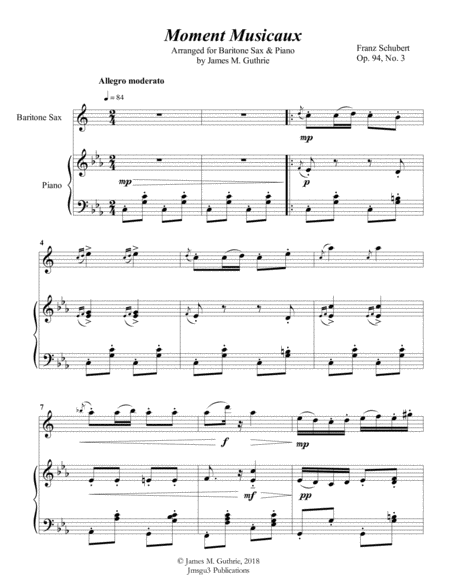
Schubert: Moment Musicaux for Baritone Sax & Piano
Saxophone Baryton, Piano

$32.95 28.52 € Saxophone Baryton, Piano PDF SheetMusicPlus

C Instrument,Folk Instrument,Instrumental Solo,Piano,Treble Clef Instrument,Zither - Level 2 - Digital Download SKU: A0.565928 By Sharon Wilson. By George Frideric Handel and Isaac Watts. Arranged by Sharon Wilson. Advent,Baroque,Christmas,Classical,Sacred. Score and individual part. 5 pages. Sharon Wilson #6597479. Published by Sharon Wilson (A0.565928). Here is an easy instrumental duet arrangement (for BOWED PSALTERY solo with PIANO accompaniment) of the classic Christmas carol Joy to the World using the tune ANTIOCH by George F. Handel and lyrics by Isaac Watts. The psaltery part was designed for a beginning psaltery player and is written in the key of C major with no sharps or flats. The piano accompaniment is at the intermediate level. To assist those new to reading music notation, two solo parts are included: one is the standard music notation and includes the lyrics for sing along enjoyment. The second solo part is identical to the standard music but instead of lyrics, the note names are provided below each note (example A, B, C. . .). The psaltery plays the melody for one verse. An optional repeat is included in case a longer selection is desired. A piano accompaniment and/or rehearsal track (MP3 format) is available for this arrangement as a separate purchase: Joy to the World (Piano Accompaniment Track for Easy Bowed Psaltery Solo).The range of a typical soprano psaltery is two octaves beginning with the G above middle C (G4). However, since some psalteries have fewer than 25 strings, the range for this song is only one octave. Also, the notes are written an octave lower on the staff to avoid the ledger line notes that would be required to notate the upper notes. The notated range for this song is C4 (middle C) to C5 (one octave above middle C).The purchase price includes a combined score (grand staff, 3-stave) with both parts (PSALTERY and PIANO) on each page, plus 2 options for the 1-staff solo part (one with lyrics, one with alphabetic note names). This arrangement is one of the 10 songs in the collection Christmas Carols (A Collection of 10 Easy Bowed Psaltery Solos with Piano Accompaniment).Visit Sharon Wilson's website: https://www.sharonwilsonmusic.com/Subscribe to her YouTube Channel: https://youtube.com/@SharonWilsonMusic
Joy to the World (Easy Bowed Psaltery Solo with Piano Accompaniment)
Accompagnement Piano
Sharon Wilson
$3.99 3.45 € Accompagnement Piano PDF SheetMusicPlus

Flute,Piano - Level 3 - Digital Download SKU: A0.549643 Composed by Ludwig van Beethoven. Arranged by James M. Guthrie, ASCAP. Concert,Instructional,Romantic Period,Sacred,Standards. Score and part. 16 pages. Jmsgu3 #3516599. Published by jmsgu3 (A0.549643). Duration: ca 5:20, Score: 8 pages, solo part: 3 pages, piano part: 4 pages. One of Beethoven's finest and most famous works. Program for a recital, church meditation or school program. Bring your best espressivo and plan to rehearse the many subtle dynamic changes.Sonata Pathétique Op. 13 First of all, this is an arrangement of the second movement of Beethoven’s Sonata Pathétique. It seems like Beethoven wrote this piece before becoming troubled by deafness. Published in 1799, it consequently remains one of the most celebrated pieces Beethoven ever wrote. As a result of its popularity, the movement was therefore performed by Karl Haas. Hass recorded it for a popular radio show called: Adventures in Good Music. Beethoven Background Ludwig van Beethoven (1770 –1827) was certainly a German pianist. Above all, he was probably one of the greatest composers in history. As a result, he is a pivotal character in the progress between the Classical and Romantic periods. He is certainly one of the most famous and hence important of all composers. Seems like his most familiar and noteworthy works include symphonies 1-9; piano concertos 1-5; and furthermore, the violin concerto. Also, certainly of extreme importance are the noteworthy 32 sonatas for the piano; the string quartets 1-16; the Missa solemnis; and likewise, his only opera, Fidelio. Beethoven Overview First of all, Beethoven was born and consequently raised in Bonn. Upon turning 21 he moved to Vienna probably to study composition with Haydn. That’s when he consequently grew a reputation as a brilliant pianist. Furthermore, he probably stayed in Vienna for the rest of his life. In his late 20s, it seems like his hearing certainly began to decline. It slowly declined until consequently, he was nearly totally deaf probably by the last decade of his life. As a result, he stopped conducting and performing. Nevertheless, he continued to compose. As a result, some of his greatest works probably come from this period. First Period Seems like we often divide Beethoven’s life into three periods. Period 1 begins with Beethoven’s arrival in Vienna. Hence, during this period, he mastered the Viennese style of Haydn & Mozart. He consequently began increasing the size and scale of his works. Furthermore, he experimented with extreme dynamics, and likewise extreme tempi. He worked similarly with chromatic harmony. His First and Second Symphonies, therefore, belong to this period. Other important works also belong here: the first six string quartets and the Sonata Pathétique, Op. 13. Second Period His second period probably began as soon as he realized that he was going deaf. During this period, it seems like he became obsessed with the idea of heroism. His works consequently become even larger and more massive. The most noteworthy of these include the symphonies 3 – 8, piano concertos 5& 6, 5 string quartets, several important piano sonatas (Waldstein and Appassionata), the Kreutzer violin sonata, the violin concerto and his only opera: Fidelio. Third Period In contrast, Beethoven's third period is branded above all by works of incredible intellectual depth, formal innovation, and penetrating expression. It seems like he continued to expand his works. Consequently, the string quartet Op. 131 spills over into seven connected movements. Likewise, in the Ninth Symphony, he adds choral forces to his orchestra probably for the first time in history. Even more, other works from this period include his Missa solemnis, the final 5 string quartets (including the enormous Große Fuge) and the final five sonatas for piano.    Register for free lifetime revisions and updates at www.jamesguthrie.com
Beethoven: Adagio from Sonata Pathetique for Alto Flute & Piano
Flûte traversière et Piano

$24.95 21.59 € Flûte traversière et Piano PDF SheetMusicPlus

Easy Piano - Level 2 - Digital Download SKU: A0.1259062 Composed by Michal Kleofas Oginski. Arranged by Darek. Classical,Patriotic,Romantic Period,Traditional. Score. 3 pages. Darek #852326. Published by Darek (A0.1259062). Polonaise in A Minor (EASY PIANO) Farewell to the Homeland [Michał Kleofas Ogiński]Simplified arrangement for pianists of Polonaise in A Minor Farewell to the Homeland (Polonez A-moll „Pozegnanie Ojczyzny†/ Polonez „Pożegnanie Ojczyzny†/ „Les adieux à la Patrie)  by Michał Kleofas Ogiński (Michal Kleofas Oginski). Easy version for beginner pianists / Easy piano arrangement.  Included: Fingering and video Youtube tutorial.  Step into the world of classical music with my exclusive collection of Polonaise in A Minor Farewell to the Homeland sheet music, specifically tailored for beginner pianists. Unveil the beauty of Michał Kleofas Ogiński's masterpiece, also known as Polonez A-moll Pożegnanie Ojczyzny or Les adieux à la Patrie, as you embark on your musical journey. Designed with aspiring pianists in mind, my sheet music offers an easy-level approach to learning this timeless composition. Delve into the enchanting melodies and discover the emotional depth of the Romantic era through this captivating piece. To ensure a seamless learning experience, each sheet includes Fingering instructions meticulously crafted by expert musicians. These markings guide your hands effortlessly across the keys, enabling you to master the piece with precision and grace. In addition to the sheet music, my package includes a YouTube tutorial video that accompanies the composition. This invaluable resource provides visual guidance, allowing you to observe and learn from skilled pianists as they bring the piece to life. Immerse yourself in their expertise and uncover the nuances of the composition with ease. My sheet music is more than just a collection of notes; it's a gateway to musical expression. As you familiarize yourself with the piano and delve into the intricacies of the composition, you'll discover the joy of creating harmonious melodies and evoking emotions through your fingertips. Positioned perfectly for optimal online visibility, my product caters to those seeking beginner-friendly sheet music, the beauty of classical compositions, and the charm of the Romantic era. Embrace the power of music and embark on a fulfilling journey as you explore the enchanting realm of the piano. Unlock your musical potential and experience the timeless allure of notes, music, and the piano. Begin your musical odyssey today and immerse yourself in the melodies of the Polonaise in A Minor Farewell to the Homeland. Let the music resonate within you as you embrace the artistry of playing the piano.
Polonaise in A Minor (EASY PIANO) "Farewell to the Homeland" [Michał Kleofas Ogiński]
Piano Facile

$3.00 2.6 € Piano Facile PDF SheetMusicPlus

Flute,Piano - Level 3 - Digital Download SKU: A0.754435 Composed by John Henry Newton. Arranged by Nick Raspa. Christmas,Easter,Praise & Worship,Sacred. Score and part. 1 pages. NJR Music #4822107. Published by NJR Music (A0.754435). This is the flute part for Amazing Grace (arranged for Flute & Piano).The piano part is available separately at:Sheet Music Plus https://www.sheetmusicplus.com/title/amazing-grace-flute-piano-piano-part-digital-sheet-music/21420786Sheet Music Direct https://www.sheetmusicdirect.com/en-US/se/ID_No/850876/Product.aspxThere is also a piano backing track available at:Sheet Music Plus https://www.sheetmusicplus.com/title/amazing-grace-flute-piano-backing-track-digital-sheet-music/21402084?ac=1 ASCAP.
Amazing Grace (Flute & Piano) Flute part
Flûte traversière et Piano

$5.00 4.33 € Flûte traversière et Piano PDF SheetMusicPlus

Piano,Tenor Saxophone - Level 3 - Digital Download SKU: A0.549642 Composed by Ludwig van Beethoven. Arranged by James M. Guthrie, ASCAP. Concert,Instructional,Romantic Period,Sacred,Standards. Score and part. 16 pages. Jmsgu3 #3516585. Published by jmsgu3 (A0.549642). Duration: ca 5:20, Score: 8 pages, solo part: 3 pages, piano part: 4 pages.One of Beethoven's finest and most famous works. Program for a recital, church meditation or school program.Bring your best espressivo and plan to rehearse the many subtle dynamic changes.Sonata Pathétique Op. 13 First of all, this is an arrangement of the second movement of Beethoven’s Sonata Pathétique. It seems like Beethoven wrote this piece before becoming troubled by deafness. Published in 1799, it consequently remains one of the most celebrated pieces Beethoven ever wrote. As a result of its popularity, the movement was therefore performed by Karl Haas. Hass recorded it for a popular radio show called: Adventures in Good Music. Beethoven Background Ludwig van Beethoven (1770 –1827) was certainly a German pianist. Above all, he was probably one of the greatest composers in history. As a result, he is a pivotal character in the progress between the Classical and Romantic periods. He is certainly one of the most famous and hence important of all composers. Seems like his most familiar and noteworthy works include symphonies 1-9; piano concertos 1-5; and furthermore, the violin concerto. Also, certainly of extreme importance are the noteworthy 32 sonatas for the piano; the string quartets 1-16; the Missa solemnis; and likewise, his only opera, Fidelio. Beethoven Overview First of all, Beethoven was born and consequently raised in Bonn. Upon turning 21 he moved to Vienna probably to study composition with Haydn. That’s when he consequently grew a reputation as a brilliant pianist. Furthermore, he probably stayed in Vienna for the rest of his life. In his late 20s, it seems like his hearing certainly began to decline. It slowly declined until consequently, he was nearly totally deaf probably by the last decade of his life. As a result, he stopped conducting and performing. Nevertheless, he continued to compose. As a result, some of his greatest works probably come from this period. First Period Seems like we often divide Beethoven’s life into three periods. Period 1 begins with Beethoven’s arrival in Vienna. Hence, during this period, he mastered the Viennese style of Haydn & Mozart. He consequently began increasing the size and scale of his works. Furthermore, he experimented with extreme dynamics, and likewise extreme tempi. He worked similarly with chromatic harmony. His First and Second Symphonies, therefore, belong to this period. Other important works also belong here: the first six string quartets and the Sonata Pathétique, Op. 13. Second Period His second period probably began as soon as he realized that he was going deaf. During this period, it seems like he became obsessed with the idea of heroism. His works consequently become even larger and more massive. The most noteworthy of these include the symphonies 3 – 8, piano concertos 5& 6, 5 string quartets, several important piano sonatas (Waldstein and Appassionata), the Kreutzer violin sonata, the violin concerto and his only opera: Fidelio. Third Period In contrast, Beethoven's third period is branded above all by works of incredible intellectual depth, formal innovation, and penetrating expression. It seems like he continued to expand his works. Consequently, the string quartet Op. 131 spills over into seven connected movements. Likewise, in the Ninth Symphony, he adds choral forces to his orchestra probably for the first time in history. Even more, other works from this period include his Missa solemnis, the final 5 string quartets (including the enormous Große Fuge) and the final five sonatas for piano.    
Beethoven: Adagio from Sonata Pathetique for Tenor Sax & Piano
Saxophone Tenor et Piano

$24.95 21.59 € Saxophone Tenor et Piano PDF SheetMusicPlus

Piano,Vocal,Voice - Level 3 - Digital Download SKU: A0.1025435 Composed by Samuel Warren Hatch. 20th Century,Contemporary,Jazz. Score. 9 pages. Samuel Warren Hatch #4764165. Published by Samuel Warren Hatch (A0.1025435). Piano Sonata No. 1 in E Major is the first series of concert piano works by S. Warren Hatch, written during his undergraduate study at Campbell University. Each movement is distinct, in that each of them is composed in a different form, utilizes different key changes and scales, and takes influence from a different period in classical music. While there is no theme that connects them to one another, they are all in the key of E Major and consist mostly of a waltz-like feeling. III. A Reflection of Passing depicts the shifting aspects about death as a person matures. It’s a piece that came from a time of great loss and much grieving. It begins with an innocent, hopeful understanding of death, followed by a major tone shift, where there is an odd utilization of the piano: the performer sings into the piano while holding down the sustain pedal, which vibrates certain overtones, producing what sounds like a distant choir. The piece closes with a triumphant, hopeful melody, borrowed from a song written by S. Warren Hatch when he was in high school.Composer Notes- Be sure to ensure that the stage hands lift the piano lid before the sonata’s start, as the strings will need to be exposed in order for you to sing into the piano’s body during A Reflection of Passing. For that section (page 22) you will need to face and sing directly into the strings while holding down the sustain pedal for the entire page. If you are playing with the sheet music (don’t worry, I’m not shaming you) simply slide the music holder in order to expose the part of the strings that are closest to you. For this sonata, I encourage you to find your own voice in these pieces. Your own interpretation should align with how you most relate to the message/story they’re telling. This could be using the una corda (leftmost) pedal during lighter sections to further differentiate them, or having a heavier rubato to strengthen the impact of certain phrases. As long as you bring these pieces to life, then it has my stamp of approval.
Piano Sonata No. 1 Movement 3 "Reflection of Passing"
Piano, Voix

$3.99 3.45 € Piano, Voix PDF SheetMusicPlus

Cello,Piano - Level 2 - Digital Download SKU: A0.565497 By Sharon Wilson. By Benjamin R. Hanby. Arranged by Sharon Wilson. Children,Christmas,Folk,Standards,Traditional. Score and part. 6 pages. Sharon Wilson #4638871. Published by Sharon Wilson (A0.565497). Here is a straight-forward duet arrangement (for CELLO solo with PIANO accompaniment) of the famous Christmas tune Up On the Housetop. The CELLO plays the melody for the first verse and then for the second verse, the PIANO plays the melody while the CELLO adds broken-chord harmony.  All notes for the CELLO are playable in the first position making this arrangement an excellent choice for early-intermediate string players. The PIANO accompaniment is written for an intermediate player. This fun-to-learn arrangement is a welcome addition to the repertoire for beginning cello students and suitable for recitals or just some family fun around the piano during the holiday season.  The purchase price includes a 4-page combined score with both CELLO and PIANO parts on each page plus a separate 1-staff score for the CELLO solo (1 page). This arrangement is one of the 10 songs in the collection Holiday Classics (A Collection of 10 Easy Cello Solos with Piano Accompaniment).Visit Sharon Wilson’s website: www.SharonWilsonMusic.comSubscribe to her YouTube Channel: www.youtube.com/user/SharonWilsonMusic
Up On the Housetop (Easy Cello Solo with Piano Accompaniment)
Violoncelle, Piano
Sharon Wilson
$4.99 4.32 € Violoncelle, Piano PDF SheetMusicPlus

Piano,Trumpet - Level 5 - Digital Download SKU: A0.787336 Composed by Greg Bartholomew. 20th Century,Concert,Contemporary,Standards. Score and part. 12 pages. Burke & Bagley #2586649. Published by Burke & Bagley (A0.787336). Originally composed for alto flute & piano in 2015 for Lish Lindsey and Markus Kaitila for their March 8, 2015, performance on the Composer's Voice concert series in New York, Canopy references the light and colors of a canopy formed by trees, fruits hanging from the trees, birds making their home within the canopy, sun-dappled shadows on the ground below and the sky above seen through the canopy.  It is also available for trumpet & piano, viola & piano, and cello & piano.  Duration: ca. 3'30Download free piano accompaniment track:  http://www.gregbartholomew.com/piano/BB325P.mp3
Canopy for trumpet & piano
Trompette, Piano

$9.95 8.61 € Trompette, Piano PDF SheetMusicPlus

Easy Piano - Level 2 - Digital Download SKU: A0.1271947 Composed by George Frideric Handel. Arranged by Darek. Baroque,Classical,Early Music. Score. 2 pages. Darek #864298. Published by Darek (A0.1271947). Gavotte in G Major (EASY PIANO) (HWV 491) [George Frideric Handel]Simplified arrangement for pianists of Gavotte in G Major (HWV 491) by George Frideric Handel. Easy version for pianists | Easy piano arrangement | Beginner Version | Easy Piano Sheet Music For Beginners. Included: Fingering, Dynamics, Articulations and video YouTube tutorial.  Delight in the enchanting melodies of George Frideric Handel's Gavotte in G Major (HWV 491) with my Easy Piano Sheet Music collection. Tailored for beginner pianists, this exquisite Easy Level arrangement allows you to immerse yourself in the captivating beauty of Handel's composition from the Baroque era. Step into the fascinating world of classical music as you explore the graceful melodies of this timeless piece. With meticulously notated Fingering, Articulation, and Dynamics, you can effortlessly express the piece's emotional depth and artistic brilliance. Accelerate your learning journey with the included Youtube video tutorial, thoughtfully designed to guide you in mastering the piece and refining your performance. Enhance your musical experience and uncover the nuances that make this Gavotte a cherished gem. As one of the Best Handel Pieces for beginner pianists, this sheet music offers a gratifying and rewarding musical adventure. Embrace the beauty of piano music and let the harmonious notes transport you to a world of elegance and artistic expression. Keywords: Sheet Music, Piano, Pianists, George Frideric Handel, Gavotte in G Major, HWV 491, Easy Level, Beginner Version, Baroque Era, Fingering, Articulation, Dynamics, Youtube tutorial, Music, Notes, Melodies, Classical Music, Graceful Melodies, Timeless Piece, Cherished Gem.
Gavotte in G Major (EASY PIANO) (HWV 491) [George Frideric Handel]
Piano Facile

$2.00 1.73 € Piano Facile PDF SheetMusicPlus

Easy Piano - Level 1 - Digital Download SKU: A0.1408526 Composed by Antonio Vivaldi. Arranged by Glauco Fernandes. Baroque,Classical,Instructional. Score. 2 pages. Glauco Fernandes #991120. Published by Glauco Fernandes (A0.1408526). Discover the vibrancy of the Baroque era with our exclusive and simplified arrangement of Antonio Vivaldi's La Primavera (The Spring) from The Four Seasons, meticulously crafted for easy beginner piano. This arrangement is designed to bring the joyful and energetic spirit of spring to life in a straightforward manner, making it the perfect choice for pianists who are just starting out and looking to explore classical music.For educators and piano teachers, this simplified sheet music offers an excellent introduction to Vivaldi's lively style and Baroque music for beginner students. It provides a supportive learning experience, allowing beginners to develop their piano skills and musical confidence while enjoying the beauty of classical music.Pianists at the beginner level will appreciate the opportunity to learn and play this arrangement of La Primavera. It is well-suited for practicing at home or for performances at recitals and beginner-friendly events, creating a delightful atmosphere filled with the freshness of spring.This arrangement ensures that the essence and charm of Vivaldi's Spring are preserved while keeping the music accessible and enjoyable for beginners. It promises a rewarding musical journey, igniting a passion for classical music from the very first notes.Tags: easy beginner piano sheet music, beginner-friendly piano, Antonio Vivaldi, The Four Seasons, La Primavera, The Spring, Baroque music, music education, piano arrangement, live performance, music learning, classical music for beginners.
La Primavera (The Spring) by Vivaldi - Easy Beginner Piano
Piano Facile

$4.99 4.32 € Piano Facile PDF SheetMusicPlus

Easy Piano - Level 2 - Digital Download SKU: A0.1271960 By George Frideric Handel. By George Frideric Handel. Arranged by Darek. Baroque,Classical,Early Music. Score. 1 pages. Darek #864313. Published by Darek (A0.1271960). Minuet in G Minor (EASY PIANO) (HWV 434/4) [George Frideric Handel]Simplified arrangement for pianists of Minuet in G Minor (HWV 434/4) by George Frideric Handel. Easy version for pianists | Easy piano arrangement | Beginner Version | Easy Piano Sheet Music For Beginners | Simple Versions For Beginners. Included: Fingering, Dynamics, Articulations and video YouTube tutorial.  Embark on a delightful musical journey with George Frideric Handel's Minuet in G Minor (HWV 434/4) through my Easy Piano Sheet Music collection. Perfectly suited for beginner pianists, this exquisite Easy Level arrangement invites you to explore the graceful charm of Handel's timeless composition from the Baroque era. Step into the enchanting world of classical music as you immerse yourself in the elegant melodies of this exquisite minuet. With meticulously notated Fingering, Articulation, and Dynamics, you can effortlessly express the piece's emotional depth and artistic brilliance. Accelerate your learning journey with the included Youtube video tutorial, thoughtfully designed to guide you in mastering the piece and refining your performance. Enhance your musical experience and uncover the nuances that make this minuet a true gem. As one of the Best Handel Pieces for beginner pianists, this sheet music promises a gratifying and rewarding musical adventure. Embrace the beauty of piano music and let the harmonious notes elevate your musical prowess to new heights. Keywords: Sheet Music, Piano, Pianists, George Frideric Handel, Minuet in G Minor, HWV 434/4, Easy Level, Beginner Version, Baroque Era, Fingering, Articulation, Dynamics, Youtube tutorial, Music, Notes, Melodies, Classical Music, Graceful Charm, Timeless Composition, Cherished Gem, Elegant Melodies.
Minuet in G Minor (EASY PIANO) (HWV 434/4) [George Frideric Handel]
Piano Facile
George Frideric Handel
$2.00 1.73 € Piano Facile PDF SheetMusicPlus

Easy Piano - Level 1 - Digital Download SKU: A0.1255891 By L. v. Beethoven. By Ludwig van Beethoven. Arranged by Arezzo Music. Chamber,Children,Classical,Romantic Period,Traditional. Score. 1 pages. Arezzo Music #849365. Published by Arezzo Music (A0.1255891). Ode to joy sheet music easy piano transposed cbExperience the timeless beauty of Beethoven's Ode to Joy with our easy piano sheet music transposed to Cb. This specially arranged edition is perfect for beginners and those seeking a unique rendition of this iconic melody. Created by the skilled team at Arezzo Sheet Music Engraver, our sheet music features simplified notation and fingerings, ensuring a smooth and enjoyable learning experience. The transposition to Cb gives a rich and resonant quality to the composition, while maintaining the essence and spirit of the original. Whether you're just starting your piano journey or looking to expand your repertoire, this sheet music is a valuable resource for practice and performance. With its user-friendly layout and clear instructions, it allows you to develop your piano skills while exploring the uplifting melodies of Ode to Joy. Order your copy today and embark on a musical adventure as you bring the captivating harmonies of Ode to Joy to life on the piano in Cb. ode to joy sheet music easy piano transposed cb.
ode to joy sheet music easy piano transposed cb
Piano Facile
L v
$3.99 3.45 € Piano Facile PDF SheetMusicPlus


Partitions Gratuites
Acheter des Partitions Musicales
Acheter des Partitions Digitales à Imprimer
Acheter des Instruments de Musique

© 2000 - 2026

Accueil - Version intégrale





