EUROPE
24702 articles
USA
0 articles
DIGITAL
1684371 articles (à imprimer)
Partitions Digitales
Partitions à imprimer
1684371 partitions trouvées


Bass Guitar - Level 1 - Digital Download SKU: A0.917920 By Gaho. By Sam Han and Sung Il Park. Arranged by Zulhilmy Zulkifli. Contemporary. Score. 11 pages. ZZ Music Solutions #6081855. Published by ZZ Music Solutions (A0.917920). Si Jag (Korean: 시작) or also translated as Start Over or Start, is a song by South Korean singer Kang Dae-ho (Korean: 강대호), better known by his stage name, Gaho. This song was released as a single on the second part of the Itaewon Class soundtrack. This song is written by Sung Il Park, Dong Sung Seo, and Sam Han. This transcription is based on the live performance at ìŒì•…노들 온 ì—ì–´ (Music Nodes on Air) which the recorded video performance can be found on Youtube. In the video, the bassist is using an Fbass BN5, which is a 5-string electric bass. While transcribing, I realised all the notes can be played on a standard 4-string bass so, I have arranged the bass part to be played on a 4-string electric bass. This song is in the key of E major and is about 3’20 long. The tempo of the music starts at 108 bpm, gradually going up, and end at 110 bpm. This score is suitable for beginner player as it involved only crochet/quarter note & quaver/eighth note, which is straightforward for sight-reading. This transcription includes 3 parts ; 1)both notation and TAB (3 pages) 2)notation-only (2 pages) 3)TAB-only (2 pages). I made these options available for any bassist with different preferences. I know we are unique, as I am a bassist as well. Have fun and good luck. Do visit me at www.zulhilmyzulkifli.com for any inquiries. Thank you for your purchase, and I hope you enjoy the music.
Si Jag
Basse electrique
Gaho
$4.99 4.32 € Basse electrique PDF SheetMusicPlus

Bass Flute,Instrumental Solo,Piano - Level 3 - Digital Download SKU: A0.549755 Composed by Peter Ilyich Tchaikovsky. Arranged by James M. Guthrie, ASCAP. Children,Christmas,Romantic Period,Standards. Score and individual part. 17 pages. Jmsgu3 #3533219. Published by jmsgu3 (A0.549755). Duration: ca. 3:15 Score: 10 pages, solo part: 2 pages, piano part: 4 pages. Tchaikovsky paints a very mysterious mood in this favorite masterpiece from the Nutcracker Suite. It is also a traditional Christmas favorite. Pyotr Ilyich Tchaikovsky Tchaikovsky is probably the most popular of the great composers in America. His music certainly appeals to musicians. Likewise, it appeals even to folks who don’t normally listen to serious music. This is probably because of his most noteworthy melodies. Above all, he writes with great emotion. This certainly makes a most noteworthy if not an unforgettable impact. Education First of all, He attended classes at the Russian Musical Society. Even more, He also attended the St. Petersburg Conservatory. There he studied music theory with Nikolai Zaremba. He also consequently studied composition with Anton Rubenstein. It seems like Rubenstein came under criticism from a group of Russian composers known as the Five. The Five The Five certainly rejected Western musical influences. They rather sought to use elements from Russian music. They furthermore wanted to use more exotic musical materials. Western Techniques More than other Russian composers, Tchaikovsky studied modern Western music. He certainly develops his music like the European masters. So, rather than repeating a motive, he moves to a new key. He then introduces a different theme in the new key. Hence, he maintained his independence from the Five. Even more, he became the first Russian composer of international stature. Influences Tchaikovsky was probably influenced in his ballet scoring by Léo Delibes. Richard Wagner influenced his symphonic writing. Tchaikovsky’s most famous works include the 1812 Overture, The Nutcracker Suite, and Swan Lake. Also famous are the Violin Concerto in D and the six symphonies. The greatest of the six symphonies may be No. 6, the Pathétique. Nutcracker Suite, Op. 71a The Nutcracker Suite is a ballet that was performed for the first time in December 1892 in St. Petersburg. To begin with, the original ballet failed to attract a positive reception. However, the ballet suite became probably one of the most popular of all of Tchaikovsky’s works. The ballet suite became even more famous in the 1960s. It is now performed all over the world, particularly during the Christmas season.
Tchaikovsky: Arabian Dance from Nutcracker Suite for Bass Flute & Piano

$32.95 28.52 € PDF SheetMusicPlus

Easy Piano - Level 1 - Digital Download SKU: A0.1505170 By Taylor Swift. By Taylor Swift. Arranged by Elizabeth Essex. 21st Century,Children,Contemporary,Pop,Singer/Songwriter. Score. 8 pages. Elizabeth Essex #1080558. Published by Elizabeth Essex (A0.1505170). The first verse and chorus 'Love Story' is arranged to be played mostly on the black keys, for early primer or pre-school level, with parent-approved lyrics for children (no swearing). Arranged in finger number notation for both hands, the left-hand notes are colored red as well as turned stem down to assist in differentiating right and left-hand notes. There is one note where the left hand must cross over to the second set of 2-black keys, which is color coded pink and labeled with the 8va. Best for very young students in their first year of piano lessons, for students learning their finger numbers. Easy. One version for right hand; one version for left hand. Two pages each for a total of 4 pagesFinger number rhythmic notation. Pre-staff / prestaff, pre-reader / prereader, pre-reading / prereading.See my other arrangements:Sheet Music Press (copyrighted music available)https://www.sheetmusicplus.com/publishers/elizabeth-essex-sheet-music/3018847Sheet Music Direct (copyrighted music available)https://www.sheetmusicdirect.com/en-US/Search.aspx?query=Elizabeth%20EssexTop Music Marketplace (piano studio licenses available)https://topmusicmarketplace.com/pages/seller-profile/elizabeths-music-artsTeachers Pay Teachers (classroom licenses available)https://www.teacherspayteachers.com/Store/Elizabeths-Music-And-ArtsTo commission an arrangement or set up Zoom piano or art lessons, contact Elizabeth: https://elizabethmusicnarts.wordpress.com.
Love Story
Piano Facile
Taylor Swift
$4.99 4.32 € Piano Facile PDF SheetMusicPlus

Baritone Saxophone,Piano - Level 3 - Digital Download SKU: A0.549598 Composed by Peter Ilyich Tchaikovsky. Arranged by James M. Guthrie, ASCAP. Instructional,Romantic Period,Standards. Score and part. 16 pages. Jmsgu3 #3512831. Published by jmsgu3 (A0.549598). Duration: 2:30, score: 8 pages, solo part: 2 pages, piano part: 5 pages. A well-known favorite masterpiece suitable for a recital or school program. Pyotr Ilyich Tchaikovsky Tchaikovsky is probably the most popular of the great composers in America. His music certainly appeals to musicians. Likewise, it appeals even to folks who don’t normally listen to serious music. This is probably because of his most noteworthy melodies. Above all, he writes with great emotion. This certainly makes a most noteworthy if not an unforgettable impact. Education First of all, He attended classes at the Russian Musical Society. Even more, He also attended the St. Petersburg Conservatory. There he studied music theory with Nikolai Zaremba. He also consequently studied composition with Anton Rubenstein. It seems like Rubenstein came under criticism from a group of Russian composers known as the Five. The Five The Five certainly rejected Western musical influences. They rather sought to use elements from Russian music. They furthermore wanted to use more exotic musical materials. Western Techniques More than other Russian composers, Tchaikovsky studied modern Western music. He certainly develops his music like the European masters. So, rather than repeating a motive, he moves to a new key. He then introduces a different theme in the new key. Hence, he maintained his independence from the Five. Even more, he became the first Russian composer of international stature. Influences Tchaikovsky was probably influenced in his ballet scoring by Léo Delibes. Richard Wagner influenced his symphonic writing. Tchaikovsky’s most famous works include the 1812 Overture, The Nutcracker Suite, and Swan Lake. Also famous are the Violin Concerto in D and the six symphonies. The greatest of the six symphonies may be No. 6, the Pathétique. Swan Lake Op. 20 Tchaikovsky composed Swan Lake in 1875-76. To begin with, most noteworthy the ballet failed to attract a positive reception. Over time, however, the ballet became probably one of the most popular of all of Tchaikovsky’s works. The ballet was certainly first performed by the Bolshoi Ballet in Moscow.
Tchaikovsky: Scene 10 from Swan Lake for Baritone Sax & Piano
Saxophone Baryton, Piano

$32.95 28.52 € Saxophone Baryton, Piano PDF SheetMusicPlus

Instrumental Duet,Piano Instrumental Duet,Piano,Violin - Level 2 - Digital Download SKU: A0.1046274 By Henry van Dyke, Ludwig van Beethoven, and Sharon Wilson. By Arthur H. Messiter, Edward H. Plumptre, Henry van Dyke, and Lugwig Van Beethoven. Arranged by Sharon Wilson. Children,Classical,Holiday,Praise & Worship,Sacred. Score and parts. 16 pages. Sharon Wilson #650780. Published by Sharon Wilson (A0.1046274). Here is a fun and upbeat instrumental trio arrangement (for two VIOLINS with PIANO accompaniment) of the classic hymn Ode to Joy by Ludwig van Beethoven. This quick-paced arrangement will brighten the hearts of the listeners as they are reminded of the lyrics penned by Henry Van Dyke: Joyful, joyful, we adore Thee, God of glory, Lord of love… The piano sets the mood with a cheerful introduction using the chorus of Rejoice, Ye Pure in Heart by Arthur H. Messiter. This introductory chorus is interspersed throughout the arrangement creating a medley of these two joyful hymns and is especially enjoyed during the Thanksgiving holiday season. VIOLIN 1 plays the melody for the first verse and then VIOLIN 2 leads with the melody for the second verse. The song begins in the key of G major and then transitions to the key of D major for the second verse. The range for each part is as follows: VIOLIN 1 – D4 to F#5; VIOLIN 2 – A3 to A5. All notes for both VIOLINS are playable in the first position making this arrangement an excellent choice for early-intermediate string players. The PIANO accompaniment is written for an intermediate player. The purchase price includes these printing options: 1. a grand staff (7 pages) with all parts on each page2. separate scores for each VIOLIN part (1 page each) and PIANO (3 pages)3. a combined VIOLIN 1 and VIOLIN 2 score (2 pages) This hymn represents JOY and is one of the 10 songs in the collection inspired by Galatians 5:22-23: The Fruit of the Spirit (10 Hymns for Violin Duet with Piano Accompaniment)Visit Sharon Wilson's website: www.SharonWilsonMusic.comSubscribe to her YouTube Channel: www.youtube.com/user/SharonWilsonMusic
Joyful, Joyful, We Adore Thee (Violin Duet with Piano Accompaniment)
Violon et Piano
Henry van Dyke, Ludwig van Beethoven, and Sharon Wilson
$5.99 5.18 € Violon et Piano PDF SheetMusicPlus

Cello Solo - Level 3 - Digital Download SKU: A0.565295 By Phillips, Craig & Dean. By Stuart Townend. Arranged by Sharon Wilson and Sharon Wilson Music. Contemporary,Easter,Praise & Worship,Sacred. Individual part. 11 pages. Sharon Wilson #3860663. Published by Sharon Wilson (A0.565295). This beloved contemporary hymn by STUART TOWNEND is arranged as an instrumental duet (for a bass clef C-instrument with piano accompaniment). The beautiful, lyrical style of this instrumental piece creates a reverent and uplifting atmosphere and is an ideal selection for any church setting. For the first verse, the CELLO plays the melody. The PIANO plays the melody for part of the second verse and then concludes with the CELLO again on melody for the final tag. The audio sample begins at the pickup to measure 9 after the piano introduction.The range for the solo instrument is the second A below middle C to the first D above (A2 to D4). For the CELLO, all notes are playable in the first position making this piece an excellent choice for early-intermediate string players.The purchase price includes these printing options: 1. a grand staff (5 pages) with all parts on each page2. separate scores for the CELLO (2 pages) and PIANO (4 pages) Visit Sharon Wilson's website: www.SharonWilsonMusic.comSubscribe to her YouTube Channel: www.youtube.com/user/SharonWilsonMusic
How Deep The Father's Love For Us
Violoncelle
Phillips, Craig & Dean
$5.99 5.18 € Violoncelle PDF SheetMusicPlus

Piano,Violin - Level 3 - Digital Download SKU: A0.549527 Composed by Edvard Grieg. Arranged by James M. Guthrie, ASCAP. Contemporary,Romantic Period,Sacred,Standards. 11 pages. Jmsgu3 #3505751. Published by jmsgu3 (A0.549527). Duration: ca. 3:40, Score: 5 pages, solo part: 2 pages, piano part: 3 pages. Super-famous instantly recognizable tune, not very difficult - suitable for a recital, funeral or church meditation. Grieg Background In the first place, Edvard Grieg (1843 –1907) was a Norwegian composer as well as a concert pianist. As a matter of fact, most music historians consider him one of the foremost Romantic era composers. Consequently, his music is part of the international standard classical repertoire. Grieg moreover used Norwegian folk music in his own compositions.  Consequently, he ushered Norwegian music to transnational consciousness. Furthermore, he forged a national musical identity for Norway. It is important to realize that he did this in a manner similar to Jean Sibelius in Finland, and BedÅ™ich Smetana in Bohemia. Legacy Grieg is especially celebrated in the city of Bergen. For example, the city has erected numerous statues depicting Grieg. Specifically, the city has named a concert hall (Grieg Hall), a music school (Grieg Academy) and a professional choir (Edvard Grieg Kor) after him. As a matter of fact, there is also a museum located at his former home in Troldhaugen. Peer Gynt Suite No. 1 (Op. 46) Grieg wrote incidental music for the purpose of illustrating a play by Ibsen known as Peer Gynt. The play includes, in particular, the famous selection entitled, In the Hall of the Mountain King. In this composition, Grieg indeed depicts the exploits of the scoundrel, Peer Gynt. In one famous episode, for example, Peer steals a bride at her wedding. For this reason, the people chase him, but soon Peer falls, thereupon striking his skull on a boulder. He wakens forthwith in a highland bounded by angry gnomes. Consequently, the music of In the Hall of the Mountain King represents the mad gnomes taunting Peer. Therefore, each time the theme repeats it gets louder and faster. In the end, Peer surprisingly escapes from the mountain. Holberg Suite and Misc. Summary It must be remembered that Grieg originally wrote his Holberg Suite for the piano. In other words, he only later arranged it for strings. Further, Grieg composed by and large many songs with lyrics by famous writers such as Heine, Goethe, Ibsen, Hans Christian Andersen, Rudyard Kipling, and others. On balance, Norwegian pianist Eva Knardahl recorded altogether Grieg’s whole piano catalog on LP in 1980. These recordings were released again on CD in 2006. In any event, Grieg himself performed and recorded the bulk of these pieces toward the end of his life.Register for free lifetime revisions and updates at www.jamesguthrie.com
Grieg: Ase's Death from Peer Gynt Suite for Violin & Piano
Violon et Piano

$28.95 25.05 € Violon et Piano PDF SheetMusicPlus

Flute,Piano - Level 4 - Digital Download SKU: A0.549725 Composed by Gabriel Faure. Arranged by James M. Guthrie, ASCAP. Contemporary,Multicultural,Romantic Period,Standards,World. Score and part. 22 pages. Jmsgu3 #3531379. Published by jmsgu3 (A0.549725). Duration: ca. 7:00, Score: 12 pages, solo part: 2 pages, piano: 7 pages. An epic choice for a recital or funeral. Fauré Background: In the first place, Gabriel Fauré 1845 –1924) was a famous French composer, musician, and educator. Furthermore, his musical ideas influenced numerous 20th-century composers. Therefore, historians regard him as one of the leading French composers of his time. Famous Works: Among his most famous compositions, by and large, are the Pavane, Elegie (op. 24), Requiem, Sicilienne, Nocturnes for piano and the songs Après un rêve and Clair de lune. Inasmuch as his early works are well-known and relatively easy to perform, Faure’s music seems to have become gradually more difficult during his later life. In other words, his later works are somewhat esoteric and complex. Early Home Life: Fauré was in fact born into a well-cultivated family. His aptitude for music became particularly clear early on - when he was still a boy. Under these circumstances, his parents sent him to a music institution in Paris. Consequently, the training he received there prepared him for a career as a church organist and choirmaster. Middle Life: It is important to realize that Fauré studied music composition with the French musical mastermind Camille Saint-Saëns, who became his lifelong friend. Fauré eventually graduated from college and earned a living as an organist and educator. During this period, he had, on the whole, little time to compose. He consequently became more successful in his middle age, becoming organist of the Église de la Madeleine and director of the Paris Conservatoire. However, he still needed time on balance for composing. Therefore, given these points, he withdrew to the countryside during the summer to focus on composing. Later Life: Fauré was, in the final analysis, recognized in France as the foremost French composer of his time. The French government held a national musical tribute particularly for him in Paris. The French President notably headed the ceremony. Elsewhere, on the contrary, Fauré's music was slow to become accepted, except of course, in England. Legacy: Historians often describe Fauré's music in general as a transition between the end of Romanticism and the beginning of modernism. As an illustration, when Fauré was born, Chopin was still composing. However, by the time of Fauré's death, jazz and atonal music, in particular, had come to fruition. Fauré, by all means, suffered from increasing deafness in his later years. Some musicologists believe this to be indeed the cause of the esoteric nature of Faure’s final works.
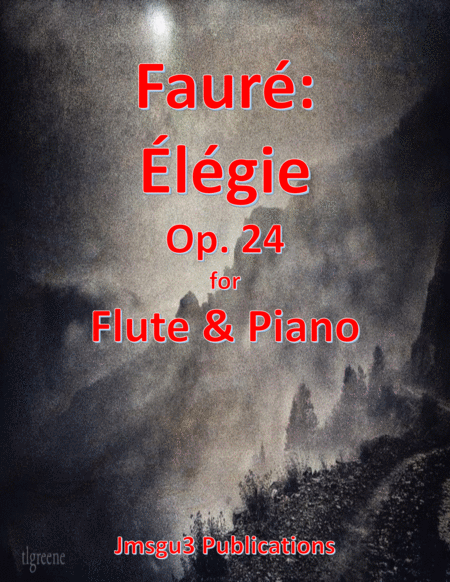
Fauré: Élégie Op. 24 for Flute & Piano
Flûte traversière et Piano

$32.95 28.52 € Flûte traversière et Piano PDF SheetMusicPlus


Partitions Gratuites
Acheter des Partitions Musicales
Acheter des Partitions Digitales à Imprimer
Acheter des Instruments de Musique

© 2000 - 2026

Accueil - Version intégrale





