EUROPE
16158 articles
USA
0 articles
DIGITAL
37455 articles (à imprimer)
Partitions Digitales
Partitions à imprimer
37455 partitions trouvées


Piano,Vocal,Voice - Level 5 - Digital Download SKU: A0.969918 By Laurell. By Anderz Wrethov, Andreas Sten Johansson, Andreas Stone Johansson, Laurell Barker, and Thomas Petersen. Arranged by Stefan Friedrich Platte. Contemporary. Score. 11 pages. ScoresForPros #6691121. Published by ScoresForPros (A0.969918). Pro version for solo voice and piano (ternary rhythms not written out)Original key (4#, 6b)Vocal range: G#3-Db5All versions:Original Key (ternary rhythms written out):https://www.sheetmusicplus.com/title/22199775Original Key (ternary rhythms written not out):https://www.sheetmusicplus.com/title/22199780Transposed Key (ternary rhythms written out):https://www.sheetmusicplus.com/title/22199782Transposed Key (ternary rhythms not written out):https://www.sheetmusicplus.com/title/22199784
Habit
Piano, Voix
Laurell
$4.99 4.32 € Piano, Voix PDF SheetMusicPlus

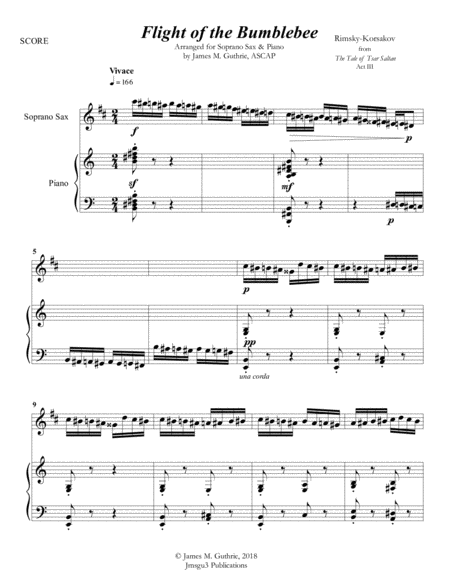
Piano,Soprano Saxophone - Level 5 - Digital Download SKU: A0.549256 Composed by Nikolay Andreyevich Rimsky-Korsakov. Arranged by James M. Guthrie, ASCAP. Instructional,Romantic Period,Standards. Score and part. 15 pages. Jmsgu3 #3473699. Published by jmsgu3 (A0.549256). Flight of the Bumblebee from Korsakov's Tale of Tsar Saltan Score: 9 pages, Solo part: 3 pages, Piano accompaniment part: 3 pages. Duration: ca. 1:15 Amaze your listeners with this short but stunning recital encore! Korsakov: Flight of the Bumblebee Flight of the Bumblebee is, to be sure, an orchestral interlude composed by Nikolai Rimsky-Korsakov for his opera The Tale of Tsar Saltan. Korsakov, of course, intended to musically portray the chaotic flying pattern of a bumblebee. Nowadays, this piece is one of the comparatively more famous classical works because it frequently appears from time to time in popular culture. In the opera, the piece appears notably at the close of Act III, Tableau 1. This is when the magic Swan-Bird, in fact, changes the Prince (the son of the Tsar) into a bee so he can fly away to visit his father. Interestingly, at this point in the drama, his father, in effect, does not know that he is alive.   Korsakov Background Nikolai Rimsky-Korsakov (1844 –1908) was a uniquely famous composer from Russia. He was likewise a member of an infamous assembly of composers called The Five. Korsakov was furthermore an expert in orchestration. His correspondingly most famous orchestral compositions-Capriccio Espagnol, the Russian Easter Festival Overture, and the Scheherazade suite-are important monuments of the standard music repertoire.  Also, comparatively very important are his suites and excerpts from his 15 operas. Korsakov was moreover fond of using Russian folklore and fairy tales in his music, such as Scheherazade.  Nationalistic Style Korsakov believed, similarly to fellow outspoken composer Balakirev, in creating a nationalistic, Russia-centric style of classical music. The new style was in fact called Orientalism. It similarly relied on native Russian materials, exotic scales, and experimental harmonic, melodic and rhythmic procedures. This practice, conversely, ran counter to the developments in Western musical culture. Musical Developments Nevertheless, Korsakov developed an appreciation of Western musical techniques after he became a professor of musical composition, harmony, and orchestration at the Saint Petersburg Conservatory in 1871. Moreover, he undertook a rigorous three-year program of self-education and mastered Western methods, incorporating them in conjunction with the influences of Mikhail Glinka and other members of The Five. His techniques of composition and orchestration were additionally enriched by his exposure to the works of Richard Wagner. Naval Service Korsakov combined his music career accordingly with a career in the Russian military. He was in the first place an officer in the Russian Navy. In due time, he was appointed as a civilian Inspector of Naval Bands. As a result, Korsakov expanded his knowledge of woodwind and brass playing, which in turn heightened his capabilities in orchestration. Legacy Korsakov in due time contributed a significant number of Russian nationalist works. He also prepared, from time to time, compositions by The Five for presentation. This brought their works straightaway into the active classical repertoire as well. He also shaped an entire generation of younger composers during his time as a music educator. Therefore, music historians consider Korsakov as the foremost engineer of what the public considers to be the Russian style of composition. He served, all in all, as a transitional figure between The Five and the classically trained composers who became the norm over time. In addition to the Russians, he forthwith influenced non-Russian composers such as Ravel, Debussy, Dukas, and Respighi.  
Korsakov: Flight of the Bumblebee for Soprano Sax & Piano
Saxophone Soprano et Piano

$32.95 28.52 € Saxophone Soprano et Piano PDF SheetMusicPlus

Instrumental Duet,Piano B-Flat Clarinet,Cello,Instrumental Duet,Piano - Level 5 - Digital Download SKU: A0.1284045 Composed by Spiritual. Arranged by Maria Thompson Corley. 21st Century,Chamber,Christian,Sacred,Traditional. 17 pages. Maria Thompson Corley #875217. Published by Maria Thompson Corley (A0.1284045). “Crossing Jordan†grew out of my daughter Kiana’s surprise request that I arrange a spiritual for voice, piano and cello for her senior recital. She received a degree in commercial music the year before COVID shut everything down, at a time before climate change made blizzards an anomaly here in Central PA. As a result, snow days still existed. I spent one of them doing the first draft of “Deep River,†her favorite.Later, I decided that if singers engage a cellist for a concert, they might like to program more than one piece for them, so I chose two more water-themed spirituals to complete the set. “His Name So Sweet†is a more meditative version of the song than I’ve generally heard. I wanted the piano, cello, and briefly the voice to imitate the fountain in the text. The mood is ecstasy, resulting from the fundamental change that baptism is meant to create. “Deep River†also includes “Michael Row The Boat Ashore†and “The Water Is Wide.†The latter isn’t a spiritual, however, taken together the message is that the river is deep, the water is wide, but with (the Archangel?) Michael’s help, Jordan can be crossed. “Wade in the Water†is one of the most well-known spirituals. I focus on the idea of escaping enslavement: the opening is quiet, furtive, maybe even nervous. The Moses in the text can be understood to be Harriet Tubman, who might urge escapees to wade in the water so pursuing dogs couldn’t follow their scent. In my mind, the ending symbolizes that the party has vanished, never to be enslaved again.The first instrumental version of “Deep River†was for trumpet and piano, performed by my sister, Alicia Thompson, and her son, Justin Griffin, during a church service in Atlanta shortly after I arranged it. After hearing a recording, I took borrowed her idea of adding a repeat (which she did to allow enough time for the ushers to take up collection). The clarinet, cello and piano version was premiered by the Isosceles Trio (Doris Hall-Gulati (clarinet), Sara Male (cello), and me (piano)). When Naima Burrs, violinist and conductor of the Petersburg Symphony, asked if I had any pieces for trio, I created a version for violin, piano and cello. The flute/piano/cello version may have been performed, but if so, nobody has mentioned it to me.
"His Name So Sweet" from Crossing Jordan for clarinet, piano and cello

$15.00 12.98 € PDF SheetMusicPlus


Partitions Gratuites
Acheter des Partitions Musicales
Acheter des Partitions Digitales à Imprimer
Acheter des Instruments de Musique

© 2000 - 2026

Accueil - Version intégrale