EUROPE
16158 articles
USA
0 articles
DIGITAL
37455 articles (à imprimer)
Partitions Digitales
Partitions à imprimer
37455 partitions trouvées


Small Ensemble Bassoon,Cello,Double Bass - Level 2 - Digital Download SKU: A0.887013 Composed by Modest Petrovich Mussorgsky. Arranged by James Brady. 20th Century,Romantic Period,Standards. Score and parts. 7 pages. James Brady Music #5709911. Published by James Brady Music (A0.887013). This arrangement of the opening of Mussorgsky's best-known work is ideally suited as an opening or closing statement piece for a group of 4 early-intermediate cellos (or basses, with one with a C extension) or other bass clef instruments. It stays true to the original piece with adaptations in range for developing players and an adapted ending better suited for standalone performance. The estimated duration of the performance is 1m 30s.Pictures at an Exhibition is a suite of pieces for piano based on pictures by Mussorgsky's friend Viktor Hartmann, who died suddenly in 1873, aged 39. A memorial exhibition of Hartmann's works was staged in St. Petersburg the following year, and Mussorgsky's suite depicts walk around it, viewing 10 pictures in total. In addition to the pieces inspired by individual pictures, the suite contains several variations of the 'Promenade' theme, which depicts Mussorgsky roving through the exhibition, now leisurely, now briskly in order to come close to a picture that had attracted his attention, and at times sadly, thinking of his departed friend. (Vladimir Stasov).Ranges have been reduced to accommodate young or developing players. The 1st part goes no higher than F4, and the bass part no lower than C2. The melody is mainly in the 1st part, with passages in the 2nd and 3rd parts from time to time, but as the texture of Mussorgksy's composition is almost exclusively homophonic, all parts have equal importance. I have inserted additional dynamics and accents to aid phrasing, and adapted the ending to suit a standalone performance.For more arrangements for developing ensembles, see:https://www.sheetmusicplus.com/publishers/james-brady-music-sheet-music/3006312
'Promenade' from Pictures at an Exhibition - easy arrangement for cello quartet
4 Violoncelles

$7.99 6.91 € 4 Violoncelles PDF SheetMusicPlus

String Orchestra - Level 3 - Digital Download SKU: A0.1181394 Composed by Viktor Kosenko. Arranged by Robert Debbaut. 20th Century,Children,Contest,Festival,Multicultural,Romantic Period,World. Score and parts. 5 pages. ROBERT DEBBAUT #781236. Published by ROBERT DEBBAUT (A0.1181394). Ukrainian and Soviet composer, Viktor Kosenko (1896-1938), was a highly regarded concert pianist, concertmaster and educator. Kosenko began his formal training at the St. Petersburg Conservatory as a composition student of Mikhail Sokolovsky. While in school he served as concertmaster of the Marinsky Theatre. Aleksandr Glazunov, the Director the Conservatory, was greatly impressed with Kosenko and spoke highly of his work.  Regarded by his contemporaries as a master of lyricism, his first compositions were markedly influenced by the works of composers such as Rachmaninov, Scriabin, Tchaikovsky and his fellow Ukrainian Mykola Lysenko.  During his short career he composed over 100 works for piano in a total of about 250 musical works. Other works include his symphonic Moldavian poem, choral and folk music arrangements, violin and piano concertos, trios and string quartets. During the 1930s Kosenko became dedicated to writing music for children. His first compositions for children were Four Children’s Pieces for piano (1930; this arranger has scored these four works for violin and piano, flute and piano, and cello and piano, as well as string orchestra). This work is one of five I have scored for as a Second Suite for String Orchestra from the twenty-four piano works for children he composed in 1936 (The First Suite is available from Carl Fischer).  If you purchase contact me about a set of parts and a wav recording at debbaut@gmail.com, subject line Kosenko.
The Camping Trip - Score Only
Orchestre à Cordes

$4.99 4.32 € Orchestre à Cordes PDF SheetMusicPlus

Brass Quintet Baritone Horn TC,Euphonium,Trombone,Trumpet,Tuba - Level 3 - Digital Download SKU: A0.817101 Composed by Anatole Liadov and Alexander Glazounov. Arranged by Charles Decker. 19th Century,Contest,Festival,Multicultural,Romantic Period,World. 22 pages. Charles Decker Music Press #3530649. Published by Charles Decker Music Press (A0.817101). These five short, elegant fanfares by former students of Nicolai Rimsky-Korsakov were composed for the 1890 concert celebrating his 20 years as professor at the St. Petersburg Conservatory in Russia. Originally scored for an orchestral brass section, the fanfares retain their brilliance as a brass quintet and parts can be doubled to intensify the musical impact. Arranged for a brass quintet of two B-flat trumpets with alternate C trumpet parts, horn in F with alternate substitute parts for horn (B-flat trumpet, treble and bass clef baritone), trombone with a substitute treble clef baritone for trombone part and tuba. This is a very accessible work for student ensembles and less experienced players that will impress audiences and add festive excitement to concerts or ceremonies. The recording is an actual brass quintet performance and not computer playback.See more than 70 mixed brass ensemble publications at Charles Decker Music Press at Sheet Music Plus for inexperienced to advanced musicians with music ranging from the Renaissance to contemporary new works for trios, quartets, quintets, brass choir and brass band. Many of the mixed brass ensemble editions include alternate and substitute parts being alternate C trumpet parts for B-flat trumpet parts, flugelhorn/trumpet substitute for horn, horn substitute for trombone and treble clef euphonium substitute for trombone. See also 50+ homogeneous brass group editions with Charles Decker Music Press at Sheet Music Plus for horn, trumpet and trombone ensembles. Check out the Music of Black Composers Series with Charles Decker Music Press at Sheet Music Plus with 25 arrangements for mixed brass ensembles ranging from early jazz to symphonic works with composers Samuel Coleridge-Taylor, R. Nathaniel Dett, William Grant Still, Will Marion Cook, James Reese Europe, James Johnson and others. All ensemble publications include recordings of the entire edition.  For more of my brass quintet editions use these links to Kendor Music and Cherry Classics Music to see listings of arrangements of music by J.S. Bach, H.L. Clarke, Debussy, Dukas, Elgar, Falla, Holst, Ives, Nestico, Rachmaninoff, Satie, and Tchaikovsky.
Five Fanfares for Rimsky-Korsakov for Brass Quintet
Quintette de Cuivres: 2 trompettes, Cor, trombone, tuba

$11.95 10.34 € Quintette de Cuivres: 2 trompettes, Cor, trombone, tuba PDF SheetMusicPlus

Concert Band - Level 3 - Digital Download SKU: A0.1021840 Composed by Johann Strauss Jr. Arranged by Albert Schwarzmann. Romantic Period. Score and parts. 113 pages. Edition Schwalbe #6488541. Published by Edition Schwalbe (A0.1021840). Johann Strauss jr. wrote Prince Baryatinsky March in 1858 in Pavlovsk, Russia, located 30 kilometers south from St. Petersburg, the capital of the Russian Empire. It was firt performed there and dedicated to Prince Aleksandr Ivanovich Baryatinsky, Russian General and Field Marshal. This transcription was commissioned by Wind Philharmonic Mozarteum Salzburg. A live recording of this piece is included on the CD on der Donau zur Wolga UMR37, Barcode 9120007611861 available at https://naxosdirekt.de/items/von-der-donau-zur-wolga-557958
Prince Baryatinsky March by Johann Strauss jr.
Orchestre d'harmonie

$80.00 69.23 € Orchestre d'harmonie PDF SheetMusicPlus

Instrumental Solo,Pipe Organ - Level 2 - Digital Download SKU: A0.1251283 By Indrė Gerikaitė. By Juozas Naujalis. Arranged by Balys Vaitkus. Classical,Religious,Romantic Period. Individual part. 2 pages. Nacionaline vargonininku asociacija #845560. Published by Nacionaline vargonininku asociacija (A0.1251283). 12 Organ Trios, Op. 4. Taking into account the date of publication (1897) these seem to be the first printed organ compositions of Naujalis. They were published in Warsaw, in the collection Preludia na organy, part 2, series III. The publication soon received positive comments in the Polish newspaper of the St. Cecilia Society, Musica sacra (1898 No. 5). There are many signs that Naujalis used this edition as his favourite teaching manual since the fingerings and pedaling given are from the author himself.Juozas Naujalis (1869–1934) – Lithuanian composer and organist. In 1892, he was appointed organist and choir leader at the Kaunas Cathedral, a position he held until his death. Naujalis became actively involved in organizing local musical societies and institutions. As an outcome of his groundbreaking work, a number of important private entities, such as the first boys’ choir in Lithuania based at the Archcathedral Basilica in Kaunas, courses and the school for organists (1911), the first legal Lithuanian bookshop and music publishing house in Kaunas (1905–1912), the first music magazine Vargonininkas (The Organist) and calendars for organists published in Lithuanian (1909–1910), and the music school in Kaunas (1919), have been launched. In 1908, he founded the Children Society and St. Gregory Society for Organists, which was later reorganised into St. Cecilia Society for church musicians (1924). Naujalis was also the first Lithuanian composer to achieve recognition abroad. His church music was published in Regensburg, Warsaw, St. Petersburg, Leipzig and Paris. In recognition of his merits in the field of church music he was made Commander of the Order of the Crown of Italy in Rome, in 1929.A total of 29 organ pieces by Naujalis were recorded at the Archcathedral Basilica in Kaunas in 2019.
Trio No. 7 in A minor, Op. 4 by Juozas Naujalis (1869–1934)
Orgue
IndrÄ— GerikaitÄ—
$4.99 4.32 € Orgue PDF SheetMusicPlus

Instrumental Solo,Piano,Piccolo - Level 2 - Digital Download SKU: A0.549434 Composed by Antonín Dvořák. Arranged by James M. Guthrie, ASCAP. Instructional,Romantic Period,Sacred,Standards. Score and individual part. 12 pages. Jmsgu3 #3494221. Published by jmsgu3 (A0.549434). Score: 7 pages, solo part: 2 pages, piano part: 3 pages. Duration: 4:25 Not difficult, but requires sensitivity & dynamic control. Suitable for recitals, church meditations, or school programs. Dvořák Background Antonín Dvořák (1841 –1904) was, of course, a composer from Czechoslovakia. As a matter of fact, he was among the first Bohemian composers to attain universal recognition. It is important to realize that the late Romantic Nationalist period featured composers who used traditional and folk elements to portray the character of their nation. In particular, we see this in the music of Grieg (Norway), Finland (Sibelius), and Smetana (Bohemia).  Dvořák relied markedly on rhythms and other characteristics of Moravian and Bohemian folk music. Ascent to Fame Dvořák was truly a child musical prodigy on the violin. The premiere performances of his compositions notably occurred in 1872 and 1873. He submitted his First Symphony in particular to a German competition, but it failed to win. Consequently, in 1874 he presented two more symphonies to the Austrian State Prize for Composition. Johannes Brahms was the principal of the jury and was accordingly very impressed. They forthwith awarded the prize to Dvořák in 1874, 1876, and 1877. At this point, Brahms thereupon endorsed Dvořák to the publisher Simrock. Later, the publisher commissioned Dvořák to compose the Slavonic Dances, Op. 46. These became popular overnight and, as a result, Dvořák's worldwide status was launched. International Status Dvořák visited England upon invitation nine times. On each visit, he frequently conducted performances of his own compositions. He conducted concerts of his music, especially in Moscow and St. Petersburg. Eventually, the Prague Conservatory in fact appointed Dvořák as a professor. There, to be sure, he wrote his famous Dumky Trio. United States Consequently, the National Conservatory of Music of America appointed him as director in 1892. As a result, Dvořák composed his two most famous symphonic works: the Symphony No. 9 (From the New World), which spread his name universally, and his Concerto for Cello and Orchestra, one of the most famous of all cello works. Moreover, he wrote his most celebrated American String Quartet during this time. At the same time, because of his growing recognition in Europe and his homesickness for his own country, he left to return to Bohemia in 1895.    
DvoÅ™ák: Largo from the New World Symphony for Piccolo & Piano

$32.95 28.52 € PDF SheetMusicPlus

Piano - Digital Download SKU: LV.12845 Composed by C. C. de Nordendorf. Portraits. Lester S. Levy Collection. 5 pages. Published by Johns Hopkins University Sheridan Libraries (LV.12845). Horace Greeley Quickstep. Music by C.C. de Nordendorf. Published 1872 by C.C. de Nordendorf Musical Exchange in Petersburg, VA. Composition of sectional with piano instrumentation. Subject headings for this piece include Portraits. About The Lester S. Levy CollectionThe Lester S. Levy Collection of Sheet Music consists of over 29,000 pieces of American popular music. Donated to Johns Hopkins University Sheridan Libraries, the collection's strength is its thorough documentation of nineteenth-century American through popular music. This sheet music has been provided by Project Gado, a San Francisco Bay Area startup whose mission is to digitize and share the world's visual history.WARNING: These titles are provided as historical documents. Language and concepts within reflect the opinions and values of the time and may be offensive to some.
Horace Greeley Quickstep
Piano seul

$5.99 5.18 € Piano seul PDF SheetMusicPlus

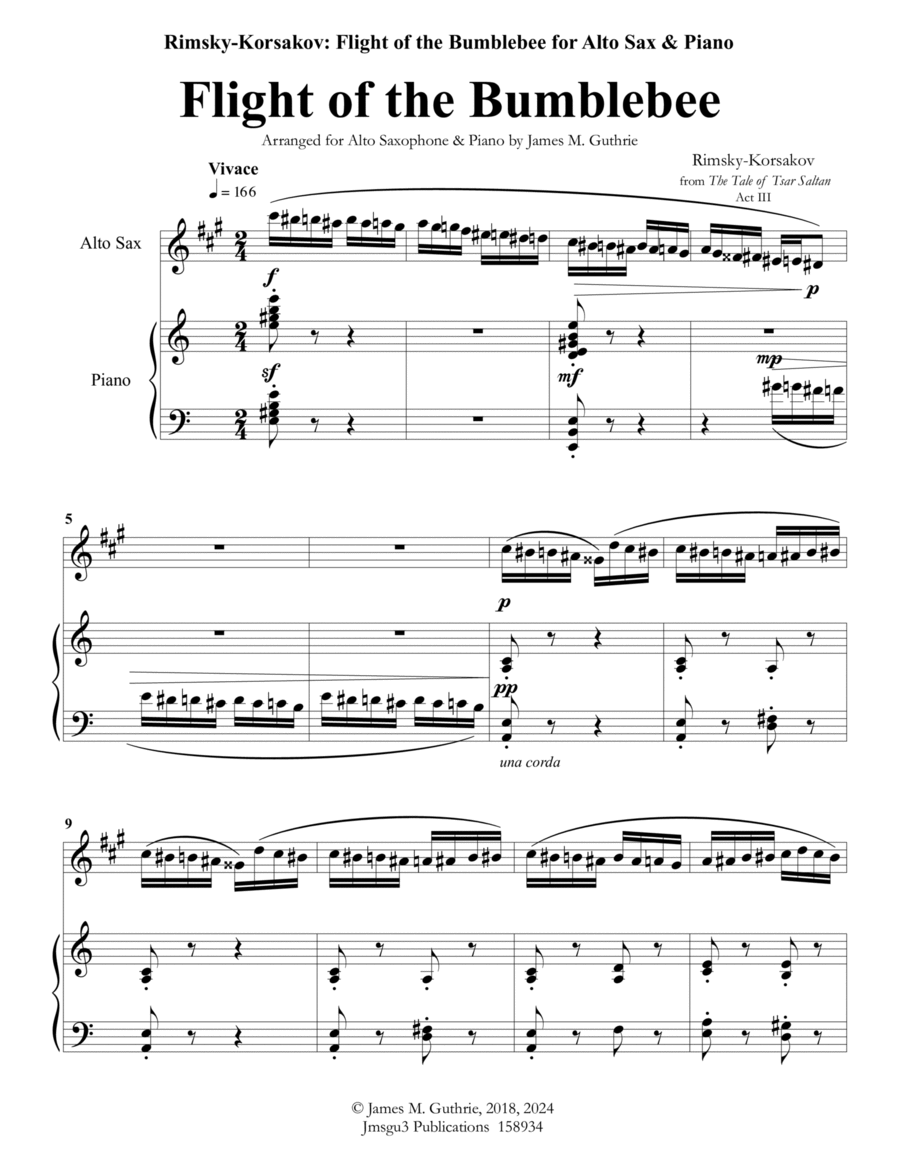
Alto Saxophone,Piano - Level 5 - Digital Download SKU: A0.549254 Composed by Nikolay Andreyevich Rimsky-Korsakov. Arranged by James M. Guthrie, ASCAP. Instructional,Romantic Period,Standards. Score and part. 15 pages. Jmsgu3 #3473685. Published by jmsgu3 (A0.549254). Flight of the Bumblebee Flight of the Bumblebee is, to be sure, an orchestral interlude composed by Nikolai Rimsky-Korsakov for his opera The Tale of Tsar Saltan. Of course, Korsakov intended to portray a bumblebee's chaotic flying pattern musically. Nowadays, this piece is one of the comparatively more famous classical works because it frequently appears occasionally in popular culture. The piece appears notably in the opera at the close of Act III, Tableau 1. This is when the magic Swan-Bird changes the Prince (the son of the Tsar) into a bee so he can fly away to visit his father. Interestingly, at this point in the drama, his father, in effect, does not know that he is alive. Korsakov Background Nikolai Rimsky-Korsakov (1844 –1908) was a uniquely famous composer from Russia. He was likewise a member of an infamous assembly of composers called The Five. Korsakov was furthermore an expert in orchestration. His correspondingly most famous orchestral compositions- Capriccio Espagnol, the Russian Easter Festival Overture, and the Scheherazade suite- are essential monuments of the standard music repertoire.  Also comparatively very important are his suites and excerpts from his 15 operas. Korsakov used Russian folklore and fairy tales, such as Scheherazade, in his music.  Nationalistic Style Like fellow outspoken composer Balakirev, Korsakov believed in creating a nationalistic, Russia-centric style of classical music. The new style was called Orientalism. It similarly relied on native Russian materials, exotic scales, and experimental harmonic, melodic, and rhythmic procedures. This practice, conversely, ran counter to the developments in Western musical culture. Musical Developments Nevertheless, Korsakov developed an appreciation of Western musical techniques after he became a professor of musical composition, harmony, and orchestration at the Saint Petersburg Conservatory in 1871. Moreover, he undertook a rigorous three-year program of self-education. He mastered Western methods, incorporating them with the influences of Mikhail Glinka and other members of The Five. His techniques of composition and orchestration were additionally enriched by his exposure to the works of Richard Wagner. Naval Service Korsakov combined his music career accordingly with a career in the Russian military. He was in the first place an officer in the Russian Navy. In due time, he was appointed a civilian Inspector of Naval Bands. As a result, Korsakov expanded his knowledge of woodwind and brass playing, which heightened his orchestration capabilities. Legacy In due time, Korsakov contributed a significant number of Russian nationalist works. He also prepared, occasionally, compositions by The Five for presentation. This brought their works straightaway into the active classical repertoire as well. He also shaped an entire generation of younger composers as a music educator. Therefore, music historians consider Korsakov the foremost engineer of what the public considers the Russian composition style. He served as a transitional figure between The Five and the classically trained composers who became the norm over time. In addition to the Russians, he influenced non-Russian composers such as Ravel, Debussy, Dukas, and Respighi.  
Korsakov: Flight of the Bumblebee for Alto Sax & Piano
Saxophone Alto et Piano

$32.95 28.52 € Saxophone Alto et Piano PDF SheetMusicPlus

String Ensemble,String Trio Cello,Violin - Level 5 - Digital Download SKU: A0.742477 Composed by Alexander Borodin. Arranged by Arte Nova Music Lab. Concert,Easter,Romantic Period,Standards,World. Score and parts. 31 pages. Arte Nova Music Lab #4602739. Published by Arte Nova Music Lab (A0.742477). Alexander Porfiryevich Borodin (Russian: ÐлекÑаÌндр ПорфиÌрьевич БородиÌн, IPA: [Élʲɪkˈsandr pÉrˈfʲi rʲjɪvʲɪtÉ• bÉ™rÉˈdʲin] (12 November 1833 – 27 February 1887) was a Russian chemist and Romantic musical composer ofGeorgian ancestry. He was one of the prominent 19th-century composers known as The Mighty Handful, a group dedicated to producing a uniquely Russian kind of classical music, rather than imitating earlier Western European models.[3][4][5]Borodin is known best for his symphonies, his two string quartets, the symphonic poem In the Steppes of Central Asia and his opera Prince Igor. Music fromPrince Igor and his string quartets was later adapted for the US musical Kismet. A doctor and chemist by profession, Borodin made important early contributions to organic chemistry. Although he is presently known better as a composer, during his lifetime, he regarded medicine and science as his primary occupations, only practising music and composition in his spare time or when he was ill. As a chemist, Borodin is known best for his work concerning organic synthesis, including being among the first chemists to demonstrate nucleophilic substitution, as well as being the co-discoverer of the aldol reaction. Borodin was a promoter of education in Russia and founded the School of Medicine for Women in Saint Petersburg, where he taught until 1885. Taken from https://en.wikipedia.org/wiki/Alexander_Borodin
String Trio in G minor
Trio à Cordes: 2 violons, violoncelle

$25.00 21.64 € Trio à Cordes: 2 violons, violoncelle PDF SheetMusicPlus


Partitions Gratuites
Acheter des Partitions Musicales
Acheter des Partitions Digitales à Imprimer
Acheter des Instruments de Musique

© 2000 - 2026

Accueil - Version intégrale