EUROPE
15474 articles
USA
0 articles
DIGITAL
34041 articles (à imprimer)
Partitions Digitales
Partitions à imprimer
34041 partitions trouvées


Instrumental Solo,Pipe Organ - Level 2 - Digital Download SKU: A0.1251299 By Indrė Gerikaitė. By Juozas Naujalis. Arranged by Balys Vaitkus. Classical,Religious,Romantic Period. Individual part. 2 pages. Nacionaline vargonininku asociacija #845568. Published by Nacionaline vargonininku asociacija (A0.1251299). 12 Organ Trios, Op. 4. Taking into account the date of publication (1897) these seem to be the first printed organ compositions of Naujalis. They were published in Warsaw, in the collection Preludia na organy, part 2, series III. The publication soon received positive comments in the Polish newspaper of the St. Cecilia Society, Musica sacra (1898 No. 5). There are many signs that Naujalis used this edition as his favourite teaching manual since the fingerings and pedaling given are from the author himself.Juozas Naujalis (1869–1934) – Lithuanian composer and organist. In 1892, he was appointed organist and choir leader at the Kaunas Cathedral, a position he held until his death. Naujalis became actively involved in organizing local musical societies and institutions. As an outcome of his groundbreaking work, a number of important private entities, such as the first boys’ choir in Lithuania based at the Archcathedral Basilica in Kaunas, courses and the school for organists (1911), the first legal Lithuanian bookshop and music publishing house in Kaunas (1905–1912), the first music magazine Vargonininkas (The Organist) and calendars for organists published in Lithuanian (1909–1910), and the music school in Kaunas (1919), have been launched. In 1908, he founded the Children Society and St. Gregory Society for Organists, which was later reorganised into St. Cecilia Society for church musicians (1924). Naujalis was also the first Lithuanian composer to achieve recognition abroad. His church music was published in Regensburg, Warsaw, St. Petersburg, Leipzig and Paris. In recognition of his merits in the field of church music he was made Commander of the Order of the Crown of Italy in Rome, in 1929.A total of 29 organ pieces by Naujalis were recorded at the Archcathedral Basilica in Kaunas in 2019.
Trio No. 12 in A major, Op. 4 by Juozas Naujalis (1869–1934)
Orgue
IndrÄ— GerikaitÄ—
$4.99 4.31 € Orgue PDF SheetMusicPlus

Flute,Piano - Level 2 - Digital Download SKU: A0.549429 Composed by Antonin Dvorak. Arranged by James M. Guthrie, ASCAP. Instructional,Romantic Period,Sacred,Standards. Score and part. 12 pages. Jmsgu3 #3494181. Published by jmsgu3 (A0.549429). Score: 7 pages, solo part: 2 pages, piano part: 3 pages. Duration: 4:25. Not difficult, but requires sensitivity & dynamic control. Suitable for recitals, church meditations, or school programs. Dvořák Background Antonín Dvořák (1841 –1904) was, of course, a composer from Czechoslovakia. As a matter of fact, he was among the first Bohemian composers to attain universal recognition. It is important to realize that the late Romantic Nationalist period featured composers who used traditional and folk elements to portray the character of their nation. In particular, we see this in the music of Grieg (Norway), Finland (Sibelius), and Smetana (Bohemia).  Dvořák relied markedly on rhythms and other characteristics of Moravian and Bohemian folk music. Ascent to Fame Dvořák was truly a child musical prodigy on the violin. The premiere performances of his compositions notably occurred in 1872 and 1873. He submitted his First Symphony in particular to a German competition, but it failed to win. Consequently, in 1874 he presented two more symphonies to the Austrian State Prize for Composition. Johannes Brahms was the principal of the jury and was accordingly very impressed. They forthwith awarded the prize to Dvořák in 1874, 1876, and 1877. At this point, Brahms thereupon endorsed Dvořák to the publisher Simrock. Later, the publisher commissioned Dvořák to compose the Slavonic Dances, Op. 46. These became popular overnight and, as a result, Dvořák's worldwide status was launched. International Status Dvořák visited England upon invitation nine times. On each visit, he frequently conducted performances of his own compositions. He conducted concerts of his music, especially in Moscow and St. Petersburg. Eventually, the Prague Conservatory in fact appointed Dvořák as a professor. There, to be sure, he wrote his famous Dumky Trio. United States Consequently, the National Conservatory of Music of America appointed him as director in 1892. As a result, Dvořák composed his two most famous symphonic works: the Symphony No. 9 (From the New World), which spread his name universally, and his Concerto for Cello and Orchestra, one of the most famous of all cello works. Moreover, he wrote his most celebrated American String Quartet during this time. At the same time, because of his growing recognition in Europe and his homesickness for his own country, he left to return to Bohemia in 1895.  
DvoÅ™ák: Largo from the New World Symphony for Alto Flute & Piano
Flûte traversière et Piano

$32.95 28.47 € Flûte traversière et Piano PDF SheetMusicPlus

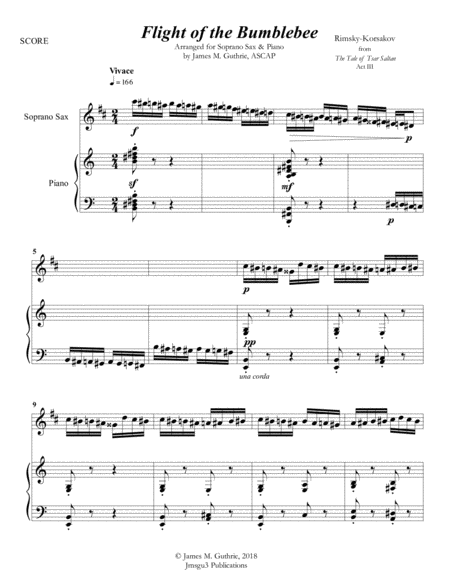
Piano,Soprano Saxophone - Level 5 - Digital Download SKU: A0.549256 Composed by Nikolay Andreyevich Rimsky-Korsakov. Arranged by James M. Guthrie, ASCAP. Instructional,Romantic Period,Standards. Score and part. 15 pages. Jmsgu3 #3473699. Published by jmsgu3 (A0.549256). Flight of the Bumblebee from Korsakov's Tale of Tsar Saltan Score: 9 pages, Solo part: 3 pages, Piano accompaniment part: 3 pages. Duration: ca. 1:15 Amaze your listeners with this short but stunning recital encore! Korsakov: Flight of the Bumblebee Flight of the Bumblebee is, to be sure, an orchestral interlude composed by Nikolai Rimsky-Korsakov for his opera The Tale of Tsar Saltan. Korsakov, of course, intended to musically portray the chaotic flying pattern of a bumblebee. Nowadays, this piece is one of the comparatively more famous classical works because it frequently appears from time to time in popular culture. In the opera, the piece appears notably at the close of Act III, Tableau 1. This is when the magic Swan-Bird, in fact, changes the Prince (the son of the Tsar) into a bee so he can fly away to visit his father. Interestingly, at this point in the drama, his father, in effect, does not know that he is alive.   Korsakov Background Nikolai Rimsky-Korsakov (1844 –1908) was a uniquely famous composer from Russia. He was likewise a member of an infamous assembly of composers called The Five. Korsakov was furthermore an expert in orchestration. His correspondingly most famous orchestral compositions-Capriccio Espagnol, the Russian Easter Festival Overture, and the Scheherazade suite-are important monuments of the standard music repertoire.  Also, comparatively very important are his suites and excerpts from his 15 operas. Korsakov was moreover fond of using Russian folklore and fairy tales in his music, such as Scheherazade.  Nationalistic Style Korsakov believed, similarly to fellow outspoken composer Balakirev, in creating a nationalistic, Russia-centric style of classical music. The new style was in fact called Orientalism. It similarly relied on native Russian materials, exotic scales, and experimental harmonic, melodic and rhythmic procedures. This practice, conversely, ran counter to the developments in Western musical culture. Musical Developments Nevertheless, Korsakov developed an appreciation of Western musical techniques after he became a professor of musical composition, harmony, and orchestration at the Saint Petersburg Conservatory in 1871. Moreover, he undertook a rigorous three-year program of self-education and mastered Western methods, incorporating them in conjunction with the influences of Mikhail Glinka and other members of The Five. His techniques of composition and orchestration were additionally enriched by his exposure to the works of Richard Wagner. Naval Service Korsakov combined his music career accordingly with a career in the Russian military. He was in the first place an officer in the Russian Navy. In due time, he was appointed as a civilian Inspector of Naval Bands. As a result, Korsakov expanded his knowledge of woodwind and brass playing, which in turn heightened his capabilities in orchestration. Legacy Korsakov in due time contributed a significant number of Russian nationalist works. He also prepared, from time to time, compositions by The Five for presentation. This brought their works straightaway into the active classical repertoire as well. He also shaped an entire generation of younger composers during his time as a music educator. Therefore, music historians consider Korsakov as the foremost engineer of what the public considers to be the Russian style of composition. He served, all in all, as a transitional figure between The Five and the classically trained composers who became the norm over time. In addition to the Russians, he forthwith influenced non-Russian composers such as Ravel, Debussy, Dukas, and Respighi.  
Korsakov: Flight of the Bumblebee for Soprano Sax & Piano
Saxophone Soprano et Piano

$32.95 28.47 € Saxophone Soprano et Piano PDF SheetMusicPlus

Oboe Solo - Level 4 - Digital Download SKU: A0.983174 Composed by Craig Wadley. 21st Century,Chamber,Contemporary,Contest,Festival. Individual part. 5 pages. Wadley Publications #4980645. Published by Wadley Publications (A0.983174). The title of Sonar’s Riddle is an anagram of Dr. Daniel Ross, and stands as a tribute to a musician known for both his kindness and humor. Dr. Daniel F. Ross (1944-2019) was a Professor of Music at Arkansas State University, where he taught the double reed studio from 1968 to 2018. During his illustrious career, he became known as not only a world-class musician, but an innovator in the field of reed-making with his Ross Gouging Machine. As a performer, he served as Principal Oboist with the Arkansas Symphony and performed with the North Arkansas Symphony, Arkansas Philharmonic Orchestra, Tupelo Symphony, Delta Symphony, Atlanta Symphony, Nashville Symphony, the St. Louis Symphony, and the St. Louis Chamber Music Society. He was a frequent soloist with the Forum Sinfonia of Krakow, Poland, touring with them in the United Stated and Europe. He held the title of Visiting Professor of Oboe at the Academy of Music in Krakow, Poland and has been a soloist with the St. Petersburg and Moscow Philharmonic orchestras in Russia. As a teacher, Dr. Ross stressed the importance of expression. For him, being a musician was an extension of being human. In order to make music, one must cross the threshold from producing technically accurate sounds into a mysterious and sometimes elusive realm of heart, love, compassion, gentleness, and joy. In Dan Ross’ studio, one learned that a musician capable of evoking strong emotions must first be a person of great character. Dan Ross excelled in all things musical, but more importantly, he was an excellent man. He may well be remembered as a great musician, a great performer and teacher, or as an innovator in the art of reed making. But his true legacy lies in the hearts that he touched and the lives that he molded. I count myself fortunate to have been one of many. Sonar’s Riddle is a brief musical portrait of Dr. Dan Ross, attempting to capture the essence of his kind spirit and boundless humor.
Sonar's Riddle (Oboe)
Hautbois (partie séparée)

$12.99 11.23 € Hautbois (partie séparée) PDF SheetMusicPlus

Piano,Vocal,Voice - Level 3 - Digital Download SKU: A0.1213269 By Mikhail Glinka. By Mikhail Glinka. Arranged by Russian for Singers. 19th Century,Classical,Instructional,Romantic Period. Score. 5 pages. Natalia Melnik #810449. Published by Natalia Melnik (A0.1213269). M.Glinka. Жаворонок / Zhavoronok / The Larkfrom the song cycle A Farewell to Saint Petersburg Original key Range:E4 - F5 (Soprano, Mezzo-Soprano)E3 - F4 (Tenor, Baritone)FREE DOWNLOAD! A quick and comprehensive tutorial on Russian phonetics: https://www.russian4singers.com/russian-diction-for-singers-1 FULL SONG PACK including Diction score (sheet music with IPA phonetics and translations), Diction audio guide, Music coaching audio guide (Voice line + piano line), Rehearsal backing track (Piano line only) https://www.russian4singers.com/product-page-2/m-glinka-the-lark-orig-key-full-packWe are offering a range of Russian diction coaching services:- individual coaching- group webinars- lectures on Russian Music Literature for singers​Please visit our website for more information https://www.russian4singers.com/bookingPlease SUBSCRIBE to Russian for Singers YouTube Channel and watch the free diction guide https://youtu.be/0oPPNkboAUo
"The Lark" Original key. DICTION SCORE with IPA and translation
Piano, Voix
Mikhail Glinka
$8.50 7.35 € Piano, Voix PDF SheetMusicPlus

Instrumental Solo,Piano,Piccolo - Level 2 - Digital Download SKU: A0.549434 Composed by Antonín Dvořák. Arranged by James M. Guthrie, ASCAP. Instructional,Romantic Period,Sacred,Standards. Score and individual part. 12 pages. Jmsgu3 #3494221. Published by jmsgu3 (A0.549434). Score: 7 pages, solo part: 2 pages, piano part: 3 pages. Duration: 4:25 Not difficult, but requires sensitivity & dynamic control. Suitable for recitals, church meditations, or school programs. Dvořák Background Antonín Dvořák (1841 –1904) was, of course, a composer from Czechoslovakia. As a matter of fact, he was among the first Bohemian composers to attain universal recognition. It is important to realize that the late Romantic Nationalist period featured composers who used traditional and folk elements to portray the character of their nation. In particular, we see this in the music of Grieg (Norway), Finland (Sibelius), and Smetana (Bohemia).  Dvořák relied markedly on rhythms and other characteristics of Moravian and Bohemian folk music. Ascent to Fame Dvořák was truly a child musical prodigy on the violin. The premiere performances of his compositions notably occurred in 1872 and 1873. He submitted his First Symphony in particular to a German competition, but it failed to win. Consequently, in 1874 he presented two more symphonies to the Austrian State Prize for Composition. Johannes Brahms was the principal of the jury and was accordingly very impressed. They forthwith awarded the prize to Dvořák in 1874, 1876, and 1877. At this point, Brahms thereupon endorsed Dvořák to the publisher Simrock. Later, the publisher commissioned Dvořák to compose the Slavonic Dances, Op. 46. These became popular overnight and, as a result, Dvořák's worldwide status was launched. International Status Dvořák visited England upon invitation nine times. On each visit, he frequently conducted performances of his own compositions. He conducted concerts of his music, especially in Moscow and St. Petersburg. Eventually, the Prague Conservatory in fact appointed Dvořák as a professor. There, to be sure, he wrote his famous Dumky Trio. United States Consequently, the National Conservatory of Music of America appointed him as director in 1892. As a result, Dvořák composed his two most famous symphonic works: the Symphony No. 9 (From the New World), which spread his name universally, and his Concerto for Cello and Orchestra, one of the most famous of all cello works. Moreover, he wrote his most celebrated American String Quartet during this time. At the same time, because of his growing recognition in Europe and his homesickness for his own country, he left to return to Bohemia in 1895.    
DvoÅ™ák: Largo from the New World Symphony for Piccolo & Piano

$32.95 28.47 € PDF SheetMusicPlus

Instrumental Solo,Pipe Organ - Level 2 - Digital Download SKU: A0.1251285 By Indrė Gerikaitė. By Juozas Naujalis. Arranged by Balys Vaitkus. Classical,Religious,Romantic Period. Individual part. 2 pages. Nacionaline vargonininku asociacija #845562. Published by Nacionaline vargonininku asociacija (A0.1251285). 12 Organ Trios, Op. 4. Taking into account the date of publication (1897) these seem to be the first printed organ compositions of Naujalis. They were published in Warsaw, in the collection Preludia na organy, part 2, series III. The publication soon received positive comments in the Polish newspaper of the St. Cecilia Society, Musica sacra (1898 No. 5). There are many signs that Naujalis used this edition as his favourite teaching manual since the fingerings and pedaling given are from the author himself.Juozas Naujalis (1869–1934) – Lithuanian composer and organist. In 1892, he was appointed organist and choir leader at the Kaunas Cathedral, a position he held until his death. Naujalis became actively involved in organizing local musical societies and institutions. As an outcome of his groundbreaking work, a number of important private entities, such as the first boys’ choir in Lithuania based at the Archcathedral Basilica in Kaunas, courses and the school for organists (1911), the first legal Lithuanian bookshop and music publishing house in Kaunas (1905–1912), the first music magazine Vargonininkas (The Organist) and calendars for organists published in Lithuanian (1909–1910), and the music school in Kaunas (1919), have been launched. In 1908, he founded the Children Society and St. Gregory Society for Organists, which was later reorganised into St. Cecilia Society for church musicians (1924). Naujalis was also the first Lithuanian composer to achieve recognition abroad. His church music was published in Regensburg, Warsaw, St. Petersburg, Leipzig and Paris. In recognition of his merits in the field of church music he was made Commander of the Order of the Crown of Italy in Rome, in 1929.A total of 29 organ pieces by Naujalis were recorded at the Archcathedral Basilica in Kaunas in 2019.
Trio No. 8 in G major, Op. 4 by Juozas Naujalis (1869–1934)
Orgue
IndrÄ— GerikaitÄ—
$4.99 4.31 € Orgue PDF SheetMusicPlus

Piano,Soprano Saxophone - Level 2 - Digital Download SKU: A0.549421 Composed by Antonin Dvorak. Arranged by James M. Guthrie, ASCAP. Instructional,Romantic Period,Sacred,Standards. Score and part. 12 pages. Jmsgu3 #3494001. Published by jmsgu3 (A0.549421). Score: 7 pages, solo part: 2 pages, piano part: 3 pages. Duration: 4:25 Not difficult, but requires sensitivity & dynamic control. Suitable for recitals, church meditations, or school programs. Dvořák Background Antonín Dvořák (1841 –1904) was, of course, a composer from Czechoslovakia. As a matter of fact, he was among the first Bohemian composers to attain universal recognition. It is important to realize that the late Romantic Nationalist period featured composers who used traditional and folk elements to portray the character of their nation. In particular, we see this in the music of Grieg (Norway), Finland (Sibelius), and Smetana (Bohemia).  Dvořák relied markedly on rhythms and other characteristics of Moravian and Bohemian folk music. Ascent to Fame Dvořák was truly a child musical prodigy on the violin. The premiere performances of his compositions notably occurred in 1872 and 1873. He submitted his First Symphony in particular to a German competition, but it failed to win. Consequently, in 1874 he presented two more symphonies to the Austrian State Prize for Composition. Johannes Brahms was the principal of the jury and was accordingly very impressed. They forthwith awarded the prize to Dvořák in 1874, 1876, and 1877. At this point, Brahms thereupon endorsed Dvořák to the publisher Simrock. Later, the publisher commissioned Dvořák to compose the Slavonic Dances, Op. 46. These became popular overnight and, as a result, Dvořák's worldwide status was launched. International Status Dvořák visited England upon invitation nine times. On each visit, he frequently conducted performances of his own compositions. He conducted concerts of his music, especially in Moscow and St. Petersburg. Eventually, the Prague Conservatory in fact appointed Dvořák as a professor. There, to be sure, he wrote his famous Dumky Trio. United States Consequently, the National Conservatory of Music of America appointed him as director in 1892. As a result, Dvořák composed his two most famous symphonic works: the Symphony No. 9 (From the New World), which spread his name universally, and his Concerto for Cello and Orchestra, one of the most famous of all cello works. Moreover, he wrote his most celebrated American String Quartet during this time. At the same time, because of his growing recognition in Europe and his homesickness for his own country, he left to return to Bohemia in 1895.
DvoÅ™ák: Largo from the New World Symphony for Soprano Sax & Piano
Saxophone Soprano et Piano

$32.95 28.47 € Saxophone Soprano et Piano PDF SheetMusicPlus

Instrumental Solo,Pipe Organ - Level 2 - Digital Download SKU: A0.1251250 By Audra Telksnytė. By Juozas Naujalis. Arranged by Balys Vaitkus. Classical,Religious,Romantic Period. Individual part. 2 pages. Nacionaline vargonininku asociacija #845527. Published by Nacionaline vargonininku asociacija (A0.1251250). 14 Preludes, Op. 20. Fourteen pieces for organ, dedicated to a “beloved friend, Fr. Teodoras Brazys,†presents the largest collection of works for this instrument in Naujalis’ oeuvre. Like Naujalis, Brazys was the graduate of the Church Music School in Regensburg. These fourteen preludes for organ appear to be written in expression of deep affinity and gratitude to a like-minded friend who shared similar values. Some of Naujalis’ organ preludes have been included in music collections abroad – by Mieczysław Surzyński in Warsaw and Joseph Joubert in Paris. Juozas Naujalis (1869–1934) – Lithuanian composer and organist. In 1892, he was appointed organist and choir leader at the Kaunas Cathedral, a position he held until his death. Naujalis became actively involved in organizing local musical societies and institutions. As an outcome of his groundbreaking work, a number of important private entities, such as the first boys’ choir in Lithuania based at the Archcathedral Basilica in Kaunas, courses and the school for organists (1911), the first legal Lithuanian bookshop and music publishing house in Kaunas (1905–1912), the first music magazine Vargonininkas (The Organist) and calendars for organists published in Lithuanian (1909–1910), and the music school in Kaunas (1919), have been launched. In 1908, he founded the Children Society and St. Gregory Society for Organists, which was later reorganised into St. Cecilia Society for church musicians (1924). Naujalis was also the first Lithuanian composer to achieve recognition abroad. His church music was published in Regensburg, Warsaw, St. Petersburg, Leipzig and Paris. In recognition of his merits in the field of church music he was made Commander of the Order of the Crown of Italy in Rome, in 1929.A total of 29 organ pieces by Naujalis were recorded at the Archcathedral Basilica in Kaunas in 2019.
Prelude No. 2 in G major “Praise be to You, Mary”, Op. 20 by Juozas Naujalis (1869–1934)
Orgue
Audra TelksnytÄ—
$4.99 4.31 € Orgue PDF SheetMusicPlus

Flute,Piano - Level 2 - Digital Download SKU: A0.549422 Composed by Antonin Dvorak. Arranged by James M. Guthrie, ASCAP. Instructional,Romantic Period,Sacred,Standards. Score and part. 12 pages. Jmsgu3 #3493997. Published by jmsgu3 (A0.549422). Score: 7 pages, solo part: 2 pages, piano part: 3 pages. Duration: 4:25 Not difficult, but requires sensitivity & dynamic control. Suitable for recitals, church meditations, or school programs. Dvořák Background Antonín Dvořák (1841 –1904) was, of course, a composer from Czechoslovakia. As a matter of fact, he was among the first Bohemian composers to attain universal recognition. It is important to realize that the late Romantic Nationalist period featured composers who used traditional and folk elements to portray the character of their nation. In particular, we see this in the music of Grieg (Norway), Finland (Sibelius), and Smetana (Bohemia).  Dvořák relied markedly on rhythms and other characteristics of Moravian and Bohemian folk music. Ascent to Fame Dvořák was truly a child musical prodigy on the violin. The premiere performances of his compositions notably occurred in 1872 and 1873. He submitted his First Symphony in particular to a German competition, but it failed to win. Consequently, in 1874 he presented two more symphonies to the Austrian State Prize for Composition. Johannes Brahms was the principal of the jury and was accordingly very impressed. They forthwith awarded the prize to Dvořák in 1874, 1876, and 1877. At this point, Brahms thereupon endorsed Dvořák to the publisher Simrock. Later, the publisher commissioned Dvořák to compose the Slavonic Dances, Op. 46. These became popular overnight and, as a result, Dvořák's worldwide status was launched. International Status Dvořák visited England upon invitation nine times. On each visit, he frequently conducted performances of his own compositions. He conducted concerts of his music, especially in Moscow and St. Petersburg. Eventually, the Prague Conservatory in fact appointed Dvořák as a professor. There, to be sure, he wrote his famous Dumky Trio. United States Consequently, the National Conservatory of Music of America appointed him as director in 1892. As a result, Dvořák composed his two most famous symphonic works: the Symphony No. 9 (From the New World), which spread his name universally, and his Concerto for Cello and Orchestra, one of the most famous of all cello works. Moreover, he wrote his most celebrated American String Quartet during this time. At the same time, because of his growing recognition in Europe and his homesickness for his own country, he left to return to Bohemia in 1895.
DvoÅ™ák: Largo from the New World Symphony for Flute & Piano
Flûte traversière et Piano

$32.95 28.47 € Flûte traversière et Piano PDF SheetMusicPlus


Partitions Gratuites
Acheter des Partitions Musicales
Acheter des Partitions Digitales à Imprimer
Acheter des Instruments de Musique

© 2000 - 2026

Accueil - Version intégrale