EUROPE
15474 articles
USA
0 articles
DIGITAL
34047 articles (à imprimer)
Partitions Digitales
Partitions à imprimer
34047 partitions trouvées


Full Orchestra - Level 3 - Digital Download SKU: A0.1380035 By The National Symphony of Ukraine, A. Leytush. By Artsibushev, Wihtol, Liadov, Sokolov, Glazunov, Rimsky-Korsakov. Arranged by Arkady Leytush. 19th Century. Score and parts. 46 pages. Arkady Leytush #964744. Published by Arkady Leytush (A0.1380035). â??Joke Quadrilleâ? is a collective composition by various composers: N.V. Artsibushev, I.I. Wihtol, A.K. Liadov, N.A. Sokolov, A.K. Glazunov, N.A. Rimsky-Korsakov (the names appears in the sequence corresponding to the order of the six figures of the Quadrille). The quadrille was published by M. Beliaev in 1891. The complete manuscript is kept at the M. I. Saltykov-Schedrin State Public Library (M.P. Beliaev archive, No.c/2a-e). Several of the manuscripts are dated. On A.K. Lyadovâ??s manuscript is â??March 9, 1890â?,on N.A. Rimsky-Korsakovâ??s Manuscript is: â??March 9, 1890. St. Petersburg.â?
Artsibushev, Wihtol, Liadov, Sokolov, Glazunov, Rimsky-Korsakov - JOKE QUADRILLE - Score Only
Orchestre
The National Symphony of Ukraine, A Leytush
$40.00 34.57 € Orchestre PDF SheetMusicPlus

String Orchestra - Level 3 - Digital Download SKU: A0.1181390 Composed by Viktor Kosenko. Arranged by Robert Debbaut. 20th Century,Children,Contest,Festival,Multicultural,Romantic Period,World. Score and parts. 6 pages. ROBERT DEBBAUT #781232. Published by ROBERT DEBBAUT (A0.1181390). Ukrainian and Soviet composer, Viktor Kosenko (1896-1938), was a highly regarded concert pianist, concertmaster and educator. Kosenko began his formal training at the St. Petersburg Conservatory as a composition student of Mikhail Sokolovsky. While in school he served as concertmaster of the Marinsky Theatre. Aleksandr Glazunov, the Director the Conservatory, was greatly impressed with Kosenko and spoke highly of his work.  Regarded by his contemporaries as a master of lyricism, his first compositions were markedly influenced by the works of composers such as Rachmaninov, Scriabin, Tchaikovsky and his fellow Ukrainian Mykola Lysenko.  During his short career he composed over 100 works for piano in a total of about 250 musical works. Other works include his symphonic Moldavian poem, choral and folk music arrangements, violin and piano concertos, trios and string quartets. During the 1930s Kosenko became dedicated to writing music for children. His first compositions for children were Four Children’s Pieces for piano (1930; this arranger has scored these four works for violin and piano, flute and piano, and cello and piano, as well as string orchestra). This work is one of five I have scored for as a Second Suite for String Orchestra from the twenty-four piano works for children he composed in 1936 (The First Suite is available from Carl Fischer).  If you purchase contact me about a set of parts and a wav recording at debbaut@gmail.com, subject line Kosenko.
In the Little Garden - Score Only
Orchestre à Cordes

$4.99 4.31 € Orchestre à Cordes PDF SheetMusicPlus

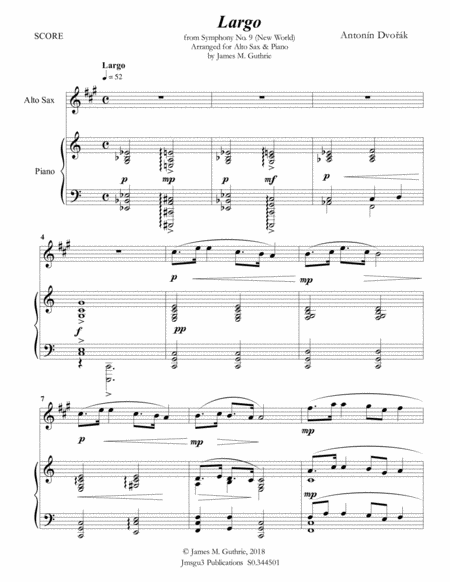
Alto Saxophone,Piano - Level 2 - Digital Download SKU: A0.549423 Composed by Antonin Dvorak. Arranged by James M. Guthrie, ASCAP. Instructional,Romantic Period,Sacred,Standards. Score and part. 12 pages. Jmsgu3 #3494005. Published by jmsgu3 (A0.549423). Score: 7 pages, solo part: 2 pages, piano part: 3 pages. Duration: 4:25. Not difficult, but requires sensitivity & dynamic control. Suitable for recitals, church meditations, or school programs. Dvořák Background Antonín Dvořák (1841 –1904) was, of course, a composer from Czechoslovakia. As a matter of fact, he was among the first Bohemian composers to attain universal recognition. It is important to realize that the late Romantic Nationalist period featured composers who used traditional and folk elements to portray the character of their nation. In particular, we see this in the music of Grieg (Norway), Finland (Sibelius), and Smetana (Bohemia).  Dvořák relied markedly on rhythms and other characteristics of Moravian and Bohemian folk music. Ascent to Fame Dvořák was truly a child musical prodigy on the violin. The premiere performances of his compositions notably occurred in 1872 and 1873. He submitted his First Symphony in particular to a German competition, but it failed to win. Consequently, in 1874 he presented two more symphonies to the Austrian State Prize for Composition. Johannes Brahms was the principal of the jury and was accordingly very impressed. They forthwith awarded the prize to Dvořák in 1874, 1876, and 1877. At this point, Brahms thereupon endorsed Dvořák to the publisher Simrock. Later, the publisher commissioned Dvořák to compose the Slavonic Dances, Op. 46. These became popular overnight and, as a result, Dvořák's worldwide status was launched. International Status Dvořák visited England upon invitation nine times. On each visit, he frequently conducted performances of his own compositions. He conducted concerts of his music, especially in Moscow and St. Petersburg. Eventually, the Prague Conservatory in fact appointed Dvořák as a professor. There, to be sure, he wrote his famous Dumky Trio. United States Consequently, the National Conservatory of Music of America appointed him as director in 1892. As a result, Dvořák composed his two most famous symphonic works: the Symphony No. 9 (From the New World), which spread his name universally, and his Concerto for Cello and Orchestra, one of the most famous of all cello works. Moreover, he wrote his most celebrated American String Quartet during this time. At the same time, because of his growing recognition in Europe and his homesickness for his own country, he left to return to Bohemia in 1895.  
DvoÅ™ák: Largo from the New World Symphony for Alto Sax & Piano
Saxophone Alto et Piano

$32.95 28.47 € Saxophone Alto et Piano PDF SheetMusicPlus

Clarinet and piano - intermediate to advanced - Digital Download SKU: S9.Q53272 Op. 73. Composed by Iwan Muller. Edited by Rainer Mohrs and Rudolf Mauz. This edition: Sheet music. (c) 2020 Schott Music GmbH & Co. KG, Mainz. Classical. Downloadable. Op. 73. 9 pages. Schott Music - Digital #Q53272. Published by Schott Music - Digital (S9.Q53272). German • Danish.Iwan Müller, clarinettist, composer and reformer of the clarinet, was born to German parents in Reval (Russia). One of his first jobs was in St. Petersburg. In 1809 he went to Paris where he worked as an instrument maker, amongst other things. In 1812 he presented his new clarinet with 13 round keys, the ‘clarinette omnitonique‘, which could be played in all keys, to a panel. Although the initial evaluation was negative, the innovation was implemented in the coming years. In 1820 Müller returned to Russia and then to Germany (Kassel, Berlin). He performed concerts in various countries and finally became a court musician in Bückeburg. Iwan Müller’s skill as a composer is revealed in both the melody and harmony of Le rêve (The Dream). The piece was published in 1845 (plate number 7855).
Le rêve
Clarinette

$3.99 3.45 € Clarinette PDF SheetMusicPlus

String Ensemble,String Trio Cello,Violin - Level 5 - Digital Download SKU: A0.742477 Composed by Alexander Borodin. Arranged by Arte Nova Music Lab. Concert,Easter,Romantic Period,Standards,World. Score and parts. 31 pages. Arte Nova Music Lab #4602739. Published by Arte Nova Music Lab (A0.742477). Alexander Porfiryevich Borodin (Russian: ÐлекÑаÌндр ПорфиÌрьевич БородиÌн, IPA: [Élʲɪkˈsandr pÉrˈfʲi rʲjɪvʲɪtÉ• bÉ™rÉˈdʲin] (12 November 1833 – 27 February 1887) was a Russian chemist and Romantic musical composer ofGeorgian ancestry. He was one of the prominent 19th-century composers known as The Mighty Handful, a group dedicated to producing a uniquely Russian kind of classical music, rather than imitating earlier Western European models.[3][4][5]Borodin is known best for his symphonies, his two string quartets, the symphonic poem In the Steppes of Central Asia and his opera Prince Igor. Music fromPrince Igor and his string quartets was later adapted for the US musical Kismet. A doctor and chemist by profession, Borodin made important early contributions to organic chemistry. Although he is presently known better as a composer, during his lifetime, he regarded medicine and science as his primary occupations, only practising music and composition in his spare time or when he was ill. As a chemist, Borodin is known best for his work concerning organic synthesis, including being among the first chemists to demonstrate nucleophilic substitution, as well as being the co-discoverer of the aldol reaction. Borodin was a promoter of education in Russia and founded the School of Medicine for Women in Saint Petersburg, where he taught until 1885. Taken from https://en.wikipedia.org/wiki/Alexander_Borodin
String Trio in G minor
Trio à Cordes: 2 violons, violoncelle

$25.00 21.6 € Trio à Cordes: 2 violons, violoncelle PDF SheetMusicPlus

Bass Clarinet,Piano - Level 2 - Digital Download SKU: A0.549432 Composed by Antonin Dvorak. Arranged by James M. Guthrie, ASCAP. Instructional,Romantic Period,Sacred,Standards. Score and part. 12 pages. Jmsgu3 #3494207. Published by jmsgu3 (A0.549432). Score: 7 pages, solo part: 2 pages, piano part: 3 pages. Duration: 4:25 Not difficult, but requires sensitivity & dynamic control. Suitable for recitals, church meditations, or school programs. Dvořák Background Antonín Dvořák (1841 –1904) was, of course, a composer from Czechoslovakia. As a matter of fact, he was among the first Bohemian composers to attain universal recognition. It is important to realize that the late Romantic Nationalist period featured composers who used traditional and folk elements to portray the character of their nation. In particular, we see this in the music of Grieg (Norway), Finland (Sibelius), and Smetana (Bohemia).  Dvořák relied markedly on rhythms and other characteristics of Moravian and Bohemian folk music. Ascent to Fame Dvořák was truly a child musical prodigy on the violin. The premiere performances of his compositions notably occurred in 1872 and 1873. He submitted his First Symphony in particular to a German competition, but it failed to win. Consequently, in 1874 he presented two more symphonies to the Austrian State Prize for Composition. Johannes Brahms was the principal of the jury and was accordingly very impressed. They forthwith awarded the prize to Dvořák in 1874, 1876, and 1877. At this point, Brahms thereupon endorsed Dvořák to the publisher Simrock. Later, the publisher commissioned Dvořák to compose the Slavonic Dances, Op. 46. These became popular overnight and, as a result, Dvořák's worldwide status was launched. International Status Dvořák visited England upon invitation nine times. On each visit, he frequently conducted performances of his own compositions. He conducted concerts of his music, especially in Moscow and St. Petersburg. Eventually, the Prague Conservatory in fact appointed Dvořák as a professor. There, to be sure, he wrote his famous Dumky Trio. United States Consequently, the National Conservatory of Music of America appointed him as director in 1892. As a result, Dvořák composed his two most famous symphonic works: the Symphony No. 9 (From the New World), which spread his name universally, and his Concerto for Cello and Orchestra, one of the most famous of all cello works. Moreover, he wrote his most celebrated American String Quartet during this time. At the same time, because of his growing recognition in Europe and his homesickness for his own country, he left to return to Bohemia in 1895.
DvoÅ™ák: Largo from the New World Symphony for Bass Clarinet & Piano
Clarinette Basse, Piano

$32.95 28.47 € Clarinette Basse, Piano PDF SheetMusicPlus

Instrumental Solo,Pipe Organ - Level 2 - Digital Download SKU: A0.1251252 By Vida Prekerytė. By Juozas Naujalis. Arranged by Balys Vaitkus. Classical,Religious,Romantic Period. Individual part. 2 pages. Nacionaline vargonininku asociacija #845529. Published by Nacionaline vargonininku asociacija (A0.1251252). 14 Preludes, Op. 20. Fourteen pieces for organ, dedicated to a “beloved friend, Fr. Teodoras Brazys,†presents the largest collection of works for this instrument in Naujalis’ oeuvre. Like Naujalis, Brazys was the graduate of the Church Music School in Regensburg. These fourteen preludes for organ appear to be written in expression of deep affinity and gratitude to a like-minded friend who shared similar values. Some of Naujalis’ organ preludes have been included in music collections abroad – by Mieczysław Surzyński in Warsaw and Joseph Joubert in Paris. Juozas Naujalis (1869–1934) – Lithuanian composer and organist. In 1892, he was appointed organist and choir leader at the Kaunas Cathedral, a position he held until his death. Naujalis became actively involved in organizing local musical societies and institutions. As an outcome of his groundbreaking work, a number of important private entities, such as the first boys’ choir in Lithuania based at the Archcathedral Basilica in Kaunas, courses and the school for organists (1911), the first legal Lithuanian bookshop and music publishing house in Kaunas (1905–1912), the first music magazine Vargonininkas (The Organist) and calendars for organists published in Lithuanian (1909–1910), and the music school in Kaunas (1919), have been launched. In 1908, he founded the Children Society and St. Gregory Society for Organists, which was later reorganised into St. Cecilia Society for church musicians (1924). Naujalis was also the first Lithuanian composer to achieve recognition abroad. His church music was published in Regensburg, Warsaw, St. Petersburg, Leipzig and Paris. In recognition of his merits in the field of church music he was made Commander of the Order of the Crown of Italy in Rome, in 1929.A total of 29 organ pieces by Naujalis were recorded at the Archcathedral Basilica in Kaunas in 2019.
Prelude No. 4 in D major, Op. 20 by Juozas Naujalis (1869–1934)
Orgue
Vida PrekerytÄ—
$4.99 4.31 € Orgue PDF SheetMusicPlus

Instrumental Solo,Pipe Organ - Level 2 - Digital Download SKU: A0.1251256 By Audra Telksnytė. By Juozas Naujalis. Arranged by Balys Vaitkus. Classical,Religious,Romantic Period. Individual part. 2 pages. Nacionaline vargonininku asociacija #845533. Published by Nacionaline vargonininku asociacija (A0.1251256). 14 Preludes, Op. 20. Fourteen pieces for organ, dedicated to a “beloved friend, Fr. Teodoras Brazys,†presents the largest collection of works for this instrument in Naujalis’ oeuvre. Like Naujalis, Brazys was the graduate of the Church Music School in Regensburg. These fourteen preludes for organ appear to be written in expression of deep affinity and gratitude to a like-minded friend who shared similar values. Some of Naujalis’ organ preludes have been included in music collections abroad – by Mieczysław Surzyński in Warsaw and Joseph Joubert in Paris. Juozas Naujalis (1869–1934) – Lithuanian composer and organist. In 1892, he was appointed organist and choir leader at the Kaunas Cathedral, a position he held until his death. Naujalis became actively involved in organizing local musical societies and institutions. As an outcome of his groundbreaking work, a number of important private entities, such as the first boys’ choir in Lithuania based at the Archcathedral Basilica in Kaunas, courses and the school for organists (1911), the first legal Lithuanian bookshop and music publishing house in Kaunas (1905–1912), the first music magazine Vargonininkas (The Organist) and calendars for organists published in Lithuanian (1909–1910), and the music school in Kaunas (1919), have been launched. In 1908, he founded the Children Society and St. Gregory Society for Organists, which was later reorganised into St. Cecilia Society for church musicians (1924). Naujalis was also the first Lithuanian composer to achieve recognition abroad. His church music was published in Regensburg, Warsaw, St. Petersburg, Leipzig and Paris. In recognition of his merits in the field of church music he was made Commander of the Order of the Crown of Italy in Rome, in 1929.A total of 29 organ pieces by Naujalis were recorded at the Archcathedral Basilica in Kaunas in 2019.
Prelude No. 6 in E major, Op. 20 by Juozas Naujalis (1869–1934)
Orgue
Audra TelksnytÄ—
$4.99 4.31 € Orgue PDF SheetMusicPlus

Full Orchestra - Level 3 - Digital Download SKU: A0.1130199 Composed by Anton Rubinstein. Arranged by Arkady Leytush. 19th Century. 107 pages. Arkady Leytush #730561. Published by Arkady Leytush (A0.1130199). Anton Rubinstein Concert Suite from “Bal costumeâ€, Op. 103 1. Polonais et polonaise 2. Toréador et andalouse 3. Pacha et almée 4. Pêcheur napolitain et napolitaine This concert suite was composed and orchestrated by me from 4 bright numbers “Bal costumeâ€, op. 103. Their strong contrasting imagery, theatricality and ingenuity provided an excellent opportunity for development in the orchestra and served as the impetus for this orchestral transcription. In addition to popularizing the work of A. Rubinstein as a composer, this music itself can become an adornment of many symphonic programs. The role and significance of Anton Rubinstein for the development of academic music in Russia is invaluable. His powerful and versatile talent manifested itself in everything he did. He remained in the history of music as an unsurpassed pianist and conductor, and as a great composer, and as the founder of the Russian Musical Society, and as the organizer of the First Russian Conservatory in St. Petersburg. Unfortunately, this all-encompassing contribution to Russian musical culture and his place in it have not yet been sufficiently appreciated by his descendants, and there are traditionally painful reasons for this. He still cannot be forgiven for his origin and some critical statements about his colleagues, which hang like a stone over the memory of this great maestro and man!
A. Rubinstein - Concert Suite from “Bal costume”, Op. 103 - Score Only
Orchestre

$100.00 86.42 € Orchestre PDF SheetMusicPlus

Brass Ensemble Horn,Trombone,Trumpet,Tuba - Level 3 - Digital Download SKU: A0.740257 Composed by Alexander Glazunov. Arranged by Craig Garner. Romantic Period,Wedding. Score and parts. 20 pages. Dorm 40 Music #2949513. Published by Dorm 40 Music (A0.740257). Glazunov was the last of the great Russian nationalist composers. A royal march section is followed by a lyric and romantic trio section, before a reprise of the march. It makes a great concert overture and will transport you back to St. Petersburg. Unique and versatile. Arrangement includes both B-flat and C trumpet parts. Performance time, 5:30. Published by Dorm 40 Music, www.dorm40music.com.
Marche de Noces (A Processional March)
Quatuor de Cuivres : 2 trompettes, trombone, tuba

$12.00 10.37 € Quatuor de Cuivres : 2 trompettes, trombone, tuba PDF SheetMusicPlus


Partitions Gratuites
Acheter des Partitions Musicales
Acheter des Partitions Digitales à Imprimer
Acheter des Instruments de Musique

© 2000 - 2026

Accueil - Version intégrale