EUROPE
15474 articles
USA
0 articles
DIGITAL
34047 articles (à imprimer)
Partitions Digitales
Partitions à imprimer
34047 partitions trouvées


Instrumental Solo,Oboe d'Amore,Piano - Level 2 - Digital Download SKU: A0.549427 Composed by Antonin Dvorak. Arranged by James M. Guthrie, ASCAP. Instructional,Romantic Period,Sacred,Standards. Score and individual part. 12 pages. Jmsgu3 #3494165. Published by jmsgu3 (A0.549427). Score: 7 pages, solo part: 2 pages, piano part: 3 pages. Duration: 4:25 Not difficult, but requires sensitivity & dynamic control. Suitable for recitals, church meditations, or school programs. Dvořák Background Antonín Dvořák (1841 –1904) was, of course, a composer from Czechoslovakia. As a matter of fact, he was among the first Bohemian composers to attain universal recognition. It is important to realize that the late Romantic Nationalist period featured composers who used traditional and folk elements to portray the character of their nation. In particular, we see this in the music of Grieg (Norway), Finland (Sibelius), and Smetana (Bohemia).  Dvořák relied markedly on rhythms and other characteristics of Moravian and Bohemian folk music. Ascent to Fame Dvořák was truly a child musical prodigy on the violin. The premiere performances of his compositions notably occurred in 1872 and 1873. He submitted his First Symphony in particular to a German competition, but it failed to win. Consequently, in 1874 he presented two more symphonies to the Austrian State Prize for Composition. Johannes Brahms was the principal of the jury and was accordingly very impressed. They forthwith awarded the prize to Dvořák in 1874, 1876, and 1877. At this point, Brahms thereupon endorsed Dvořák to the publisher Simrock. Later, the publisher commissioned Dvořák to compose the Slavonic Dances, Op. 46. These became popular overnight and, as a result, Dvořák's worldwide status was launched. International Status Dvořák visited England upon invitation nine times. On each visit, he frequently conducted performances of his own compositions. He conducted concerts of his music, especially in Moscow and St. Petersburg. Eventually, the Prague Conservatory in fact appointed Dvořák as a professor. There, to be sure, he wrote his famous Dumky Trio. United States Consequently, the National Conservatory of Music of America appointed him as director in 1892. As a result, Dvořák composed his two most famous symphonic works: the Symphony No. 9 (From the New World), which spread his name universally, and his Concerto for Cello and Orchestra, one of the most famous of all cello works. Moreover, he wrote his most celebrated American String Quartet during this time. At the same time, because of his growing recognition in Europe and his homesickness for his own country, he left to return to Bohemia in 1895.  
DvoÅ™ák: Largo from the New World Symphony for Oboe d'Amore & Piano

$32.95 28.47 € PDF SheetMusicPlus

Instrumental Solo,Pipe Organ - Level 2 - Digital Download SKU: A0.1251282 By Indrė Gerikaitė. By Juozas Naujalis. Arranged by Balys Vaitkus. Classical,Religious,Romantic Period. Individual part. 2 pages. Nacionaline vargonininku asociacija #845558. Published by Nacionaline vargonininku asociacija (A0.1251282). 12 Organ Trios, Op. 4. Taking into account the date of publication (1897) these seem to be the first printed organ compositions of Naujalis. They were published in Warsaw, in the collection Preludia na organy, part 2, series III. The publication soon received positive comments in the Polish newspaper of the St. Cecilia Society, Musica sacra (1898 No. 5). There are many signs that Naujalis used this edition as his favourite teaching manual since the fingerings and pedaling given are from the author himself.Juozas Naujalis (1869–1934) – Lithuanian composer and organist. In 1892, he was appointed organist and choir leader at the Kaunas Cathedral, a position he held until his death. Naujalis became actively involved in organizing local musical societies and institutions. As an outcome of his groundbreaking work, a number of important private entities, such as the first boys’ choir in Lithuania based at the Archcathedral Basilica in Kaunas, courses and the school for organists (1911), the first legal Lithuanian bookshop and music publishing house in Kaunas (1905–1912), the first music magazine Vargonininkas (The Organist) and calendars for organists published in Lithuanian (1909–1910), and the music school in Kaunas (1919), have been launched. In 1908, he founded the Children Society and St. Gregory Society for Organists, which was later reorganised into St. Cecilia Society for church musicians (1924). Naujalis was also the first Lithuanian composer to achieve recognition abroad. His church music was published in Regensburg, Warsaw, St. Petersburg, Leipzig and Paris. In recognition of his merits in the field of church music he was made Commander of the Order of the Crown of Italy in Rome, in 1929.A total of 29 organ pieces by Naujalis were recorded at the Archcathedral Basilica in Kaunas in 2019.
Trio No. 6 in B-flat minor, Op. 4 by Juozas Naujalis (1869–1934)
Orgue
IndrÄ— GerikaitÄ—
$4.99 4.31 € Orgue PDF SheetMusicPlus

Violin and piano - intermediate to advanced - Digital Download SKU: S9.Q7068 Composed by Henri Vieuxtemps. This edition: Sheet music. Violin Library. Downloadable. Op. 32/2. Schott Music - Digital #Q7068. Published by Schott Music - Digital (S9.Q7068). In the time of travelling violin virtuosos in the 19th century, the Belgian composer Henri Vieuxtemps was regarded as one of the 'greatest', next to Paganini, Spohr, Bériot, Wieniawski and others. His concert tours led him to the 'new world' and through Europe to Russia where he lived in Petersburg for a few years and founded the violin class at the local conservatoire. His most important pupil - after his return to his Belgian home country - was Eugène Ysaÿe. As a composer, he had written compositions mainly, though not exclusively for 'his' instrument, the violin. He also wrote concertos and chamber music, especially catchy salon music repertoire pieces such as his Rondino, a virtuoso piece with a soulful middle section - a real treat as an encore!
Rondino
Violon et Piano

$12.99 11.23 € Violon et Piano PDF SheetMusicPlus

Piano Solo - Level 3 - Digital Download SKU: A0.1042210 By Piotr Ilitch Tchaikovski. By Piotr Ilitch Tchaikovski. Arranged by Stepan Esipoff Edited. Contest,Festival,Film/TV,Instructional,Romantic Period,Wedding. Score. 8 pages. Flavio Regis Cunha #647014. Published by Flavio Regis Cunha (A0.1042210). The Dance of the Sugar Plum Fairy is a dance for a ballerina. It is the third movement in The Nutcracker pas de deux. This pas de deux is from Act 2 of the 1892 ballet The Nutcracker. It is danced by the principal female dancer. The number was choreographed by Lev Ivanov to music written by Tchaikovsky. Choreographer Marius Petipa wanted the Sugar Plum Fairy's music to sound like drops of water shooting from a fountain. Tchaikovsky found the ideal instrument to do this job in Paris in 1891. It was then that he came across the recently invented celesta. This instrument looked like a piano. It sounded like bells. Tchaikovsky wrote, [The celesta is] midway between a tiny piano and a Glockenspiel, with a divinely wonderful sound. He wanted to use the celesta in The Nutcracker. He asked his publisher to buy one. He wanted to keep the purchase a secret. He did not want other Russian composers to get wind of it and ... use it for unusual effects before me. Tchaikovsky introduced the celesta to Russian music lovers on 19 March 1892 when the Nutcracker Suite was performed for the Russian Musical Society in St. Petersburg. The instrument is forever identified with the Sugar Plum Fairy. It is heard in other parts of Act 2 of The Nutcracker besides the Sugar Plum Fairy's dance.[3] The Dance of the Sugar Plum Fairy is one of the ballet's best known musical numbers. It is often jazzed up for television commercials at Christmas time. This arrangement was written by Stepan Esipoff and Edited by FLAVIO REGIS CUNHA. Intermediate level Format: Concert 9 x 12 inches. 8 pages.
Dance of the Sugar-Plum Fairy for Piano Solo
Piano seul
Piotr Ilitch Tchaikovski
$3.99 3.45 € Piano seul PDF SheetMusicPlus

Instrumental Solo,Pipe Organ - Level 2 - Digital Download SKU: A0.1251281 By Indrė Gerikaitė. By Juozas Naujalis. Arranged by Balys Vaitkus. Classical,Religious,Romantic Period. Individual part. 2 pages. Nacionaline vargonininku asociacija #845557. Published by Nacionaline vargonininku asociacija (A0.1251281). 12 Organ Trios, Op. 4. Taking into account the date of publication (1897) these seem to be the first printed organ compositions of Naujalis. They were published in Warsaw, in the collection Preludia na organy, part 2, series III. The publication soon received positive comments in the Polish newspaper of the St. Cecilia Society, Musica sacra (1898 No. 5). There are many signs that Naujalis used this edition as his favourite teaching manual since the fingerings and pedaling given are from the author himself.Juozas Naujalis (1869–1934) – Lithuanian composer and organist. In 1892, he was appointed organist and choir leader at the Kaunas Cathedral, a position he held until his death. Naujalis became actively involved in organizing local musical societies and institutions. As an outcome of his groundbreaking work, a number of important private entities, such as the first boys’ choir in Lithuania based at the Archcathedral Basilica in Kaunas, courses and the school for organists (1911), the first legal Lithuanian bookshop and music publishing house in Kaunas (1905–1912), the first music magazine Vargonininkas (The Organist) and calendars for organists published in Lithuanian (1909–1910), and the music school in Kaunas (1919), have been launched. In 1908, he founded the Children Society and St. Gregory Society for Organists, which was later reorganised into St. Cecilia Society for church musicians (1924). Naujalis was also the first Lithuanian composer to achieve recognition abroad. His church music was published in Regensburg, Warsaw, St. Petersburg, Leipzig and Paris. In recognition of his merits in the field of church music he was made Commander of the Order of the Crown of Italy in Rome, in 1929.A total of 29 organ pieces by Naujalis were recorded at the Archcathedral Basilica in Kaunas in 2019.
Trio No. 5 in A-flat major, Op. 4 by Juozas Naujalis (1869–1934)
Orgue
IndrÄ— GerikaitÄ—
$4.99 4.31 € Orgue PDF SheetMusicPlus

Alto Saxophone,Piano - Level 5 - Digital Download SKU: A0.549254 Composed by Nikolay Andreyevich Rimsky-Korsakov. Arranged by James M. Guthrie, ASCAP. Instructional,Romantic Period,Standards. Score and part. 15 pages. Jmsgu3 #3473685. Published by jmsgu3 (A0.549254). Flight of the Bumblebee Flight of the Bumblebee is, to be sure, an orchestral interlude composed by Nikolai Rimsky-Korsakov for his opera The Tale of Tsar Saltan. Of course, Korsakov intended to portray a bumblebee's chaotic flying pattern musically. Nowadays, this piece is one of the comparatively more famous classical works because it frequently appears occasionally in popular culture. The piece appears notably in the opera at the close of Act III, Tableau 1. This is when the magic Swan-Bird changes the Prince (the son of the Tsar) into a bee so he can fly away to visit his father. Interestingly, at this point in the drama, his father, in effect, does not know that he is alive. Korsakov Background Nikolai Rimsky-Korsakov (1844 –1908) was a uniquely famous composer from Russia. He was likewise a member of an infamous assembly of composers called The Five. Korsakov was furthermore an expert in orchestration. His correspondingly most famous orchestral compositions- Capriccio Espagnol, the Russian Easter Festival Overture, and the Scheherazade suite- are essential monuments of the standard music repertoire.  Also comparatively very important are his suites and excerpts from his 15 operas. Korsakov used Russian folklore and fairy tales, such as Scheherazade, in his music.  Nationalistic Style Like fellow outspoken composer Balakirev, Korsakov believed in creating a nationalistic, Russia-centric style of classical music. The new style was called Orientalism. It similarly relied on native Russian materials, exotic scales, and experimental harmonic, melodic, and rhythmic procedures. This practice, conversely, ran counter to the developments in Western musical culture. Musical Developments Nevertheless, Korsakov developed an appreciation of Western musical techniques after he became a professor of musical composition, harmony, and orchestration at the Saint Petersburg Conservatory in 1871. Moreover, he undertook a rigorous three-year program of self-education. He mastered Western methods, incorporating them with the influences of Mikhail Glinka and other members of The Five. His techniques of composition and orchestration were additionally enriched by his exposure to the works of Richard Wagner. Naval Service Korsakov combined his music career accordingly with a career in the Russian military. He was in the first place an officer in the Russian Navy. In due time, he was appointed a civilian Inspector of Naval Bands. As a result, Korsakov expanded his knowledge of woodwind and brass playing, which heightened his orchestration capabilities. Legacy In due time, Korsakov contributed a significant number of Russian nationalist works. He also prepared, occasionally, compositions by The Five for presentation. This brought their works straightaway into the active classical repertoire as well. He also shaped an entire generation of younger composers as a music educator. Therefore, music historians consider Korsakov the foremost engineer of what the public considers the Russian composition style. He served as a transitional figure between The Five and the classically trained composers who became the norm over time. In addition to the Russians, he influenced non-Russian composers such as Ravel, Debussy, Dukas, and Respighi.  
Korsakov: Flight of the Bumblebee for Alto Sax & Piano
Saxophone Alto et Piano

$32.95 28.47 € Saxophone Alto et Piano PDF SheetMusicPlus

Instrumental Duet,Piano Cello,Flute,Instrumental Duet,Piano - Level 5 - Digital Download SKU: A0.1272503 By Maria Thompson Corley. By Anonymous. Arranged by Maria Thompson Corley. 21st Century,Classical,Religious,Sacred,Spiritual. 31 pages. Maria Thompson Corley #864728. Published by Maria Thompson Corley (A0.1272503). “Crossing Jordan†grew out of my daughter Kiana’s surprise request that I arrange a spiritual for voice, piano and cello for her senior recital. She received a degree in commercial music the year before COVID shut everything down, at a time before climate change made blizzards an anomaly here in Central PA. As a result, snow days still existed. I spent one of them doing the first draft of “Deep River,†her favorite.Later, I decided that if singers engage a cellist for a concert, they might like to program more than one piece for them, so I chose two more water-themed spirituals to complete the set. “His Name So Sweet†is a more meditative version of the song than I’ve generally heard. I wanted the piano, cello, and briefly the voice to imitate the fountain in the text. The mood is ecstasy, resulting from the fundamental change that baptism is meant to create. “Deep River†also includes “Michael Row The Boat Ashore†and “The Water Is Wide.†The latter isn’t a spiritual, however, taken together the message is that the river is deep, the water is wide, but with (the Archangel?) Michael’s help, Jordan can be crossed. “Wade in the Water†is one of the most well-known spirituals. I focus on the idea of escaping enslavement: the opening is quiet, furtive, maybe even nervous. The Moses in the text can be understood to be Harriet Tubman, who might urge escapees to wade in the water so pursuing dogs couldn’t follow their scent. In my mind, the ending symbolizes that the party has vanished, never to be enslaved again.The first instrumental version of “Deep River†was for trumpet and piano, performed by my sister, Alicia Thompson, and her son, Justin Griffin, during a church service in Atlanta shortly after I arranged it. After hearing a recording, I took borrowed her idea of adding a repeat (which she did to allow enough time for the ushers to take up collection). The clarinet, cello and piano version was premiered by the Isosceles Trio (Doris Hall-Gulati (clarinet), Sara Male (cello), and me (piano)). When Naima Burrs, violinist and conductor of the Petersburg Symphony, asked if I had any pieces for trio, I created a version for violin, piano and cello. The flute/piano/cello version may have been performed, but if so, nobody has mentioned it to me. Please note that the YouTube version uses a clarinet. The flute version is slightly different, to accommodate the difference in range.P.S. I’d love to hear that version, if you have a recording of it.
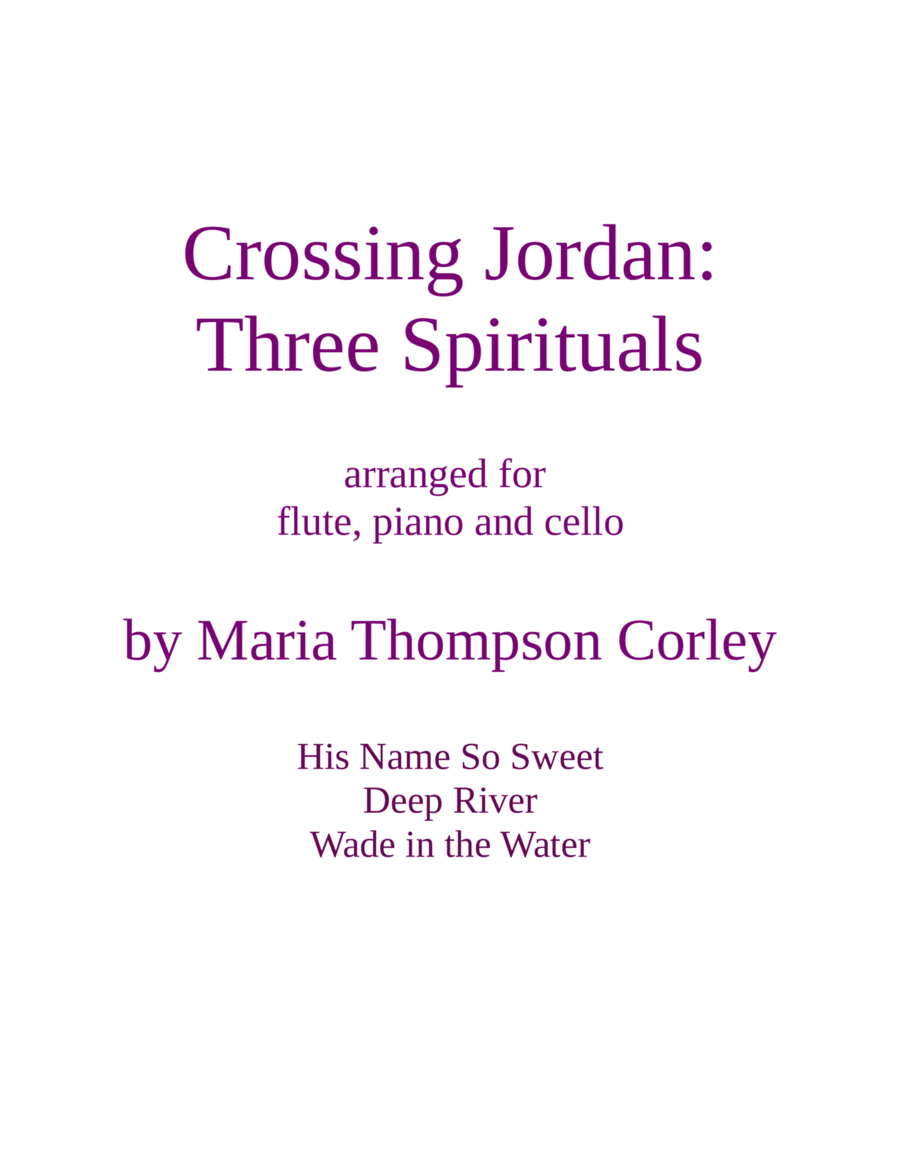
Crossing Jordan: Three Spirituals for flute, piano and cello
Maria Thompson Corley
$30.00 25.92 € PDF SheetMusicPlus

Brass Ensemble Euphonium,Horn,Trombone,Trumpet,Tuba - Level 3 - Digital Download SKU: A0.817103 Composed by Anton Liadov and Alexander Glazounov. Arranged by Charles Decker. Classical,Historic,Instructional,Multicultural,Romantic Period,World. 35 pages. Charles Decker Music Press #3532445. Published by Charles Decker Music Press (A0.817103). Five short fanfares from the 1890 concert celebrating Nicolai Rimsky-Korsakov's twenty-year tenure as professor at the St. Petersburg Conservatory in Russia. Brilliantly scored for an orchestral brass section by two former students of Rimsky-Korsakov, the brief fanfares can highlight not only brass ensemble concerts or special ceremonies, but make a memorable concert opening for a band or orchestra brass section. This edition is scored for three B-flat trumpets with alternate C  trumpet parts, 4 horns in F, 3 trombones in the bass clef, tuba, timpani, and tenor drum.  The audio file is an actual large brass ensemble performance of the entire work and not a computer playback of the score.See 50+ homogeneous brass editions for trumpet, horn and trombone ensembles and 75+ mixed brass ensemble publications with Charles Decker Music Press at Sheet Music Plus for inexperienced to advanced musicians with music ranging from the Renaissance to contemporary new works for trios, quartets, quintets, brass choir and brass band. Many of the mixed brass ensemble editions include alternate and substitute parts being alternate C trumpet parts for B-flat trumpet parts, flugelhorn/trumpet substitute for horn, horn substitute for trombone and treble clef euphonium substitute for trombone. To see our Music of Black Composers Series enter “Black Composers Series†in the search box at Charles Decker Music Press for 25 arrangements for mixed brass ensembles ranging from early jazz to symphonic works with composers Samuel Coleridge-Taylor, R. Nathaniel Dett, William Grant Still, Will Marion Cook, James Reese Europe, James Johnson and others..  For more brass quintet editions by Charles Decker use these links to Kendor Music  and  Cherry Classics Music for listings of arrangements of music by J.S. Bach, H.L. Clarke, Debussy, Dukas, Elgar, Falla, Holst, Ives, Nestico, Rachmaninoff, Satie, and Tchaikovsky.
Five Fanfares for Rimsky-Korsakov for Brass Choir
Flûte, Hautbois, Clarinette, Basson

$16.95 14.65 € Flûte, Hautbois, Clarinette, Basson PDF SheetMusicPlus

Brass Ensemble Euphonium,Trombone,Tuba - Level 2 - Digital Download SKU: A0.887012 Composed by Modest Petrovich Mussorgsky. Arranged by James Brady. Romantic Period,Standards. Score and parts. 7 pages. James Brady Music #5312711. Published by James Brady Music (A0.887012). This arrangement of the opening of Mussorgsky's best-known work is ideally suited as an opening or closing statement piece for a group of 4 early-intermediate trombones (1 bass trombone or tuba) or other bass clef instruments. It stays true to the original piece with adaptations in range for developing players and an adapted ending better suited for standalone performance. The estimated duration of the performance is 1m 30s.Pictures at an Exhibition is a suite of pieces for piano based on pictures by Mussorgsky's friend Viktor Hartmann, who died suddenly in 1873, aged 39. A memorial exhibition of Hartmann's works was staged in St. Petersburg the following year, and Mussorgsky's suite depicts walk around it, viewing 10 pictures in total. In addition to the pieces inspired by individual pictures, the suite contains several variations of the 'Promenade' theme, which depicts Mussorgsky roving through the exhibition, now leisurely, now briskly in order to come close to a picture that had attracted his attention, and at times sadly, thinking of his departed friend. (Vladimir Stasov). This arrangement presents the opening version of the 'Promenade', adapted to suit a group of 4 trombones (1 bass trombone or tuba) or similar group of bass clef instruments. The ranges have been reduced to accommodate young or developing players. The 1st part goes no higher than F4, and the bass part no lower than Bb1 (optionally A1). The melody is mainly in the 1st part, with passages in the 2nd and 3rd parts from time to time, but as the texture of Mussorgksy's composition is almost exclusively homophonic, all parts have equal importance. I have inserted additional dynamics and accents to aid phrasing, and adapted the ending to suit a standalone performance.
'Promenade' from Pictures at an Exhibition - easy arrangement for trombone quartet/tuba
Quatuor de cuivres: 4 trombones

$7.99 6.9 € Quatuor de cuivres: 4 trombones PDF SheetMusicPlus


Partitions Gratuites
Acheter des Partitions Musicales
Acheter des Partitions Digitales à Imprimer
Acheter des Instruments de Musique

© 2000 - 2026

Accueil - Version intégrale





