EUROPE
9773 articles
USA
5422 articles
DIGITAL
3274 articles (à imprimer)
Partitions Digitales
Partitions à imprimer
3274 partitions trouvées


Instrumental Solo,Pipe Organ - Level 2 - Digital Download SKU: A0.1251298 By Indrė Gerikaitė. By Juozas Naujalis. Arranged by Balys Vaitkus. Classical,Religious,Romantic Period. Individual part. 2 pages. Nacionaline vargonininku asociacija #845567. Published by Nacionaline vargonininku asociacija (A0.1251298). 12 Organ Trios, Op. 4. Taking into account the date of publication (1897) these seem to be the first printed organ compositions of Naujalis. They were published in Warsaw, in the collection Preludia na organy, part 2, series III. The publication soon received positive comments in the Polish newspaper of the St. Cecilia Society, Musica sacra (1898 No. 5). There are many signs that Naujalis used this edition as his favourite teaching manual since the fingerings and pedaling given are from the author himself.Juozas Naujalis (1869–1934) – Lithuanian composer and organist. In 1892, he was appointed organist and choir leader at the Kaunas Cathedral, a position he held until his death. Naujalis became actively involved in organizing local musical societies and institutions. As an outcome of his groundbreaking work, a number of important private entities, such as the first boys’ choir in Lithuania based at the Archcathedral Basilica in Kaunas, courses and the school for organists (1911), the first legal Lithuanian bookshop and music publishing house in Kaunas (1905–1912), the first music magazine Vargonininkas (The Organist) and calendars for organists published in Lithuanian (1909–1910), and the music school in Kaunas (1919), have been launched. In 1908, he founded the Children Society and St. Gregory Society for Organists, which was later reorganised into St. Cecilia Society for church musicians (1924). Naujalis was also the first Lithuanian composer to achieve recognition abroad. His church music was published in Regensburg, Warsaw, St. Petersburg, Leipzig and Paris. In recognition of his merits in the field of church music he was made Commander of the Order of the Crown of Italy in Rome, in 1929.A total of 29 organ pieces by Naujalis were recorded at the Archcathedral Basilica in Kaunas in 2019.
Trio No. 11 in E major, Op. 4 by Juozas Naujalis (1869–1934)
Orgue
IndrÄ— GerikaitÄ—
$4.99 4.28 € Orgue PDF SheetMusicPlus

French Horn,Piano - Level 3 - Digital Download SKU: A0.549612 Composed by Peter Ilyich Tchaikovsky. Arranged by James M. Guthrie, ASCAP. Instructional,Romantic Period,Standards. Score and part. 15 pages. Jmsgu3 #3513735. Published by jmsgu3 (A0.549612). Tchaikovsky is probably the most popular of the great composers in America. His music certainly appeals to musicians. Likewise, it appeals even to folks who don't usually listen to serious music. This is probably because of his most noteworthy melodies. Above all, he writes with great emotion. This certainly makes a most extraordinary, if not an unforgettable, impact. Education He attended classes at the Russian Musical Society and participated at the St. Petersburg Conservatory. There, he studied music theory with Nikolai Zaremba. Consequently, he also studied composition with Anton Rubenstein.  Rubenstein was criticized by Russian composers known as the Five. The Five The Five indeed rejected Western musical influences. They instead sought to use elements from Russian music. Furthermore, they wanted to use more exotic musical materials. Western Techniques More than other Russian composers, Tchaikovsky studied modern Western music. He develops his music like the European masters. So, rather than repeating a motive, he moves to a new key. He then introduces a different theme in the new key. Hence, he maintained his independence from the Five. Even more, he became the first Russian composer of international stature. Influences Tchaikovsky was probably influenced in his ballet scoring by Léo Delibes. Richard Wagner influenced his symphonic writing. Tchaikovsky's most famous works include the 1812 Overture, The Nutcracker Suite, and Swan Lake. Also notable are the Violin Concerto in D and the six symphonies. The greatest of the six symphonies may be No. 6, the Pathétique. Swan Lake Op. 20 Tchaikovsky composed Swan Lake in 1875-76. The ballet failed to attract a positive reception. Over time, however, it became one of the most popular of all of Tchaikovsky's works. The ballet was first performed by the Bolshoi Ballet in Moscow.
Tchaikovsky: Scene 10 from Swan Lake for French Horn & Piano
Cor et Piano

$32.95 28.27 € Cor et Piano PDF SheetMusicPlus

Full Orchestra - Level 3 - Digital Download SKU: A0.1130199 Composed by Anton Rubinstein. Arranged by Arkady Leytush. 19th Century. 107 pages. Arkady Leytush #730561. Published by Arkady Leytush (A0.1130199). Anton Rubinstein Concert Suite from “Bal costumeâ€, Op. 103 1. Polonais et polonaise 2. Toréador et andalouse 3. Pacha et almée 4. Pêcheur napolitain et napolitaine This concert suite was composed and orchestrated by me from 4 bright numbers “Bal costumeâ€, op. 103. Their strong contrasting imagery, theatricality and ingenuity provided an excellent opportunity for development in the orchestra and served as the impetus for this orchestral transcription. In addition to popularizing the work of A. Rubinstein as a composer, this music itself can become an adornment of many symphonic programs. The role and significance of Anton Rubinstein for the development of academic music in Russia is invaluable. His powerful and versatile talent manifested itself in everything he did. He remained in the history of music as an unsurpassed pianist and conductor, and as a great composer, and as the founder of the Russian Musical Society, and as the organizer of the First Russian Conservatory in St. Petersburg. Unfortunately, this all-encompassing contribution to Russian musical culture and his place in it have not yet been sufficiently appreciated by his descendants, and there are traditionally painful reasons for this. He still cannot be forgiven for his origin and some critical statements about his colleagues, which hang like a stone over the memory of this great maestro and man!
A. Rubinstein - Concert Suite from “Bal costume”, Op. 103 - Score Only
Orchestre

$100.00 85.79 € Orchestre PDF SheetMusicPlus

Brass Ensemble Euphonium,Horn,Trombone,Trumpet,Tuba - Level 3 - Digital Download SKU: A0.817103 Composed by Anton Liadov and Alexander Glazounov. Arranged by Charles Decker. Classical,Historic,Instructional,Multicultural,Romantic Period,World. 35 pages. Charles Decker Music Press #3532445. Published by Charles Decker Music Press (A0.817103). Five short fanfares from the 1890 concert celebrating Nicolai Rimsky-Korsakov's twenty-year tenure as professor at the St. Petersburg Conservatory in Russia. Brilliantly scored for an orchestral brass section by two former students of Rimsky-Korsakov, the brief fanfares can highlight not only brass ensemble concerts or special ceremonies, but make a memorable concert opening for a band or orchestra brass section. This edition is scored for three B-flat trumpets with alternate C  trumpet parts, 4 horns in F, 3 trombones in the bass clef, tuba, timpani, and tenor drum.  The audio file is an actual large brass ensemble performance of the entire work and not a computer playback of the score.See 50+ homogeneous brass editions for trumpet, horn and trombone ensembles and 75+ mixed brass ensemble publications with Charles Decker Music Press at Sheet Music Plus for inexperienced to advanced musicians with music ranging from the Renaissance to contemporary new works for trios, quartets, quintets, brass choir and brass band. Many of the mixed brass ensemble editions include alternate and substitute parts being alternate C trumpet parts for B-flat trumpet parts, flugelhorn/trumpet substitute for horn, horn substitute for trombone and treble clef euphonium substitute for trombone. To see our Music of Black Composers Series enter “Black Composers Series†in the search box at Charles Decker Music Press for 25 arrangements for mixed brass ensembles ranging from early jazz to symphonic works with composers Samuel Coleridge-Taylor, R. Nathaniel Dett, William Grant Still, Will Marion Cook, James Reese Europe, James Johnson and others..  For more brass quintet editions by Charles Decker use these links to Kendor Music  and  Cherry Classics Music for listings of arrangements of music by J.S. Bach, H.L. Clarke, Debussy, Dukas, Elgar, Falla, Holst, Ives, Nestico, Rachmaninoff, Satie, and Tchaikovsky.
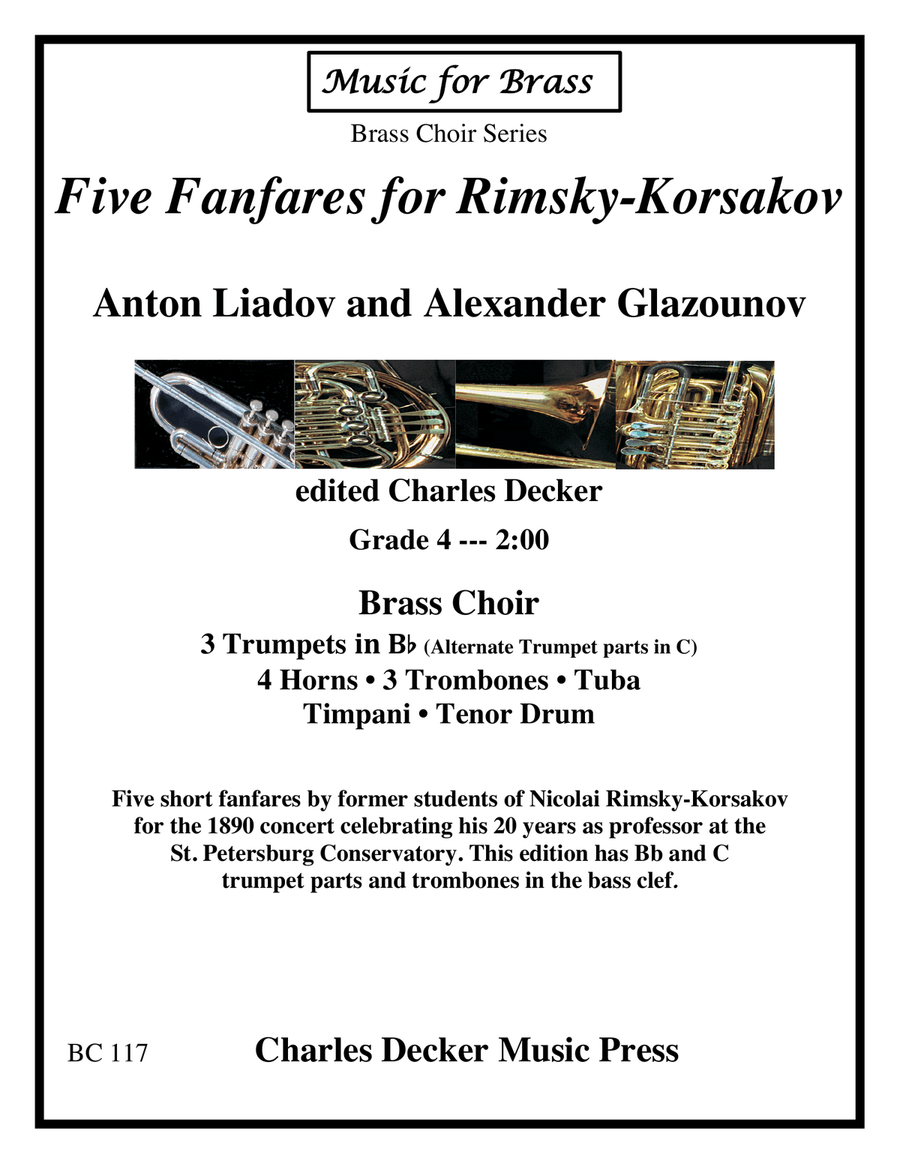
Five Fanfares for Rimsky-Korsakov for Brass Choir
Flûte, Hautbois, Clarinette, Basson

$16.95 14.54 € Flûte, Hautbois, Clarinette, Basson PDF SheetMusicPlus

Instrumental Solo,Pipe Organ - Level 2 - Digital Download SKU: A0.1251281 By Indrė Gerikaitė. By Juozas Naujalis. Arranged by Balys Vaitkus. Classical,Religious,Romantic Period. Individual part. 2 pages. Nacionaline vargonininku asociacija #845557. Published by Nacionaline vargonininku asociacija (A0.1251281). 12 Organ Trios, Op. 4. Taking into account the date of publication (1897) these seem to be the first printed organ compositions of Naujalis. They were published in Warsaw, in the collection Preludia na organy, part 2, series III. The publication soon received positive comments in the Polish newspaper of the St. Cecilia Society, Musica sacra (1898 No. 5). There are many signs that Naujalis used this edition as his favourite teaching manual since the fingerings and pedaling given are from the author himself.Juozas Naujalis (1869–1934) – Lithuanian composer and organist. In 1892, he was appointed organist and choir leader at the Kaunas Cathedral, a position he held until his death. Naujalis became actively involved in organizing local musical societies and institutions. As an outcome of his groundbreaking work, a number of important private entities, such as the first boys’ choir in Lithuania based at the Archcathedral Basilica in Kaunas, courses and the school for organists (1911), the first legal Lithuanian bookshop and music publishing house in Kaunas (1905–1912), the first music magazine Vargonininkas (The Organist) and calendars for organists published in Lithuanian (1909–1910), and the music school in Kaunas (1919), have been launched. In 1908, he founded the Children Society and St. Gregory Society for Organists, which was later reorganised into St. Cecilia Society for church musicians (1924). Naujalis was also the first Lithuanian composer to achieve recognition abroad. His church music was published in Regensburg, Warsaw, St. Petersburg, Leipzig and Paris. In recognition of his merits in the field of church music he was made Commander of the Order of the Crown of Italy in Rome, in 1929.A total of 29 organ pieces by Naujalis were recorded at the Archcathedral Basilica in Kaunas in 2019.
Trio No. 5 in A-flat major, Op. 4 by Juozas Naujalis (1869–1934)
Orgue
IndrÄ— GerikaitÄ—
$4.99 4.28 € Orgue PDF SheetMusicPlus

Concert Band - Level 4 - Digital Download SKU: A0.1505932 Composed by Johann Strauss Jr. Arranged by Albert Schwarzmann. 19th Century,Romantic Period. 289 pages. Edition Schwalbe #1081312. Published by Edition Schwalbe (A0.1505932). Aus den Bergen (From the Mountains) was composed in summer 1864 during Johann Strauss' annual concert trip to Russia. It  premiered on 2 October 1864 in Pavlovsk near St. Petersburg and was dedicated to the famous Viennese music critic Eduard Hanslick.  This arrangement in the original key of the orchestral version was commissioned by Salzburg Wind Philharmonic, principal conductor  Hansjoerg Angerer and premiered at their Three Kings' Concert on 6 January 2020 at the Grosses Festspielhaus  (Large Festival Hall) in Salzburg, Austria and broadcasted live by Austrian television.  Albert Schwarzmann had to step in at very short notice for the sick Hansjoerg Angerer, who performed this piece at the same event  on 6 January 2024. A live recording of this concert is available at  https://www.salzburg-windphilharmonic.at/de/dreikonigskonzert-2024-aus-den-bergen/ .
Aus den Bergen (From the Mountains), Walzer (Waltz) op. 292
Orchestre d'harmonie

$142.40 122.17 € Orchestre d'harmonie PDF SheetMusicPlus

String Orchestra - Level 3 - Digital Download SKU: A0.1181395 Composed by Viktor Kosenko. Arranged by Robert Debbaut. 20th Century,Children,Contest,Festival,Multicultural,Romantic Period,World. Score and parts. 10 pages. ROBERT DEBBAUT #781237. Published by ROBERT DEBBAUT (A0.1181395). Ukrainian and Soviet composer, Viktor Kosenko (1896-1938), was a highly regarded concert pianist, concertmaster and educator. Kosenko began his formal training at the St. Petersburg Conservatory as a composition student of Mikhail Sokolovsky. While in school he served as concertmaster of the Marinsky Theatre. Aleksandr Glazunov, the Director the Conservatory, was greatly impressed with Kosenko and spoke highly of his work.  Regarded by his contemporaries as a master of lyricism, his first compositions were markedly influenced by the works of composers such as Rachmaninov, Scriabin, Tchaikovsky and his fellow Ukrainian Mykola Lysenko.  During his short career he composed over 100 works for piano in a total of about 250 musical works. Other works include his symphonic Moldavian poem, choral and folk music arrangements, violin and piano concertos, trios and string quartets. During the 1930s Kosenko became dedicated to writing music for children. His first compositions for children were Four Children’s Pieces for piano (1930; this arranger has scored these four works for violin and piano, flute and piano, and cello and piano, as well as string orchestra). This work is one of five I have scored for as a Second Suite for String Orchestra from the twenty-four piano works for children he composed in 1936 (The First Suite is available from Carl Fischer).  If you purchase contact me about a set of parts and a wav recording at debbaut@gmail.com, subject line Kosenko.
Music for Dancing - Score Only
Orchestre à Cordes

$4.99 4.28 € Orchestre à Cordes PDF SheetMusicPlus

Orchestra - Digital Download SKU: S9.Q40349 Composed by Alexander Borodin. This edition: study score. Ernst Eulenburg - Orchestra - Score. Eulenburg Miniature Scores. Downloadable, Study score. Ernst Eulenburg & Co. GmbH - Digital #Q40349. Published by Ernst Eulenburg & Co. GmbH - Digital (S9.Q40349). Key: B minor. German • English • French.It took Borodin almost five years to write his first symphony, and the composition of 'Symphony No. 2' was to take just as much time. One should not forget, however, that music was mainly a leisure activity for the professor of organic chemistry in St. Petersburg. His work on 'Prince Igor' begun after the world premiere of Symphony No. 1 finished in favour of the second symphony, but part of the musical material found its way into the new composition, and even the extant programme testifies to the critical analysis of the music theatre: the gathering of Russian warriors in the first movement, the Old Slavonic bard in the andante, and the party scene to the sounds of the gusli in the finale.
Symphony No. 2 B minor
Orchestre

$17.99 15.43 € Orchestre PDF SheetMusicPlus

Instrumental Solo,Pipe Organ - Level 2 - Digital Download SKU: A0.1251259 By Vida Prekerytė. By Juozas Naujalis. Arranged by Balys Vaitkus. Classical,Religious,Romantic Period. Individual part. 3 pages. Nacionaline vargonininku asociacija #845537. Published by Nacionaline vargonininku asociacija (A0.1251259). 14 Preludes, Op. 20. Fourteen pieces for organ, dedicated to a “beloved friend, Fr. Teodoras Brazys,†presents the largest collection of works for this instrument in Naujalis’ oeuvre. Like Naujalis, Brazys was the graduate of the Church Music School in Regensburg. These fourteen preludes for organ appear to be written in expression of deep affinity and gratitude to a like-minded friend who shared similar values. Some of Naujalis’ organ preludes have been included in music collections abroad – by Mieczysław Surzyński in Warsaw and Joseph Joubert in Paris. Juozas Naujalis (1869–1934) – Lithuanian composer and organist. In 1892, he was appointed organist and choir leader at the Kaunas Cathedral, a position he held until his death. Naujalis became actively involved in organizing local musical societies and institutions. As an outcome of his groundbreaking work, a number of important private entities, such as the first boys’ choir in Lithuania based at the Archcathedral Basilica in Kaunas, courses and the school for organists (1911), the first legal Lithuanian bookshop and music publishing house in Kaunas (1905–1912), the first music magazine Vargonininkas (The Organist) and calendars for organists published in Lithuanian (1909–1910), and the music school in Kaunas (1919), have been launched. In 1908, he founded the Children Society and St. Gregory Society for Organists, which was later reorganised into St. Cecilia Society for church musicians (1924). Naujalis was also the first Lithuanian composer to achieve recognition abroad. His church music was published in Regensburg, Warsaw, St. Petersburg, Leipzig and Paris. In recognition of his merits in the field of church music he was made Commander of the Order of the Crown of Italy in Rome, in 1929.A total of 29 organ pieces by Naujalis were recorded at the Archcathedral Basilica in Kaunas in 2019.
Prelude No. 9 in D minor, Op. 20 by Juozas Naujalis (1869–1934)
Orgue
Vida PrekerytÄ—
$4.99 4.28 € Orgue PDF SheetMusicPlus

Piano,Vocal,Voice - Level 3 - Digital Download SKU: A0.1409091 By Mikhail Glinka. By Mikhail Glinka. Arranged by Russian for Singers. 19th Century,Classical,Instructional,Romantic Period. Score. 9 pages. Natalia Melnik #991696. Published by Natalia Melnik (A0.1409091). M.Glinka. ÐšÐ¾Ð»Ñ‹Ð±ÐµÐ»ÑŒÐ½Ð°Ñ Ð¿ÐµÑÐ½Ñ / Kolybel'naya pesnya / Lullaby from the song cycle A Farewell to Saint PetersburgPoem by N.Kukol'nikOriginal key (A minor)Range:E4 - F5 (Soprano, Mezzo-Soprano)E3 - F4 (Tenor, Baritone)FREE DOWNLOAD! A quick and comprehensive tutorial on Russian phonetics:https://www.russian4singers.com/russian-diction-for-singers-1 We are offering a range of Russian diction coaching services:- individual coaching- group webinars- lectures on Russian Music Literature for singers​Please visit our website for more information https://www.russian4singers.com/bookingPlease SUBSCRIBE to Russian for Singers YouTube Channel and watch the free diction guides for many Russian songs and arias https://www.youtube.com/watch?v=4oVKmn2SppU
GLINKA: "Lullaby" Original key (A min). DICTION SCORE with IPA and translation
Piano, Voix
Mikhail Glinka
$8.50 7.29 € Piano, Voix PDF SheetMusicPlus

Instrumental Solo,Pipe Organ - Level 2 - Digital Download SKU: A0.1251254 By Audra Telksnytė. By Juozas Naujalis. Arranged by Balys Vaitkus. Classical,Religious,Romantic Period. Individual part. 2 pages. Nacionaline vargonininku asociacija #845531. Published by Nacionaline vargonininku asociacija (A0.1251254). 14 Preludes, Op. 20. Fourteen pieces for organ, dedicated to a “beloved friend, Fr. Teodoras Brazys,†presents the largest collection of works for this instrument in Naujalis’ oeuvre. Like Naujalis, Brazys was the graduate of the Church Music School in Regensburg. These fourteen preludes for organ appear to be written in expression of deep affinity and gratitude to a like-minded friend who shared similar values. Some of Naujalis’ organ preludes have been included in music collections abroad – by Mieczysław Surzyński in Warsaw and Joseph Joubert in Paris. Juozas Naujalis (1869–1934) – Lithuanian composer and organist. In 1892, he was appointed organist and choir leader at the Kaunas Cathedral, a position he held until his death. Naujalis became actively involved in organizing local musical societies and institutions. As an outcome of his groundbreaking work, a number of important private entities, such as the first boys’ choir in Lithuania based at the Archcathedral Basilica in Kaunas, courses and the school for organists (1911), the first legal Lithuanian bookshop and music publishing house in Kaunas (1905–1912), the first music magazine Vargonininkas (The Organist) and calendars for organists published in Lithuanian (1909–1910), and the music school in Kaunas (1919), have been launched. In 1908, he founded the Children Society and St. Gregory Society for Organists, which was later reorganised into St. Cecilia Society for church musicians (1924). Naujalis was also the first Lithuanian composer to achieve recognition abroad. His church music was published in Regensburg, Warsaw, St. Petersburg, Leipzig and Paris. In recognition of his merits in the field of church music he was made Commander of the Order of the Crown of Italy in Rome, in 1929.A total of 29 organ pieces by Naujalis were recorded at the Archcathedral Basilica in Kaunas in 2019.
Prelude No. 5 in F-sharp minor, Op. 20 by Juozas Naujalis (1869–1934)
Orgue
Audra TelksnytÄ—
$4.99 4.28 € Orgue PDF SheetMusicPlus

Baritone Saxophone,Piano - Level 3 - Digital Download SKU: A0.549598 Composed by Peter Ilyich Tchaikovsky. Arranged by James M. Guthrie, ASCAP. Instructional,Romantic Period,Standards. Score and part. 16 pages. Jmsgu3 #3512831. Published by jmsgu3 (A0.549598). Duration: 2:30, score: 8 pages, solo part: 2 pages, piano part: 5 pages. A well-known favorite masterpiece suitable for a recital or school program. Pyotr Ilyich Tchaikovsky Tchaikovsky is probably the most popular of the great composers in America. His music certainly appeals to musicians. Likewise, it appeals even to folks who don’t normally listen to serious music. This is probably because of his most noteworthy melodies. Above all, he writes with great emotion. This certainly makes a most noteworthy if not an unforgettable impact. Education First of all, He attended classes at the Russian Musical Society. Even more, He also attended the St. Petersburg Conservatory. There he studied music theory with Nikolai Zaremba. He also consequently studied composition with Anton Rubenstein. It seems like Rubenstein came under criticism from a group of Russian composers known as the Five. The Five The Five certainly rejected Western musical influences. They rather sought to use elements from Russian music. They furthermore wanted to use more exotic musical materials. Western Techniques More than other Russian composers, Tchaikovsky studied modern Western music. He certainly develops his music like the European masters. So, rather than repeating a motive, he moves to a new key. He then introduces a different theme in the new key. Hence, he maintained his independence from the Five. Even more, he became the first Russian composer of international stature. Influences Tchaikovsky was probably influenced in his ballet scoring by Léo Delibes. Richard Wagner influenced his symphonic writing. Tchaikovsky’s most famous works include the 1812 Overture, The Nutcracker Suite, and Swan Lake. Also famous are the Violin Concerto in D and the six symphonies. The greatest of the six symphonies may be No. 6, the Pathétique. Swan Lake Op. 20 Tchaikovsky composed Swan Lake in 1875-76. To begin with, most noteworthy the ballet failed to attract a positive reception. Over time, however, the ballet became probably one of the most popular of all of Tchaikovsky’s works. The ballet was certainly first performed by the Bolshoi Ballet in Moscow.
Tchaikovsky: Scene 10 from Swan Lake for Baritone Sax & Piano
Saxophone Baryton, Piano

$32.95 28.27 € Saxophone Baryton, Piano PDF SheetMusicPlus


Partitions Gratuites
Acheter des Partitions Musicales
Acheter des Partitions Digitales à Imprimer
Acheter des Instruments de Musique

© 2000 - 2025

Accueil - Version intégrale





