EUROPE
13085 articles
USA
0 articles
DIGITAL
44325 articles (à imprimer)
Partitions Digitales
Partitions à imprimer
44325 partitions trouvées


Cello Duet Cello - Level 3 - Digital Download SKU: A0.552404 Composed by Leo Delibes (1836-1891). Arranged by James M. Guthrie. Holiday,Romantic Period,Standards,Wedding. Score. 7 pages. Jmsgu3 #6342545. Published by jmsgu3 (A0.552404). Duo of the Flowers from Lakme, Act I. A popular wedding selection.Leo Delibes (1836-1891) was a French composer of the Romantic period best known for his ballets and operas. He was a child prodigy and began composing music at the age of seven. He studied at the Paris Conservatoire, where he developed a mastery of the symphonic form and wrote several pieces for the orchestra. His works for the stage are among the most popular and beloved of the Romantic era, including the ballets Coppélia and Sylvia, and the opera Lakmé.Delibes was a pioneer in the use of orchestral color and instrumental effects to enhance the dramatic narrative of his works. His works are often praised for their lyricism, graceful melodies, and colorful orchestrations. His music is considered to be a bridge between the grandiose and romantic works of the French composers before him, such as Gounod and Berlioz, and the more intimate and melodic style of composers like Debussy and Ravel.Delibes’ influence can be heard in the works of later composers such as Stravinsky and Prokofiev, and his music continues to be performed and enjoyed today. His contributions to music history are significant, and his works remain beloved masterpieces of the Romantic era.Léo Delibes' opera Lakmé is an opera in three acts. It was first performed in 1883 at the Théâtre Lyrique in Paris. The libretto was written by Edmond Gondinet and Philippe Gille. The story is set in British-occupied India and tells the story of a young Indian girl, Lakmé, who is in love with a British officer, Gerald. The story follows the couple's romantic journey, as well as the obstacles they face from Lakmé's father and the British military. The opera is best known for its beautiful score, which includes the famous aria The Flower Duet as well as the duet Lakmé! The Bell Song. The opera has been performed in opera houses all over the world and is considered one of Delibes' most popular works.The Duo des Fleurs, composed by French composer Léo Delibes, is a ballet pas de deux from the ballet Lakme, Act I. It is a beloved masterpiece of the Romantic period and is often performed as a standalone piece in many ballet performances. The piece is typically danced by two female ballet dancers and is known for its playful and lighthearted nature. The music consists of a melody that alternates between the two dancers and is often accompanied by a lighthearted waltz. The music has a strong sense of unity and connection between the two dancers, which is enhanced by the use of the same melody. The piece also features a beautiful soaring coda that gives it a sense of grandeur and beauty. The Duo des Fleurs is an exquisite piece of music and an enduring classic of the ballet repertoire.
Delibes: Duo des Fleurs for Cello Duo & Piano
2 Violoncelles (duo)

$26.95 23.22 € 2 Violoncelles (duo) PDF SheetMusicPlus

Small Ensemble B-Flat Clarinet,Bassoon,Oboe,Tenor Saxophone - Level 4 - Digital Download SKU: A0.799462 Composed by Drake Mabry. Contemporary. Score and parts. 24 pages. Drake Mabry #1989261. Published by Drake Mabry (A0.799462). Three Painters was a 2008 commission from the Conservatory of Music in Chalons, France. Each of the three movements is inspired by some of my favorite painters, in this case Yves Klein, Zao Wou-ki and Jackson Pollock for the first, second and third movements respectively. I first saw Yves Klein work on a visit to Balbao, Spain during an exhibit of his art at the Guggenheim Museum. There was a kind of giant sandbox filled with his famous blue pigment. The lighting created timbral shadows which varied depending on where the viewer stood. It was difficult to leave. I first saw Zao Wou-ki's paintings during an exhibit in Paris around 2000 – I don't remember where. The abstract shape and colors fascinated me and each work seemed to explore a different emotional perspective. And they were simply beautiful. In 1967 I began my music studies in New York and within a few months of arriving went to the Museum of Modern Art at W. 53rd street. On the way there I crossed paths with Moondog on the street near the museum dressed in his Viking outfit. From my first visit, the two artists I remember most vividly were Jackson Pollock and Alexander Calder. Jackson Pollock's art washed over my senses and I stared at One: Number 31 1950 for what seemed to be hours. And Calder's mobiles danced in slow motion and also captivated me. Someday I will write a work to pay homage to him. Three Painters depicts what I see in the works of these artists as sound over time. The first movement (Yves Klein) explores the subtle changing orchestrational timbres on the pitch 'F'. The second movement (Zao Wou-ki) uses the instruments without their reeds and/or mouthpieces resulting in waves of air sounds washing over the senses. The Third movement (Jackson Pollock) is a jazz-like romp which transfers his vibrant visual energy to a full-blown big band style played by the ensemble. The duration is 12 minutes.Three Painters was premiered by an ensemble conducted by Philippe Cambreling at the Auditorium, CRR de Chalon sur Saône, France on March 22, 2009.
Three Painters (score)

$9.99 8.61 € PDF SheetMusicPlus

Violin Duet Violin - Level 3 - Digital Download SKU: A0.552401 Composed by Leo Delibes (1836-1891). Arranged by James M. Guthrie. Instructional,Romantic Period,Standards,Wedding. 7 pages. Jmsgu3 #6342505. Published by jmsgu3 (A0.552401). Duo of flowers from Lakme, Act I. A popular wedding selection.Leo Delibes (1836-1891) was a French composer of the Romantic period best known for his ballets and operas. He was a child prodigy and began composing music at the age of seven. He studied at the Paris Conservatoire, where he developed a mastery of the symphonic form and wrote several pieces for the orchestra. His works for the stage are among the most popular and beloved of the Romantic era, including the ballets Coppélia and Sylvia, and the opera Lakmé.Delibes was a pioneer in the use of orchestral color and instrumental effects to enhance the dramatic narrative of his works. His works are often praised for their lyricism, graceful melodies, and colorful orchestrations. His music is considered to be a bridge between the grandiose and romantic works of the French composers before him, such as Gounod and Berlioz, and the more intimate and melodic style of composers like Debussy and Ravel.Delibes’ influence can be heard in the works of later composers such as Stravinsky and Prokofiev, and his music continues to be performed and enjoyed today. His contributions to music history are significant, and his works remain beloved masterpieces of the Romantic era.Léo Delibes' opera Lakmé is an opera in three acts. It was first performed in 1883 at the Théâtre Lyrique in Paris. The libretto was written by Edmond Gondinet and Philippe Gille. The story is set in British-occupied India and tells the story of a young Indian girl, Lakmé, who is in love with a British officer, Gerald. The story follows the couple's romantic journey, as well as the obstacles they face from Lakmé's father and the British military. The opera is best known for its beautiful score, which includes the famous aria The Flower Duet as well as the duet Lakmé! The Bell Song. The opera has been performed in opera houses all over the world and is considered one of Delibes' most popular works.The Duo des Fleurs, composed by French composer Léo Delibes, is a ballet pas de deux from the ballet Lakme, Act I. It is a beloved masterpiece of the Romantic period and is often performed as a standalone piece in many ballet performances. The piece is typically danced by two female ballet dancers and is known for its playful and lighthearted nature. The music consists of a melody that alternates between the two dancers and is often accompanied by a lighthearted waltz. The music has a strong sense of unity and connection between the two dancers, which is enhanced by the use of the same melody. The piece also features a beautiful soaring coda that gives it a sense of grandeur and beauty. The Duo des Fleurs is an exquisite piece of music and an enduring classic of the ballet repertoire.
Delibes: Duo des Fleurs for Violin Duo & Piano
2 Violons (duo)

$26.95 23.22 € 2 Violons (duo) PDF SheetMusicPlus

Voice and piano - Medium - Digital Download SKU: MQ.8492-25E Composed by MeeAe Cecilia Nam and Theodore Gouvy. Instrument part. 6 pages. E. C. Schirmer Music Company - Digital #8492-25E. Published by E. C. Schirmer Music Company - Digital (MQ.8492-25E). French.Gouvy was known for writing some of the most beautiful melodies of the Romantic period. His style is a combination of German forms and an early French romantic harmonic structure. His writing for the piano in the songs is totally unified in mood and description with the voice, just as the piano is in Schubert’s songs. The equal partnership of the vocal line and piano interact closely to bring the poetry vividly into life with unimaginable artistic heights and unbridled passion.This volume includes Gouvy songs set to 18 poems of Philippe Desportes (1546–1606), and 18 poems of Moritz Hartmann (1821–1872). The elements of Romantic love poetry, such as enchanting love and its pain, and the personifying of nature, are fluently described with a great sensitivity in both voice and piano. Gouvy’s melody stir up the imagination because of his special treatment of words through a distinguishable and melodious vocal line, and his story telling and poetic treatment and development of the piano accompaniment. His compositional artistry places him in the upper echelons of art-song composers. One should note that Gouvy had a special fondness for the 16th Century poetry of La Pléiade (a group of Renaissance French poets, led by Pièrre de Ronsard (1524–1585). Desportes was truly the heir to Ronsard; however his work, when compared to that of Ronsard, is filled with greater abstraction and greater fluidity. Desportes seems to avoid any of the passionate anger that is occasionally characteristic of La Pléiade. This may be an indication that Desportes lived in a less distressed time. It also seems necessary to point out that he learned much in his early career by copying and studying the earlier works of La Pléiade. This has led some scholars to label him as a plagiarist, but it is important to realize that all the members of La Pléiade copied from each other when they wished to learn something new, and truly understand the style of the other poets in the group. Gouvy’s only choice of poems from his contemporaries, were the works of Moritz Hartmann (1821–1872), a good friend of Gouvy’s. Much of his poetry was strongly political in support of freedom of the individual. He traveled to Leipzig in 1845, but when the authorities discovered a volume of patriotic poems entitled Kelch und Schwert (Chalice and Sword), he fled to Belgium and France. It is at this time that he possibly met Théodore Gouvy. Eighteen poems of Hartmann were translated from German to French by the French poet, Adolph Larmande, of whom very little is known. Pierre Toussaint Adolphe Larmande seems to have been a rather obscure poet and musician. We know that he taught music theory at the Paris Conservatory at the same time Anton Reicha and Michele Carafa were on the faculty. We also know that in 1847 he married an English woman by the name of Marie Caroline Bradley. There are random documents, such as a Certificate of Arrival in London, England, in 1837, but there are no birth and death dates given, and that includes his obituary notice. Contents:18 Sonnets et Chansons de Desportes pour ténor ou soprano et piano, Op. 45 Six poésies allemandes de Moritz Hartmann pour baryton et piano, Op. 21 Douze poésies allemandes de Moritz Hartmann pour ténor et piano, Op. 26 (Poésies françaises d’Adolphe Larmande).
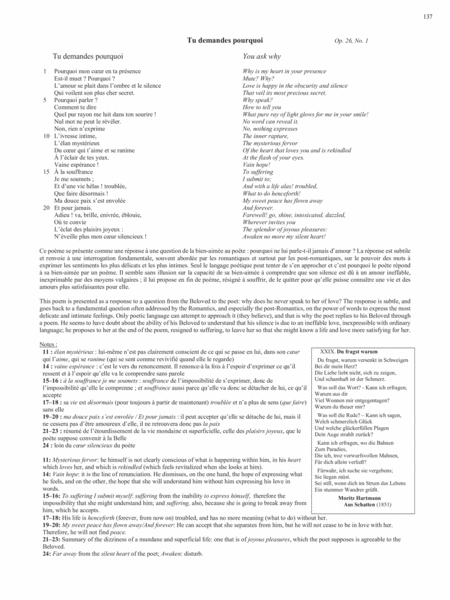
Op. 1, No. 1: Tu demandes pourquoi from Songs of Gouvy, V2 (Downloadable)
Piano, Voix

$3.00 2.59 € Piano, Voix PDF SheetMusicPlus


Partitions Gratuites
Acheter des Partitions Musicales
Acheter des Partitions Digitales à Imprimer
Acheter des Instruments de Musique

© 2000 - 2026

Accueil - Version intégrale





