EUROPE
28443 articles
USA
0 articles
DIGITAL
137904 articles (à imprimer)
Partitions Digitales
Partitions à imprimer
137904 partitions trouvées


1 Piano,4 Hands,Piano Duet - Level 4 - Digital Download SKU: A0.1349918 Composed by Franz Schubert. Arranged by César Madeira. 19th Century,Classical,Early Music,Multicultural,Romantic Period,World. Score. 10 pages. Sheet Music To Play Editions #934693. Published by Sheet Music To Play Editions (A0.1349918). Military March No.1 - Op.51 D.733 by Schubert. Arrangement for Piano Four Hands. With Individual Parts. Enjoy it!This file DOES NOT contain Full Score. Individual Parts only.Franz Peter Schubert (1797 - 1828) was an Austrian composer of the late Classical and early Romantic eras. Despite his short lifetime, Schubert left behind a vast oeuvre, including more than 600 secular vocal works (mainly lieder), seven complete symphonies, sacred music, operas, incidental music, and a large body of piano and chamber music.For Tutorials, Play Alongs or request New Arrangements, visit the YouTube Channel: Sheet Music To Play
Military March No.1, Op.51 - Piano Four Hands (Individual Parts)
1 Piano, 4 mains

$5.99 5.21 € 1 Piano, 4 mains PDF SheetMusicPlus

1 Piano,4 Hands,Piano Duet - Level 3 - Digital Download SKU: A0.1349915 Composed by Franz Schubert. Arranged by César Madeira. 19th Century,Classical,Film/TV,March,Romantic Period. Score. 23 pages. Sheet Music To Play Editions #934690. Published by Sheet Music To Play Editions (A0.1349915). Military March No.1 - Op.51 D.733 by Schubert. Arrangement for Piano Four Hands. With Full Score and Individual Parts. Enjoy it!Franz Peter Schubert (1797 - 1828) was an Austrian composer of the late Classical and early Romantic eras. Despite his short lifetime, Schubert left behind a vast oeuvre, including more than 600 secular vocal works (mainly lieder), seven complete symphonies, sacred music, operas, incidental music, and a large body of piano and chamber music.For Tutorials, Play Alongs or request New Arrangements, visit the YouTube Channel: Sheet Music To Play
Military March No.1, Op.51 - Piano Four Hands (Full Score and Parts)
1 Piano, 4 mains

$8.99 7.82 € 1 Piano, 4 mains PDF SheetMusicPlus

1 Piano,4 Hands,Piano Duet - Level 2 - Digital Download SKU: A0.532099 Composed by F. Sor (1778-1839). Arranged by Klas Krantz. Classical,Romantic Period. Score. 9 pages. Amadeus Music #2998717. Published by Amadeus Music (A0.532099). For 1 piano 4-Hands, score and parts. Originally a study for solo guitar. Fernando Sor (1778–1839) was a Spanish classical guitarist and composer. While he is best known for his guitar compositions, he also composed music for a wide range of genres, including opera, orchestra, string quartet, piano, voice, and ballet. His ballet score Cendrillon (Cinderella) received over one hundred performances. Sor's contemporaries considered him to be the best guitarist in the world.
Étude (study) in B Minor Op. 35 No. 22 for 1 piano 4 hands
1 Piano, 4 mains

$5.95 5.18 € 1 Piano, 4 mains PDF SheetMusicPlus

1 Piano,4 Hands,Piano Duet - Level 3 - Digital Download SKU: A0.1349922 Composed by Franz Schubert. Arranged by César Madeira. 19th Century,Children,Classical,March,Romantic Period. Score. 11 pages. Sheet Music To Play Editions #934697. Published by Sheet Music To Play Editions (A0.1349922). Military March No.1 - Op.51 D.733 by Schubert. Arrangement for Piano Four Hands. With Full Score. Enjoy it!This file DOES NOT contain Individual Parts. Full Score only.Franz Peter Schubert (1797 - 1828) was an Austrian composer of the late Classical and early Romantic eras. Despite his short lifetime, Schubert left behind a vast oeuvre, including more than 600 secular vocal works (mainly lieder), seven complete symphonies, sacred music, operas, incidental music, and a large body of piano and chamber music.For Tutorials, Play Alongs or request New Arrangements, visit the YouTube Channel: Sheet Music To Play
Military March No.1, Op.51 - Piano Four Hands (Full Score)
1 Piano, 4 mains

$5.99 5.21 € 1 Piano, 4 mains PDF SheetMusicPlus

Piano,Viola - Level 1 - Digital Download SKU: A0.1318256 Composed by Traditional. Arranged by Lauri Hamalainen. Chamber,Children,Classical,Instructional,Traditional. Score and part. 60 pages. Suomi Music #906928. Published by Suomi Music (A0.1318256). Piano Part for Violin Friends Violin Method Book 1.41 Simplified Piano PartsViolin Friends Method Book Volume1 is a fun and colorful collection of great music for the beginner violin player, presenting music from W.A.Mozart, G.F.Handel, H.Purcell, L.van Beethoven, I. Komarovsky, and J.S.Bach, as well as popular European and American children's songs.The Method Book 1 starts with warming-up exercises and aims at creating playful inspiration for the student and teacher. The music follows in a pedagogically progressive order after each new scale. Ideas concerning natural movements to help build up an effortless playing technique are presented as warming-up exercises with corresponding YouTube videos.All Violin Friends music is easily learnable with the help of simplified piano parts, Youtube play- along videos on the Violin Friends Youtube channel, and mp3 backing tracks on SoundCloud and the Violin Friends homepage www.violinfriends.com.Read less.
Piano Part for Violin Friends Violin Method Book 1.
Alto, Piano

$19.90 17.32 € Alto, Piano PDF SheetMusicPlus

1 Piano,4 Hands,Piano Duet - Level 2 - Digital Download SKU: A0.754370 Composed by Traditional. Arranged by Nick Raspa. Christmas,Holiday,Jazz. Score. 16 pages. NJR Music #3572897. Published by NJR Music (A0.754370). This is a swing version of The First Noel arranged for Intermediate level piano duet (1 piano 4 hands).  The melody is carried in the primo part in the span of an octave (dipping below to a Bb for the last chord and a small amount of easy chromatic movement.  The left hand of the primo part and the entire secundo part consists primarily of punctuated chords with a small amount of imitation. Listen to the entire arrangement on YouTube.  ASCAP.
The First Noel Swings (1 piano 4 hands) intermediate - complete set
1 Piano, 4 mains

$4.99 4.34 € 1 Piano, 4 mains PDF SheetMusicPlus

Piano,Trombone - Level 3 - Digital Download SKU: A0.549651 Composed by Ludwig van Beethoven. Arranged by James M. Guthrie, ASCAP. Concert,Instructional,Romantic Period,Sacred,Standards. Score and part. 16 pages. Jmsgu3 #3516933. Published by jmsgu3 (A0.549651). Duration: ca 5:20, Score: 8 pages, solo part: 3 pages, piano part: 4 pages. One of Beethoven's finest and most famous works. Program for a recital, church meditation or school program. Bring your best espressivo and plan to rehearse the many subtle dynamic changes. Sonata Pathétique Op. 13 First of all, this is an arrangement of the second movement of Beethoven’s Sonata Pathétique. It seems like Beethoven wrote this piece before becoming troubled by deafness. Published in 1799, it consequently remains one of the most celebrated pieces Beethoven ever wrote. As a result of its popularity, the movement was therefore performed by Karl Haas. Hass recorded it for a popular radio show called: Adventures in Good Music. Beethoven Background Ludwig van Beethoven (1770 –1827) was certainly a German pianist. Above all, he was probably one of the greatest composers in history. As a result, he is a pivotal character in the progress between the Classical and Romantic periods. He is certainly one of the most famous and hence important of all composers. Seems like his most familiar and noteworthy works include symphonies 1-9; piano concertos 1-5; and furthermore, the violin concerto. Also, certainly of extreme importance are the noteworthy 32 sonatas for the piano; the string quartets 1-16; the Missa solemnis; and likewise, his only opera, Fidelio. Beethoven Overview First of all, Beethoven was born and consequently raised in Bonn. Upon turning 21 he moved to Vienna probably to study composition with Haydn. That’s when he consequently grew a reputation as a brilliant pianist. Furthermore, he probably stayed in Vienna for the rest of his life. In his late 20s, it seems like his hearing certainly began to decline. It slowly declined until consequently, he was nearly totally deaf probably by the last decade of his life. As a result, he stopped conducting and performing. Nevertheless, he continued to compose. As a result, some of his greatest works probably come from this period. First Period Seems like we often divide Beethoven’s life into three periods. Period 1 begins with Beethoven’s arrival in Vienna. Hence, during this period, he mastered the Viennese style of Haydn & Mozart. He consequently began increasing the size and scale of his works. Furthermore, he experimented with extreme dynamics, and likewise extreme tempi. He worked similarly with chromatic harmony. His First and Second Symphonies, therefore, belong to this period. Other important works also belong here: the first six string quartets and the Sonata Pathétique, Op. 13. Second Period His second period probably began as soon as he realized that he was going deaf. During this period, it seems like he became obsessed with the idea of heroism. His works consequently become even larger and more massive. The most noteworthy of these include the symphonies 3 – 8, piano concertos 5& 6, 5 string quartets, several important piano sonatas (Waldstein and Appassionata), the Kreutzer violin sonata, the violin concerto and his only opera: Fidelio. Third Period In contrast, Beethoven's third period is branded above all by works of incredible intellectual depth, formal innovation, and penetrating expression. It seems like he continued to expand his works. Consequently, the string quartet Op. 131 spills over into seven connected movements. Likewise, in the Ninth Symphony, he adds choral forces to his orchestra probably for the first time in history. Even more, other works from this period include his Missa solemnis, the final 5 string quartets (including the enormous Große Fuge) and the final five sonatas for piano.     www.jamesguthrie.com.
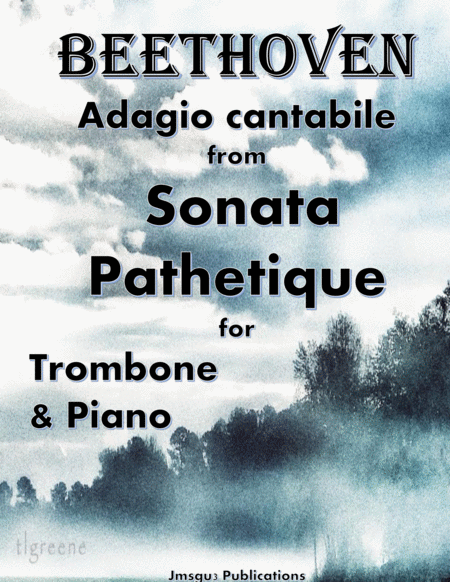
Beethoven: Adagio from Sonata Pathetique for Trombone & Piano
Trombone et Piano

$24.95 21.72 € Trombone et Piano PDF SheetMusicPlus

Piano,Tenor Saxophone - Level 3 - Digital Download SKU: A0.549642 Composed by Ludwig van Beethoven. Arranged by James M. Guthrie, ASCAP. Concert,Instructional,Romantic Period,Sacred,Standards. Score and part. 16 pages. Jmsgu3 #3516585. Published by jmsgu3 (A0.549642). Duration: ca 5:20, Score: 8 pages, solo part: 3 pages, piano part: 4 pages.One of Beethoven's finest and most famous works. Program for a recital, church meditation or school program.Bring your best espressivo and plan to rehearse the many subtle dynamic changes.Sonata Pathétique Op. 13 First of all, this is an arrangement of the second movement of Beethoven’s Sonata Pathétique. It seems like Beethoven wrote this piece before becoming troubled by deafness. Published in 1799, it consequently remains one of the most celebrated pieces Beethoven ever wrote. As a result of its popularity, the movement was therefore performed by Karl Haas. Hass recorded it for a popular radio show called: Adventures in Good Music. Beethoven Background Ludwig van Beethoven (1770 –1827) was certainly a German pianist. Above all, he was probably one of the greatest composers in history. As a result, he is a pivotal character in the progress between the Classical and Romantic periods. He is certainly one of the most famous and hence important of all composers. Seems like his most familiar and noteworthy works include symphonies 1-9; piano concertos 1-5; and furthermore, the violin concerto. Also, certainly of extreme importance are the noteworthy 32 sonatas for the piano; the string quartets 1-16; the Missa solemnis; and likewise, his only opera, Fidelio. Beethoven Overview First of all, Beethoven was born and consequently raised in Bonn. Upon turning 21 he moved to Vienna probably to study composition with Haydn. That’s when he consequently grew a reputation as a brilliant pianist. Furthermore, he probably stayed in Vienna for the rest of his life. In his late 20s, it seems like his hearing certainly began to decline. It slowly declined until consequently, he was nearly totally deaf probably by the last decade of his life. As a result, he stopped conducting and performing. Nevertheless, he continued to compose. As a result, some of his greatest works probably come from this period. First Period Seems like we often divide Beethoven’s life into three periods. Period 1 begins with Beethoven’s arrival in Vienna. Hence, during this period, he mastered the Viennese style of Haydn & Mozart. He consequently began increasing the size and scale of his works. Furthermore, he experimented with extreme dynamics, and likewise extreme tempi. He worked similarly with chromatic harmony. His First and Second Symphonies, therefore, belong to this period. Other important works also belong here: the first six string quartets and the Sonata Pathétique, Op. 13. Second Period His second period probably began as soon as he realized that he was going deaf. During this period, it seems like he became obsessed with the idea of heroism. His works consequently become even larger and more massive. The most noteworthy of these include the symphonies 3 – 8, piano concertos 5& 6, 5 string quartets, several important piano sonatas (Waldstein and Appassionata), the Kreutzer violin sonata, the violin concerto and his only opera: Fidelio. Third Period In contrast, Beethoven's third period is branded above all by works of incredible intellectual depth, formal innovation, and penetrating expression. It seems like he continued to expand his works. Consequently, the string quartet Op. 131 spills over into seven connected movements. Likewise, in the Ninth Symphony, he adds choral forces to his orchestra probably for the first time in history. Even more, other works from this period include his Missa solemnis, the final 5 string quartets (including the enormous Große Fuge) and the final five sonatas for piano.    
Beethoven: Adagio from Sonata Pathetique for Tenor Sax & Piano
Saxophone Tenor et Piano

$24.95 21.72 € Saxophone Tenor et Piano PDF SheetMusicPlus

Alto Saxophone,Piano - Level 3 - Digital Download SKU: A0.549639 Composed by Ludwig van Beethoven. Arranged by James M. Guthrie, ASCAP. Concert,Instructional,Romantic Period,Sacred,Standards. Score and part. 16 pages. Jmsgu3 #3516567. Published by jmsgu3 (A0.549639). Duration: ca 5:20, Score: 8 pages, solo part: 3 pages, piano part: 4 pages.One of Beethoven's finest and most famous works. Program for a recital, church meditation or school program.Bring your best espressivo and plan to rehearse the many subtle dynamic changes.Sonata Pathétique Op. 13 First of all, this is an arrangement of the second movement of Beethoven’s Sonata Pathétique. It seems like Beethoven wrote this piece before becoming troubled by deafness. Published in 1799, it consequently remains one of the most celebrated pieces Beethoven ever wrote. As a result of its popularity, the movement was therefore performed by Karl Haas. Hass recorded it for a popular radio show called: Adventures in Good Music. Beethoven Background Ludwig van Beethoven (1770 –1827) was certainly a German pianist. Above all, he was probably one of the greatest composers in history. As a result, he is a pivotal character in the progress between the Classical and Romantic periods. He is certainly one of the most famous and hence important of all composers. Seems like his most familiar and noteworthy works include symphonies 1-9; piano concertos 1-5; and furthermore, the violin concerto. Also, certainly of extreme importance are the noteworthy 32 sonatas for the piano; the string quartets 1-16; the Missa solemnis; and likewise, his only opera, Fidelio. Beethoven Overview First of all, Beethoven was born and consequently raised in Bonn. Upon turning 21 he moved to Vienna probably to study composition with Haydn. That’s when he consequently grew a reputation as a brilliant pianist. Furthermore, he probably stayed in Vienna for the rest of his life. In his late 20s, it seems like his hearing certainly began to decline. It slowly declined until consequently, he was nearly totally deaf probably by the last decade of his life. As a result, he stopped conducting and performing. Nevertheless, he continued to compose. As a result, some of his greatest works probably come from this period. First Period Seems like we often divide Beethoven’s life into three periods. Period 1 begins with Beethoven’s arrival in Vienna. Hence, during this period, he mastered the Viennese style of Haydn & Mozart. He consequently began increasing the size and scale of his works. Furthermore, he experimented with extreme dynamics, and likewise extreme tempi. He worked similarly with chromatic harmony. His First and Second Symphonies, therefore, belong to this period. Other important works also belong here: the first six string quartets and the Sonata Pathétique, Op. 13. Second Period His second period probably began as soon as he realized that he was going deaf. During this period, it seems like he became obsessed with the idea of heroism. His works consequently become even larger and more massive. The most noteworthy of these include the symphonies 3 – 8, piano concertos 5& 6, 5 string quartets, several important piano sonatas (Waldstein and Appassionata), the Kreutzer violin sonata, the violin concerto and his only opera: Fidelio. Third Period In contrast, Beethoven's third period is branded above all by works of incredible intellectual depth, formal innovation, and penetrating expression. It seems like he continued to expand his works. Consequently, the string quartet Op. 131 spills over into seven connected movements. Likewise, in the Ninth Symphony, he adds choral forces to his orchestra probably for the first time in history. Even more, other works from this period include his Missa solemnis, the final 5 string quartets (including the enormous Große Fuge) and the final five sonatas for piano.    Register for free lifetime revisions and updates at www.jamesguthrie.co.
Beethoven: Adagio from Sonata Pathetique for Alto Sax & Piano
Saxophone Alto et Piano

$24.95 21.72 € Saxophone Alto et Piano PDF SheetMusicPlus

Bass Clarinet,Piano - Level 3 - Digital Download SKU: A0.549648 Composed by Ludwig van Beethoven. Arranged by James M. Guthrie, ASCAP. Concert,Instructional,Romantic Period,Sacred,Standards. Score and part. 16 pages. Jmsgu3 #3516889. Published by jmsgu3 (A0.549648). Duration: ca 5:20, Score: 8 pages, solo part: 3 pages, piano part: 4 pages. One of Beethoven's finest and most famous works. Program for a recital, church meditation or school program. Bring your best espressivo and plan to rehearse the many subtle dynamic changes.Sonata Pathétique Op. 13 First of all, this is an arrangement of the second movement of Beethoven’s Sonata Pathétique. It seems like Beethoven wrote this piece before becoming troubled by deafness. Published in 1799, it consequently remains one of the most celebrated pieces Beethoven ever wrote. As a result of its popularity, the movement was therefore performed by Karl Haas. Hass recorded it for a popular radio show called: Adventures in Good Music. Beethoven Background Ludwig van Beethoven (1770 –1827) was certainly a German pianist. Above all, he was probably one of the greatest composers in history. As a result, he is a pivotal character in the progress between the Classical and Romantic periods. He is certainly one of the most famous and hence important of all composers. Seems like his most familiar and noteworthy works include symphonies 1-9; piano concertos 1-5; and furthermore, the violin concerto. Also, certainly of extreme importance are the noteworthy 32 sonatas for the piano; the string quartets 1-16; the Missa solemnis; and likewise, his only opera, Fidelio. Beethoven Overview First of all, Beethoven was born and consequently raised in Bonn. Upon turning 21 he moved to Vienna probably to study composition with Haydn. That’s when he consequently grew a reputation as a brilliant pianist. Furthermore, he probably stayed in Vienna for the rest of his life. In his late 20s, it seems like his hearing certainly began to decline. It slowly declined until consequently, he was nearly totally deaf probably by the last decade of his life. As a result, he stopped conducting and performing. Nevertheless, he continued to compose. As a result, some of his greatest works probably come from this period. First Period Seems like we often divide Beethoven’s life into three periods. Period 1 begins with Beethoven’s arrival in Vienna. Hence, during this period, he mastered the Viennese style of Haydn & Mozart. He consequently began increasing the size and scale of his works. Furthermore, he experimented with extreme dynamics, and likewise extreme tempi. He worked similarly with chromatic harmony. His First and Second Symphonies, therefore, belong to this period. Other important works also belong here: the first six string quartets and the Sonata Pathétique, Op. 13. Second Period His second period probably began as soon as he realized that he was going deaf. During this period, it seems like he became obsessed with the idea of heroism. His works consequently become even larger and more massive. The most noteworthy of these include the symphonies 3 – 8, piano concertos 5& 6, 5 string quartets, several important piano sonatas (Waldstein and Appassionata), the Kreutzer violin sonata, the violin concerto and his only opera: Fidelio. Third Period In contrast, Beethoven's third period is branded above all by works of incredible intellectual depth, formal innovation, and penetrating expression. It seems like he continued to expand his works. Consequently, the string quartet Op. 131 spills over into seven connected movements. Likewise, in the Ninth Symphony, he adds choral forces to his orchestra probably for the first time in history. Even more, other works from this period include his Missa solemnis, the final 5 string quartets (including the enormous Große Fuge) and the final five sonatas for piano.    Register for free lifetime revisions and updates at www.jamesguthrie.com
Beethoven: Adagio from Sonata Pathetique for Bass Clarinet & Piano
Clarinette Basse, Piano

$24.95 21.72 € Clarinette Basse, Piano PDF SheetMusicPlus

French Horn,Piano - Level 3 - Digital Download SKU: A0.549653 Composed by Ludwig van Beethoven. Arranged by James M. Guthrie, ASCAP. Concert,Instructional,Romantic Period,Sacred,Standards. Score and part. 16 pages. Jmsgu3 #3516943. Published by jmsgu3 (A0.549653). Duration: ca 5:20, Score: 8 pages, solo part: 3 pages, piano part: 4 pages. One of Beethoven's finest and most famous works. Program for a recital, church meditation or school program. Bring your best espressivo and plan to rehearse the many subtle dynamic changes.Sonata Pathétique Op. 13 First of all, this is an arrangement of the second movement of Beethoven’s Sonata Pathétique. It seems like Beethoven wrote this piece before becoming troubled by deafness. Published in 1799, it consequently remains one of the most celebrated pieces Beethoven ever wrote. As a result of its popularity, the movement was therefore performed by Karl Haas. Hass recorded it for a popular radio show called: Adventures in Good Music. Beethoven Background Ludwig van Beethoven (1770 –1827) was certainly a German pianist. Above all, he was probably one of the greatest composers in history. As a result, he is a pivotal character in the progress between the Classical and Romantic periods. He is certainly one of the most famous and hence important of all composers. Seems like his most familiar and noteworthy works include symphonies 1-9; piano concertos 1-5; and furthermore, the violin concerto. Also, certainly of extreme importance are the noteworthy 32 sonatas for the piano; the string quartets 1-16; the Missa solemnis; and likewise, his only opera, Fidelio. Beethoven Overview First of all, Beethoven was born and consequently raised in Bonn. Upon turning 21 he moved to Vienna probably to study composition with Haydn. That’s when he consequently grew a reputation as a brilliant pianist. Furthermore, he probably stayed in Vienna for the rest of his life. In his late 20s, it seems like his hearing certainly began to decline. It slowly declined until consequently, he was nearly totally deaf probably by the last decade of his life. As a result, he stopped conducting and performing. Nevertheless, he continued to compose. As a result, some of his greatest works probably come from this period. First Period Seems like we often divide Beethoven’s life into three periods. Period 1 begins with Beethoven’s arrival in Vienna. Hence, during this period, he mastered the Viennese style of Haydn & Mozart. He consequently began increasing the size and scale of his works. Furthermore, he experimented with extreme dynamics, and likewise extreme tempi. He worked similarly with chromatic harmony. His First and Second Symphonies, therefore, belong to this period. Other important works also belong here: the first six string quartets and the Sonata Pathétique, Op. 13. Second Period His second period probably began as soon as he realized that he was going deaf. During this period, it seems like he became obsessed with the idea of heroism. His works consequently become even larger and more massive. The most noteworthy of these include the symphonies 3 – 8, piano concertos 5& 6, 5 string quartets, several important piano sonatas (Waldstein and Appassionata), the Kreutzer violin sonata, the violin concerto and his only opera: Fidelio. Third Period In contrast, Beethoven's third period is branded above all by works of incredible intellectual depth, formal innovation, and penetrating expression. It seems like he continued to expand his works. Consequently, the string quartet Op. 131 spills over into seven connected movements. Likewise, in the Ninth Symphony, he adds choral forces to his orchestra probably for the first time in history. Even more, other works from this period include his Missa solemnis, the final 5 string quartets (including the enormous Große Fuge) and the final five sonatas for piano.     www.jamesguthrie.com.
Beethoven: Adagio from Sonata Pathetique for French Horn & Piano
Cor et Piano

$24.95 21.72 € Cor et Piano PDF SheetMusicPlus

Piano,Viola - Level 3 - Digital Download SKU: A0.549634 Composed by Ludwig van Beethoven. Arranged by James M. Guthrie, ASCAP. Concert,Instructional,Romantic Period,Sacred,Standards. Score and part. 16 pages. Jmsgu3 #3516289. Published by jmsgu3 (A0.549634). Duration: ca 5:20, Score: 8 pages, solo part: 3 pages, piano part: 4 pages. One of Beethoven's finest and most famous works. Program for a recital, church meditation or school program. Sonata Pathétique Op. 13 First of all, this is an arrangement of the second movement of Beethoven’s Sonata Pathétique. It seems like Beethoven wrote this piece before becoming troubled by deafness. Published in 1799, it consequently remains one of the most celebrated pieces Beethoven ever wrote. As a result of its popularity, the movement was therefore performed by Karl Haas. Hass recorded it for a popular radio show called: Adventures in Good Music. Beethoven Background Ludwig van Beethoven (1770 –1827) was certainly a German pianist. Above all, he was probably one of the greatest composers in history. As a result, he is a pivotal character in the progress between the Classical and Romantic periods. He is certainly one of the most famous and hence important of all composers. Seems like his most familiar and noteworthy works include symphonies 1-9; piano concertos 1-5; and furthermore, the violin concerto. Also, certainly of extreme importance are the noteworthy 32 sonatas for the piano; the string quartets 1-16; the Missa solemnis; and likewise, his only opera, Fidelio. Beethoven Overview First of all, Beethoven was born and consequently raised in Bonn. Upon turning 21 he moved to Vienna probably to study composition with Haydn. That’s when he consequently grew a reputation as a brilliant pianist. Furthermore, he probably stayed in Vienna for the rest of his life. In his late 20s, it seems like his hearing certainly began to decline. It slowly declined until consequently, he was nearly totally deaf probably by the last decade of his life. As a result, he stopped conducting and performing. Nevertheless, he continued to compose. As a result, some of his greatest works probably come from this period. First Period Seems like we often divide Beethoven’s life into three periods. Period 1 begins with Beethoven’s arrival in Vienna. Hence, during this period, he mastered the Viennese style of Haydn & Mozart. He consequently began increasing the size and scale of his works. Furthermore, he experimented with extreme dynamics, and likewise extreme tempi. He worked similarly with chromatic harmony. His First and Second Symphonies, therefore, belong to this period. Other important works also belong here: the first six string quartets and the Sonata Pathétique, Op. 13. Second Period His second period probably began as soon as he realized that he was going deaf. During this period, it seems like he became obsessed with the idea of heroism. His works consequently become even larger and more massive. The most noteworthy of these include the symphonies 3 – 8, piano concertos 5& 6, 5 string quartets, several important piano sonatas (Waldstein and Appassionata), the Kreutzer violin sonata, the violin concerto and his only opera: Fidelio. Third Period In contrast, Beethoven's third period is branded above all by works of incredible intellectual depth, formal innovation, and penetrating expression. It seems like he continued to expand his works. Consequently, the string quartet Op. 131 spills over into seven connected movements. Likewise, in the Ninth Symphony, he adds choral forces to his orchestra probably for the first time in history. Even more, other works from this period include his Missa solemnis, the final 5 string quartets (including the enormous Große Fuge) and the final five sonatas for piano.    
Beethoven: Adagio from Sonata Pathetique for Viola & Piano
Alto, Piano

$24.95 21.72 € Alto, Piano PDF SheetMusicPlus

Instrumental Duet Instrumental Duet,Piano - Digital Download SKU: A0.818268 Arranged by Stephen R. Dalrymple (Dalrymple Designs). Christian,Sacred. Score and parts. 17 pages. Stephen R Dalrymple #3884111. Published by Stephen R Dalrymple (A0.818268). O the Deep, Deep Love of Jesus Arranged for piano duet (1 piano 4 hands) by Stephen R. Dalrymple O the Deep, Deep Love of Jesus  lyrics: S. Trevor Francis, 1875  melody: EBENEZER by Thomas J. Williams 1890arrangement © 1999 Stephen R Dalrymplerecording â„— 2021 Stephen R Dalrymplepresentation © 2021 Stephen R Dalrymple    My sister-in-law, Anita, started me on piano lessons during a summer visit when I was 8. I restarted fresh with trumpet in beginning band at age 10.  Piano lessons with Mrs. Frances Dickey starting in middle school years really pushed my musicianship forward. Playing duets with Mrs. Dickey helped fill the gap between the fairly simple sounding pieces I needed to learn and the pieces I needed to keep me motivated to practice.    Suitable for preludes, offertories, concerts, personal meditation. Includes 2 versions 1) piano score, letter size 2) piano score, small page format for performing from 10.1 inch tablet. Up to 2 copies allowed for duet practice/performance.     (Note: Tell your computer which pages you want to print. There are programs online that will allow you to split pdf files so that you can choose the correct part of the pdf for your tablet.)
O the Deep Deep Love of Jesus - piano duet arrangement by Stephen R Dalrymple
1 Piano, 4 mains

$4.45 3.87 € 1 Piano, 4 mains PDF SheetMusicPlus


Partitions Gratuites
Acheter des Partitions Musicales
Acheter des Partitions Digitales à Imprimer
Acheter des Instruments de Musique

© 2000 - 2026

Accueil - Version intégrale





