EUROPE
28443 articles
USA
0 articles
DIGITAL
137904 articles (à imprimer)
Partitions Digitales
Partitions à imprimer
137904 partitions trouvées


Flute,Piano - Level 2 - Digital Download SKU: A0.549353 Composed by Bach-Gounod. Arranged by James M. Guthrie, ASCAP. Christmas,Contemporary,Easter,Wedding. Score and part. 12 pages. Jmsgu3 #3490009. Published by jmsgu3 (A0.549353). This arrangement follows the original Bach prelude and so excludes the extra measure that Schwencke introduced in 1783. If you prefer the extra measure, please see Bach-Gounod: Ave Maria, Schwencke version for Flute & Piano -S0.661745. The convenient 1st & 2nd endings provide an option for extended performance with minimal page turns for the accompanist. The duration with repeat is about 4:50. Score: 6 pages. Solo part: 1 page, piano part: 4 pages. Based on Prelude #1 in C Major from the Well-Tempered Clavier, Book 1. Well suited for church meditations or school programs or recital encores. Ave Maria Ave Maria is a Catholic prayer that consequently asks for the mother of Jesus (Mary) to intercede. Charles Gounod composed a famous version of the Ave Maria. He was a French Romantic composer who overlaid a new melody on an existing Bach chord progression. The progression is from Bach’s Prelude No. 1 from Well-Tempered Clavier I. This version, as well as Schubert’s version, have become essential items at weddings, masses, and funerals. Bach Overview First of all, Johann Sebastian Bach is maybe the greatest composer in music history. Certainly, he was prolific. As a result, everyone has heard of his works. Furthermore, these works number well over a thousand. It seems like people are probably most familiar with instrumental works such as the Brandenburg Concertos, and the Goldberg Variations. But, similarly famous are such noteworthy works as the Well-Tempered Clavier, the Musical Offering, and the Art of Fugue. Seems like his most famous vocal works include the most noteworthy Mass in B Minor. Also, most noteworthy, though, are the St. John Passion, and certainly the Christmas Oratorio.  History Bach came from a long line of musicians and above all, composers. Consequently, he, first of all, pursued a career as a church organist. So as a result, he gained employment in various Protestant churches in Germany. For a while, he worked as a court musician in Weimar and Köthen. Here he probably developed his organ style and likewise his chamber music style. Eventually, he gained an appointment as Cantor of St. Thomas in Leipzig. Here he worked until difficulties with his employer ultimately drove him away. The King of Poland finally appointed him as court composer.  Style It seems like Bach created an engaging new international style. He synthesized elements of the most noteworthy European music ideas into his new style. Even more, this new style was probably his synthesis of European musical rhythm and form. Furthermore, he demonstrated a complete mastery of counterpoint and motivic development. His sense of harmonic organization probably propelled him to the top. Revival               Mendelssohn conducted a Bach revival in the nineteenth century. His effort probably helped to re-familiarize the public with the magnitude of Bach’s works. During this period, scholars published many noteworthy Bach biographies. Moreover, Wolfgang Schmieder published the BWV (Bach Werke Verzeichnis). As a result, this is now the official catalog of his entire artistic output. The BWV number allows us to locate a work in the catalog. Sometimes scholars will simply use an S (Schmieder) as an abbreviation for BWV.  
Bach-Gounod: Ave Maria for Flute & Piano
Flûte traversière et Piano

$32.95 28.68 € Flûte traversière et Piano PDF SheetMusicPlus

B-Flat Clarinet,Bassoon,Flute,Oboe,Piano - Level 4 - Digital Download SKU: A0.1248306 By Yuan-Chen Li. By Yuan-Chen Li. Arranged by Yuan-Chen Li. 21st Century,Chamber,Classical,Contemporary,Multicultural,World. 62 pages. Yuan-Chen Li #842845. Published by Yuan-Chen Li (A0.1248306). Set for 1 flute, 1 oboe, 1 B-flat clarinet, 1 bassoon, and piano, Yuan-Chen Li's 8-minute long wind and piano quinetet Butterfly was commissioned by Norfolk Chamber Music Festival (Norfolk Connecticut, 2007) of Yale University School of Music, and premiered by the parcipant musicians of the workshop, and subsquently received its New York premiere in IMANI Winds' summer chamber music festival (2012). In the first and second movements, the music emulates the movement of butterfly’s flying and the delightful spirit of the spring time. The last movement lends itself to a poetic moment, evoking the sense of the transformation of butterfly’s life and its beautifulness. Musicians would be surprised by the intricate rhythms, unpredictable move across the mode, whistletone, and witty interaction among performing partners.  (The document includes parts for each of the wind player; the pianist reads from the full score)
Butterfly, for piano quintet
Hautbois, Piano (duo)
Yuan-Chen Li
$17.99 15.66 € Hautbois, Piano (duo) PDF SheetMusicPlus

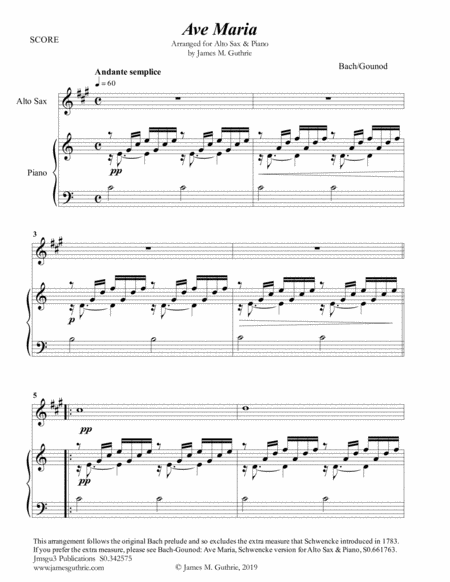
Alto Saxophone,Piano - Level 2 - Digital Download SKU: A0.549364 Composed by Bach-Gounod. Arranged by James M. Guthrie, ASCAP. Christmas,Contemporary,Easter,Wedding. Score and part. 11 pages. Jmsgu3 #3490139. Published by jmsgu3 (A0.549364). This arrangement follows the original Bach prelude and so excludes the extra measure that Schwencke introduced in 1783. If you prefer the extra measure, please see Bach-Gounod: Ave Maria, Schwencke version for Alto Sax & Piano, S0.661763. The convenient 1st & 2nd endings provide an option for extended performance with minimal page turns for the accompanist. The duration with repeat is about 4:50. Score: 6 pages. Solo part: 1 page, piano part: 4 pages. Based on Prelude #1 in C Major from the Well-Tempered Clavier, Book 1. Well suited for church meditations or school programs or recital encores. Ave Maria Ave Maria is a Catholic prayer that consequently asks for the mother of Jesus (Mary) to intercede. Charles Gounod composed a famous version of the Ave Maria. He was a French Romantic composer who overlaid a new melody on an existing Bach chord progression. The progression is from Bach’s Prelude No. 1 from Well-Tempered Clavier I. This version, as well as Schubert’s version, have become essential items at weddings, masses, and funerals. Bach Overview First of all, Johann Sebastian Bach is maybe the greatest composer in music history. Certainly, he was prolific. As a result, everyone has heard of his works. Furthermore, these works number well over a thousand. It seems like people are probably most familiar with instrumental works such as the Brandenburg Concertos, and the Goldberg Variations. But, similarly famous are such noteworthy works as the Well-Tempered Clavier, the Musical Offering, and the Art of Fugue. Seems like his most famous vocal works include the most noteworthy Mass in B Minor. Also, most noteworthy, though, are the St. John Passion, and certainly the Christmas Oratorio.  History Bach came from a long line of musicians and above all, composers. Consequently, he, first of all, pursued a career as a church organist. So as a result, he gained employment in various Protestant churches in Germany. For a while, he worked as a court musician in Weimar and Köthen. Here he probably developed his organ style and likewise his chamber music style. Eventually, he gained an appointment as Cantor of St. Thomas in Leipzig. Here he worked until difficulties with his employer ultimately drove him away. The King of Poland finally appointed him as court composer.  Style It seems like Bach created an engaging new international style. He synthesized elements of the most noteworthy European music ideas into his new style. Even more, this new style was probably his synthesis of European musical rhythm and form. Furthermore, he demonstrated a complete mastery of counterpoint and motivic development. His sense of harmonic organization probably propelled him to the top. Revival               Mendelssohn conducted a Bach revival in the nineteenth century. His effort probably helped to re-familiarize the public with the magnitude of Bach’s works. During this period, scholars published many noteworthy Bach biographies. Moreover, Wolfgang Schmieder published the BWV (Bach Werke Verzeichnis). As a result, this is now the official catalog of his entire artistic output. The BWV number allows us to locate a work in the catalog. Sometimes scholars will simply use an S (Schmieder) as an abbreviation for BWV.  
Bach-Gounod: Ave Maria for Alto Sax & Piano
Saxophone Alto et Piano

$32.95 28.68 € Saxophone Alto et Piano PDF SheetMusicPlus

English Horn,Piano - Level 2 - Digital Download SKU: A0.549361 Composed by Bach-Gounod. Arranged by James M. Guthrie, ASCAP. Christmas,Contemporary,Easter,Wedding. Score and part. 11 pages. Jmsgu3 #3490119. Published by jmsgu3 (A0.549361). This arrangement follows the original Bach prelude and so excludes the extra measure that Schwencke introduced in 1783. If you prefer the extra measure, please see Bach-Gounod: Ave Maria, Schwencke version for English Horn & Piano, S0.661819. The convenient 1st & 2nd endings provide an option for extended performance with minimal page turns for the accompanist. The duration with repeat is about 4:50. Score: 6 pages. Solo part: 1 page, piano part: 4 pages. Based on Prelude #1 in C Major from the Well-Tempered Clavier, Book 1. Well suited for church meditations or school programs or recital encores. Ave Maria Ave Maria is a Catholic prayer that consequently asks for the mother of Jesus (Mary) to intercede. Charles Gounod composed a famous version of the Ave Maria. He was a French Romantic composer who overlaid a new melody on an existing Bach chord progression. The progression is from Bach’s Prelude No. 1 from Well-Tempered Clavier I. This version, as well as Schubert’s version, have become essential items at weddings, masses, and funerals. Bach Overview First of all, Johann Sebastian Bach is maybe the greatest composer in music history. Certainly, he was prolific. As a result, everyone has heard of his works. Furthermore, these works number well over a thousand. It seems like people are probably most familiar with instrumental works such as the Brandenburg Concertos, and the Goldberg Variations. But, similarly famous are such noteworthy works as the Well-Tempered Clavier, the Musical Offering, and the Art of Fugue. Seems like his most famous vocal works include the most noteworthy Mass in B Minor. Also, most noteworthy, though, are the St. John Passion, and certainly the Christmas Oratorio.  History Bach came from a long line of musicians and above all, composers. Consequently, he, first of all, pursued a career as a church organist. So as a result, he gained employment in various Protestant churches in Germany. For a while, he worked as a court musician in Weimar and Köthen. Here he probably developed his organ style and likewise his chamber music style. Eventually, he gained an appointment as Cantor of St. Thomas in Leipzig. Here he worked until difficulties with his employer ultimately drove him away. The King of Poland finally appointed him as court composer.  Style It seems like Bach created an engaging new international style. He synthesized elements of the most noteworthy European music ideas into his new style. Even more, this new style was probably his synthesis of European musical rhythm and form. Furthermore, he demonstrated a complete mastery of counterpoint and motivic development. His sense of harmonic organization probably propelled him to the top. Revival               Mendelssohn conducted a Bach revival in the nineteenth century. His effort probably helped to re-familiarize the public with the magnitude of Bach’s works. During this period, scholars published many noteworthy Bach biographies. Moreover, Wolfgang Schmieder published the BWV (Bach Werke Verzeichnis). As a result, this is now the official catalog of his entire artistic output. The BWV number allows us to locate a work in the catalog. Sometimes scholars will simply use an S (Schmieder) as an abbreviation for BWV.  
Bach-Gounod: Ave Maria for English Horn & Piano
Cor anglais, Piano

$32.95 28.68 € Cor anglais, Piano PDF SheetMusicPlus

French Horn,Piano - Level 2 - Digital Download SKU: A0.549371 Composed by Bach-Gounod. Arranged by James M. Guthrie, ASCAP. Christmas,Contemporary,Easter,Wedding. Score and part. 11 pages. Jmsgu3 #3491319. Published by jmsgu3 (A0.549371). This arrangement follows the original Bach prelude and so excludes the extra measure that Schwencke introduced in 1783. If you prefer the extra measure, please see Bach-Gounod: Ave Maria, Schwencke version for French Horn & Piano, S0.661839 . The convenient 1st & 2nd endings provide an option for extended performance with minimal page turns for the accompanist. The duration with repeat is about 4:50. Score: 6 pages. Solo part: 1 page, piano part: 4 pages. Based on Prelude #1 in C Major from the Well-Tempered Clavier, Book 1. Well suited for church meditations or school programs or recital encores. Ave Maria Ave Maria is a Catholic prayer that consequently asks for the mother of Jesus (Mary) to intercede. Charles Gounod composed a famous version of the Ave Maria. He was a French Romantic composer who overlaid a new melody on an existing Bach chord progression. The progression is from Bach’s Prelude No. 1 from Well-Tempered Clavier I. This version, as well as Schubert’s version, have become essential items at weddings, masses, and funerals. Bach Overview First of all, Johann Sebastian Bach is maybe the greatest composer in music history. Certainly, he was prolific. As a result, everyone has heard of his works. Furthermore, these works number well over a thousand. It seems like people are probably most familiar with instrumental works such as the Brandenburg Concertos, and the Goldberg Variations. But, similarly famous are such noteworthy works as the Well-Tempered Clavier, the Musical Offering, and the Art of Fugue. Seems like his most famous vocal works include the most noteworthy Mass in B Minor. Also, most noteworthy, though, are the St. John Passion, and certainly the Christmas Oratorio.  History Bach came from a long line of musicians and above all, composers. Consequently, he, first of all, pursued a career as a church organist. So as a result, he gained employment in various Protestant churches in Germany. For a while, he worked as a court musician in Weimar and Köthen. Here he probably developed his organ style and likewise his chamber music style. Eventually, he gained an appointment as Cantor of St. Thomas in Leipzig. Here he worked until difficulties with his employer ultimately drove him away. The King of Poland finally appointed him as court composer.  Style It seems like Bach created an engaging new international style. He synthesized elements of the most noteworthy European music ideas into his new style. Even more, this new style was probably his synthesis of European musical rhythm and form. Furthermore, he demonstrated a complete mastery of counterpoint and motivic development. His sense of harmonic organization probably propelled him to the top. Revival               Mendelssohn conducted a Bach revival in the nineteenth century. His effort probably helped to re-familiarize the public with the magnitude of Bach’s works. During this period, scholars published many noteworthy Bach biographies. Moreover, Wolfgang Schmieder published the BWV (Bach Werke Verzeichnis). As a result, this is now the official catalog of his entire artistic output. The BWV number allows us to locate a work in the catalog. Sometimes scholars will simply use an S (Schmieder) as an abbreviation for BWV.  
Bach-Gounod: Ave Maria for French Horn & Piano
Cor et Piano

$32.95 28.68 € Cor et Piano PDF SheetMusicPlus

Flute,Piano - Level 2 - Digital Download SKU: A0.549354 Composed by Bach-Gounod. Arranged by James M. Guthrie, ASCAP. Christmas,Contemporary,Easter,Wedding. Score and part. 11 pages. Jmsgu3 #3490015. Published by jmsgu3 (A0.549354). This arrangement follows the original Bach prelude and so excludes the extra measure that Schwencke introduced in 1783. If you prefer the extra measure, please see Bach-Gounod: Ave Maria, Schwencke version for Alto Flute & Piano, S0.661753. The convenient 1st & 2nd endings provide an option for extended performance with minimal page turns for the accompanist. The duration with repeat is about 4:50. Score: 6 pages. Solo part: 1 page, piano part: 4 pages. Based on Prelude #1 in C Major from the Well-Tempered Clavier, Book 1. Well suited for church meditations or school programs or recital encores. Ave Maria Ave Maria is a Catholic prayer that consequently asks for the mother of Jesus (Mary) to intercede. Charles Gounod composed a famous version of the Ave Maria. He was a French Romantic composer who overlaid a new melody on an existing Bach chord progression. The progression is from Bach’s Prelude No. 1 from Well-Tempered Clavier I. This version, as well as Schubert’s version, have become essential items at weddings, masses, and funerals. Bach Overview First of all, Johann Sebastian Bach is maybe the greatest composer in music history. Certainly, he was prolific. As a result, everyone has heard of his works. Furthermore, these works number well over a thousand. It seems like people are probably most familiar with instrumental works such as the Brandenburg Concertos, and the Goldberg Variations. But, similarly famous are such noteworthy works as the Well-Tempered Clavier, the Musical Offering, and the Art of Fugue. Seems like his most famous vocal works include the most noteworthy Mass in B Minor. Also, most noteworthy, though, are the St. John Passion, and certainly the Christmas Oratorio.  History Bach came from a long line of musicians and above all, composers. Consequently, he, first of all, pursued a career as a church organist. So as a result, he gained employment in various Protestant churches in Germany. For a while, he worked as a court musician in Weimar and Köthen. Here he probably developed his organ style and likewise his chamber music style. Eventually, he gained an appointment as Cantor of St. Thomas in Leipzig. Here he worked until difficulties with his employer ultimately drove him away. The King of Poland finally appointed him as court composer.  Style It seems like Bach created an engaging new international style. He synthesized elements of the most noteworthy European music ideas into his new style. Even more, this new style was probably his synthesis of European musical rhythm and form. Furthermore, he demonstrated a complete mastery of counterpoint and motivic development. His sense of harmonic organization probably propelled him to the top. Revival               Mendelssohn conducted a Bach revival in the nineteenth century. His effort probably helped to re-familiarize the public with the magnitude of Bach’s works. During this period, scholars published many noteworthy Bach biographies. Moreover, Wolfgang Schmieder published the BWV (Bach Werke Verzeichnis). As a result, this is now the official catalog of his entire artistic output. The BWV number allows us to locate a work in the catalog. Sometimes scholars will simply use an S (Schmieder) as an abbreviation for BWV.  
Bach-Gounod: Ave Maria for Alto Flute & Piano
Flûte traversière et Piano

$32.95 28.68 € Flûte traversière et Piano PDF SheetMusicPlus

Euphonium,Piano - Level 2 - Digital Download SKU: A0.549370 Composed by Bach-Gounod. Arranged by James M. Guthrie, ASCAP. Christmas,Contemporary,Easter,Wedding. Score and part. 11 pages. Jmsgu3 #3491309. Published by jmsgu3 (A0.549370). This arrangement follows the original Bach prelude and so excludes the extra measure that Schwencke introduced in 1783. If you prefer the extra measure, please see Bach-Gounod: Ave Maria, Schwencke version for Euphonium & Piano, S0.661829. The convenient 1st & 2nd endings provide an option for extended performance with minimal page turns for the accompanist. The duration with repeat is about 4:50. Score: 6 pages. Solo part: 1 page, piano part: 4 pages. Based on Prelude #1 in C Major from the Well-Tempered Clavier, Book 1. Well suited for church meditations or school programs or recital encores. Ave Maria Ave Maria is a Catholic prayer that consequently asks for the mother of Jesus (Mary) to intercede. Charles Gounod composed a famous version of the Ave Maria. He was a French Romantic composer who overlaid a new melody on an existing Bach chord progression. The progression is from Bach’s Prelude No. 1 from Well-Tempered Clavier I. This version, as well as Schubert’s version, have become essential items at weddings, masses, and funerals. Bach Overview First of all, Johann Sebastian Bach is maybe the greatest composer in music history. Certainly, he was prolific. As a result, everyone has heard of his works. Furthermore, these works number well over a thousand. It seems like people are probably most familiar with instrumental works such as the Brandenburg Concertos, and the Goldberg Variations. But, similarly famous are such noteworthy works as the Well-Tempered Clavier, the Musical Offering, and the Art of Fugue. Seems like his most famous vocal works include the most noteworthy Mass in B Minor. Also, most noteworthy, though, are the St. John Passion, and certainly the Christmas Oratorio.  History Bach came from a long line of musicians and above all, composers. Consequently, he, first of all, pursued a career as a church organist. So as a result, he gained employment in various Protestant churches in Germany. For a while, he worked as a court musician in Weimar and Köthen. Here he probably developed his organ style and likewise his chamber music style. Eventually, he gained an appointment as Cantor of St. Thomas in Leipzig. Here he worked until difficulties with his employer ultimately drove him away. The King of Poland finally appointed him as court composer.  Style It seems like Bach created an engaging new international style. He synthesized elements of the most noteworthy European music ideas into his new style. Even more, this new style was probably his synthesis of European musical rhythm and form. Furthermore, he demonstrated a complete mastery of counterpoint and motivic development. His sense of harmonic organization probably propelled him to the top. Revival               Mendelssohn conducted a Bach revival in the nineteenth century. His effort probably helped to re-familiarize the public with the magnitude of Bach’s works. During this period, scholars published many noteworthy Bach biographies. Moreover, Wolfgang Schmieder published the BWV (Bach Werke Verzeichnis). As a result, this is now the official catalog of his entire artistic output. The BWV number allows us to locate a work in the catalog. Sometimes scholars will simply use an S (Schmieder) as an abbreviation for BWV.  
Bach-Gounod: Ave Maria for Euphonium & Piano
Euphonium, Piano (duo)

$32.95 28.68 € Euphonium, Piano (duo) PDF SheetMusicPlus

Easy Piano - Level 1 - Digital Download SKU: A0.1107190 Composed by Traditional. Arranged by Amanda Dills. Halloween,Instructional,Spiritual,Thriller,Traditional. Score. 1 pages. Amanda Dills #709912. Published by Amanda Dills (A0.1107190). This minor-key variation on Jolly Old St Nicholas features lots of accidentals and humorous Halloween lyrics.  The right hand stays in D minor position, with the left hand thumb on middle C, resulting in a modified Middle C hand position that’s perfect for beginning players who are starting to branch out and play with accidentals. Arrangement Details: • Number of Pages: 1 • Duration: 30 seconds • Hand Position: modified Middle C Position (RH thumb on D) • Key: D minor • Includes: 1 verse with original lyrics • Features: finger numbers, funny lyrics, accidentals, dynamics, and articluation markings • Great For: sight reading, teaching major and minor, Halloween recitals and lessons, moving out of Middle C hand position, introducing chromatics, beginners, self-taught, group lessons About the Arranger: Amanda Dills is a composer and arranger (and educator and instructional designer) from Oklahoma City.  She has a degrees in Music Education and Music Composition, and teaching experience in settings ranging from private violin and piano instruction to K12 Vocal Music to college music theory courses.  For more information (including full composition and arrangement catalogue and fun freebies!), visit www.amandasmusicshop.com Looking for other minor key variations or humorous Halloween pieces? Here are some other pieces by this arranger you may like: • Black Bat, Black Bat (Sheet Music Plus | Sheet Music Direct) • The Spooky Scary Spider (Sheet Music Plus | Sheet Music Direct) • Seven Sinister Songs for Easy Piano (Sheet Music Plus | Sheet Music Direct) • Pumpkin Spiced: intermediate arrangement of the Coffee Dance from the Nutcracker (Sheet Music Plus | Sheet Music Direct)
Grumpy Gooey Goblin Guy (a Halloween variation of Jolly Old St Nicholas for Easy Piano)
Piano Facile

$1.99 1.73 € Piano Facile PDF SheetMusicPlus

Piano,Soprano Saxophone - Level 2 - Digital Download SKU: A0.549366 Composed by Bach-Gounod. Arranged by James M. Guthrie, ASCAP. Christmas,Contemporary,Easter,Wedding. Score and part. 14 pages. Jmsgu3 #3490157. Published by jmsgu3 (A0.549366). This arrangement follows the original Bach prelude and so excludes the extra measure that Schwencke introduced in 1783. If you prefer the extra measure, please see Bach-Gounod: Ave Maria, Schwencke version for Soprano Sax & Piano - S0.661999. The convenient 1st & 2nd endings provide an option for extended performance with minimal page turns for the accompanist. The duration with repeat is about 4:50. Score: 6 pages. Solo part: 1 page, piano part: 4 pages. Based on Prelude #1 in C Major from the Well-Tempered Clavier, Book 1. Well suited for church meditations or school programs or recital encores. Ave Maria Ave Maria is a Catholic prayer that consequently asks for the mother of Jesus (Mary) to intercede. Charles Gounod composed a famous version of the Ave Maria. He was a French Romantic composer who overlaid a new melody on an existing Bach chord progression. The progression is from Bach’s Prelude No. 1 from Well-Tempered Clavier I. This version, as well as Schubert’s version, have become essential items at weddings, masses, and funerals. Bach Overview First of all, Johann Sebastian Bach is maybe the greatest composer in music history. Certainly, he was prolific. As a result, everyone has heard of his works. Furthermore, these works number well over a thousand. It seems like people are probably most familiar with instrumental works such as the Brandenburg Concertos, and the Goldberg Variations. But, similarly famous are such noteworthy works as the Well-Tempered Clavier, the Musical Offering, and the Art of Fugue. Seems like his most famous vocal works include the most noteworthy Mass in B Minor. Also, most noteworthy, though, are the St. John Passion, and certainly the Christmas Oratorio.  History Bach came from a long line of musicians and above all, composers. Consequently, he, first of all, pursued a career as a church organist. So as a result, he gained employment in various Protestant churches in Germany. For a while, he worked as a court musician in Weimar and Köthen. Here he probably developed his organ style and likewise his chamber music style. Eventually, he gained an appointment as Cantor of St. Thomas in Leipzig. Here he worked until difficulties with his employer ultimately drove him away. The King of Poland finally appointed him as court composer.  Style It seems like Bach created an engaging new international style. He synthesized elements of the most noteworthy European music ideas into his new style. Even more, this new style was probably his synthesis of European musical rhythm and form. Furthermore, he demonstrated a complete mastery of counterpoint and motivic development. His sense of harmonic organization probably propelled him to the top. Revival               Mendelssohn conducted a Bach revival in the nineteenth century. His effort probably helped to re-familiarize the public with the magnitude of Bach’s works. During this period, scholars published many noteworthy Bach biographies. Moreover, Wolfgang Schmieder published the BWV (Bach Werke Verzeichnis). As a result, this is now the official catalog of his entire artistic output. The BWV number allows us to locate a work in the catalog. Sometimes scholars will simply use an S (Schmieder) as an abbreviation for BWV.  
Bach-Gounod: Ave Maria for Soprano Sax & Piano
Saxophone Soprano et Piano

$32.95 28.68 € Saxophone Soprano et Piano PDF SheetMusicPlus

Easy Piano - Level 1 - Digital Download SKU: A0.1105605 Composed by Traditional. Arranged by Amanda Dills. Halloween,Instructional,Standards,Thriller,Traditional. Score. 1 pages. Amanda Dills #708819. Published by Amanda Dills (A0.1105605). Dr. Frankenstein had a lab…IT’S ALIVE!  This minor-key version of Old MacDonald features fun Halloween-themed lyrics and cool accidentals. The entire piece is in modified middle C position, making it perfect for beginning players. Arrangement Details: • Number of Pages: 1• Duration:  approx 1 min• Hand Position: Middle C Position with accidentals• Key:  C Minor• Includes:  one verse, with new spooky lyrics• Features:  Lyrics, finger numbers• Great For: sight reading, Halloween recitals and lessons, beginners, self-taught, group lessons About the Arranger: Amanda Dills is a composer and arranger (and educator and instructional designer) from Oklahoma City.  She has a degrees in Music Education and Music Composition, and teaching experience in settings ranging from private violin and piano instruction to K12 Vocal Music to college music theory courses.  For more information (including full composition and arrangement catalogue and fun freebies!), visit www.amandasmusicshop.com Looking for Halloween-themed music?  Here are some other pieces by this arranger you may like: • Addams Family Theme (Sheet Music Plus | Sheet Music Direct)• Spooky Scary Skeletons (Sheet Music Plus | Sheet Music Direct)• Seven Sinister Songs for Easy Piano (Sheet Music Plus | Sheet Music Direct)
Dr. Frankenstein Had a Lab (a Halloween version of Old MacDonald for Easy Piano)
Piano Facile

$1.99 1.73 € Piano Facile PDF SheetMusicPlus

Piano Solo - Level 3 - Digital Download SKU: A0.596596 Composed by Juan María Solare. 20th Century,Contemporary,Standards. Score. 12 pages. Juan Maria Solare #5888527. Published by Juan Maria Solare (A0.596596). Three Homages for piano solo1 - Seduce us badly (to Claude Debussy)2 - Ave Verdi (to Giuseppe Verdi) 3 - Schubertango (to Franz Schubert)Three Homagesfor piano solo1) Seduce us badly is an anagram of Claude Debussy. Stephen Porter's project Re-Imagining Debussy required the work to interact in some way with the music or compositional spirit of Debussy. I answered by using some of his technical devices: chords parallelisms, whole-tone scales, brief melodic shapes, central notes and a broad multi-layered texture. 2) Ave VerdiA miniature composed on the death-day of Verdi (27th January 2013). The piece is based on the 7-tone scala enigmatica used by Giuseppe Verdi in his Ave Maria (1889, first from Quattro Pezzi Sacri) and its complement (the missing 5 notes), treated as twelve-tone field. The piece is dedicated to that other Giuseppe: Lupis. The scala enigmatica: [Do - Reb - Mi - Fa# - Sol# - La# - Si] Complement: [Re - Mib - Fa - Sol - La]Original Tone Row: 0 1 4 6 8 10 11 2 3 5 7 9 3) SchubertangoTango music has more to do with Franz Schubert than with any other classical composer. Harmonies and types of melody are extremely similar. Such similarities cease, at the latest, when we come to rhythm. This miniature shows how Schubert's melodies can be flawlessly integrated into the musical language of tango. If one doesn't know the original pieces, you will not even recognize at all that there is a quotation. In the score, the composer kindly tags the sources of the quotations; nevertheless, there is also a hidden quotation (or rather an allusion) that doesn't stem from Schubert: it is the chord progression (not the melody) of a very well known tango of the modern era. Do you find it? The Schubertango was composed in Bremen (Germany) on 28 November 2014 and has a duration of 1 minute. The piece is dedicated to pianist Stephen Porter, in the frame of his project Re-Imagining Schubert, hosted by Vox Novus (New York City) and their cycle Fifteen Minutes of Fame. Juan Maria Solare, born 1966 in Argentina, works currently in Germany as composer, pianist (contemporary & tango) and teaching at the University of Bremen and at the Hochschule fuer Kuenste Bremen. His music has been performed in five continents. Find his music on Spotify, Apple Music, Napster, etc. https://sptfy.com/jmsolare   ï»¿
Three Homages [piano solo]
Piano seul

$3.00 2.61 € Piano seul PDF SheetMusicPlus

Baritone Saxophone,Piano - Level 2 - Digital Download SKU: A0.549365 Composed by Bach-Gounod. Arranged by James M. Guthrie, ASCAP. Christmas,Contemporary,Easter,Wedding. Score and part. 11 pages. Jmsgu3 #3490145. Published by jmsgu3 (A0.549365). This arrangement follows the original Bach prelude and so excludes the extra measure that Schwencke introduced in 1783. If you prefer the extra measure, please see Bach-Gounod: Ave Maria, Schwencke version for Baritone Sax & Piano, S0.661797. The convenient 1st & 2nd endings provide an option for extended performance with minimal page turns for the accompanist. The duration with repeat is about 4:50. Score: 6 pages. Solo part: 1 page, piano part: 4 pages. Based on Prelude #1 in C Major from the Well-Tempered Clavier, Book 1. Well suited for church meditations or school programs or recital encores.  Ave Maria Ave Maria is a Catholic prayer that consequently asks for the mother of Jesus (Mary) to intercede. Charles Gounod composed a famous version of the Ave Maria. He was a French Romantic composer who overlaid a new melody on an existing Bach chord progression. The progression is from Bach’s Prelude No. 1 from Well-Tempered Clavier I. This version, as well as Schubert’s version, have become essential items at weddings, masses, and funerals. Bach Overview First of all, Johann Sebastian Bach is maybe the greatest composer in music history. Certainly, he was prolific. As a result, everyone has heard of his works. Furthermore, these works number well over a thousand. It seems like people are probably most familiar with instrumental works such as the Brandenburg Concertos, and the Goldberg Variations. But, similarly famous are such noteworthy works as the Well-Tempered Clavier, the Musical Offering, and the Art of Fugue. Seems like his most famous vocal works include the most noteworthy Mass in B Minor. Also, most noteworthy, though, are the St. John Passion, and certainly the Christmas Oratorio.  History Bach came from a long line of musicians and above all, composers. Consequently, he, first of all, pursued a career as a church organist. So as a result, he gained employment in various Protestant churches in Germany. For a while, he worked as a court musician in Weimar and Köthen. Here he probably developed his organ style and likewise his chamber music style. Eventually, he gained an appointment as Cantor of St. Thomas in Leipzig. Here he worked until difficulties with his employer ultimately drove him away. The King of Poland finally appointed him as court composer.  Style It seems like Bach created an engaging new international style. He synthesized elements of the most noteworthy European music ideas into his new style. Even more, this new style was probably his synthesis of European musical rhythm and form. Furthermore, he demonstrated a complete mastery of counterpoint and motivic development. His sense of harmonic organization probably propelled him to the top. Revival               Mendelssohn conducted a Bach revival in the nineteenth century. His effort probably helped to re-familiarize the public with the magnitude of Bach’s works. During this period, scholars published many noteworthy Bach biographies. Moreover, Wolfgang Schmieder published the BWV (Bach Werke Verzeichnis). As a result, this is now the official catalog of his entire artistic output. The BWV number allows us to locate a work in the catalog. Sometimes scholars will simply use an S (Schmieder) as an abbreviation for BWV.  
Bach-Gounod: Ave Maria for Baritone Sax & Piano
Saxophone Baryton, Piano

$32.95 28.68 € Saxophone Baryton, Piano PDF SheetMusicPlus

Piano,Viola - Level 4 - Digital Download SKU: A0.1300651 By Geraldine Green. By Geraldine (Denny) Green. Arranged by Geraldine Green. 21st Century,Chamber,Children,Classical. Score and part. 22 pages. Geraldine (Denny) Green at Oakmountmusic #890393. Published by Geraldine (Denny) Green at Oakmountmusic (A0.1300651). ALL PURCHASES COME WITH SCORE AND PARTSThe Pines Of Roselawn, Intermezzo for Solo Cello and Strings – October 2012.  Duration Approx. 12 minutesThis piece was written in memory of my father, Colum Denny, who passed away in May 2012.It is slow, beautiful and very Romantic in character. Its middle section is more turbulent with an exciting mixture of intensity and soaring “flying musicâ€.While the orchestral parts are fairly straightforward, the cello solo part would suit a cellist of about grade 7 upwards.There are 4 arrangements available;No.1 – School Arrangement ;  for Cello solo, Violins 1, 2 and 3. Cellos 1 and 2No.2 – Standard Arrangement; for Cello solo, Violins 1 and 2, Viola, Cello and Double BassNo.3 – Cello Solo and PianoNo.4 – Viola Solo and Piano.
The Pines Of Roselawn, Intermezzo For Solo Cello and Strings (Viola and Piano Arrangement)
Alto, Piano
Geraldine Green
$15.00 13.06 € Alto, Piano PDF SheetMusicPlus

Bass Clarinet,Piano - Level 2 - Digital Download SKU: A0.549358 Composed by Bach-Gounod. Arranged by James M. Guthrie, ASCAP. Christmas,Contemporary,Easter,Wedding. Score and part. 11 pages. Jmsgu3 #3490039. Published by jmsgu3 (A0.549358). This arrangement follows the original Bach prelude and so excludes the extra measure that Schwencke introduced in 1783. If you prefer the extra measure, please see Bach-Gounod: Ave Maria, Schwencke version for Bass Clarinet & Piano, S0.661771. The convenient 1st & 2nd endings provide an option for extended performance with minimal page turns for the accompanist. The duration with repeat is about 4:50. Score: 6 pages. Solo part: 1 page, piano part: 4 pages. Based on Prelude #1 in C Major from the Well-Tempered Clavier, Book 1. Well suited for church meditations or school programs or recital encores. Ave Maria Ave Maria is a Catholic prayer that consequently asks for the mother of Jesus (Mary) to intercede. Charles Gounod composed a famous version of the Ave Maria. He was a French Romantic composer who overlaid a new melody on an existing Bach chord progression. The progression is from Bach’s Prelude No. 1 from Well-Tempered Clavier I. This version, as well as Schubert’s version, have become essential items at weddings, masses, and funerals. Bach Overview First of all, Johann Sebastian Bach is maybe the greatest composer in music history. Certainly, he was prolific. As a result, everyone has heard of his works. Furthermore, these works number well over a thousand. It seems like people are probably most familiar with instrumental works such as the Brandenburg Concertos, and the Goldberg Variations. But, similarly famous are such noteworthy works as the Well-Tempered Clavier, the Musical Offering, and the Art of Fugue. Seems like his most famous vocal works include the most noteworthy Mass in B Minor. Also, most noteworthy, though, are the St. John Passion, and certainly the Christmas Oratorio.  History Bach came from a long line of musicians and above all, composers. Consequently, he, first of all, pursued a career as a church organist. So as a result, he gained employment in various Protestant churches in Germany. For a while, he worked as a court musician in Weimar and Köthen. Here he probably developed his organ style and likewise his chamber music style. Eventually, he gained an appointment as Cantor of St. Thomas in Leipzig. Here he worked until difficulties with his employer ultimately drove him away. The King of Poland finally appointed him as court composer.  Style It seems like Bach created an engaging new international style. He synthesized elements of the most noteworthy European music ideas into his new style. Even more, this new style was probably his synthesis of European musical rhythm and form. Furthermore, he demonstrated a complete mastery of counterpoint and motivic development. His sense of harmonic organization probably propelled him to the top. Revival               Mendelssohn conducted a Bach revival in the nineteenth century. His effort probably helped to re-familiarize the public with the magnitude of Bach’s works. During this period, scholars published many noteworthy Bach biographies. Moreover, Wolfgang Schmieder published the BWV (Bach Werke Verzeichnis). As a result, this is now the official catalog of his entire artistic output. The BWV number allows us to locate a work in the catalog. Sometimes scholars will simply use an S (Schmieder) as an abbreviation for BWV.  
Bach-Gounod: Ave Maria for Bass Clarinet & Piano
Clarinette Basse, Piano

$32.95 28.68 € Clarinette Basse, Piano PDF SheetMusicPlus

Cello,Piano - Level 4 - Digital Download SKU: A0.1300648 By Geraldine Green. By Geraldine (Denny) Green. Arranged by Geraldine Green. 21st Century,Chamber,Children,Classical. Score and part. 22 pages. Geraldine (Denny) Green at Oakmountmusic #890388. Published by Geraldine (Denny) Green at Oakmountmusic (A0.1300648). ALL PURCHASES COME WITH SCORE AND PARTSThe Pines Of Roselawn, Intermezzo for Solo Cello and Strings – October 2012.  Duration Approx. 12 minutesThis piece was written in memory of my father, Colum Denny, who passed away in May 2012.It is slow, beautiful and very Romantic in character. Its middle section is more turbulent with an exciting mixture of intensity and soaring “flying musicâ€.While the orchestral parts are fairly straightforward, the cello solo part would suit a cellist of about grade 7 upwards.There are 4 arrangements available;No.1 – School Arrangement ;  for Cello solo, Violins 1, 2 and 3. Cellos 1 and 2No.2 – Standard Arrangement; for Cello solo, Violins 1 and 2, Viola, Cello and Double BassNo.3 – Cello Solo and PianoNo.4 – Viola Solo and Piano.
The Pines Of Roselawn, Intermezzo For Solo Cello and Strings (Cello and Piano Arrangement)
Violoncelle, Piano
Geraldine Green
$15.00 13.06 € Violoncelle, Piano PDF SheetMusicPlus


Partitions Gratuites
Acheter des Partitions Musicales
Acheter des Partitions Digitales à Imprimer
Acheter des Instruments de Musique

© 2000 - 2026

Accueil - Version intégrale