EUROPE
4389 articles
USA
2452 articles
DIGITAL
402462 articles (à imprimer)
Partitions Digitales
Partitions à imprimer
402462 partitions trouvées


Piano,Soprano Saxophone - Level 2 - Digital Download SKU: A0.587901 Composed by G F Handel. Arranged by David McKeown. Baroque,Concert,Contemporary,Opera,Standards. Score and part. 5 pages. David McKeown #5042563. Published by David McKeown (A0.587901). Ombra Mai Fù is the beautiful opening aria from Handel’s Opera Serse, (Xerxes). The opera was not well received when it premiered in London in 1736 and sank into immediate obscurity, only to re-emerged as one of Handel’s best-loved works nearly two hundred years later. Ombra Mai Fù is often referred to as Handel’s Largo. In 1906 Ombra Mai Fù gained the distinction of being the first piece of music ever broadcast on radio. This full version of Ombra Mai Fù is arranged as a Solo for Soprano Saxophone and Piano and both parts are reasonably simple; the performance time is around three minutes. The pdf file contains both the piano score and a separate solo part. You can listen to a full performance of this arrangement on Alto Saxophone via the YouTube link above.Musicians at an early intermediate level and above will find Ombra Mai Fù ideal for formal and informal performances, with both the solo and accompaniment enjoying melodic interest. Teachers will enjoy using this arrangement as a fun way to help with developing tone, phrasing and expression. There are many more top quality arrangements and compositions by David McKeown for you to browse at http://www.sheetmusicplus.com/publishers/david-mckeown/6203 
Handel's Largo from Xerxes, Ombra Mai Fù, for solo Soprano Saxophone and Piano
Saxophone Soprano et Piano

$4.60 3.92 € Saxophone Soprano et Piano PDF SheetMusicPlus

Alto Saxophone,Piano - Level 2 - Digital Download SKU: A0.587913 Composed by G F Handel. Arranged by David McKeown. Baroque,Concert,Contemporary,Opera,Standards. Score and part. 5 pages. David McKeown #5042587. Published by David McKeown (A0.587913). Ombra Mai Fù is the beautiful opening aria from Handel’s Opera Serse, (Xerxes). The opera was not well received when it premiered in London in 1736 and sank into immediate obscurity, only to re-emerged as one of Handel’s best-loved works nearly two hundred years later. Ombra Mai Fù is often referred to as Handel’s Largo. In 1906 Ombra Mai Fù gained the distinction of being the first piece of music ever broadcast on radio. This full version of Ombra Mai Fù is arranged as a Solo for Alto Saxophone and Piano and both parts are reasonably simple; the performance time is around three minutes. The pdf file contains both the piano score and a separate solo part. You can listen to a full performance of this arrangement on Alto Saxophone via the YouTube link above.Musicians at an early intermediate level and above will find Ombra Mai Fù ideal for formal and informal performances, with both the solo and accompaniment enjoying melodic interest. Teachers will enjoy using this arrangement as a fun way to help with developing tone, phrasing and expression. There are many more top quality arrangements and compositions by David McKeown for you to browse at http://www.sheetmusicplus.com/publishers/david-mckeown/6203
Handel's Largo from Xerxes, Ombra Mai Fù, for solo Alto Saxophone and Piano
Saxophone Alto et Piano

$4.60 3.92 € Saxophone Alto et Piano PDF SheetMusicPlus

Alto Saxophone,Piano - Level 3 - Digital Download SKU: A0.533497 Composed by Ali Ben Sou Alle. Concert,Romantic Period,Standards. Score and part. 19 pages. Musik Fabrik Music Publishing #3000441. Published by Musik Fabrik Music Publishing (A0.533497). Meyerbeer’s Opera Le Prophète was one of the most influential works of the 19th century, inspiring Verdi, Wagner, Liszt andothers with its dramatic score. Caprice sur Le Prophète de Meyerbeer begins with an extended Aria with several cadenzas. The work ends with a Polka in Rondo form which has a brillant variation.One of the most enigmatic figures in the history of Wind Music, Ali Ben Sou Alle (Charles-Valentin Soualle) was born in 1820 in Arras, France. After receiving his first prize in Clarinet at the Paris Conservatory in 1844. he served as the director of music of The French Marine Band in Senegal, and then was named first clarinet solo at the Opéra-Comique in Paris. However, after the Revolution of 1848, Soualle was forced to flee France to England where he settled in London, playing in the Orchestra of the Queen's Theatre. His songs and piano pieces were published in London.While in London, Soualle met another exiled French musician, Louis Antoine Jullien, who conducted a light music series in London. Jullien encouraged Soualle to take up the saxophone, and after modifying the instrument by adding a single octave mechanism (the modern system used today) and keys for the lower register, Soualle became known as a virtuoso and began touring performing solo recitals (or mono-concerts, as they were called at the time) calling his modified saxophone the «turcophone ». He performed in all the European capitals and then traveled to Australia, New Zealand, Manilla, Java, through China and then to India where he finally settled in Mysore, becoming the director of the Royal Music for the Maharadjah. It was during this period that he converted to Islam and changed his nmae to Ali ben Sou Alle (or Ali, son of Soualle). He subsequently travaled to Ile Maurice, to French Polynesia, the Cap of Natal and the Cap of Good Hope. All of these voyages were subjects of musical works which Soualle entitled Souvenirs de... and may perhaps have been part of a collectionknown as The Royal Album which was presented to the Prince of Wales after a royal concert. Soualle returned to Mysore in 1858 and was almost killed in the Indian Revolution.Around 1860, Soualle returned to France for health reasons and began publishing his own music. On March 27 1865, he performed a command performance for the Emperor Napoleon III at the Tuileries Palace in the presence of the entire Imperial Family. After 1865, nothing more is known about him.
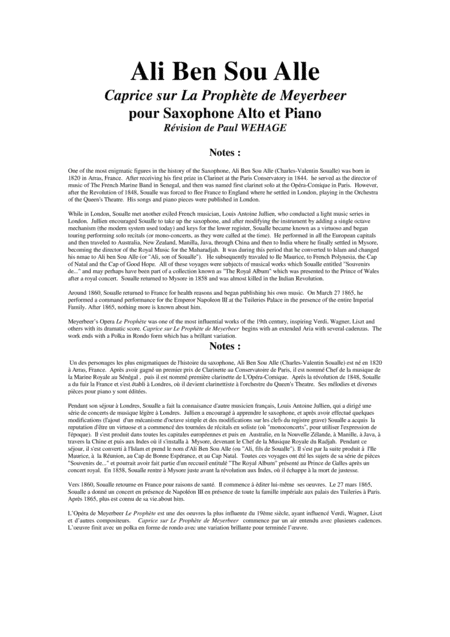
Ali Ben Sou Alle: Caprice sur La Prophète de Meyerbeer for alto saxophone and piano
Saxophone Alto et Piano

$11.95 10.19 € Saxophone Alto et Piano PDF SheetMusicPlus

Piano,Soprano Saxophone - Level 3 - Digital Download SKU: A0.533495 Composed by Ali Ben Sou Alle. Concert,Romantic Period,Standards. Score and part. 18 pages. Musik Fabrik Music Publishing #3000191. Published by Musik Fabrik Music Publishing (A0.533495). “Loc-tee-kun-tzin: air chinoise et Rondo. Souvenirs de la Chine starts with a setting of the Chinese folksong « Loc-tee-kun-tzin », one of eight used by Pucinni in his opera Turandot but set in a completely different harmonic context here. The Rondo which follows is in the form of a valse with several scherzando passages and an brillant code. The folksong is briefly reprised before the concise endingOne of the most enigmatic figures in the history of Wind Music, Ali Ben Sou Alle (Charles-Valentin Soualle) s born in 1820 in Arras, France. After receiving his first prize in Clarinet at the Paris Conservatory in 1844. he served as the director of music of The French Marine Band in Senegal, and then was named first clarinet solo at the Opéra-Comique in Paris. However, after the Revolution of 1848, Soualle was forced to flee France to England where he settled in London, playing in the Orchestra of the Queen's Theatre. His songs and piano pieces were published in London.While in London, Soualle met another exiled French musician, Louis Antoine Jullien, who conducted a light music series in London. Jullien encouraged Soualle to take up the saxophone, and after modifying the instrument by adding a single octave mechanism (the modern system used today) and keys for the lower register, Soualle became known as a virtuoso and began touring performing solo recitals (or mono-concerts, as they were called at the time) calling his modified saxophone the «turcophone ». He performed in all the European capitals and then traveled to Australia, New Zealand, Manilla, Java, through China and then to India where he finally settled in Mysore, becoming the director of the Royal Music for the Maharadjah. It was during this period that he converted to Islam and changed his nmae to Ali ben Sou Alle (or Ali, son of Soualle). He subsequently travaled to Ile Maurice, to French Polynesia, the Cap of Natal and the Cap of Good Hope. All of these voyages were subjects of musical works which Soualle entitled Souvenirs de... and may perhaps have been part of a collectionknown as The Royal Album which was presented to the Prince of Wales after a royal concert. Soualle returned to Mysore in 1858 and was almost killed in the Indian Revolution.Around 1860, Soualle returned to France for health reasons and began publishing his own music. On March 27 1865, he performed a command performance for the Emperor Napoleon III at the Tuileries Palace in the presence of the entire Imperial Family. After 1865, nothing more is known about him.
Ali Ben Sou Alle: Souvenirs de la Chine for soprano saxophone and piano
Saxophone Soprano et Piano

$11.95 10.19 € Saxophone Soprano et Piano PDF SheetMusicPlus

Alto Saxophone,Piano - Level 4 - Digital Download SKU: A0.533499 Composed by Ali Ben Sou Alle. Concert,Romantic Period,Standards. Score and part. 28 pages. Musik Fabrik Music Publishing #3000445. Published by Musik Fabrik Music Publishing (A0.533499). Meyerbeer’s Opera Le Prophète was one of the most influential works of the 19th century, inspiring Verdi, Wagner, Liszt and others with its dramatic score. Caprice sur Le Prophète de Meyerbeer begins with an extended Aria with several cadenzas. The work ends with a Polka in Rondo form which has a brillant variation.One of the most enigmatic figures in the history of Wind Music, Ali Ben Sou Alle (Charles-Valentin Soualle) was born in 1820 in Arras, France. After receiving his first prize in Clarinet at the Paris Conservatory in 1844. he served as the director of music of The French Marine Band in Senegal, and then was named first clarinet solo at the Opéra-Comique in Paris. However, after the Revolution of 1848, Soualle was forced to flee France to England where he settled in London, playing in the Orchestra of the Queen's Theatre. His songs and piano pieces were published in London.While in London, Soualle met another exiled French musician, Louis Antoine Jullien, who conducted a light music series in London. Jullien encouraged Soualle to take up the saxophone, and after modifying the instrument by adding a single octave mechanism (the modern system used today) and keys for the lower register, Soualle became known as a virtuoso and began touring performing solo recitals (or mono-concerts, as they were called at the time) calling his modified saxophone the «turcophone ». He performed in all the European capitals and then traveled to Australia, New Zealand, Manilla, Java, through China and then to India where he finally settled in Mysore, becoming the director of the Royal Music for the Maharadjah. It was during this period that he converted to Islam and changed his nmae to Ali ben Sou Alle (or Ali, son of Soualle). He subsequently travaled to Ile Maurice, to French Polynesia, the Cap of Natal and the Cap of Good Hope. All of these voyages were subjects of musical works which Soualle entitled Souvenirs de... and may perhaps have been part of a collectionknown as The Royal Album which was presented to the Prince of Wales after a royal concert. Soualle returned to Mysore in 1858 and was almost killed in the Indian Revolution.Around 1860, Soualle returned to France for health reasons and began publishing his own music. On March 27 1865, he performed a command performance for the Emperor Napoleon III at the Tuileries Palace in the presence of the entire Imperial Family. After 1865, nothing more is known about him.

Ali Ben Sou Alle: Fantaisie sur Robert le Diable for alto saxophone and piano
Saxophone Alto et Piano

$19.95 17.01 € Saxophone Alto et Piano PDF SheetMusicPlus


Partitions Gratuites
Acheter des Partitions Musicales
Acheter des Partitions Digitales à Imprimer
Acheter des Instruments de Musique

© 2000 - 2025

Accueil - Version intégrale




