EUROPE
476 articles
USA
0 articles
DIGITAL
825 articles (à imprimer)
Partitions Digitales
Partitions à imprimer
825 partitions trouvées

1 ....271 286 301 316 331 ....811

Piano Solo - Level 3 - Digital Download SKU: A0.1029559 Composed by Peter Daniel Klein. 20th Century,Contemporary. Score. 6 pages. Peter Daniel Klein #5307267. Published by Peter Daniel Klein (A0.1029559). I have written a programmatic, neo-romantic/post-romantic prose and musical fragment/miniature based on Schlegel's writings about a Hedgehog. Fragment in the sense that it is not fully developed, yet, in another sense, it is overdeveloped for its length. There are several modern elements in that it is bitonal at one point. At another point, I pit Scriabin's mystic chord, which is his synthetic mode, against what I feel is its nearest aeolian mode, c-minor, which is modernistically dissonant.   It is written in 'classicized' AABA popular song form, which is perfect for a miniature. It revolves around the programmatic, free verse' Prayer,' a plea to God for sleep, elusive due to the mourning of lost love and the associated emptiness and grief felt deep in the night. It is motivic in that there is a repeated augmented 6 to a half-diminished cadence that introduces the theme and then serves to transition each small section, in a secondary dominant style repetition until reaching tonic.   -A1 is a simple statement of the linear theme and harmony in 6ths, and 9ths, almost in keeping with the introductory and transitionary cadence, at least intervallically.   -A2 is a restatement of that theme with an added countermelody (which becomes the subject of section B) woven between the upper linear melody and the altered bass accompaniment.   -B begins with a short statement of the countermelody bi-tonally, the left hand in c minor, the right in g minor. There is a brief transposition between several keys, bitonally, while the sostenuto pedal holds a pedal tone until it attenuates completely.  The two measures build from repressed despondency to rage, as strong emotions often do, quickly turning to dissonant chaos. The dynamics and intensity build to a diminished chord whose top note moves up half a step to a Scriabin mystic chord arpeggio.  The held sustain pedal melds the dissonance together with emotional tumult, which fades as quickly as it came, as outbursts often do.   -A3 starts with the motivic cadence and a deep bass pedal tone. This section is the crowning moment in the piece. In sixths, the macabre accompaniment moves to the right-hand upper tessitura as the more developed 'A' melody moans below in the bass and baritone as the music ebbs away. A simple c-minor arpeggio strains against a very similar Scriabin mystic chord arpeggio, an octave or a minor seventh apart, ending on an A major and A flat in sweet, gentle, unresolved dissonance against a dying root pedal tone, the final teardrop.  
A Prayer and a Prelude
Piano seul

$4.99 4.26 € Piano seul PDF SheetMusicPlus

Instrumental Solo,Keyboard - Level 5 - Digital Download SKU: A0.1278259 Composed by Johann Sebastian Bach. Arranged by Chris Benton. Baroque,Early Music. Individual part. 10 pages. Chris Benton #869961. Published by Chris Benton (A0.1278259). This volume contains the Prelude & Fugue No. 4 in C sharp minor (BWV 849)  from The Well-Tempered Clavier, Part 1, by Johann Sebastian Bach, presented here in chromatic inversion. Every detail from the original is preserved exactly except it is, quite literally, turned upside down; mirrored note for note, interval for interval, around an axis, which in this case is middle D on the keyboard. This process transforms this well-known work profoundly, allowing the player to hear it afresh from an entirely new perspective.
Prelude & Fugue No. 4 in C sharp minor (BWV 849) - Chromatically Inverted
Piano seul

$1.99 1.7 € Piano seul PDF SheetMusicPlus

Instrumental Solo,Keyboard - Level 5 - Digital Download SKU: A0.1362285 Composed by Johann Sebastian Bach. Arranged by Chris Benton. Baroque,Early Music. Individual part. 10 pages. Chris Benton #946763. Published by Chris Benton (A0.1362285). This volume contains the Prelude & Fugue No. 4 in C sharp minor (BWV 873) from The Well-Tempered Clavier, Part 2, by Johann Sebastian Bach, presented here in chromatic inversion. Every detail from the original is preserved exactly except it is, quite literally, turned upside down; mirrored note for note, interval for interval, around an axis, which in this case is middle D on the keyboard. This process transforms this well-known work profoundly, allowing the player to hear it afresh from an entirely new perspective.
Prelude & Fugue No. 4 in C sharp minor (BWV 873) - Chromatically Inverted
Piano seul

$1.99 1.7 € Piano seul PDF SheetMusicPlus

String Orchestra - Digital Download SKU: A0.933524 Composed by Ludwig van Beethoven, Cees Nieuwenhuizen. Arranged by Upstream Music. Classical. Score and parts. 24 pages. Upstream Music #6353319. Published by Upstream Music (A0.933524). The Prelude and Fugue in C major were created during the period of study with Johann Georg Albrechtsberger, who lived from February 3, 1736 to March 7, 1809. Albrechtsberger was an Austrian theoretician and pedagogue of music, an organist, as well as a composer. He entered upon his career early as a choirboy in the choir of the monastery of Melk, Austria. There he was discovered by the crown prince, the later emperor Joseph II. The latter facilitated an appointment as the court organist.Later Albrechtsberger became conductor of the chapel choir of the famous Stephansdom in Vienna. Albrechtsberger was a highly praised pedagogue; Beethoven, too, was among his pupils. It was this composer that studied with Albrechtsberger from January 1794 to March/May 1795. Together with Beethoven, Albrechtsberger researched all forms of the counterpoint, which is most manifest in the large number of exercises passed down; over 300 studies, fugues etc. have been preserved with corrections and alterations by Albrechtsberger. During this period of study, greater works were also composed, such as the Dona Nobis Pacem (Hess A57), the Prelude and Fugue in E minor (Hess 29), the Prelude and Fugue in F major (Hess 30) and the present one in C major (Hess 31). The piece was probably composed in 1794-95; this opus also shows numerous improvements and alterations by his master, although some alterations are by Beethoven himself. The manuscript of the work is to be found in Vienna, and did not appear in print until 1967 for the first time.The present version sticks closely to Beethoven’s, but has been provided with a double bass part so as to adapt the work for being performed with a larger strength than for which it was originally written. The strength originally intended by Beethoven was two violins, a viola and a cello, so as a string quartet. With the supplementary bass part, the piece can also be played by a string orchestra, which will no doubt promote its dissemination and familiarity. In a sense, the work is already a preliminary study for the string quartets Opus 18 produced later.Especially the rhythm, melodic forms, and the counterpoint applied, frequently return in these string quartets. Beethoven has hardly indicated any rests in the empty bars; Cees has as yet added them.The phrasing, dynamics and time indications have also been added. Beethoven merely writes down the notes, while we have to accept the fact that various notes have been changed by Albrechtsberger but Beethoven’s notes might have been just as interesting. Of some notes it was not clear what Beethoven exactly meant; in such a case, Cees has adhered to the harmonious form, adapting the notes which, logically speaking, fit in with the harmonic unity.
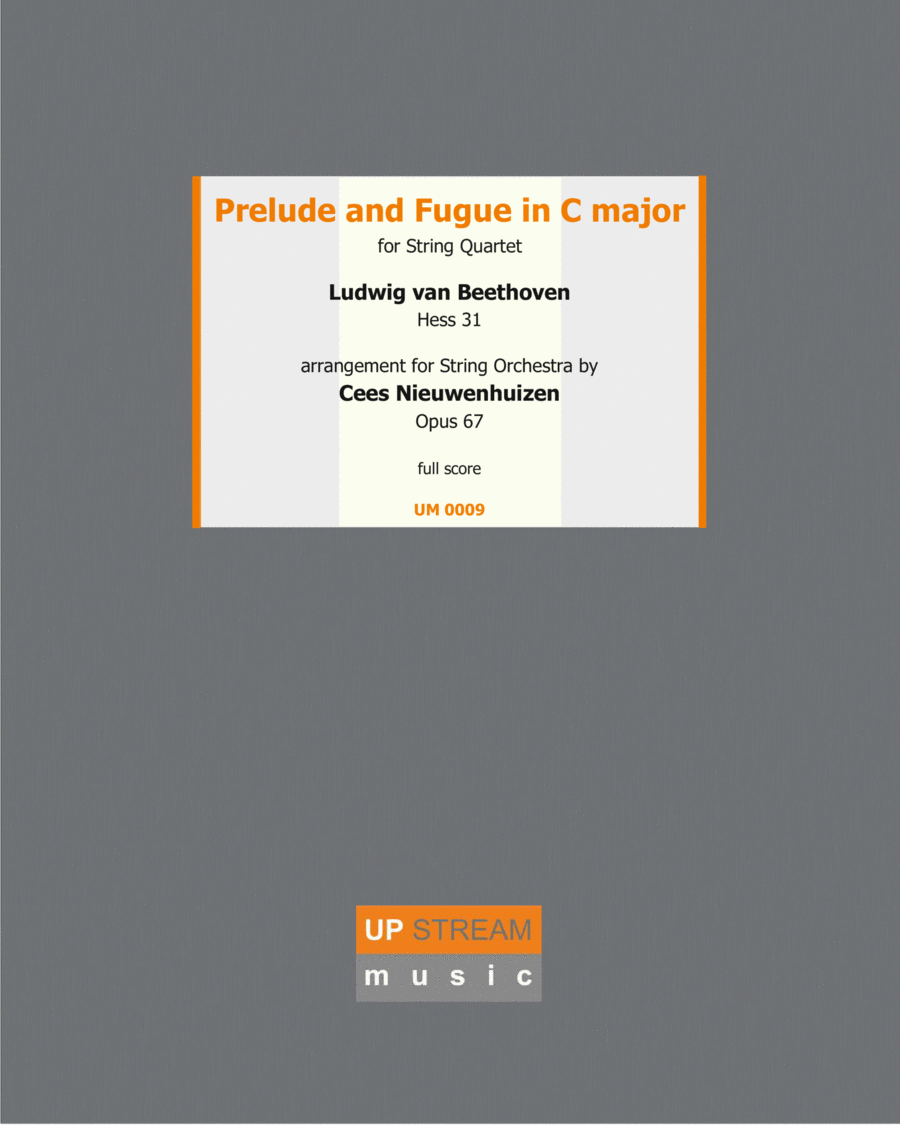
Prelude and Fugue in C major for String Orchestra - Arrangement of Beethoven Hess 31
Orchestre à Cordes

$29.00 24.77 € Orchestre à Cordes PDF SheetMusicPlus

Brass Ensemble - Level 4 - Digital Download SKU: A0.806770 Composed by Johann Sebastian Bach. Arranged by Glen Poehlmann. Baroque. Score and parts. 15 pages. Arrangements by GPoehlmann #5829075. Published by arrangements by GPoehlmann (A0.806770). PRELUDE and FUGUE in G MINOR for BRASS QUINTETJ.S. Bach's beautiful organ solo has been arranged for a Brass Quintet.82 measures. Meter: 6/4 (Prelude) - 4/4 (Fugue). Key G minor.  Medium Difficult (Grade 4)Instrument Ranges (C4=middle C): Trumpet 1 G4 - B5 (written).  Trumpet 2 C4 - A5 (written).Horn in F C4 - Eb5 (written).  Trombone G2 - F4.  Tuba A1 - G3.
PRELUDE and FUGUE in G MINOR (J.S. Bach) for BRASS QUINTET
Quintette de Cuivres: 2 trompettes, Cor, trombone, tuba

$6.00 5.13 € Quintette de Cuivres: 2 trompettes, Cor, trombone, tuba PDF SheetMusicPlus

Small Ensemble - Level 3 - Digital Download SKU: A0.835890 Composed by Frederic Chopin. Arranged by Paul Burnell. Contemporary,Romantic Period. Score and parts. 19 pages. Paul Burnell #6570875. Published by Paul Burnell (A0.835890). Prélude in E Minor, Frédéric Chopin, arranged by Paul Burnell for instruments in four parts(24 Préludes, Op. 28: No.4 in E Minor)Duration 1:55Score in CThe arrangement is suitable for multiple quartet combinations with parts available (and potential instrumentations suggested) as follows:Part 1: C, Eb (Flute, Oboe, Alto Recorder, Eb Clarinet, Violin 1)Part 2: C, Bb, G (Alto Flute, Oboe, Tenor Recorder, Bb Clarinet, Violin 2)Part 3: C, Bb, Eb, F (Bb Clarinet, Bass Recorder, Alto Saxophone, Horn in F, Violin 3, Viola)Part 4: C, Bb, F (Bassoon, Great bass Recorder, Tenor Saxophone, Horn in F, 'Cello)Part 4 may be played an octave lower than written - using the 'Bass Clef up 8' part.Any other appropriate instruments, even if not suggested above, may play.Play notes in brackets if the main notes are out of range.Programme note:The Prélude E minor by Polish composer Frédéric Chopin (1810 – 1849) is the fourth of the 24 Chopin Préludes, Op. 28, first published in 1839. The piece has featured in many movies, including being played by Jack Nicholson's character in 'Five Easy Pieces' (1970).
Prélude in E Minor, arranged for instruments in four parts

$3.99 3.41 € PDF SheetMusicPlus


1 ....271 286 301 316 331 ....811


Partitions Gratuites
Acheter des Partitions Musicales
Acheter des Partitions Digitales à Imprimer
Acheter des Instruments de Musique

© 2000 - 2026

Accueil - Version intégrale





