EUROPE
2404 articles
USA
0 articles
DIGITAL
4533 articles (à imprimer)
Partitions Digitales
Partitions à imprimer
4533 partitions trouvées


Piano Solo - Level 5 - Digital Download SKU: A0.1285388 By Hakan Ali Toker. By Frederic F. Chopin. Arranged by Hakan Ali Toker. 19th Century,20th Century,Classical,Romantic Period. Score. 106 pages. Hakan Ali Toker #876505. Published by Hakan Ali Toker (A0.1285388). A set of 12 etudes, all based on music by Chopin. The first 10 etudes are created by cross-breeding music by Chopin with the work of another composer. The texture of one work has been applied to the harmony of another. The last two are created by a different approach: work by one composer has been recreated in the style of another. All based on ideas of Prof. Douglas HofstadterNo. 1: Texture of J. S. Bach's C Major Prelude BWV 846 from book I of the Well-tempered Clavier applied to the harmony of F. F. Chopin's C Major Etude Op. 10 no. 1No. 2: Vice versaNo. 3: Texture of J. S. Bach's ce minor Prelude BWV 847 from book I of the Well-tempered Clavier applied to the harmony of F. F. Chopin's c minor Etude Op. 25 no. 12 No. 4: Vice versaNo. 5: Texture of F. F. Chopin's Etude Op. 10 No. 6 applied to the harmony of the composer's own Prelude in A Major Op. 28 no. 7No. 6: Variations on F. F. Chopin's Prelude in c minor Op. 28 no. 20, each variation based on a different etude by Chopin himselfNo. 7: Texture of F. F. Chopin's Etude in A Flat Major Op. 25 no.1 applied to the harmony and melody of F. Loewe's song I Could Have Danced All Night from My Fair LadyNo. 8: Texture of F. F. Chopin's Etude in C Major Op. 10 no.1 applied to the harmony of the the composer's own Etude in c minor Op. 25 no. 12No. 9: Vice VersaNo. 10: Texture of F. F. Chopin's Prelude in f# minor Op. 28 no. 8 and his Fantaisie-Impromptu in c# minor Op. 66 applied to the harmony and melody of A. DvorÌŒaÌk's Humoresque Op. 101 no. 7No. 11: S. S. Prokofiev's Waltz Op. 65 no. 6 in the style of F. ChopinNo. 12: F. F. Chopin's Waltz in f#minor Op. 69 no. 2 in the style of S. S. Prokofiev.
Hybrid Studies
Piano seul
Hakan Ali Toker
$20.00 17.39 € Piano seul PDF SheetMusicPlus

Piano Solo - Level 3 - Digital Download SKU: A0.972635 Composed by James Siddons. 20th Century,Contemporary,Ragtime,Standards. Score. 10 pages. James Siddons Music and Writings #3022927. Published by James Siddons Music and Writings (A0.972635). These seven short pieces were composed in the early months of 1976 as imitations of some of the composers and musical styles of the early twentieth century. They were never performed or published at the time. They are useful as didactic studies for student pianists. The seven pieces areI. Intonatione In the Whole-Tone ScaleII. Prélude and Nocturne in ModesIII. An Impression of ImpressionismIV. An Imitation of Roy HarrisV. Adding Chord-Tones While Shifting MetersVI. Ragtime BitonalityVII. Diatonic Waltz Program Notes: The Intonatione In the Whole-Tone Scale recalls the Renaissance Italian musical form that evolved into the prèlude in later organ music, as well as the use of Italian forms in the atonal music of Arnold Schoenberg, and some neo-Baroque composers of the twentieth century. In contrast, the whole-tone scale is reminiscent of generally tonal composers, including Debussy. The Martial Prèlude and Nocturne in Modes recalls the many pre-twentieth century pairings of preludes with fugues and other forms. The pairing with a nocturne evokes an air of Romanticism. The Martial Prèlude is a march-like fanfare, in Lydian mode on C. The Chopinesque Nocturne is in Phrygian mode, on E flat. An Impression of Impressionism evokes some of Debussy’s Preludes pour Piano, including a suggestive title at the bottom of the page, as Debussy himself did. For the young pianist aiming to master the works of Debussy, the arpeggio patterns, block chords, and sequential motives will prove helpful as introductory exercises. An Imitation of Roy Harris was inspired by the occasion in 1976 when James Siddons heard Roy Harris speaking in person about his compositions. Siddons was impressed by Harris’ youth in Oklahoma, and how the solidity of American rural life shaped Harris’ symphonic music. When taking questions at the end of the lecture, a young composer asked Harris about his creative methods when composing music. Well, Harris responded, You don’t pull up a potato just to see if its growing. Adding Chord-Tones While Shifting Meters is a technical exercise that is nonetheless fun to listen to, and fun to play. A student pianist should be asked to analyze the harmony in this piece, and to describe what shifts are taking place when the musical meter (as well as phrasing and rhythm patterns) change. The echoes of Stravinsky and Bartók should be apparent to the listener and pianist. Ragtime was not regarded as art music of the same caliber as Stravinsky and Schoenberg, or even Copland and Gershwin, until the 1970s. The inclusion of ragtime in these seven pieces would not have been accepted by composers of the early twentieth century, Stravinsky excepted. Ragtime Bitonality explores how such piano music might have sounded had major composers of the 1900-1920 era taken an interest in its march-like vitality. There is even a touch of atonality! In contrast to the powerful rhythms and juxtaposed tonal relations in much early twentieth-century music, there were works by many composers that continued familiar melodic patterns and balanced forms, offering musical relief in a turbulent era in music history. The Diatonic Waltz is offered here as a quiet, peaceful conclusion to our tour of musical styles in classical music of a century ago. About the Composer: James Siddons is a composer and pianist as well as musicologist. His research guide to the music of Japanese composer Toru Takemitsu was published in 2001. For more information, see www.JamesSiddons.com
Seven Pieces in Twentieth-Century Styles
Piano seul

$5.00 4.35 € Piano seul PDF SheetMusicPlus

Instrumental Solo,Piano and Keyboard - Level 5 - Interactive Download SKU: A0.480874 By PETER Z SALTZMAN. By PETER Z SALTZMAN. This edition: Interactive Download. Blues,Children,Classical,Jazz. Individual part. 2 pages. Duration 86. Salt Muse, Inc #77okvfC6ltCj6rma22mFYB. Published by Salt Muse, Inc (A0.480874). Key: F major.Though it starts simply enough, this bluesy lullaby becomes increasingly complex as voices that started as accompaniment become counterpoint and the harmony becomes more and more, well, blue. So whille it initially seems pretty easy pianistically speaking, it ends up anything but. (For this reason, I'll be posting a simplified version soon: I think it would be an attractive recital piece for young pianists wanteding something a bit different.) Blues Lullaby comes from a suite/album called Blues, Preludes and Feuds. You can hear the entire album on any of the standard streaming services (Spotify, Apple, etc.) or here on Bandcamp: https://petersaltzman.bandcamp.com/album/blues-preludes-feuds-1-4.
Blues Lullaby
Piano seul
PETER Z SALTZMAN
$3.95 3.43 € Piano seul PDF SheetMusicPlus

Brass Ensemble - Level 5 - Digital Download SKU: A0.792105 Composed by Johann Sebastian Bach. Arranged by Gordon Cherry. Baroque,Easter,Sacred. Score and parts. 6 pages. Gordon Cherry #3451773. Published by Gordon Cherry (A0.792105). This work gives all three tubists a real workout. The 2nd part plays the moving voice in the midrange along with the third part on the bass tuba line. The first part for Euphoniums (can be played by an F tuba player with a good high register) plays the choral prelude melody on top in a beautiful legato line. This work gives all three tubists a real workout. The 2nd part plays the moving voice in the midrange along with the third part on the bass tuba line. The first part for Euphoniums (can be played by an F tuba player with a good high register) plays the choral prelude melody on top in a beautiful legato line. This work gives all three tubists a real workout. The 2nd part plays the moving voice in the midrange along with the third part on the bass tuba line. The first part for Euphoniums (can be played by an F tuba player with a good high register) plays the choral prelude melody on top in a beautiful legato line.
Sleepers Awake (Wachet Auf) for Tuba Trio
3 Tubas (trio)

$12.50 10.87 € 3 Tubas (trio) PDF SheetMusicPlus

Piano Solo - Level 3 - Digital Download SKU: A0.1253588 By Keith & Kristyn Getty X Skye Peterson. By Ben Shive, Bryan Christopher Fowler, Skye Peterson, and Thomas Anderson. Arranged by Brian Buda. Christian,Contemporary,Easter,Praise & Worship,Wedding. Score. 16 pages. Budaful music #847237. Published by budaful music (A0.1253588). This is piano solo arrangement of the contemporary hymn I Am Not My Own. This beautiful hymn of dedication is appropriate in many situations: preludes and offertories as well as in weddings. The first 2 pages are firmly in the intermediate range but it gets progressively more moderately advanced. The harmonies and attention to details aim at helping the pianist to best communicate the truths of the hymn. The biggest difference in this arrangment from the Getty's recording is the intro and interludes that make reference to the old hymn 'Take My Life and Let it Be Consecrated'. Ideal for preludes and/or prayer time. Run time is approx 4:50 but it depends on which performance options are taken.This setting implements all 4 verses of the hymn and is in similar form to the Getty's recording, for that reason– though with some modifications– it is possible to use this setting for vocalists as well. 3 performance options: 1) play it all the way through, 2) 2 verses/chorus with ending, 3) 3 verses with ending. In addition, 3 Key options are provided: A-Bb-C (A is key it was arranged in, some chord voicings/fingerings might need to be adjusted for the alternate keys.).
I Am Not My Own
Piano seul
Keith & Kristyn Getty X Skye Peterson
$6.99 6.08 € Piano seul PDF SheetMusicPlus

Piano Solo - Level 3 - Digital Download SKU: A0.1012004 Composed by Haydon Harvey. Contemporary,World. Score. 6 pages. Haydon Harvey #3526863. Published by Haydon Harvey (A0.1012004). I have always been fascinated by celestial objects and phenomena. The sheer scale of these bodies, let alone the beauty they possess, always has me in awe and so I've written a series of pieces called the Nebula Preludes for solo piano and 'Pillars of Creation' is the first of the preludes. This piece involves a lot of octave playing and smooth connection of these octaves is vital for the 'lyrical' quality intended in the beginning of the piece while a more robust approach is needed for a quality of grandeur. It is roughly 3 minutes in length.You can follow me on YouTube to stay up-to-date with my latest compositions:https://youtube.com/channel/UCDH5k8WC2fjcY_5i6fmyHfg
Pillars of Creation
Piano seul

$3.99 3.47 € Piano seul PDF SheetMusicPlus

Brass Quintet Horn,Trombone,Trumpet,Tuba - Level 4 - Digital Download SKU: A0.1223683 By George B Chave. By Claude Debussy. Arranged by George B Chave. 20th Century,Classical. 9 pages. BrassMagicMusic.com #819834. Published by BrassMagicMusic.com (A0.1223683). This arrangement features horn on the primary melody, and generally places the work in the lower and darker registers of the other instruments.  At the climax the first trumpet climbs out of the darkness and into the bright upper register.  As the theme is recalled/remembered at the end, trumpet with harmon mute lends a nostalgic feeling.  Combined with my arrangement of General Lavine and Heather, this would make a great recital set of Debussy's music.  Buy all three Debussy Preludes as a set (including Heather, The Girl With The Flaxen Hair, and General Lavine) and save over 14%. Just Search: Three Debussy Preludes (brass quintet).
The Girl With The Flaxen Hair (brass quintet)
Quintette de Cuivres: 2 trompettes, Cor, trombone, tuba
George B Chave
$6.99 6.08 € Quintette de Cuivres: 2 trompettes, Cor, trombone, tuba PDF SheetMusicPlus

Instrumental Solo - Level 5 - Digital Download SKU: A0.818281 By Stephen R Dalrymple. By Sergei Rachmaninoff. Arranged by Edited by Stephen R Dalrymple. Romantic Period. Individual part. 18 pages. Stephen R Dalrymple #4966281. Published by Stephen R Dalrymple (A0.818281). Élegié in E Flat Minor for solo piano (Classical Music for Tablet Series) ♫ by Sergei Vasilyevich Rachmaninoff (Opus 3.1) ♫ Rachmaninoff (born in 1873) , Russian composer, virtuoso pianist, and conductor, was considered one of the finest pianists of his day. His compositions belong to the Romantic period of music history. He graduated at the Moscow Conservatory in 1892. After the premiere of his First Symphony in 1897, the negative reaction by an important critic sent him into a tailspin of depression that lasted several years. ♫ In 1909 he performed a series of 26 performances with the Boston Symphony Orchestra in the USA. In 1914 he travelled to England for a concert tour. ♫ In February 1917 on the day the Socialist Revolution began in St Petersburg, he performed a benefit piano recital in Moscow for wounded Russian soldiers. When he returned home, he found that a group of Social Revolutionary Party members had seized his property as their own communal property. He had invested most of his earnings on the estate, but left it behind. Rachmaninoff's concert performance in Yalta on 5 September 1917 was to be his last in Russia. The chaos and tension of the October Revolution was daunting. He composed with the noise of gunshots and rallies in the background. He received an invitation to perform 10 recitals across Scandinavia. He accepted the offer, using it as an excuse to obtain permits so he and his family could flee Russia. ♫ He returned to the USA in November 1918 and America became his home. When he became an American citizen in 1943, Sergei Rachmaninoff said: “This is the only place on earth where a human being is respected for what he is and what he does, and it does not matter who he is and where he came from.†He died in March 1943 from cancer at the age of 70. (condensed from Wikipedia - October 2022) ♫ Rachmaninoff’s Opus 3 contains 5 piano pieces. The first is the Élegié in E Flat Minor, the second is the Prelude in C# Minor (one of his most famous piano compositions). This opus was finished in 1892, when he was 19 years old. The Prelude in C# Minor is loud, explosive, and declarative; the Élegié in E Flat Minor is soft, fluid, and contemplative. ♫ Edited for 10 inch tablet by Stephen R Dalrymple ♫ Sequenced by the Editor ♫ The Classical Music for Tablet Series offers piano masterworks by classical composers formatted to be read on 10 inch tablets. I use an Amazon Kindle with Mobile Sheets Pro and an Air Turn blue tooth foot pedal to practice and perform piano music. Similar products available to provide other tablets the same functionality. ♫ The pieces in this series have not been arranged, but most have been edited slightly, and have been formatted to fit screen size. For example, in the tablet versions, first and second endings are often removed and the repeated measures and endings written into the music so the performer can avoid having to go back to previous pages. These kinds of section repeats were invented to spare the composer’s time and the cost of extra paper and ink. But with a tablet the cost of paper and ink is irrelevant. ♫ Although there are a lot more page turns with a 10 inch screen compared with letter size pages, the readability of the music (due to the backlighting on the tablet) and the portability of the music (travelling with a small tablet instead of oversized books or portfolios of sheet music) easily makes up for the extra page turns. ♫ Your purchase provides one .pdf file that contains both the tablet edition and the letter size page (printable) version. There are several programs available online that will allow you to separate this .pdf file into 2 .pdf files to make it more useful.
Elegie in Eb Minor (Classical Music for Tablet Series)
Piano seul
Stephen R Dalrymple
$3.99 3.47 € Piano seul PDF SheetMusicPlus

Choral Choir (SATB) - Level 3 - Digital Download SKU: A0.926664 Composed by Michael A. Morizio. A Cappella,Christian,Sacred. Octavo. 8 pages. M.A. Morizio #3588427. Published by M.A. Morizio (A0.926664). The Apostle John’s visions in Revelation are nothing less than astounding to all readers. However, little is it known that another Hymn to Christ is neatly tucked into the very first seven verses of this last book of the Bible. John begins his Revelation (verses 1-3) with a prelude, introducing Jesus Christ and the apocalypse (revelation) that was made to him via the angel sent to describe all the things about which he was to write. He says, Blessed is the one who reads aloud the words of this prophecy, and blessed are those who hear, and keep what is written in it, for the time is near. After this short prelude, John delivers an epistolary opening (a greeting identifying the author and recipients), then pronounces a blessing upon the recipients-verses 4-6. After both the prelude and the opening, John immediately proceeds to another known Hymn to Christ, in verse 7, which I have called, Behold He Is Coming.  When presented with the text in Revelation 1:7, I immediately thought, Where is the Gospel, the good news, in this piece? After several minutes of meditating on the text, I realized the Gospel message was right there in front of me-in the very last line: Yes, so be it [Lord], so be it, [Amen!] There will be peace! All will be known. Every single person will understand, at that point. The end, is the ushering in of a new beginning. The piece is scored in G minor for SATB with flute and Bâ™­ clarinet accompaniment. In the opening phrase, we hear the clarinet on a sustained high (concert) G, which crescendos into a quick, descending sixteenth note pattern. There is urgency! The flute joins the clarinet in a duet to complete the introduction to the anthem. Then, the choir begins their haunting chant, Behold, He is coming with the clouds. Every eye will see Him, even those who pierced Him. Every eye will see Him and all the tribes of the earth will mourn over Him . Alas, there is peace! The two instruments dissolve into an a cappella four-part chorale where the choir creates the agreement between the text and the music, modulating to the relative major (Bâ™­)-all is reconciled in a final Amen!
BEHOLD HE IS COMING (SATB) – Revelation 1:7
Chorale SATB

$1.99 1.73 € Chorale SATB PDF SheetMusicPlus

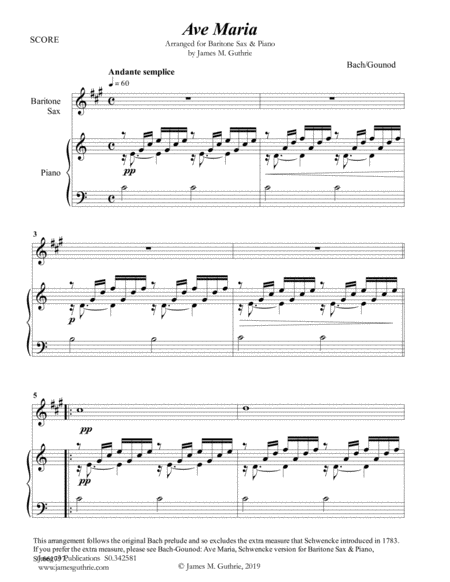
Baritone Saxophone,Piano - Level 2 - Digital Download SKU: A0.549365 Composed by Bach-Gounod. Arranged by James M. Guthrie, ASCAP. Christmas,Contemporary,Easter,Wedding. Score and part. 11 pages. Jmsgu3 #3490145. Published by jmsgu3 (A0.549365). This arrangement follows the original Bach prelude and so excludes the extra measure that Schwencke introduced in 1783. If you prefer the extra measure, please see Bach-Gounod: Ave Maria, Schwencke version for Baritone Sax & Piano, S0.661797. The convenient 1st & 2nd endings provide an option for extended performance with minimal page turns for the accompanist. The duration with repeat is about 4:50. Score: 6 pages. Solo part: 1 page, piano part: 4 pages. Based on Prelude #1 in C Major from the Well-Tempered Clavier, Book 1. Well suited for church meditations or school programs or recital encores.  Ave Maria Ave Maria is a Catholic prayer that consequently asks for the mother of Jesus (Mary) to intercede. Charles Gounod composed a famous version of the Ave Maria. He was a French Romantic composer who overlaid a new melody on an existing Bach chord progression. The progression is from Bach’s Prelude No. 1 from Well-Tempered Clavier I. This version, as well as Schubert’s version, have become essential items at weddings, masses, and funerals. Bach Overview First of all, Johann Sebastian Bach is maybe the greatest composer in music history. Certainly, he was prolific. As a result, everyone has heard of his works. Furthermore, these works number well over a thousand. It seems like people are probably most familiar with instrumental works such as the Brandenburg Concertos, and the Goldberg Variations. But, similarly famous are such noteworthy works as the Well-Tempered Clavier, the Musical Offering, and the Art of Fugue. Seems like his most famous vocal works include the most noteworthy Mass in B Minor. Also, most noteworthy, though, are the St. John Passion, and certainly the Christmas Oratorio.  History Bach came from a long line of musicians and above all, composers. Consequently, he, first of all, pursued a career as a church organist. So as a result, he gained employment in various Protestant churches in Germany. For a while, he worked as a court musician in Weimar and Köthen. Here he probably developed his organ style and likewise his chamber music style. Eventually, he gained an appointment as Cantor of St. Thomas in Leipzig. Here he worked until difficulties with his employer ultimately drove him away. The King of Poland finally appointed him as court composer.  Style It seems like Bach created an engaging new international style. He synthesized elements of the most noteworthy European music ideas into his new style. Even more, this new style was probably his synthesis of European musical rhythm and form. Furthermore, he demonstrated a complete mastery of counterpoint and motivic development. His sense of harmonic organization probably propelled him to the top. Revival               Mendelssohn conducted a Bach revival in the nineteenth century. His effort probably helped to re-familiarize the public with the magnitude of Bach’s works. During this period, scholars published many noteworthy Bach biographies. Moreover, Wolfgang Schmieder published the BWV (Bach Werke Verzeichnis). As a result, this is now the official catalog of his entire artistic output. The BWV number allows us to locate a work in the catalog. Sometimes scholars will simply use an S (Schmieder) as an abbreviation for BWV.  
Bach-Gounod: Ave Maria for Baritone Sax & Piano
Saxophone Baryton, Piano

$32.95 28.65 € Saxophone Baryton, Piano PDF SheetMusicPlus

Piano,Soprano Saxophone - Level 2 - Digital Download SKU: A0.549366 Composed by Bach-Gounod. Arranged by James M. Guthrie, ASCAP. Christmas,Contemporary,Easter,Wedding. Score and part. 14 pages. Jmsgu3 #3490157. Published by jmsgu3 (A0.549366). This arrangement follows the original Bach prelude and so excludes the extra measure that Schwencke introduced in 1783. If you prefer the extra measure, please see Bach-Gounod: Ave Maria, Schwencke version for Soprano Sax & Piano - S0.661999. The convenient 1st & 2nd endings provide an option for extended performance with minimal page turns for the accompanist. The duration with repeat is about 4:50. Score: 6 pages. Solo part: 1 page, piano part: 4 pages. Based on Prelude #1 in C Major from the Well-Tempered Clavier, Book 1. Well suited for church meditations or school programs or recital encores. Ave Maria Ave Maria is a Catholic prayer that consequently asks for the mother of Jesus (Mary) to intercede. Charles Gounod composed a famous version of the Ave Maria. He was a French Romantic composer who overlaid a new melody on an existing Bach chord progression. The progression is from Bach’s Prelude No. 1 from Well-Tempered Clavier I. This version, as well as Schubert’s version, have become essential items at weddings, masses, and funerals. Bach Overview First of all, Johann Sebastian Bach is maybe the greatest composer in music history. Certainly, he was prolific. As a result, everyone has heard of his works. Furthermore, these works number well over a thousand. It seems like people are probably most familiar with instrumental works such as the Brandenburg Concertos, and the Goldberg Variations. But, similarly famous are such noteworthy works as the Well-Tempered Clavier, the Musical Offering, and the Art of Fugue. Seems like his most famous vocal works include the most noteworthy Mass in B Minor. Also, most noteworthy, though, are the St. John Passion, and certainly the Christmas Oratorio.  History Bach came from a long line of musicians and above all, composers. Consequently, he, first of all, pursued a career as a church organist. So as a result, he gained employment in various Protestant churches in Germany. For a while, he worked as a court musician in Weimar and Köthen. Here he probably developed his organ style and likewise his chamber music style. Eventually, he gained an appointment as Cantor of St. Thomas in Leipzig. Here he worked until difficulties with his employer ultimately drove him away. The King of Poland finally appointed him as court composer.  Style It seems like Bach created an engaging new international style. He synthesized elements of the most noteworthy European music ideas into his new style. Even more, this new style was probably his synthesis of European musical rhythm and form. Furthermore, he demonstrated a complete mastery of counterpoint and motivic development. His sense of harmonic organization probably propelled him to the top. Revival               Mendelssohn conducted a Bach revival in the nineteenth century. His effort probably helped to re-familiarize the public with the magnitude of Bach’s works. During this period, scholars published many noteworthy Bach biographies. Moreover, Wolfgang Schmieder published the BWV (Bach Werke Verzeichnis). As a result, this is now the official catalog of his entire artistic output. The BWV number allows us to locate a work in the catalog. Sometimes scholars will simply use an S (Schmieder) as an abbreviation for BWV.  
Bach-Gounod: Ave Maria for Soprano Sax & Piano
Saxophone Soprano et Piano

$32.95 28.65 € Saxophone Soprano et Piano PDF SheetMusicPlus


Partitions Gratuites
Acheter des Partitions Musicales
Acheter des Partitions Digitales à Imprimer
Acheter des Instruments de Musique

© 2000 - 2026

Accueil - Version intégrale