EUROPE
20004 articles
USA
0 articles
DIGITAL
56836 articles (à imprimer)
Partitions Digitales
Partitions à imprimer
56836 partitions trouvées


Piano,Tenor Saxophone - Level 2 - Digital Download SKU: A0.549424 Composed by Antonin Dvorak. Arranged by James M. Guthrie, ASCAP. Instructional,Romantic Period,Sacred,Standards. Score and part. 12 pages. Jmsgu3 #3494011. Published by jmsgu3 (A0.549424). Score: 7 pages, solo part: 2 pages, piano part: 3 pages. Duration: 4:25 Not difficult, but requires sensitivity & dynamic control. Suitable for recitals, church meditations, or school programs. Dvořák Background Antonín Dvořák (1841 –1904) was, of course, a composer from Czechoslovakia. As a matter of fact, he was among the first Bohemian composers to attain universal recognition. It is important to realize that the late Romantic Nationalist period featured composers who used traditional and folk elements to portray the character of their nation. In particular, we see this in the music of Grieg (Norway), Finland (Sibelius), and Smetana (Bohemia).  Dvořák relied markedly on rhythms and other characteristics of Moravian and Bohemian folk music. Ascent to Fame Dvořák was truly a child musical prodigy on the violin. The premiere performances of his compositions notably occurred in 1872 and 1873. He submitted his First Symphony in particular to a German competition, but it failed to win. Consequently, in 1874 he presented two more symphonies to the Austrian State Prize for Composition. Johannes Brahms was the principal of the jury and was accordingly very impressed. They forthwith awarded the prize to Dvořák in 1874, 1876, and 1877. At this point, Brahms thereupon endorsed Dvořák to the publisher Simrock. Later, the publisher commissioned Dvořák to compose the Slavonic Dances, Op. 46. These became popular overnight and, as a result, Dvořák's worldwide status was launched. International Status Dvořák visited England upon invitation nine times. On each visit, he frequently conducted performances of his own compositions. He conducted concerts of his music, especially in Moscow and St. Petersburg. Eventually, the Prague Conservatory in fact appointed Dvořák as a professor. There, to be sure, he wrote his famous Dumky Trio. United States Consequently, the National Conservatory of Music of America appointed him as director in 1892. As a result, Dvořák composed his two most famous symphonic works: the Symphony No. 9 (From the New World), which spread his name universally, and his Concerto for Cello and Orchestra, one of the most famous of all cello works. Moreover, he wrote his most celebrated American String Quartet during this time. At the same time, because of his growing recognition in Europe and his homesickness for his own country, he left to return to Bohemia in 1895.
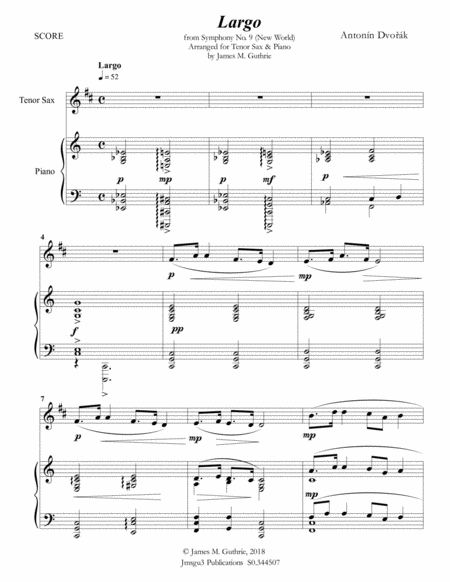
DvoÅ™ák: Largo from the New World Symphony for Tenor Sax & Piano
Saxophone Tenor et Piano

$32.95 28.68 € Saxophone Tenor et Piano PDF SheetMusicPlus

Small Ensemble - Level 1 - Digital Download SKU: A0.890779 Composed by Georg Philipp Telemann. Arranged by Sneakwood Editions. Baroque,Folk,Jewish,World. Score and parts. 32 pages. Sneakwood Editions #5799897. Published by Sneakwood Editions (A0.890779). Georg Philipp Telemann – Polish Dances from the Rostock Manuscript TWV 45 (Danse d`Polones / Danse Polonie)Telemann was seduced by Polish music, especially by his dances and popular musicI became acquainted there and also in Krakau with Polish and Moravian music in its true, barbaric beauty […] […] it is impossible to imagine the fantastic musical ideas they presented between dances when the dancers rested and the musicians improvised music together [‘jammed’] to fill out the time. Anyone who paid very close attention could pick up in 8 days sufficient musical ideas to last a lifetime.(Telemann’s autobiography, published in Mattheson’s Ehren-Pforte, Hamburg, 1740)It is easy to understand, through Telemann’s own words, the great influence that Polish music and Polish dances had on Telemann. It was in 1705 when Telemann become Kapellmeister for the court of Count Erdmann II of Promnitz at Sorau (now Å»ary, in Poland), His career there was cut short in early 1706 by the hostilities of the Great Northern War but his contact with Polish music marked him for life.These Polish dances found in Rostock are a reflection of the music that Telemann heard and transcribed. A reflection of that barbaric beauty.The manuscript was discovered in 1986 at the University of Rostock. It consists of two volumes. One of the volumes contains the violin part and the other the bass part.
Telemann – Polish Dances from the Rostock Manuscript TWV 45

$18.00 15.67 € PDF SheetMusicPlus

Piano Solo - Level 3 - Digital Download SKU: A0.697738 Composed by John Bacchus Dykes. Arranged by Sandy McIntire. Classical,Easter,Instructional,Sacred,Traditional. Score. 5 pages. Sandy McIntire #6609267. Published by Sandy McIntire (A0.697738). Ten Thousand Times Ten Thousand or Alford is a Christian anthem appropriate for Advent and All Saints Day as well as general worship services. This arrangement, an Intermediate Piano Solo, includes variations that enhance Dykes' dramatic and impressive melody bringing out its subtle harmonies. Choirs that have recorded this hymn include the Moravian Church Choir and the Mormon Tabernacle Choir.Other Advent hymns arranged by McIntire for piano are The Wexford Carol and Come Thou Long-Expected Jesus, available at sheetmusicplus.
Ten Thousand Times Ten Thousand (Alford)
Piano seul

$5.50 4.79 € Piano seul PDF SheetMusicPlus

Baritone Horn TC,Euphonium,Piano - Level 2 - Digital Download SKU: A0.552853 Composed by Antonin Dvorak. Arranged by James M. Guthrie, ASCAP. Instructional,Romantic Period,Sacred,Standards. Score and part. 12 pages. Jmsgu3 #3494239. Published by jmsgu3 (A0.552853). Score: 7 pages, solo part: 2 pages, piano part: 3 pages. Duration: 4:25 Not difficult, but requires sensitivity & dynamic control. Suitable for recitals, church meditations, or school programs. Dvořák Background Antonín Dvořák (1841 –1904) was, of course, a composer from Czechoslovakia. As a matter of fact, he was among the first Bohemian composers to attain universal recognition. It is important to realize that the late Romantic Nationalist period featured composers who used traditional and folk elements to portray the character of their nation. In particular, we see this in the music of Grieg (Norway), Finland (Sibelius) and Smetana (Bohemia).  Dvořák relied markedly on rhythms and other characteristics of Moravian and Bohemian folk music. Ascent to Fame Dvořák was truly a child musical prodigy on the violin. The premiere performances of his compositions notably occurred 1872 and 1873. He submitted his First Symphony in particular to a German competition, but it failed to win. Consequently, in 1874 he submitted two more symphonies to the Austrian State Prize for Composition. Johannes Brahms was the principal of the jury and was accordingly very impressed. They forthwith awarded the prize to Dvořák in 1874, 1876 and 1877. At this point, Brahms thereupon endorsed Dvořák to the publisher Simrock. Later, the publisher commissioned Dvořák therefore to compose the Slavonic Dances, Op. 46. These became popular overnight and, as a result, Dvořák's worldwide status was launched. International Status Dvořák visited England upon invitation all in all nine times. On each visit, he frequently conducted performances of his own compositions. He conducted concerts of his music, especially in Moscow and St. Petersburg. Eventually, the Prague Conservatory in fact appointed Dvořák as a professor. There, to be sure, he wrote his famous Dumky Trio. United States Consequently, the National Conservatory of Music of America appointed him as director in 1892. As a result, Dvořák composed his two most famous symphonic works: the Symphony No. 9 (From the New World), which spread his name universally, and his Concerto for Cello and Orchestra, one of the most famous of all cello works. Moreover, he wrote his most celebrated American String Quartet during this time. At the same time, because of his growing recognition in Europe and his homesickness for his own country, he left to return to Bohemia in 1895.
DvoÅ™ák: Largo from the New World Symphony for Baritone Horn & Piano

$32.95 28.68 € PDF SheetMusicPlus

3, 4, or 5 octaves handbells - Level 2+ - Digital Download SKU: C7.CGB1007 Composed by Karen Lakey Buckwalter. Arranged by Karen Lakey Buckwalter. Christmas. With Piano, flute, chime tree. Full score. 20 pages. Chorister's Guild - Digital #CGB1007. Published by Chorister's Guild - Digital (C7.CGB1007). UPC: 749193025437.Written by Moravian lyricist, James Montgomery, the text of Angels from the Realms of Glory tells the story of Christ’s birth from the perspective of the angels, then shepherds, then magi and finally all creation. This arrangement of REGENT SQUARE by Karen Buckwalter begins and ends with a more pastoral feeling of the shepherds keeping watch over their flocks. As the piece progresses, we hear the combined angelic realms of glory, shepherds, magi and all creation worshiping the infant King.
Angels from the Realms of Glory - Full Score
Cloches

$12.95 11.27 € Cloches PDF SheetMusicPlus

B-Flat Clarinet,Piano - Level 2 - Digital Download SKU: A0.549420 Composed by Antonin Dvorak. Arranged by James M. Guthrie, ASCAP. Instructional,Romantic Period,Sacred,Standards. Score and part. 12 pages. Jmsgu3 #3493999. Published by jmsgu3 (A0.549420). Score: 7 pages, solo part: 2 pages, piano part: 3 pages. Duration: 4:25 Not difficult, but requires sensitivity & dynamic control. Suitable for recitals, church meditations, or school programs. Dvořák Background Antonín Dvořák (1841 –1904) was, of course, a composer from Czechoslovakia. As a matter of fact, he was among the first Bohemian composers to attain universal recognition. It is important to realize that the late Romantic Nationalist period featured composers who used traditional and folk elements to portray the character of their nation. In particular, we see this in the music of Grieg (Norway), Finland (Sibelius), and Smetana (Bohemia).  Dvořák relied markedly on rhythms and other characteristics of Moravian and Bohemian folk music. Ascent to Fame Dvořák was truly a child musical prodigy on the violin. The premiere performances of his compositions notably occurred in 1872 and 1873. He submitted his First Symphony in particular to a German competition, but it failed to win. Consequently, in 1874 he presented two more symphonies to the Austrian State Prize for Composition. Johannes Brahms was the principal of the jury and was accordingly very impressed. They forthwith awarded the prize to Dvořák in 1874, 1876, and 1877. At this point, Brahms thereupon endorsed Dvořák to the publisher Simrock. Later, the publisher commissioned Dvořák to compose the Slavonic Dances, Op. 46. These became popular overnight and, as a result, Dvořák's worldwide status was launched. International Status Dvořák visited England upon invitation nine times. On each visit, he frequently conducted performances of his own compositions. He conducted concerts of his music, especially in Moscow and St. Petersburg. Eventually, the Prague Conservatory in fact appointed Dvořák as a professor. There, to be sure, he wrote his famous Dumky Trio. United States Consequently, the National Conservatory of Music of America appointed him as director in 1892. As a result, Dvořák composed his two most famous symphonic works: the Symphony No. 9 (From the New World), which spread his name universally, and his Concerto for Cello and Orchestra, one of the most famous of all cello works. Moreover, he wrote his most celebrated American String Quartet during this time. At the same time, because of his growing recognition in Europe and his homesickness for his own country, he left to return to Bohemia in 1895.  

DvoÅ™ák: Largo from the New World Symphony for Clarinet & Piano
Clarinette et Piano

$32.95 28.68 € Clarinette et Piano PDF SheetMusicPlus

Concert Band - Level 3 - Digital Download SKU: A0.990611 Composed by Unknown. Arranged by Emmett Anglin. Folk,Patriotic,Traditional. Score and parts. 63 pages. OTBM #3258329. Published by OTBM (A0.990611). The original of Luto Quickstep is in the Moravian Music Foundation’sholdings in Winston-Salem, NC. They have the only collectionof music from a southern band form the Civil War that I knowof. A group of men from that community enlisted as a group inThe 26th NC Regiment, C.S.A. during the Civil War. Eventuallythey were captured. The Union Army kept their instruments butsomehow the music made its way back to Winston-Salem. Theoriginal instrumentation is for brass band. This is for full modern concert band.
Band Music of the Civil War - Luto Quickstep -from the Confederate States - Concert Band
Orchestre d'harmonie

$25.00 21.76 € Orchestre d'harmonie PDF SheetMusicPlus

Bass Clarinet,Piano - Level 2 - Digital Download SKU: A0.549432 Composed by Antonin Dvorak. Arranged by James M. Guthrie, ASCAP. Instructional,Romantic Period,Sacred,Standards. Score and part. 12 pages. Jmsgu3 #3494207. Published by jmsgu3 (A0.549432). Score: 7 pages, solo part: 2 pages, piano part: 3 pages. Duration: 4:25 Not difficult, but requires sensitivity & dynamic control. Suitable for recitals, church meditations, or school programs. Dvořák Background Antonín Dvořák (1841 –1904) was, of course, a composer from Czechoslovakia. As a matter of fact, he was among the first Bohemian composers to attain universal recognition. It is important to realize that the late Romantic Nationalist period featured composers who used traditional and folk elements to portray the character of their nation. In particular, we see this in the music of Grieg (Norway), Finland (Sibelius), and Smetana (Bohemia).  Dvořák relied markedly on rhythms and other characteristics of Moravian and Bohemian folk music. Ascent to Fame Dvořák was truly a child musical prodigy on the violin. The premiere performances of his compositions notably occurred in 1872 and 1873. He submitted his First Symphony in particular to a German competition, but it failed to win. Consequently, in 1874 he presented two more symphonies to the Austrian State Prize for Composition. Johannes Brahms was the principal of the jury and was accordingly very impressed. They forthwith awarded the prize to Dvořák in 1874, 1876, and 1877. At this point, Brahms thereupon endorsed Dvořák to the publisher Simrock. Later, the publisher commissioned Dvořák to compose the Slavonic Dances, Op. 46. These became popular overnight and, as a result, Dvořák's worldwide status was launched. International Status Dvořák visited England upon invitation nine times. On each visit, he frequently conducted performances of his own compositions. He conducted concerts of his music, especially in Moscow and St. Petersburg. Eventually, the Prague Conservatory in fact appointed Dvořák as a professor. There, to be sure, he wrote his famous Dumky Trio. United States Consequently, the National Conservatory of Music of America appointed him as director in 1892. As a result, Dvořák composed his two most famous symphonic works: the Symphony No. 9 (From the New World), which spread his name universally, and his Concerto for Cello and Orchestra, one of the most famous of all cello works. Moreover, he wrote his most celebrated American String Quartet during this time. At the same time, because of his growing recognition in Europe and his homesickness for his own country, he left to return to Bohemia in 1895.

DvoÅ™ák: Largo from the New World Symphony for Bass Clarinet & Piano
Clarinette Basse, Piano

$32.95 28.68 € Clarinette Basse, Piano PDF SheetMusicPlus

Piano,Trombone - Level 2 - Digital Download SKU: A0.549436 Composed by Antonín Dvořák. Arranged by James M. Guthrie, ASCAP. Instructional,Romantic Period,Sacred,Standards. Score and part. 12 pages. Jmsgu3 #3494231. Published by jmsgu3 (A0.549436). Score: 7 pages, solo part: 2 pages, piano part: 3 pages. Duration: 4:25 Not difficult, but requires sensitivity & dynamic control. Suitable for recitals, church meditations, or school programs. Dvořák Background Antonín Dvořák (1841 –1904) was, of course, a composer from Czechoslovakia. As a matter of fact, he was among the first Bohemian composers to attain universal recognition. It is important to realize that the late Romantic Nationalist period featured composers who used traditional and folk elements to portray the character of their nation. In particular, we see this in the music of Grieg (Norway), Finland (Sibelius), and Smetana (Bohemia).  Dvořák relied markedly on rhythms and other characteristics of Moravian and Bohemian folk music. Ascent to Fame Dvořák was truly a child musical prodigy on the violin. The premiere performances of his compositions notably occurred in 1872 and 1873. He submitted his First Symphony in particular to a German competition, but it failed to win. Consequently, in 1874 he presented two more symphonies to the Austrian State Prize for Composition. Johannes Brahms was the principal of the jury and was accordingly very impressed. They forthwith awarded the prize to Dvořák in 1874, 1876, and 1877. At this point, Brahms thereupon endorsed Dvořák to the publisher Simrock. Later, the publisher commissioned Dvořák to compose the Slavonic Dances, Op. 46. These became popular overnight and, as a result, Dvořák's worldwide status was launched. International Status Dvořák visited England upon invitation nine times. On each visit, he frequently conducted performances of his own compositions. He conducted concerts of his music, especially in Moscow and St. Petersburg. Eventually, the Prague Conservatory in fact appointed Dvořák as a professor. There, to be sure, he wrote his famous Dumky Trio. United States Consequently, the National Conservatory of Music of America appointed him as director in 1892. As a result, Dvořák composed his two most famous symphonic works: the Symphony No. 9 (From the New World), which spread his name universally, and his Concerto for Cello and Orchestra, one of the most famous of all cello works. Moreover, he wrote his most celebrated American String Quartet during this time. At the same time, because of his growing recognition in Europe and his homesickness for his own country, he left to return to Bohemia in 1895.  

DvoÅ™ák: Largo from the New World Symphony for Trombone & Piano
Trombone et Piano

$32.95 28.68 € Trombone et Piano PDF SheetMusicPlus


Partitions Gratuites
Acheter des Partitions Musicales
Acheter des Partitions Digitales à Imprimer
Acheter des Instruments de Musique

© 2000 - 2026

Accueil - Version intégrale


