EUROPE
19996 articles
USA
11206 articles
DIGITAL
56839 articles (à imprimer)
Partitions Digitales
Partitions à imprimer
56839 partitions trouvées


Voice and piano - Medium - Digital Download SKU: MQ.8492-09E Composed by MeeAe Cecilia Nam and Theodore Gouvy. Instrument part. 4 pages. E. C. Schirmer Music Company - Digital #8492-09E. Published by E. C. Schirmer Music Company - Digital (MQ.8492-09E). French.Gouvy was known for writing some of the most beautiful melodies of the Romantic period. His style is a combination of German forms and an early French romantic harmonic structure. His writing for the piano in the songs is totally unified in mood and description with the voice, just as the piano is in Schubert’s songs. The equal partnership of the vocal line and piano interact closely to bring the poetry vividly into life with unimaginable artistic heights and unbridled passion.This volume includes Gouvy songs set to 18 poems of Philippe Desportes (1546–1606), and 18 poems of Moritz Hartmann (1821–1872). The elements of Romantic love poetry, such as enchanting love and its pain, and the personifying of nature, are fluently described with a great sensitivity in both voice and piano. Gouvy’s melody stir up the imagination because of his special treatment of words through a distinguishable and melodious vocal line, and his story telling and poetic treatment and development of the piano accompaniment. His compositional artistry places him in the upper echelons of art-song composers. One should note that Gouvy had a special fondness for the 16th Century poetry of La Pléiade (a group of Renaissance French poets, led by Pièrre de Ronsard (1524–1585). Desportes was truly the heir to Ronsard; however his work, when compared to that of Ronsard, is filled with greater abstraction and greater fluidity. Desportes seems to avoid any of the passionate anger that is occasionally characteristic of La Pléiade. This may be an indication that Desportes lived in a less distressed time. It also seems necessary to point out that he learned much in his early career by copying and studying the earlier works of La Pléiade. This has led some scholars to label him as a plagiarist, but it is important to realize that all the members of La Pléiade copied from each other when they wished to learn something new, and truly understand the style of the other poets in the group. Gouvy’s only choice of poems from his contemporaries, were the works of Moritz Hartmann (1821–1872), a good friend of Gouvy’s. Much of his poetry was strongly political in support of freedom of the individual. He traveled to Leipzig in 1845, but when the authorities discovered a volume of patriotic poems entitled Kelch und Schwert (Chalice and Sword), he fled to Belgium and France. It is at this time that he possibly met Théodore Gouvy. Eighteen poems of Hartmann were translated from German to French by the French poet, Adolph Larmande, of whom very little is known. Pierre Toussaint Adolphe Larmande seems to have been a rather obscure poet and musician. We know that he taught music theory at the Paris Conservatory at the same time Anton Reicha and Michele Carafa were on the faculty. We also know that in 1847 he married an English woman by the name of Marie Caroline Bradley. There are random documents, such as a Certificate of Arrival in London, England, in 1837, but there are no birth and death dates given, and that includes his obituary notice. Contents:18 Sonnets et Chansons de Desportes pour ténor ou soprano et piano, Op. 45 Six poésies allemandes de Moritz Hartmann pour baryton et piano, Op. 21 Douze poésies allemandes de Moritz Hartmann pour ténor et piano, Op. 26 (Poésies françaises d’Adolphe Larmande).
Op. 45, No. 9: Si la pitié trouve en vous from Songs of Gouvy, V2 (Downloadable)
Piano, Voix

$3.00 2.57 € Piano, Voix PDF SheetMusicPlus

Ukulele - Level 3 - Digital Download SKU: A0.1151103 By Michael P Walker. By Francesco Molino. Arranged by Michael P Walker. 19th Century,Classical. Score. 53 pages. Michael P Walker #751283. Published by Michael P Walker (A0.1151103). Who would have thought you could play classical music on a ukulele? But you can! Francesco Molino was an Italian musician and composer, born at Ivrea near Turin on 4 June 1768. At the age of fifteen, in 1783, he enrolled in the band of the Piedmont Regiment as an oboist, a post from which he resigned in 1793. He often traveled to Spain to give concerts. From 1786 to 1789, he played the viola in the orchestra of the Teatro Regio in Turin, and from 1814 to 1818, he was employed in the royal chapel in Turin. By 1817 he had published two guitar methods. Then in about 1820, he moved to Paris where he was very active as a teacher and composer, until his death there in 1847. His works were largely neglected until the twentieth century when many of them were republished. Have fun! Along with this book, there are more than 80 books of arrangements of Renaissance, Baroque, Classical, and Romantic era music for the baritone ukulele and there are more than Sixty-five others with arrangements for the Low G ukulele. You can find them here: https://morgancomusic.com.
Francesco Molino: Three Sonatas and Six Themes with Variations For Low G Ukulele
Ukulele
Michael P Walker
$19.95 17.12 € Ukulele PDF SheetMusicPlus

Voice and piano (2 songs with violoncello; 1 vocal duet) - Medium - Digital Download SKU: MQ.8491-26E Composed by MeeAe Cecilia Nam and Theodore Gouvy. 3 pages. E. C. Schirmer Music Company - Digital #8491-26E. Published by E. C. Schirmer Music Company - Digital (MQ.8491-26E). French.A French composer, Théodore Gouvy (1819-1898) was one of the most significant composers of 19th Century in Europe. The movement of rediscovering his instrumental music has been increasingly successful in Europe since the 1990s, especially following the birth of L’Institut Gouvy in France. However, his solo vocal music has been waiting to be unveiled to the public. Volume One includes 52 songs of Gouvy.Gouvy traveled widely throughout Europe. He was also a lover of nature. Generally, he spent his winters in Leipzig, but in the summertime, he always returned to Hombourg-Haut, France, to stroll through the woods, to hunt, and to relax. Gouvy was fluent in several languages and had a great appreciation of the Renaissance French Poetry of Pierre de Ronsard whose poetry he had set to music. The fifty-two songs in this volume are largely by Ronsard and other Renaissance poets of La Pléiade.Although Ronsard is approximately 300 years older than Gouvy, they both seem to have the same interest in classical literature, though, admittedly, for different reasons. Celebrated by the French and English courts, Ronsard (1525-1585) was the leader of La Pléiade: a group of seven poets (Joachim Du Bellay (1522-1560), Rémy Belleau (1528-1577), Étienne Jodelle (1532-1573), Pontus de Tyard (1521-1603), Jean–Antoine Baïf (1532-1589), and Jean Daurat (1508-1588), who dedicated their efforts to writing poetry in French rather than in Latin (or Greek) as most of the Romantic poets did. They wished to enrich the French language, and establish a new literature which would be the equal of the other literature of their period, and the equal to poets of the past. French Romantic poetry featured the closeness of the poet to nature, and his ability to communicate with nature by personifying (anthropomorphizing) all of nature’s elements: flowers, the planets, the moon, the breeze, and even the sand upon the shore. As a significant melodist, Gouvy’s treatment of the vocal solo line and his treatment and development of the piano accompaniment places him in the upper echelons as a composer of songs. His diverse cultural life led a rich and significant musical life, interacting with his contemporaries who admired his work, and whom Gouvy knew well, such as Liszt, Brahms, Schumann, Mendelssohn, Berlioz and Gounod. Contents:Six Odes de Ronsard pour ténor et piano, Op. 37 (No. 3 et No. 5 avec violoncelle) Neuf Poésies de Ronsard pour soprano ou ténor et piano, Op. 41 Six Poésies de Ronsard pour soprano ou ténor et piano, Op. 42 Quatre Odes de Ronsard pour baryton et piano, Op. 43 Huit Poésies de Ronsard pour ténor ou soprano et piano, Op. 44 Sept Poésies de Ronsard pour ténor ou soprano et piano, Op. 47.
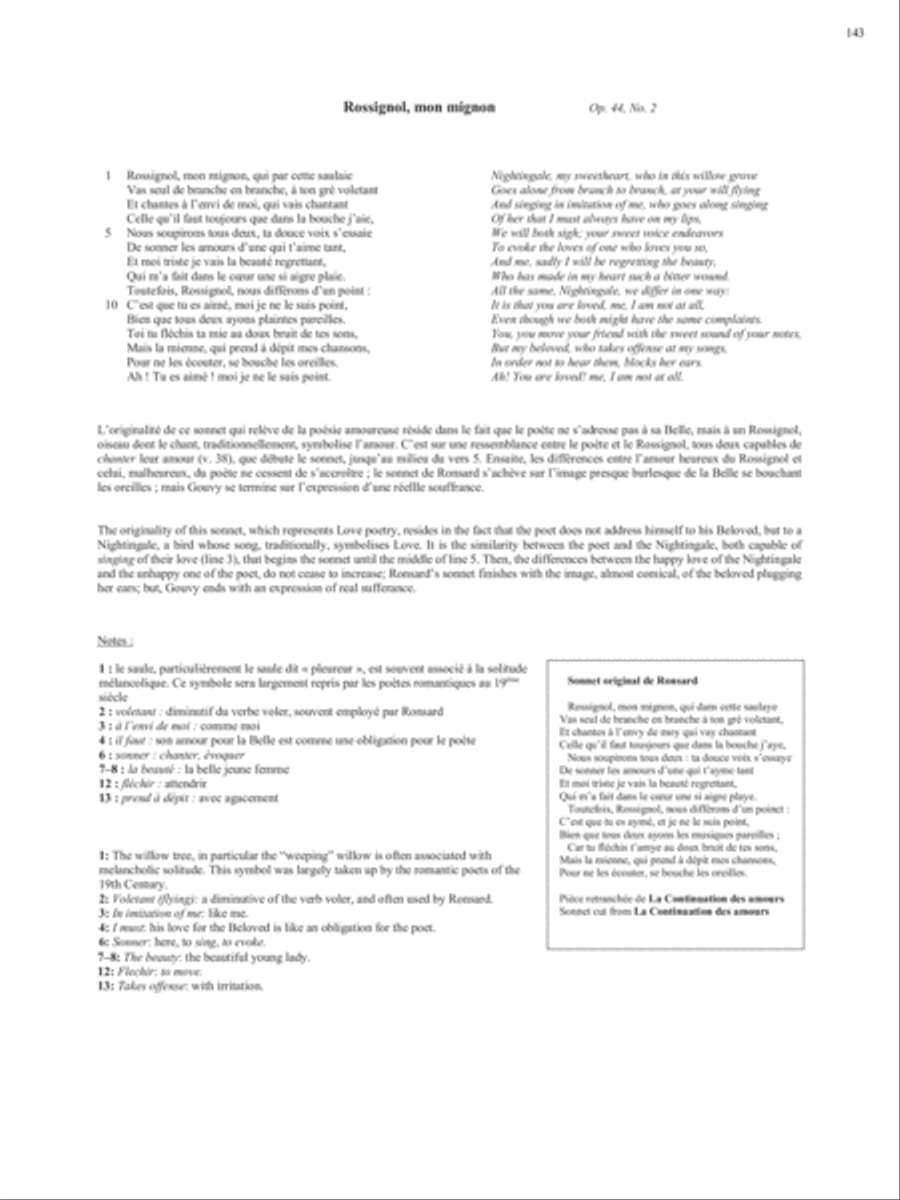
Op. 44, No. 1: À Marguerite from Songs of Gouvy, V1 (Downloadable)
Piano, Voix

$3.00 2.57 € Piano, Voix PDF SheetMusicPlus

Voice and piano (2 songs with violoncello; 1 vocal duet) - Medium - Digital Download SKU: MQ.8491-01E Composed by MeeAe Cecilia Nam and Theodore Gouvy. 5 pages. E. C. Schirmer Music Company - Digital #8491-01E. Published by E. C. Schirmer Music Company - Digital (MQ.8491-01E). French.A French composer, Théodore Gouvy (1819-1898) was one of the most significant composers of 19th Century in Europe. The movement of rediscovering his instrumental music has been increasingly successful in Europe since the 1990s, especially following the birth of L’Institut Gouvy in France. However, his solo vocal music has been waiting to be unveiled to the public. Volume One includes 52 songs of Gouvy.Gouvy traveled widely throughout Europe. He was also a lover of nature. Generally, he spent his winters in Leipzig, but in the summertime, he always returned to Hombourg-Haut, France, to stroll through the woods, to hunt, and to relax. Gouvy was fluent in several languages and had a great appreciation of the Renaissance French Poetry of Pierre de Ronsard whose poetry he had set to music. The fifty-two songs in this volume are largely by Ronsard and other Renaissance poets of La Pléiade.Although Ronsard is approximately 300 years older than Gouvy, they both seem to have the same interest in classical literature, though, admittedly, for different reasons. Celebrated by the French and English courts, Ronsard (1525-1585) was the leader of La Pléiade: a group of seven poets (Joachim Du Bellay (1522-1560), Rémy Belleau (1528-1577), Étienne Jodelle (1532-1573), Pontus de Tyard (1521-1603), Jean–Antoine Baïf (1532-1589), and Jean Daurat (1508-1588), who dedicated their efforts to writing poetry in French rather than in Latin (or Greek) as most of the Romantic poets did. They wished to enrich the French language, and establish a new literature which would be the equal of the other literature of their period, and the equal to poets of the past. French Romantic poetry featured the closeness of the poet to nature, and his ability to communicate with nature by personifying (anthropomorphizing) all of nature’s elements: flowers, the planets, the moon, the breeze, and even the sand upon the shore. As a significant melodist, Gouvy’s treatment of the vocal solo line and his treatment and development of the piano accompaniment places him in the upper echelons as a composer of songs. His diverse cultural life led a rich and significant musical life, interacting with his contemporaries who admired his work, and whom Gouvy knew well, such as Liszt, Brahms, Schumann, Mendelssohn, Berlioz and Gounod. Contents:Six Odes de Ronsard pour ténor et piano, Op. 37 (No. 3 et No. 5 avec violoncelle) Neuf Poésies de Ronsard pour soprano ou ténor et piano, Op. 41 Six Poésies de Ronsard pour soprano ou ténor et piano, Op. 42 Quatre Odes de Ronsard pour baryton et piano, Op. 43 Huit Poésies de Ronsard pour ténor ou soprano et piano, Op. 44 Sept Poésies de Ronsard pour ténor ou soprano et piano, Op. 47.
Op. 37, No. 1: Chère Vesper, lumière dorée from Songs of Gouvy, V1 (Downloadable)
Piano, Voix

$3.00 2.57 € Piano, Voix PDF SheetMusicPlus

Brass Ensemble Trombone - Level 5 - Digital Download SKU: A0.811037 Composed by Hans Leo Hassler. Arranged by David Mathie. Baroque,Classical,Renaissance. Score and parts. 18 pages. Gordon Cherry #4729065. Published by Gordon Cherry (A0.811037). Hans Leo Hassler (1564-1612), son of an organist, was born in Nuremberg and received his initial training in music from his father.  As a young man he studied in Venice and became close friends with Giovanni Gabrieli, both eventually studying composition with Giovanni's Uncle Andrea.  Hassler gained a reputation as an innovative composer and also traveled throughout Germany as a consultant in the construction of pipe organs.  1. Tanzen und Springen (Dancing and Jumping) 2. Ach, weh des Leiden (Oh Pain and Suffering) 3. Herzlieb zu dir Allein (I Give my Dear Heart to You Alone) The first part is in tenor clef, the rest in bass clef.  The works can be performed by intermediate players.  The 3 movements total about 7 minutes in length.  Good for recitals and concerts. 
Three Madrigals for Trombone Quintet

$17.50 15.02 € PDF SheetMusicPlus

Voice and piano (2 songs with violoncello; 1 vocal duet) - Medium - Digital Download SKU: MQ.8491-49E Composed by MeeAe Cecilia Nam and Theodore Gouvy. 5 pages. E. C. Schirmer Music Company - Digital #8491-49E. Published by E. C. Schirmer Music Company - Digital (MQ.8491-49E). French.A French composer, Théodore Gouvy (1819-1898) was one of the most significant composers of 19th Century in Europe. The movement of rediscovering his instrumental music has been increasingly successful in Europe since the 1990s, especially following the birth of L’Institut Gouvy in France. However, his solo vocal music has been waiting to be unveiled to the public. Volume One includes 52 songs of Gouvy.Gouvy traveled widely throughout Europe. He was also a lover of nature. Generally, he spent his winters in Leipzig, but in the summertime, he always returned to Hombourg-Haut, France, to stroll through the woods, to hunt, and to relax. Gouvy was fluent in several languages and had a great appreciation of the Renaissance French Poetry of Pierre de Ronsard whose poetry he had set to music. The fifty-two songs in this volume are largely by Ronsard and other Renaissance poets of La Pléiade.Although Ronsard is approximately 300 years older than Gouvy, they both seem to have the same interest in classical literature, though, admittedly, for different reasons. Celebrated by the French and English courts, Ronsard (1525-1585) was the leader of La Pléiade: a group of seven poets (Joachim Du Bellay (1522-1560), Rémy Belleau (1528-1577), Étienne Jodelle (1532-1573), Pontus de Tyard (1521-1603), Jean–Antoine Baïf (1532-1589), and Jean Daurat (1508-1588), who dedicated their efforts to writing poetry in French rather than in Latin (or Greek) as most of the Romantic poets did. They wished to enrich the French language, and establish a new literature which would be the equal of the other literature of their period, and the equal to poets of the past. French Romantic poetry featured the closeness of the poet to nature, and his ability to communicate with nature by personifying (anthropomorphizing) all of nature’s elements: flowers, the planets, the moon, the breeze, and even the sand upon the shore. As a significant melodist, Gouvy’s treatment of the vocal solo line and his treatment and development of the piano accompaniment places him in the upper echelons as a composer of songs. His diverse cultural life led a rich and significant musical life, interacting with his contemporaries who admired his work, and whom Gouvy knew well, such as Liszt, Brahms, Schumann, Mendelssohn, Berlioz and Gounod. Contents:Six Odes de Ronsard pour ténor et piano, Op. 37 (No. 3 et No. 5 avec violoncelle) Neuf Poésies de Ronsard pour soprano ou ténor et piano, Op. 41 Six Poésies de Ronsard pour soprano ou ténor et piano, Op. 42 Quatre Odes de Ronsard pour baryton et piano, Op. 43 Huit Poésies de Ronsard pour ténor ou soprano et piano, Op. 44 Sept Poésies de Ronsard pour ténor ou soprano et piano, Op. 47.

Op. 48, No. 9: Le Ruisseau from Songs of Gouvy, V1 (Downloadable)
Piano, Voix

$3.00 2.57 € Piano, Voix PDF SheetMusicPlus

Voice and piano (2 songs with violoncello; 1 vocal duet) - Medium - Digital Download SKU: MQ.8491-13E Composed by MeeAe Cecilia Nam and Theodore Gouvy. 5 pages. E. C. Schirmer Music Company - Digital #8491-13E. Published by E. C. Schirmer Music Company - Digital (MQ.8491-13E). French.A French composer, Théodore Gouvy (1819-1898) was one of the most significant composers of 19th Century in Europe. The movement of rediscovering his instrumental music has been increasingly successful in Europe since the 1990s, especially following the birth of L’Institut Gouvy in France. However, his solo vocal music has been waiting to be unveiled to the public. Volume One includes 52 songs of Gouvy.Gouvy traveled widely throughout Europe. He was also a lover of nature. Generally, he spent his winters in Leipzig, but in the summertime, he always returned to Hombourg-Haut, France, to stroll through the woods, to hunt, and to relax. Gouvy was fluent in several languages and had a great appreciation of the Renaissance French Poetry of Pierre de Ronsard whose poetry he had set to music. The fifty-two songs in this volume are largely by Ronsard and other Renaissance poets of La Pléiade.Although Ronsard is approximately 300 years older than Gouvy, they both seem to have the same interest in classical literature, though, admittedly, for different reasons. Celebrated by the French and English courts, Ronsard (1525-1585) was the leader of La Pléiade: a group of seven poets (Joachim Du Bellay (1522-1560), Rémy Belleau (1528-1577), Étienne Jodelle (1532-1573), Pontus de Tyard (1521-1603), Jean–Antoine Baïf (1532-1589), and Jean Daurat (1508-1588), who dedicated their efforts to writing poetry in French rather than in Latin (or Greek) as most of the Romantic poets did. They wished to enrich the French language, and establish a new literature which would be the equal of the other literature of their period, and the equal to poets of the past. French Romantic poetry featured the closeness of the poet to nature, and his ability to communicate with nature by personifying (anthropomorphizing) all of nature’s elements: flowers, the planets, the moon, the breeze, and even the sand upon the shore. As a significant melodist, Gouvy’s treatment of the vocal solo line and his treatment and development of the piano accompaniment places him in the upper echelons as a composer of songs. His diverse cultural life led a rich and significant musical life, interacting with his contemporaries who admired his work, and whom Gouvy knew well, such as Liszt, Brahms, Schumann, Mendelssohn, Berlioz and Gounod. Contents:Six Odes de Ronsard pour ténor et piano, Op. 37 (No. 3 et No. 5 avec violoncelle) Neuf Poésies de Ronsard pour soprano ou ténor et piano, Op. 41 Six Poésies de Ronsard pour soprano ou ténor et piano, Op. 42 Quatre Odes de Ronsard pour baryton et piano, Op. 43 Huit Poésies de Ronsard pour ténor ou soprano et piano, Op. 44 Sept Poésies de Ronsard pour ténor ou soprano et piano, Op. 47.

Op. 41, No. 7: Que dites-vous, que faites-vous, mignonne? from Songs of Gouvy, V1 (Downloadable)
Piano, Voix

$3.00 2.57 € Piano, Voix PDF SheetMusicPlus

String Quartet String Quartet - Level 5 - Digital Download SKU: A0.987847 Composed by Robert M. Greenberg. 20th Century. Score and parts. 178 pages. Robert M. Greenberg #90283. Published by Robert M. Greenberg (A0.987847). Preferred Contact Information: RMonteverdi@comcast.net Performing Rights Organization: BMI Website: robertgreenbergmusic.com Facebook Band Page: facebook.com/RobertGreenbergMusic Duration: ca. 33 minutes Year of composition: 1995 Program Note: I. With Friends Like These II. Inner Voices III. Little Hands and Little Feet IV. Freund Barry V. Friendly Persuasion VI. All For One and One For All I've known the Alexander String Quartet since 1987. More than just colleagues, they have become my friends: I've traveled with them, performed with them, watched them rehearse, dined with them in their homes and they in mine; I know their children and they know my children. Throughout the time I've known the members of the quartet I have observed the relationship between them, that special bond shared by the members of any touring band, described by one pundit as being like a bad marriage with no sex. Such issues notwithstanding, this particular marriage works. A string quartet represents, perhaps, the ultimate musical compromise between individual incentive and the common good. In a string quartet, by definition, four distinct instrumental voices and four different instrumental roles unite to create a whole greater than its parts. And, lest we forget, behind each instrument is a person, with his own particular attitudes, feelings, needs, and, yes, issues, all of which must be tempered and blended for the common good of a good performance. Among Friends is, its liberties aside, about the four people behind the instruments of the Alexander String Quartet and their relationships with one another; the way they play, rehearse, get along and, on occasion, not get along. The first movement, With Friends Like These is gritty and contentious in tone. The players argue, debate, annoy, tease, irk, cajole, abuse, harass, form brief alliances, heap merde upon, gang up on, and otherwise find endless ways to irritate each other. It is in this movement that the individual characters of the four instrumental parts stand in highest relief: the first violin as coloratura prima donna, forever attempting to soar above it all; the second violin as the voice in the wilderness, the viola as the voice of reason and the 'cello as mover and shaker. The opening of the movement is marked argument in progress; with greatest intensity. The second, third and fourth movements are a series of portraits, played without a break. In movement two, Inner Voices, the second violin and viola are featured in a collegial and decidedly non-contentious dialogue. Movement three, Little Hands and Little Feet, is the quiet center of the quartet. It is here that the first violin finally attains the lyric heights vainly sought in the first movement. The fourth movement is a vigorous dance entitled Freund Barry. This movement honors three great friends: Dr. Barry Gardiner, whose friendship and support made the writing of this quartet possible; Gustav Mahler, whose Symphony No. 4, second movement (Freund Heine) inspired this one; and Sandy Wilson, who first encouraged me to compose my second string quartet (Child's Play) for the Alexander in 1987 and whose boisterous 'cello is Freund Barry's alter-ego. The fifth movement is entitled Friendly Persuasion. Rapid fire repeated notes, accompanimental figures and melodic lines are shuttled about from voice to voice, each time elaborated or altered in some way. In this way the music slowly metamorphoses, ultimately arriving at a version of the argumentative music that concluded the first movement. Movement six, All For One and One For All is a fast, brief coda/finale, during which the quartet plays primarily in unison, the musical antithesis of the contentious argument that began the quartet. Among Friends was commissioned by the Koussevitzky Foundation in the Library of Congress and the Alexander String Quartet. Among Friends i.
String Quartet No. 3: Among Friends
Quatuor à cordes: 2 violons, alto, violoncelle

$36.00 30.89 € Quatuor à cordes: 2 violons, alto, violoncelle PDF SheetMusicPlus

Voice and piano - Medium - Digital Download SKU: MQ.8492-22E Composed by MeeAe Cecilia Nam and Theodore Gouvy. Instrument part. 5 pages. E. C. Schirmer Music Company - Digital #8492-22E. Published by E. C. Schirmer Music Company - Digital (MQ.8492-22E). French.Gouvy was known for writing some of the most beautiful melodies of the Romantic period. His style is a combination of German forms and an early French romantic harmonic structure. His writing for the piano in the songs is totally unified in mood and description with the voice, just as the piano is in Schubert’s songs. The equal partnership of the vocal line and piano interact closely to bring the poetry vividly into life with unimaginable artistic heights and unbridled passion.This volume includes Gouvy songs set to 18 poems of Philippe Desportes (1546–1606), and 18 poems of Moritz Hartmann (1821–1872). The elements of Romantic love poetry, such as enchanting love and its pain, and the personifying of nature, are fluently described with a great sensitivity in both voice and piano. Gouvy’s melody stir up the imagination because of his special treatment of words through a distinguishable and melodious vocal line, and his story telling and poetic treatment and development of the piano accompaniment. His compositional artistry places him in the upper echelons of art-song composers. One should note that Gouvy had a special fondness for the 16th Century poetry of La Pléiade (a group of Renaissance French poets, led by Pièrre de Ronsard (1524–1585). Desportes was truly the heir to Ronsard; however his work, when compared to that of Ronsard, is filled with greater abstraction and greater fluidity. Desportes seems to avoid any of the passionate anger that is occasionally characteristic of La Pléiade. This may be an indication that Desportes lived in a less distressed time. It also seems necessary to point out that he learned much in his early career by copying and studying the earlier works of La Pléiade. This has led some scholars to label him as a plagiarist, but it is important to realize that all the members of La Pléiade copied from each other when they wished to learn something new, and truly understand the style of the other poets in the group. Gouvy’s only choice of poems from his contemporaries, were the works of Moritz Hartmann (1821–1872), a good friend of Gouvy’s. Much of his poetry was strongly political in support of freedom of the individual. He traveled to Leipzig in 1845, but when the authorities discovered a volume of patriotic poems entitled Kelch und Schwert (Chalice and Sword), he fled to Belgium and France. It is at this time that he possibly met Théodore Gouvy. Eighteen poems of Hartmann were translated from German to French by the French poet, Adolph Larmande, of whom very little is known. Pierre Toussaint Adolphe Larmande seems to have been a rather obscure poet and musician. We know that he taught music theory at the Paris Conservatory at the same time Anton Reicha and Michele Carafa were on the faculty. We also know that in 1847 he married an English woman by the name of Marie Caroline Bradley. There are random documents, such as a Certificate of Arrival in London, England, in 1837, but there are no birth and death dates given, and that includes his obituary notice. Contents:18 Sonnets et Chansons de Desportes pour ténor ou soprano et piano, Op. 45 Six poésies allemandes de Moritz Hartmann pour baryton et piano, Op. 21 Douze poésies allemandes de Moritz Hartmann pour ténor et piano, Op. 26 (Poésies françaises d’Adolphe Larmande).
Op. 21, No. 4: Dans les bois from Songs of Gouvy, V2 (Downloadable)
Piano, Voix

$3.00 2.57 € Piano, Voix PDF SheetMusicPlus

Voice and piano - Medium - Digital Download SKU: MQ.8492-25E Composed by MeeAe Cecilia Nam and Theodore Gouvy. Instrument part. 6 pages. E. C. Schirmer Music Company - Digital #8492-25E. Published by E. C. Schirmer Music Company - Digital (MQ.8492-25E). French.Gouvy was known for writing some of the most beautiful melodies of the Romantic period. His style is a combination of German forms and an early French romantic harmonic structure. His writing for the piano in the songs is totally unified in mood and description with the voice, just as the piano is in Schubert’s songs. The equal partnership of the vocal line and piano interact closely to bring the poetry vividly into life with unimaginable artistic heights and unbridled passion.This volume includes Gouvy songs set to 18 poems of Philippe Desportes (1546–1606), and 18 poems of Moritz Hartmann (1821–1872). The elements of Romantic love poetry, such as enchanting love and its pain, and the personifying of nature, are fluently described with a great sensitivity in both voice and piano. Gouvy’s melody stir up the imagination because of his special treatment of words through a distinguishable and melodious vocal line, and his story telling and poetic treatment and development of the piano accompaniment. His compositional artistry places him in the upper echelons of art-song composers. One should note that Gouvy had a special fondness for the 16th Century poetry of La Pléiade (a group of Renaissance French poets, led by Pièrre de Ronsard (1524–1585). Desportes was truly the heir to Ronsard; however his work, when compared to that of Ronsard, is filled with greater abstraction and greater fluidity. Desportes seems to avoid any of the passionate anger that is occasionally characteristic of La Pléiade. This may be an indication that Desportes lived in a less distressed time. It also seems necessary to point out that he learned much in his early career by copying and studying the earlier works of La Pléiade. This has led some scholars to label him as a plagiarist, but it is important to realize that all the members of La Pléiade copied from each other when they wished to learn something new, and truly understand the style of the other poets in the group. Gouvy’s only choice of poems from his contemporaries, were the works of Moritz Hartmann (1821–1872), a good friend of Gouvy’s. Much of his poetry was strongly political in support of freedom of the individual. He traveled to Leipzig in 1845, but when the authorities discovered a volume of patriotic poems entitled Kelch und Schwert (Chalice and Sword), he fled to Belgium and France. It is at this time that he possibly met Théodore Gouvy. Eighteen poems of Hartmann were translated from German to French by the French poet, Adolph Larmande, of whom very little is known. Pierre Toussaint Adolphe Larmande seems to have been a rather obscure poet and musician. We know that he taught music theory at the Paris Conservatory at the same time Anton Reicha and Michele Carafa were on the faculty. We also know that in 1847 he married an English woman by the name of Marie Caroline Bradley. There are random documents, such as a Certificate of Arrival in London, England, in 1837, but there are no birth and death dates given, and that includes his obituary notice. Contents:18 Sonnets et Chansons de Desportes pour ténor ou soprano et piano, Op. 45 Six poésies allemandes de Moritz Hartmann pour baryton et piano, Op. 21 Douze poésies allemandes de Moritz Hartmann pour ténor et piano, Op. 26 (Poésies françaises d’Adolphe Larmande).
Op. 1, No. 1: Tu demandes pourquoi from Songs of Gouvy, V2 (Downloadable)
Piano, Voix

$3.00 2.57 € Piano, Voix PDF SheetMusicPlus

Voice and piano - Medium - Digital Download SKU: MQ.8492-08E Composed by MeeAe Cecilia Nam and Theodore Gouvy. Instrument part. 5 pages. E. C. Schirmer Music Company - Digital #8492-08E. Published by E. C. Schirmer Music Company - Digital (MQ.8492-08E). French.Gouvy was known for writing some of the most beautiful melodies of the Romantic period. His style is a combination of German forms and an early French romantic harmonic structure. His writing for the piano in the songs is totally unified in mood and description with the voice, just as the piano is in Schubert’s songs. The equal partnership of the vocal line and piano interact closely to bring the poetry vividly into life with unimaginable artistic heights and unbridled passion.This volume includes Gouvy songs set to 18 poems of Philippe Desportes (1546–1606), and 18 poems of Moritz Hartmann (1821–1872). The elements of Romantic love poetry, such as enchanting love and its pain, and the personifying of nature, are fluently described with a great sensitivity in both voice and piano. Gouvy’s melody stir up the imagination because of his special treatment of words through a distinguishable and melodious vocal line, and his story telling and poetic treatment and development of the piano accompaniment. His compositional artistry places him in the upper echelons of art-song composers. One should note that Gouvy had a special fondness for the 16th Century poetry of La Pléiade (a group of Renaissance French poets, led by Pièrre de Ronsard (1524–1585). Desportes was truly the heir to Ronsard; however his work, when compared to that of Ronsard, is filled with greater abstraction and greater fluidity. Desportes seems to avoid any of the passionate anger that is occasionally characteristic of La Pléiade. This may be an indication that Desportes lived in a less distressed time. It also seems necessary to point out that he learned much in his early career by copying and studying the earlier works of La Pléiade. This has led some scholars to label him as a plagiarist, but it is important to realize that all the members of La Pléiade copied from each other when they wished to learn something new, and truly understand the style of the other poets in the group. Gouvy’s only choice of poems from his contemporaries, were the works of Moritz Hartmann (1821–1872), a good friend of Gouvy’s. Much of his poetry was strongly political in support of freedom of the individual. He traveled to Leipzig in 1845, but when the authorities discovered a volume of patriotic poems entitled Kelch und Schwert (Chalice and Sword), he fled to Belgium and France. It is at this time that he possibly met Théodore Gouvy. Eighteen poems of Hartmann were translated from German to French by the French poet, Adolph Larmande, of whom very little is known. Pierre Toussaint Adolphe Larmande seems to have been a rather obscure poet and musician. We know that he taught music theory at the Paris Conservatory at the same time Anton Reicha and Michele Carafa were on the faculty. We also know that in 1847 he married an English woman by the name of Marie Caroline Bradley. There are random documents, such as a Certificate of Arrival in London, England, in 1837, but there are no birth and death dates given, and that includes his obituary notice. Contents:18 Sonnets et Chansons de Desportes pour ténor ou soprano et piano, Op. 45 Six poésies allemandes de Moritz Hartmann pour baryton et piano, Op. 21 Douze poésies allemandes de Moritz Hartmann pour ténor et piano, Op. 26 (Poésies françaises d’Adolphe Larmande).
Op. 45, No. 8: Mon bel et doux tourment from Songs of Gouvy, V2 (Downloadable)
Piano, Voix

$3.00 2.57 € Piano, Voix PDF SheetMusicPlus

Voice and piano (2 songs with violoncello; 1 vocal duet) - Medium - Digital Download SKU: MQ.8491-30E Composed by MeeAe Cecilia Nam and Theodore Gouvy. 5 pages. E. C. Schirmer Music Company - Digital #8491-30E. Published by E. C. Schirmer Music Company - Digital (MQ.8491-30E). French.A French composer, Théodore Gouvy (1819-1898) was one of the most significant composers of 19th Century in Europe. The movement of rediscovering his instrumental music has been increasingly successful in Europe since the 1990s, especially following the birth of L’Institut Gouvy in France. However, his solo vocal music has been waiting to be unveiled to the public. Volume One includes 52 songs of Gouvy.Gouvy traveled widely throughout Europe. He was also a lover of nature. Generally, he spent his winters in Leipzig, but in the summertime, he always returned to Hombourg-Haut, France, to stroll through the woods, to hunt, and to relax. Gouvy was fluent in several languages and had a great appreciation of the Renaissance French Poetry of Pierre de Ronsard whose poetry he had set to music. The fifty-two songs in this volume are largely by Ronsard and other Renaissance poets of La Pléiade.Although Ronsard is approximately 300 years older than Gouvy, they both seem to have the same interest in classical literature, though, admittedly, for different reasons. Celebrated by the French and English courts, Ronsard (1525-1585) was the leader of La Pléiade: a group of seven poets (Joachim Du Bellay (1522-1560), Rémy Belleau (1528-1577), Étienne Jodelle (1532-1573), Pontus de Tyard (1521-1603), Jean–Antoine Baïf (1532-1589), and Jean Daurat (1508-1588), who dedicated their efforts to writing poetry in French rather than in Latin (or Greek) as most of the Romantic poets did. They wished to enrich the French language, and establish a new literature which would be the equal of the other literature of their period, and the equal to poets of the past. French Romantic poetry featured the closeness of the poet to nature, and his ability to communicate with nature by personifying (anthropomorphizing) all of nature’s elements: flowers, the planets, the moon, the breeze, and even the sand upon the shore. As a significant melodist, Gouvy’s treatment of the vocal solo line and his treatment and development of the piano accompaniment places him in the upper echelons as a composer of songs. His diverse cultural life led a rich and significant musical life, interacting with his contemporaries who admired his work, and whom Gouvy knew well, such as Liszt, Brahms, Schumann, Mendelssohn, Berlioz and Gounod. Contents:Six Odes de Ronsard pour ténor et piano, Op. 37 (No. 3 et No. 5 avec violoncelle) Neuf Poésies de Ronsard pour soprano ou ténor et piano, Op. 41 Six Poésies de Ronsard pour soprano ou ténor et piano, Op. 42 Quatre Odes de Ronsard pour baryton et piano, Op. 43 Huit Poésies de Ronsard pour ténor ou soprano et piano, Op. 44 Sept Poésies de Ronsard pour ténor ou soprano et piano, Op. 47.

Op. 44, No. 5: Vous méprisez nature from Songs of Gouvy, V1 (Downloadable)
Piano, Voix

$3.00 2.57 € Piano, Voix PDF SheetMusicPlus

Voice and piano (2 songs with violoncello; 1 vocal duet) - Medium - Digital Download SKU: MQ.8491-25E Composed by MeeAe Cecilia Nam and Theodore Gouvy. 5 pages. E. C. Schirmer Music Company - Digital #8491-25E. Published by E. C. Schirmer Music Company - Digital (MQ.8491-25E). French.A French composer, Théodore Gouvy (1819-1898) was one of the most significant composers of 19th Century in Europe. The movement of rediscovering his instrumental music has been increasingly successful in Europe since the 1990s, especially following the birth of L’Institut Gouvy in France. However, his solo vocal music has been waiting to be unveiled to the public. Volume One includes 52 songs of Gouvy.Gouvy traveled widely throughout Europe. He was also a lover of nature. Generally, he spent his winters in Leipzig, but in the summertime, he always returned to Hombourg-Haut, France, to stroll through the woods, to hunt, and to relax. Gouvy was fluent in several languages and had a great appreciation of the Renaissance French Poetry of Pierre de Ronsard whose poetry he had set to music. The fifty-two songs in this volume are largely by Ronsard and other Renaissance poets of La Pléiade.Although Ronsard is approximately 300 years older than Gouvy, they both seem to have the same interest in classical literature, though, admittedly, for different reasons. Celebrated by the French and English courts, Ronsard (1525-1585) was the leader of La Pléiade: a group of seven poets (Joachim Du Bellay (1522-1560), Rémy Belleau (1528-1577), Étienne Jodelle (1532-1573), Pontus de Tyard (1521-1603), Jean–Antoine Baïf (1532-1589), and Jean Daurat (1508-1588), who dedicated their efforts to writing poetry in French rather than in Latin (or Greek) as most of the Romantic poets did. They wished to enrich the French language, and establish a new literature which would be the equal of the other literature of their period, and the equal to poets of the past. French Romantic poetry featured the closeness of the poet to nature, and his ability to communicate with nature by personifying (anthropomorphizing) all of nature’s elements: flowers, the planets, the moon, the breeze, and even the sand upon the shore. As a significant melodist, Gouvy’s treatment of the vocal solo line and his treatment and development of the piano accompaniment places him in the upper echelons as a composer of songs. His diverse cultural life led a rich and significant musical life, interacting with his contemporaries who admired his work, and whom Gouvy knew well, such as Liszt, Brahms, Schumann, Mendelssohn, Berlioz and Gounod. Contents:Six Odes de Ronsard pour ténor et piano, Op. 37 (No. 3 et No. 5 avec violoncelle) Neuf Poésies de Ronsard pour soprano ou ténor et piano, Op. 41 Six Poésies de Ronsard pour soprano ou ténor et piano, Op. 42 Quatre Odes de Ronsard pour baryton et piano, Op. 43 Huit Poésies de Ronsard pour ténor ou soprano et piano, Op. 44 Sept Poésies de Ronsard pour ténor ou soprano et piano, Op. 47.

Op. 43, No. 4: Adieu à la jeunesse from Songs of Gouvy, V1 (Downloadable)
Piano, Voix

$3.00 2.57 € Piano, Voix PDF SheetMusicPlus

Small Ensemble Piano,Violin,Voice - Level 4 - Digital Download SKU: A0.955811 Composed by Manuel M. Ponce. Arranged by Scott S. Stewart. 20th Century,Concert,Holiday,Romantic Period,World. Score and parts. 8 pages. Scott S. Stewart #6088787. Published by Scott S. Stewart (A0.955811). In 1912 Mexican composer Manuel M. Ponce traveled to Aguascalientes on vacation and spent an evening looking at the starry night. This inspired him to compose the words and music for the song, Estrellita (Star of Love/Little Star/Petit Astre/Stellina).  The text ‘Star from far away, you know about my love and my suffering…’ has been speculated by many that these lyrics are Ponce’s sentimental expressions for his beloved Mexico as a little star… ‘Because I cannot live without his love.’ Or, it is widely held that the lovely melody of Estrellita came to Ponce in a moment of inspiration while spending a romantic evening with his wife… either scenario could be true.  In 1923 violinist Jascha Heifetz was in Mexico City and realized he didn’t have any work by a Mexican composer on his program.  While in a café, he heard a local musician sing the popular song Estrellita and noted its title on a napkin. Estrellita became one of his favorite encore songs ever since. Scored for solo violin, tenor and piano this trio runs 2:59. 
Estrellita (Star of Love - Mexican Love Song)

$24.99 21.44 € PDF SheetMusicPlus

Voice and piano - Medium - Digital Download SKU: MQ.8492-24E Composed by MeeAe Cecilia Nam and Theodore Gouvy. Instrument part. 5 pages. E. C. Schirmer Music Company - Digital #8492-24E. Published by E. C. Schirmer Music Company - Digital (MQ.8492-24E). French.Gouvy was known for writing some of the most beautiful melodies of the Romantic period. His style is a combination of German forms and an early French romantic harmonic structure. His writing for the piano in the songs is totally unified in mood and description with the voice, just as the piano is in Schubert’s songs. The equal partnership of the vocal line and piano interact closely to bring the poetry vividly into life with unimaginable artistic heights and unbridled passion.This volume includes Gouvy songs set to 18 poems of Philippe Desportes (1546–1606), and 18 poems of Moritz Hartmann (1821–1872). The elements of Romantic love poetry, such as enchanting love and its pain, and the personifying of nature, are fluently described with a great sensitivity in both voice and piano. Gouvy’s melody stir up the imagination because of his special treatment of words through a distinguishable and melodious vocal line, and his story telling and poetic treatment and development of the piano accompaniment. His compositional artistry places him in the upper echelons of art-song composers. One should note that Gouvy had a special fondness for the 16th Century poetry of La Pléiade (a group of Renaissance French poets, led by Pièrre de Ronsard (1524–1585). Desportes was truly the heir to Ronsard; however his work, when compared to that of Ronsard, is filled with greater abstraction and greater fluidity. Desportes seems to avoid any of the passionate anger that is occasionally characteristic of La Pléiade. This may be an indication that Desportes lived in a less distressed time. It also seems necessary to point out that he learned much in his early career by copying and studying the earlier works of La Pléiade. This has led some scholars to label him as a plagiarist, but it is important to realize that all the members of La Pléiade copied from each other when they wished to learn something new, and truly understand the style of the other poets in the group. Gouvy’s only choice of poems from his contemporaries, were the works of Moritz Hartmann (1821–1872), a good friend of Gouvy’s. Much of his poetry was strongly political in support of freedom of the individual. He traveled to Leipzig in 1845, but when the authorities discovered a volume of patriotic poems entitled Kelch und Schwert (Chalice and Sword), he fled to Belgium and France. It is at this time that he possibly met Théodore Gouvy. Eighteen poems of Hartmann were translated from German to French by the French poet, Adolph Larmande, of whom very little is known. Pierre Toussaint Adolphe Larmande seems to have been a rather obscure poet and musician. We know that he taught music theory at the Paris Conservatory at the same time Anton Reicha and Michele Carafa were on the faculty. We also know that in 1847 he married an English woman by the name of Marie Caroline Bradley. There are random documents, such as a Certificate of Arrival in London, England, in 1837, but there are no birth and death dates given, and that includes his obituary notice. Contents:18 Sonnets et Chansons de Desportes pour ténor ou soprano et piano, Op. 45 Six poésies allemandes de Moritz Hartmann pour baryton et piano, Op. 21 Douze poésies allemandes de Moritz Hartmann pour ténor et piano, Op. 26 (Poésies françaises d’Adolphe Larmande).
Op. 21, No. 6: Amour brisé from Songs of Gouvy, V2 (Downloadable)
Piano, Voix

$3.00 2.57 € Piano, Voix PDF SheetMusicPlus


Partitions Gratuites
Acheter des Partitions Musicales
Acheter des Partitions Digitales à Imprimer
Acheter des Instruments de Musique

© 2000 - 2026

Accueil - Version intégrale

