EUROPE
14270 articles
USA
0 articles
DIGITAL
4649 articles (à imprimer)
Partitions Digitales
Partitions à imprimer
4649 partitions trouvées


1 Piano,4 Hands,Piano Duet - Digital Download SKU: A0.1501193 Composed by Rafael Hernandez. Arranged by Neil Crossland. Classical,Contemporary,Latin. Score. 17 pages. Neil Crossland #1077151. Published by Neil Crossland (A0.1501193). Rafael Hernández, born in Puerto Rico in 1892, is one of the most influential Latin American composers of the 20th century. His work spans multiple genres, but he is particularly renowned for his contributions to Puerto Rican music, where his compositions have become staples. Among his most famous works is El Cumbanchero, a lively, infectious piece that exemplifies the rhythmic vitality and melodic richness of Latin music. Written in 1943, El Cumbanchero quickly became a hit, celebrated for its exuberant syncopation and catchy melodies that evoke the spirit of the Caribbean.El Cumbanchero has been widely covered and arranged by various artists, but one of the most unique interpretations came from the flamboyant American pianist, Liberace. Known for his elaborate showmanship, Liberace’s version of El Cumbanchero brings a dazzling, virtuosic flair to the piece, combining his classical technique with a flair for dramatic embellishment. His rendition adds layers of complexity and a certain theatricality that aligns perfectly with his style, transforming the original piece into a showcase for his talents.Inspired by Liberace's arrangement, Neil Crossland created a four-hand version of El Cumbanchero based on this interpretation. This arrangement allows two pianists to bring even more depth and dynamism to the piece, capturing both the original's infectious energy and Liberace's intricate, virtuosic style. By blending Hernández's vibrant composition with Liberace's unique interpretation, Crossland's four-hand version offers a fresh and exciting way to experience this Latin American classic.
Rafael Hernandez Marin El Cumbanchero arranged from Liberace's own interpretation by Neil Crossland
1 Piano, 4 mains
blending Hernández's vibrant composition with Liberace's unique interpretation, Crossland's four-hand version offers a fresh and exciting way to experience this Latin American classic


$9.99 8.67 € 1 Piano, 4 mains PDF SheetMusicPlus

Clarinet Duet Bass Clarinet - Level 4 - Digital Download SKU: A0.1240995 Composed by Everardo García Vargas. Chamber,Classical,Holiday,Multicultural,Traditional,World. 2 scores. 13 pages. Everardo García Vargas #836391. Published by Everardo García Vargas (A0.1240995). Recuerdos de mi tierra - Dúo para ClarinetesEsta pieza evoca recuerdos de los años 90 cuando formaba parte de la Banda BASTLAM en la comunidad Mixe de Tlahuitoltepec, Oaxaca, México. Practicábamos el estilo Zapateado-Vals con solos y acompañamiento de banda. Cada instrumento tenía solos y tuttis únicos. En ese entonces, era innovador tocar como solista en un pueblo rico en cultura pero aislado y con limitado acceso a información y conocimientos formales de música. Prácticamente no existían bandas infantiles ni juveniles, por lo que la creación de la Banda Infantil-Juvenil-Bastlam fue uno de los primeros grandes proyectos impulsados por las autoridades municipales. Posteriormente, adoptaron el proyecto y continuaron formando bandas infantiles escalonadamente en dicha comunidad replicándose en otros pueblos y regiones de Oaxaca. El origen del zapateado es incierto. Se cree que proviene de las sevillanas, fandanguillos, bulerías y peteneras españolas, las cuales se fusionaron con elementos africanos. Sin embargo, fue en México donde este tipo de zapateado instrumental se arraigó y enriqueció en las bandas filarmónicas tradicionales de los pueblos oaxaqueños. El zapateado representa una fusión global entre culturas y sus representaciones. No existe ningún baile o forma musical completamente puro; todos son producto de mestizajes.
Recuerdos de mi tierra - Dúo para Clarinetes
2 Clarinettes (duo)

$24.00 20.84 € 2 Clarinettes (duo) PDF SheetMusicPlus

Instrumental Duet,Piano B-Flat Trumpet,Instrumental Duet,Piano,Tenor Trombone - Level 4 - Digital Download SKU: A0.747015 By The Andrews Sisters. By Aloysio Oliveira, Ervin Drake, and Zequinha Abreu. Arranged by Keith Terrett. Classical,Latin,Multicultural,World. 10 pages. Keith Terrett #5870055. Published by Keith Terrett (A0.747015). Arranged for for Bb Trumpet, C Trombone & Piano Tico-Tico no fubá (sparrow in the cornmeal, or, literally, rufous-collared sparrow in the cornmeal) is a Brazilian choro song written by Zequinha de Abreu in 1917. A great arrangement for your next performance, sure to be a big hit with your audience!Its original title was Tico-Tico no farelo (sparrow in the bran), but since Brazilian guitarist Américo Jacomino Canhoto (1889–1928) had a work with the same title, Abreu's work was given its present name in 1931, and sometime afterward Aloysio de Oliveira wrote the original Portuguese lyrics.Eros Volusia and her dancers dance to Tico-Tico in 1942 Rio Rita. Ethel Smith performed Tico-Tico onscreen in Bathing Beauty (1944). Carmen Miranda performed Tico-Tico onscreen in Copacabana (1947); It was also featured in the Aquarela do Brasil segment of the Walt Disney film Saludos Amigos (1942) and in Woody Allen's Radio Days (1987).In Quebec the song has been used for several decades in commercials for Sico paint.In season three of Mama's Family episode An Ill Wind, an intoxicated Iola briefly sings the song's chorus before passing out onto a bed.This song can be heard on various episodes of the Belgian Kabouter Wesley cartoon.In season one of Narcos: Mexico, episode 3 (El Padrino), the orchestral version of the song is played by a band during a reception. A biographical movie about Zequinha de Abreu with the same title, Tico-Tico no Fubá was produced in 1952 by the Brazilian film studio Companhia Cinematográfica Vera Cruz, starring Anselmo Duarte as Abreu.The title phrase also features in the lyrics to the song O Pato made famous by João Gilberto.Choro (Portuguese pronunciation: [ˈʃoɾu], cry or lament), also popularly called chorinho (little cry or little lament), is an instrumental Brazilian popular music genre which originated in 19th century Rio de Janeiro. Despite its name, the music often has a fast and happy rhythm. It is characterized by virtuosity, improvisation and subtle modulations, and is full of syncopation and counterpoint. Choro is considered the first characteristically Brazilian genre of urban popular music. The serenaders who play choros are known as chorõe
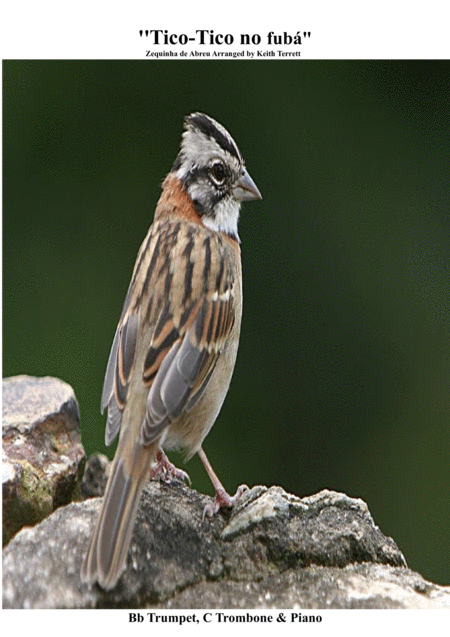
Tico Tico (tico Tico No Fuba)
The Andrews Sisters
$12.99 11.28 € PDF SheetMusicPlus


Partitions Gratuites
Acheter des Partitions Musicales
Acheter des Partitions Digitales à Imprimer
Acheter des Instruments de Musique

© 2000 - 2026

Accueil - Version intégrale





