EUROPE
1291 articles
USA
890 articles
DIGITAL
690 articles ( imprimer)
Partitions Digitales
Partitions à imprimer
690 partitions trouvées

1 ....511 526 541 556 571 ....676

Piano Quartet,String Ensemble Cello,Piano,Viola,Violin - Level 3 - Digital Download SKU: A0.552117 Composed by George Friderick Handel (1685-1756). Arranged by James M. Guthrie. Baroque,Instructional,Standards,Wedding. Score and parts. 36 pages. Jmsgu3 #6121085. Published by jmsgu3 (A0.552117). Seven popular pieces from Handel's Water Music - most often requested for weddings. Score: 16 pages, Duration 12:15. Players may read from the score, or from the included instrumental parts.Contents: 1. Air2. Minuet3. Bourrée4. Hornpipe5. Rigaudon6. Minuet7. AndanteHandel's Water Music is one of his most famous compositions. It was written for King George I's pleasure barge trip along the River Thames in 1717. The Water Music is divided into three suites, each containing a variety of movements. The music features a mix of dance rhythms such as minuets, bourrees, and hornpipes, along with lively fanfares and slower, more stately airs. Its combination of light and playful music with grandeur and pomp has made it one of the most beloved pieces of classical music. Water Music has been performed by many orchestras and is a popular choice for special occasions, such as coronations and weddings. Its enduring popularity has helped to make it one of Handel's most famous and beloved compositions.Weddings during the time of Handel were usually quite extravagant affairs. The ceremony was typically held in a church and was accompanied by a full orchestra. Handel's own compositions were frequently used to provide the music for the ceremony. This was especially true in London, where Handel was based and where his music was extremely popular. Handel wrote a number of pieces specifically for use at weddings, including the popular Wedding Anthem and the Wedding Anthem in D Major. Handel's music provided a sense of grandeur and elegance to the proceedings and was often used to give the wedding an extra special touch.The festivities following the ceremony were also often quite lavish, with a large feast and plenty of dancing. Handel's music was often used to provide the background music for the dancing, and he wrote many dance suites that were specifically designed for this purpose. The bride and groom would often have a special dance to the music of Handel's Water Music, a particularly popular piece for the occasion. Guests at the wedding would be treated to a variety of Handel's works, ranging from his operas to his oratorios, which often had a spiritual or religious theme. Handel's music provided a sense of joy and celebration to the wedding and helped make it an occasion to remember.
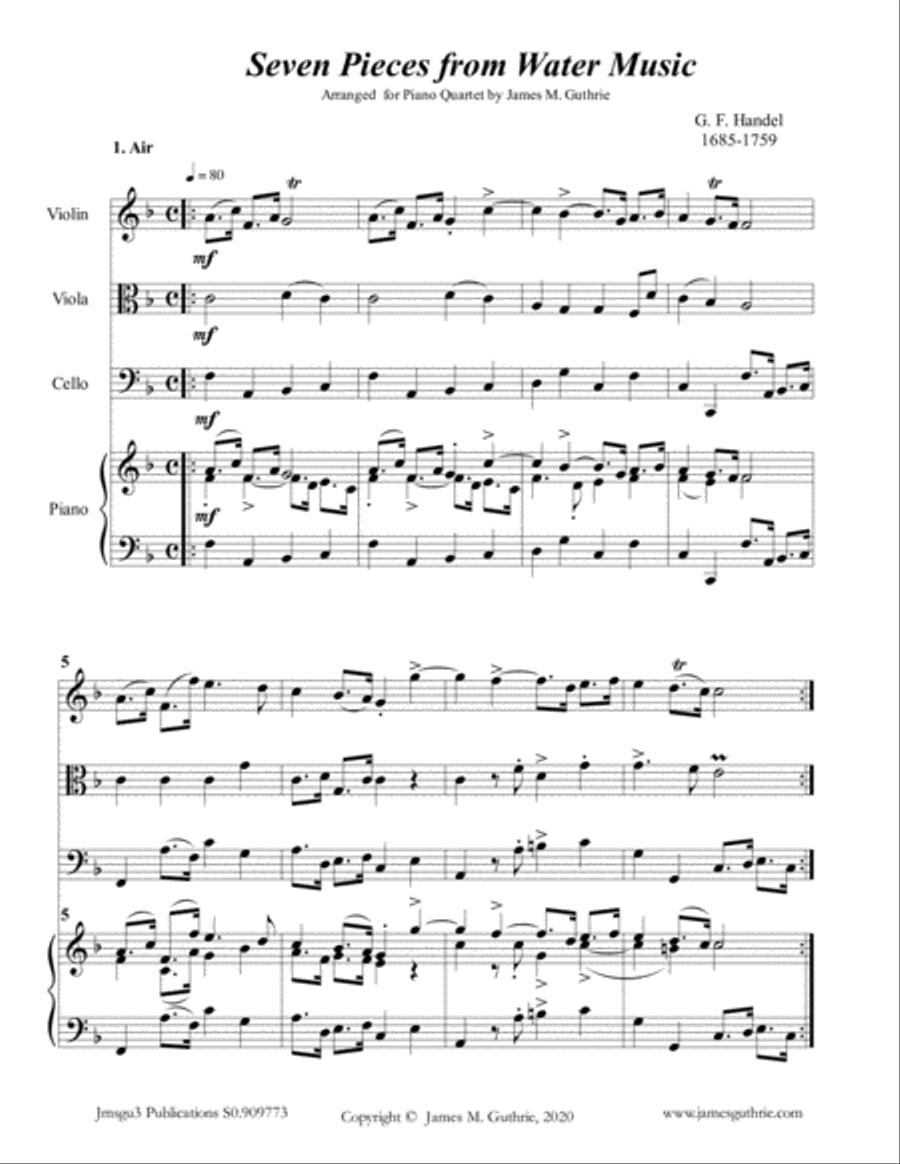
Handel: Seven Pieces from Water Music for Piano Quartet
Piano Quatuor: piano, violon, alto, violoncelle

$36.95 31.21 € Piano Quatuor: piano, violon, alto, violoncelle PDF SheetMusicPlus

Baritone Saxophone,Piano - Level 1 - Digital Download SKU: A0.548670 Composed by Adam. Arranged by James M. Guthrie, ASCAP. Christian,Christmas. Score and part. 10 pages. Jmsgu3 #3410425. Published by jmsgu3 (A0.548670). Duration: 4:56 Score 5 pg. 44 ms. Solo part: 2 pg. Piano part: 3 pg. Cantique de Noël The French composer Adolphe Adam was already famous as a composer of many successful ballets and operas. Then, in the 1840’s he wrote his most famous work - O Holy Night. The original song title was Minuit Chretiens or Cantique de Noël.  Placide Cappeau provided the original song lyrics. The song was first performed in Roquemaure by the opera singer Emily Laurey at midnight mass in 1847. It became very popular among the French, much the way that Silent Night was famous elsewhere. In the 1850’s John S. Dwight, a Unitarian minister and music teacher translated the song into English.   Adolphe Adam In his younger years, Adam studied organ and composition at the Paris Conservatoire. He also played the timpani in the Conservatoire orchestra. Adam used his savings and borrowed money to open a new opera house - the fourth opera house in Paris in 1847. Unfortunately, the Revolution of 1848 forced him to close. He taught composition at the Paris Conservatoire from 1849 until his death in 1856. Placide Cappeau The poet Cappeau was an advocate of the French Enlightenment philosopher Voltaire.  Voltaire was renowned for criticizing the Catholic church, religious intolerance, and dogma in general. Consequently, Cappeau made the Redeemer figure in his song a kind of reformer of injustices, in particular, the problem of original sin. To begin with, people recognized Cappeau’s theology as eccentric, probably even doubtful. Theology In the earlier form of Minuit, the Christ figure descends to intervene with His Father’s plan to punish mankind.  Traditional doctrine pronounces that Christ came from love, not to intervene. This version also declares that Christ appeared to expunge the original sin of Adam. Cappeau removed this part from his poem years later, because he just didn’t believe it.  He preferred to portray Christ as the reformer of disparity and unfairness. Before long, the writer/politician Alphonse de Lamartine referred to the Minuit as the the Marseillaise of religion. Most French churchmen agreed with this idea but certainly did not consider it a tribute.  Register for free lifetime updates and revisions at www.jamesguthrie.com
O Holy Night for Baritone Sax & Piano
Saxophone Baryton, Piano

$24.95 21.07 € Saxophone Baryton, Piano PDF SheetMusicPlus

Cello,Piano,Viola,Violin - Level 2 - Digital Download SKU: A0.548706 Composed by Adam. Arranged by James M. Guthrie, ASCAP. Christmas,Standards. 18 pages. Jmsgu3 #3411563. Published by jmsgu3 (A0.548706). Cantique de Noël The French composer Adolphe Adam was already famous as a composer of many successful ballets and operas. Then, in the 1840s, he wrote his most famous work - O Holy Night. The original song title was Minuit Chretiens or Cantique de Noël.  Placide Cappeau provided the original song lyrics. The song was first performed in Roquemaure by the opera singer Emily Laurey at midnight mass in 1847. It became trendy among the French, much like Silent Night was famous elsewhere. In 1850, John S. Dwight, a Unitarian minister and music teacher, translated the song into English.   Adolphe Adam Adam studied organ and composition at the Paris Conservatoire in his younger years. He also played the timpani in the Conservatoire orchestra. Adam used his savings and borrowed money to open a new opera house - the fourth opera house in Paris in 1847. Unfortunately, the Revolution of 1848 forced him to close. He taught composition at the Paris Conservatoire from 1849 until he died in 1856. Placide Cappeau The poet Cappeau was an advocate of the French Enlightenment philosopher Voltaire. Voltaire was renowned for criticizing the Catholic church, religious intolerance, and dogma in general. Consequently, Cappeau made the Redeemer figure in his song a kind of reformer of injustices, particularly the problem of original sin. To begin with, people recognized Cappeau's theology as eccentric, probably even doubtful. Theology In the earlier form of Minuit, the Christ figure descends to intervene with His Father's plan to punish humanity. Traditional doctrine pronounces that Christ came from love, not to intervene. This version also declares that Christ appeared to delete the original sin of Adam. Cappeau removed this part from his poem years later because he didn't believe it. He preferred to portray Christ as the reformer of disparity and unfairness. Before long, the writer/politician Alphonse de Lamartine called the Minuit the Marseillaise of religion. Most French churchmen agreed with this idea but did not consider it a tribute.    
O Holy Night for Piano Quartet
Piano Quatuor: piano, violon, alto, violoncelle

$39.95 33.74 € Piano Quatuor: piano, violon, alto, violoncelle PDF SheetMusicPlus

Organ or piano, treble C instrument or B-flat instrument, flute, oboe, violin - Moderately Easy - Digital Download SKU: MQ.20-915-5E Composed by Robert J. Powell. Lent. Instrument parts. 5 pages. MorningStar Music Publishers - Digital Sheet Music #20-915-5E. Published by MorningStar Music Publishers - Digital Sheet Music (MQ.20-915-5E). This set of instrumental pieces can be used throughout the church year with a variety of different instruments. Reproducible parts for flute, oboe, violin, or other C instruments are included. Includes:Advent: The Angel Gabriel from Heaven CameGabriels MessageChristmas: Dost Thou in a Manger LieDies est laetitiaeEpiphany: Brightest and BestStar in the EastLent: Sunset to Sunrise Changes NowKedronPalm Sunday: The Royal Banners Forward GoVexilla Regis/ProdeuntEaster: Loves Redeeming Work Is DoneSavannahEaster: The Strife Is OerVictory/PalestrinaAscension: Hail the Day That Sees Him RiseLlanfairPentecost: The Lone, Wild BirdProspect Parts for B-flat instrument are available separately.
Sunset to Sunrise Changes Now (Downloadable)

$5.00 4.22 € PDF SheetMusicPlus

Organ or piano, treble C instrument or B-flat instrument, flute, oboe, violin - Moderately Easy - Digital Download SKU: MQ.20-915-6E Composed by Robert J. Powell. Easter. Instrument parts. 5 pages. MorningStar Music Publishers - Digital Sheet Music #20-915-6E. Published by MorningStar Music Publishers - Digital Sheet Music (MQ.20-915-6E). This set of instrumental pieces can be used throughout the church year with a variety of different instruments. Reproducible parts for flute, oboe, violin, or other C instruments are included. Includes:Advent: The Angel Gabriel from Heaven CameGabriels MessageChristmas: Dost Thou in a Manger LieDies est laetitiaeEpiphany: Brightest and BestStar in the EastLent: Sunset to Sunrise Changes NowKedronPalm Sunday: The Royal Banners Forward GoVexilla Regis/ProdeuntEaster: Loves Redeeming Work Is DoneSavannahEaster: The Strife Is OerVictory/PalestrinaAscension: Hail the Day That Sees Him RiseLlanfairPentecost: The Lone, Wild BirdProspect Parts for B-flat instrument are available separately.
Loves Redeeming Work Is Done (Downloadable)

$5.00 4.22 € PDF SheetMusicPlus

Organ or piano, treble C instrument or B-flat instrument, flute, oboe, violin - Moderately Easy - Digital Download SKU: MQ.20-915-8E Composed by Robert J. Powell. Ascension. Instrument parts. 9 pages. MorningStar Music Publishers - Digital Sheet Music #20-915-8E. Published by MorningStar Music Publishers - Digital Sheet Music (MQ.20-915-8E). This set of instrumental pieces can be used throughout the church year with a variety of different instruments. Reproducible parts for flute, oboe, violin, or other C instruments are included. Includes:Advent: The Angel Gabriel from Heaven CameGabriels MessageChristmas: Dost Thou in a Manger LieDies est laetitiaeEpiphany: Brightest and BestStar in the EastLent: Sunset to Sunrise Changes NowKedronPalm Sunday: The Royal Banners Forward GoVexilla Regis/ProdeuntEaster: Loves Redeeming Work Is DoneSavannahEaster: The Strife Is OerVictory/PalestrinaAscension: Hail the Day That Sees Him RiseLlanfairPentecost: The Lone, Wild BirdProspect Parts for B-flat instrument are available separately.
Hail the Day That Sees Him Rise (Downloadable)

$5.00 4.22 € PDF SheetMusicPlus

Alto Saxophone,Piano - Level 1 - Digital Download SKU: A0.548668 Composed by Adam. Arranged by James M. Guthrie, ASCAP. Christian,Christmas. Score and part. 10 pages. Jmsgu3 #3410421. Published by jmsgu3 (A0.548668). O Holy Night arranged for alto sax & piano. Duration: 4:56, 44 ms. Score: 5 pg Part: 2 pg, piano part: 3 pg.Cantique de Noël The French composer Adolphe Adam was already famous as a composer of many successful ballets and operas. Then, in the 1840’s he wrote his most famous work - O Holy Night. The original song title was Minuit Chretiens or Cantique de Noël.  Placide Cappeau provided the original song lyrics. The song was first performed in Roquemaure by the opera singer Emily Laurey at midnight mass in 1847. It became very popular among the French, much the way that Silent Night was famous elsewhere. In the 1850’s John S. Dwight, a Unitarian minister and music teacher translated the song into English.   Adolphe Adam In his younger years, Adam studied organ and composition at the Paris Conservatoire. He also played the timpani in the Conservatoire orchestra. Adam used his savings and borrowed money to open a new opera house - the fourth opera house in Paris in 1847. Unfortunately, the Revolution of 1848 forced him to close. He taught composition at the Paris Conservatoire from 1849 until his death in 1856. Placide Cappeau The poet Cappeau was an advocate of the French Enlightenment philosopher Voltaire.  Voltaire was renowned for criticizing the Catholic church, religious intolerance, and dogma in general. Consequently, Cappeau made the Redeemer figure in his song a kind of reformer of injustices, in particular, the problem of original sin. To begin with, people recognized Cappeau’s theology as eccentric, probably even doubtful. Theology In the earlier form of Minuit, the Christ figure descends to intervene with His Father’s plan to punish mankind.  Traditional doctrine pronounces that Christ came from love, not to intervene. This version also declares that Christ appeared to expunge the original sin of Adam. Cappeau removed this part from him poem years later, because he just didn’t believe it.  He preferred to portray Christ as the reformer of disparity and unfairness. Before long, the writer/politician Alphonse de Lamartine referred to the Minuit as the the Marseillaise of religion. Most French churchmen agreed with this idea but certainly did not consider it a tribute.  Register for free lifetime updates and revisions at www.jamesguthrie.com
O Holy Night for Alto Sax & Piano
Saxophone Alto et Piano

$24.95 21.07 € Saxophone Alto et Piano PDF SheetMusicPlus

Piano Quintet,String Ensemble Piano - Level 3 - Digital Download SKU: A0.552018 Composed by George Friderick Handel (1685-1756). Arranged by James M. Guthrie. Baroque,Instructional,Standards,Wedding. Score and parts. 43 pages. Jmsgu3 #6053173. Published by jmsgu3 (A0.552018). Seven popular pieces from Handel's Water Music - most often requested for weddings. Score: 16 pages, Duration 12:15. Players may read from the score, or from the included instrumental parts.Contents: 1. Air2. Minuet3. Bourrée4. Hornpipe5. Rigaudon6. Minuet7. AndanteHandel's Water Music is one of his most famous compositions. It was written for King George I's pleasure barge trip along the River Thames in 1717. The Water Music is divided into three suites, each containing a variety of movements. The music features a mix of dance rhythms such as minuets, bourrees, and hornpipes, along with lively fanfares and slower, more stately airs. Its combination of light and playful music with grandeur and pomp has made it one of the most beloved pieces of classical music. Water Music has been performed by many orchestras and is a popular choice for special occasions, such as coronations and weddings. Its enduring popularity has helped to make it one of Handel's most famous and beloved compositions.Weddings during the time of Handel were usually quite extravagant affairs. The ceremony was typically held in a church and was accompanied by a full orchestra. Handel's own compositions were frequently used to provide the music for the ceremony. This was especially true in London, where Handel was based and where his music was extremely popular. Handel wrote a number of pieces specifically for use at weddings, including the popular Wedding Anthem and the Wedding Anthem in D Major. Handel's music provided a sense of grandeur and elegance to the proceedings and was often used to give the wedding an extra special touch.The festivities following the ceremony were also often quite lavish, with a large feast and plenty of dancing. Handel's music was often used to provide the background music for the dancing, and he wrote many dance suites that were specifically designed for this purpose. The bride and groom would often have a special dance to the music of Handel's Water Music, a particularly popular piece for the occasion. Guests at the wedding would be treated to a variety of Handel's works, ranging from his operas to his oratorios, which often had a spiritual or religious theme. Handel's music provided a sense of joy and celebration to the wedding and helped make it an occasion to remember.
Handel: Seven Pieces from Water Music for Piano Quintet

$38.95 32.9 € PDF SheetMusicPlus

Cello Solo - Digital Download SKU: A0.961997 Composed by Ma Shui Long 馬水龍. 20th Century,Contemporary. Individual part. 17 pages. SpringAutumnmusic #2341883. Published by SpringAutumnmusic (A0.961997). 《水墨畫之冥想》(九支大提琴室內樂曲) 1994年  作曲者自幼喜愛繪畫與音樂。爾後,雖然選擇了音樂為終身志業,但對繪畫的興趣與狂熱,始終有增無減。在已完成的音樂作品中,幾首均與繪畫有密切的關係。作曲者認為,所有的藝術創作,雖然因其使用的素材不同或表現的技法相異,但最後所要呈現的藝術本質,應是殊途同歸,音樂與繪畫更是不例外。   本曲創作的動機,來自於傳統水墨畫中的「虛實相生」觀念。古人笪重光「畫筌」云:實處之妙,皆因虛處而生,也就是無虛不易顯實,無空不能存虛。無疏不能成密,無密不能見疏,是以虛實相生,疏密相用。作曲者試圖以此繪畫手法,呈現在此首樂曲結構中,如時間與空間的對比,織度與密度的互換,實體與空靈的轉變等,以求音畫之意境。 ※本曲由文建會委託創作,首演於1995年11月25日於國家演奏廳,由財團法人邱再興文教基金會主辦之「春秋樂集95秋 · 室內樂之夜」。由涂惠民擔任指揮,大提琴演奏家為孫琬玲、黃智瑛、鄭佩玲、曾史妃、洪婉容、黃韻宇、劉姝嫥、蘇千芳、王佩瑜。   《Meditation on Ink Painting》for Nine Cellos (1994)     Music and painting are two beloved arts for Professor Ma since he was a kid. Even he finally decided devoted to music composing for his life, he always had the passion for painting. Several Professor Ma’s compositions were highly inspired from the concepts and techniques of painting. Professor Ma believed that all the arts, although they present differently on the usages of materials or techniques, the essence and highest acheivement of all arts must be the same, including both music and painting.     Meditation on Paintings in Ink was directly inspired by the techniques of Chinese traditional ink painting and the concept of the mutuality in virtuality and reality. The composer attempted to transform the philosophy that derive from the virtuality-reality relationship into the composition, presented it as the contrast between time and space, the alternation of texture and density, or, the changing of emptiness and fullness, etc., in order to establish an artistic atmosphere of musical painting.     Meditation on Paintings in Ink was commissioned by the Council for Cultural Affairs, premiered in the National Concert Hall, on 25th of November 1995. It was programed in the Euterpe: Spring and Autumn concert series Autumn 1995: A Night of Chamber Music, held by the Chew’s Culture Foundation. The world premiere was conducted by Hwei-Ming Twu and the nine cellists were Wan-Ling Sun, Jyh-Ing Huang, Pei-Ling Cheng (Yi-Chin Cheng) , Shih-Fei Tseng, Wan-Rong Hung, Yun-Yu Huang, Chu-Chuan Liu, Monica C.F. Su and Pei-Yu Wang.
Meditation on Ink Painting《水墨畫之冥想》
Violoncelle

$13.99 11.82 € Violoncelle PDF SheetMusicPlus

Organ or piano, treble C instrument or B-flat instrument, flute, oboe, violin - Moderately Easy - Digital Download SKU: MQ.20-915-4E Composed by Robert J. Powell. Passion/Palm Sunday. Instrument parts. 6 pages. MorningStar Music Publishers - Digital Sheet Music #20-915-4E. Published by MorningStar Music Publishers - Digital Sheet Music (MQ.20-915-4E). This set of instrumental pieces can be used throughout the church year with a variety of different instruments. Reproducible parts for flute, oboe, violin, or other C instruments are included. Includes:Advent: The Angel Gabriel from Heaven CameGabriels MessageChristmas: Dost Thou in a Manger LieDies est laetitiaeEpiphany: Brightest and BestStar in the EastLent: Sunset to Sunrise Changes NowKedronPalm Sunday: The Royal Banners Forward GoVexilla Regis/ProdeuntEaster: Loves Redeeming Work Is DoneSavannahEaster: The Strife Is OerVictory/PalestrinaAscension: Hail the Day That Sees Him RiseLlanfairPentecost: The Lone, Wild BirdProspect Parts for B-flat instrument are available separately.
The Royal Banners Forward Go (Downloadable)

$5.00 4.22 € PDF SheetMusicPlus

Cello,Piano - Level 2 - Digital Download SKU: A0.548673 Composed by Adam. Arranged by James M. Guthrie, ASCAP. Christmas. Score and part. 10 pages. Jmsgu3 #3410433. Published by jmsgu3 (A0.548673). Cantique de Noël The French composer Adolphe Adam was already famous as a composer of many successful ballets and operas. Then, in the 1840s, he wrote his most famous work - O Holy Night. The original song title was Minuit Chretiens or Cantique de Noël.  Placide Cappeau provided the original song lyrics. The song was first performed in Roquemaure by the opera singer Emily Laurey at midnight mass in 1847. It became very popular among the French, much like Silent Night was famous elsewhere. In 1850, John S. Dwight, a Unitarian minister and music teacher, translated the song into English.   Adolphe Adam Adam studied organ and composition at the Paris Conservatoire in his younger years. He also played the timpani in the Conservatoire orchestra. Adam used his savings and borrowed money to open a new opera house - the fourth opera house in Paris in 1847. Unfortunately, the Revolution of 1848 forced him to close. He taught composition at the Paris Conservatoire from 1849 until he died in 1856. Placide Cappeau The poet Cappeau was an advocate of the French Enlightenment philosopher Voltaire. Voltaire was renowned for criticizing the Catholic church, religious intolerance, and dogma in general. Consequently, Cappeau made the Redeemer figure in his song a kind of reformer of injustices, particularly the problem of original sin. To begin with, people recognized Cappeau's theology as eccentric, probably even doubtful. Theology In the earlier form of Minuit, the Christ figure descends to intervene with His Father's plan to punish humanity. Traditional doctrine pronounces that Christ came from love, not to intervene. This version also declares that Christ appeared to delete the original sin of Adam. Cappeau removed this part from his poem years later because he didn't believe it. He preferred to portray Christ as the reformer of disparity and unfairness. Before long, the writer/politician Alphonse de Lamartine called the Minuit the Marseillaise of religion. Most French churchmen agreed with this idea but did not consider it a tribute.    
O Holy Night for Cello & Piano
Violoncelle, Piano

$26.95 22.76 € Violoncelle, Piano PDF SheetMusicPlus

Piano Trio - Level 3 - Digital Download SKU: A0.552118 Composed by George Friderick Handel (1685-1756). Arranged by James M. Guthrie. Baroque,Instructional,Standards,Wedding. 32 pages. Jmsgu3 #6121129. Published by jmsgu3 (A0.552118). Seven popular pieces from Handel's Water Music - most often requested for weddings. Score: 16 pages, Duration 12:15. Players may read from the score, or from the included instrumental parts.Contents:1. Air2. Minuet3. Bourrée4. Hornpipe5. Rigaudon6. Minuet7. AndanteHandel's Water Music is one of his most famous compositions. It was written for King George I's pleasure barge trip along the River Thames in 1717. The Water Music is divided into three suites, each containing a variety of movements. The music features a mix of dance rhythms such as minuets, bourrees, and hornpipes, along with lively fanfares and slower, more stately airs. Its combination of light and playful music with grandeur and pomp has made it one of the most beloved pieces of classical music. Water Music has been performed by many orchestras and is a popular choice for special occasions, such as coronations and weddings. Its enduring popularity has helped to make it one of Handel's most famous and beloved compositions.Weddings during the time of Handel were usually quite extravagant affairs. The ceremony was typically held in a church and was accompanied by a full orchestra. Handel's own compositions were frequently used to provide the music for the ceremony. This was especially true in London, where Handel was based and where his music was extremely popular. Handel wrote a number of pieces specifically for use at weddings, including the popular Wedding Anthem and the Wedding Anthem in D Major. Handel's music provided a sense of grandeur and elegance to the proceedings and was often used to give the wedding an extra special touch.The festivities following the ceremony were also often quite lavish, with a large feast and plenty of dancing. Handel's music was often used to provide the background music for the dancing, and he wrote many dance suites that were specifically designed for this purpose. The bride and groom would often have a special dance to the music of Handel's Water Music, a particularly popular piece for the occasion. Guests at the wedding would be treated to a variety of Handel's works, ranging from his operas to his oratorios, which often had a spiritual or religious theme. Handel's music provided a sense of joy and celebration to the wedding and helped make it an occasion to remember.

Handel: Seven Pieces from Water Music for Piano Trio
Piano Trio: piano, violon, violoncelle

$36.95 31.21 € Piano Trio: piano, violon, violoncelle PDF SheetMusicPlus

Flute,Piano - Level 1 - Digital Download SKU: A0.548672 Composed by Adam. Arranged by James M. Guthrie, ASCAP. Christmas. Score and part. 10 pages. Jmsgu3 #3410429. Published by jmsgu3 (A0.548672). Duration: 4:56. Score 5 pg. 44 ms. Solo part: 2 pg. Piano part: 3 pg. Cantique de Noël The French composer Adolphe Adam was already famous as a composer of many successful ballets and operas. Then, in the 1840’s he wrote his most famous work - O Holy Night. The original song title was Minuit Chretiens or Cantique de Noël.  Placide Cappeau provided the original song lyrics. The song was first performed in Roquemaure by the opera singer Emily Laurey at midnight mass in 1847. It became very popular among the French, much the way that Silent Night was famous elsewhere. In the 1850’s John S. Dwight, a Unitarian minister and music teacher translated the song into English.   Adolphe Adam In his younger years, Adam studied organ and composition at the Paris Conservatoire. He also played the timpani in the Conservatoire orchestra. Adam used his savings and borrowed money to open a new opera house - the fourth opera house in Paris in 1847. Unfortunately, the Revolution of 1848 forced him to close. He taught composition at the Paris Conservatoire from 1849 until his death in 1856. Placide Cappeau The poet Cappeau was an advocate of the French Enlightenment philosopher Voltaire.  Voltaire was renowned for criticizing the Catholic church, religious intolerance, and dogma in general. Consequently, Cappeau made the Redeemer figure in his song a kind of reformer of injustices, in particular, the problem of original sin. To begin with, people recognized Cappeau’s theology as eccentric, probably even doubtful. Theology In the earlier form of Minuit, the Christ figure descends to intervene with His Father’s plan to punish mankind.  Traditional doctrine pronounces that Christ came from love, not to intervene. This version also declares that Christ appeared to expunge the original sin of Adam. Cappeau removed this part from his poem years later, because he just didn’t believe it.  He preferred to portray Christ as the reformer of disparity and unfairness. Before long, the writer/politician Alphonse de Lamartine referred to the Minuit as the the Marseillaise of religion. Most French churchmen agreed with this idea but certainly did not consider it a tribute.    
Cantique de Noël for Flute & Piano
Flte traversire et Piano

$24.95 21.07 € Flte traversire et Piano PDF SheetMusicPlus

Piano,Violin - Level 2 - Digital Download SKU: A0.548680 Composed by Adam. Arranged by James M. Guthrie, ASCAP. Christian,Christmas. 10 pages. Jmsgu3 #3410445. Published by jmsgu3 (A0.548680). Duration: 4:56. Score 5 pg. 44 ms. Solo part: 2 pg. Piano part: 3 pg. Cantique de Noël The French composer Adolphe Adam was already famous as a composer of many successful ballets and operas. Then, in the 1840’s he wrote his most famous work - O Holy Night. The original song title was Minuit Chretiens or Cantique de Noël.  Placide Cappeau provided the original song lyrics. The song was first performed in Roquemaure by the opera singer Emily Laurey at midnight mass in 1847. It became very popular among the French, much the way that Silent Night was famous elsewhere. In the 1850’s John S. Dwight, a Unitarian minister and music teacher translated the song into English.   Adolphe Adam In his younger years, Adam studied organ and composition at the Paris Conservatoire. He also played the timpani in the Conservatoire orchestra. Adam used his savings and borrowed money to open a new opera house - the fourth opera house in Paris in 1847. Unfortunately, the Revolution of 1848 forced him to close. He taught composition at the Paris Conservatoire from 1849 until his death in 1856. Placide Cappeau The poet Cappeau was an advocate of the French Enlightenment philosopher Voltaire.  Voltaire was renowned for criticizing the Catholic church, religious intolerance, and dogma in general. Consequently, Cappeau made the Redeemer figure in his song a kind of reformer of injustices, in particular, the problem of original sin. To begin with, people recognized Cappeau’s theology as eccentric, probably even doubtful. Theology In the earlier form of Minuit, the Christ figure descends to intervene with His Father’s plan to punish mankind.  Traditional doctrine pronounces that Christ came from love, not to intervene. This version also declares that Christ appeared to expunge the original sin of Adam. Cappeau removed this part from his poem years later, because he just didn’t believe it.  He preferred to portray Christ as the reformer of disparity and unfairness. Before long, the writer/politician Alphonse de Lamartine referred to the Minuit as the the Marseillaise of religion. Most French churchmen agreed with this idea but certainly did not consider it a tribute.  Register for free lifetime updates and revisions at www.jamesguthrie.com
O Holy Night for Violin & Piano
Violon et Piano

$24.95 21.07 € Violon et Piano PDF SheetMusicPlus

Piano,Viola - Level 2 - Digital Download SKU: A0.548681 Composed by Adam. Arranged by James M. Guthrie, ASCAP. Christian,Christmas. Score and part. 10 pages. Jmsgu3 #3410447. Published by jmsgu3 (A0.548681). Duration: 4:56. Score 5 pg. 44 ms. Solo part: 2 pg. Piano part: 3 pg.Cantique de Noël The French composer Adolphe Adam was already famous as a composer of many successful ballets and operas. Then, in the 1840’s he wrote his most famous work - O Holy Night. The original song title was Minuit Chretiens or Cantique de Noël.  Placide Cappeau provided the original song lyrics. The song was first performed in Roquemaure by the opera singer Emily Laurey at midnight mass in 1847. It became very popular among the French, much the way that Silent Night was famous elsewhere. In the 1850’s John S. Dwight, a Unitarian minister and music teacher translated the song into English.   Adolphe Adam In his younger years, Adam studied organ and composition at the Paris Conservatoire. He also played the timpani in the Conservatoire orchestra. Adam used his savings and borrowed money to open a new opera house - the fourth opera house in Paris in 1847. Unfortunately, the Revolution of 1848 forced him to close. He taught composition at the Paris Conservatoire from 1849 until his death in 1856. Placide Cappeau The poet Cappeau was an advocate of the French Enlightenment philosopher Voltaire.  Voltaire was renowned for criticizing the Catholic church, religious intolerance, and dogma in general. Consequently, Cappeau made the Redeemer figure in his song a kind of reformer of injustices, in particular, the problem of original sin. To begin with, people recognized Cappeau’s theology as eccentric, probably even doubtful. Theology In the earlier form of Minuit, the Christ figure descends to intervene with His Father’s plan to punish mankind.  Traditional doctrine pronounces that Christ came from love, not to intervene. This version also declares that Christ appeared to expunge the original sin of Adam. Cappeau removed this part from his poem years later, because he just didn’t believe it.  He preferred to portray Christ as the reformer of disparity and unfairness. Before long, the writer/politician Alphonse de Lamartine referred to the Minuit as the the Marseillaise of religion. Most French churchmen agreed with this idea but certainly did not consider it a tribute.  Register for free lifetime updates and revisions at www.jamesguthrie.com
O Holy Night for Viola & Piano
Alto, Piano

$24.95 21.07 € Alto, Piano PDF SheetMusicPlus


1 ....511 526 541 556 571 ....676


Partitions Gratuites
Acheter des Partitions Musicales
Acheter des Partitions Digitales à Imprimer
Acheter des Instruments de Musique

© 2000 - 2026

Accueil - Version intégrale




