EUROPE
6357 articles
USA
0 articles
DIGITAL
18582 articles (à imprimer)
Partitions Digitales
Partitions à imprimer
18582 partitions trouvées


Instrumental Duet Instrumental Duet,Vibraphone,Voice - Digital Download SKU: A0.835762 Composed by Paul Burnell. Contemporary. Score and parts. 4 pages. Paul Burnell #3057425. Published by Paul Burnell (A0.835762). The ‘Little Era Ending Songs’ are for soprano and vibraphone. Each of the songs are a brief reflection on the demise of the human race presented in moods ranging from sombre to ironic to wry. There are seven songs in the series:  ‘So Many Will Fall’, ‘Turning Round the Sun’, ‘Charon Charon’, ‘Left Unsaid’, ‘The Petri Dish’, ‘The Last Lullaby’, and ‘Nowhere to Go, so Here We Go’. The songs may be performed independently, or severally together in any order. The songs are dedicated to Chris Brannick and Sara Stowe, and were first performed by them on 14 November 2015’ at the Friends Meeting House, Brighton, UK.
Left Unsaid

$1.99 1.73 € PDF SheetMusicPlus

Violin Duet Violin - Level 3 - Digital Download SKU: A0.1488279 Composed by William Shield. Arranged by Robert Hoskins. Classical. 89 pages. Artaria Editions #1065167. Published by Artaria Editions (A0.1488279). Artaria Editions AE387The London premires of Opp.1 and 2 probably took place at William Napier's morning concerts held at the Thatched House Tavern in St. James's Street. The performers at this venue were gentlemen amateurs backed with some professional assistance (possibly including Shield) and the audience consisted largely of nobility (but not ladies) on their way to court. Napier's concerts were more than a vehicle for airing newly published works or composers, and when it was proposed to revive the series in 1792, the Morning Chronicle of 28 January recalled that they had served to improve the taste and science of the amateur as well as introducing professional merit to the highest patronage. Shield's duets, expressly written with talented amateurs in mind (according to the title-page of Op.2), exactly suited the repertoire of the morning concerts.Both sets of duets are neatly engineered with a violinist's grasp of technique and articultion, and with each part sharing in the musical interest. The prevailing spirit of Op. 1 is Italianate and there are many attractive details to be heard. The amoroso movement of No.1, for example, with its ardent episodes and the hunting rondo of No.2 which begins with the representation of distant horn calls and later depicts a chromatically wounded prey. If the opening of No. 3 gives the impression of an exotic dance, including the audible thrum of a guitar or harp, then the rondo of No.4 can be imagined as a spring song animated with birds and breezes. The opening of No.5 is as propulsive as a theatre overture whilst No.6, written for either violins or flutes, assumes a suitably fluty tone. Op.2 is an altogether more compact set which sharpens the focus on elements already noticed in Op.1. Shield employs a variety of forms including minuet, variations, rondo and canon; and he also adopts vocal styles including lyric song (for the affettuoso movement of No.1) and arioso (for the opening adagio of No.2). The first movement of No. 3 sounds like a mini stage overture whilst the adagio of No. 5 can be heard as a melting duet. Both movements of No. 4 adhere to folk style, incorporating hurdygurdy like figurations and simulated versions of the northern pipe-tunes which Shield himself so avidly collected.   This edition presents as faithfully as possible the intentions of Napier's source. The style and notation of articulation and dynamic markings have been standardised throughout and, where missing, markings have been reconstructed from parallel passages. The notation of appoggiature has also been standardised to minimize confusion. Obvious wrong notes have been corrected without comment; editorial emendations with no authority from the source are placed within brackets. Robert Hoskins.
Six Violin Duets, Op. 1
2 Violons (duo)

$72.00 62.61 € 2 Violons (duo) PDF SheetMusicPlus

Violin Duet Violin - Level 3 - Digital Download SKU: A0.1488280 Composed by William Shield. Arranged by Robert Hoskins. Classical. 59 pages. Artaria Editions #1065168. Published by Artaria Editions (A0.1488280). Artaria Editions AE388The London premires of Opp.1 and 2 probably took place at William Napier's morning concerts held at the Thatched House Tavern in St. James's Street. The performers at this venue were gentlemen amateurs backed with some professional assistance (possibly including Shield) and the audience consisted largely of nobility (but not ladies) on their way to court. Napier's concerts were more than a vehicle for airing newly published works or composers, and when it was proposed to revive the series in 1792, the Morning Chronicle of 28 January recalled that they had served to improve the taste and science of the amateur as well as introducing professional merit to the highest patronage. Shield's duets, expressly written with talented amateurs in mind (according to the title-page of Op.2), exactly suited the repertoire of the morning concerts.Both sets of duets are neatly engineered with a violinist's grasp of technique and articultion, and with each part sharing in the musical interest. The prevailing spirit of Op. 1 is Italianate and there are many attractive details to be heard. The amoroso movement of No.1, for example, with its ardent episodes and the hunting rondo of No.2 which begins with the representation of distant horn calls and later depicts a chromatically wounded prey. If the opening of No. 3 gives the impression of an exotic dance, including the audible thrum of a guitar or harp, then the rondo of No.4 can be imagined as a spring song animated with birds and breezes. The opening of No.5 is as propulsive as a theatre overture whilst No.6, written for either violins or flutes, assumes a suitably fluty tone. Op.2 is an altogether more compact set which sharpens the focus on elements already noticed in Op.1. Shield employs a variety of forms including minuet, variations, rondo and canon; and he also adopts vocal styles including lyric song (for the affettuoso movement of No.1) and arioso (for the opening adagio of No.2). The first movement of No. 3 sounds like a mini stage overture whilst the adagio of No. 5 can be heard as a melting duet. Both movements of No. 4 adhere to folk style, incorporating hurdygurdy like figurations and simulated versions of the northern pipe-tunes which Shield himself so avidly collected.  This edition presents as faithfully as possible the intentions of Napier's source. The style and notation of articulation and dynamic markings have been standardised throughout and, where missing, markings have been reconstructed from parallel passages. The notation of appoggiature has also been standardised to minimize confusion. Obvious wrong notes have been corrected without comment; editorial emendations with no authority from the source are placed within brackets.  Robert Hoskins.
Six Violin Duets, Op. 2
2 Violons (duo)

$72.00 62.61 € 2 Violons (duo) PDF SheetMusicPlus

Full Orchestra - Level 4 - Digital Download SKU: A0.1454722 Composed by Al Stillman and Elmer Bernstein. Arranged by John Langley / Studio Orchestrations. Film/TV,Historic,March,Patriotic,Thriller. 106 pages. Www.studio-orchestrations.com #1033795. Published by www.studio-orchestrations.com (A0.1454722). The Great Escape (1963) is one of the great American epic war adventure films starring some of the greatest actors of the age like Steve McQueen, James Garner, Richard Attenborough, Charles Bronson, Donald Pleasence, James Coburn, David McCallum, Gordon Jackson, among many others.  The soundtrack was composed by Elmer Bernstein who had enjoyed great acclaim for his music for the 1960 epic The Magnificent 7 (also starrring Steve McQueen).  The Great Escape March theme is regarded as one of the best loved war film themes harnessing both a British and an American patriotic flavour in its themes.  Its bitter sweet jauntiness successfully catches the mood of the film, the optimism and indominatable spirit of the prisoners always hell bent on trying to escape, and the German march theme also makes a brief appearance to reflect all the voices in the narrative of the story.  Other film composers have used a similar approach using a jaunty march theme like Bernstein does - notably The bridge over the river Kwai and A bridge too far - while other composers have tried (arguably) less successfully to encapsulate appropriate pathos alongside that optimism in the 'optimistic' themes.This arrangement is a great bite sized orchestral excerpt appropriate for any concert of film music, or military war/historic themes. INSTRUMENTATION:FlutePiccolo2 Oboes2 Clarinets2 Bassoons4 Horns4 Trumpets3 TrombonesTubaTimpani3 Percussion [Bass Drum/Cymbals/2 Side Drums]StringsFeel free to browse other similar titles on this website written by John langley and Paul Campbell at www.studio-orchestrations.com
The Great Escape March
Orchestre

$100.00 86.96 € Orchestre PDF SheetMusicPlus

Easy Piano - Level 1 - Digital Download SKU: A0.1418577 By Raphaël Novarina. By Raphaël Novarina. Arranged by Raphaël Novarina. 20th Century,Children,Classical,Instructional,Romantic Period. Score. 3 pages. Raphaël Novarina #1000149. Published by Raphaël Novarina (A0.1418577). La première horloge is a Piano BalladA very easy oneThe rythm is slow and calmEmotional Piano Ballad Instrumental Song Piano Love Songs Romantic Piano BalladsA ballade (from French ballade, French pronunciation: [baˈlad], and German Ballade, German pronunciation: [baˈlaËdÉ™], both being words for ballad), in classical music since the late 18th century, refers to a setting of a literary ballad, a narrative poem, in the musical tradition of the Lied, or to a one-movement instrumental piece with lyrical and dramatic narrative qualities reminiscent of such a song setting, especially a piano ballade.In 19th century romantic music, a piano ballad (or 'ballade') is a genre of solo piano pieces[1][2] written in a balletic narrative style, often with lyrical elements interspersed. This type of work made its first appearance with Chopin's Ballade No. 1 in G minor, Op. 23 of 1831–35, closely followed by the ballad included in Clara Schumann's Soirées musicales Op. 6 published in the same year.
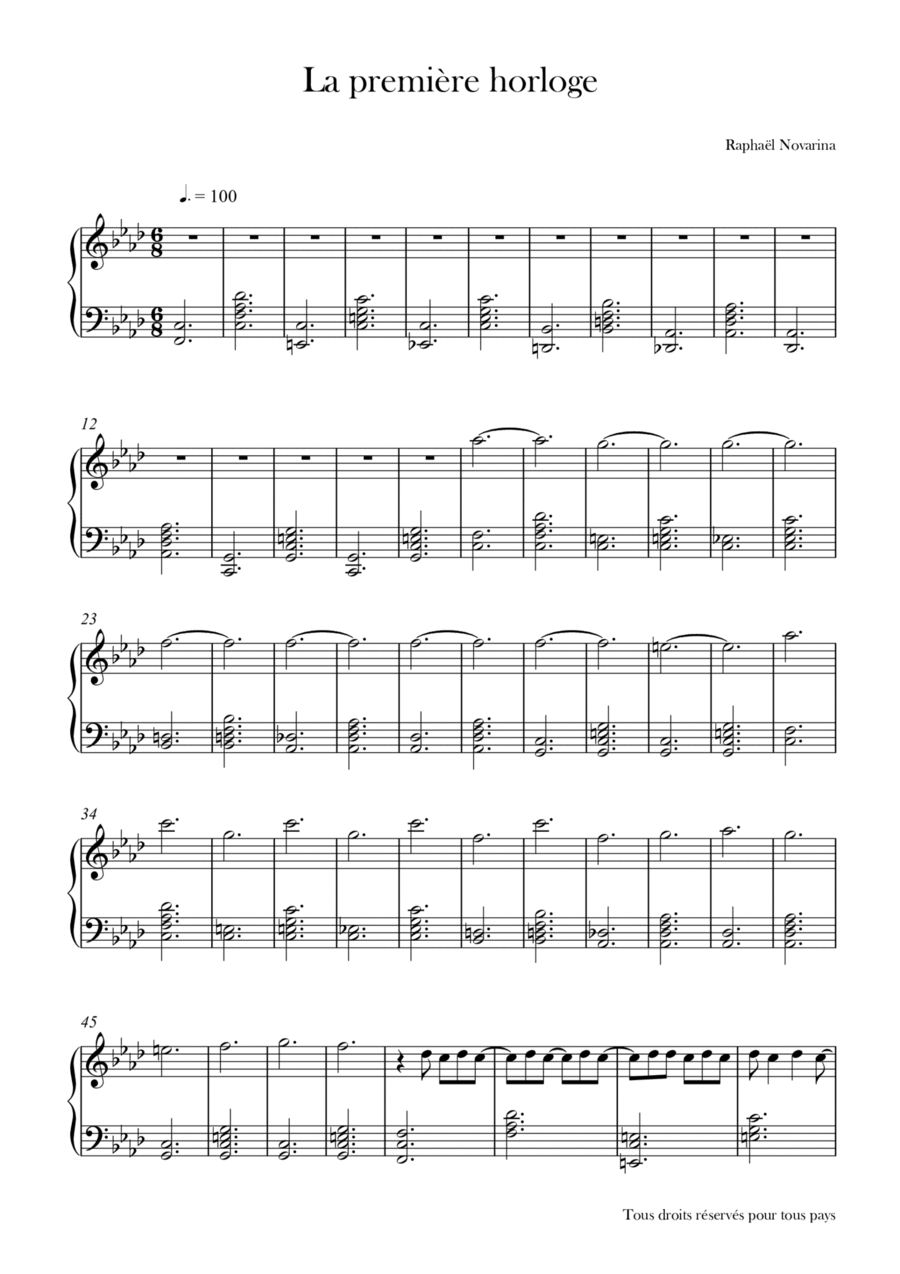
La première horloge
Piano Facile
Raphaël Novarina
$1.99 1.73 € Piano Facile PDF SheetMusicPlus

Piano Solo - Level 5 - Digital Download SKU: A0.1226201 By Andrew Harrison. By Andrew Harrison. 21st Century,Classical,Contemporary,Historic. Score. 31 pages. Phantom Dog Music #822230. Published by Phantom Dog Music (A0.1226201). The Drumfire Was Incessant, and Continued All Night With Unabated Fury is a solo piano piece, inspired by Newton Wanliss’s harrowing account of the Battle of Pozieres in his 1929 war biography The History of the 14th Battalion, A.I.F. The Battle of Pozieres ran between July and August 1916, as part of the First World War’s Somme Offensive. The composition focuses on the days leading up to August 9th, 1916, when my great-great uncle Private Leslie Robins, an infantryman in the 14th Battalion, was shot and wounded.In the early stages of writing the piece, whilst conducting preliminary research into the Battle of Pozieres, I was struck by the disparity between the British High Command’s notion of formulating a ‘plan’ for the battle, and the actuality of what occurred once soldiers ‘went over the top’ into no-man’s land. This dichotomous concept – exerting control over an inherently fluid and dynamic situation – I found to be most intriguing. It segued neatly into my aesthetic explorations of the role of improvisation (a dynamic process) within a larger notated context (a controlled environment). I decided that this dichotomy would play a fundamental role within the piece.Australian pianist Zubin Kanga commissioned The Drumfire… for his 2012 Spectrum concert series. The piece was given its world premiere on August 11th 2012 at the Melbourne Recital Centre, and was also performed at the Independent Theatre in Sydney on August 16th 2012.
The Drumfire Was Incessant, and Continued All Night With Unabated Fury
Piano seul
Andrew Harrison
$59.99 52.17 € Piano seul PDF SheetMusicPlus


Partitions Gratuites
Acheter des Partitions Musicales
Acheter des Partitions Digitales à Imprimer
Acheter des Instruments de Musique

© 2000 - 2026

Accueil - Version intégrale





