EUROPE
571 articles
USA
0 articles
DIGITAL
530 articles (à imprimer)
Partitions Digitales
Partitions à imprimer
530 partitions trouvées

1 ....121 136 151 166 181 ....526

Concert Band - Level 5 - Digital Download SKU: A0.1021848 Composed by Franz von Suppe. Arranged by Albert Schwarzmann. Romantic Period. Score and parts. 192 pages. Edition Schwalbe #6644221. Published by Edition Schwalbe (A0.1021848). Franz von Suppé was a typical child of the multiethic Austrian-Hungarian monarchy with Italian, Dalmatian and Viennese ancestors. His full name was Francesco Ezechiele Ermenegildo de Suppè. He is regarded as father of the Viennese operetta. As he very often composed on bad quality librettos, most of his operettas nowadays are no more performed on stage. But many of his overtures and melodies are still popular, like this overture to the operetta Ein Morgen, ein Mittag, ein Abend in Wien (Morning, Noon and Night in Vienna), which was first performed in Vienna in February 1844. The original cello solo starting at bar 14was transcribed in this arrangement to the bass clarinet, as it is the only wind instrument in this score covering the range of the cello's solo part. There are also alternatives for clarinet (as in the orchestral score) or flugelhorn combined with euphonium. This transcription was commissioned by Wind Philharmonic Mozarteum Salzburg and first performed conducted by Hansjoerg Angerer at their 2014 New Year's Concert on January 6th in Salzburg, Austria. A live recording of this piece is included on the CD Eine musikalische Reise UMR65, Barcode 9120007612141 available at https://naxosdirekt.de/items/eine-musikalische-reise-557962 . Further details at: https://www.blaeserphilharmonie-mozarteum.at/
Ein Morgen, ein Mittag, ein Abend in Wien (Morning, Noon and Night in Vienna), overture by Franz von
Orchestre d'harmonie

$142.40 123.06 € Orchestre d'harmonie PDF SheetMusicPlus

Voice, recorder and percussion - Digital Download SKU: S9.Q2433 Minor: Bordun. Composed by Carl Orff and Gunild Keetman. Arranged by Arnold Walter and Doreen Hall. This edition: score for voice and/or instruments. Orff-Schulwerk. Downloadable, Vocal and performing score. Op. 4. Schott Music - Digital #Q2433. Published by Schott Music - Digital (S9.Q2433). English.Carl Orff devoted much of his life to the development of a philosophy of Music for Children, based on his belief that music is the natural outcome of speech, rhythm and movement. His ideas and pioneering work have had a major influence on music and dance education throughout the world and today that work continues under the guidance of leading teachers and educators in many countries. The five basic German volumes of Music for Children by Carl Orff and Gunild Keetman were published between 1950 and 1954. Edition have since been published in Bolivia, Brazil, Canada, Czechoslovakia, Denmark, Estonia, France, Ghana, Great Britain (including a special Welsh edition), Greece, Italy, Japan, Korea, Latin-America, the Netherlands, Portugal, Spain, Sweden, Taiwan and the USA. In 1952 the first edition in translation appeared, an English language adaptation by Doreen Hall and Arnold Walter for their Canadian and American students. A few years later, Margaret Murray independently developed a version (1957-1966), essentially to fulfil the needs of United Kingdom teachers. Inevitably the considerable growth of Orff-Schulwerk in the United States led to the publication of the American Edition (1977) to satisfy the requirements of a different educational system and national heritage. Orff-Schulwerk: Music for Children has proved itself to be a stimulating source of material for music teaching. Carl Orff's fundamental educational ideas have revitalized music education in nursery schools, at all levels of primary and secondary education and in special music schools, based on the concepts that: - music, dance and language are inter-related and animated through rhythm. - when children discover, invent, improvise and compose, their experience of music is intensified. These creative activities are complementary to those of interpreting and listening to music. - all who take part are encouraged to contribute, not only vocally but also instrumentally. - the Orff approach to music education is many sided; it is concerned with practical music-making, it provides fundamental experiences and it lays the foundation for a comprehensive musical training. - movement games and activities for body awareness in space, time and flow, lead to movement improvisation and dance forms. - music and dance have been notated in many different ways in history. Various ways of writing down sounds and music, as well as playing from and interpreting different kinds of sources are being explored. Today, countless teachers and institutions are using these ideas. More and more teachers look for ways of invovling their students in active music making. In particular, they seek to challenge their pupils' creativity by the use of music, dance and speech - as media of human expression - as a foundation of all education. A prerequisite for work in Orff-Schulwerk is the artistic and pedagogical training of teachers. The Orff Institute was founded in 1961 as a Department of the 'Mozarteum', in Salzburg, Austria. Training offered includes a four-year diploma course, a two-year post-graduate course, and a one-year-course in English. At the opening of the Orff Institute in Salzburg in 1963, Carl Orff ended his speech with a quotation from Schiller: 'I have done my part, now do yours.' That challenge has been taken up by teachers worldwide. Hall/Walter Edition Based on Volumes 1, 2 and 4 of the original German Edition musik für Kinder, english adaption with additional material by Doreen Hall and Arnold Walter.
Music for Children

$11.99 10.36 € PDF SheetMusicPlus

Woodwind Ensemble Clarinet - Level 3 - Digital Download SKU: A0.568055 Composed by Trad. Arranged by Thomas Graf. Christmas. 11 pages. Thomas Graf - the-hit-factory.com #2551039. Published by Thomas Graf - the-hit-factory.com (A0.568055). Polyphonic arrangement of the famous Austrian Christmas Carol and lullaby. The melody is a folk tune (authorship unknown) from the State of Salzburg. The tune appeared for the first time in 1865 in a folksong collection of Maria Vinzenz Süß (1802-1868), founder of the Salzburg Museum,  it has changed slightly over the years but remains attributed to G. Götsch. As played by the ORIGINAL DRACHENFELSERMUSIKANTEN. Big fun to play! Not difficult.   Instrumentation:  Clarinet 1 in Bb, Clarinet 2 in Bb/Basset Horn, Bass Clarinet in Bb    Listen to the recording - a challenge for your ensemble.  Check out our latest uploads:  http://www.sheetmusicplus.com/publishers/thomas-graf-the-hit-factory-com/smp-press/3001412+1303131?N...              Any individual arrangement and substitute parts are available on request. Call +49 (0) 172 2515987 E-Mail: info@the-hit-factory.com. www.the-hit-factory.com facebook: https://www.facebook.com/hitfactorymusic    New catalog included (2016,9 pages) Video: https://youtu.be/DDfpgLbfWpY
Still Still Still - Christmas song - Clarinet Trio
Ensemble de Clarinettes

$9.99 8.63 € Ensemble de Clarinettes PDF SheetMusicPlus

Voice, recorder and percussion - Digital Download SKU: S9.Q53825 Major: Dominant and Subdominant Triads. Arranged by Margaret Murray. This edition: score for voice and/or instruments. Orchestration - Orff Schulwerk - keys. Orff-Schulwerk. Downloadable, Vocal and performing score. Op. 3. Schott Music - Digital #Q53825. Published by Schott Music - Digital (S9.Q53825). English.Carl Orff devoted much of his life to the development of a philosophy of Music for Children, based on his belief that music is the natural outcome of speech, rhythm and movement. His ideas and pioneering work have had a major influence on music and dance education throughout the world and today that work continues under the guidance of leading teachers and educators in many countries. The five basic German volumes of Music for Children by Carl Orff and Gunild Keetman were published between 1950 and 1954. Editions have since been published in Bolivia, Brazil, Canada, Czechoslovakia, Denmark, Estonia, France, Ghana, Great Britain (including a special Welsh edition), Greece, Italy, Japan, Korea, Latin-America, the Netherlands, Portugal, Spain, Sweden, Taiwan and the USA. In 1952 the first edition in translation appeared an English language adaptation by Doreen Hall and Arnold Walter for their Canadian and American students. A few years later, Margaret Murray independently developed a version (1957-1966), essentially to fulfil the needs of United Kingdom teachers. Inevitably the considerable growth of Orff-Schulwerk in the United States led to the publication of the American Edition (1977) to satisfy the requirements of a different educational system and national heritage. Orff-Schulwerk: Music for Children has proved itself to be a stimulating source of material for music teaching. Carl Orff's fundamental educational ideas have revitalized music education in nursery schools, at all levels of primary and secondary education and in special music schools, based on the concepts that: - music, dance and language are inter-related and animated through rhythm. - when children discover, invent, improvise and compose, their experience of music is intensified. These creative activities are complementary to those of interpreting and listening to music. - all who take part are encouraged to contribute, not only vocally but also instrumentally. - the Orff approach to music education is many sided; it is concerned with practical music-making, it provides fundamental experiences and it lays the foundation for a comprehensive musical training. - movement games and activities for body awareness in space, time and flow, lead to movement improvisation and dance forms. - music and dance have been notated in many different ways in history. Various ways of writing down sounds and music, as well as playing from and interpreting different kinds of sources are being explored. Today, countless teachers and institutions are using these ideas. More and more teachers look for ways of involving their students in active music making. In particular, they seek to challenge their pupils' creativity by the use of music, dance and speech - as media of human expression - as a foundation of all education. A prerequisite for work in Orff-Schulwerk is the artistic and pedagogical training of teachers. The Orff Institute was founded in 1961 as a Department of the 'Mozarteum', in Salzburg, Austria. Training offered includes a four-year diploma course, a two-year post-graduate course, and a one-year-course in English. At the opening of the Orff Institute in Salzburg in 1963, Carl Orff ended his speech with a quotation from Schiller: 'I have done my part, now do yours.' That challenge has been taken up by teachers worldwide. Murray Edition English adaption, with additional material, by Margaret Murray. Besed on, and containing all the rhythmic and instrumental material from the main five volumes of the original German edition. Contents of this third volume: The instrumentation and range of keys are inceased. The settings include the chords on the fourth and fifth notes of the major scale.
Music for Children

$21.99 19 € PDF SheetMusicPlus

Guitar,Voice - Level 3 - Digital Download SKU: A0.1120790 By Simon James, Charlie Manton,. By Traditional Austrian. Arranged by Simon James. Christian,Christmas,Classical,Contemporary,Traditional. Full Performance. Duration 132. DML #722006. Published by DML (A0.1120790). Still, still, still is an Austrian Christmas carol and lullaby. The melody is a folk tune from Salzburg. The tune appeared for the first time in 1865 in a folksong collection of Vinzenz Maria Süß (1802–1868), founder of the Salzburg Museum. There are various English translations but this one is my own and I have tried to stay close to the original German version supporting the idea of a lullaby, a mother trying to get her baby off to sleep. I have added a fourth verse which is essentially the first verse but with the words changed so that the baby is now sleeping. Score available.
Still, Still, Still
Simon James, Charlie Manton,
$1.99 1.72 € PDF SheetMusicPlus

Woodwind Ensemble Bass Flute - Level 3 - Digital Download SKU: A0.568258 Composed by Trad. Arranged by Thomas Graf. Christmas. 22 pages. Thomas Graf - the-hit-factory.com #2893739. Published by Thomas Graf - the-hit-factory.com (A0.568258). Polyphonic arrangement of the famous Austrian Christmas Carol and lullaby. The melody is a folk tune (authorship unknown) from the State of Salzburg. The tune appeared for the first time in 1865 in a folksong collection of Maria Vinzenz Süß (1802-1868), founder of the Salzburg Museum,  it has changed slightly over the years but remains attributed to G. Götsch. As played by the ORIGINAL DRACHENFELSERMUSIKANTEN. Big fun to play! Not difficult.   Instrumentation:  Flute 1/2/3, Alto Flute, Bass Flute             Listen to the recording - a challenge for your ensemble.  Please don't forget to review your purchase - you will help other musicians to choose the perfect arrangement for their ensemble. Thank you very much!               Check out our latest uploads:  http://www.sheetmusicplus.com/publishers/thomas-graf-the-hit-factory-com/smp-press/3001412+1303131?N...                      Any individual arrangement and substitute parts are available on request. Call +49 (0) 172 2515987 E-Mail: info@the-hit-factory.com. www.the-hit-factory.com facebook: https://www.facebook.com/hitfactorymusic               Video: https://www.youtu.be/QVxrKWOt91I   .
Still Still Still - Christmas song - Flute Quintet

$14.99 12.95 € PDF SheetMusicPlus

Choral Choir (SSA) - Level 3 - Digital Download SKU: A0.748602 Composed by 4th century Latin text, Jakob Hintze, Robert Campbell, and SALZBURG. Arranged by Fritz Stanley. A Cappella,Christian,Easter,Gospel,Praise & Worship. Octavo. 7 pages. MicStanley #6453391. Published by MicStanley (A0.748602). At The Lamb's High Feast We Sing is a classical hymn song based on SALZBURG tune, composed by Jakob Hintze from the 4th century Latin text and translated to English by Robert Campbell. The song is about Jesus as the Lamb of GOD who redeemed our sins, that everyone who believes in HIM as GOD and Savior will not die but receive an eternal life. Arranged by Fritz Stanley for three-part chorus of female voices (SSA) in a cappella.
At The Lamb's High Feast We Sing - SSA A Cappella
Chorale 3 parties

$2.00 1.73 € Chorale 3 parties PDF SheetMusicPlus

Piano,Vocal,Voice - Level 2 - Digital Download SKU: A0.805576 Composed by Traditional Austrian Carol. Arranged by Marcus Martin. Children,Christmas,Romantic Period. Score. 5 pages. Cornelius Edition (uk) #6133717. Published by Cornelius Edition (uk) (A0.805576). This Traditional Austrian Carol is re-arranged for solo voice and piano by. Marcus Martin. The melody is a folk tune from the district of Salzburg and appeared for the first time in 1865 in a folksong collection by Vinzenz Maria Süß (1802–1868),  founder of the Salzburg Museum. There were originally 5 stanzas of German text, here reduced to 4 verses in English with 3 possible permutations of performance. Although intended for solo voice the carol is equally effective sung by a unison choir and also suitable for children's voices. For more arrangements by Marcus Martin please visit http://www.marcusmartinmusic.co.uk/page_1863221.html
Still, Still, Still arranged for solo voice or unison singing
Chorale Unison

$2.99 2.58 € Chorale Unison PDF SheetMusicPlus

Small Ensemble,Strings Piano - Level 3 - Digital Download SKU: A0.549783 Composed by Wolfgang Amadeus Mozart. Arranged by James M. Guthrie, ASCAP. Classical,Concert,Sacred,Standards,World. Score and parts. 27 pages. Jmsgu3 #3535793. Published by jmsgu3 (A0.549783). Mozart's Romanze from Eine Kleine Nachtmusik, K. 525 for String Quartet and Piano (Piano Quintet). Duration: ca. 7:00. Score: 11 pages. Violin I: 4 pages, Violin II: 3 pages, Viola: 3 pages, Cello: 2 pages, piano: 4 pages. This is one of the most beloved works in all of Mozart's catalog making it a strong choice for a recital, meditation, nightclub, church or wedding reception. Eine kleine Nachtmusik Eine kleine Nachtmusik is also at the same time known as Serenade No. 13. Indeed, we find it listed in the Köchel Catalog as K. 525. With this in mind, Mozart composed the piece by all means in 1787 probably as a commission. To clarify, the title translates as a little night-music. Mozart originally scored the work in particular for an ensemble of two violins, viola, and cello with double bass (optional). In modern times the work is certainly usually performed by string orchestras, though it is often in fact performed by a string quartet – with or without double bass. Publication A point often overlooked is that the name of the work derives from the entry Mozart made in his private journal. He wrote: Eine kleine Nacht-Musik. This explains that Mozart was probably not naming the piece, but only entering a record that he had completed it. Nevertheless, the work was published by and large in 1827. It had been sold to the publisher for the most part in 1799 by Mozart's widow Constanze. Nowadays, it is on balance extensively performed and recorded. Some critics ultimately claim that it is the most popular of all Mozart's works.   Early Years Wolfgang Amadeus Mozart (1756 – 1791), was a productive and significant Austrian classical composer. Mozart displayed unusual musical capability from his earliest childhood. It seems like he was already capable on keyboard and violin at the age of two. He started composing at age five and performed before European royalty. Middle Period At 17, Mozart was working as a musician at the Salzburg Royal court but grew agitated from boredom and traveled to search for a more interesting job. While visiting Vienna in 1781, he was summarily dismissed from his Salzburg job. Nevertheless, he decided to stay in the capital (Vienna), where he achieved much fame but little economic haven. Throughout his concluding years in the Capital, he composed many of his most famous works: symphonies, operas, and concertos. Final Period The conditions surrounding his death have been much the subject of much conjecture and mythology. He composed more than 600 works, many recognized as highpoints of symphonic, chamber, concertante, choral and operatic. He is among the most everlastingly popular of classical composers, and his impact is substantial on succeeding Western art music.  Register for free lifetime updates and revisions of this product at www.jamesguthrie.com
Mozart: Romanze from K. 525 for Piano Quintet

$19.95 17.24 € PDF SheetMusicPlus

Voice, recorder and percussion - Digital Download SKU: S9.Q47192 Minor: Drone Bass-Triads. Arranged by Margaret Murray. This edition: score for voice and/or instruments. Songs - Orff Schulwerk - pieces. Orff-Schulwerk. Downloadable, Vocal and performing score. Op. 4. Schott Music - Digital #Q47192. Published by Schott Music - Digital (S9.Q47192). English.Carl Orff devoted much of his life to the development of a philosophy of Music for Children, based on his belief that music is the natural outcome of speech, rhythm and movement. His ideas and pioneering work have had a major influence on music and dance education throughout the world and today that work continues under the guidance of leading teachers and educators in many countries. The five basic German volumes of Music for Children by Carl Orff and Gunild Keetman were published between 1950 and 1954. Editions have since been published in Bolivia, Brazil, Canada, Czechoslovakia, Denmark, Estonia, France, Ghana, Great Britain (including a special Welsh edition), Greece, Italy, Japan, Korea, Latin-America, the Netherlands, Portugal, Spain, Sweden, Taiwan and the USA. In 1952 the first edition in translation appeared an English language adaptation by Doreen Hall and Arnold Walter for their Canadian and American students. A few years later, Margaret Murray independently developed a version (1957-1966), essentially to fulfil the needs of United Kingdom teachers. Inevitably the considerable growth of Orff-Schulwerk in the United States led to the publication of the American Edition (1977) to satisfy the requirements of a different educational system and national heritage. Orff-Schulwerk: Music for Children has proved itself to be a stimulating source of material for music teaching. Carl Orff's fundamental educational ideas have revitalized music education in nursery schools, at all levels of primary and secondary education and in special music schools, based on the concepts that: - music, dance and language are inter-related and animated through rhythm. - when children discover, invent, improvise and compose, their experience of music is intensified. These creative activities are complementary to those of interpreting and listening to music. - all who take part are encouraged to contribute, not only vocally but also instrumentally. - the Orff approach to music education is many sided; it is concerned with practical music-making, it provides fundamental experiences and it lays the foundation for a comprehensive musical training. - movement games and activities for body awareness in space, time and flow, lead to movement improvisation and dance forms. - music and dance have been notated in many different ways in history. Various ways of writing down sounds and music, as well as playing from and interpreting different kinds of sources are being explored. Today, countless teachers and institutions are using these ideas. More and more teachers look for ways of involving their students in active music making. In particular, they seek to challenge their pupils' creativity by the use of music, dance and speech - as media of human expression - as a foundation of all education. A prerequisite for work in Orff-Schulwerk is the artistic and pedagogical training of teachers. The Orff Institute was founded in 1961 as a Department of the 'Mozarteum', in Salzburg, Austria. Training offered includes a four-year diploma course, a two-year post-graduate course, and a one-year-course in English. At the opening of the Orff Institute in Salzburg in 1963, Carl Orff ended his speech with a quotation from Schiller: 'I have done my part, now do yours.' That challenge has been taken up by teachers worldwide. Murray Edition English adaption, with additional material, by Margaret Murray. Besed on, and containing all the rhythmic and instrumental material from the main five volumes of the original German edition. Contents of this fourth volume: Songs and pieces using the full range of the aeolian, dorian and phrygian modes. Accompaniements are founded on drone bass with the later addition of simple chords.
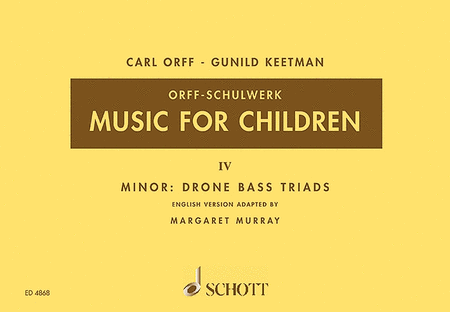
Music for Children

$21.99 19 € PDF SheetMusicPlus

String Orchestra - Level 3 - Digital Download SKU: A0.567753 Composed by Traditional. Arranged by Thomas Graf. Baroque,Christmas,Classical,World. Score and parts. 21 pages. Thomas Graf - the-hit-factory.com #504877. Published by Thomas Graf - the-hit-factory.com (A0.567753). Polyphonic arrangement of the famous Austrian Christmas Carol and lullaby. The melody is a folk tune (authorship unknown) from the State of Salzburg. The tune appeared for the first time in 1865 in a folksong collection of Maria Vinzenz Süß (1802-1868), founder of the Salzburg Museum,  it has changed slightly over the years but remains attributed to G. Götsch. As played by the ORIGINAL DRACHENFELSERMUSIKANTEN. Big fun to play! Not difficult.  Instrumentation:  Violin 1+2, Viola, Cello, Contra Bass             Listen to the recording - a challenge for your ensemble.  Please don't forget to review your purchase - you will help other musicians to choose the perfect arrangement for their ensemble. Thank you very much!               Check out our latest uploads:  http://www.sheetmusicplus.com/publishers/thomas-graf-the-hit-factory-com/smp-press/3001412+1303131?N...                      Any individual arrangement and substitute parts are available on request. Call +49 (0) 172 2515987 E-Mail: info@the-hit-factory.com. www.the-hit-factory.com facebook: https://www.facebook.com/hitfactorymusic               Video: https://www.youtu.be/ymmlglUSUkY   .
Still Still Still - Christmas song - String Orchestra
Orchestre à Cordes

$19.99 17.27 € Orchestre à Cordes PDF SheetMusicPlus

Concert Band - Level 4 - Digital Download SKU: A0.1021846 Composed by Pascual Marquina Narro. Arranged by Albert Schwarzmann. Latin,World. Score and parts. 97 pages. Edition Schwalbe #6500347. Published by Edition Schwalbe (A0.1021846). España cañí is a famous piece of Spanish music and represents the Spanish form of march, a paso doble. It was composed in 1923 by Pascual Marquina (1873 - 1948). This arrangement was commissioned by Wind Philharmonic Mozarteum Salzburg and first performed in 2012 in Salzburg, Austria. A live recording of this piece is included on the CD Eine musikalische Reise UMR65, Barcode 9120007612141 available at https://naxosdirekt.de/items/eine-musikalische-reise-557962
ESPAÑA CAÑI, Pasodoble español by Pascual Marquina Narro (1873 - 1948)
Orchestre d'harmonie

$88.00 76.05 € Orchestre d'harmonie PDF SheetMusicPlus

String Quartet String Quartet - Level 3 - Digital Download SKU: A0.1111558 Composed by Trad. Arranged by Thomas Graf. Christmas. Score and parts. 14 pages. Thomas Graf - the-hit-factory.com #713851. Published by Thomas Graf - the-hit-factory.com (A0.1111558). Polyphonic arrangement of the famous Austrian Christmas Carol and lullaby. The melody is a folk tune (authorship unknown) from the State of Salzburg. The tune appeared for the first time in 1865 in a folksong collection of Maria Vinzenz Suess (1802-1868); founder of the Salzburg Museum; it has changed slightly over the years but remains attributed to G. Goetsch. As played by the ORIGINAL DRACHENFELSERMUSIKANTEN. Big fun to play! Not difficult. About this arrangement: Instrumentation: Full Score Violin 1 Violin 2 Viola Cello Any individual arrangement and substitute parts are available on request. Call +49 (0) 172 2515987 E-Mail: info@the-hit-factory.com. www.the-hit-factory.com facebook: https://www.facebook.com/hitfactorymusic.
Still Still Still - Christmas song - String Quartet - G
Quatuor à cordes: 2 violons, alto, violoncelle

$16.00 13.83 € Quatuor à cordes: 2 violons, alto, violoncelle PDF SheetMusicPlus

Concert Band - Level 4 - Digital Download SKU: A0.1485949 Composed by Johann Strauss Jr. Arranged by Albert Schwarzmann. 19th Century,Romantic Period. 90 pages. Edition Schwalbe #1063001. Published by Edition Schwalbe (A0.1485949). Johann Strauss jr. composed this polka francaise processing motives from the operetta A Night in Venice, especially from  the song of same name in the 3rd final. It was first performed in 1884 in the Vienna Volksgarten conducted by his youngest  brother Eduard. This transcription was commissioned by Wind Philharmonic Mozarteum Salzburg, chief conductor Hansjoerg  Angerer and first performed at their New Year's Concert at January 6th 2017 at Großes Festspielhaus in Salzburg, Austria.  A live recording of this piece is included on the CD Viva l'Italia  https://www.jpc.de/jpcng/classic/detail/-/art/viva-l-italia/hnum/10428716/?iampartner=303&subid=umr12&ref=partner.jpc.de .
Die Tauben von San Marco (The Pigeons of San Marco)
Orchestre d'harmonie

$74.00 63.95 € Orchestre d'harmonie PDF SheetMusicPlus


1 ....121 136 151 166 181 ....526


Partitions Gratuites
Acheter des Partitions Musicales
Acheter des Partitions Digitales à Imprimer
Acheter des Instruments de Musique

© 2000 - 2026

Accueil - Version intégrale





