EUROPE
584 articles
USA
1289 articles
DIGITAL
878 articles (à imprimer)
Partitions Digitales
Partitions à imprimer
878 partitions trouvées

1 ....391 406 421 436 451 ....871

Brass Quartet - Level 2 - Digital Download SKU: A0.1258043 Composed by Guillaume de Machaut, 1300-1377. Arranged by James M. Guthrie. Chamber,Contest,Early Music,Festival,Historic,Medieval. 38 pages. Jmsgu3 #851281. Published by jmsgu3 (A0.1258043). 1. Kyrie2. Gloria3. Credo4. Sanctus5. Agnus dei6. Ite missa estGuillaume de Machaut composed the Messe de Nostre Dame, also known as the Mass of Our Lady, in the early 1360s. He wrote the mass for the Cathedral at Reims, where he served as a canon, a permanent clergy member. According to a rubric found at the Cathedral, it would have likely been performed for the Saturday Lady Mass. Guillaume de Machaut's Messe de Nostre Dame is significant in the history of music for several reasons: It is the first complete setting of the Ordinary of the Mass by a single composer that has survived. It is a unified mass, meaning that the composer selected relevant chants for each section as the borrowed tenor. It was composed in four voices, which was unusual at the time. The texts of both Gloria and Credo are quite lengthy, and therefore Machaut set these movements in a style reminiscent of the earlier discant style, having short phrases, similar rhythmic motion in all parts, and a low ratio of notes per syllable of text, both ending with long, rhapsodic sections for the final word, Amen. Machaut's Messe de Nostre Dame is a landmark in musical history, but it is far from being avant-garde merely for the sake of uniqueness. It is considered to be a culmination of the musical style of the Ars Nova period, which was characterized by complex polyphonic textures and rhythmic innovations. The mass is also significant because it was composed during a time of great political and social upheaval in Europe, and it reflects the changing attitudes towards religion and music during this period. Overall, Machaut's Messe de Nostre Dame is a significant work that represents a culmination of the musical style of the Ars Nova period and reflects the changing attitudes towards religion and music during the 14th century. The mass consists of five movements: Kyrie, Gloria, Credo, Sanctus, and Agnus Dei, followed by the dismissal Ite, missa est. The tenor of the Kyrie is based on Vatican Kyrie IV, the Sanctus, and Agnus correspond to Vatican Mass XVII, and the Ite is on Sanctus VIII. The Gloria and Credo have no apparent chant basis, although they are stylistically related to one another. The mass is a unified mass, meaning that the composer selected relevant chants for each section as the borrowed tenor. The Messe de Nostre Dame is significant in the history of music because it is the first complete setting of the Ordinary of the Mass by a single composer that has survived. It is also significant because it was composed during a time of great political and social upheaval in Europe, and it reflects the changing attitudes towards religion and music during this period. Overall, the Messe de Nostre Dame was an important part of the liturgical practices of the time, and it is still regarded as a masterpiece of medieval music and of all religious music.
Machaut: Le Messe de Nostre Dame for 2 Horns & 2 Trombones - Score Only
Quatuor de Cuivres : 2 trompettes, trombone, tuba

$49.95 42.87 € Quatuor de Cuivres : 2 trompettes, trombone, tuba PDF SheetMusicPlus

Brass Quartet Cornet,Horn,Trombone - Level 2 - Digital Download SKU: A0.1257210 Composed by Guillaume de Machaut, 1300-1377. Arranged by James M. Guthrie, ASCAP. Chamber,Contest,Early Music,Festival,Historic,Medieval. 83 pages. Jmsgu3 #850538. Published by jmsgu3 (A0.1257210). INSTRUMENTATION: Cornet, French Horn & 2 Trombones1. Kyrie2. Gloria3. Credo4. Sanctus5. Agnus dei6. Ite missa estGuillaume de Machaut composed the Messe de Nostre Dame, also known as the Mass of Our Lady, in the early 1360s. He wrote the mass for the Cathedral at Reims, where he served as a canon, a permanent clergy member. According to a rubric at the Cathedral, it would have likely been performed for the Saturday Lady Mass. Guillaume de Machaut's Messe de Nostre Dame is significant in the history of music for several reasons: It is the first complete setting of the Ordinary of the Mass by a single composer that has survived. It is a unified mass, meaning the composer selected relevant chants for each section as the borrowed tenor. It was composed in four voices, which was unusual at the time. The texts of both Gloria and Credo are pretty lengthy. Therefore, Machaut set these movements in a style reminiscent of the earlier discant style, having short phrases, similar rhythmic motion in all parts, and a low ratio of notes per syllable of text, ending with long, rhapsodic sections for the final word, Amen. Machaut's Messe de Nostre Dame is a landmark in musical history, but it is far from being avant-garde merely for its uniqueness. It is considered to be a culmination of the musical style of the Ars Nova period, which was characterized by complex polyphonic textures and rhythmic innovations. The mass is also significant because it was composed during a time of great political and social upheaval in Europe, and it reflects the changing attitudes towards religion and music during this period. Overall, Machaut's Messe de Nostre Dame is a significant work that represents a culmination of the musical style of the Ars Nova period and reflects the changing attitudes towards religion and music during the 14th century. The mass consists of five movements: Kyrie, Gloria, Credo, Sanctus, and Agnus Dei, followed by the dismissal Ite, missa est. The tenor of the Kyrie is based on Vatican Kyrie IV, the Sanctus and Agnus correspond to Vatican Mass XVII, and the Ite is on Sanctus VIII. Although the Gloria and Credo have no apparent chant basis, they are stylistically related. The mass is unified, meaning that the composer selected relevant chants for each section as the borrowed tenor. The Messe de Nostre Dame is significant in the history of music because it is the first complete setting of the Ordinary of the Mass by a single composer that has survived. It is also significant because it was composed during a time of great political and social upheaval in Europe, and it reflects the changing attitudes towards religion and music during this period. Overall, the Messe de Nostre Dame was a vital part of the liturgical practices of the time, and it is still regarded as a masterpiece of medieval and religious music.
Machaut: Le Messe de Nostre Dame for Brass Quartet

$74.95 64.33 € PDF SheetMusicPlus

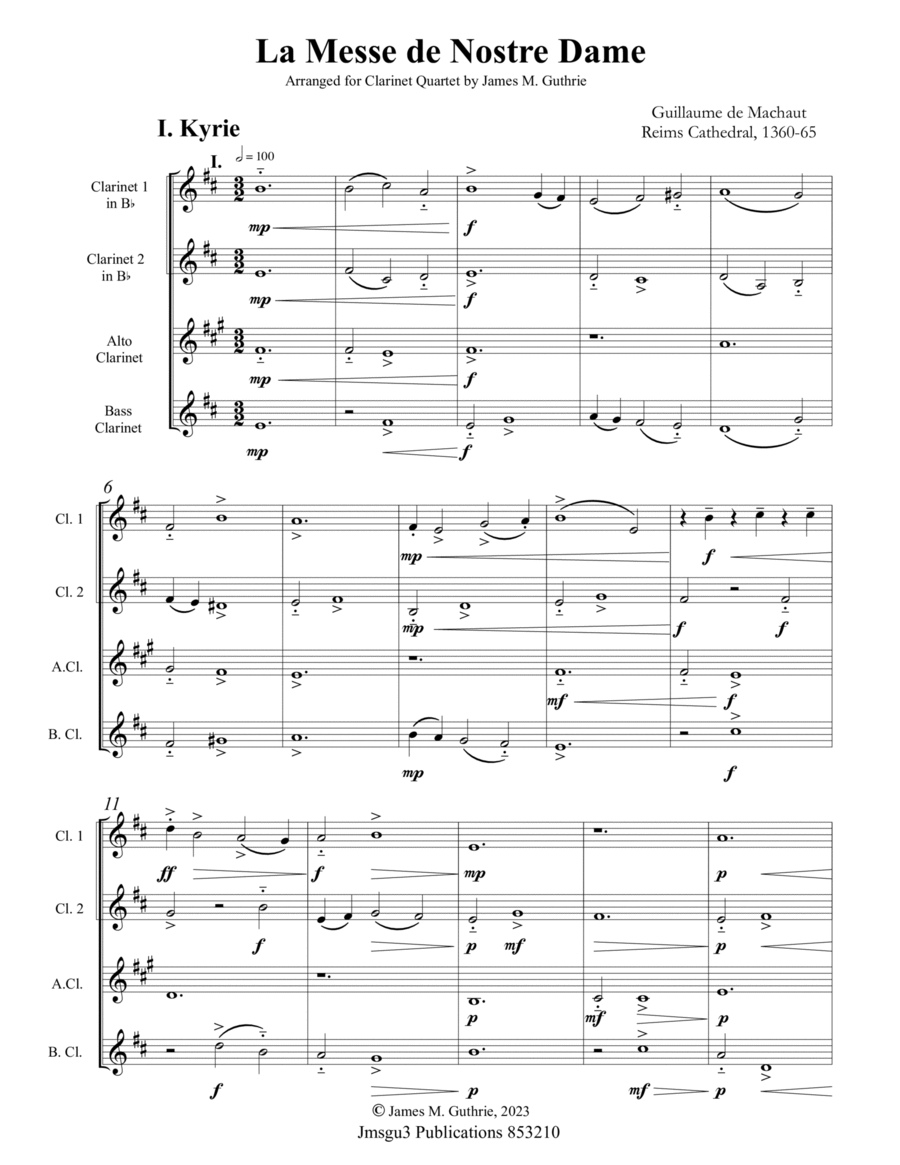
Woodwind Ensemble,Woodwind Quartet - Level 2 - Digital Download SKU: A0.1259372 Composed by Guillaume de Machaut, 1300-1377. Arranged by James M. Guthrie. Chamber,Contest,Early Music,Festival,Historic,Medieval. 38 pages. Jmsgu3 #852647. Published by jmsgu3 (A0.1259372). INSTRUMENTATION: 2 Clarinets in Bb, 1 Alto Clarinet, 1 Bass Clarinet1. Kyrie2. Gloria3. Credo4. Sanctus5. Agnus dei6. Ite missa estGuillaume de Machaut composed the Messe de Nostre Dame, also known as the Mass of Our Lady, in the early 1360s. He wrote the mass for the Cathedral at Reims, where he served as a canon, a permanent clergy member. According to a rubric found at the Cathedral, it would have likely been performed for the Saturday Lady Mass. Guillaume de Machaut's Messe de Nostre Dame is significant in the history of music for several reasons:1. It is the first complete setting of the Ordinary of the Mass by a single composer that has survived.2. It is a unified mass, meaning that the composer selected relevant chants for each section as the borrowed tenor.3. It was composed in four voices, which was unusual at the time.4. The texts of both Gloria and Credo are quite lengthy, and therefore Machaut set these movements in a style reminiscent of the earlier discant style, having short phrases, similar rhythmic motion in all parts, and a low ratio of notes per syllable of text, both ending with long, rhapsodic sections for the final word, Amen.Machaut's Messe de Nostre Dame is a landmark in musical history, but it is far from being avant-garde merely for the sake of uniqueness. It is considered to be a culmination of the musical style of the Ars Nova period, which was characterized by complex polyphonic textures and rhythmic innovations. The mass is also significant because it was composed during a time of great political and social upheaval in Europe, and it reflects the changing attitudes towards religion and music during this period. Overall, Machaut's Messe de Nostre Dame is a significant work that represents a culmination of the musical style of the Ars Nova period and reflects the changing attitudes towards religion and music during the 14th century. The mass consists of five movements: Kyrie, Gloria, Credo, Sanctus, and Agnus Dei, followed by the dismissal Ite, missa est. The tenor of the Kyrie is based on Vatican Kyrie IV, the Sanctus, and Agnus correspond to Vatican Mass XVII, and the Ite is on Sanctus VIII. The Gloria and Credo have no apparent chant basis, although they are stylistically related to one another. The mass is a unified mass, meaning that the composer selected relevant chants for each section as the borrowed tenor. The Messe de Nostre Dame is significant in the history of music because it is the first complete setting of the Ordinary of the Mass by a single composer that has survived. It is also significant because it was composed during a time of great political and social upheaval in Europe, and it reflects the changing attitudes towards religion and music during this period. Overall, the Messe de Nostre Dame was an important part of the liturgical practices of the time, and it is still regarded as a masterpiece of medieval music and of all religious music.
Machaut: La Messe de Nostre Dame for Clarinet Quartet - Score Only
Quatuor de Clarinettes: 4 clarinettes

$49.95 42.87 € Quatuor de Clarinettes: 4 clarinettes PDF SheetMusicPlus

Saxophone Quartet,Woodwind Ensemble Alto Saxophone,Baritone Saxophone,Tenor Saxophone - Level 2 - Digital Download SKU: A0.1257962 Composed by Guillaume de Machaut, 1300-1377. Arranged by James M. Guthrie, ASCAP. Chamber,Contest,Early Music,Festival,Historic,Medieval. 85 pages. Jmsgu3 #851199. Published by jmsgu3 (A0.1257962). 1. Kyrie2. Gloria3. Credo4. Sanctus5. Agnus dei6. Ite missa estGuillaume de Machaut composed the Messe de Nostre Dame, also known as the Mass of Our Lady, in the early 1360s. He wrote the mass for the Cathedral at Reims, where he served as a canon, a permanent clergy member. According to a rubric found at the Cathedral, it would have likely been performed for the Saturday Lady Mass. Guillaume de Machaut's Messe de Nostre Dame is significant in the history of music for several reasons: It is the first complete setting of the Ordinary of the Mass by a single composer that has survived. It is a unified mass, meaning that the composer selected relevant chants for each section as the borrowed tenor. It was composed in four voices, which was unusual at the time. The texts of both Gloria and Credo are quite lengthy, and therefore Machaut set these movements in a style reminiscent of the earlier discant style, having short phrases, similar rhythmic motion in all parts, and a low ratio of notes per syllable of text, both ending with long, rhapsodic sections for the final word, Amen. Machaut's Messe de Nostre Dame is a landmark in musical history, but it is far from being avant-garde merely for the sake of uniqueness. It is considered to be a culmination of the musical style of the Ars Nova period, which was characterized by complex polyphonic textures and rhythmic innovations. The mass is also significant because it was composed during a time of great political and social upheaval in Europe, and it reflects the changing attitudes towards religion and music during this period. Overall, Machaut's Messe de Nostre Dame is a significant work that represents a culmination of the musical style of the Ars Nova period and reflects the changing attitudes towards religion and music during the 14th century. The mass consists of five movements: Kyrie, Gloria, Credo, Sanctus, and Agnus Dei, followed by the dismissal Ite, missa est. The tenor of the Kyrie is based on Vatican Kyrie IV, the Sanctus, and Agnus correspond to Vatican Mass XVII, and the Ite is on Sanctus VIII. The Gloria and Credo have no apparent chant basis, although they are stylistically related to one another. The mass is a unified mass, meaning that the composer selected relevant chants for each section as the borrowed tenor. The Messe de Nostre Dame is significant in the history of music because it is the first complete setting of the Ordinary of the Mass by a single composer that has survived. It is also significant because it was composed during a time of great political and social upheaval in Europe, and it reflects the changing attitudes towards religion and music during this period. Overall, the Messe de Nostre Dame was an important part of the liturgical practices of the time, and it is still regarded as a masterpiece of medieval music and of all religious music.

Machaut: La Messe de Nostre Dame for Saxophone Quartet
Quatuor de Saxophones: 4 saxophones

$74.95 64.33 € Quatuor de Saxophones: 4 saxophones PDF SheetMusicPlus

Instrumental Solo,Organ - Level 4 - Digital Download SKU: A0.1472149 Composed by Guillaume de Machaut. Arranged by James M. Guthrie. Christian,Early Music,Historic,Medieval,Sacred. Individual part. 24 pages. Jmsgu3 #1049849. Published by jmsgu3 (A0.1472149). While the study score edition preserves the cross-voicing of the original four-voice score, the performance edition streamlines the cross-voicing to produce a far more accessible version for the organ. 1. Kyrie 2. Gloria 3. Credo 4. Sanctus 5. Agnus dei 6. Ite missa est Guillaume de Machaut composed the Messe de Nostre Dame, also known as the Mass of Our Lady, in the early 1360s. He wrote the mass for the Cathedral at Reims, where he served as a canon and a permanent clergy member. According to a rubric at the Cathedral, it would have likely been performed for the Saturday Lady Mass. Machaut's Messe de Nostre Dame is significant in the history of music for several reasons: It is the first complete setting of the Ordinary of the Mass by a single composer that has survived. It is a unified mass, meaning the composer selected relevant chants for each section as the borrowed tenor. It was composed in four voices, which was unusual at the time. The texts of both Gloria and Credo are pretty lengthy. Therefore, Machaut set these movements in a style reminiscent of the earlier discant style, having short phrases, similar rhythmic motion in all parts, and a low ratio of notes per syllable of text, ending with long, rhapsodic sections for the final word, Amen. Machaut's Messe de Nostre Dame is a landmark in musical history, but it is far from being avant-garde merely for its uniqueness. It is considered to be a culmination of the musical style of the Ars Nova period, which was characterized by complex polyphonic textures and rhythmic innovations. The mass is also significant because it was composed during a time of great political and social upheaval in Europe, and it reflects the changing attitudes towards religion and music during this period. Overall, Machaut's Messe de Nostre Dame is a significant work that represents a culmination of the musical style of the Ars Nova period and reflects the changing attitudes towards religion and music during the 14th century. The mass consists of five movements: Kyrie, Gloria, Credo, Sanctus, and Agnus Dei, followed by the dismissal Ite, missa est. The tenor of the Kyrie is based on Vatican Kyrie IV, the Sanctus, and Agnus correspond to Vatican Mass XVII, and the Ite is on Sanctus VIII. Although the Gloria and Credo have no apparent chant basis, they are stylistically related. The mass is unified, meaning the composer selected relevant chants as the borrowed tenor for each section. The Messe de Nostre Dame is significant in the history of music because it is the first complete setting of the Ordinary of the Mass by a single composer that has survived. It is also significant because it was composed during a time of great political and social upheaval in Europe, and it reflects the changing attitudes towards religion and music during this period. Overall, the Messe de Nostre Dame was a vital part of the liturgical practices of the time, and it is still regarded as a masterpiece of medieval and religious music.
Machaut: La Messe de Nostre Dame for Organ - Performance Edition
Orgue

$49.95 42.87 € Orgue PDF SheetMusicPlus

String Quartet Cello,String Quartet,Viola,Violin - Level 2 - Digital Download SKU: A0.1257127 Composed by Guillaume de Machaut, 1300-1377. Arranged by James M. Guthrie, ASCAP. Chamber,Contest,Early Music,Festival,Historic,Medieval. 84 pages. Jmsgu3 #850426. Published by jmsgu3 (A0.1257127). 1. Kyrie2. Gloria3. Credo4. Sanctus5. Agnus dei6. Ite missa estGuillaume de Machaut composed the Messe de Nostre Dame, also known as the Mass of Our Lady, in the early 1360s. He wrote the mass for the Cathedral at Reims, where he served as a canon, a permanent clergy member. According to a rubric found at the Cathedral, it would have likely been performed for the Saturday Lady Mass. Guillaume de Machaut's Messe de Nostre Dame is significant in the history of music for several reasons: It is the first complete setting of the Ordinary of the Mass by a single composer that has survived. It is a unified mass, meaning that the composer selected relevant chants for each section as the borrowed tenor. It was composed in four voices, which was unusual at the time. The texts of both Gloria and Credo are quite lengthy, and therefore Machaut set these movements in a style reminiscent of the earlier discant style, having short phrases, similar rhythmic motion in all parts, and a low ratio of notes per syllable of text, both ending with long, rhapsodic sections for the final word, Amen. Machaut's Messe de Nostre Dame is a landmark in musical history, but it is far from being avant-garde merely for the sake of uniqueness. It is considered to be a culmination of the musical style of the Ars Nova period, which was characterized by complex polyphonic textures and rhythmic innovations. The mass is also significant because it was composed during a time of great political and social upheaval in Europe, and it reflects the changing attitudes towards religion and music during this period. Overall, Machaut's Messe de Nostre Dame is a significant work that represents a culmination of the musical style of the Ars Nova period and reflects the changing attitudes towards religion and music during the 14th century. The mass consists of five movements: Kyrie, Gloria, Credo, Sanctus, and Agnus Dei, followed by the dismissal Ite, missa est. The tenor of the Kyrie is based on Vatican Kyrie IV, the Sanctus, and Agnus correspond to Vatican Mass XVII, and the Ite is on Sanctus VIII. The Gloria and Credo have no apparent chant basis, although they are stylistically related to one another. The mass is a unified mass, meaning that the composer selected relevant chants for each section as the borrowed tenor. The Messe de Nostre Dame is significant in the history of music because it is the first complete setting of the Ordinary of the Mass by a single composer that has survived. It is also significant because it was composed during a time of great political and social upheaval in Europe, and it reflects the changing attitudes towards religion and music during this period. Overall, the Messe de Nostre Dame was an important part of the liturgical practices of the time, and it is still regarded as a masterpiece of medieval music and of all religious music.

Machaut: La Messe de Nostre Dame for String Quartet
Quatuor à cordes: 2 violons, alto, violoncelle

$74.95 64.33 € Quatuor à cordes: 2 violons, alto, violoncelle PDF SheetMusicPlus

Brass Quartet - Level 2 - Digital Download SKU: A0.1257202 Composed by Guillaume de Machaut, 1300-1377. Arranged by James M. Guthrie, ASCAP. Chamber,Contest,Early Music,Festival,Historic,Medieval. 38 pages. Jmsgu3 #850533. Published by jmsgu3 (A0.1257202). INSTRUMENTATION: Cornet, French Horn & 2 Trombones 1. Kyrie 2. Gloria 3. Credo 4. Sanctus 5. Agnus dei 6. Ite missa est Guillaume de Machaut composed the Messe de Nostre Dame, also known as the Mass of Our Lady, in the early 1360s. He wrote the mass for the Cathedral at Reims, where he served as a canon, a permanent clergy member. According to a rubric at the Cathedral, it would have likely been performed for the Saturday Lady Mass.   Guillaume de Machaut's Messe de Nostre Dame is significant in the history of music for several reasons: It is the first complete setting of the Ordinary of the Mass by a single composer that has survived. It is a unified mass, meaning the composer selected relevant chants for each section as the borrowed tenor. It was composed in four voices, which was unusual at the time. The texts of both Gloria and Credo are pretty lengthy. Therefore, Machaut set these movements in a style reminiscent of the earlier discant style, having short phrases, similar rhythmic motion in all parts, and a low ratio of notes per syllable of text, ending with long, rhapsodic sections for the final word, Amen. Machaut's Messe de Nostre Dame is a landmark in musical history, but it is far from being avant-garde merely for its uniqueness. It is considered to be a culmination of the musical style of the Ars Nova period, which was characterized by complex polyphonic textures and rhythmic innovations. The mass is also significant because it was composed during a time of great political and social upheaval in Europe, and it reflects the changing attitudes towards religion and music during this period. Overall, Machaut's Messe de Nostre Dame is a significant work that represents a culmination of the musical style of the Ars Nova period and reflects the changing attitudes towards religion and music during the 14th century.   The mass consists of five movements: Kyrie, Gloria, Credo, Sanctus, and Agnus Dei, followed by the dismissal Ite, missa est. The tenor of the Kyrie is based on Vatican Kyrie IV, the Sanctus and Agnus correspond to Vatican Mass XVII, and the Ite is on Sanctus VIII. Although the Gloria and Credo have no apparent chant basis, they are stylistically related. The mass is unified, meaning the composer selected relevant chants as the borrowed tenor for each section. The Messe de Nostre Dame is significant in the history of music because it is the first complete setting of the Ordinary of the Mass by a single composer that has survived. It is also significant because it was composed during a time of great political and social upheaval in Europe, and it reflects the changing attitudes towards religion and music during this period.  Overall, the Messe de Nostre Dame was a vital part of the liturgical practices of the time, and it is still regarded as a masterpiece of medieval and religious music.
Machaut: La Messe de Nostre Dame for Brass Quartet - Score Only
Quatuor de Cuivres : 2 trompettes, trombone, tuba

$49.95 42.87 € Quatuor de Cuivres : 2 trompettes, trombone, tuba PDF SheetMusicPlus

Woodwind Ensemble,Woodwind Quartet - Level 2 - Digital Download SKU: A0.1258034 Composed by Guillaume de Machaut, 1300-1377. Arranged by James M. Guthrie. Chamber,Contest,Early Music,Festival,Historic,Medieval. 38 pages. Jmsgu3 #851272. Published by jmsgu3 (A0.1258034). Instrumentation: English Horn Duo & Bassoon Duo.1. Kyrie2. Gloria3. Credo4. Sanctus5. Agnus dei6. Ite missa estGuillaume de Machaut composed the Messe de Nostre Dame, also known as the Mass of Our Lady, in the early 1360s. He wrote the mass for the Cathedral at Reims, where he served as a canon, a permanent clergy member. According to a rubric found at the Cathedral, it would have likely been performed for the Saturday Lady Mass. Guillaume de Machaut's Messe de Nostre Dame is significant in the history of music for several reasons: It is the first complete setting of the Ordinary of the Mass by a single composer that has survived. It is a unified mass, meaning that the composer selected relevant chants for each section as the borrowed tenor. It was composed in four voices, which was unusual at the time. The texts of both Gloria and Credo are quite lengthy, and therefore Machaut set these movements in a style reminiscent of the earlier discant style, having short phrases, similar rhythmic motion in all parts, and a low ratio of notes per syllable of text, both ending with long, rhapsodic sections for the final word, Amen. Machaut's Messe de Nostre Dame is a landmark in musical history, but it is far from being avant-garde merely for the sake of uniqueness. It is considered to be a culmination of the musical style of the Ars Nova period, which was characterized by complex polyphonic textures and rhythmic innovations. The mass is also significant because it was composed during a time of great political and social upheaval in Europe, and it reflects the changing attitudes towards religion and music during this period. Overall, Machaut's Messe de Nostre Dame is a significant work that represents a culmination of the musical style of the Ars Nova period and reflects the changing attitudes towards religion and music during the 14th century. The mass consists of five movements: Kyrie, Gloria, Credo, Sanctus, and Agnus Dei, followed by the dismissal Ite, missa est. The tenor of the Kyrie is based on Vatican Kyrie IV, the Sanctus, and Agnus correspond to Vatican Mass XVII, and the Ite is on Sanctus VIII. The Gloria and Credo have no apparent chant basis, although they are stylistically related to one another. The mass is a unified mass, meaning that the composer selected relevant chants for each section as the borrowed tenor. The Messe de Nostre Dame is significant in the history of music because it is the first complete setting of the Ordinary of the Mass by a single composer that has survived. It is also significant because it was composed during a time of great political and social upheaval in Europe, and it reflects the changing attitudes towards religion and music during this period. Overall, the Messe de Nostre Dame was an important part of the liturgical practices of the time, and it is still regarded as a masterpiece of medieval music and of all religious music.

Machaut: La Messe de Nostre Dame for 2 English Horns & 2 Bassoons - Score Only
Flûte, Hautbois, Clarinette, Basson

$49.95 42.87 € Flûte, Hautbois, Clarinette, Basson PDF SheetMusicPlus

Choral Choir,Choral (TTBB Chorus) - Level 4 - Digital Download SKU: A0.1512585 Composed by Claus Woschenko (*1979). 21st Century,Classical,Contemporary,Praise & Worship,Sacred. 31 pages. Claus Woschenko #1087567. Published by Claus Woschenko (A0.1512585). Claus Woschenko: Mass for Male Voices (2020)My Mass for Male Voices is particularly characterized by the combination of different musical styles – historically speaking, the range extends from echoes of early polyphony to the modern hymn in the Pleni sunt coeli et terra of the Sanctus. And this is where the broad foundation on which today's mass settings rest can be experienced.I. Kyrie, II. Gloria, III. Credo, IV. Sanctus-Benedictus, V. Agnus DeiDuration: about 22 MinutesSoundsample: Agnus DeiClaus Woschenko: Messe für Männerstimmen (2020)Meine Messe für Männerstimmen ist besonders durch die Zusammenführung verschiedener (kirchen-)musikalischer Stilrichtungen gekennzeichnet – historisch gesehen reicht die Spannweite von Anklängen an frühe Mehrstimmigkeit bis zum modernen Kirchenlied im Pleni sunt coeli et terra des Sanctus. Und hierin wird das breite Fundament erfahrbar, auf dem heutige Messvertonungen ruhen.I. Kyrie, II. Gloria, III. Credo, IV. Sanctus-Benedictus, V. Agnus DeiDauer: Etwa 22 MinutenKlangbeispiel: Agnus Deikeywords: Messe, holy mass; latein, latin, griechisch, greek.
Messe für Männerstimmen (Mass for Male Voices) (2020)
Chorale TTBB

$19.00 16.31 € Chorale TTBB PDF SheetMusicPlus

Woodwind Ensemble,Woodwind Quartet Bass Clarinet,E-Flat Clarinet - Level 2 - Digital Download SKU: A0.1260025 Composed by Guillame de Machaut, 1300-1377. Arranged by James M. Guthrie. Chamber,Contest,Early Music,Festival,Historic,Medieval. 86 pages. Jmsgu3 #853210. Published by jmsgu3 (A0.1260025). INSTRUMENTATION: 2 Clarinets in Bb, 1 Alto Calrinet, 1 Bass Clarinet1. Kyrie2. Gloria3. Credo4. Sanctus5. Agnus dei6. Ite missa estGuillaume de Machaut composed the Messe de Nostre Dame, also known as the Mass of Our Lady, in the early 1360s. He wrote the mass for the Cathedral at Reims, where he served as a canon, a permanent clergy member. According to a rubric found at the Cathedral, it would have likely been performed for the Saturday Lady Mass. Guillaume de Machaut's Messe de Nostre Dame is significant in the history of music for several reasons:1. It is the first complete setting of the Ordinary of the Mass by a single composer that has survived.2. It is a unified mass, meaning that the composer selected relevant chants for each section as the borrowed tenor.3. It was composed in four voices, which was unusual at the time.4. The texts of both Gloria and Credo are quite lengthy, and therefore Machaut set these movements in a style reminiscent of the earlier discant style, having short phrases, similar rhythmic motion in all parts, and a low ratio of notes per syllable of text, both ending with long, rhapsodic sections for the final word, Amen.Machaut's Messe de Nostre Dame is a landmark in musical history, but it is far from being avant-garde merely for the sake of uniqueness. It is considered to be a culmination of the musical style of the Ars Nova period, which was characterized by complex polyphonic textures and rhythmic innovations. The mass is also significant because it was composed during a time of great political and social upheaval in Europe, and it reflects the changing attitudes towards religion and music during this period. Overall, Machaut's Messe de Nostre Dame is a significant work that represents a culmination of the musical style of the Ars Nova period and reflects the changing attitudes towards religion and music during the 14th century. The mass consists of five movements: Kyrie, Gloria, Credo, Sanctus, and Agnus Dei, followed by the dismissal Ite, missa est. The tenor of the Kyrie is based on Vatican Kyrie IV, the Sanctus, and Agnus correspond to Vatican Mass XVII, and the Ite is on Sanctus VIII. The Gloria and Credo have no apparent chant basis, although they are stylistically related to one another. The mass is a unified mass, meaning that the composer selected relevant chants for each section as the borrowed tenor. The Messe de Nostre Dame is significant in the history of music because it is the first complete setting of the Ordinary of the Mass by a single composer that has survived. It is also significant because it was composed during a time of great political and social upheaval in Europe, and it reflects the changing attitudes towards religion and music during this period. Overall, the Messe de Nostre Dame was an important part of the liturgical practices of the time, and it is still regarded as a masterpiece of medieval music and of all religious music.

Machaut: Le Messe de Nostre Dame for Clarinet Quartet
Quatuor de Clarinettes: 4 clarinettes

$74.95 64.33 € Quatuor de Clarinettes: 4 clarinettes PDF SheetMusicPlus

Woodwind Ensemble,Woodwind Quartet Alto Flute,Bass Flute - Level 2 - Digital Download SKU: A0.1260536 Composed by Guillaume de Machaut, 1300-1377. Arranged by James M. Guthrie. Chamber,Contest,Early Music,Festival,Historic,Medieval. 86 pages. Jmsgu3 #853678. Published by jmsgu3 (A0.1260536). INSTRUMENTATION: 2 ALTO FLUTES, 2 BASS FLUTES1. Kyrie2. Gloria3. Credo4. Sanctus5. Agnus dei6. Ite missa estGuillaume de Machaut composed the Messe de Nostre Dame, also known as the Mass of Our Lady, in the early 1360s. He wrote the mass for the Cathedral at Reims, where he served as a canon, a permanent clergy member. According to a rubric found at the Cathedral, it would have likely been performed for the Saturday Lady Mass. Guillaume de Machaut's Messe de Nostre Dame is significant in the history of music for several reasons:1. It is the first complete setting of the Ordinary of the Mass by a single composer that has survived.2. It is a unified mass, meaning that the composer selected relevant chants for each section as the borrowed tenor.3. It was composed in four voices, which was unusual at the time.4. The texts of both Gloria and Credo are quite lengthy, and therefore Machaut set these movements in a style reminiscent of the earlier discant style, having short phrases, similar rhythmic motion in all parts, and a low ratio of notes per syllable of text, both ending with long, rhapsodic sections for the final word, Amen.Machaut's Messe de Nostre Dame is a landmark in musical history, but it is far from being avant-garde merely for the sake of uniqueness. It is considered to be a culmination of the musical style of the Ars Nova period, which was characterized by complex polyphonic textures and rhythmic innovations. The mass is also significant because it was composed during a time of great political and social upheaval in Europe, and it reflects the changing attitudes towards religion and music during this period. Overall, Machaut's Messe de Nostre Dame is a significant work that represents a culmination of the musical style of the Ars Nova period and reflects the changing attitudes towards religion and music during the 14th century. The mass consists of five movements: Kyrie, Gloria, Credo, Sanctus, and Agnus Dei, followed by the dismissal Ite, missa est. The tenor of the Kyrie is based on Vatican Kyrie IV, the Sanctus, and Agnus correspond to Vatican Mass XVII, and the Ite is on Sanctus VIII. The Gloria and Credo have no apparent chant basis, although they are stylistically related to one another. The mass is a unified mass, meaning that the composer selected relevant chants for each section as the borrowed tenor. The Messe de Nostre Dame is significant in the history of music because it is the first complete setting of the Ordinary of the Mass by a single composer that has survived. It is also significant because it was composed during a time of great political and social upheaval in Europe, and it reflects the changing attitudes towards religion and music during this period. Overall, the Messe de Nostre Dame was an important part of the liturgical practices of the time, and it is still regarded as a masterpiece of medieval music and of all religious music.

Machaut: La Messe de Nostre Dame for Flute Quartet
Quatuor de Flûtes : 4 flûtes

$74.95 64.33 € Quatuor de Flûtes : 4 flûtes PDF SheetMusicPlus

String Quartet String Quartet - Level 2 - Digital Download SKU: A0.1257044 Composed by Guillaume de Machaut, 1300-1377. Arranged by James M. Guthrie, ASCAP. Chamber,Contest,Early Music,Festival,Historic,Medieval. 38 pages. Jmsgu3 #850380. Published by jmsgu3 (A0.1257044). 1. Kyrie2. Gloria3. Credo4. Sanctus5. Agnus dei6. Ite missa estGuillaume de Machaut composed the Messe de Nostre Dame, also known as the Mass of Our Lady, in the early 1360s. He wrote the mass for the Cathedral at Reims, where he served as a canon, a permanent clergy member. According to a rubric found at the Cathedral, it would have likely been performed for the Saturday Lady Mass. Guillaume de Machaut's Messe de Nostre Dame is significant in the history of music for several reasons: It is the first complete setting of the Ordinary of the Mass by a single composer that has survived. It is a unified mass, meaning that the composer selected relevant chants for each section as the borrowed tenor. It was composed in four voices, which was unusual at the time. The texts of both Gloria and Credo are quite lengthy, and therefore Machaut set these movements in a style reminiscent of the earlier discant style, having short phrases, similar rhythmic motion in all parts, and a low ratio of notes per syllable of text, both ending with long, rhapsodic sections for the final word, Amen. Machaut's Messe de Nostre Dame is a landmark in musical history, but it is far from being avant-garde merely for the sake of uniqueness. It is considered to be a culmination of the musical style of the Ars Nova period, which was characterized by complex polyphonic textures and rhythmic innovations. The mass is also significant because it was composed during a time of great political and social upheaval in Europe, and it reflects the changing attitudes towards religion and music during this period. Overall, Machaut's Messe de Nostre Dame is a significant work that represents a culmination of the musical style of the Ars Nova period and reflects the changing attitudes towards religion and music during the 14th century. The mass consists of five movements: Kyrie, Gloria, Credo, Sanctus, and Agnus Dei, followed by the dismissal Ite, missa est. The tenor of the Kyrie is based on Vatican Kyrie IV, the Sanctus, and Agnus correspond to Vatican Mass XVII, and the Ite is on Sanctus VIII. The Gloria and Credo have no apparent chant basis, although they are stylistically related to one another. The mass is a unified mass, meaning that the composer selected relevant chants for each section as the borrowed tenor. The Messe de Nostre Dame is significant in the history of music because it is the first complete setting of the Ordinary of the Mass by a single composer that has survived. It is also significant because it was composed during a time of great political and social upheaval in Europe, and it reflects the changing attitudes towards religion and music during this period. Overall, the Messe de Nostre Dame was an important part of the liturgical practices of the time, and it is still regarded as a masterpiece of medieval music and of all religious music.

Machaut: La Messe de Nostre Dame for String Quartet - Score Only
Quatuor à cordes: 2 violons, alto, violoncelle

$49.95 42.87 € Quatuor à cordes: 2 violons, alto, violoncelle PDF SheetMusicPlus

Instrumental Solo,Organ - Level 4 - Digital Download SKU: A0.1471905 Composed by Guillaume de Machaut. Arranged by James M. Guthrie. Christian,Early Music,Historic,Medieval,Religious. Individual part. 23 pages. Jmsgu3 #1049538. Published by jmsgu3 (A0.1471905). 1. Kyrie 2. Gloria 3. Credo 4. Sanctus 5. Agnus dei 6. Ite missa est Guillaume de Machaut composed the Messe de Nostre Dame, also known as the Mass of Our Lady, in the early 1360s. He wrote the mass for the Cathedral at Reims, where he served as a canon and a permanent clergy member. According to a rubric at the Cathedral, it would have likely been performed for the Saturday Lady Mass. Machaut's Messe de Nostre Dame is significant in the history of music for several reasons: It is the first complete setting of the Ordinary of the Mass by a single composer that has survived. It is a unified mass, meaning the composer selected relevant chants for each section as the borrowed tenor. It was composed in four voices, which was unusual at the time. The texts of both Gloria and Credo are pretty lengthy. Therefore, Machaut set these movements in a style reminiscent of the earlier discant style, having short phrases, similar rhythmic motion in all parts, and a low ratio of notes per syllable of text, ending with long, rhapsodic sections for the final word, Amen. Machaut's Messe de Nostre Dame is a landmark in musical history, but it is far from being avant-garde merely for its uniqueness. It is considered to be a culmination of the musical style of the Ars Nova period, which was characterized by complex polyphonic textures and rhythmic innovations. The mass is also significant because it was composed during a time of great political and social upheaval in Europe, and it reflects the changing attitudes towards religion and music during this period. Overall, Machaut's Messe de Nostre Dame is a significant work that represents a culmination of the musical style of the Ars Nova period and reflects the changing attitudes towards religion and music during the 14th century. The mass consists of five movements: Kyrie, Gloria, Credo, Sanctus, and Agnus Dei, followed by the dismissal Ite, missa est. The tenor of the Kyrie is based on Vatican Kyrie IV, the Sanctus, and Agnus correspond to Vatican Mass XVII, and the Ite is on Sanctus VIII. Although the Gloria and Credo have no apparent chant basis, they are stylistically related. The mass is unified, meaning the composer selected relevant chants as the borrowed tenor for each section. The Messe de Nostre Dame is significant in the history of music because it is the first complete setting of the Ordinary of the Mass by a single composer that has survived. It is also significant because it was composed during a time of great political and social upheaval in Europe, and it reflects the changing attitudes towards religion and music during this period. Overall, the Messe de Nostre Dame was a vital part of the liturgical practices of the time, and it is still regarded as a masterpiece of medieval and religious music.
Machaut: La Messe de Nostre Dame for Organ
Orgue

$39.95 34.29 € Orgue PDF SheetMusicPlus

Brass Quartet Horn,Trombone - Level 2 - Digital Download SKU: A0.1258806 Composed by Guillaume de Machaut, 1300-1377. Arranged by James M. Guthrie. Chamber,Contest,Early Music,Festival,Historic,Medieval. 84 pages. Jmsgu3 #852054. Published by jmsgu3 (A0.1258806). INSTRUMENTATION: 2 Horns in F, 2 Tenor Trombones.1. Kyrie2. Gloria3. Credo4. Sanctus5. Agnus dei6. Ite missa estGuillaume de Machaut composed the Messe de Nostre Dame, also known as the Mass of Our Lady, in the early 1360s. He wrote the mass for the Cathedral at Reims, where he served as a canon, a permanent clergy member. According to a rubric found at the Cathedral, it would have likely been performed for the Saturday Lady Mass. Guillaume de Machaut's Messe de Nostre Dame is significant in the history of music for several reasons:1. It is the first complete setting of the Ordinary of the Mass by a single composer that has survived.2. It is a unified mass, meaning that the composer selected relevant chants for each section as the borrowed tenor.3. It was composed in four voices, which was unusual at the time.4. The texts of both Gloria and Credo are quite lengthy, and therefore Machaut set these movements in a style reminiscent of the earlier discant style, having short phrases, similar rhythmic motion in all parts, and a low ratio of notes per syllable of text, both ending with long, rhapsodic sections for the final word, Amen.Machaut's Messe de Nostre Dame is a landmark in musical history, but it is far from being avant-garde merely for the sake of uniqueness. It is considered to be a culmination of the musical style of the Ars Nova period, which was characterized by complex polyphonic textures and rhythmic innovations. The mass is also significant because it was composed during a time of great political and social upheaval in Europe, and it reflects the changing attitudes towards religion and music during this period. Overall, Machaut's Messe de Nostre Dame is a significant work that represents a culmination of the musical style of the Ars Nova period and reflects the changing attitudes towards religion and music during the 14th century. The mass consists of five movements: Kyrie, Gloria, Credo, Sanctus, and Agnus Dei, followed by the dismissal Ite, missa est. The tenor of the Kyrie is based on Vatican Kyrie IV, the Sanctus, and Agnus correspond to Vatican Mass XVII, and the Ite is on Sanctus VIII. The Gloria and Credo have no apparent chant basis, although they are stylistically related to one another. The mass is a unified mass, meaning that the composer selected relevant chants for each section as the borrowed tenor. The Messe de Nostre Dame is significant in the history of music because it is the first complete setting of the Ordinary of the Mass by a single composer that has survived. It is also significant because it was composed during a time of great political and social upheaval in Europe, and it reflects the changing attitudes towards religion and music during this period. Overall, the Messe de Nostre Dame was an important part of the liturgical practices of the time, and it is still regarded as a masterpiece of medieval music and of all religious music.
Machaut: La Messe de Nostre Dame for 2 Horns & 2 Trombones

$74.95 64.33 € PDF SheetMusicPlus


1 ....391 406 421 436 451 ....871


Partitions Gratuites
Acheter des Partitions Musicales
Acheter des Partitions Digitales à Imprimer
Acheter des Instruments de Musique

© 2000 - 2026

Accueil - Version intégrale