EUROPE
2513 articles
USA
0 articles
DIGITAL
48390 articles (à imprimer)
Partitions Digitales
Partitions à imprimer
48390 partitions trouvées


Woodwind Ensemble,Woodwind Quartet Alto Saxophone,Baritone Saxophone,Tenor Saxophone - Level 4 - Digital Download SKU: A0.806849 Composed by Stephen Foster. Arranged by Glen Poehlmann. Folk. 15 pages. Arrangements by GPoehlmann #6017993. Published by arrangements by GPoehlmann (A0.806849). STEPHEN FOSTER MEDLEY for AATB SAXOPHONE QUARTET (unaccompanied)Delightful medley of Stephen Foster tunes that includes: Oh! Susanna; Beautiful Dreamer; Camptown Races; & My Old Kentucky Home.77 measures.  Performance Time approx. 3:18.  Medium Difficult (Grade 3+).Key: F - G (concert).  Meter: 4/4 - 9/8.  Instrument Ranges (C4=middle C):Alto 1 F#4 - E6 (written).  Alto 2 D4 - C#6 (written).  Tenor D4 - A5 (written).  Bari A3 - B5 (written).
STEPHEN FOSTER MEDLEY for AATB SAXOPHONE QUARTET (unaccompanied)
Quatuor de Saxophones: 4 saxophones

$6.00 5.23 € Quatuor de Saxophones: 4 saxophones PDF SheetMusicPlus

Woodwind Ensemble,Woodwind Quartet Alto Saxophone,Baritone Saxophone,Soprano Saxophone,Tenor Saxophone - Level 2 - Digital Download SKU: A0.568938 Arranged by Thomas Graf. Contemporary. 25 pages. Thomas Graf - the-hit-factory.com #3430243. Published by Thomas Graf - the-hit-factory.com (A0.568938). La Paloma  is a popular Spanish song that has been produced and reinterpreted in diverse cultures, settings, arrangements, and recordings over the last 140 years. The song was composed and written by the Spanish composer from the Basque region Sebastián Iradier (later Yradier) after he visited Cuba in 1861. Iradier may have composed  La Paloma  around 1863, just two years before he died in Spain in obscurity, never to learn how popular his song would become.  La Paloma  belongs to a genre of songs called  Habaneras,  a musical style developed in 19th-century Spain that is still today very much present in the form of folk songs and formal compositions, particularly in the Northern Basque Region and East Coast (Catalonia and Valencia) regions of the country. Like all  Habaneras,  its characteristic and distinct rhythm reflects the fusion of the local Cuban songs that the Spanish sailors of the time brought back with them from their travels to the island, with the rhythm structure of the flamenco tanguillo gaditano (original from Cádiz, Andalusia). Very quickly  La Paloma  became popular outside of Spain, particularly in Mexico, and soon spread around the world. In many places, including Afghanistan, Hawaii, the Philippines, Germany, Romania, Zanzibar, and Goa it gained the status of a quasi-folk song. Over the years the popularity of  La Paloma  has surged and receded periodically, but never subsided. It may be considered one of the first universal popular hits and has appealed to artists of diverse musical backgrounds.[1] There are more than one thousand versions of this song, and that together with  Yesterday  by the Beatles, is one of the most recorded songs in the history of music.  ï»¿Instrumentation:  Soprano (Alto), Alto, Tenor, Baritone           ï»¿ Listen to the recording - a challenge for your ensemble.  Please don't forget to review your purchase - you will help other musicians to choose the perfect arrangement for their ensemble. Thank you very much!              ï»¿Check out our latest uploads:  http://www.sheetmusicplus.com/publishers/thomas-graf-the-hit-factory-com/smp-press/3001412+1303131?N...                      Any individual arrangement and substitute parts are available on request. Call +49 (0) 172 2515987 E-Mail: info@the-hit-factory.com. www.the-hit-factory.com facebook: https://www.facebook.com/hitfactorymusic              ï»¿Video: https://www.youtu.be/qR5PI78fGqM   .
La Paloma - Spanish Habanera - Saxophone Quartet H - Arrangement: Thomas H. Graf
Quatuor de Saxophones: 4 saxophones

$10.49 9.14 € Quatuor de Saxophones: 4 saxophones PDF SheetMusicPlus

Saxophone Quartet,Woodwind Ensemble Alto Saxophone,Baritone Saxophone,Tenor Saxophone - Level 4 - Digital Download SKU: A0.1129897 Composed by Converse/Scriven. Arranged by Phil Beaman. Blues,Sacred,Spiritual,Standards. 7 pages. Phil Beaman #730307. Published by Phil Beaman (A0.1129897). Traditional hymn reinterpreted in the Gospel/Blues/Spiritual genre. This piece is all about the harmony in 4 part chorale style. The Time Signature changes every measure, with irregular measures and offbeats and syncopation, but a steady pulse. A soulful piece for service or recital. Advanced Intermediate because of rhythm. part ranges - 10th 3 page score, 1 page @ part 3:00 minutes.
What a Friend- saxophone quartet
Quatuor de Saxophones: 4 saxophones

$7.99 6.96 € Quatuor de Saxophones: 4 saxophones PDF SheetMusicPlus

Woodwind Ensemble,Woodwind Quartet Alto Saxophone,Baritone Saxophone,Soprano Saxophone,Tenor Saxophone - Level 1 - Digital Download SKU: A0.936694 Composed by Alison Jackson, Jonathan Eno BEM. Instructional. 19 pages. Jonathan Eno #6039299. Published by Jonathan Eno (A0.936694). This contemporary tutor book is part of the amazing Hot House eBOOX series. Featuring input from the international award-winning team at Hot House, the woodwind BOOX were principally authored and curated by Alison Jackson. As an integral member of the Hot House team, Alison is currently the Director of ALL the Hot House Music Schools based in the West Midlands and is an expert pedagogist.Each BOOX has been designed to help you learn to play your instrument both individually and as part of a band. We want you to love playing both written music and improvising i.e. music without notes (making it up). Each level features band music, you can play this with your teacher on the same instrument or… even better your friends around the world on different instruments.Above all, remember that music should be fun, it is always more fun when you play with a friend. Why not record yourselves playing and post it on our social media platforms, we would love to hear you:https://www.facebook.com/bigbangsheethttps://twitter.com/bigbangsheet#joinourtribe #bbmusic #boox #eboox #hhmusicNeed help???Tel: 03303 200 880Email: info@bigbangsheetmusic.co.ukWeb: www.bbmusic.co.ukIf you enjoy this tutor boox, why not check out some of the other titles from the Big Bang Music including:Don't Stop Me Now - QueenHold My Hand - Jess GlynneSuper Mario Theme - Nintendo You can listen to the world famous Hot House Saxophonix perform on all streaming platforms including: https://open.spotify.com/artist/0yJpRZxHG1GA38gv43QM5d?si=Bz9kCSaGRam4AsA1mOk_wQhttps://music.apple.com/gb/album/get-lucky/1518278864?i=1518278866This is perfect for schools and students!www.twitter.com/hhyouthjazzwww.twitter.com/jonenowww.instagram.com/HHMusicSchoolwww.facebook.com/bigbangsheetwww.twitter.com/bigbangsheetwww.hhmusic.co.ukwww.bbmusic.co.uk
Saxophone Tutor Boox - Level 2 (Debut)
Quatuor de Saxophones: 4 saxophones

$9.99 8.7 € Quatuor de Saxophones: 4 saxophones PDF SheetMusicPlus

Saxophone Quartet,Woodwind Ensemble Alto Saxophone,Baritone Saxophone,Tenor Saxophone - Level 2 - Digital Download SKU: A0.1257962 Composed by Guillaume de Machaut, 1300-1377. Arranged by James M. Guthrie, ASCAP. Chamber,Contest,Early Music,Festival,Historic,Medieval. 85 pages. Jmsgu3 #851199. Published by jmsgu3 (A0.1257962). 1. Kyrie2. Gloria3. Credo4. Sanctus5. Agnus dei6. Ite missa estGuillaume de Machaut composed the Messe de Nostre Dame, also known as the Mass of Our Lady, in the early 1360s. He wrote the mass for the Cathedral at Reims, where he served as a canon, a permanent clergy member. According to a rubric found at the Cathedral, it would have likely been performed for the Saturday Lady Mass. Guillaume de Machaut's Messe de Nostre Dame is significant in the history of music for several reasons: It is the first complete setting of the Ordinary of the Mass by a single composer that has survived. It is a unified mass, meaning that the composer selected relevant chants for each section as the borrowed tenor. It was composed in four voices, which was unusual at the time. The texts of both Gloria and Credo are quite lengthy, and therefore Machaut set these movements in a style reminiscent of the earlier discant style, having short phrases, similar rhythmic motion in all parts, and a low ratio of notes per syllable of text, both ending with long, rhapsodic sections for the final word, Amen. Machaut's Messe de Nostre Dame is a landmark in musical history, but it is far from being avant-garde merely for the sake of uniqueness. It is considered to be a culmination of the musical style of the Ars Nova period, which was characterized by complex polyphonic textures and rhythmic innovations. The mass is also significant because it was composed during a time of great political and social upheaval in Europe, and it reflects the changing attitudes towards religion and music during this period. Overall, Machaut's Messe de Nostre Dame is a significant work that represents a culmination of the musical style of the Ars Nova period and reflects the changing attitudes towards religion and music during the 14th century. The mass consists of five movements: Kyrie, Gloria, Credo, Sanctus, and Agnus Dei, followed by the dismissal Ite, missa est. The tenor of the Kyrie is based on Vatican Kyrie IV, the Sanctus, and Agnus correspond to Vatican Mass XVII, and the Ite is on Sanctus VIII. The Gloria and Credo have no apparent chant basis, although they are stylistically related to one another. The mass is a unified mass, meaning that the composer selected relevant chants for each section as the borrowed tenor. The Messe de Nostre Dame is significant in the history of music because it is the first complete setting of the Ordinary of the Mass by a single composer that has survived. It is also significant because it was composed during a time of great political and social upheaval in Europe, and it reflects the changing attitudes towards religion and music during this period. Overall, the Messe de Nostre Dame was an important part of the liturgical practices of the time, and it is still regarded as a masterpiece of medieval music and of all religious music.
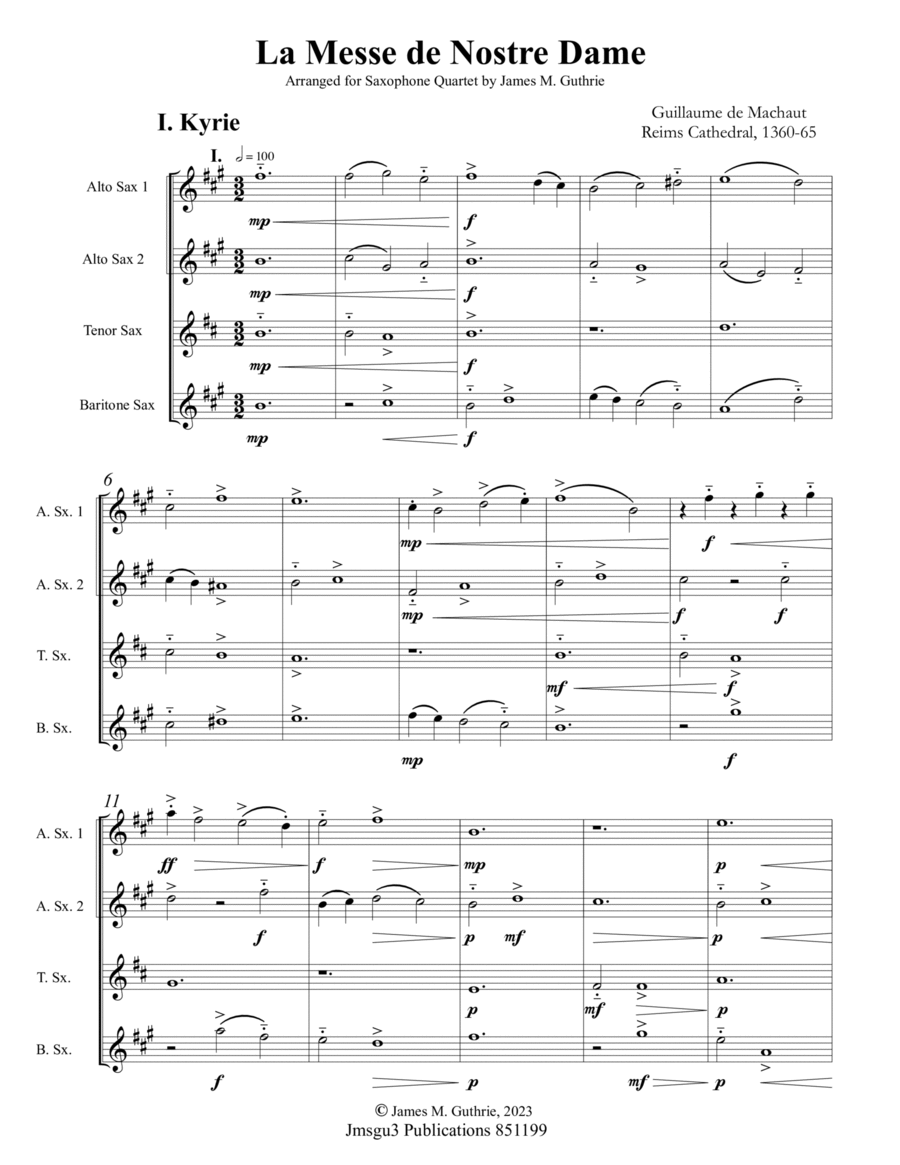
Machaut: La Messe de Nostre Dame for Saxophone Quartet
Quatuor de Saxophones: 4 saxophones

$74.95 65.3 € Quatuor de Saxophones: 4 saxophones PDF SheetMusicPlus

Woodwind Ensemble,Woodwind Quartet Alto Saxophone,Baritone Saxophone,Soprano Saxophone,Tenor Saxophone - Level 4 - Digital Download SKU: A0.527518 Composed by Edvard Grieg. Arranged by Diego Marani. Classical,Instructional,Opera,Romantic Period,Standards. 9 pages. Diego Marani #2838003. Published by Diego Marani (A0.527518). In the Hall of the Mountain King (Norwegian: I Dovregubbens hall) is a piece of orchestral music composed by Edvard Grieg for the sixth scene of act 2 in Henrik Ibsen's 1876 play Peer Gynt. It was originally part of Opus 23 but was later extracted as the final piece of Peer Gynt, Suite No. 1, Op. 46. Its easily recognizable theme has helped it attain iconic status in popular culture, where it has been arranged by many artists.This arrangement for Sax Quartet includes the following parts: Bb Soprano, Eb Alto, Bb Tenor and Eb Baritone.
In The Hall of the Mountain King from "Peer Gynt" for Saxophone Quartet
Quatuor de Saxophones: 4 saxophones

$8.90 7.75 € Quatuor de Saxophones: 4 saxophones PDF SheetMusicPlus


Partitions Gratuites
Acheter des Partitions Musicales
Acheter des Partitions Digitales à Imprimer
Acheter des Instruments de Musique

© 2000 - 2026

Accueil - Version intégrale





