EUROPE
5946 articles
USA
115458 articles
DIGITAL
574823 articles (à imprimer)
Partitions Digitales
Partitions à imprimer
574823 partitions trouvées


Piano Solo - Level 3 - Digital Download SKU: A0.1325492 By Stephen R Dalrymple. By Charles Wesley & Felix Mendelssohn (WH Cummings). Arranged by Stephen R Dalrymple. Advent,Sacred. Score. 17 pages. Stephen R Dalrymple #913719. Published by Stephen R Dalrymple (A0.1325492). Hark the Herald Angels Sing♫ by Charles Wesley (1739) and Felix Mendelsohn (adapted by W H Cummings (1857) ♫ with  Δόξα á¼Î½ ὑψίστοις θεῷ (Glory to God in the Highest) ♫ original song © 2023 Stephen R Dalrymple♫ piano solo arrangement by Stephen R Dalrymple♫ performed by the arranger♫ music © 2023 Stephen R Dalrymple ♫ recording â„—  2023 Stephen R Dalrymple ♫ presentation © 2023 Stephen R Dalrymple ♫ Charles Wesley started his poem with ‘Listen to the angels !’ This started me wondering, what did the angels’ voices sound like ? ♫ Prosody is study of the intonation, stress, and rhythm of the speech of a language (contrasted with the sounds of the vowels and consonants.) Could I replicate the angel’s basic speech patterns? My study of Greek in seminary has given me a pretty good idea of how to pronounce the consonants and vowels of the Greek language. But I would want to listen to someone who actually speaks Greek as their mother tongue to have an idea of the prosody. After further study, I have rewritten the angels’ music; this update represents my latest understanding.♫ Although Latin was the language of the Roman conquerors, Greek was the lingua franca of the Mediterranean world of the first century. Some scholars want us to believe that most of the Jews were not erudite enough to speak Greek. ♫ Yet those of us who have travelled to countries like Haiti, are not surprised that many people there speak Kreyòl, French, English and Spanish!♫ I began searching for someone who actually spoke Greek conversationally to pronounce Luke 2 :14 in Greek. After I found a reliable source, I reduced the rhythm and the accented sylables to simpified music notation. I pulled from my knowledge of ancient modes and used my imagination to add pitches and repetitions of phrases. The melodic and harmonic result is completely inventive, but I believe the basic rhythm of the speech is fairly accurate.♫ This .pdf file includes 2 files: 1) Letter size piano score 2) Small page piano score for performing from a 10 inch tablet♫ (Tell your computer which pages you want to print. There are programs online that will allow you to split pdf files so that you can choose the correct part of the pdf for your tablet.)♫ A duplicate YouTube Video is available in French (Écoutez le chant des anges) https://youtu.be/9_equasuWR4YouTube Channel: @DalrympleDesigns.
Hark the Herald Angels Sing with  ΔÏŒξα á¼ν ὑψίστοις θεá¿· (Glory to God in the Highest) 
Piano seul
Stephen R Dalrymple
$4.50 3.78 € Piano seul PDF SheetMusicPlus

Brass Ensemble - Level 3 - Digital Download SKU: A0.739464 Composed by Various. Arranged by David Catherwood. Contemporary. Score and parts. 96 pages. Opus 3 Music #4292265. Published by Opus 3 Music (A0.739464). Brass Quartet Collection - Seven Really Useful Pieces A great collection of pieces suitable for many occasions -  weddings, formal dinners, concerts, graduations, etc.  Indeed any occasion where a Brass quartet/band might be required to provide music. For Concert use the pieces could be combined into short Suites eg 'Two pieces by Handel', 'Classics from Europe' etcContents1. March from Scipio (Handel) 2.Air from Rinaldo (Handel) 3.Theme from Sleeping Beauty Waltz (Tchaikovsky) 4.St. Anthony Chorale (Brahms) 5.Theme from Pomp & Circumstance March No.4 (Elgar)6.Ode to Joy (Beethoven)7.Pavane (Arbeau) These arrangements are suitable for virtually any Brass Quartet combination (or small Brass Band) As with all music available from Opus 3 Music these arrangements have been well tried and tested in performanceThe download contains a generous set of parts for the following instruments covering standard brass quartets and small brass bands (Unity series) ALSO INCLUDED IS A SCORE in C (Making it easy to use a keyboard to teach/help individual parts without having to transpose various parts in Bb, Eb or F)Part 1 in Bb (Trumpet or Cornet 1)Part 2 in Bb (Trumpet or Cornet 2)Part 2 in Eb (Horn 1)Part 3 in Bb (Trombone/Baritone)Part 3 in Eb (Horn 2)Part 3 in F (Horn in F)Part 3 in C (Trombone)Part 4 in C (Bass Trombone/Tuba)Part 4 in Bb (Euphonium/Bb Bass)Part 4 in Eb ( Eb Bass)Optional Percussion Parts for all pieces
Brass Collection - 7 Really Useful Pieces Arr. for Brass Quartet/small Brass band by D Catherwood
Ensemble de cuivres

$14.99 12.58 € Ensemble de cuivres PDF SheetMusicPlus

Concert Band - Level 4 - Digital Download SKU: A0.1239680 Composed by David M. Stewart. March. Score and Parts. 92 pages. DMStewart Music #835071. Published by DMStewart Music (A0.1239680). This piece, The Palatka Port March, is intended to depict a little of the sense of life in the early years of Florida on the St. John’s River. It was once a target for ships venturing out to find the New World. It has been used to ferry barges and livestock. Some simply used it for sailing and transportation throughout the years, and some to catch fish to provide for themselves. The life on this river has been diverse, yet fulfilling over the years and will continue to be so in the future.   The melodies in this piece were taken from the shape of the St. Johns River from its upper point in Jacksonville, to where our part of the story ends in Palatka. Notice the falling and rising 8th note runs at the beginning, this represents the rise and the fall of the river as it enters Jacksonville from the Atlantic Ocean. The first strain is a linear, yet very regal melody where the heavy beats follow the contour of the river as it runs south. Here you can picture the ships coming from Europe across the ocean and the excitement they felt when they reached it. The second strain is more playful and represents the life that the river has provided for people for centuries. The Trio represents the calmness and civility when Palatka was discovered, and the happiness the settlers must have felt knowing they had found their perfect place to call home. The break strain represents the hard work and efforts that were put forth to secure the land and build a community. There would have been many triumphs and many successes, but the journey would have not been easy. The final strain is the culmination of the piece. This is the celebration and the feeling of personal nobility that all of the settlers felt after taking a river and dirt and building a city. I hope you enjoy, The Palatka Port March!
The Palatka Port March
Orchestre d'harmonie

$50.00 41.95 € Orchestre d'harmonie PDF SheetMusicPlus

Instrumental Solo,Piano,Trombone/Baritone B.C. - Level 5 - Digital Download SKU: A0.1435171 Composed by F.E. Weatherly/Stephen Adams. Arranged by Marc Donatelle. 19th Century,Chamber,Classical,Praise & Worship,Religious. Score and individual part. 15 pages. Marc Donatelle #1015268. Published by Marc Donatelle (A0.1435171). The Holy City is a Victorian religious-ballad composed in 1892 by Michael Maybrick (aka Stephen Adams) with lyrics by Frederic Weatherly. It was sung by Jeanette MacDonald in the 1936 hit movie San Francisco.This is the first solo (and performance) I played at 9 years old and a favorite of my mother. She likely knew it from the movie. I always was a fan of theme and variations, a la Arthur Pryor. A bit autobiographical, the theme is like I would have played at 9 years old, Variation 1 like High School, Variation 2 like University, and the finale like a professional.The audio sample is a small taste of the theme and each variation.
The Holy City

$20.00 16.78 € PDF SheetMusicPlus

Brass Quintet - Level 3 - Digital Download SKU: A0.1372446 By Solo Trumpet Player. By Franz Schubert. Arranged by ed. W Beeler & orchestration by Peet du Toit. Classical. 4 pages. Peet du Toit #956746. Published by Peet du Toit (A0.1372446). Franz Peter Schubert (German: [fÊants ˈpeËtÉ ËˆÊƒuËbÉt]; 31 January 1797 – 19 November 1828) was an Austrian composer of the late Classical and early Romantic eras. Despite his short life, Schubert left behind a vast oeuvre, including more than 600 secular vocal works (mainly lieder), seven complete symphonies, sacred music, operas, incidental music, and a large body of piano and chamber music. His major works include the art songs Erlkönig, Gretchen am Spinnrade, Ave Maria; the Trout Quintet, the unfinished Symphony No. 8 in B minor, the Great Symphony No. 9 in C major, the String Quartet No. 14 Death and the Maiden, a String Quintet, the two sets of Impromptus for solo piano, the three last piano sonatas, the Fantasia in F minor for piano four hands, the opera Fierrabras, the incidental music to the play Rosamunde, and the song cycles Die schöne Müllerin, Winterreise and Schwanengesang.Born in the Himmelpfortgrund suburb of Vienna, Schubert showed uncommon gifts for music from an early age. His father gave him his first violin lessons and his elder brother gave him piano lessons, but Schubert soon exceeded their abilities. In 1808, at the age of eleven, he became a pupil at the Stadtkonvikt school, where he became acquainted with the orchestral music of Joseph Haydn, Wolfgang Amadeus Mozart, and Ludwig van Beethoven. He left the Stadtkonvikt at the end of 1813 and returned home to live with his father, where he began studying to become a schoolteacher. Despite this, he continued his studies in composition with Antonio Salieri and still composed prolifically. In 1821, Schubert was admitted to the Gesellschaft der Musikfreunde as a performing member, which helped establish his name among the Viennese citizenry. He gave a concert of his works to critical acclaim in March 1828, the only time he did so in his career. He died eight months later at the age of 31, the cause officially attributed to typhoid fever, but believed by some historians to be syphilis.Appreciation of Schubert's music while he was alive was limited to a relatively small circle of admirers in Vienna, but interest in his work increased greatly in the decades following his death. Felix Mendelssohn, Robert Schumann, Franz Liszt, Johannes Brahms and other 19th-century composers discovered and championed his works. Today, Schubert is ranked among the greatest composers in the history of Western classical music and his work continues to be admired and widely performed.
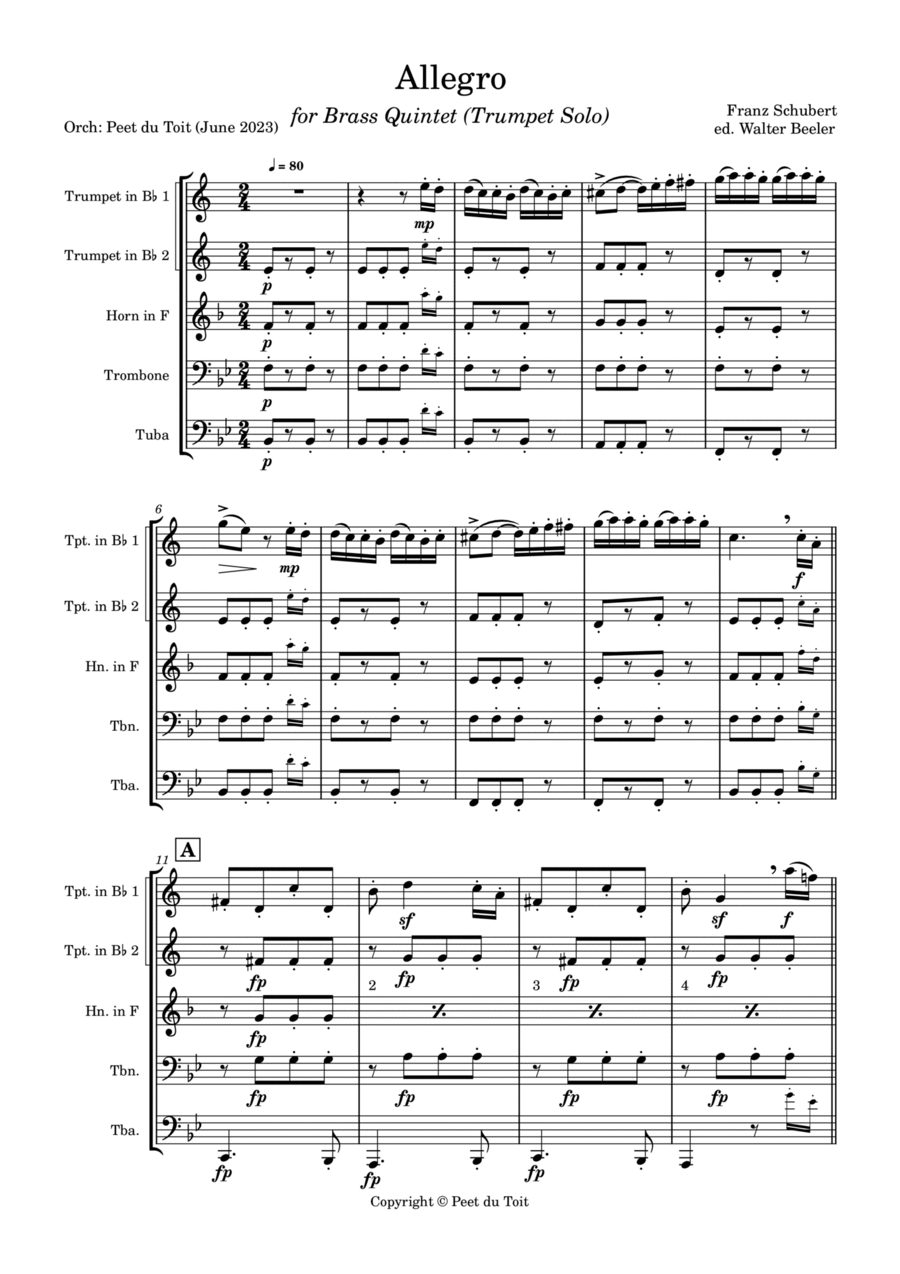
Allegro - Score Only
Quintette de Cuivres: 2 trompettes, Cor, trombone, tuba
Solo Trumpet Player
$17.00 14.26 € Quintette de Cuivres: 2 trompettes, Cor, trombone, tuba PDF SheetMusicPlus

Piano Solo - Digital Download SKU: A0.938197 Composed by John Bacchus Dykes. Arranged by April Rundquist. Christian,Sacred. Score. 8 pages. April Ann Rundquist #2033633. Published by April Ann Rundquist (A0.938197). This has always been a very visual arrangement for me with a rough narrative. It starts with the trumpets at the end of the world, the sense of quiet expectation. Wind across a field. It drops off into the silence of outer space. The initial theme presented against that impersonal void, knowing that He's out there, somewhere. Some of this is very difficult for me to describe because this is really about the Triune God, the great creative power, the mover in harmony and cooperation with Himself. The second verse is more grand, the love, the sense of story. And then it gets very, very big, in the way that I AM is always in capitals. Who WAS and IS and evermore shall BE! And in my mind that word BE is light, and just explodes against the blackness into a billion sparkles. And we shrink down to the microcosm for a moment, the wonders of His creative power in the tiny worlds, and it fades to the black of space again. Holy, Holy, Holy, though the darkness hide Thee. The Light that we can't see that would outshine all the stars. More beauty, and then we tumble down the waterfall of Living Water from the Throne of God...in Heaven. The golden palaces and the wonder, the unearthliness, the richness of the life. For a moment it's more simple and I'm reminded of an old hymn being sung in a rustic church. Then a vision of the Cosmic Christ from Revelation giving a benediction, and we're plunged into the chorus of Heaven, the new song of the 144,000. (this part sounds really good on an acoustic piano because the sound physically builds on itself) And it ends as it began...
Holy Holy Holy (To Thee We Sing)
Piano seul

$4.99 4.19 € Piano seul PDF SheetMusicPlus

Woodwind Ensemble,Woodwind Quintet Bassoon,Clarinet,Flute,Horn,Oboe - Level 3 - Digital Download SKU: A0.553834 Composed by Camille Saint-Saens. Arranged by Ray Thompson. Contemporary,Romantic Period,Standards. 7 pages. RayThompsonMusic #4897109. Published by RayThompsonMusic (A0.553834). The Carnival of the Animals (Le carnaval des animaux) is a humorous musical suite of fourteen movements by the French Romantic composer Camille Saint-Saëns. The work was written for private performance by an ad hoc ensemble of two pianos and other instruments, and lasts around 25 minutes.Originally scored Double bass and piano: this section is marked Allegro pomposo, the perfect caricature for an elephant. The piano plays a waltz-like triplet figure while the bass hums the melody beneath it. Like Tortues, this is also a musical joke-the thematic material is taken from the Scherzo from Mendelssohn's incidental music to A Midsummer Night's Dream and Berlioz's Dance of the Sylphs from The Damnation of Faust. The two themes were both originally written for high, lighter-toned instruments (flute and various other woodwinds, and violin, accordingly); the joke is that Saint-Saëns moves this to the lowest and heaviest-sounding instrument in the orchestra, the double bass.Arranged her for standard wind quintetI have given the tune to the bassoon with the horn taking the 8 bars of the Dance of the Sylphs music.The  notes of the chords are given to the other 3 instruments but not always tutti _ wind players have to breath!
Saint-Saëns: Le Carnaval des Animaux (The Carnival of the Animals) V. L'Éléphant - wind quintet
Quintette à Vent: flûte, Hautbois, basson, clarinette, Cor

$9.95 8.35 € Quintette à Vent: flûte, Hautbois, basson, clarinette, Cor PDF SheetMusicPlus


Partitions Gratuites
Acheter des Partitions Musicales
Acheter des Partitions Digitales à Imprimer
Acheter des Instruments de Musique

© 2000 - 2026

Accueil - Version intégrale





