EUROPE
969 articles
USA
5290 articles
DIGITAL
9077 articles (à imprimer)
Partitions Digitales
Partitions à imprimer
9077 partitions trouvées


Saxophone Quintet,Woodwind Ensemble Tenor Saxophone - Level 4 - Digital Download SKU: A0.813473 Composed by Johann Pachelbel. Arranged by Regis Bookshar. Baroque,Multicultural,Standards,Wedding,World. 27 pages. Regis Bookshar #6264887. Published by Regis Bookshar (A0.813473). Canon in D (Pachelbel) (D) (Tenor Saxophone Quintet) - Advanced/Intermediate - Digital Download. This selection, Johann Pachelbel's celebrated Canon in D, is perhaps the most famous canon ever written and has been one of my favorite compositions to arrange. A canon is a polyphonic device in which several voices play the same music, entering in sequence. Pachelbel's Canon in D, was originally written in the key of D Major and was scored for three violins arranged in canon, accompanied by a basso continuo which repeats the same harmonic progression throughout the entire piece. The common musical term for this is ostinato or ground bass. Regis Bookshar has now arranged this music for a Tenor Saxophone Quintet. Three Tenor Saxophones play the melody in canon while the ostinato accompaniment is played by the other two Tenor Saxophones. This arrangement is suitable for high school and college students but could also be performed by professional performers. It is perfect for concerts and church services, especially for Weddings, but could be performed for any occasion. Included are a score and a complete set of parts (27 pages). This version is written in the key of D Major, as is the original version, but, if you prefer, another version, written in the key of Bb Major, to make it a little easier for some younger performers, is also available. Other versions of Pachelbel's Canon in D have also been arranged by Regis Bookshar and are available for a wide variety of instrumental Quintets and Octets, in both the keys of D Major and Bb Major. I think that String players would probably prefer to play the versions in the key of D Major while the Brass and Woodwind musicians might prefer to play the Bb Major versions. I hope you take the time to compare the different versions to find the right version for you. To help you decide which version, or versions, you may want to choose, I have included several musical samples for you to listen to and to hear what these arrangements may sound like and so that you may compare the various arrangements. Also, just to let you know, the Octets written in the key of Bb Major have full-length recordings while the Octets in D Major and all Quintets have only the first 25 measures, or so, available to hear. Please feel free to search for other arrangements by Regis Bookshar which are also available. There are quite a few other arrangements in a variety of styles and I'm certain you will find something else which might interest you as well. Please keep checking because I plan to continue to add new arrangements as often as I can. I'm certain that this exciting arrangement of Pachelbel's Canon in D will be a challenge to some performers but will continue to entertain both performers and audiences alike for years to come.
Canon in D (Pachelbel) (D) (Tenor Saxophone Quintet)
Quintette de Saxophone: 5 saxophones

$20.00 16.89 € Quintette de Saxophone: 5 saxophones PDF SheetMusicPlus

Tenor Saxophone Solo - Level 4 - Digital Download SKU: A0.533334 Composed by Magaly Ruiz. 20th Century,Concert,Contemporary,Latin,Standards. Individual part. 7 pages. Musik Fabrik Music Publishing #2344363. Published by Musik Fabrik Music Publishing (A0.533334). Written for Paul Wehage for the 1997 Donne in Musica Festival in Fiuggi, Italy, this work uses elements of Cuban folk music. Doris Magaly Ruiz Lastres was born in Santa Clara, Cuba, in 1941 . In 1981 she graduated with a degree in Composition from the Instituto Superior de Arte de La Habana, where she studied with Harold Gramatges, CÉsar PÉrez Sentenat, JosÉ ArdÉvol, FÉlix Guerrero, Alfredo Diez Nieto, Dolores Torres and Roberto Valera. Since then, she has worked as a Professor at the Instituto as well as at the Instituto Superior Pedagógico Enrique JosÉ Varona and the provincial school of music, Amadeo Roldán. She has been worked for many years as technical advisor of the subject Harmony in the Dirección Nacional de Enseñanza Artística, and technical advisor in the Centro para la Investigación y Desarrollo de la Música Cubana. Her curriculum is published in prestigious dictionaries such as The Grove Dictionary of Music and Musicians and «Diccionario Iberoamericano de la Música». Several of her compositions are included as part of the curriculum of the leading music education institutions in Cuba, among them, the Conservatorio Amadeo Roldán, the Instituto Superior de Arte de La Habana, the Instituto Superior Pedagógico Enrique JosÉ Varona and Conservatorio Alejandro Garcia Caturla. Her compositions have been performed at many festivals such as the International Musical Festival, Festival de La Habana, Festival Boleros de Oro, International Festival of Contemporary Music, the International Festival Donne in Musica in Fiuggi, Italy and the Festival Sounds of Americas, New York, United States. She has received the First Award in the music contests Concurso La Edad de Oro, Concurso de la Dirección Nacional de Enseñanza Artística, Concurso Amadeo Roldán and the Concurso de la Unión Nacional de Escritores y Artistas de Cuba. She has also been awarded several medals and honours, among them The Medalla por la Educación Cubana, Medalla al MÉrito Pedagógico, Medalla JosÉ Tey, Distinción Especial of the Cuban Ministry of Education, and the Premio Anual de Composición of the Unión Nacional de Escritores y Artistas de Cuba for lifetime achievement.
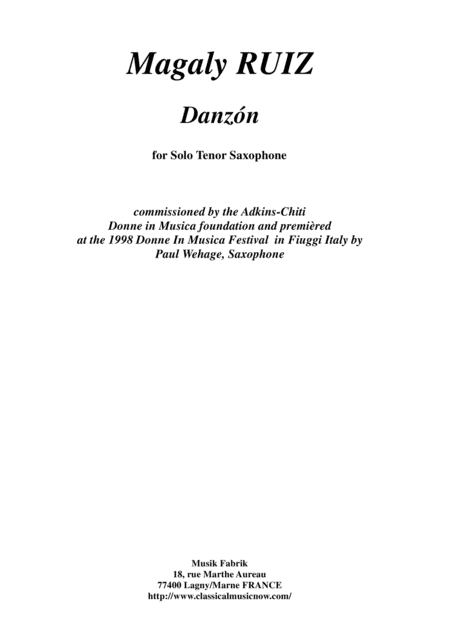
Magaly Ruiz: Danzón for solo tenor saxophone
Saxophone Tenor

$10.35 8.74 € Saxophone Tenor PDF SheetMusicPlus

Piano Solo - Level 3 - Digital Download SKU: A0.1399857 By Stacey Plays Hymns. By Stacey Plays Hymns. Arranged by Anastace. Christian,Easter,Praise & Worship,Religious,Sacred. Score. 5 pages. Anastace #983085. Published by Anastace (A0.1399857). Here is the piano solo version of He is Risen, as heard on my YouTube channel with all the other Easter and Holy week music. This piano solo works well for a prelude, postlude, or musical interlude during communion, especially for Resurrection Sunday or any of the Easter Season church services after Easter Sunday! If the full version is being used congregationally or as a sung solo in a service, this is a lovely way to tie the whole service together musically, by using this piano version as a postlude or prelude to make the service match nicely. Most recommended is to use the powerful, sung version as the Easter Proclamation at the beginning of the service, and this piano solo at the end to make a beautifully cohesive service.Also available, by searching Stacey Plays Hymns and the song title on this site, are the following versions:Piano Solo in D Major [to match original recording]Piano Vocal in D [original key]Piano Vocal in G [for high or low voices]Lead Sheets in several useful keysFor other formats including large print, or extended choral harmony versions, please write me at staceyplayshymns@gmail.com and I'll be glad to make them especially for you. Purchase includes a free license for one church service with under 300 people, with proper attribution and credit in any printed or online materials. For a license to use this work on a larger scale, please contact me for permission and other usage details including lyrics formatted for printing in church bulletins or for powerpoint. Please let me know if there is any other way I can serve you as a congregation or fellow music/choir director as I endeavour to write several new choral anthems per year, along with my other recording work.Thank you for supporting modern hymnwriters and musicians!
He Is Risen [Easter Piano Solo in C Major]
Piano seul
Stacey Plays Hymns
$5.00 4.22 € Piano seul PDF SheetMusicPlus

Choral Choir (SAB) - Digital Download SKU: A0.996345 Composed by Elizabeth Clarke. Arranged by Published by Suzy Johnson. Contemporary. Octavo. 11 pages. Suzanne Johnson #4883399. Published by Suzanne Johnson (A0.996345). This encouraging song was composed by Elizabeth Clarke, a nurse who generously gave all royalties to hospitals in her home country of Canada. It was recorded by several country singers as well as Doris Day and Bing Crosby.  The arrangement can be performed with straight or swung eighth notes. It includes a heartfelt second verse in a minor key and includes several measures of whistling. It is available in SAB or SAB Older Adult versions. (Older adult version is easier to read with bigger Arial print; notes and accompaniment have not been enlarged.) Will receive its premier with a dementia choir, but should be fun for any age. 3 minutes.
There's A Bluebird On Your Windowsill
Chorale 3 parties

$2.25 1.9 € Chorale 3 parties PDF SheetMusicPlus

Concert Band - Level 4 - Digital Download SKU: A0.1287085 Composed by Camille Saint-Saens. Arranged by Thomas PECHOT. 19th Century,Classical. Score and Parts. 102 pages. Thomas PECHOT #878092. Published by Thomas PECHOT (A0.1287085). Concert band PDF sheet music Several extra-parts for brass Several optional parts.Camille Saint-Saëns (1835-1921) composed in 1874 a tone poem : Danse Macabre, op. 40. This one is accompanied by a poem written by Henri Cazalis whose first lies are : « Zig, zig, zig, Death in cadence, Striking a tomb with his heel, Death at midnight plays a dance-tune, Zig, zig, zag, on his violin ». Danse Macabre was used in a lot of series and movies.More concert band PDF sheet music go to https://thomaspechot.com
Danse Macabre
Orchestre d'harmonie

$69.99 59.11 € Orchestre d'harmonie PDF SheetMusicPlus

Brass Ensemble - Level 4 - Digital Download SKU: A0.808684 Composed by Irving Berlin (1888–1989). Arranged by F. Leslie Smith. Holiday,Jazz,Patriotic. Score and parts. 42 pages. Sweetwater Brass Press #3582931. Published by Sweetwater Brass Press (A0.808684). Irving Berlin’s composition Alexander’s Ragtime Band was not only his first hit, it was also one of the most popular songs ever. It first gained widespread recognition when Emma Carus sang it in Chicago in 1911, and then it really took off when Al Jolson performed it in New York. It’s no wonder the popularity of Alexander’s has been so long-lived. Both words and music are absolutely bouncy and upbeat. The lyrics proclaim the Ragtime Band to be the best . . . in the land and invite the listener to come on and hear the group, even to meet its leader! The tune is energetic and lively, a salute to the toe-tapping Dixieland style that even then was developing in New Orleans.  This arrangement takes the natural exuberance of the melody and raises it a couple of notches. Wide open and sprightly, it features the trombone, but also gives each of the other parts a chance to shine, too. In addition to several iterations of the well-known chorus, it also includes the seldom-heard verse and even throws in a few true ragtime licks, quotes from Scott Joplin and Percy Wenrich. The tempo is a bouncy, cut-time 76, with some fairly tricky rhythms and one ritardando near the middle. Trumpet 1 plays a couple of notes above its staff, one A and one B. Trombone plays F above its staff several times and one brief G. Tuba’s lowest note is F below the staff. This arrangement was completed in 2018, and performance time runs about 4 minutes, 33 seconds. The arranger, Les Smith, would be very interested in your comments; contact him at lessmith@ufl.edu or leave a review on the SheetMusicPlus website. For more arrangements by Les, enter Sweetwater Brass Press (without the quotation marks) in the SheetMusicPlus or Sheet Music Direct search box. (Also, purchase of this piece entitles you to your choice of another of his arrangements at no charge; send a copy of your purchase receipt directly to him at lessmith61@bellsouth.net.)
Alexander’s Ragtime Band
Ensemble de cuivres

$9.95 8.4 € Ensemble de cuivres PDF SheetMusicPlus

Small Ensemble Flute,Harp - Level 5 - Digital Download SKU: A0.912915 Composed by Brandon Nelson. Concert,Contemporary. Score and parts. 16 pages. Brandon Nelson #1998621. Published by Brandon Nelson (A0.912915). A great piece to show off the talents of mature flute and lever harp performers, this colorful character piece is appropriate for any recital or concert setting. Mannanàn mac Lir occupied several roles in the mythological universe of the Celtic peoples. Most notably, he was considered to be the god of the seas. He was also regarded as a psychopomp-that is, a figure associated with the realm of the dead, acting as a sort of veil between the worlds. In this work, I play on his connection to the sea by quoting the traditional Manx folk tune The Storm Is Up (Callin Veg Dhoan). The tune is developed through several permutations, each portraying a role Mannanàn played. Each movement is ushered to us by a psychopomp veil. With the Churl in the Drab Coat refers to Mannanàn’s association with the trickster figure Bodach an Chota Lachtna. The movement is erratic yet impishly playful. Mannanàn was also regarded as a sort of magician king. In that respect, he was given the role of Guardian of Mag Mell, a place that is comparable to the Nordic conception of Valhalla. Mag Mell was a plain of joy, a kingdom under the sea for a select few. Mannanàn protected this realm with the help of Fragarach, a sword which could slice through any armor and could compel anyone to tell the truth. This movement is bold and heavy in spirit, gradually becoming more dissonant as if portraying an ugly battle to defend this beautiful place. The final veil transports us to the end of times, a fading away of the once-great pantheon. That storm, as all must do, comes to a quiet, peaceful end. Learn more about me at bnelsonmusic.wordpress.com.
Mannanan mac Lir
Harpe, Flûte (duo)

$12.99 10.97 € Harpe, Flûte (duo) PDF SheetMusicPlus

Piano Solo - Level 5 - Digital Download SKU: A0.828227 Composed by John Hatton. Arranged by Paul Thurmond. 20th Century,Baroque,Christian,Sacred. Score. 7 pages. Paul Thurmond #4968929. Published by Paul Thurmond (A0.828227). Tune: DUKE STREETUse: Prelude, PostludeOne Sunday my church was singing Jesus Shall Reign Where’er the Sun as the opening hymn. It’s our tradition that the last stanza of a hymn is sung in unison, so that I as the organist can change the harmonization and keep things interesting. Sometimes I know ahead of time what I’m going to do, and sometimes I make it up on the spot.On this particular morning I planned on being spontaneous. (Can spontaneity be planned?) When we got to the final stanza, I threw on the 16′ pedal reed and went to town.I don’t know if this is the case for all musicians, but while I’m playing my brain is working on several different levels. Most of these are involved in actually playing the music, but there’s also a running commentary on how things are going. This commentary is usually really boring: It’s going okay. It’s going okay. It’s going okay. Sometimes the messages are more interesting: Uh-oh. She just dropped her mute. I missed that chord; remember to circle it when we’re done. My page turner appears to be on fire.So: We’re in the final stanza of Jesus Shall Reign Where’er the Sun. Big, majestic hymn. Over a hundred congregants and choir members are enthusiastically singing in unison. I’m leading them from the organ with an improvised accompaniment that involves all of my limbs. It’s fair to say that I was concentrating hard.Suddenly the commentary part of my brain breaks in: Dude, your feet are totally playing Canon in D. Cool!Canon in D is the most famous work of Johann Pachelbel, a German composer who preceded Bach by a few decades. It’s overused at weddings, but it’s actually a really good piece of music. The original is for three violins and a basso continuo part, which would usually have been played by harpsichord and cello. In this case, the basso continuo plays the same eight measures again and again throughout the piece. This technique of repetition is called a ground bass. While that’s going on, the violins play several different themes on top of it.When I was improvising that Sunday, my feet had accidentally wandered into that ground bass part, which happened to fit nicely with the melody we were singing. During the sermon (sorry Pastor!) I started going through the violin themes in my head, seeing if any of them could also match up with the hymn tune. Some of them worked and some didn’t. I decided to write a sort of theme and variations, where the hymn tune appears in various forms. Sometimes it’s played along with one of the violin themes, and sometimes a violin theme serves as an interlude on its own. And except for one passage, the left hand is always playing some version of the basso continuo theme. I also changed the meter from 4/4 to 3/4 to make it more interesting. It culminates in a climax worthy of a king. I hope you enjoy it.
Jesus Shall Reign Where'er the Sun
Piano seul

$4.99 4.21 € Piano seul PDF SheetMusicPlus

Saxophone Ensemble,Woodwind Ensemble Alto Saxophone,Baritone Saxophone,Bass Saxophone,Soprano Saxophone,Tenor Saxophone - Level 4 - Digital Download SKU: A0.1140852 By Oscar Peterson. By Harriette Hamilton and Oscar Peterson. Arranged by James Pybus. 20th Century,Blues,Jazz,Praise & Worship,Spiritual. 39 pages. James Pybus #741106. Published by James Pybus (A0.1140852). Recognized as one of Oscar Peterson’s most significant compositions, Hymn to Freedom was written in 1962 and was swiftly embraced by people over the world as the anthem of the Civil Rights Movement. The piece was Peterson’s first major work and was written with encouragement from his producer and dear friend Norman Granz. During those initial recording sessions, Granz urged Peterson to create a tune with a “definitive early-blues feelâ€. For inspiration, Peterson drew upon various church renderings of Negro spirituals recalled from his childhood in Montreal. He aimed to maintain the unadorned, yet poignant quality of these early Baptist hymns while composing the beginning chorus of Hymn to Freedom. Upon its completion, Peterson and Granz decided that lyrics would complement the music and contacted Malcolm Dodds, composer, arranger and choir director of The Malcolm Dodds Singers, a backup group for many popular artists of the day. Dodds turned to his collaborator Harriette Hamilton, who had been writing lyrics for the choir group’s original compositions for several years. According to Hamilton, “all the lyrics had to do was express in very simple language the hope for unity, peace, and dignity for mankind. It was easy to write.†With Peterson on piano, Ray Brown on bass and Ed Thigpen on drums, the trio recorded the piece on Night Train (Verve 1962), which became one of their most commercially successful albums. Critical acclaim moved Peterson to record Hymn to Freedom on several albums that followed. This arrangement is playable by SATB Saxophone Quartet with optional Bass Saxophone, String Bass and Drums. For performances by SATB Saxophone Quartet without rhythm, the part marked Baritone Saxophone 2 (substitute Bass Saxophone) should be used. Some improvising is allowed for in the soprano, alto and tenor parts. Optional written solos are provided. This arrangement will enhance a wide variety of concert programmes and performance situations. The duration is 4:45. Contact me at james.pybus56@gmail.com.
Hymn To Freedom
Ensemble de saxophones
Oscar Peterson
$24.99 21.11 € Ensemble de saxophones PDF SheetMusicPlus

Woodwind Ensemble,Woodwind Quintet Flute - Level 2 - Digital Download SKU: A0.1128491 Composed by Ludwig van Beethoven. Arranged by Ander. Classical,Film/TV,Instructional,March,Romantic Period. 16 pages. Woods Only, Arrangements #729114. Published by Woods Only, Arrangements (A0.1128491). This arrangement adapted for flute quintet was written keeping the characteristics of the original work, in order to be performed by young music students who want to enter the symphonic music. Besides, it can also be used by professional musicians, for recitals, repertoire, academic presentations and didactic material. As much as it is a funeral march, it is well suited for any musical performance occasion. The transcription is faithful to the structure, with only one change of key, so that it is comfortable for all the instruments in the formation, as well as for use in ensemble practice between musicians of different traditions. Ludwig van Beethoven began concentrated work on his Symphony No. 7 in A major Op. 92 in 1811, it was completed in 1812, and was dedicated to Count Moritz von Fries, and premiered in Vienna on December 8, 1813. It is considered a remarkable example of the more ebullient side of Beethoven's compositional personality and evidence that even after the onset of deafness, he still found cause for musical optimism. The second movement Allegretto is a funeral march in everything but name. Often several contrasting melodic ideas are made to coexist, as if Beethoven were imagining several processions converging on the cemetery at the same time. As he was working on this symphony during the years of the Napoleonic Wars, this experience was probably within his experience. It was also used as the soundtrack to the film Knowing, by director Alex Proyas and starring Nicolas Cage, where it is used in the final scene of the film. Beethoven called Symphony No. 7 his most excellent symphony, and a music critic of the time reported, this symphony is the most melodically rich and the most pleasing and comprehensible of all Beethoven's symphonies..
Symphony No. 7 by Beethoven for Flute Quintet
Quintette de Flûte : 5 flûtes

$9.99 8.44 € Quintette de Flûte : 5 flûtes PDF SheetMusicPlus

Guitar,Piano,Vocal,Voice - Level 2 - Digital Download SKU: A0.1302223 By Barry Manilow. By Richard Kerr and Scott English. Arranged by Unimusic Academy. Contemporary,Pop,Rock,Singer/Songwriter. Score. 5 pages. Unimusic Academy (Academia Unimusica) #891827. Published by Unimusic Academy (Academia Unimusica) (A0.1302223). Mandy is a romantic song that has had several versions. It was recorded for the first time in 1971, with the title Brandy by Scott English, however, it achieved popularity with the version by the American Barry Manilow in 1974, being his first song to reach number one on the Billboard Hot 100 and his first golden song.1​2​In 1992 the Italian music producer Marco Parmigiani produced a Eurodance version on 12-inch vinyl. It was released in Italy on the Disc-O-Very Records label, and a year later it was published in Spain on the legendary Barcelona label Max Music. The version was heard a lot in Valencian clubs in the 90s.It was later re-recorded by the Irish group Westlife in 2003, and this version became number one on the UK chart.3The song also appeared in several films, such as Can't Hardly Wait, being performed by various characters. One theory says that because of Manilow's alcoholism, Brandy became Mandy.It is thought that Scott English wrote Brandy inspired by his favorite dog that he let escape. English claimed (reported in The Billboard Book of Number One Adult Contemporary Hits) that an assistant called him early that morning to ask who Brandy was, and he, irritated, lied that it was a dog so that the conversation will end quickly.When Manilow recorded Mandy he was not happy with the electronic rhythm of English's original version, so he preferred to sing it as a ballad and was much more pleased with the results.The song was parodied on the show Gift Grub under the title Andy on The Drew Carey Show, where the name Mandy is replaced by Kyra. Who also performed a parody of Mandy was the German singer LaFee at the age of 13. Thanks to this imitation, called Handy, a music producer discovered her in a children's singing competition in Germany.Korean actor, singer and model Jang Keun Suk sings this song during the movie You are my petIt also appeared in an episode of CSI: Crime Scene Investigation (originally aired in November 2006), and in an episode of The Simpsons, Homer sings it to Margo as Oh, Margo. Years later, in an episode of Family Guy, Manilow himself sings to Gregg a version of his song, Oh, Quagmire..
Mandy
Piano, Voix et Guitare
Barry Manilow
$8.00 6.76 € Piano, Voix et Guitare PDF SheetMusicPlus

Woodwind Ensemble Bassoon - Level 4 - Digital Download SKU: A0.813459 Composed by Johann Pachelbel. Arranged by Regis Bookshar. Baroque,Multicultural,Standards,Wedding,World. 30 pages. Regis Bookshar #6264763. Published by Regis Bookshar (A0.813459). Canon in D (Pachelbel) (D) (Bassoon Quintet) - Advanced/Intermediate - Digital Download. This selection, Johann Pachelbel's celebrated Canon in D, is perhaps the most famous canon ever written and has been one of my favorite compositions to arrange. A canon is a polyphonic device in which several voices play the same music, entering in sequence. Pachelbel's Canon in D, was originally written in the key of D Major and was scored for three violins arranged in canon, accompanied by a basso continuo which repeats the same harmonic progression throughout the entire piece. The common musical term for this is ostinato or ground bass. Regis Bookshar has now arranged this music for a Bassoon Quintet. Three Bassoons play the melody in canon while the ostinato accompaniment is played by the other two.Bassoons. This arrangement is suitable for high school and college students but could also be performed by professional performers. It is perfect for concerts and church services, especially for Weddings, but could be performed for any occasion. Included are a score and a complete set of parts (30 pages). This version is written in the key of D Major, as is the original version, but another version, if you prefer, is also available in the key of Bb Major, to make it a little easier for some younger performers. Other versions of Pachelbel's Canon in D have also been arranged by Regis Bookshar and are available for a wide variety of instrumental Quintets and Octets, in both the keys of D Major and Bb Major. I think that String players would probably prefer to play the versions in the key of D Major while the Brass and Woodwind musicians might prefer to play the Bb Major versions. I hope you take the time to compare the different versions to find the right version for you. To help you decide which version, or versions, you may want to choose, I have included several musical samples for you to listen to and to hear what these arrangements may sound like and so that you may compare the various arrangements. Also, just to let you know, the Octets written in the key of Bb Major have full-length recordings while the Octets in D Major and all Quintets have only the first 25 measures, or so, available to hear. Please feel free to search for other arrangements by Regis Bookshar which are also available. There are quite a few other arrangements in a variety of styles and I'm certain you will find something else which might interest you as well. Please keep checking because I plan to continue to add new arrangements as often as I can. I'm certain that this exciting arrangement of Pachelbel's Canon in D will be a challenge to some performers but will continue to entertain both performers and audiences alike for years to come.
Canon in D (Pachelbel) (D) (Bassoon Quintet)
Ensemble de Bassons

$20.00 16.89 € Ensemble de Bassons PDF SheetMusicPlus

Concert Band - Level 4 - Digital Download SKU: A0.1309766 Composed by Jay Rifkin, Lebo M, and Mark Mancina. Arranged by Andrea Smiley. Broadway,Classical,Film/TV,Multicultural,Musical/Show,World. 77 pages. Andrea Smiley #898932. Published by Andrea Smiley (A0.1309766). Several years ago, I lost my father suddenly.  One of the things that helped me through the grieving proess was music.  The music of Kings of the Past and He Lives in You from Disney's The Lion King resonated in me during this time and, being a musician, I started searching for an arrangement of this for symphonic wind ensemble.  Much to my disappointment, I could not find such an arrangement.  So, I sat down and wrote this out, developing the emotional tones I felt during the process, traveling from grief and despair to eventually hope and celebraton of who my father was and that he continues to abide in me in spirit, and developing the difficuty level I thought would be welcome in the type of ensemble I like to play in.  I would recommend this score and parts to a community band or a skilled high school band, as ther are several chances to highlight the different sections of the band with multiple solos that will challenge the range on the instrumentalists.
He Lives In You (reprise)
Orchestre d'harmonie

$65.00 54.9 € Orchestre d'harmonie PDF SheetMusicPlus

String Quintet Viola - Level 2 - Digital Download SKU: A0.1164613 Composed by Ludwig van Beethoven. Arranged by Ander. Classical,Film/TV,Instructional,March,Romantic Period. 16 pages. Woods Only, Arrangements #764948. Published by Woods Only, Arrangements (A0.1164613). This arrangement adapted for viola quintet was written keeping the characteristics of the original work, in order to be performed by young music students who want to enter the symphonic music. Besides, it can also be used by professional musicians, for recitals, repertoire, academic presentations and didactic material. As much as it is a funeral march, it is well suited for any musical performance occasion. The transcription is faithful to the structure, with only one change of key, so that it is comfortable for all the instruments in the formation, as well as for use in ensemble practice between musicians of different traditions.Ludwig van Beethoven began concentrated work on his Symphony No. 7 in A major Op. 92 in 1811, it was completed in 1812, and was dedicated to Count Moritz von Fries, and premiered in Vienna on December 8, 1813. It is considered a remarkable example of the more ebullient side of Beethoven's compositional personality and evidence that even after the onset of deafness, he still found cause for musical optimism. The second movement Allegretto is a funeral march in everything but name. Often several contrasting melodic ideas are made to coexist, as if Beethoven were imagining several processions converging on the cemetery at the same time. As he was working on this symphony during the years of the Napoleonic Wars, this experience was probably within his experience. It was also used as the soundtrack to the film Knowing, by director Alex Proyas and starring Nicolas Cage, where it is used in the final scene of the film. Beethoven called Symphony No. 7 his most excellent symphony, and a music critic of the time reported, this symphony is the most melodically rich and the most pleasing and comprehensible of all Beethoven's symphonies..
Symphony No. 7 by Beethoven for Viola Quintet

$9.99 8.44 € PDF SheetMusicPlus


Partitions Gratuites
Acheter des Partitions Musicales
Acheter des Partitions Digitales à Imprimer
Acheter des Instruments de Musique

© 2000 - 2026

Accueil - Version intégrale





