EUROPE
1 articles
USA
0 articles
DIGITAL
1356 articles (à imprimer)
Partitions Digitales
Partitions à imprimer
1356 partitions trouvées


Piano,Soprano Saxophone - Level 3 - Digital Download SKU: A0.549382 Composed by George Frideric Handel. Arranged by James M. Guthrie, ASCAP. Baroque,Sacred,Standards,Wedding. Score and part. 9 pages. Jmsgu3 #3492289. Published by jmsgu3 (A0.549382). Duration: 4:55, Score: 6 pages, Solo part: 1 page, piano part: 2 pages. A very famous aria (Ombra mai fu) from XerxesSuitable for any venue requiring meditative music. Excellent choice for a recital encore. Xerxes Xerxes is, in fact, an opera seria in three acts by Handel. Moreover, Handel conducted the premiere performance in London in 1738. Handel casts the opera in Persia in 470 BC. The part of Xerxes was indeed originally sung by a soprano castrato. Nowadays, the part is generally sung by a mezzo-soprano or conversely a counter-tenor. In the first place, Xerxes sings an opening aria, Ombra mai fu to a plane tree. Handel sets this aria to one of his most truly famous melodies. Although many refer to it traditionally as Handel’s Largo, Handel has, on the contrary, clearly marked Larghetto in the score. Handel Background George Frideric Handel (1685 - 1759) was born in Germany but eventually became a British citizen. Nonetheless, he was a famous Baroque composer. In fact, he became famous for his operas, oratorios, anthems, and organ concertos. Handel studied music and, by and large, worked as a composer in Germany and Italy before moving to London. On the whole, Handel was very familiar with the contemporary music of Italy and Germany. Career in England It is essential to realize that Italian opera was all the rage in England at the time. Moreover, Handel was really good at writing them. Therefore, he started not one but three opera companies in England. Alexander's Feast was a huge success in 1736, but Handel began composing English choral works. After success with the Messiah in 1742) he certainly never again wrote an Italian opera. Consequently, he died in 1759, a treasured genius. Accordingly, the English government gave him full state honors at his funeral. Hence, he is buried in Westminster Abbey in London. Legacy Music historians agree that Handel was in general one of the greatest composers of the Baroque era.  To demonstrate, his works such as the Messiah, Water Music, and Music for the Royal Fireworks remain consistently popular up to the present time. He especially composed the coronation anthem, Zadok the Priest for the coronation of George II. Nevertheless, it has specifically been performed at every succeeding British coronation since. His oratorio Solomon has by all means also continued to be prevalent. As a matter of fact, Sinfonia from act 3 was featured in the 2012 London Olympics opening ceremony. Handel was particularly prolific. To enumerate, he wrote over forty operas.  Since the late 1960s, we have expressly experienced a revival of baroque music. Similarly, we have especially seen a pique of interest in historically informed musical performances. Since his death in 1779, interest in Handel's music has all in all, expanded.  
Handel: Largo from Xerxes for Soprano Sax & Piano
Saxophone Soprano et Piano

$32.95 28.52 € Saxophone Soprano et Piano PDF SheetMusicPlus

Piano,Tenor Saxophone - Level 3 - Digital Download SKU: A0.549385 Composed by George Frideric Handel. Arranged by James M. Guthrie, ASCAP. Baroque,Sacred,Standards,Wedding. Score and part. 9 pages. Jmsgu3 #3492303. Published by jmsgu3 (A0.549385). Duration: 4:55, Score: 6 pages, Solo part: 1 page, piano part: 2 pages. A very famous aria (Ombra mai fu) from XerxesSuitable for any venue requiring meditative music. Excellent choice for a recital encore. Xerxes Xerxes is, in fact, an opera seria in three acts by Handel. Moreover, Handel conducted the premiere performance in London in 1738. Handel casts the opera in Persia in 470 BC. The part of Xerxes was indeed originally sung by a soprano castrato. Nowadays, the part is generally sung by a mezzo-soprano or conversely a counter-tenor. In the first place, Xerxes sings an opening aria, Ombra mai fu to a plane tree. Handel sets this aria to one of his most truly famous melodies. Although many refer to it traditionally as Handel’s Largo, Handel has, on the contrary, clearly marked Larghetto in the score. Handel Background George Frideric Handel (1685 - 1759) was born in Germany but eventually became a British citizen. Nonetheless, he was a famous Baroque composer. In fact, he became famous for his operas, oratorios, anthems, and organ concertos. Handel studied music and, by and large, worked as a composer in Germany and Italy before moving to London. On the whole, Handel was very familiar with the contemporary music of Italy and Germany. Career in England It is essential to realize that Italian opera was all the rage in England at the time. Moreover, Handel was really good at writing them. Therefore, he started not one but three opera companies in England. Alexander's Feast was a huge success in 1736, but Handel began composing English choral works. After success with the Messiah in 1742) he certainly never again wrote an Italian opera. Consequently, he died in 1759, a treasured genius. Accordingly, the English government gave him full state honors at his funeral. Hence, he is buried in Westminster Abbey in London. Legacy Music historians agree that Handel was in general one of the greatest composers of the Baroque era.  To demonstrate, his works such as the Messiah, Water Music, and Music for the Royal Fireworks remain consistently popular up to the present time. He especially composed the coronation anthem, Zadok the Priest for the coronation of George II. Nevertheless, it has specifically been performed at every succeeding British coronation since. His oratorio Solomon has by all means also continued to be prevalent. As a matter of fact, Sinfonia from act 3 was featured in the 2012 London Olympics opening ceremony. Handel was particularly prolific. To enumerate, he wrote over forty operas.  Since the late 1960s, we have expressly experienced a revival of baroque music. Similarly, we have especially seen a pique of interest in historically informed musical performances. Since his death in 1779, interest in Handel's music has all in all, expanded.  
Handel: Largo from Xerxes for Tenor Sax & Piano
Saxophone Tenor et Piano

$32.95 28.52 € Saxophone Tenor et Piano PDF SheetMusicPlus

Tenor Saxophone Duet Tenor Saxophone - Level 3 - Digital Download SKU: A0.589327 Composed by Traditional. Arranged by David McKeown. Jewish,Wedding,World. Score. 5 pages. David McKeown #6022271. Published by David McKeown (A0.589327). Silver Wedding, (Die Silberne Khasene in Yiddish), is a Jewish Folk tune, often performed by Klezmer musicians. This version is arranged as a duet for two Tenor Saxophones. Jewish Wedding bands, prominent in early twentieth century New York, were well placed to take advantage of the phonograph recording revolution. Accordingly, we are fortunate to have a rich record of the musical style of the time. Silver Wedding first appeared in a 1915 recording by Abe Elenkrig’s Orchestra. Elenkrig was born in Ukraine, which may point to the origins of the tune. Silver Wedding is in a Bulgar style, a happy piece designed to escort the newly-weds from the ceremony to the feast. Silver Wedding is simply arranged in a key and range best suited to the instruments. The melody is in three sections; overall the tune is played twice with a short introduction and coda and with constant variations in the accompaniment. Silver Wedding is suitable for players at an intermediate level and above. With a performance time of around three minutes, this version of Silver Wedding is perfect for weddings, celebrations and concert performances, both formal and informal. Click the link above to listen to a full Youtube performance of the Clarinet version of this duet.There are many more top quality arrangements and compositions by David McKeown for you to browse at http://www.sheetmusicplus.com/publishers/david-mckeown/6203 
Silver Wedding, Klezmer Tune for Tenor Saxophone Duet
2 Saxophones (duo)

$3.99 3.45 € 2 Saxophones (duo) PDF SheetMusicPlus

Soprano Saxophone Duet Soprano Saxophone - Level 3 - Digital Download SKU: A0.589326 Composed by Traditional. Arranged by David McKeown. Jewish,Wedding,World. Score. 5 pages. David McKeown #6022269. Published by David McKeown (A0.589326). Silver Wedding, (Die Silberne Khasene in Yiddish), is a Jewish Folk tune, often performed by Klezmer musicians. This version is arranged as a duet for two Soprano Saxophones. Jewish Wedding bands, prominent in early twentieth century New York, were well placed to take advantage of the phonograph recording revolution. Accordingly, we are fortunate to have a rich record of the musical style of the time. Silver Wedding first appeared in a 1915 recording by Abe Elenkrig’s Orchestra. Elenkrig was born in Ukraine, which may point to the origins of the tune. Silver Wedding is in a Bulgar style, a happy piece designed to escort the newly-weds from the ceremony to the feast. Silver Wedding is simply arranged in a key and range best suited to the instruments. The melody is in three sections; overall the tune is played twice with a short introduction and coda and with constant variations in the accompaniment. Silver Wedding is suitable for players at an intermediate level and above. With a performance time of around three minutes, this version of Silver Wedding is perfect for weddings, celebrations and concert performances, both formal and informal. Click the link above to listen to a full Youtube performance of the Clarinet version of this duet.There are many more top quality arrangements and compositions by David McKeown for you to browse at http://www.sheetmusicplus.com/publishers/david-mckeown/6203 
Silver Wedding, Klezmer Tune for Soprano Saxophone Duet
2 Saxophones (duo)

$3.99 3.45 € 2 Saxophones (duo) PDF SheetMusicPlus

Piano,Soprano Saxophone - Level 4 - Digital Download SKU: A0.533492 Composed by Ali Ben Sou Alle. Concert,Romantic Period,Standards. Score and part. 16 pages. Musik Fabrik Music Publishing #3000185. Published by Musik Fabrik Music Publishing (A0.533492). Souvenirs d’Angleterre is composed of an opening aria with a number of cadenzas followed by a Valse brillante with variations. Stylistically, the work seems to be more influenced by German Classical music (note especially the classical piano figurations in the opening aria, reminiscent of such composers as Beethoven and Weber). The Valse has an expressive variation in a minor key and the entire work ends, elegantly, pianissimo.One of the most enigmatic figures in the history of the Saxophone, Ali Ben Sou Alle (Charles-Valentin Soualle) was born in1820 in Arras, France. After receiving his first prize in Clarinet at the Paris Conservatory in 1844. he served as the director ofmusic of The French Marine Band in Senegal, and then was named first clarinet solo at the Opéra-Comique in Paris. However, after the Revolution of 1848, Soualle was forced to flee France to England where he settled in London, playing in the Orchestra of the Queen's Theatre. His songs and piano pieces were published in London.While in London, Soualle met another exiled French musician, Louis Antoine Jullien, who conducted a light music series inLondon. Jullien encouraged Soualle to take up the saxophone, and after modifying the instrument by adding a single octavemechanism (the modern system used today) and keys for the lower register, Soualle became known as a virtuoso and begantouring performing solo recitals (or mono-concerts, as they were called at the time) calling his modified saxophone the«turcophone ». He performed in all the European capitals and then traveled to Australia, New Zealand, Manilla, Java, throughChina and then to India where he finally settled in Mysore, becoming the director of the Royal Music for the Maharadjah. It wasduring this period that he converted to Islam and changed his nmae to Ali ben Sou Alle (or Ali, son of Soualle). Hesubsequently travaled to Ile Maurice, to French Polynesia, the Cap of Natal and the Cap of Good Hope. All of these voyageswere subjects of musical works which Soualle entitled Souvenirs de... and may perhaps have been part of a collection knownas The Royal Album which was presented to the Prince of Wales after a royal concert. Soualle returned to Mysore in 1858 and was almost killed in the Indian Revolution.Around 1860, Soualle returned to France for health reasons and began publishing his own music. On March 27 1865, heperformed a command performance for the Emperor Napoleon III at the Tuileries Palace in the presence of the entire ImperialFamily. After 1865, nothing more is known about him.
Ali Ben Sou Alle: Souvenirs d'Angleterre for soprano saxophone and piano
Saxophone Soprano et Piano

$11.95 10.34 € Saxophone Soprano et Piano PDF SheetMusicPlus

Tenor Saxophone Duet Tenor Saxophone - Level 3 - Digital Download SKU: A0.589024 Composed by Traditional. Arranged by David McKeown. Jewish,Wedding,World. Score. 4 pages. David McKeown #6020765. Published by David McKeown (A0.589024). Hava Nagila is a Hebrew Folk tune, often performed by Klezmer musicians. This version is arranged as a duet for two Tenor Saxophones. Hava Nagila was originally a Nigun melody thought to have originated in the Ukraine. In 1918 a professor and musicologist at the Hebrew University in Jerusalem, Abraham Zevi Idelsohn, set the tune to words adapted from Psalm 118. Hava Nagila was first performed at celebrations at the end of the Great War and quickly spread throughout the Jewish diaspora. In the fifties and sixties, performances by singers as diverse as Harry Belafonte and Bob Dylan popularised the song far beyond its original Jewish audience. Hava Nagila remains one of the best-known and loved Klezmer standards today, traditionally performed at Jewish celebrations.Hava Nagila is simply arranged in a key and range best suited to the instruments. After a steady beginning, the melody gradually increases in tempo, with constant variations in the accompaniment. Hava Nagila is suitable for players at an intermediate level and above. With a performance time of around two and a half minutes, this version of Hava Nagila is perfect for celebrations, weddings and concert performances, both formal and informal. Click the link above to listen to a full Youtube performance of the Clarinet version of this duet.There are many more top quality arrangements and compositions by David McKeown for you to browse at http://www.sheetmusicplus.com/publishers/david-mckeown/6203
Hava Nagila, Klezmer tune for Tenor Saxophone Duet
2 Saxophones (duo)

$3.99 3.45 € 2 Saxophones (duo) PDF SheetMusicPlus

Soprano Saxophone Duet Soprano Saxophone - Level 3 - Digital Download SKU: A0.589299 Composed by Traditional. Arranged by David McKeown. Jewish,Wedding,World. Score. 4 pages. David McKeown #6020799. Published by David McKeown (A0.589299). Hava Nagila is a Hebrew Folk tune, often performed by Klezmer musicians. This version is arranged as a duet for two Soprano Saxophones. Hava Nagila was originally a Nigun melody thought to have originated in the Ukraine. In 1918 a professor and musicologist at the Hebrew University in Jerusalem, Abraham Zevi Idelsohn, set the tune to words adapted from Psalm 118. Hava Nagile was first performed at celebrations at the end of the Great War and quickly spread throughout the Jewish diaspora. In the fifties and sixties, performances by singers as diverse as Harry Belafonte and Bob Dylan popularised the song far beyond its original Jewish audience. Hava Nagila remains one of the best-known and loved Klezmer standards today, traditionally performed at Jewish celebrations.Hava Nagila is simply arranged in a key and range best suited to the instruments. After a steady beginning, the melody gradually increases in tempo, with constant variations in the accompaniment. Hava Nagila is suitable for players at an intermediate level and above. With a performance time of around two and a half minutes, this version of Hava Nagila is perfect for celebrations, weddings and concert performances, both formal and informal. Click the link above to listen to a full Youtube performance of the Clarinet version of this duet.There are many more top quality arrangements and compositions by David McKeown for you to browse at http://www.sheetmusicplus.com/publishers/david-mckeown/6203
Hava Nagila, Klezmer tune for Soprano Saxophone Duet
2 Saxophones (duo)

$3.99 3.45 € 2 Saxophones (duo) PDF SheetMusicPlus

Piano,Soprano Saxophone - Level 4 - Digital Download SKU: A0.533351 Composed by Ali Ben Sou Alle. Arranged by Paul Wehage. Concert,Romantic Period,Standards. Score and part. 33 pages. Musik Fabrik Music Publishing #2363197. Published by Musik Fabrik Music Publishing (A0.533351). One of the most enigmatic figures in the history of the Saxophone, Ali Ben Sou Alle (Charles-Valentin Soualle) was born in1820 in Arras, France. After receiving his first prize in Clarinet at the Paris Conservatory in 1844. he served as the director ofmusic of The French Marine Band in Senegal, and then was named first clarinet solo at the Opéra-Comique in Paris. However, after the Revolution of 1848, Soualle was forced to flee France to England where he settled in London, playing in the Orchestra of the Queen's Theatre. His songs and piano pieces were published in London.While in London, Soualle met another exiled French musician, Louis Antoine Jullien, who conducted a light music series inLondon. Jullien encouraged Soualle to take up the saxophone, and after modifying the instrument by adding a single octavemechanism (the modern system used today) and keys for the lower register, Soualle became known as a virtuoso and begantouring performing solo recitals (or mono-concerts, as they were called at the time) calling his modified saxophone the«turcophone ». He performed in all the European capitals and then traveled to Australia, New Zealand, Manilla, Java, throughChina and then to India where he finally settled in Mysore, becoming the director of the Royal Music for the Maharadjah. It wasduring this period that he converted to Islam and changed his nmae to Ali ben Sou Alle (or Ali, son of Soualle). Hesubsequently travaled to Ile Maurice, to French Polynesia, the Cap of Natal and the Cap of Good Hope. All of these voyageswere subjects of musical works which Soualle entitled Souvenirs de... and may perhaps have been part of a collection knownas The Royal Album which was presented to the Prince of Wales after a royal concert. Soualle returned to Mysore in 1858 and was almost killed in the Indian Revolution.Around 1860, Soualle returned to France for health reasons and began publishing his own music. On March 27 1865, heperformed a command performance for the Emperor Napoleon III at the Tuileries Palace in the presence of the entire ImperialFamily. After 1865, nothing more is known about him.Souvenirs du Cap Bonne Espérence (Souvenirs of the Cap of Good Hope) begins with a dramatic aria, perhaps evoking the trip to the Cap which was, in the 19th century, still very dangerous. The Irish folksong « the Irish Emigrant » is presented as a them and in two variations. Finally an extended polka in rondo form finishes the work brilliantly.
Ali Ben Sou Alle: Souvenirs du Cap Bonne Espérence Largo, Variations sur “The Irish Emigrant" et Pol
Saxophone Soprano et Piano

$19.95 17.27 € Saxophone Soprano et Piano PDF SheetMusicPlus

Baritone Saxophone,Piano - Level 3 - Digital Download SKU: A0.549384 Composed by George Frideric Handel. Arranged by James M. Guthrie, ASCAP. Baroque,Sacred,Standards,Wedding. Score and part. 9 pages. Jmsgu3 #3492299. Published by jmsgu3 (A0.549384). Duration: 4:55, Score: 6 pages, Solo part: 1 page, piano part: 2 pages. A very famous aria (Ombra mai fu) from XerxesSuitable for any venue requiring meditative music. Excellent choice for a recital encore.Xerxes Xerxes is, in fact, an opera seria in three acts by Handel. Moreover, Handel conducted the premiere performance in London in 1738. Handel casts the opera in Persia in 470 BC. The part of Xerxes was indeed originally sung by a soprano castrato. Nowadays, the part is generally sung by a mezzo-soprano or conversely a counter-tenor. In the first place, Xerxes sings an opening aria, Ombra mai fu to a plane tree. Handel sets this aria to one of his most truly famous melodies. Although many refer to it traditionally as Handel’s Largo, Handel has, on the contrary, clearly marked Larghetto in the score. Handel Background George Frideric Handel (1685 - 1759) was born in Germany, but eventually became a British citizen. Nonetheless, he was a famous Baroque composer. In fact, he became famous for his operas, oratorios, anthems, and organ concertos. Handel studied music and, by and large, worked as a composer in Germany and Italy before moving to London. On the whole, Handel was very familiar with the contemporary music of Italy and Germany. Career in England It is important to realize that Italian opera was all the rage in England at the time. Moreover, Handel was really good at writing them. Therefore, he started not one but three opera companies in England. Alexander's Feast was a huge success in 1736, but Handel nevertheless began composing English choral works. After success with the Messiah in 1742) he certainly never again wrote an Italian opera. Consequently, he died in 1759, a treasured genius. Accordingly, the English government gave him full state honors at his funeral. Hence, he is buried in Westminster Abbey in London. Legacy Music historians agree that Handel was in general one of the greatest composers of the Baroque era.  To demonstrate, his works such as the Messiah, Water Music, and Music for the Royal Fireworks remain consistently popular up to the present time. He especially composed the coronation anthem, Zadok the Priest for the coronation of George II. Nevertheless, it has specifically been performed at every succeeding British coronation since. His oratorio Solomon has by all means also continued to be prevalent. As a matter of fact, the Sinfonia from act 3 was featured the 2012 London Olympics opening ceremony. Handel was particularly prolific. To enumerate, he wrote over forty operas.  Since the late 1960s, we have expressly experienced a revival of baroque music. Similarly, we have especially seen a pique of interest in historically informed musical performance. Since his death in 1779, interest in Handel's music has, all in all, expanded.   Register for free lifetime updates and revisions of this product at www.jamesguthrie.com.
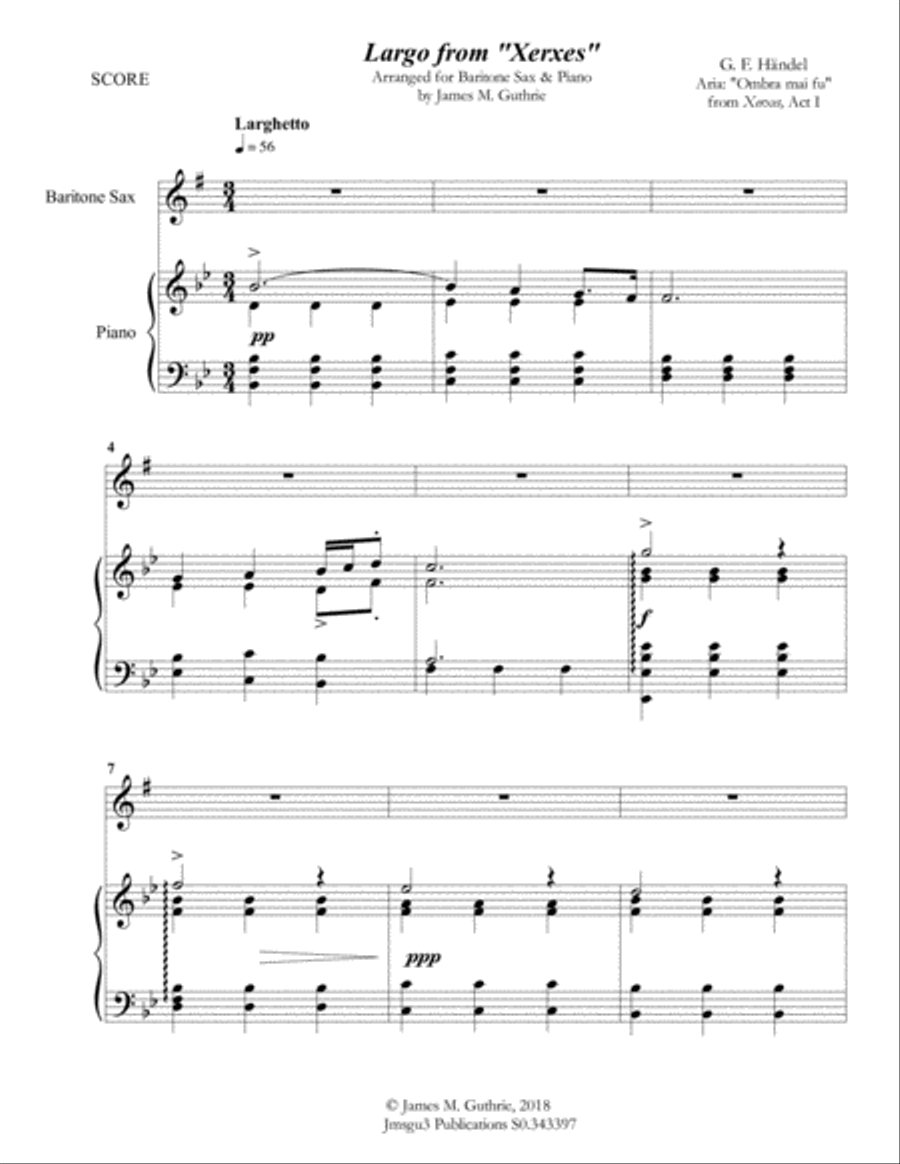
Handel: Largo from Xerxes for Baritone Sax & Piano
Saxophone Baryton, Piano

$32.95 28.52 € Saxophone Baryton, Piano PDF SheetMusicPlus

Piano,Tenor Saxophone - Level 2 - Digital Download SKU: A0.550935 Composed by J. S. Bach - Gounod. Arranged by James M. Guthrie, ASCAP. Christmas,Concert,Contemporary,Easter,Wedding. Score and part. 12 pages. Jmsgu3 #4888767. Published by jmsgu3 (A0.550935). This arrangement features the controversial Schwencke measure (ms. 27) that was originally introduced in 1783 by Christian Friedrich Gottlieb Schwencke. The convenient 1st & 2nd endings provide an option for extended performance. Duration with repeat - 4:50. Score: 7 pages. Solo part: 1 page, piano part: 4 pages. Based on Prelude #1 in C Major from the Well-Tempered Clavier, Book 1. Well suited for church meditations or school programs or recital encores. Register for free lifetime updates and revisions at www.jamesguthrie.comAve MariaAve Maria is a Catholic prayer that consequently asks for the mother of Jesus (Mary) to intercede. Charles Gounod composed a famous version of the Ave Maria. He was a French Romantic composer who overlaid a new melody on an existing Bach chord progression. The progression is from Bach’s Prelude No. 1 from Well-Tempered Clavier I. This version, as well as Schubert’s version, have become essential items at weddings, masses, and funerals.Bach OverviewFirst of all, Johann Sebastian Bach is maybe the greatest composer in music history. Certainly, he was prolific. As a result, everyone has heard of his works. Furthermore, these works number well over a thousand. It seems like people are probably most familiar with the instrumental works such as the Brandenburg Concertos, and the Goldberg Variations. But, similarly famous are such noteworthy works as the Well-Tempered Clavier, the Musical Offering, and certainly the Art of Fugue. Seems like his most famous vocal works include the most noteworthy Mass in B Minor. Also, most noteworthy, though, are the St. John Passion, and certainly the Christmas Oratorio. HistoryBach came from a long line of musicians and above all, composers. Consequently, he, first of all, pursued a career as a church organist. So as a result, he gained employment in various Protestant churches in Germany. For a while, he worked as a court musician in Weimar and Köthen. Here he probably developed his organ style and likewise his chamber music style. Eventually, he, therefore, gained an appointment as Cantor of St. Thomas in Leipzig. Here he worked until difficulties with his employer ultimately drove him away. The King of Poland finally appointed him as a court composer. StyleIt seems like Bach created a fascinating new international style. He synthesized elements of the most noteworthy European music ideas into his new style. Even more, this new style was probably his synthesis of European musical rhythm and form. Furthermore, he demonstrated a complete mastery of counterpoint and motivic development. His sense of harmonic organization probably propelled him to the top.Revival              Mendelssohn conducted a Bach revival in the nineteenth century. His effort probably helped to re-familiarize the public with the magnitude of Bach’s works. During this period, scholars published many noteworthy Bach biographies. Moreover, Wolfgang Schmieder published the BWV (Bach Werke Verzeichnis). As a result, this is now the official catalog of his entire artistic output. The BWV number allows us to locate a work in the catalog. Sometimes scholars will simply use an S (Schmieder) as an abbreviation for BWV. VoyagerNASA launched two Voyager spacecraft in 1977. Onboard are phonograph records with sounds, music, and images of life on Earth. The purpose of the launch was to inform intelligent extraterrestrial life forms about conditions on Earth. The music on the disc is varied. There is Bach, Mozart, Beethoven and Stravinsky among others. However, because Bach is so important in our music history, it contains three times more Bach that all the others combined.
Bach-Gounod: Ave Maria, Schwencke version for Tenor Sax & Piano
Saxophone Tenor et Piano

$27.95 24.19 € Saxophone Tenor et Piano PDF SheetMusicPlus

Piano,Soprano Saxophone - Level 2 - Digital Download SKU: A0.550932 Composed by J. S. Bach - Gounod. Arranged by James M. Guthrie, ASCAP. Christmas,Easter,Wedding. Score and part. 12 pages. Jmsgu3 #4888739. Published by jmsgu3 (A0.550932). This arrangement features the controversial Schwencke measure (ms. 27) that was originally introduced in 1783 by Christian Friedrich Gottlieb Schwencke. The convenient 1st & 2nd endings provide an option for extended performance. Duration with repeat - 4:50. Score: 6 pages. Solo part: 1 page, piano part: 4 pages. Based on Prelude #1 in C Major from the Well-Tempered Clavier, Book 1. Well suited for church meditations or school programs or recital encores.  Ave Maria Ave Maria is a Catholic prayer that consequently asks for the mother of Jesus (Mary) to intercede. Charles Gounod composed a famous version of the Ave Maria. He was a French Romantic composer who overlaid a new melody on an existing Bach chord progression. The progression is from Bach’s Prelude No. 1 from Well-Tempered Clavier I. This version, as well as Schubert’s version, have become essential items at weddings, masses, and funerals. Bach Overview First of all, Johann Sebastian Bach is maybe the greatest composer in music history. Certainly, he was prolific. As a result, everyone has heard of his works. Furthermore, these works number well over a thousand. It seems like people are probably most familiar with instrumental works such as the Brandenburg Concertos, and the Goldberg Variations. But, similarly famous are such noteworthy works as the Well-Tempered Clavier, the Musical Offering, and the Art of Fugue. Seems like his most famous vocal works include the most noteworthy Mass in B Minor. Also, most noteworthy, though, are the St. John Passion, and certainly the Christmas Oratorio.  History Bach came from a long line of musicians and above all, composers. Consequently, he, first of all, pursued a career as a church organist. So as a result, he gained employment in various Protestant churches in Germany. For a while, he worked as a court musician in Weimar and Köthen. Here he probably developed his organ style and likewise his chamber music style. Eventually, he, therefore, gained an appointment as Cantor of St. Thomas in Leipzig. Here he worked until difficulties with his employer ultimately drove him away. The King of Poland finally appointed him as a court composer.  Style It seems like Bach created an engaging new international style. He synthesized elements of the most noteworthy European music ideas into his new style. Even more, this new style was probably his synthesis of European musical rhythm and form. Furthermore, he demonstrated a complete mastery of counterpoint and motivic development. His sense of harmonic organization probably propelled him to the top. Revival               Mendelssohn conducted a Bach revival in the nineteenth century. His effort probably helped to re-familiarize the public with the magnitude of Bach’s works. During this period, scholars published many noteworthy Bach biographies. Moreover, Wolfgang Schmieder published the BWV (Bach Werke Verzeichnis). As a result, this is now the official catalog of his entire artistic output. The BWV number allows us to locate a work in the catalog. Sometimes scholars will simply use an S (Schmieder) as an abbreviation for BWV.  Voyager NASA launched two Voyager spacecraft in 1977. Onboard are phonograph records with sounds, music, and images of life on Earth. The purpose of the launch was to inform intelligent extraterrestrial life forms about conditions on Earth. The music on the disc is varied. There is Bach, Mozart, Beethoven, and Stravinsky among others. However, because Bach is so important in our music history, it contains three times more Bach than all the others combined.
Bach-Gounod: Ave Maria, Schwencke version for Soprano Sax & Piano
Saxophone Soprano et Piano

$32.95 28.52 € Saxophone Soprano et Piano PDF SheetMusicPlus

Baritone Saxophone,Piano - Level 2 - Digital Download SKU: A0.550924 Composed by J. S. Bach - Gounod. Arranged by James M. Guthrie, ASCAP. Christmas,Easter,Standards. Score and part. 12 pages. Jmsgu3 #4888325. Published by jmsgu3 (A0.550924). This arrangement features the controversial Schwencke measure (ms. 27) that was originally introduced in 1783 by Christian Friedrich Gottlieb Schwencke. The convenient 1st & 2nd endings provide an option for extended performance. Duration with repeat - 4:50. Score: 6 pages. Solo part: 1 page, piano part: 4 pages. Based on Prelude #1 in C Major from the Well-Tempered Clavier, Book 1. Well suited for church meditations or school programs or recital encores.  Ave Maria Ave Maria is a Catholic prayer that consequently asks for the mother of Jesus (Mary) to intercede. Charles Gounod composed a famous version of the Ave Maria. He was a French Romantic composer who overlaid a new melody on an existing Bach chord progression. The progression is from Bach’s Prelude No. 1 from Well-Tempered Clavier I. This version, as well as Schubert’s version, have become essential items at weddings, masses, and funerals. Bach Overview First of all, Johann Sebastian Bach is maybe the greatest composer in music history. Certainly, he was prolific. As a result, everyone has heard of his works. Furthermore, these works number well over a thousand. It seems like people are probably most familiar with instrumental works such as the Brandenburg Concertos, and the Goldberg Variations. But, similarly famous are such noteworthy works as the Well-Tempered Clavier, the Musical Offering, and the Art of Fugue. Seems like his most famous vocal works include the most noteworthy Mass in B Minor. Also, most noteworthy, though, are the St. John Passion, and certainly the Christmas Oratorio.  History Bach came from a long line of musicians and above all, composers. Consequently, he, first of all, pursued a career as a church organist. So as a result, he gained employment in various Protestant churches in Germany. For a while, he worked as a court musician in Weimar and Köthen. Here he probably developed his organ style and likewise his chamber music style. Eventually, he, therefore, gained an appointment as Cantor of St. Thomas in Leipzig. Here he worked until difficulties with his employer ultimately drove him away. The King of Poland finally appointed him as a court composer.  Style It seems like Bach created an engaging new international style. He synthesized elements of the most noteworthy European music ideas into his new style. Even more, this new style was probably his synthesis of European musical rhythm and form. Furthermore, he demonstrated a complete mastery of counterpoint and motivic development. His sense of harmonic organization probably propelled him to the top. Revival               Mendelssohn conducted a Bach revival in the nineteenth century. His effort probably helped to re-familiarize the public with the magnitude of Bach’s works. During this period, scholars published many noteworthy Bach biographies. Moreover, Wolfgang Schmieder published the BWV (Bach Werke Verzeichnis). As a result, this is now the official catalog of his entire artistic output. The BWV number allows us to locate a work in the catalog. Sometimes scholars will simply use an S (Schmieder) as an abbreviation for BWV.  Voyager NASA launched two Voyager spacecraft in 1977. Onboard are phonograph records with sounds, music, and images of life on Earth. The purpose of the launch was to inform intelligent extraterrestrial life forms about conditions on Earth. The music on the disc is varied. There is Bach, Mozart, Beethoven, and Stravinsky among others. However, because Bach is so important in our music history, it contains three times more Bach than all the others combined.
Bach-Gounod: Ave Maria, Schwencke version for Baritone Sax & Piano
Saxophone Baryton, Piano

$32.95 28.52 € Saxophone Baryton, Piano PDF SheetMusicPlus

Instrumental Duet Clarinet,Instrumental Duet,Soprano Saxophone - Level 3 - Digital Download SKU: A0.589325 Composed by Traditional. Arranged by David McKeown. Jewish,Wedding,World. Score and parts. 5 pages. David McKeown #6022267. Published by David McKeown (A0.589325). Silver Wedding, (Die Silberne Khasene in Yiddish), is a Jewish Folk tune, often performed by Klezmer musicians. This version is arranged as a duet for one Soprano Saxophone and one Clarinet. Jewish Wedding bands, prominent in early twentieth century New York, were well placed to take advantage of the phonograph recording revolution. Accordingly, we are fortunate to have a rich record of the musical style of the time. Silver Wedding first appeared in a 1915 recording by Abe Elenkrig’s Orchestra. Elenkrig was born in Ukraine, which may point to the origins of the tune. Silver Wedding is in a Bulgar style, a happy piece designed to escort the newly-weds from the ceremony to the feast. Silver Wedding is simply arranged in a key and range best suited to the instruments. The melody is in three sections; overall the tune is played twice with a short introduction and coda and with constant variations in the accompaniment. Silver Wedding is suitable for players at an intermediate level and above. With a performance time of around three minutes, this version of Silver Wedding is perfect for weddings, celebrations and concert performances, both formal and informal. Click the link above to listen to a full Youtube performance of the Clarinet version of this duet.There are many more top quality arrangements and compositions by David McKeown for you to browse at http://www.sheetmusicplus.com/publishers/david-mckeown/6203
Silver Wedding, Klezmer Tune for Soprano Saxophone and Clarinet Duet
Saxophone, Clarinette (duo)

$3.99 3.45 € Saxophone, Clarinette (duo) PDF SheetMusicPlus

Instrumental Duet Clarinet,Instrumental Duet,Soprano Saxophone - Level 3 - Digital Download SKU: A0.588559 Composed by Traditional. Arranged by David McKeown. Jewish,Wedding,World. Score and parts. 4 pages. David McKeown #6020767. Published by David McKeown (A0.588559). Hava Nagila is a Hebrew Folk tune, often performed by Klezmer musicians. This version is arranged as a duet for one Soprano Saxophone and one Clarinet.Hava Nagila was originally a Nigun melody thought to have originated in the Ukraine. In 1918 a professor and musicologist at the Hebrew University in Jerusalem, Abraham Zevi Idelsohn, set the tune to words adapted from Psalm 118. Hava Nagila was first performed at celebrations at the end of the Great War and quickly spread throughout the Jewish diaspora. In the fifties and sixties, performances by singers as diverse as Harry Belafonte and Bob Dylan popularised the song far beyond its original Jewish audience. Hava Nagila remains one of the best-known and loved Klezmer standards today, traditionally performed at Jewish celebrations.Hava Nagila is simply arranged in a key and range best suited to the instruments. After a steady beginning, the melody gradually increases in tempo, with constant variations in the accompaniment. Hava Nagila is suitable for players at an intermediate level and above. With a performance time of around two and a half minutes, this version of Hava Nagila is perfect for celebrations, weddings and concert performances, both formal and informal. Click the link above to listen to a full Youtube performance of the Clarinet version of this duet.There are many more top quality arrangements and compositions by David McKeown for you to browse at http://www.sheetmusicplus.com/publishers/david-mckeown/6203
Hava Nagila, Klezmer tune for Soprano Saxophone and Clarinet Duet
Saxophone, Clarinette (duo)

$3.99 3.45 € Saxophone, Clarinette (duo) PDF SheetMusicPlus

Piano,Soprano Saxophone - Level 4 - Digital Download SKU: A0.533349 Composed by Ali Ben Sou Alle. Arranged by Paul Wehage. Concert,Romantic Period,Standards. Score and part. 42 pages. Musik Fabrik Music Publishing #2348225. Published by Musik Fabrik Music Publishing (A0.533349). One of the most enigmatic figures in the history of the Saxophone, Ali Ben Sou Alle (Charles-Valentin Soualle) was born in 1820 in Arras, France. After receiving his first prize in Clarinet at the Paris Conservatory in 1844. he served as the director ofmusic of The French Marine Band in Senegal, and then was named first clarinet solo at the Opéra-Comique in Paris. However, after the Revolution of 1848, Soualle was forced to flee France to England where he settled in London, playing in the Orchestra of the Queen's Theatre. His songs and piano pieces were published in London. While in London, Soualle met another exiled French musician, Louis Antoine Jullien, who conducted a light music series in London. Jullien encouraged Soualle to take up the saxophone, and after modifying the instrument by adding a single octave mechanism (the modern system used today) and keys for the lower register, Soualle became known as a virtuoso and began touring performing solo recitals (or mono-concerts, as they were called at the time) calling his modified saxophone the «turcophone ». He performed in all the European capitals and then traveled to Australia, New Zealand, Manilla, Java, through China and then to India where he finally settled in Mysore, becoming the director of the Royal Music for the Maharadjah. It was during this period that he converted to Islam and changed his nmae to Ali ben Sou Alle (or Ali, son of Soualle). He subsequently travaled to Ile Maurice, to French Polynesia, the Cap of Natal and the Cap of Good Hope. All of these voyages were subjects of musical works which Soualle entitled Souvenirs de... and may perhaps have been part of a collection known as The Royal Album which was presented to the Prince of Wales after a royal concert. Soualle returned to Mysore in 1858 and was almost killed in the Indian Revolution. Around 1860, Soualle returned to France for health reasons and began publishing his own music. On March 27 1865, he performed a command performance for the Emperor Napoleon III at the Tuileries Palace in the presence of the entire Imperial Family. After 1865, nothing more is known about him.Souvenirs d’Ecosse begins with a classical aria which leads to theme and three variations on the Scottish song « Charley is my Darling », a ballade by Charles Gray (1782-1851). The work ends with a brillant and decidedly non-Scottish bolero, which was probably a piece that Soualle wrote while he was in Scotland.
Ali Ben Sou Alle: Souvenirs d’Écosse Introduction, Variations sur "Charley is my darling" et Boléro
Saxophone Soprano et Piano

$19.95 17.27 € Saxophone Soprano et Piano PDF SheetMusicPlus


Partitions Gratuites
Acheter des Partitions Musicales
Acheter des Partitions Digitales à Imprimer
Acheter des Instruments de Musique

© 2000 - 2026

Accueil - Version intégrale





