EUROPE
0 articles
USA
0 articles
DIGITAL
23 articles (à imprimer)
Partitions Digitales
Partitions à imprimer
23 partitions trouvées


String Orchestra - Level 4 - Digital Download SKU: A0.1183534 Composed by Joseph Bologne, Chevalier de St. Georges. Arranged by Robert Debbaut. Classical,Contest,Festival,Historic,Multicultural,World. 28 pages. ROBERT DEBBAUT #783207. Published by ROBERT DEBBAUT (A0.1183534). How is it that one can be born a slave in French colonial Guadeloupe and rise to be among Paris’ musical giants, to become a colonel in the French Army as well as the frequent dinner guest of princes and potentates? The story of Joseph Bologne, Chevalier de Saint-Georges, is surely an interesting one, even the stuff of which movies are made.Joseph Bologne’s father, Georges Bologne de Saint-Georges was a French planter. Saint-Georges was the name of his plantation. He impregnated Anne, the Senegalese slave of his wife, who bore him a son in 1745. Uncharacteristic of many of these sort of relationships he acknowledged the child was his and gave him his family name. When he was seven Bologne’s father took him to Paris for his education, enrolling him in a boarding school. Two years later he and the child’s mother returned to France and set up housekeeping as a family in Paris’ Saint-Germain-des-PrĂ©s district.At age thirteen Joseph’s father enrolled him in the Royal Technical Academy of Fencing and Swordsmanship. He quickly became the finest swordsman in the academy, perhaps in all of Paris. Upon graduation he was made an Officer of the King’s Bodyguard and a chevalier (an honorary knighthood). He went on to serve tours of duty in the French Army during the Seven Years War (1756-1763) and later after the French Revolution, where he was Colonel and commander of an all-Black regiment of the Revolutionary Army. All this in spite of the fact that French law forbade him, a man of African heritage, to become a citizen, to retain his father’s royal title of “Gentleman of the King’s Chamber,” or to marry outside his class.There is limited information about Bologne’s musical training, but he was obviously so well-skilled that Italian violinist-composer Antonio Lolli (1725-1802) wrote two violin concertos for him and French composer François-Joseph Gossec (1734-1829) dedicated his set of String Trios, Op. 9 to Bologne. Lolli may have worked with him on violin technique and Gossec composition, but this may be apocryphal. Bologne played in Gossec’s orchestra, and was later both leader and conductor of the group.As a composer Joseph Bologne was quite prolific, composing six operas, fourteen violin concertos, four symphonies concertantes, and numerous chamber works and songs. His Six String Quartets, Op. 1, Nos. 1-6 date from 1770-1771 and were published by the Paris publishing house of Jean-Georges Sieber (1738-1822) in 1773 (There are a total of 18 quartets: Six Quartets “au goĂ»t du jour” [up-to-date] from 1779 and the Opus 14 set of six which date from 1785). The Opus 1 quartets are dedicated to Anne Louis Alexandre de Montmorency (1724-1812), 7th Prince of Robeck (Robecq) and Grand Duke of Spain.The Opus 1 quartets all display a similarity to the Italian opera overtures from earlier in the Eighteenth Century (often called “sinfonia”) in that they have an overall “A-B-A” form with the ‘A’ sections being robust allegros and all ‘B’ sections marked “rondo.” As such, in arranging them for string orchestra it seemed quite natural to rename them “overtures.” Certain liberties were taken by the arranger in order to maintain the integrity of the classic Rondo formula. All six have been arranged in this manner for string orchestra. They vary in length from twelve to almost twenty minutes. If you wish to obtain parts, write to debbaut@gmail.com and pay $42 via venmo or $40 via personal check and they will be sent to you in pdf format.
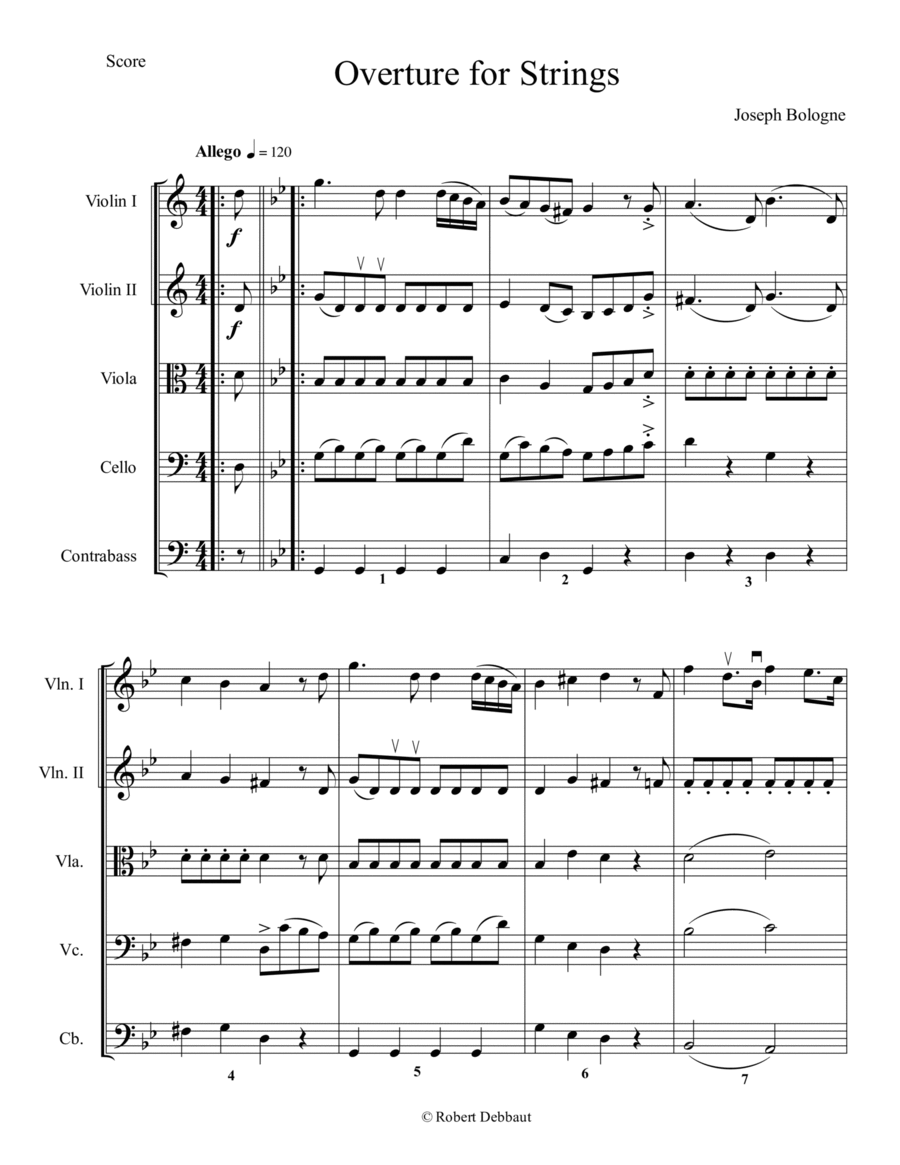
Overture for Strings No. 3 - Score Only
Orchestre à Cordes

$9.99 8.7 € Orchestre à Cordes PDF SheetMusicPlus

String Orchestra - Level 4 - Digital Download SKU: A0.1183537 Composed by Joseph Bologne, Chevalier de St. Georges. Arranged by Robert Debbaut. Classical,Contest,Festival,Historic,Multicultural,World. 57 pages. ROBERT DEBBAUT #783210. Published by ROBERT DEBBAUT (A0.1183537). How is it that one can be born a slave in French colonial Guadeloupe and rise to be among Paris’ musical giants, to become a colonel in the French Army as well as the frequent dinner guest of princes and potentates? The story of Joseph Bologne, Chevalier de Saint-Georges, is surely an interesting one, even the stuff of which movies are made.Joseph Bologne’s father, Georges Bologne de Saint-Georges was a French planter. Saint-Georges was the name of his plantation. He impregnated Anne, the Senegalese slave of his wife, who bore him a son in 1745. Uncharacteristic of many of these sort of relationships he acknowledged the child was his and gave him his family name. When he was seven Bologne’s father took him to Paris for his education, enrolling him in a boarding school. Two years later he and the child’s mother returned to France and set up housekeeping as a family in Paris’ Saint-Germain-des-PrĂ©s district.At age thirteen Joseph’s father enrolled him in the Royal Technical Academy of Fencing and Swordsmanship. He quickly became the finest swordsman in the academy, perhaps in all of Paris. Upon graduation he was made an Officer of the King’s Bodyguard and a chevalier (an honorary knighthood). He went on to serve tours of duty in the French Army during the Seven Years War (1756-1763) and later after the French Revolution, where he was Colonel and commander of an all-Black regiment of the Revolutionary Army. All this in spite of the fact that French law forbade him, a man of African heritage, to become a citizen, to retain his father’s royal title of “Gentleman of the King’s Chamber,” or to marry outside his class.There is limited information about Bologne’s musical training, but he was obviously so well-skilled that Italian violinist-composer Antonio Lolli (1725-1802) wrote two violin concertos for him and French composer François-Joseph Gossec (1734-1829) dedicated his set of String Trios, Op. 9 to Bologne. Lolli may have worked with him on violin technique and Gossec composition, but this may be apocryphal. Bologne played in Gossec’s orchestra, and was later both leader and conductor of the group.As a composer Joseph Bologne was quite prolific, composing six operas, fourteen violin concertos, four symphonies concertantes, and numerous chamber works and songs. His Six String Quartets, Op. 1, Nos. 1-6 date from 1770-1771 and were published by the Paris publishing house of Jean-Georges Sieber (1738-1822) in 1773 (There are a total of 18 quartets: Six Quartets “au goĂ»t du jour” [up-to-date] from 1779 and the Opus 14 set of six which date from 1785). The Opus 1 quartets are dedicated to Anne Louis Alexandre de Montmorency (1724-1812), 7th Prince of Robeck (Robecq) and Grand Duke of Spain.The Opus 1 quartets all display a similarity to the Italian opera overtures from earlier in the Eighteenth Century (often called “sinfonia”) in that they have an overall “A-B-A” form with the ‘A’ sections being robust allegros and all ‘B’ sections marked “rondo.” As such, in arranging them for string orchestra it seemed quite natural to rename them “overtures.” Certain liberties were taken by the arranger in order to maintain the integrity of the classic Rondo formula. All six have been arranged in this manner for string orchestra. They vary in length from twelve to almost twenty minutes. If you wish to obtain parts, write to debbaut@gmail.com and pay $42 via venmo or $40 via personal check and they will be sent to you in pdf format.
Overture for Strings No. 6 - Score Only
Orchestre à Cordes

$9.99 8.7 € Orchestre à Cordes PDF SheetMusicPlus

String Orchestra - Level 4 - Digital Download SKU: A0.1183535 Composed by Joseph Bologne, Chevalier de St. Georges. Arranged by Robert Debbaut. Classical,Contest,Festival,Historic,Multicultural,World. 34 pages. ROBERT DEBBAUT #783208. Published by ROBERT DEBBAUT (A0.1183535). How is it that one can be born a slave in French colonial Guadeloupe and rise to be among Paris’ musical giants, to become a colonel in the French Army as well as the frequent dinner guest of princes and potentates? The story of Joseph Bologne, Chevalier de Saint-Georges, is surely an interesting one, even the stuff of which movies are made.Joseph Bologne’s father, Georges Bologne de Saint-Georges was a French planter. Saint-Georges was the name of his plantation. He impregnated Anne, the Senegalese slave of his wife, who bore him a son in 1745. Uncharacteristic of many of these sort of relationships he acknowledged the child was his and gave him his family name. When he was seven Bologne’s father took him to Paris for his education, enrolling him in a boarding school. Two years later he and the child’s mother returned to France and set up housekeeping as a family in Paris’ Saint-Germain-des-PrĂ©s district.At age thirteen Joseph’s father enrolled him in the Royal Technical Academy of Fencing and Swordsmanship. He quickly became the finest swordsman in the academy, perhaps in all of Paris. Upon graduation he was made an Officer of the King’s Bodyguard and a chevalier (an honorary knighthood). He went on to serve tours of duty in the French Army during the Seven Years War (1756-1763) and later after the French Revolution, where he was Colonel and commander of an all-Black regiment of the Revolutionary Army. All this in spite of the fact that French law forbade him, a man of African heritage, to become a citizen, to retain his father’s royal title of “Gentleman of the King’s Chamber,” or to marry outside his class.There is limited information about Bologne’s musical training, but he was obviously so well-skilled that Italian violinist-composer Antonio Lolli (1725-1802) wrote two violin concertos for him and French composer François-Joseph Gossec (1734-1829) dedicated his set of String Trios, Op. 9 to Bologne. Lolli may have worked with him on violin technique and Gossec composition, but this may be apocryphal. Bologne played in Gossec’s orchestra, and was later both leader and conductor of the group.As a composer Joseph Bologne was quite prolific, composing six operas, fourteen violin concertos, four symphonies concertantes, and numerous chamber works and songs. His Six String Quartets, Op. 1, Nos. 1-6 date from 1770-1771 and were published by the Paris publishing house of Jean-Georges Sieber (1738-1822) in 1773 (There are a total of 18 quartets: Six Quartets “au goĂ»t du jour” [up-to-date] from 1779 and the Opus 14 set of six which date from 1785). The Opus 1 quartets are dedicated to Anne Louis Alexandre de Montmorency (1724-1812), 7th Prince of Robeck (Robecq) and Grand Duke of Spain.The Opus 1 quartets all display a similarity to the Italian opera overtures from earlier in the Eighteenth Century (often called “sinfonia”) in that they have an overall “A-B-A” form with the ‘A’ sections being robust allegros and all ‘B’ sections marked “rondo.” As such, in arranging them for string orchestra it seemed quite natural to rename them “overtures.” Certain liberties were taken by the arranger in order to maintain the integrity of the classic Rondo formula. All six have been arranged in this manner for string orchestra. They vary in length from twelve to almost twenty minutes. If you wish to obtain parts, write to debbaut@gmail.com and pay $42 via venmo or $40 via personal check and they will be sent to you in pdf format.

Overture for Strings No. 4 - Score Only
Orchestre à Cordes

$9.99 8.7 € Orchestre à Cordes PDF SheetMusicPlus

String Orchestra - Level 4 - Digital Download SKU: A0.1183536 Composed by Joseph Bologne, Chevalier de St. Georges. Arranged by Robert Debbaut. Classical,Contest,Festival,Historic,Multicultural,World. 39 pages. ROBERT DEBBAUT #783209. Published by ROBERT DEBBAUT (A0.1183536). How is it that one can be born a slave in French colonial Guadeloupe and rise to be among Paris’ musical giants, to become a colonel in the French Army as well as the frequent dinner guest of princes and potentates? The story of Joseph Bologne, Chevalier de Saint-Georges, is surely an interesting one, even the stuff of which movies are made.Joseph Bologne’s father, Georges Bologne de Saint-Georges was a French planter. Saint-Georges was the name of his plantation. He impregnated Anne, the Senegalese slave of his wife, who bore him a son in 1745. Uncharacteristic of many of these sort of relationships he acknowledged the child was his and gave him his family name. When he was seven Bologne’s father took him to Paris for his education, enrolling him in a boarding school. Two years later he and the child’s mother returned to France and set up housekeeping as a family in Paris’ Saint-Germain-des-PrĂ©s district.At age thirteen Joseph’s father enrolled him in the Royal Technical Academy of Fencing and Swordsmanship. He quickly became the finest swordsman in the academy, perhaps in all of Paris. Upon graduation he was made an Officer of the King’s Bodyguard and a chevalier (an honorary knighthood). He went on to serve tours of duty in the French Army during the Seven Years War (1756-1763) and later after the French Revolution, where he was Colonel and commander of an all-Black regiment of the Revolutionary Army. All this in spite of the fact that French law forbade him, a man of African heritage, to become a citizen, to retain his father’s royal title of “Gentleman of the King’s Chamber,” or to marry outside his class.There is limited information about Bologne’s musical training, but he was obviously so well-skilled that Italian violinist-composer Antonio Lolli (1725-1802) wrote two violin concertos for him and French composer François-Joseph Gossec (1734-1829) dedicated his set of String Trios, Op. 9 to Bologne. Lolli may have worked with him on violin technique and Gossec composition, but this may be apocryphal. Bologne played in Gossec’s orchestra, and was later both leader and conductor of the group.As a composer Joseph Bologne was quite prolific, composing six operas, fourteen violin concertos, four symphonies concertantes, and numerous chamber works and songs. His Six String Quartets, Op. 1, Nos. 1-6 date from 1770-1771 and were published by the Paris publishing house of Jean-Georges Sieber (1738-1822) in 1773 (There are a total of 18 quartets: Six Quartets “au goĂ»t du jour” [up-to-date] from 1779 and the Opus 14 set of six which date from 1785). The Opus 1 quartets are dedicated to Anne Louis Alexandre de Montmorency (1724-1812), 7th Prince of Robeck (Robecq) and Grand Duke of Spain.The Opus 1 quartets all display a similarity to the Italian opera overtures from earlier in the Eighteenth Century (often called “sinfonia”) in that they have an overall “A-B-A” form with the ‘A’ sections being robust allegros and all ‘B’ sections marked “rondo.” As such, in arranging them for string orchestra it seemed quite natural to rename them “overtures.” Certain liberties were taken by the arranger in order to maintain the integrity of the classic Rondo formula. All six have been arranged in this manner for string orchestra. They vary in length from twelve to almost twenty minutes. If you wish to obtain parts, write to debbaut@gmail.com and pay $42 via venmo or $40 via personal check and they will be sent to you in pdf format.

Overture for Strings No. 5 - Score Only
Orchestre à Cordes

$9.99 8.7 € Orchestre à Cordes PDF SheetMusicPlus

String Orchestra - Level 4 - Digital Download SKU: A0.1183533 Composed by Joseph Bologne, Chevalier de St. Georges. Arranged by Robert Debbaut. Classical,Contest,Festival,Historic,Multicultural,World. 43 pages. ROBERT DEBBAUT #783206. Published by ROBERT DEBBAUT (A0.1183533). How is it that one can be born a slave in French colonial Guadeloupe and rise to be among Paris’ musical giants, to become a colonel in the French Army as well as the frequent dinner guest of princes and potentates? The story of Joseph Bologne, Chevalier de Saint-Georges, is surely an interesting one, even the stuff of which movies are made.Joseph Bologne’s father, Georges Bologne de Saint-Georges was a French planter. Saint-Georges was the name of his plantation. He impregnated Anne, the Senegalese slave of his wife, who bore him a son in 1745. Uncharacteristic of many of these sort of relationships he acknowledged the child was his and gave him his family name. When he was seven Bologne’s father took him to Paris for his education, enrolling him in a boarding school. Two years later he and the child’s mother returned to France and set up housekeeping as a family in Paris’ Saint-Germain-des-PrĂ©s district.At age thirteen Joseph’s father enrolled him in the Royal Technical Academy of Fencing and Swordsmanship. He quickly became the finest swordsman in the academy, perhaps in all of Paris. Upon graduation he was made an Officer of the King’s Bodyguard and a chevalier (an honorary knighthood). He went on to serve tours of duty in the French Army during the Seven Years War (1756-1763) and later after the French Revolution, where he was Colonel and commander of an all-Black regiment of the Revolutionary Army. All this in spite of the fact that French law forbade him, a man of African heritage, to become a citizen, to retain his father’s royal title of “Gentleman of the King’s Chamber,” or to marry outside his class.There is limited information about Bologne’s musical training, but he was obviously so well-skilled that Italian violinist-composer Antonio Lolli (1725-1802) wrote two violin concertos for him and French composer François-Joseph Gossec (1734-1829) dedicated his set of String Trios, Op. 9 to Bologne. Lolli may have worked with him on violin technique and Gossec composition, but this may be apocryphal. Bologne played in Gossec’s orchestra, and was later both leader and conductor of the group.As a composer Joseph Bologne was quite prolific, composing six operas, fourteen violin concertos, four symphonies concertantes, and numerous chamber works and songs. His Six String Quartets, Op. 1, Nos. 1-6 date from 1770-1771 and were published by the Paris publishing house of Jean-Georges Sieber (1738-1822) in 1773 (There are a total of 18 quartets: Six Quartets “au goĂ»t du jour” [up-to-date] from 1779 and the Opus 14 set of six which date from 1785). The Opus 1 quartets are dedicated to Anne Louis Alexandre de Montmorency (1724-1812), 7th Prince of Robeck (Robecq) and Grand Duke of Spain.The Opus 1 quartets all display a similarity to the Italian opera overtures from earlier in the Eighteenth Century (often called “sinfonia”) in that they have an overall “A-B-A” form with the ‘A’ sections being robust allegros and all ‘B’ sections marked “rondo.” As such, in arranging them for string orchestra it seemed quite natural to rename them “overtures.” Certain liberties were taken by the arranger in order to maintain the integrity of the classic Rondo formula. All six have been arranged in this manner for string orchestra. They vary in length from twelve to almost twenty minutes. If you wish to obtain parts, write to debbaut@gmail.com and pay $42 via venmo or $40 via personal check and they will be sent to you in pdf format.

Overture for Strings No. 2 - Score Only
Orchestre à Cordes

$9.99 8.7 € Orchestre à Cordes PDF SheetMusicPlus

Choral Choir (SATB) - Level 3 - Digital Download SKU: A0.1084615 Composed by Alan Bullard. Children,Christmas,Classical. Octavo. 36 pages. Colne Edition / BullardMusic #688801. Published by Colne Edition / BullardMusic (A0.1084615). A seasonable celebration for SATB choir, optional youth choir and narrator, with piano (or brass quintet, or string quintet, score and parts available from www.colneedition.co.uk). Duration c. 25-30 minutes. This 8-movement cantata contrasts the cooking of the Christmas dinner with more reflective Christmas themes, with an opportunity for the audience to join in at the end. Ideal for Christmas concerts. We welcome you to our ‘Feast for Christmas’.  In the first movement, Christmas Welcome, the scene is set: but the key to a successful Christmas dinner is forward planning and in the second movement the Christmas Pudding is prepared in November, on ‘Stir-up Sunday’. In the third movement, Christmas Eve, the early twentieth century poet Robert Bridges looks back, on a frosty evening, from his own time to the very distant past, and considers what Christmas means to him. Then in the fourth movement, our Christmas Feast is prepared, and the Christmas Grace (fifth movement) is not forgotten.  It is of course impolite to sing during the actual Christmas Dinner itself, but towards the end of the meal the peace is rudely interrupted by the sixth movement, Christmas Crackers. The seventh movement, Christmas Spirit, reminds us, in seventeenth-century words, of how we should share our good fortune with those who have need of it, and in the last movement, Christmas Celebration, the audience is invited to join in, with the last verse of the well known ‘We wish you a merry Christmas’ Some separate movements are also available: Christmas Recipe, Festival (Christmas) Grace, and Christmas Celebration. Alan Bullard’s choral works are performed worldwide, and many have been recorded and broadcast. He has a growing reputation for music that choirs enjoy performing, and which speaks directly to audiences. The Colne Choral Series contains a range of Bullard’s pieces for adult and youth choirs of all types, including cantatas and choral suites as well as individual movements. For full details please visit www.colneedition.co.uk or www.alanbullard.co.uk.
A Feast for Christmas (a seasonal entertainment for SATB & optional youth choir)
Chorale SATB

$3.99 3.47 € Chorale SATB PDF SheetMusicPlus

Fl. Ob. Cl. Hn. Bsn. - Intermediate - Digital Download SKU: F2.FM629 Composed by Nicole Buetti. Five movements for Wind Quintet. Score and parts. 31 pages. Forton Music - Digital #FM629. Published by Forton Music - Digital (F2.FM629). ISBN 9790570485284.This piece was composed for the Assisi Performing Arts Festival woodwind quintet. It's made up of five movements, each reflecting a different aspect of the beautiful and mystical town of Assisi, Italy. Movement one, 'Sunrise', begins as the sun's light extends over walls and the many churches that adorn the mountainside. Movement 2 is entitled 'Tourists' and reflects the hustle and bustle of incoming visitors to the shops and chapels with imitations of car horns and the pandemonium of the crowds. The third movement is 'Monasteries'. As the orders of monks and nuns are called to Vespers, you can hear their voices from monasteries, chapels and churches throughout Assisi. A beautiful cacophony of sacred music rises above the town! The 4th movement is titled 'Rocca Maggiore' after the lookout post atop a great hill that looks out over the top of the city and across the valley. The hike up to this post is steep, but at the top you are rewarded with not only a spectacular view, but the songs of birds soaring over the town. The 5th and final movement is 'Sunset and Dinner with Family and Friends'. This movement symbolizes the end of the day as all the tourists are gone and the families and friends in Assisi sit down together for their delicious evening meals. Wine, incredible food and conversation close out the day as the sun sets behind the mountain. This piece was written as a tribute to one of the most spiritual and beautiful places in the world...Assisi, Italy.
Reflections of Assisi

$15.95 13.89 € PDF SheetMusicPlus

Saxophone Quartet,Woodwind Ensemble Alto Saxophone,Baritone Saxophone,Soprano Saxophone,Tenor Saxophone - Level 4 - Digital Download SKU: A0.1106177 Composed by Pierre Leemans. Arranged by James Pybus. 20th Century,Chamber,Contest,Festival,Historic,March. 21 pages. James Pybus #709291. Published by James Pybus (A0.1106177). Pierre Leemans, Dutch: Pieter Leemans, (1897 – 1980) was a Belgian musician and composer. He worked in a variety of genres, including orchestral and choral music, film scores, and songs, but is best known for his marches. The March of the Belgian Paratroopers (Marche des Parachutistes Belges) is especially popular. While Leemans was serving in the Belgian army during World War 1, on a request from his commander he began to write a march, which he did not finish. During World War 2, when the Belgian parachute brigade was formed, he was having dinner with a group of paratroopers and was again asked to compose a march. During one single night Leemans composed this march on themes recalled from his earlier effort. This arrangement for SATB Saxophone Quartet is suitable for a variety of performance and concert settings. The duration is 2:34. Contact me at james.pybus56@gmail.com.
March Of The Belgian Paratroops (marche Des Parachutistes Belges)
Quatuor de Saxophones: 4 saxophones

$20.00 17.42 € Quatuor de Saxophones: 4 saxophones PDF SheetMusicPlus

String Quartet Cello,String Quartet,Viola,Violin - Level 4 - Digital Download SKU: A0.1307119 By Ellie Goulding. By Ali Payami, Ilya, Max Martin, Savan Kotecha, and Tove Lo. Arranged by AZSAP MUSiC. Film/TV,Pop. 8 pages. AZSAP MUSiC #896373. Published by AZSAP MUSiC (A0.1307119). Indulge in the sultry and enchanting world of Love Me Like You Do from the iconic film 50 Shades of Grey, beautifully arranged for a string quartet. This arrangement captures the sensuality and passion of the original, making it a perfect choice for weddings, romantic events, or any occasion where love and desire take center stage.Key Features:1. Sensual Melodies: Immerse yourself in the seductive and emotive melodies of Love Me Like You Do, thoughtfully transcribed for violin, viola, and cello. The string quartet arrangement retains the song's intense and passionate essence, creating a stirring and intimate experience.2. Versatile Performance: Whether you're planning a wedding ceremony, a sultry cocktail hour, an anniversary celebration, or a romantic dinner, this arrangement adds a touch of sophistication and allure to your event. It appeals to both classical music enthusiasts and contemporary music lovers.3. Professional Arrangement: Crafted by skilled musicians, this arrangement ensures that each instrument contributes to the rich and emotionally charged performance, delivering a captivating and memorable musical experience.4. Emotional Depth: Love Me Like You Do is a song that resonates deeply with its themes of love, desire, and vulnerability. When performed by a string quartet, these emotions are intensified, creating a truly unforgettable experience.Experience the intoxicating charm of Love Me Like You Do through this exquisite string quartet arrangement. Let the music tell your love story and create memories that will last a lifetime, leaving your audience captivated and enthralled.
Love Me Like You Do
Quatuor à cordes: 2 violons, alto, violoncelle
Ellie Goulding
$12.99 11.31 € Quatuor à cordes: 2 violons, alto, violoncelle PDF SheetMusicPlus

Clarinet Quartet,Woodwind Ensemble Bass Clarinet - Level 4 - Digital Download SKU: A0.1453065 By mvmt. I from String Quartet No. 4 in C, KV 157. By Wolfgang Amadeus Mozart. Arranged by Mark A. Craig/Craig Music Publishers (ASCAP). Chamber,Classical,Multicultural,World. 28 pages. Mark A. Craig #1032312. Published by Mark A. Craig (A0.1453065). This clarinet quartet arrangement of the first movement, Allegro, from Wolfgang Amadeus Mozart's String Quartet No. 4 in C, KV 157, was written for professional, college, and upper-level high school ensembles. It's perfect for recitals, graduations, weddings, educational outreach events, and background dinner music gigs. My arrangements for CQ feature equally balanced parts--all Bb's will get to play the melody, counter melody/harmony, and obbligato/technical passages equally.If you like this arrangement, you might also like my clarinet quartet arrangement of Davide Delle Cese's L'Ingelsina (The Little English Girl). It's available on Sheet Music Direct:https://www.sheetmusicdirect.com/en-US/se/ID_No/911663/Product.aspxand Sheet Music Plus:https://www.sheetmusicplus.com/en/product/l-inglesina-the-little-english-girl-cq-20657563.htmlHere are some links if you'd like to check out my social media pages. Please like and follow my pages, and feel free to leave comments below. Thanks!Facebook: https://www.facebook.com/craigmusicpublishers/Instagram:  https://www.instagram.com/craigmusicpublishers/YouTube: www.youtube.com/@CraigMusicPublishers.
Allegro
Quatuor de Clarinettes: 4 clarinettes
mvmt I from String Quartet No
$15.00 13.06 € Quatuor de Clarinettes: 4 clarinettes PDF SheetMusicPlus

String Trio Cello,Viola,Violin - Level 3 - Digital Download SKU: A0.1307117 By Dario Marianelli. By Dario Marianelli. Arranged by AZSAP MUSiC. Classical,Film/TV. 4 pages. AZSAP MUSiC #896371. Published by AZSAP MUSiC (A0.1307117). Embark on a journey to the refined world of classical elegance with our enchanting string trio arrangement of Liz on Top of the World from the beloved Pride and Prejudice movie soundtrack. This arrangement is thoughtfully crafted for violin, cello, and a versatile second violin/viola part, offering a flexible and beautiful musical addition for weddings, events, or intimate gatherings.Key Features:1. Graceful Arrangement: Liz on Top of the World is known for its timeless beauty and elegance, and this string trio arrangement expertly captures the delicate melodies and emotive atmosphere of the original score.2. Versatile Second Violin/Viola Parts: This arrangement provides the choice to perform the second violin or viola part, ensuring adaptability to suit the strengths and preferences of the ensemble, making it suitable for various trio configurations.3. Ideal for Special Occasions: Whether you're planning a wedding, a cocktail reception, a romantic dinner, or any event that calls for refined musical accompaniment, this arrangement adds a touch of sophistication and romance to the atmosphere.4. Captivating Musical Experience: Liz on Top of the World is celebrated for its ability to convey a sense of timeless romance and serenity, and this arrangement evokes the same sentiments, creating a captivating and memorable experience for your audience.Delight in the elegance and timeless charm of Liz on Top of the World with this versatile string trio arrangement. Whether you're the lead violinist, cellist, or choose to perform the second violin or viola part, this arrangement promises a beautiful and evocative musical journey that will resonate deeply with your listeners, leaving a lasting impression on your special occasion.
Liz On Top Of The World
Trio à Cordes: violon, alto, violoncelle
Dario Marianelli
$12.99 11.31 € Trio à Cordes: violon, alto, violoncelle PDF SheetMusicPlus

Woodwind Ensemble,Woodwind Quintet Bass Clarinet,Bassoon,Flute,Horn,Oboe - Level 3 - Digital Download SKU: A0.1447498 By Adoramus Vocal Ensemble Burrows Mark. By Antiphon For Maundy Thursday and Maurice Durufle. Arranged by Mark A. Craig/Craig Music Publishers. 20th Century,Holiday,Multicultural,Sacred,World. 17 pages. Mark A. Craig #1027280. Published by Mark A. Craig (A0.1447498). This setting of Maurice Duruflé's beautiful motet, Ubi Caritas, is from his Quatre Motets and arranged for woodwind quintet. Originally a choral music standard, this transcription is perfect for recitals, background dinner music gigs, funerals, or church services. This arrangement can be performed by most ensembles, ranging from advanced high school ensembles to professional woodwind quintets. I have included an alternate bass clarinet part in lieu of a missing bassoon.The live recording for this piece includes a bass clarinetist in place of a bassoonist. If you would like to hear the original version with bassoon, please visit my YouTube page: https://youtu.be/4w1Fw2fomqcIf you like this arrangement, you might like another one of my choral transcriptions: Charles Villiers Standford's Beati Quorum Via, available on Sheet Music Plus: https://www.sheetmusicplus.com/en/product/stanford-beati-quorum-via-from-three-latin-motets-opus-38-21875273.html and Sheet Music Direct: https://www.sheetmusicdirect.com/en-US/se/ID_No/911720/Product.aspxHere are some links if you'd like to check out my social media pages. Facebook: https://www.facebook.com/craigmusicpublishers/Instagram:  https://www.instagram.com/craigmusicpublishers/YouTube: www.youtube.com/@CraigMusicPublishers.
Ubi Caritas
Quintette à Vent: flûte, Hautbois, basson, clarinette, Cor
Adoramus Vocal Ensemble Burrows Mark
$15.00 13.06 € Quintette à Vent: flûte, Hautbois, basson, clarinette, Cor PDF SheetMusicPlus

C Instrument - Level 2 - Digital Download SKU: A0.880963 By Desi Valentine. By Desi Valentine, Nana, Nana Afriyie, and Rune Westberg. Arranged by Marco Polo C. Ignacio. Contemporary. Lead Sheet / Fake Book. 2 pages. MARCO POLO IGNACIO #6362145. Published by MARCO POLO IGNACIO (A0.880963). Desi Valentine was born and raised in Catford London. Desi is a UK native that is paving the way for his bluesy, soulful sound to blend with today’s modern pop world. Having sung backing vocals for such artists as Sir Elton John and Gloria Estefan and starred in West End and Broadway shows. His song Fate Don't Know You: When Fate Don’t Know You landed on Spotify’s Viral 50 internationally, Desi had just been laid off from a bartending job. It was so strange to be wildly celebrated on one hand, and then really struggling on the other, he says. When the song went up on the charts, Desi was rehearsing to open for Blondie, making plans for Bumbershoot festival, and then going to 7-11 for dinner because a hot dog was $2.99..
Fate Don't Know You
Instruments en Do
Desi Valentine
$4.99 4.35 € Instruments en Do PDF SheetMusicPlus


Partitions Gratuites
Acheter des Partitions Musicales
Acheter des Partitions Digitales à Imprimer
Acheter des Instruments de Musique

© 2000 - 2026

Accueil - Version intégrale


