EUROPE
484 articles
USA
0 articles
DIGITAL
9660 articles (à imprimer)
Partitions Digitales
Partitions à imprimer
9660 partitions trouvées


Instrumental Duet Instrumental Duet,Piano - Level 5 - Digital Download SKU: A0.966758 Composed by IL EST NE, UN FLAMBEAU JEANNETTE ISABELLE. Arranged by Dillon Ekle. 20th Century,Christian,Christmas. Score and parts. 21 pages. Dillon Ekle #6110795. Published by Dillon Ekle (A0.966758). This advanced duet is primarily inspired by the carol He Is Born, but also contains many references to Bring a Torch, Jeannette, Isabelle. Both melodies are explored in several minor modes before He Is Born is finally presented in its familiar, major tonality.Careful pedaling is essential to keep the running lines clear and to allow staccato articulations to pop against legato melody lines. The melodies move through several ranges of the keyboard and across both players, requiring the musicians to be aware of balance within their own parts and across the instrument.The PDF file is formatted to be printed double-sided. Once printed and bound, odd numbered pages (including the cover page) should be on the right (where the primo player sits), and even numbered pages should be on the left (where the secondo player sits). Alternatively, if two pianos are being used, the file can be printed single-sided and the parts separated out; the primo player will have the odd numbered pages, and the secondo player will have the even numbered pages.
He Is Born
1 Piano, 4 mains

$4.99 4.32 € 1 Piano, 4 mains PDF SheetMusicPlus

Bass Clarinet,Instrumental Solo - Level 3 - Digital Download SKU: A0.1314265 Composed by Camille Saint-Saens. Arranged by James M. Guthrie. 19th Century,Chamber,Contest,Festival,Historic,Wedding. Individual part. 11 pages. Jmsgu3 #903006. Published by jmsgu3 (A0.1314265). Saint-Saëns: The Swan (Le Cygne) movement 13 from the Carnival of the Animals Suite. One of his most popular and widely recognized works, it is the only movement from the Carnival Suite that Saint-Saëns permitted to be performed publicly during his lifetime. This is an excellent recital encore to demonstrate melodic playing and strategic phrasing.The Carnival of the AnimalsThe Carnival of the Animals is an entertaining musical suite of fourteen movements by Camille Saint-Saëns. The work was composed for private performance by an ensemble of two pianos and solo instruments. The Swan (No. 13) is among the fourteen most famous movements. In its entirety, it lasts about 25 minutes.Saint-Saëns BackgroundCharles-Camille Saint-Saëns 1835 – 1921) was, by all means, in particular, a famous French composer, brilliant organist, and significant musical mastermind of the Romantic era. Indeed, his most famous compositions, in the long run, include his Piano Concerto No. 2 (1868), Cello Concerto No. 1 (1872), and the Danse macabre (1874). Notwithstanding, we must also add Violin Concerto No. 3 (1880), Symphony No. 3 (the Organ Symphony, 1886), and, it must be remembered, Carnival of the Animals (1886) to the list.ChildhoodIt is essential to realize that Saint-Saëns was undoubtedly, in fact, a child musical prodigy. Consequently, with this in mind, he made his concert debut, albeit at ten years old. Another critical point to remember is that he expressly studied at the Paris Conservatoire, then, despite reality, conversely followed a traditional career path as a church organist. Nevertheless, twenty years later, on the other hand, he left to become a successful freelance pianist and composer despite, as has been noted, his former employment situation. Furthermore, his performances were, after all, markedly in demand - not only in Europe but, above all, in the Americas all in all as well.YouthA point often overlooked is that in his youth, Saint-Saëns was undoubtedly excited about the modern music of the day. He was, in essence, fond of the music of his contemporaries, particularly Schumann, Liszt, and, for the most part, Wagner. In contrast, however, his compositions seemed, in fact, primarily confined within the conservative classical tradition. Be that as it may, he was, at the same time, nevertheless, a scholar of musical history.CriticismOn the whole, his conservatism, in fact, ultimately brought him into frequent conflict in his later years with composers of the impressionist and, in particular, the dodecaphonic schools of musical thought. A point often overlooked is that he included neoclassical elements in his music, contrary to some critics. Furthermore, in so doing, he provided the most compelling evidence that he predicted the techniques and works by Stravinsky and Les Six. To put it another way, given these points, he was regarded, perhaps for the most part unfairly, as a non-progressive reactionary henceforth around the time of his passing.LegacySaint-Saëns taught briefly in Paris, where his students included Gabriel Fauré. Maurice Ravel later studied with Fauré. In conclusion, both Ravel and Fauré were powerfully influenced by Saint-Saëns, whom they respected as a musical mastermind.
Saint-Saëns: The Swan for Bass Clarinet & Piano
Clarinette Basse

$32.95 28.52 € Clarinette Basse PDF SheetMusicPlus

Piano,Soprano Saxophone - Level 3 - Digital Download SKU: A0.1314331 Composed by Camille Saint-Saens. Arranged by James M. Guthrie. 19th Century,Chamber,Contest,Festival,Historic,Romantic Period. Score and part. 11 pages. Jmsgu3 #903074. Published by jmsgu3 (A0.1314331). Saint-Saëns: The Swan (Le Cygne) movement 13 from the Carnival of the Animals Suite. One of his most popular and widely recognized works, it is the only movement from the Carnival Suite that Saint-Saëns permitted to be performed publicly during his lifetime. This is an excellent recital encore to demonstrate melodic playing and strategic phrasing.The Carnival of the AnimalsThe Carnival of the Animals is an entertaining musical suite of fourteen movements by Camille Saint-Saëns. The work was composed for private performance by an ensemble of two pianos and solo instruments. The Swan (No. 13) is among the fourteen most famous movements. In its entirety, it lasts about 25 minutes.Saint-Saëns BackgroundCharles-Camille Saint-Saëns 1835 – 1921) was, by all means, in particular, a famous French composer, brilliant organist, and significant musical mastermind of the Romantic era. Indeed, his most famous compositions, in the long run, include his Piano Concerto No. 2 (1868), Cello Concerto No. 1 (1872), and the Danse macabre (1874). Notwithstanding, we must also add Violin Concerto No. 3 (1880), Symphony No. 3 (the Organ Symphony, 1886), and, it must be remembered, Carnival of the Animals (1886) to the list.ChildhoodIt is essential to realize that Saint-Saëns was undoubtedly, in fact, a child musical prodigy. Consequently, with this in mind, he made his concert debut, albeit at ten years old. Another critical point to remember is that he expressly studied at the Paris Conservatoire, then, despite reality, conversely followed a traditional career path as a church organist. Nevertheless, twenty years later, on the other hand, he left to become a successful freelance pianist and composer despite, as has been noted, his former employment situation. Furthermore, his performances were, after all, markedly in demand - not only in Europe but, above all, in the Americas all in all as well.YouthA point often overlooked is that in his youth, Saint-Saëns was undoubtedly excited about the modern music of the day. He was, in essence, fond of the music of his contemporaries, particularly Schumann, Liszt, and, for the most part, Wagner. In contrast, however, his compositions seemed, in fact, primarily confined within the conservative classical tradition. Be that as it may, he was, at the same time, nevertheless, a scholar of musical history.CriticismOn the whole, his conservatism, in fact, ultimately brought him into frequent conflict in his later years with composers of the impressionist and, in particular, the dodecaphonic schools of musical thought. A point often overlooked is that he included neoclassical elements in his music, contrary to some critics. Furthermore, in so doing, he provided the most compelling evidence that he predicted the techniques and works by Stravinsky and Les Six. To put it another way, given these points, he was regarded, perhaps for the most part unfairly, as a non-progressive reactionary henceforth around the time of his passing.LegacySaint-Saëns taught briefly in Paris, where his students included Gabriel Fauré. Maurice Ravel later studied with Fauré. In conclusion, both Ravel and Fauré were powerfully influenced by Saint-Saëns, whom they respected as a musical mastermind.
Saint-Saëns: The Swan for Soprano Sax & Piano
Saxophone Soprano et Piano

$32.95 28.52 € Saxophone Soprano et Piano PDF SheetMusicPlus

French Horn,Piano - Level 3 - Digital Download SKU: A0.1313124 Composed by Camille Saint-Saens. Arranged by James M. Guthrie. 19th Century,Chamber,Contest,Festival,Romantic Period,Wedding. Score and part. 9 pages. Jmsgu3 #901955. Published by jmsgu3 (A0.1313124). Saint-Saëns: The Swan (Le Cygne) movement 13 from the Carnival of the Animals Suite. One of his most popular and widely recognized works, it is the only movement from the Carnival Suite that Saint-Saëns permitted to be performed publicly during his lifetime. This is an excellent recital encore to demonstrate melodic playing and strategic phrasing.The Carnival of the AnimalsThe Carnival of the Animals is an entertaining musical suite of fourteen movements by Camille Saint-Saëns. The work was composed for private performance by an ensemble of two pianos and solo instruments. The Swan (No. 13) is among the fourteen most famous movements. In its entirety, it lasts about 25 minutes.Saint-Saëns BackgroundCharles-Camille Saint-Saëns 1835 – 1921) was, by all means, in particular, a famous French composer, brilliant organist, and significant musical mastermind of the Romantic era. Indeed, his most famous compositions, in the long run, include his Piano Concerto No. 2 (1868), Cello Concerto No. 1 (1872), and the Danse macabre (1874). Notwithstanding, we must also add Violin Concerto No. 3 (1880), Symphony No. 3 (the Organ Symphony, 1886), and, it must be remembered, Carnival of the Animals (1886) to the list.ChildhoodIt is essential to realize that Saint-Saëns was undoubtedly, in fact, a child musical prodigy. Consequently, with this in mind, he made his concert debut, albeit at ten years old. Another critical point to remember is that he expressly studied at the Paris Conservatoire, then, despite reality, conversely followed a traditional career path as a church organist. Nevertheless, twenty years later, on the other hand, he left to become a successful freelance pianist and composer despite, as has been noted, his former employment situation. Furthermore, his performances were, after all, markedly in demand - not only in Europe but, above all, in the Americas all in all as well.YouthA point often overlooked is that in his youth, Saint-Saëns was undoubtedly excited about the modern music of the day. He was, in essence, fond of the music of his contemporaries, particularly Schumann, Liszt, and, for the most part, Wagner. In contrast, however, his compositions seemed, in fact, primarily confined within the conservative classical tradition. Be that as it may, he was, at the same time, nevertheless, a scholar of musical history.CriticismOn the whole, his conservatism, in fact, ultimately brought him into frequent conflict in his later years with composers of the impressionist and, in particular, the dodecaphonic schools of musical thought. A point often overlooked is that he included neoclassical elements in his music, contrary to some critics. Furthermore, in so doing, he provided the most compelling evidence that he predicted the techniques and works by Stravinsky and Les Six. To put it another way, given these points, he was regarded, perhaps for the most part unfairly, as a non-progressive reactionary henceforth around the time of his passing.LegacySaint-Saëns taught briefly in Paris, where his students included Gabriel Fauré. Maurice Ravel later studied with Fauré. In conclusion, both Ravel and Fauré were powerfully influenced by Saint-Saëns, whom they respected as a musical mastermind.

Saint-Saëns: The Swan for French Horn & Piano
Cor et Piano

$32.95 28.52 € Cor et Piano PDF SheetMusicPlus

Oboe,Piano - Level 3 - Digital Download SKU: A0.1314269 Composed by Camille Saint-Saens. Arranged by James M. Guthrie. 19th Century,Chamber,Contest,Festival,Historic,Romantic Period. Score and part. 11 pages. Jmsgu3 #903011. Published by jmsgu3 (A0.1314269). Saint-Saëns: The Swan (Le Cygne) movement 13 from the Carnival of the Animals Suite. One of his most popular and widely recognized works, it is the only movement from the Carnival Suite that Saint-Saëns permitted to be performed publicly during his lifetime. This is an excellent recital encore to demonstrate melodic playing and strategic phrasing.The Carnival of the AnimalsThe Carnival of the Animals is an entertaining musical suite of fourteen movements by Camille Saint-Saëns. The work was composed for private performance by an ensemble of two pianos and solo instruments. The Swan (No. 13) is among the fourteen most famous movements. In its entirety, it lasts about 25 minutes.Saint-Saëns BackgroundCharles-Camille Saint-Saëns 1835 – 1921) was, by all means, in particular, a famous French composer, brilliant organist, and significant musical mastermind of the Romantic era. Indeed, his most famous compositions, in the long run, include his Piano Concerto No. 2 (1868), Cello Concerto No. 1 (1872), and the Danse macabre (1874). Notwithstanding, we must also add Violin Concerto No. 3 (1880), Symphony No. 3 (the Organ Symphony, 1886), and, it must be remembered, Carnival of the Animals (1886) to the list.ChildhoodIt is essential to realize that Saint-Saëns was undoubtedly, in fact, a child musical prodigy. Consequently, with this in mind, he made his concert debut, albeit at ten years old. Another critical point to remember is that he expressly studied at the Paris Conservatoire, then, despite reality, conversely followed a traditional career path as a church organist. Nevertheless, twenty years later, on the other hand, he left to become a successful freelance pianist and composer despite, as has been noted, his former employment situation. Furthermore, his performances were, after all, markedly in demand - not only in Europe but, above all, in the Americas all in all as well.YouthA point often overlooked is that in his youth, Saint-Saëns was undoubtedly excited about the modern music of the day. He was, in essence, fond of the music of his contemporaries, particularly Schumann, Liszt, and, for the most part, Wagner. In contrast, however, his compositions seemed, in fact, primarily confined within the conservative classical tradition. Be that as it may, he was, at the same time, nevertheless, a scholar of musical history.CriticismOn the whole, his conservatism, in fact, ultimately brought him into frequent conflict in his later years with composers of the impressionist and, in particular, the dodecaphonic schools of musical thought. A point often overlooked is that he included neoclassical elements in his music, contrary to some critics. Furthermore, in so doing, he provided the most compelling evidence that he predicted the techniques and works by Stravinsky and Les Six. To put it another way, given these points, he was regarded, perhaps for the most part unfairly, as a non-progressive reactionary henceforth around the time of his passing.LegacySaint-Saëns taught briefly in Paris, where his students included Gabriel Fauré. Maurice Ravel later studied with Fauré. In conclusion, both Ravel and Fauré were powerfully influenced by Saint-Saëns, whom they respected as a musical mastermind.

Saint-Saëns: The Swan for Oboe & Piano
Hautbois, Piano (duo)

$32.95 28.52 € Hautbois, Piano (duo) PDF SheetMusicPlus

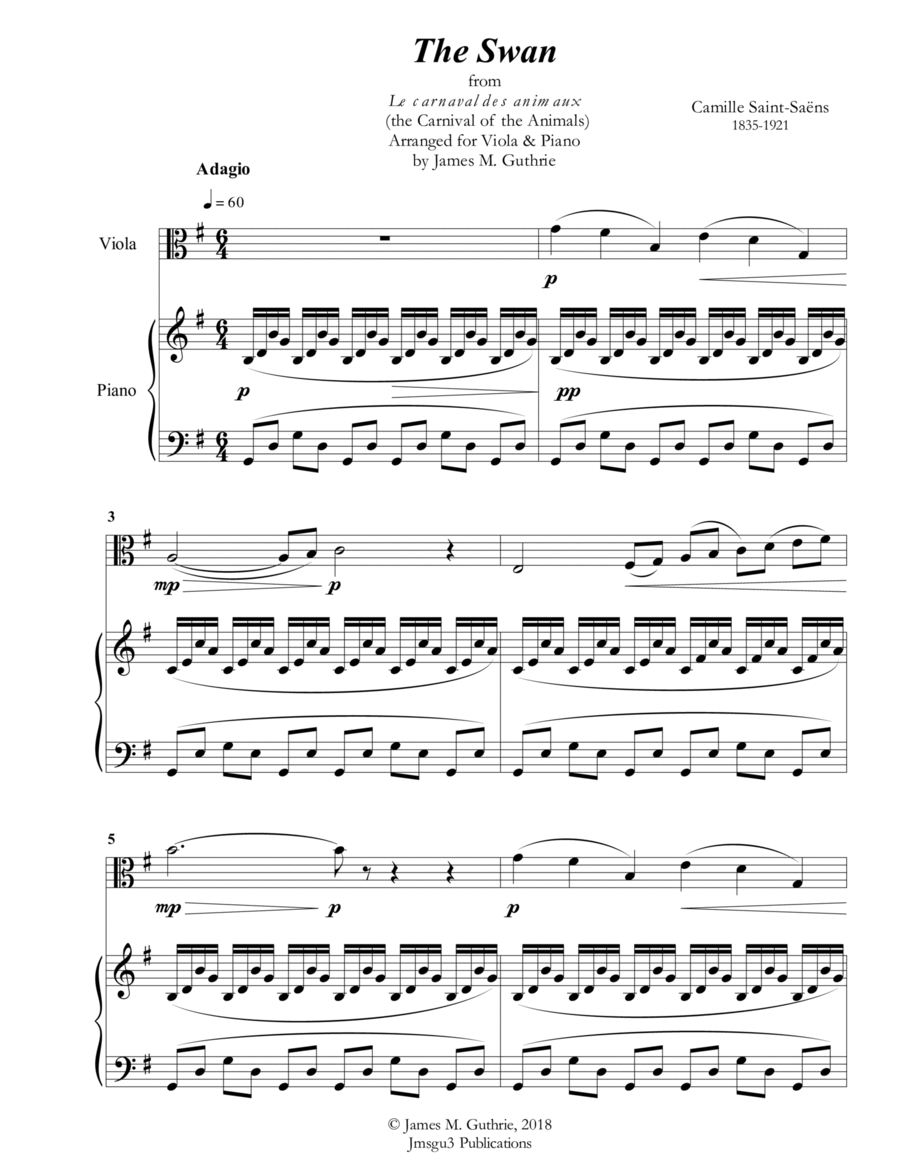
Piano,Viola - Level 3 - Digital Download SKU: A0.1254033 Composed by Camille Saint-Saens. Arranged by James M. Guthrie, ASCAP. 19th Century,Chamber,Contest,Festival,Historic,Romantic Period. Score and part. 9 pages. Jmsgu3 #847646. Published by jmsgu3 (A0.1254033). Saint-Saëns: The Swan (Le Cygne) movement 13 from the Carnival of the Animals Suite. One of his most popular and widely recognized works, it is the only movement from the Carnival Suite that Saint-Saëns permitted to be performed publicly during his lifetime. This is an excellent recital encore to demonstrate melodic playing and strategic phrasing.The Carnival of the AnimalsThe Carnival of the Animals is an entertaining musical suite of fourteen movements by Camille Saint-Saëns. The work was composed for private performance by an ensemble of two pianos and solo instruments. The Swan (No. 13) is among the fourteen most famous movements. In its entirety, it lasts about 25 minutes.Saint-Saëns BackgroundCharles-Camille Saint-Saëns 1835 – 1921) was, by all means, in particular, a famous French composer, brilliant organist, and significant musical mastermind of the Romantic era. Indeed, his most famous compositions, in the long run, include his Piano Concerto No. 2 (1868), Cello Concerto No. 1 (1872), and the Danse macabre (1874). Notwithstanding, we must also add Violin Concerto No. 3 (1880), Symphony No. 3 (the Organ Symphony, 1886), and, it must be remembered, Carnival of the Animals (1886) to the list.ChildhoodIt is essential to realize that Saint-Saëns was undoubtedly, in fact, a child musical prodigy. Consequently, with this in mind, he made his concert debut, albeit at ten years old. Another critical point to remember is that he expressly studied at the Paris Conservatoire, then, despite reality, conversely followed a traditional career path as a church organist. Nevertheless, twenty years later, on the other hand, he left to become a successful freelance pianist and composer despite, as has been noted, his former employment situation. Furthermore, his performances were, after all, markedly in demand - not only in Europe but, above all, in the Americas all in all as well.YouthA point often overlooked is that in his youth, Saint-Saëns was undoubtedly excited about the modern music of the day. He was, in essence, fond of the music of his contemporaries, particularly Schumann, Liszt, and, for the most part, Wagner. In contrast, however, his compositions seemed, in fact, primarily confined within the conservative classical tradition. Be that as it may, he was, at the same time, nevertheless, a scholar of musical history.CriticismOn the whole, his conservatism, in fact, ultimately brought him into frequent conflict in his later years with composers of the impressionist and, in particular, the dodecaphonic schools of musical thought. A point often overlooked is that he included neoclassical elements in his music, contrary to some critics. Furthermore, in so doing, he provided the most compelling evidence that he predicted the techniques and works by Stravinsky and Les Six. To put it another way, given these points, he was regarded, perhaps for the most part unfairly, as a non-progressive reactionary henceforth around the time of his passing.LegacySaint-Saëns taught briefly in Paris, where his students included Gabriel Fauré. Maurice Ravel later studied with Fauré. In conclusion, both Ravel and Fauré were powerfully influenced by Saint-Saëns, whom they respected as a musical mastermind.

Saint-Saens: The Swan for Viola and Piano
Alto, Piano

$34.95 30.25 € Alto, Piano PDF SheetMusicPlus

Cello,Piano - Level 3 - Digital Download SKU: A0.1314243 Composed by Camille Saint-Saens. Arranged by James M. Guthrie. 19th Century,Contest,Festival,Historic,Romantic Period,Wedding. Score and part. 11 pages. Jmsgu3 #902984. Published by jmsgu3 (A0.1314243). Saint-Saëns: The Swan (Le Cygne) movement 13 from the Carnival of the Animals Suite. One of his most popular and widely recognized works, it is the only movement from the Carnival Suite that Saint-Saëns permitted to be performed publicly during his lifetime. This is an excellent recital encore to demonstrate melodic playing and strategic phrasing. The Carnival of the AnimalsThe Carnival of the Animals is an entertaining musical suite of fourteen movements by Camille Saint-Saëns. The work was composed for private performance by an ensemble of two pianos and solo instruments. The Swan (No. 13) is among the fourteen most famous movements. In its entirety, it lasts about 25 minutes. Saint-Saëns BackgroundCharles-Camille Saint-Saëns 1835 – 1921) was, by all means, in particular, a famous French composer, brilliant organist, and significant musical mastermind of the Romantic era. Indeed, his most famous compositions, in the long run, include his Piano Concerto No. 2 (1868), Cello Concerto No. 1 (1872), and the Danse macabre (1874). Notwithstanding, we must also add Violin Concerto No. 3 (1880), Symphony No. 3 (the Organ Symphony, 1886), and, it must be remembered, Carnival of the Animals (1886) to the list. ChildhoodIt is essential to realize that Saint-Saëns was undoubtedly, in fact, a child musical prodigy. Consequently, with this in mind, he made his concert debut, albeit at ten years old. Another critical point to remember is that he expressly studied at the Paris Conservatoire, then, despite reality, conversely followed a traditional career path as a church organist. Nevertheless, twenty years later, on the other hand, he left to become a successful freelance pianist and composer despite, as has been noted, his former employment situation. Furthermore, his performances were, after all, markedly in demand - not only in Europe but, above all, in the Americas all in all as well. YouthA point often overlooked is that in his youth, Saint-Saëns was undoubtedly excited about the modern music of the day. He was, in essence, fond of the music of his contemporaries, particularly Schumann, Liszt, and, for the most part, Wagner. In contrast, however, his compositions seemed, in fact, primarily confined within the conservative classical tradition. Be that as it may, he was, at the same time, nevertheless, a scholar of musical history.CriticismOn the whole, his conservatism, in fact, ultimately brought him into frequent conflict in his later years with composers of the impressionist and, in particular, the dodecaphonic schools of musical thought. A point often overlooked is that he included neoclassical elements in his music, contrary to some critics. Furthermore, in so doing, he provided the most compelling evidence that he predicted the techniques and works by Stravinsky and Les Six. To put it another way, given these points, he was regarded, perhaps for the most part unfairly, as a non-progressive reactionary henceforth around the time of his passing. LegacySaint-Saëns taught briefly in Paris, where his students included Gabriel Fauré. Maurice Ravel later studied with Fauré. In conclusion, both Ravel and Fauré were powerfully influenced by Saint-Saëns, whom they respected as a musical mastermind.

Saint-Saëns: The Swan for Cello & Piano
Violoncelle, Piano

$32.95 28.52 € Violoncelle, Piano PDF SheetMusicPlus

Piano,Violin - Level 3 - Digital Download SKU: A0.1254029 Composed by Camille Saint-Saens. Arranged by James M. Guthrie, ASCAP. 19th Century,Chamber,Contest,Festival,Historic,Romantic Period. 9 pages. Jmsgu3 #847642. Published by jmsgu3 (A0.1254029). Saint-Saëns: The Swan (Le Cygne) movement 13 from the Carnival of the Animals Suite. One of his most popular and widely recognized works, it is the only movement from the Carnival Suite that Saint-Saëns permitted to be performed publicly during his lifetime. This is an excellent recital encore to demonstrate melodic playing and strategic phrasing.The Carnival of the AnimalsThe Carnival of the Animals is an entertaining musical suite of fourteen movements by Camille Saint-Saëns. The work was composed for private performance by an ensemble of two pianos and solo instruments. The Swan (No. 13) is among the fourteen most famous movements. In its entirety, it lasts about 25 minutes.Saint-Saëns BackgroundCharles-Camille Saint-Saëns 1835 – 1921) was, by all means, in particular, a famous French composer, brilliant organist, and significant musical mastermind of the Romantic era. Indeed, his most famous compositions, in the long run, include his Piano Concerto No. 2 (1868), Cello Concerto No. 1 (1872), and the Danse macabre (1874). Notwithstanding, we must also add Violin Concerto No. 3 (1880), Symphony No. 3 (the Organ Symphony, 1886), and, it must be remembered, Carnival of the Animals (1886) to the list.ChildhoodIt is essential to realize that Saint-Saëns was undoubtedly, in fact, a child musical prodigy. Consequently, with this in mind, he made his concert debut, albeit at ten years old. Another critical point to remember is that he expressly studied at the Paris Conservatoire, then, despite reality, conversely followed a traditional career path as a church organist. Nevertheless, twenty years later, on the other hand, he left to become a successful freelance pianist and composer despite, as has been noted, his former employment situation. Furthermore, his performances were, after all, markedly in demand - not only in Europe but, above all, in the Americas all in all as well.YouthA point often overlooked is that in his youth, Saint-Saëns was undoubtedly excited about the modern music of the day. He was, in essence, fond of the music of his contemporaries, particularly Schumann, Liszt, and, for the most part, Wagner. In contrast, however, his compositions seemed, in fact, primarily confined within the conservative classical tradition. Be that as it may, he was, at the same time, nevertheless, a scholar of musical history.CriticismOn the whole, his conservatism, in fact, ultimately brought him into frequent conflict in his later years with composers of the impressionist and, in particular, the dodecaphonic schools of musical thought. A point often overlooked is that he included neoclassical elements in his music, contrary to some critics. Furthermore, in so doing, he provided the most compelling evidence that he predicted the techniques and works by Stravinsky and Les Six. To put it another way, given these points, he was regarded, perhaps for the most part unfairly, as a non-progressive reactionary henceforth around the time of his passing.LegacySaint-Saëns taught briefly in Paris, where his students included Gabriel Fauré. Maurice Ravel later studied with Fauré. In conclusion, both Ravel and Fauré were powerfully influenced by Saint-Saëns, whom they respected as a musical mastermind.

Saint-Saens: The Swan for Violin and Piano
Violon et Piano

$34.95 30.25 € Violon et Piano PDF SheetMusicPlus

Piano,Soprano Flute - Level 3 - Digital Download SKU: A0.1314255 Composed by Camille Saint-Saens. Arranged by James M. Guthrie. 19th Century,Chamber,Contest,Festival,Historic,Romantic Period. Score and part. 11 pages. Jmsgu3 #902996. Published by jmsgu3 (A0.1314255). Saint-Saëns: The Swan (Le Cygne) movement 13 from the Carnival of the Animals Suite. One of his most popular and widely recognized works, it is the only movement from the Carnival Suite that Saint-Saëns permitted to be performed publicly during his lifetime. This is an excellent recital encore to demonstrate melodic playing and strategic phrasing. The Carnival of the AnimalsThe Carnival of the Animals is an entertaining musical suite of fourteen movements by Camille Saint-Saëns. The work was composed for private performance by an ensemble of two pianos and solo instruments. The Swan (No. 13) is among the fourteen most famous movements. In its entirety, it lasts about 25 minutes. Saint-Saëns BackgroundCharles-Camille Saint-Saëns 1835 – 1921) was, by all means, in particular, a famous French composer, brilliant organist, and significant musical mastermind of the Romantic era. Indeed, his most famous compositions, in the long run, include his Piano Concerto No. 2 (1868), Cello Concerto No. 1 (1872), and the Danse macabre (1874). Notwithstanding, we must also add Violin Concerto No. 3 (1880), Symphony No. 3 (the Organ Symphony, 1886), and, it must be remembered, Carnival of the Animals (1886) to the list. Childhood It is essential to realize that Saint-Saëns was undoubtedly, in fact, a child musical prodigy. Consequently, with this in mind, he made his concert debut, albeit at ten years old. Another critical point to remember is that he expressly studied at the Paris Conservatoire, then, despite reality, conversely followed a traditional career path as a church organist. Nevertheless, twenty years later, on the other hand, he left to become a successful freelance pianist and composer despite, as has been noted, his former employment situation. Furthermore, his performances were, after all, markedly in demand - not only in Europe but, above all, in the Americas all in all as well. YouthA point often overlooked is that in his youth, Saint-Saëns was undoubtedly excited about the modern music of the day. He was, in essence, fond of the music of his contemporaries, particularly Schumann, Liszt, and, for the most part, Wagner. In contrast, however, his compositions seemed, in fact, primarily confined within the conservative classical tradition. Be that as it may, he was, at the same time, nevertheless, a scholar of musical history. Criticism On the whole, his conservatism, in fact, ultimately brought him into frequent conflict in his later years with composers of the impressionist and, in particular, the dodecaphonic schools of musical thought. A point often overlooked is that he included neoclassical elements in his music, contrary to some critics. Furthermore, in so doing, he provided the most compelling evidence that he predicted the techniques and works by Stravinsky and Les Six. To put it another way, given these points, he was regarded, perhaps for the most part unfairly, as a non-progressive reactionary henceforth around the time of his passing.LegacySaint-Saëns taught briefly in Paris, where his students included Gabriel Fauré. Maurice Ravel later studied with Fauré. In conclusion, both Ravel and Fauré were powerfully influenced by Saint-Saëns, whom they respected as a musical mastermind.

Saint-Saëns: The Swan for Flute & Piano
Flûte traversière et Piano

$32.95 28.52 € Flûte traversière et Piano PDF SheetMusicPlus

B-Flat Clarinet,Piano - Level 3 - Digital Download SKU: A0.1314273 Composed by Camille Saint-Saens. Arranged by James M. Guthrie. 19th Century,Chamber,Contest,Festival,Historic,Romantic Period. Score and part. 11 pages. Jmsgu3 #903015. Published by jmsgu3 (A0.1314273). Saint-Saëns: The Swan (Le Cygne) movement 13 from the Carnival of the Animals Suite. One of his most popular and widely recognized works, it is the only movement from the Carnival Suite that Saint-Saëns permitted to be performed publicly during his lifetime. This is an excellent recital encore to demonstrate melodic playing and strategic phrasing.The Carnival of the AnimalsThe Carnival of the Animals is an entertaining musical suite of fourteen movements by Camille Saint-Saëns. The work was composed for private performance by an ensemble of two pianos and solo instruments. The Swan (No. 13) is among the fourteen most famous movements. In its entirety, it lasts about 25 minutes.Saint-Saëns BackgroundCharles-Camille Saint-Saëns 1835 – 1921) was, by all means, in particular, a famous French composer, brilliant organist, and significant musical mastermind of the Romantic era. Indeed, his most famous compositions, in the long run, include his Piano Concerto No. 2 (1868), Cello Concerto No. 1 (1872), and the Danse macabre (1874). Notwithstanding, we must also add Violin Concerto No. 3 (1880), Symphony No. 3 (the Organ Symphony, 1886), and, it must be remembered, Carnival of the Animals (1886) to the list.ChildhoodIt is essential to realize that Saint-Saëns was undoubtedly, in fact, a child musical prodigy. Consequently, with this in mind, he made his concert debut, albeit at ten years old. Another critical point to remember is that he expressly studied at the Paris Conservatoire, then, despite reality, conversely followed a traditional career path as a church organist. Nevertheless, twenty years later, on the other hand, he left to become a successful freelance pianist and composer despite, as has been noted, his former employment situation. Furthermore, his performances were, after all, markedly in demand - not only in Europe but, above all, in the Americas all in all as well.YouthA point often overlooked is that in his youth, Saint-Saëns was undoubtedly excited about the modern music of the day. He was, in essence, fond of the music of his contemporaries, particularly Schumann, Liszt, and, for the most part, Wagner. In contrast, however, his compositions seemed, in fact, primarily confined within the conservative classical tradition. Be that as it may, he was, at the same time, nevertheless, a scholar of musical history.CriticismOn the whole, his conservatism, in fact, ultimately brought him into frequent conflict in his later years with composers of the impressionist and, in particular, the dodecaphonic schools of musical thought. A point often overlooked is that he included neoclassical elements in his music, contrary to some critics. Furthermore, in so doing, he provided the most compelling evidence that he predicted the techniques and works by Stravinsky and Les Six. To put it another way, given these points, he was regarded, perhaps for the most part unfairly, as a non-progressive reactionary henceforth around the time of his passing.LegacySaint-Saëns taught briefly in Paris, where his students included Gabriel Fauré. Maurice Ravel later studied with Fauré. In conclusion, both Ravel and Fauré were powerfully influenced by Saint-Saëns, whom they respected as a musical mastermind.
Saint-Saëns: The Swan for Clarinet & Piano
Clarinette et Piano

$32.95 28.52 € Clarinette et Piano PDF SheetMusicPlus

Alto Saxophone,Piano - Level 3 - Digital Download SKU: A0.1314328 Composed by Camille Saint-Saens. Arranged by James M. Guthrie. 19th Century,Chamber,Contest,Festival,Historic,Romantic Period. Score and part. 11 pages. Jmsgu3 #903072. Published by jmsgu3 (A0.1314328). Saint-Saëns: The Swan (Le Cygne) movement 13 from the Carnival of the Animals Suite. One of his most popular and widely recognized works, it is the only movement from the Carnival Suite that Saint-Saëns permitted to be performed publicly during his lifetime. This is an excellent recital encore to demonstrate melodic playing and strategic phrasing.The Carnival of the AnimalsThe Carnival of the Animals is an entertaining musical suite of fourteen movements by Camille Saint-Saëns. The work was composed for private performance by an ensemble of two pianos and solo instruments. The Swan (No. 13) is among the fourteen most famous movements. In its entirety, it lasts about 25 minutes.Saint-Saëns BackgroundCharles-Camille Saint-Saëns 1835 – 1921) was, by all means, in particular, a famous French composer, brilliant organist, and significant musical mastermind of the Romantic era. Indeed, his most famous compositions, in the long run, include his Piano Concerto No. 2 (1868), Cello Concerto No. 1 (1872), and the Danse macabre (1874). Notwithstanding, we must also add Violin Concerto No. 3 (1880), Symphony No. 3 (the Organ Symphony, 1886), and, it must be remembered, Carnival of the Animals (1886) to the list.ChildhoodIt is essential to realize that Saint-Saëns was undoubtedly, in fact, a child musical prodigy. Consequently, with this in mind, he made his concert debut, albeit at ten years old. Another critical point to remember is that he expressly studied at the Paris Conservatoire, then, despite reality, conversely followed a traditional career path as a church organist. Nevertheless, twenty years later, on the other hand, he left to become a successful freelance pianist and composer despite, as has been noted, his former employment situation. Furthermore, his performances were, after all, markedly in demand - not only in Europe but, above all, in the Americas all in all as well.YouthA point often overlooked is that in his youth, Saint-Saëns was undoubtedly excited about the modern music of the day. He was, in essence, fond of the music of his contemporaries, particularly Schumann, Liszt, and, for the most part, Wagner. In contrast, however, his compositions seemed, in fact, primarily confined within the conservative classical tradition. Be that as it may, he was, at the same time, nevertheless, a scholar of musical history.CriticismOn the whole, his conservatism, in fact, ultimately brought him into frequent conflict in his later years with composers of the impressionist and, in particular, the dodecaphonic schools of musical thought. A point often overlooked is that he included neoclassical elements in his music, contrary to some critics. Furthermore, in so doing, he provided the most compelling evidence that he predicted the techniques and works by Stravinsky and Les Six. To put it another way, given these points, he was regarded, perhaps for the most part unfairly, as a non-progressive reactionary henceforth around the time of his passing.LegacySaint-Saëns taught briefly in Paris, where his students included Gabriel Fauré. Maurice Ravel later studied with Fauré. In conclusion, both Ravel and Fauré were powerfully influenced by Saint-Saëns, whom they respected as a musical mastermind.
Saint-Saëns: The Swan for Alto Sax & Piano
Saxophone Alto et Piano

$32.95 28.52 € Saxophone Alto et Piano PDF SheetMusicPlus

Instrumental Duet Instrumental Duet,Mandolin,Violin - Level 3 - Digital Download SKU: A0.971649 Composed by Jeffrey Hoover. 20th Century,Contemporary. Score and parts. 13 pages. Musicart Publications #4367746. Published by Musicart Publications (A0.971649). Inner Rhythm (six small paintings) for solo mandolin or violin is inspired by a series of six pastel chalk paintings of the same title by the composer. (Duration, 9 min. 45 sec. in performance) With Inner Rhythm, the music parallels the visual gestures and textures seen in the paintings. The pitches of the melodies are related to the visual color of the paintings. In a similar way that the eye tracks or views the paintings, the music of Inner Rhythm is heard in time. The development of the music follows an organic development, the melody moving like the gestures in the paintings. Images of the paintings are available directly from the composer to project during the performance if desired.Jeffrey Hoover's compositions- music ranging from soloist to symphony orchestra -have received recognition through the prestigious Trieste prize, the international Luigi Russolo competition, awards from Mu Phi Epsilon, the Lancaster Fine Arts Festival, grants, publications fellowships and more than 20 commissions. He is a member of the ACME roster of Mu Phi Epsilon, recognized for distinguished achievement as a composer.   One unique aspect of Hoover’s work is when he combines composition with his paintings, creating synergetic art that intrigues and captivate audiences and performers alike. His paintings are seen in exhibitions and in concerts where his paintings are projected while musicians perform his music. Hoover’s background as a performer includes both classical and jazz music, as saxophonist and conductor. His book The Arts and Society: Making New Worlds is published by Kendall Hunt Publishing.Hoover was born on September 11, 1959, in Anderson, Indiana. He holds a Ph.D. in Fine Arts (Composition and Interdisciplinary Fine Arts) from Texas Tech University, as well as a Bch.Sc. from Ball State University. His career in higher education has included both faculty and arts administration appointments.        
Inner Rhythm - six small paintings (for solo mandolin or violin)

$13.95 12.07 € PDF SheetMusicPlus

Alto Voice,Vocal Solo - Level 3 - Digital Download SKU: A0.859667 Composed by Sydney Stevens. Contemporary,Country,Folk,New Age,Pop. 6 pages. Sydney Stevens, Water Music #2959565. Published by Sydney Stevens, Water Music (A0.859667). Contact: sydneystevenspianostudio@gmail.comHerbie: Emotional, heartfelt piano/vocal composed by Sydney Stevens (ASCAP). Sheet music arrangement is for piano/vocal/chords. From  Album: Cycles of Life Theme: What a pal, what a joyful friend. Appropriate for the loss of a loved one. Song was inspired by the loss of a pet. Mood: Flowing, reflective, tender, comforting Musical Traits: Strong melody, arpeggiated left hand piano, right hand reflects vocal part. Performance Time: 2:48 Sydney Stevens music is available on: Pandora, Spotify, iTunes, Amazon, Whisperings Solo Piano Radio, AllMusic More Links: www.sydneystevenswatermusic.com http://www.linkedin.com/in/sydney-stevens-532a113a BIOGRAPHY:Sydney Stevens began writing melodies on the piano before she could reach the pedals. Her earliest memory was watching her mother play classical piano. She began piano lessons at the age of 8, and started composing shortly thereafter.Stevens approaches her compositions as an artist. She paints musical portraits of the things that bring meaning to life: relationship to living things, emotional healing, discovering what matters most and honoring that as best we are able. Stevens' beautiful piano-based music aligns one with their own heart. Although some of her music can be described as New Age, her roots are heavily based in classical and jazz. Her study of classical composition makes her music more complex than some New Age music. Her music has been likened to the impressionistic composers such as Claude Debussy. Sydney's formal training is also reflected in her ability to compose for orchestral instruments. Her latest release, Cycles of Life, was solely recorded and produced by Sydney, programming all of the virtual instruments.Sydney has a great love for jazz. Keith Jarrett was an influence on her with his innovative and improvisational piano recordings and performances. She was particularly impressed with the freedom of style he portrayed in his performances. Bill Evans was something Sydney heard played as a young child. Where her mother was a classical pianist, her father was a jazz pianist. Perhaps that's why some of Sydney’s music can be described as a crossover between classical and jazz--remnants from those early years. Joni Mitchell and Judy Collins were big inspirations for Sydney's songwriting. She was especially drawn to the deeply emotional lyrics in many of their songs.Cycles of Life, the title track from Sydney's current release, was composed for her late step dad. The song is about the cycle of birth and death: Cycles of life go on, yet we carry all that we've known and loved through the ages. Time, another track on Sydney's current release, is a song about how time passes more quickly when we are doing something we cherish. Brian's Song, inspired by the loss of her father-in-law, reflects: All that really matters is the way we fill our heart, and the ways that it has loved. Dawn, a track from Sydney's album Seasons, is a beautiful piano-based instrumental with light string background. It portrays that very peaceful hour as the sun slowly lights up the world -- the hour of dawn.Sydney is a poet. She sees the world through a heart that feels the joy and sorrow of the world and those she meets. Her gift is the ability to transfer that emotion into music. Listening to her music is like taking a journey. She delves into depths of emotion, often taking the listener to places that can be difficult to go without the comfort of a beautiful song to accompany them.
Herbie
Voix Alto, Piano

$4.95 4.28 € Voix Alto, Piano PDF SheetMusicPlus

Piano Solo - Level 4 - Digital Download SKU: A0.933520 Composed by Ludwig van Beethoven, Cees Nieuwenhuizen. Classical. Score. 48 pages. Upstream Music #482215. Published by Upstream Music (A0.933520). There are many more unfinished than completed compositions of Beethoven that have been preserved. ln these fragments one sees ideas for individual works. A large number of sketchbooks and sketches from the composer were preserved and are housed in libraries and private collections all over the globe. Some sketches are no more than brief experiments or short elaborated ideas, but there are also fragments preserved that nearly give us a complete picture of a composition. In the so-called Kafka sketchbook, which was published in 1970 in London, approximately 500 fragments of manuscripts were bundled that stem from 1786 - 1799. The Fantasia Sonata in D (deest 45) for piano forte in three parts, was hidden in the archives since 1792. This sonata of the young Beethoven, with striking similarities to the Moonlight sonata and the Pastorale has never been performed on stage. Young pianotalent Martin Oei played it for the first time in the Concertgebouw Amsterdam, October 21st, 2012. The large, over 1100 bars comprising torso now known as Fantasia Sonata in D from 1792, cannot be called a sketch anymore, although Beethoven has not completed the work and used many ideas in other, later works. The reconstruction of the sketches was done by the Dutch Beethoven musicologist and composer Cees Nieuwenhuizen. The piece was probably written in Bonn, three years before he started to write his first official piano sonata of a series of 32 sonatas. In November 1792 Beethoven went from Bonn to Vienna to study with the famous composer Joseph Haydn (1732–1809). Beethoven rapidly proceeded to make his mark as a brilliant keyboard performer and as a gifted young composer with a number of works to his credit. In 1795 his first mature published works appeared, and his career was officially launched. Striking harmonies The re-using of previously drafted material is quite common in Beethoven's works. Apparently the material wasn't yet ripe enough at the time of its origination, or perhaps Beethoven changed his mind with regards to the new composition. This could very well be so regarding the torso from Kafka’s sketchbook that we now call the Piano Fantasia sonata in D. This piece contains 1100 bars of music, not taking into account the alternative bars. The piece is composed by Beethoven in 1792 - 1793 and was set up as a tripartite sonata in D with remarkable abnormalities in terms of form and content. There are striking harmonies that cannot be found in other works composed in that same period. It’s possible that the composer didn’t have the courage to publish it or that indeed the time was not yet ripe for it. Finally the composer let the draft go and never came back to it. Or did he? Thematic similarities We find phrases in several later works that share similarities with ideas and themes from Fantasia sonata in D. The first part of Fantasia sonata has the same theme as the trio of the third movement of Symphony no. 7 (in A Major Opus 92). Even the key and also the rhythm in 3/4 time are the same. This cannot be a coincidence. Similar mood and thematic parallels can be found in the Pastorale, the Sonata for piano no. 15 (Opus 28): it is striking that this piece is also composed in D and in 3/4 time. We find similar dramatic expression in the Sonata for piano no. I 7 in d minor Opus 31 no. 2. The second movement of the Fantasia sonata nearly has the same theme as the second movement of the Sonata for piano no. 23 in minor (the Appassionato Opus 57). Martin Oei, Daiel Wayenberg, Cees Nieuwenhuizen at The World Premiere in The Concertgebouw Beethoven begins the third movement of the Fantasia sonata with the main theme of the first movement, but now in e minor. lts appearance in minor is an entirely new idea. Nevertheless Beethoven doesn't elaborate the idea any further because it disappears after 29 bars. Now a new agitated theme starts in d minor, which was announced in the first movement, but now reappears in its complete.
Fantasia Sonata in D Major for piano solo - Ludwig van Beethoven (Unv 12 / deest 45) - Reconstructio
Piano seul

$29.00 25.1 € Piano seul PDF SheetMusicPlus

Small Ensemble,Strings Piano Accompaniment,Viola - Level 4 - Digital Download SKU: A0.530636 Composed by Various. Arranged by Daniel Kelley. Contemporary,Sacred,Spiritual,Wedding. Score and parts. 50 pages. Last Resort Music Publishing #4854635. Published by Last Resort Music Publishing (A0.530636). Including works by Handel, Massenet & Mozart and titles such as Amazing Grace, Dodi Li & Be Thou My VisionAn incredible collection of 35 arrangements for strings, woodwinds and piano – these mix and match trios allow the performer to pick the instrumentation. A versatile must-have for any musician, Music for Three is perfect for weddings, recitals, concerts, and any chamber music gatherings. Parts are available separately or may be purchased as sets. The keyboard/guitar part encompasses both parts 2 and 3. Therefore, the arrangements could be played as a piano trio, or an entire trio could play with a pianist - as long as Part 1 is being played. Table of Contents My Heart Ever Faithful Aria from Cantata #68 (Bach)Wachet Auf Chorale from Cantata #140 (Bach)Agnus Dei from incidental music to L'Arlesienne (Bizet)Amazing Grace (Early American Melody)Hallelujah Chorus from The Messiah (Handel)Heavens Are Telling, The from The Creation (Haydn)Children's Prayer from Hansel and Gretel (Humperdink)A Mighty Fortress is Our God (Luther)Meditation from Thais (Massenet)On Wings of Song from Op. 34 #2 (Mendelssohn)Alleluia from Exsultate Jubilate, K. 165 (Mozart)Ave Maria (Schubert)SImple Gifts (Shaker Hymn)Deep River (Spiritual)Give Me That Old-Time Religion (Spiritual)Go Tell It on the Mountain (Spiritual)He's Got the Whole World in His Hands (Spiritual)Nobody Knows the Trouble I've Seen (Spiritual)Sometimes I Feel Like a Motherless Child (Spiritual)Swing Low, Sweet Chariot (Spiritual)Were You There? (Spiritual)Battle Hymn of the Republic (Steffe & Howe)Onward Christian Soldiers (Sullivan)Be Thou My Vision (Traditional Irish Melody) Traditional Jewish BashanaDodi Li (Bridal March) Erev Shel Shoshanim (Wedding processional) Hava Nagila and  Tsena TsenaJerusalem of Gold (Y'rushalayim Shel Zahov)Od Yeshoma, Version 1 (Wedding recessional)Od Yeshoma, Version 2 (Wedding recessional)Oif'n PripetshokOse Shalom and Hevenu Shalom Aleychem Simon Tov and Chosen Kalle Mazel Tov (Wedding recessional)Yedid Nefesh (Wedding processional)The following parts are available for Music for Three, Volume 350311 Part 1 Flute or Oboe or Violin50313  Part 1 Clarinet in Bb50321 Part 2 Flute or Oboe or Violin50322 Part 2 Viola 50323 Part 2 Clarinet in Bb50331 Part 3 Cello or Bassoon50340 Keyboard or Guitar50399 Score Please visit www.lastresortmusic.com for more titles and information! 
Music for Three, Volume 3 Part 2 Viola 50322

$20.00 17.31 € PDF SheetMusicPlus


Partitions Gratuites
Acheter des Partitions Musicales
Acheter des Partitions Digitales à Imprimer
Acheter des Instruments de Musique

© 2000 - 2026

Accueil - Version intégrale