EUROPE
484 articles
USA
0 articles
DIGITAL
9655 articles (à imprimer)
Partitions Digitales
Partitions à imprimer
9655 partitions trouvées


Chamber Orchestra - Level 4 - Digital Download SKU: A0.1080705 Composed by Claude Debussy/Robert Orledge. 20th Century,Romantic Period,Standards. Score and parts. 30 pages. Musik Fabrik Music Publishing #4727447. Published by Musik Fabrik Music Publishing (A0.1080705). Instrumentation2 flûtes/2 flutescor anglais (doublant hautbois/doubling oboe)clarinette en La/clarinet in Abasson/bassooncor en Fa/horn in Fpercission (1 éxecutant - timbales (3)/cymbale suspendue, tambour de basque)/percussion (1 performer - timpani (3)/suspended cymbal, tambourine)harpe/harp9 cordes/9 strings (2.2.2.2.1)durée/duration: 5 minutes 30 secconds (environ/approx.) Une versions pour violon et piano ainsi qu’une version pour violon et orchestre (31CA(hb)23/2100/timb/perc/hpe/cordes)est également disponibile/A version for violin and piano as well as a version for violin and orchestra (31EH(ob)23/2100/timp/perc/strings) is also available.______________________Prmière: Edmond Agapian, violin with the Calagray (CA) Youth orchestra, cond. Gareth Jones, University of Calgary, 28 Janaury, 2011Première of the version for violin and 17 instruments: Frédéric Moisan, violin Orchestre 21 cond. Paolo Bellomio, Unveristy of Montreal, Canada, 2 March 2012Preface:In the early 1890s, Debussy composed the opening of a lyrical piece in E major for violin and piano, perhaps as a shorter companion piece for the violin Nocturne he was planning for the Belgian violinist Eugène Ysaÿe. After Debussy’s death in 1918, his second wife Emma often gave away sketch pages to performers or composers as memorials to her beloved husband , and this particular page was given to the Cuban born pianist and composer Joaquin Nin (1879-1949). It came up for sale in the catalogue of the British antiquarian dealer Lisa Cox in 2010 and although it might possibly be an early song for contralto and piano, the more dynamic idea in bar 12 strongly suggests the violin, especially as it begins on an open D string. Moreover, there is no text and in pieces of this length, Debussy usually wrote at least one word in, if only to remind himself where he had got to in any song. So my starting point was a complete 12-bar melody gently undulating in the violin’s lowest register over a sensual accompaniment, rising to a climax in bar 12 and giving me a contrasting idea that I could use as a link between sections and in the cadenza. As the B section (bars 14-26) derives directly from Debussy’s opening theme by metamorphosis, my own additions were restricted to the central section (bars 27-57) - comprising a new scherzando idea (C) and the more lyrical D (bars 36-46). C returns at bar 47, followed by the opening sections in reverse order, so that the Sérénade begins and ends with Debussy’s material and is cast in arch form (ABCDCBA). Robert OrledgeBrighton, 19 June 2019Robert Orledge was born in Bath in 1948 and educated at Clare College, Cambridge, where he gained his doctorate for his study of the composer Charles KÅ“chlin in 1973.   Between 1971 and 1991 He rose from Lecturer to Professor in the Music Department of the University of Liverpool, publishing books on Gabriel Fauré, Claude Debussy, Charles KÅ“chlin and Erik Satie, as well as numerous articles, editions and reviews.   As a historical musicologist, Professor Orledge specialized in the way composers composed, ,and since taking early retirement in 2004, he has concentrated on completing and orchestrating Debussy’s unfinished works, and especially his theatre projects. His completion of Debussy’s opera The Fall of the House of Usher (1908-17) was successfully premiered at the Bregenz Opera Festival in Austria in August 2006 and has since been performed in America, Portugal Germany and Holland, as well as being broadcast throughout Europe. A DVD of the Bregenz premier is available on Capriccio 93517, produced by Phylida Lloyd and conducted by Lawrence Foster. His completion of the Chinese ballet No-ja-li ou Le Palais du Silence (1914) was also premiered in 2006 in Los Angeles and ot.
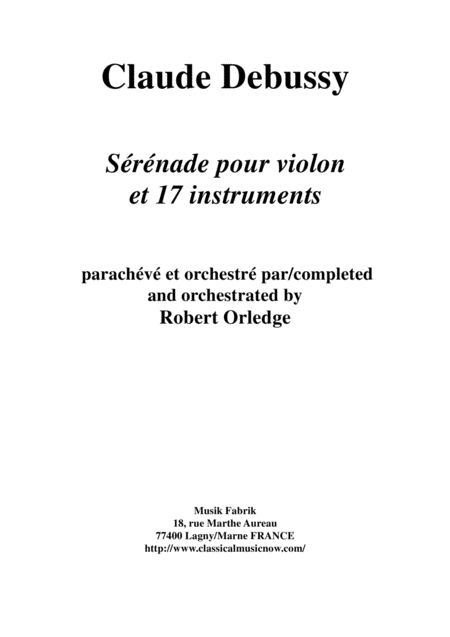
Claude Debussy: Sérénade for violin and 17 instrments, full score and solo part only (parts on ren
Orchestre de chambre

$16.95 14.7 € Orchestre de chambre PDF SheetMusicPlus

Instrumental Duet B-Flat Clarinet,Instrumental Duet,Oboe - Level 2 - Digital Download SKU: A0.857506 Composed by Thomas Van Dyke Wiesenthal. Arranged by Brittany Sommerville. Classical,Contest,Festival,Multicultural,Renaissance,Traditional,World. Score and parts. 2 pages. Brittany Sommerville #463969. Published by Brittany Sommerville (A0.857506). Cheer Up, Pull Away: A Duet for Oboe and Bb Clarinet is inspired by the travels of Thomas Forrest (1729-1802). Forrest was a captain in the British Royal Navy and a captain for the British East India Company. During his travels to Indonesia, he recorded his adventures in a journal. The Maluku islands are a province in Indonesia, west of New Guinea. The islands were known for their production of nutmeg and cloves. During Forrest's time in the Maluku islands, he came across a local fishing vessel. There, he noticed that when the sailors on the ship became fatigued, the first-mate would begin a call of motivation to the men at the oars. The men would respond back with a melody, which lighted their drowsy spirits enough to continue rowing for the whole night. Forrest recorded one of these locals songs. Translated into English, the chants contain, What fishes abound in its main; Behold you island afar; Haste, Haste and the fishes obtain. In 1818, Thomas Van Dyke Wiesenthal of the United States Navy composed a chorus and piano arrangement based on Forrest's journals; Cheer up! Pull away! The song featured calls and responses as similar to the sea chanties from the Maluku sailors. The melody in this arrangement of Cheer Up, Pull Away is passed between the oboe and the Bb clarinet; resembling the call and response of the Maluku sea chanties. The dynamically loud and abrupt sixteenth note arpeggios throughout the piece represent abrupt transition from drowsy and fatigued sailors to alert and motivated crew after participating in the chanty. This arrangement is suggested for those in grades 8, 9 and 10. Students will gain experience working with a six-eight time signature and controlling dynamics without being distracted with difficult fingerings and octaves. This piece may be used in solo and ensemble competitions throughout the United States of America, or as a fun piece for students to become comfortable in a six-eight time signature. There are 68 measures in this piece. The tempo is set to be dotted quarter note = 80 BPM; students should perform the piece in any tempo best suited to their needs. This piece will be 104 seconds long at quarter note = 80 BPM. Bb Concert Key.
Cheer Up, Pull Away: A Duet for Oboe and Bb Clarinet

$4.99 4.33 € PDF SheetMusicPlus

Piano,Soprano Flute - Level 4 - Digital Download SKU: A0.1499262 Composed by James Albert Yeager. 21st Century,Chamber,Contemporary. Score and part. 43 pages. James A. Yeager #1075315. Published by James A. Yeager (A0.1499262). Foreword:Each movement revisits classic paradigms— (I & II) ternary song form,(III) theme & variations. The third movement treats the two themes as children at play with games such as tag and hide-and-seek as variations. Both themes become partner songs leading to fugue, which is, after all, the ultimate musical game.Performance Notes:I Moderato,  slurs in the flute suggest phrasing but are optional in terms of breathing. The B section at letter C has a canon between flute and piano (left-hand) which suggests imitation in articulations and dynamics. The climax just before letter D can be stretched slightly more than poco rit. implies. II Slowly gently, must not be played slower than indicated. The middle section at letter B begins with a subito forte. At 3 measures before letter C the fermatas allow a certain freedom. When the flute releases the piano can continue the left-hand chord. The piano should use una corda in the bridge at letter C. Elsewhere, the piano may also employ una corda in quiet places ad libitum. At final note the flute can fade to nothing if breath runs out and just remain in pose as the final note of the piano is allowed to vanish.III Majestic with vigour, two given themes from ca. 1934 are Old Abram Brown by Benjamin Britten and Kookabura Sits on the Old Gum Tree by Marion Sinclair and both are rounds for children. The flute boldly declares theme one at the outset. The piano arpeggiations begin sonorously and quiet before letter A. In Variation 1 the piano must begin softer than the low register flute. The piano left-hand upper notes [A, then G, then D-A fifth) may require use of the sostenuto pedal. Variation 2 is a caccia or chase. Variation 3 is a barcarolle where theme 1 is hiding in the flute part. Variation 4 introduces the second theme (flute) in partnership with theme 1 (piano). Four measures before letter I the piano makes an ogre of theme 2 and should be humorously ponderous. The fugue subject might be the teacher who brings everyone into the final partner song of themes. The piece finishes as it began except for a wistful ending.James Albert Yeager (b.1946)James began his career as organist and choral conductor then harpsichordist and finally, professor of sacred music. As an organ major at The Ohio State University, he studied with Dr. Wilbur Held (B.Mus. 1969). Professor Joseph Goodman mentored him in composition at Union Theological Seminary in New York city (M. Sac. Mus, 1971). At the University of Colorado-Boulder, he returned to the organ, nevertheless, keeping composition as a mainstay (D.M.A. 1985). While in Colorado he composed two film scores for student filmmakers as well as choral and organ compositions. He was appointed Director of Sacred Music at the Pontifical College Josephinum (Columbus, Ohio) and rose to the rank of Professor (1984-2009). He retired as professor emeritus in 2009 and moved to New Mexico. While residing in Mountainair, New Mexico, he was organist/choral director for 12 years at a major Albuquerque church retiring again in 2021. He led choirs of all ages from children through the elderly. His most recent compositions include Passacaglia & Fugue for Organ and Chamber Orchestra (2022), a Fugue for Piano and Orchestra (2022), a Sonatina for Flute and Piano(2023), and the Sonata for Piano Quintet (2024) as well as several smaller works for voice and piano.
Sonatina for Flute and Piano

$30.00 26.02 € PDF SheetMusicPlus

Piano Solo - Level 3 - Digital Download SKU: A0.818283 By Stephen R Dalrymple. By Franz Joseph Haydn. Arranged by edited by Stephen R Dalrymple (Dalrymple Designs). Classical. Score. 14 pages. Stephen R Dalrymple #4967139. Published by Stephen R Dalrymple (A0.818283). Piano Sonata 40.2 Presto (Classical Music for Tablet Series) Franz Joseph Haydn was born in 1732 in a small village in Austria, near the Hungarian border. ♫ His father was a wheelwright and a leader of the town. His mother had been a cook in the palace of a Count. His father had taught himself to play the harp. His family was musical and often sang together (16 brothers and sisters). His father saw that he was extremely musical and that he couldn’t get the education he needed in his little village. When he was 6 years old, he was sent to the home of a relative about 7 miles away to study to be a musician. He never lived with his parents again. ♫ In 1752 he was employed by Count Karl Joseph Morzin, leading the Count’s small orchestra and writing the first of his symphonies. ♫ In 1760 he married Maria Keller. They had a very unhappy marriage, producing no children. ♫ In 1760 Count Paul Andre Esterhazy (one of the wealthiest and most important nobles in the Austrian empire) hired him as assistant director of music. In 1766 at the age of 34, Prince Nikolaus Esterhazy appointed Haydn his Director of Music. His job was divided between the Esterhazy palace in Austria their palace across the border Hungary. ♫ Haydn dedicated Piano Sonata 40 to Princess Marie Esterhazy. He worked for the Esterhazys for the next 28 years, writing hundreds of pieces of music for the prince. After about 15 years, he signed a new contract allowing him to write music for other customers. Haydn’s reputation grew to international fame. ♫ Haydn wrote 104 Symphonies. (Some count 107.) Not unlike George Washington, nicknamed the “Father of our Countryâ€, yet had no children, Haydn is known as the “Father of the Symphony.†and the “Father of the string Quartet.†♫ Napoleon captured Vienna in 1809. Napoleon, himself, ordered an honor guard be placed at Haydn’s home where Haydn lay dying. ♫ The Classical Music for Tablet Series offers piano masterworks by classical composers formatted to be read on 10 inch tablets. I use an Amazon Kindle with Mobile Sheets Pro and an Air Turn blue tooth foot pedal to practice and perform piano music. Similar products available to provide other tablets the same functionality. ♫ The pieces in this series have not been arranged, but most have been edited slightly, and have been formatted to fit this screen size. For example, in the tablet versions, first and second endings are often removed and the repeated measures and endings written into the music so the performer can avoid having to go back to previous pages. These kinds of section repeats were invented to spare the composer’s time and the cost of extra paper and ink. But with a tablet the cost of paper and ink is irrelevant. ♫ Although there are a lot more page turns with a 10 inch screen compared with letter size pages, the readability of the music (due to the backlighting on the tablet) and the portability of the music (travelling with a small tablet instead of oversized books or portfolios of sheet music) easily makes up for the extra page turns. ♫ Your purchase provides one .pdf file that contains both the tablet edition and the letter size page (printable) version. There are several programs available online that will allow you to separate this .pdf file into 2 .pdf files to make it more useful.
Haydn Piano Sonata 40.2 Presto (Classical Music for Tablet Series)
Piano seul
Stephen R Dalrymple
$3.99 3.46 € Piano seul PDF SheetMusicPlus

Piano Solo - Level 3 - Digital Download SKU: A0.818282 By Stephen R Dalrymple. By Franz Joseph Haydn. Arranged by edited by Stephen R Dalrymple (Dalrymple Designs). Classical. Score. 17 pages. Stephen R Dalrymple #4967137. Published by Stephen R Dalrymple (A0.818282). Franz Joseph Haydn was born in 1732 in a small village in Austria, near the Hungarian border. ♫ His father was a wheelwright and a leader of the town. His mother had been a cook in the palace of a Count. His father had taught himself to play the harp. His family was musical and often sang together (16 brothers and sisters). His father saw that he was extremely musical and that he couldn’t get the education he needed in his little village. When he was 6 years old, he was sent to the home of a relative about 7 miles away to study to be a musician. He never lived with his parents again. ♫ In 1752 he was employed by Count Karl Joseph Morzin, leading the Count’s small orchestra and writing the first of his symphonies. ♫ In 1760 he married Maria Keller. They had a very unhappy marriage, producing no children. ♫ In 1760 Count Paul Andre Esterhazy (one of the wealthiest and most important nobles in the Austrian empire) hired him as assistant director of music. In 1766 at the age of 34, Prince Nikolaus Esterhazy appointed Haydn his Director of Music. His job was divided between the Esterhazy palace in Austria their palace across the border Hungary. ♫ Haydn dedicated Piano Sonata 40 to Princess Marie Esterhazy. He worked for the Esterhazys for the next 28 years, writing hundreds of pieces of music for the prince. After about 15 years, he signed a new contract allowing him to write music for other customers. Haydn’s reputation grew to international fame. ♫ Haydn wrote 104 Symphonies. Not unlike George Washington, nicknamed the “Father of our Countryâ€, yet had no children, Haydn is known as the “Father of the Symphony.†♫ Napoleon captured Vienna in 1809. Napoleon, himself, ordered an honor guard be placed at Haydn’s home where Haydn lay dying. ♫ The Classical Music for Tablet Series offers piano masterworks by classical composers formatted to be read on 10 inch tablets. I use an Amazon Kindle with Mobile Sheets Pro and an Air Turn blue tooth foot pedal to practice and perform piano music. Similar products available to provide other tablets the same functionality. ♫ The pieces in this series have not been arranged, but most have been edited slightly, and have been formatted to fit this screen size. For example, in the tablet versions, first and second endings are often removed and the repeated measures and endings written into the music so the performer can avoid having to go back to previous pages. These kinds of section repeats were invented to spare the composer’s time and the cost of extra paper and ink. But with a tablet the cost of paper and ink is irrelevant. ♫ Although there are a lot more page turns with a 10 inch screen compared with letter size pages, the readability of the music (due to the backlighting on the tablet) and the portability of the music (travelling with a small tablet instead of oversized books or portfolios of sheet music) easily makes up for the extra page turns. ♫ Your purchase provides one .pdf file that contains both the tablet edition and the letter size page (printable) version. There are several programs available online that will allow you to separate this .pdf file into 2 .pdf files to make it more useful.
Haydn Piano Sonata 40.1 Allegretto innocente (Classical Music for Tablet Series)
Piano seul
Stephen R Dalrymple
$3.99 3.46 € Piano seul PDF SheetMusicPlus

Piano/Vocal/Chords - Digital Download SKU: AX.00-XS-0000265 Composed by Johnny Mercer and Richard A. Whiting. Standard. 4 pages. Alfred Music - Digital Sheet Music #00-XS-0000265. Published by Alfred Music - Digital Sheet Music (AX.00-XS-0000265). ISBN 9780739074770. UPC: 038081404509.Johnny Mercer (1909--1976) was not only one of America's greatest lyricists---he helped define the American South from the outside in. His words paint rich and vivid portraits of life in his native Georgia. Mercer wrote a wide variety of songs, from lush, dreamy ballads to plays on colloquial American expressions. He joined forces with some of the most talented composers of his day, including Harold Arlen, Hoagy Carmichael, and Henry Mancini, to fashion one of the most startlingly original catalogs in American popular music. This songbook commemorates the centennial of his birth with piano/vocal sheet music arrangements (including guitar chord frames) for 46 of his most famous and best-loved classics. Titles: Ac-cent-tchu-ate the Positive * And the Angels Sing * Any Place I Hang My Hat Is Home * Autumn Leaves * Bless Yore Beautiful Hide * Blues in the Night * Charade * Come Rain or Come Shine * Day In---Day Out * Days of Wine and Roses * Dream * Drinking Again * Emily * Fools Rush In (Where Angels Fear to Tread) * G.I. Jive * The Glow-Worm * Goody-Goody * Hooray for Hollywood * I Thought About You * I Wanna Be Around * If I Had My Druthers * I'm an Old Cowhand (from the Rio Grande) * I'm Old Fashioned * In the Cool, Cool, Cool of the Evening * Jeepers Creepers * Laura * Lazybones * Legalize My Name * Moon River * My Shining Hour * Namely You * On the Atchison, Topeka and the Santa Fe * One for My Baby (and One More for the Road) * Satan's Li'l Lamb * Satin Doll * Skylark * Something's Gotta Give * Strip Polka * Summer Wind * The Sweetheart Tree * That Old Black Magic * Too Marvelous for Words * Two of a Kind * When the World Was Young * You Must Have Been a Beautiful Baby * You Were Never Lovelier.
Hooray for Hollywood
Piano, Voix et Guitare

$3.99 3.46 € Piano, Voix et Guitare PDF SheetMusicPlus

Solo Guitar - Level 3 - Digital Download SKU: A0.971655 Composed by Jeffrey Hoover. 20th Century,Contemporary. Individual part. 10 pages. Musicart Publications #5793563. Published by Musicart Publications (A0.971655). An Unexpected Vista is a work for solo guitar by Jeffrey Hoover. Cinematic in quality, the music possesses an expansiveness. While a contemporary work, this composition has been performed effectively on programs that include Classical, Romantic, or 20th-century works. As with other compositions by Hoover, there is an interpretive painting by Hoover that may be projected during the performance if desired.  The score in this edition is arranged to be printed double-sided, with correct page turns.Jeffrey Hoover's compositions- music ranging from soloist to symphony orchestra -have received recognition through the Universal Edition/SMP Press Contemporary Composition Award, the prestigious Trieste prize, the international Luigi Russolo competition, awards from Mu Phi Epsilon, the Lancaster Fine Arts Festival, grants, publications fellowships and more than 20 commissions. He is a member of the ACME roster of Mu Phi Epsilon, recognized for distinguished achievement as a composer. One unique aspect of Hoover’s work is when he combines composition with his paintings, creating synergetic art that intrigues and captivate audiences and performers alike. His paintings are seen in exhibitions and in concerts where his paintings are projected while musicians perform his music. Hoover’s background as a performer includes both classical and jazz music, as saxophonist and conductor. His book The Arts and Society: Making New Worlds is published by Kendall Hunt Publishing.Hoover was born on September 11, 1959, in Anderson, Indiana. He holds a Ph.D. in Fine Arts (Composition and Interdisciplinary Fine Arts) from Texas Tech University, as well as an M.M and Bch.Sc. from Ball State University. His career in higher education has included both faculty and arts administration appointments. For more information about his compositions, availability for appearance and festivals, and commissions, please contact him through his website.https://jeffreyhooverart.wixsite.com/mysite
An Unexpected Vista (guitar)
Guitare

$9.95 8.63 € Guitare PDF SheetMusicPlus

Acoustic Guitar,Instrumental Solo - Level 3 - Digital Download SKU: A0.1156205 Composed by Traditional/Anonymous. Arranged by Socrates Arvanitakis. Classical,Early Music,Folk,Traditional. Individual part. 43 pages. Socrates Arvanitakis #756519. Published by Socrates Arvanitakis (A0.1156205). This is the seventeenth volume of an extensive collection of folk songs arranged for the classical guitar mostly in two-part counterpoint. The arrangements are of moderate difficulty and the aims of this publication are to familiarise, entertain and educate guitarists (and other musicians) with a melodic repertoire of lasting aesthetic value, under the light of contrapuntal treatment. The thirty five volumes of this collection can certainly be printed on paper if so desired and there are a few pages in each volume, either blank or with photographs of various musicians, which can be inserted at will in any place for the correct ordering of left and right hand pages so that page turns can be avoided. The principle of avoiding page turns has been maintained in all volumes, but this edition is also designed with mobile electronic devices in mind such as tablets etc, using the environment and facilities of a score reading application, towards a paperless world, at least in music. Therefore the size of the staves is bigger than usual for ease of reading on a small screen but not big enough to exceed the limit of a two-page view. Active internal links for navigating from thematic indexes to particular songs and back to indexes have been added, and also external internet links to sites that give further information for the 945 songs of this first collection for classical guitar.Folk Songs For Classical Guitar - Volume 17 (Songs 433-459)I Love My LoveI must live all aloneI saw a maidenI will Give my Love an AppleI will give you the keys of Heaven (Cheshire)I wish I was Single AgainI wish I wish 1 (My True Love Once He courted Me 1)I wish I wish 2 (My True Love Once He courted Me 2)I wish I wish 3 (My True Love Once He courted Me 3)I wish I wish 4 (My True Love Once He courted Me 4)I Wonder as I WanderI’ll Build Myself A Gallant ShipI’ll Mount the Air on Swallow’s Wings [The Loyal Lover]I’ll Tell You of a FellowI’m a Man that’s done wrong to my ParentsI’m A’ Doon For Lack of JohnnieI’se the B’y That Builds the BoatI’ve Set My Face For Zion’s KingdomIn a British Man O’ WarIn Bethlehem CityIn Good King Arthur’s Time (King Arthur’s Servants)In My Father’s GardenIn Nightly StillnessIron Horse (THE)Isle of DreamsIt’s of a farmer all in the town.
Folk Songs For Classical Guitar - Volume 17 (Songs 433-459)

$25.00 21.68 € PDF SheetMusicPlus

Piano and orchestra - difficult - Digital Download SKU: S9.Q3160 Composed by Rodion Shchedrin. This edition: piano reduction for 2 pianos. Downloadable, Piano reduction. Duration 32 minutes. Schott Music - Digital #Q3160. Published by Schott Music - Digital (S9.Q3160). Shchedrin, son of a composer and music teacher, underwent a thorough musical training in Moscow. His versatility and dazzling competence across a wide variety of musical genres are surely a result of his studies. The composer is also an exceptional pianist and frequently performs his own piano works (concertos, sonatas, 24 preludes and fugues, etc.) on the concert platform. While employing a variety of modern compositional techniques he has, nevertheless, succeeded in uniting traditional and contemporary forms. His work is suffused with his love for Russian folkmusic, poetry and literature, yet it is not just relevant in his homeland but speaks to a wider audience. His more recent works too, are characterized by this fusion of a deep Slavic sensitivity with outstanding virtuosity.3 (3. auch Picc.) · 3 (3. auch Engl. Hr.) · 2 · 2 – 4 · 3 · 3 · 1 – 4 P. S. (I: hg. Crot. [chrom.] · Tr. [h.] · Choclo · Glass-chimes; II: Gong [h.] · Tamt. [t.] · Tr. [m.] · Choclo · Guiro [m.]; III: Sonagli [Troika] · gr. Tr. · Bambusi [oder Guiro h.]) (3 Spieler) – Str. (16 · 14 · 12 · 10 · 8).
Piano Concerto No. 5
2 Pianos, 4 mains

$43.99 38.15 € 2 Pianos, 4 mains PDF SheetMusicPlus

Instrumental Solo,Oboe d'Amore,Piano - Level 3 - Digital Download SKU: A0.549756 Composed by Peter Ilyich Tchaikovsky. Arranged by James M. Guthrie, ASCAP. Children,Christmas,Romantic Period,Standards. Score and individual part. 17 pages. Jmsgu3 #3533231. Published by jmsgu3 (A0.549756). Duration: ca. 3:15 Score: 10 pages, solo part: 2 pages, piano part: 4 pages. Tchaikovsky paints a very mysterious mood in this favorite masterpiece from the Nutcracker Suite. It is also a traditional Christmas favorite. Pyotr Ilyich Tchaikovsky Tchaikovsky is probably the most popular of the great composers in America. His music certainly appeals to musicians. Likewise, it appeals even to folks who don’t normally listen to serious music. This is probably because of his most noteworthy melodies. Above all, he writes with great emotion. This certainly makes a most noteworthy if not an unforgettable impact. Education First of all, He attended classes at the Russian Musical Society. Even more, He also attended the St. Petersburg Conservatory. There he studied music theory with Nikolai Zaremba. He also consequently studied composition with Anton Rubenstein. It seems like Rubenstein came under criticism from a group of Russian composers known as the Five. The Five The Five certainly rejected Western musical influences. They rather sought to use elements from Russian music. They furthermore wanted to use more exotic musical materials. Western Techniques More than other Russian composers, Tchaikovsky studied modern Western music. He certainly develops his music like the European masters. So, rather than repeating a motive, he moves to a new key. He then introduces a different theme in the new key. Hence, he maintained his independence from the Five. Even more, he became the first Russian composer of international stature. Influences Tchaikovsky was probably influenced in his ballet scoring by Léo Delibes. Richard Wagner influenced his symphonic writing. Tchaikovsky’s most famous works include the 1812 Overture, The Nutcracker Suite, and Swan Lake. Also famous are the Violin Concerto in D and the six symphonies. The greatest of the six symphonies may be No. 6, the Pathétique. Nutcracker Suite, Op. 71a The Nutcracker Suite is a ballet that was performed for the first time in December 1892 in St. Petersburg. To begin with, the original ballet failed to attract a positive reception. However, the ballet suite became probably one of the most popular of all of Tchaikovsky’s works. The ballet suite became even more famous in the 1960s. It is now performed all over the world, particularly during the Christmas season.
Tchaikovsky: Arabian Dance from Nutcracker Suite for Oboe d'Amore & Piano

$32.95 28.58 € PDF SheetMusicPlus

Euphonium,Piano - Level 3 - Digital Download SKU: A0.549751 Composed by Peter Ilyich Tchaikovsky. Arranged by James M. Guthrie, ASCAP. Children,Christmas,Romantic Period,Standards. Score and part. 17 pages. Jmsgu3 #3532699. Published by jmsgu3 (A0.549751). Duration: ca. 3:15 Score: 10 pages, solo part: 2 pages, piano part: 4 pages. Tchaikovsky paints a very mysterious mood in this favorite masterpiece from the Nutcracker Suite. It is also a traditional Christmas favorite. Pyotr Ilyich Tchaikovsky Tchaikovsky is probably the most popular of the great composers in America. His music certainly appeals to musicians. Likewise, it appeals even to folks who don’t normally listen to serious music. This is probably because of his most noteworthy melodies. Above all, he writes with great emotion. This certainly makes a most noteworthy if not an unforgettable impact. Education First of all, He attended classes at the Russian Musical Society. Even more, He also attended the St. Petersburg Conservatory. There he studied music theory with Nikolai Zaremba. He also consequently studied composition with Anton Rubenstein. It seems like Rubenstein came under criticism from a group of Russian composers known as the Five. The Five The Five certainly rejected Western musical influences. They rather sought to use elements from Russian music. They furthermore wanted to use more exotic musical materials. Western Techniques More than other Russian composers, Tchaikovsky studied modern Western music. He certainly develops his music like the European masters. So, rather than repeating a motive, he moves to a new key. He then introduces a different theme in the new key. Hence, he maintained his independence from the Five. Even more, he became the first Russian composer of international stature. Influences Tchaikovsky was probably influenced in his ballet scoring by Léo Delibes. Richard Wagner influenced his symphonic writing. Tchaikovsky’s most famous works include the 1812 Overture, The Nutcracker Suite, and Swan Lake. Also famous are the Violin Concerto in D and the six symphonies. The greatest of the six symphonies may be No. 6, the Pathétique. Nutcracker Suite, Op. 71a The Nutcracker Suite is a ballet that was performed for the first time in December 1892 in St. Petersburg. To begin with, the original ballet failed to attract a positive reception. However, the ballet suite became probably one of the most popular of all of Tchaikovsky’s works. The ballet suite became even more famous in the 1960s. It is now performed all over the world, particularly during the Christmas season.
Tchaikovsky: Arabian Dance from Nutcracker Suite for Baritone Sax & Piano
Euphonium, Piano (duo)

$32.95 28.58 € Euphonium, Piano (duo) PDF SheetMusicPlus

Euphonium,Piano - Level 3 - Digital Download SKU: A0.549764 Composed by Peter Ilyich Tchaikovsky. Arranged by James M. Guthrie, ASCAP. Children,Christmas,Romantic Period,Standards. Score and part. 17 pages. Jmsgu3 #3533945. Published by jmsgu3 (A0.549764). Duration: ca. 3:15 Score: 10 pages, solo part: 2 pages, piano part: 4 pages. Tchaikovsky paints a very mysterious mood in this favorite masterpiece from the Nutcracker Suite. It is also a traditional Christmas favorite. Pyotr Ilyich Tchaikovsky Tchaikovsky is probably the most popular of the great composers in America. His music certainly appeals to musicians. Likewise, it appeals even to folks who don’t normally listen to serious music. This is probably because of his most noteworthy melodies. Above all, he writes with great emotion. This certainly makes a most noteworthy if not an unforgettable impact. Education First of all, He attended classes at the Russian Musical Society. Even more, He also attended the St. Petersburg Conservatory. There he studied music theory with Nikolai Zaremba. He also consequently studied composition with Anton Rubenstein. It seems like Rubenstein came under criticism from a group of Russian composers known as the Five. The Five The Five certainly rejected Western musical influences. They rather sought to use elements from Russian music. They furthermore wanted to use more exotic musical materials. Western Techniques More than other Russian composers, Tchaikovsky studied modern Western music. He certainly develops his music like the European masters. So, rather than repeating a motive, he moves to a new key. He then introduces a different theme in the new key. Hence, he maintained his independence from the Five. Even more, he became the first Russian composer of international stature. Influences Tchaikovsky was probably influenced in his ballet scoring by Léo Delibes. Richard Wagner influenced his symphonic writing. Tchaikovsky’s most famous works include the 1812 Overture, The Nutcracker Suite, and Swan Lake. Also famous are the Violin Concerto in D and the six symphonies. The greatest of the six symphonies may be No. 6, the Pathétique. Nutcracker Suite, Op. 71a The Nutcracker Suite is a ballet that was performed for the first time in December 1892 in St. Petersburg. To begin with, the original ballet failed to attract a positive reception. However, the ballet suite became probably one of the most popular of all of Tchaikovsky’s works. The ballet suite became even more famous in the 1960s. It is now performed all over the world, particularly during the Christmas season.
Tchaikovsky: Arabian Dance from Nutcracker Suite for Euphonium & Piano
Euphonium, Piano (duo)

$32.95 28.58 € Euphonium, Piano (duo) PDF SheetMusicPlus


Partitions Gratuites
Acheter des Partitions Musicales
Acheter des Partitions Digitales à Imprimer
Acheter des Instruments de Musique

© 2000 - 2026

Accueil - Version intégrale





