EUROPE
32 articles
USA
0 articles
DIGITAL
1114 articles (ŕ imprimer)
Partitions Digitales
Partitions à imprimer
1114 partitions trouvées


Brass Quintet Baritone Horn TC,Bass Trombone,Cornet,Euphonium,Flugelhorn,Trumpet,Tuba - Level 3 - Digital Download SKU: A0.1321540 Composed by Pietro Mascagni. Arranged by Rob Bushnell. Classical,Easter,Film/TV,Opera,Romantic Period. 18 pages. RBMusic #910007. Published by RBMusic (A0.1321540). In 1889, a struggling composer called Pietro Mascagni heard about a sponsored competition for one-act operas, specifically for young Italian composers who had not yet had an opera performed, only two months before the deadline. With little time, he selected the subject for his opera and asked his childhood friend, Giovanni Targioni-Tozzetti (who was helped by Guido Menasci), to write a libretto for him. Mascagni selected a story that he had seen as a play in Milan in early 1884 by realist writer Giovanni Verga, “Rustic Chivalry”, or Cavalleria rusticana. A passionate love tragedy featuring seduction, adultery, revenge and murder, it is surprising set on Easter morning.Mascagni received only a few verses at a time from his librettists, but he was not worried because he had the opera clear in his mind: “I identified with the drama to such an extent that I felt it within myself in terms of music.” After two months’ of work, the music for Cavalleria rusticana was finished but he feared the opera would fail and put the music in a draw. Fortunately, his wife sent it off, he unanimously won the competition and was soon the talk of Europe. (At the premiere in May 1890 in Rome, Mascagni received no fewer than 60 curtain calls.) Unfortunately, it was a one-hit wonder with Mascagni unable to repeat its success, saying towards the end of his life that “it is a pity I wrote Cavalleria first for I was crowned before I became king.” He died, penniless, in 1945.Today, few people have heard of Mascagni’s name, and, if they have, it is rarely in relation to anything but one piece from Cavalleria rusticana, the Intermezzo. A short piece of purely orchestral music that is uses to denote the passage of time, the orchestration is very simple but it is such an indulgently beautiful melody (based on a hymn heard earlier in the short opera) that perfectly captures the peace of country living in Sicily against the intense feelings of the main characters and the looming tragedy to come.The piece is so popular that (along with the “Easter Hymn” from the same opera), it is the only reason Mascagni features in the Classic FM’s Hall of Fame.The piece was used in the 1980 film Raging Bull and the 1990 film The Godfather Part III.This arrangement includes alternative parts for tenor horn, treble-clef trombone/euphonium and tuba. A recording of the original song can be found on YouTube: https://www.youtube.com/watch?v=Kgr-I1y1_2M.Other searchable terms: Italy, Martin Scorsese, Robert De Niro, Joe Pesci, Cathy Moriarty, Nicholas Colasanto, Theresa Saldana, Frank Vincent, Al Pacino, Diane Keaton, Talia Shire, Andy García, Eli Wallach, Joe Mantegna, Bridget Fonda, George Hamilton, Sofia Coppola.
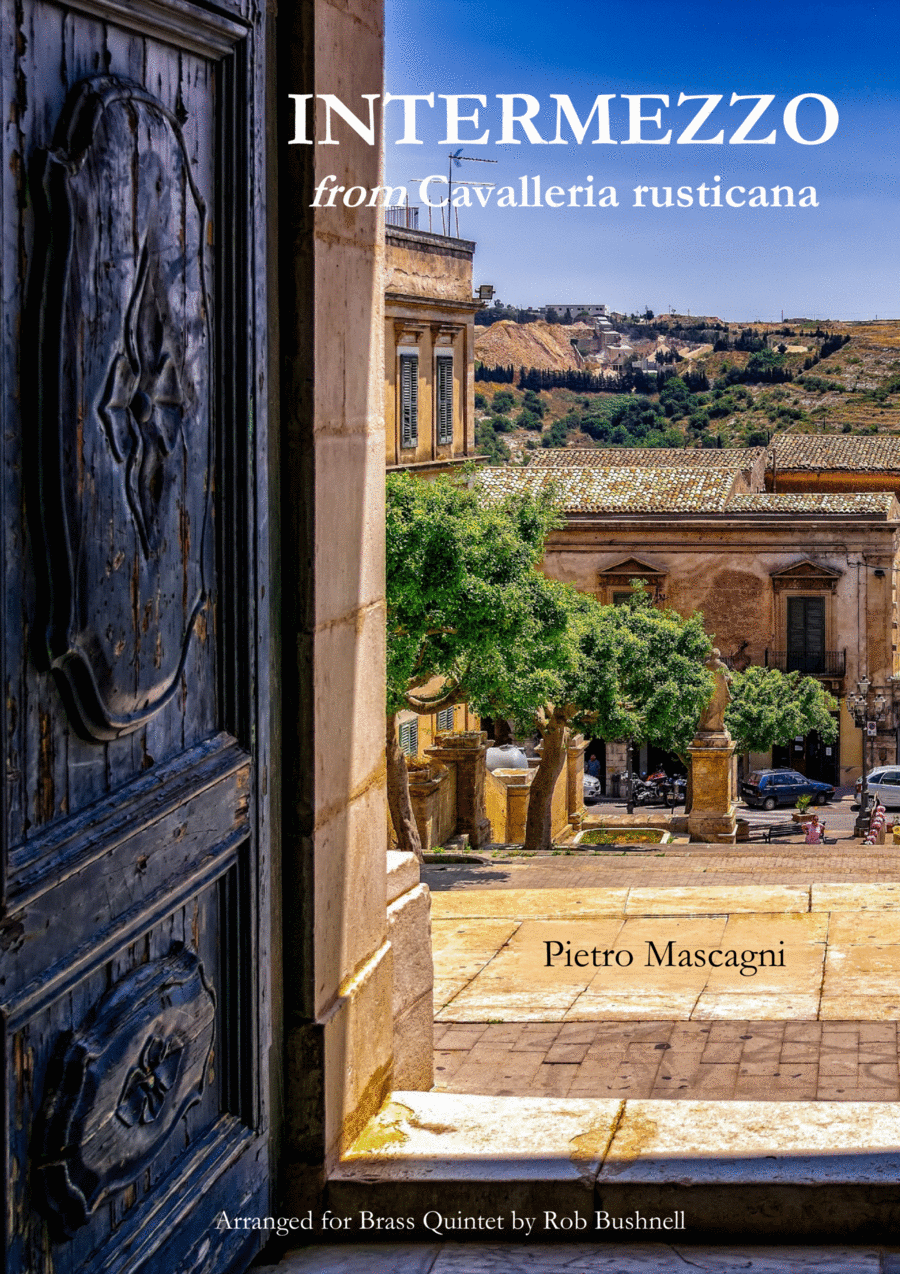
Intermezzo from "Cavalleria rusticana" (Mascagni) - Brass Quintet

$19.99 17.4 € PDF SheetMusicPlus

Clarinet Quartet,Woodwind Ensemble Bass Clarinet,E-Flat Clarinet - Level 3 - Digital Download SKU: A0.1325229 Composed by Pietro Mascagni. Arranged by Rob Bushnell. Classical,Easter,Film/TV,Opera,Romantic Period. 15 pages. RBMusic #913462. Published by RBMusic (A0.1325229). In 1889, a struggling composer called Pietro Mascagni heard about a sponsored competition for one-act operas, specifically for young Italian composers who had not yet had an opera performed, only two months before the deadline. With little time, he selected the subject for his opera and asked his childhood friend, Giovanni Targioni-Tozzetti (who was helped by Guido Menasci), to write a libretto for him. Mascagni selected a story that he had seen as a play in Milan in early 1884 by realist writer Giovanni Verga, “Rustic Chivalry”, or Cavalleria rusticana. A passionate love tragedy featuring seduction, adultery, revenge and murder, it is surprising set on Easter morning.Mascagni received only a few verses at a time from his librettists, but he was not worried because he had the opera clear in his mind: “I identified with the drama to such an extent that I felt it within myself in terms of music.” After two months’ of work, the music for Cavalleria rusticana was finished but he feared the opera would fail and put the music in a draw. Fortunately, his wife sent it off, he unanimously won the competition and was soon the talk of Europe. (At the premiere in May 1890 in Rome, Mascagni received no fewer than 60 curtain calls.) Unfortunately, it was a one-hit wonder with Mascagni unable to repeat its success, saying towards the end of his life that “it is a pity I wrote Cavalleria first for I was crowned before I became king.” He died, penniless, in 1945.Today, few people have heard of Mascagni’s name, and, if they have, it is rarely in relation to anything but one piece from Cavalleria rusticana, the Intermezzo. A short piece of purely orchestral music that is uses to denote the passage of time, the orchestration is very simple but it is such an indulgently beautiful melody (based on a hymn heard earlier in the short opera) that perfectly captures the peace of country living in Sicily against the intense feelings of the main characters and the looming tragedy to come.The piece is so popular that (along with the “Easter Hymn” from the same opera), it is the only reason Mascagni features in the Classic FM’s Hall of Fame.The piece was used in the 1980 film Raging Bull and the 1990 film The Godfather Part III.This arrangement includes alternative parts for clarinet in E-flat and alto clarinet in E-flat. A recording of the original song can be found on YouTube: https://www.youtube.com/watch?v=Kgr-I1y1_2M.Other searchable terms: Italy, Martin Scorsese, Robert De Niro, Joe Pesci, Cathy Moriarty, Nicholas Colasanto, Theresa Saldana, Frank Vincent, Al Pacino, Diane Keaton, Talia Shire, Andy García, Eli Wallach, Joe Mantegna, Bridget Fonda, George Hamilton, Sofia Coppola.
Intermezzo from "Cavalleria rusticana" (Mascagni) - Clarinet Quartet
Quatuor de Clarinettes: 4 clarinettes

$15.99 13.92 € Quatuor de Clarinettes: 4 clarinettes PDF SheetMusicPlus

Piano,Violin - Level 4 - Digital Download SKU: A0.1315952 Composed by Pietro Mascagni. Arranged by Rob Bushnell. Classical,Easter,Film/TV,Opera,Romantic Period. 8 pages. RBMusic #904730. Published by RBMusic (A0.1315952). In 1889, a struggling composer called Pietro Mascagni heard about a sponsored competition for one-act operas, specifically for young Italian composers who had not yet had an opera performed, only two months before the deadline. With little time, he selected the subject for his opera and asked his childhood friend, Giovanni Targioni-Tozzetti (who was helped by Guido Menasci), to write a libretto for him. Mascagni selected a story that he had seen as a play in Milan in early 1884 by realist writer Giovanni Verga, “Rustic Chivalry”, or Cavalleria rusticana. A passionate love tragedy featuring seduction, adultery, revenge and murder, it is surprising set on Easter morning.Mascagni received only a few verses at a time from his librettists, but he was not worried because he had the opera clear in his mind: “I identified with the drama to such an extent that I felt it within myself in terms of music.” After two months’ of work, the music for Cavalleria rusticana was finished but he feared the opera would fail and put the music in a draw. Fortunately, his wife sent it off, he unanimously won the competition and was soon the talk of Europe. (At the premiere in May 1890 in Rome, Mascagni received no fewer than 60 curtain calls.) Unfortunately, it was a one-hit wonder with Mascagni unable to repeat its success, saying towards the end of his life that “it is a pity I wrote Cavalleria first for I was crowned before I became king.” He died, penniless, in 1945.Today, few people have heard of Mascagni’s name, and, if they have, it is rarely in relation to anything but one piece from Cavalleria rusticana, the Intermezzo. A short piece of purely orchestral music that is uses to denote the passage of time, the orchestration is very simple but it is such an indulgently beautiful melody (based on a hymn heard earlier in the short opera) that perfectly captures the peace of country living in Sicily against the intense feelings of the main characters and the looming tragedy to come.The piece is so popular that (along with the “Easter Hymn” from the same opera), it is the only reason Mascagni features in the Classic FM’s Hall of Fame.The piece was used in the 1980 film Raging Bull and the 1990 film The Godfather Part III.A recording of the original song can be found on YouTube: https://www.youtube.com/watch?v=Kgr-I1y1_2M.Other searchable terms: Italy, Martin Scorsese, Robert De Niro, Joe Pesci, Cathy Moriarty, Nicholas Colasanto, Theresa Saldana, Frank Vincent, Al Pacino, Diane Keaton, Talia Shire, Andy García, Eli Wallach, Joe Mantegna, Bridget Fonda, George Hamilton, Sofia Coppola.

Intermezzo from "Cavalleria rusticana" (Mascagni) - Solo Violin and Piano
Violon et Piano

$15.99 13.92 € Violon et Piano PDF SheetMusicPlus

Solo Guitar - Level 1 - Digital Download SKU: A0.1171119 Composed by Scott Joplin. Arranged by Brian Streckfus. 20th Century,Barbershop,Blues,Folk,Ragtime. Individual part. 2 pages. Brian Streckfus #771449. Published by Brian Streckfus (A0.1171119). 1. 2 page arrangement for guitar. I'm sorry to say this is not the full version, but a 16 page version is long winded for my purposes.2. Guitar Tab added. 3. Slurs and slides added. 4. Re-harmonized to be idiomatic for guitar, be less cliche,  and to emphasize the main melody more. 5. Some composers indications added when really necessary.  6. Left hand fingerings added.7. Chord nomenclature added.8. Overly excessive ties removed.9. Some octaves changes to better suit guitar.Tips:1. Be very careful of the difference between slurs and ties! Sometimes I don't show slurs on the tab, but this time I had to.2. The rests are real and they are suggested because they lead to a jazzier rag time sound. I feel like it goes without saying that sustain is ultimately up to the performer, which is why I removed a lot of pedantic ties; they seem to add confusion half the time. 3. The D7 is a slight key change because it has an F# in the chord. It's a secodary dominace chord, V7/V, and often a vii7b5 can replace it. In other words, the F# goes gravitates into the next chord, a G Major chord.4. G6 is really just the 3 thinnest strings of the guitar open. It's a great transition chord.5. The D# is part of the C major blues scale.6. Adding more 7th chords than originally there is almost always an interesting pursuit. Going from G to G7 can certainly aid in helping things sound more goofy.
The Entertainer (Excerpt)
Guitare

$1.99 1.73 € Guitare PDF SheetMusicPlus

Horn,Trombone,Trumpet,Tuba - Level 4 - Digital Download SKU: A0.1158678 Composed by Dr. Daniel N. Thrower. 20th Century,Chamber,Classical,Historic. 30 pages. Https://gildedmusicpress.com/ #758696. Published by https://gildedmusicpress.com/ (A0.1158678). The opening of this 4-minute piece is dance-like, intimating a celebratory mood up front—alone at first, but shared with the ensemble throughout the piece. After much celebration, the piece ends solemnly, as if giving each other final hugs and good-byes. Every Airman has a story to tell. “Farewell Celebration” is part of my story as an Airman musician. It is a fitting farewell to the Heartland of America Band stationed at Offutt Air Force Base in Bellevue, Nebraska, and to the entire American Midwest, as my family and I finalized our plans to uproot for an extraordinary three-year adventure in Asia. Work on this composition began toward the end of July and beginning of August 2021 as a melody with instructions to be the opening of a brass quintet piece, beginning with trumpet alone. It remained in that state until January 2022 when I entered this sketch into the computer to be worked on sporadically along with several other works in progress. When I contracted Covid-19 in July 2022, all of these works and other incipient pieces received attention, but this one more than most others. In the fall, I felt an urgency to complete it as a sentimental gesture of enthusiastic good-byes due to many life changes taking place. In particular, my fourth son, Paul, was departing for two years for Brazil. I was compelled to complete this work before he left on October 17, 2022, which I accomplished the day prior to his departure. In addition to Paul’s farewell, two co-workers with whom I had worked closely in the Air Force brass quintet called “Offutt Brass,” were also moving on with new exciting chapters in their lives. MSgt Ben Kadow, our fantastic trombonist, had received an assignment to move to Germany, leaving us on November 8. And MSgt Ryan Heseltine, our unparalleled French horn player, retired at the end of the year. On top of all that, in September I was given an assignment to move to Japan the following summer. Some farewells are more difficult to endure than others, though all seem to have varied brands of profound emotion. In contrast to saying good-bye to a loved one who passes away, all of these farewells were joyful, albeit poignant. “Farewell Celebration” is dedicated to my son Paul, to my outstanding professional colleagues, Ben Kadow and Ryan Heseltine, and to all our friends and family members who we left behind as we moved to Japan.
Farewell Celebration (for Brass Quintet)
Quintette de Cuivres: 2 trompettes, Cor, trombone, tuba

$24.95 21.72 € Quintette de Cuivres: 2 trompettes, Cor, trombone, tuba PDF SheetMusicPlus

Piano/Vocal/Chords - Digital Download SKU: AX.00-PS-0015535 By Diana Krall. By Al Lewis, Al Sherman, and Carl Hoefle. Jazz. 6 pages. Alfred Music - Digital Sheet Music #00-PS-0015535. Published by Alfred Music - Digital Sheet Music (AX.00-PS-0015535). ISBN 9780739093771. UPC: 038081452937.This official piano sheet music companion folio to Diana Krall's 11th studio album will delight any pianist who loves jazz and blues. The melodic 1920s- and '30s-era songs are naturally enjoyable at the keys, as are the songs from later eras, like Lonely Avenue and Wide River to Cross. Vocal melodies, complete lyrics, and chords are included. Titles: We Just Couldn't Say Goodbye * There Ain't No Sweet Man That's Worth the Salt of My Tears * Just Like a Butterfly That's Caught in the Rain * You KnowF--I Know Ev'rything's Made for Love * Glad Rag Doll * I'm a Little Mixed Up * Prairie Lullaby * Here Lies Love * I Used to Love You but It's All Over Now * Let It Rain * Lonely Avenue * Wide River to Cross * When the Curtain Comes Down.
When the Curtain Comes Down
Piano, Voix et Guitare
Diana Krall
$3.99 3.47 € Piano, Voix et Guitare PDF SheetMusicPlus

Piano,Violin - Level 5 - Digital Download SKU: A0.533318 Composed by Jacques Leguerney. 20th Century,Concert,Standards. 71 pages. Musik Fabrik Music Publishing #2343095. Published by Musik Fabrik Music Publishing (A0.533318). Première Sonate pour piano et violonI. ModĂ©rĂ©II. Assez lentIII. AnimĂ©IV. Bien allant, mais d'expression tranquilleJacques Leguerney began the composition of his First Sonata for Piano and Violin in 1926, shortly after beginning composition studies with Nadia Boulanger. She was reportedly quite enthusiastic about the natural talent of her new student, and offered to give him private lessons to supplement her analysis classes. Leguerney was already reticent about studying composition. In an interview in 1989, he remembered his feeling at that time, saying that I found that this was useless work. If one is gifted for music, one is capable of writing harmonies. instead, Leguerney showed his Sonata to the French composer Albert Roussel, who was renting an apartment on Avenue Wagram in a building next to that of the Leguerney family. Leguerneyremembered Roussel's apartment with its dark blue walls and gilded Indian statues! Roussel encouraged his efforts and said of the second theme of the first movement: I would have liked to have written that. (J'aurais Ă©tĂ© très content d'avoir Ă©crit ça.)The first performance of the Sonata was given by the pianist ThĂ©rèse Cahen (1897-1944) and the violinist Hortense de Sampigny (? – 1970) in a private concert. The violinist was already a well-known concert artist. De Sampigny finished her studies at the Paris Conservatory in 1915, where she was in the class of Jules Boucherit. In 1918 she married the French author Auguste Bailly (1878-1967). From 1921, she was a member of the Trio Trillat, founded by the pianist Ennemond Trillat with the collaboration of cellist Jean Witkowski. The Trio was active in concerts and recordings in France and abroad for about thirty years. De Sampigny later taught at the Conservatory as assistant to RenĂ© Benedetti. ThĂ©rèse Cahen had studied piano, harmony and counterpoint at the Schola Cantorum, where she obtained a Second Prize. She was a faithful friend and muse for Leguerney, and recruited many musicians for first performances of his vocal and chamber works. She was deported to Auschwitz on July 31, 1944, a few weeks before the Liberation of Paris. This edition of the Sonata was performed at a private concert in Vernon (France) in July 2011 by French violinist Marion Larigaudrie and pianist Mary Dibbern.  It is based upon the autograph manuscript OL 23, on deposit at the Music Department of the Bibliothèque national in Paris.
Jacques Leguerney: Première Sonate for piano and violin
Violon et Piano

$25.95 22.59 € Violon et Piano PDF SheetMusicPlus

Piano/Vocal/Chords - Digital Download SKU: AX.00-PS-0015536 By Diana Krall. By Hal Dyson and James Kendis. Jazz. 5 pages. Alfred Music - Digital Sheet Music #00-PS-0015536. Published by Alfred Music - Digital Sheet Music (AX.00-PS-0015536). ISBN 9780739093771. UPC: 038081452937.This official piano sheet music companion folio to Diana Krall's 11th studio album will delight any pianist who loves jazz and blues. The melodic 1920s- and '30s-era songs are naturally enjoyable at the keys, as are the songs from later eras, like Lonely Avenue and Wide River to Cross. Vocal melodies, complete lyrics, and chords are included. Titles: We Just Couldn't Say Goodbye * There Ain't No Sweet Man That's Worth the Salt of My Tears * Just Like a Butterfly That's Caught in the Rain * You KnowF--I Know Ev'rything's Made for Love * Glad Rag Doll * I'm a Little Mixed Up * Prairie Lullaby * Here Lies Love * I Used to Love You but It's All Over Now * Let It Rain * Lonely Avenue * Wide River to Cross * When the Curtain Comes Down.
Let It Rain
Piano, Voix et Guitare
Diana Krall
$3.99 3.47 € Piano, Voix et Guitare PDF SheetMusicPlus

Concert Band - Level 3 - Digital Download SKU: A0.1035592 Composed by Edward Elgar. Arranged by Joel Jacklich (A.S.C.A.P.). Romantic Period. Score and parts. 76 pages. Joel Jacklich #640816. Published by Joel Jacklich (A0.1035592). PROGRAM NOTE: Rosemary - That's for remembrance.... In 1882, Sir Edward Elgar jotted down in his musical notebook a piano piece he titled Douce Pensée (Sweet Thought). There it remained until 1913 when he got it out again, revised it slightly, re-titled it Rosemary - That's for remembrance, and published it for the first time. The title comes from Ophelia's Garland Speech in Shakespeare's Hamlet, where she says, There's rosemary, that's for remembrance. Pray you, love, remember. In 1915, the First World War had been raging in Europe for a year, and many British composers and poets had turned to artistic means to mourn those who died in the trenches of across the Channel. Elgar orchestrated the work at that time. In 1925, London publisher W. Paxton published arrangements by C. Jenkins made for brass and reed band and for military band; however, these are now out of print and no longer available. In the fall of 2015, Mitch Sturman, director of the Wilson Junior High School Warrior Band in El Centro, California, asked me to make an arrangement of Rosemary for the Eighth Annual Concert of Premieres, a series Sturman had begun in 2008, commissioning new works by known composers, and commissioning new arrangements of pieces he felt were worthy works in the public domain that were no longer in print and/or were written for ensembles containing instruments no longer part of the standard modern band or orchestra. INSTRUMENTATION: Flute I (4), Flute II (4), Oboe (1), Clarinet I (4), Clarinet II (4), Clarinet III (4), Bass Clarinet (1), Bassoon (1), Alto Saxophone (4), Tenor Saxophone (2), Baritone Saxophone (1); Trumpet I (3), Trumpet II (3), French Horn (2), Baritone Horn T.C. (2), Baritone Horn B.C. (2), Trombone (6), Tuba (2); Timpani [F2, B-flat 2] (1), Snare Drum (1),Triange (1), Suspended Cymbal (1), Bass Drum (1), Glockenspiel (1). Joel Jacklich May 21, 2015 El Centro, California.
Rosemary - "That's for remembrance...."
Orchestre d'harmonie

$50.00 43.52 € Orchestre d'harmonie PDF SheetMusicPlus

Violin Solo - Level 2 - Digital Download SKU: A0.1017149 Composed by James F. Babcock. Contemporary. 15 pages. James Babcock #6350285. Published by James Babcock (A0.1017149). FROM CHILDHOOD – Violin part only. 15 pgs. (Piano accomp. 35 pgs. Sold separately. ) Four easy to Intermediate violin solos for instruction and performance. With piano accompaniments.  Each of the four pieces is available separately on SMP.   (1) MARGARET DANCING.  (SO.      ) Like a Beethoven song and country dance, this piece offers pleasing melodies for the beginner who is well along, both to study and to perform in recital.   (2) MUSICBOX. (SO.      )  This short easy piece imitates the sound of a music box, including its running down at the end.  For instruction it can serve to introduce the student to light staccato bowing or up and down slurred staccato bowing.  For performance it can serve as an amusing interlude.   (3) HYMNSONG. (SO.      )  In the form of an etude, this piece consists of a simple theme with numerous variations, somewhat like Paganini’s famous Caprice 24.  Of intermediate difficulty, it offers double stops, tremolo, and various bowings. For performance it can be played as is or it can easily be shortened by omission of one or more passages.   (4) MOTHER’S STORIES.  (SO.      ) Varying from sweet to dramatic, this simple composition offers an opportunity for emotional interpretation. Intermediate from that standpoint, It is otherwise basically easy. A nice recital piece. Your compositions are charming and melodic, useful both for training and performance.-Thomas Lindsay, former concertmaster, Virginia Beach Symphony and New Jersey Pops.
FROM CHILDHOOD four pieces for violin
Violon

$5.25 4.57 € Violon PDF SheetMusicPlus

Piano,Vocal,Voice - Level 2 - Digital Download SKU: A0.810393 By Weezer. By Rivers Cuomo. Arranged by Laura Reynolds. Pop,Rock. Score. 8 pages. Laura Reynolds #6516947. Published by Laura Reynolds (A0.810393). This arrangement of Say It Ain’t So is best for late beginners and early intermediate piano students. It contains bass clef notation in the right hand, 6th intervals, sharps and flats, and ledger lines learned in Faber 3A series lesson books. It’s a great arrangement made for performances and set lists. Excludes the guitar solo, but the rest of the song is written out in easy notation for students. If you like this arrangement be sure to check out my website Laurareynoldsmusic.com and my other arrangements sold here on sheet music plus.
Say It Ain't So
Piano, Voix
Weezer
$7.50 6.53 € Piano, Voix PDF SheetMusicPlus


Partitions Gratuites
Acheter des Partitions Musicales
Acheter des Partitions Digitales à Imprimer
Acheter des Instruments de Musique

© 2000 - 2026

Accueil - Version intégrale




