EUROPE
0 articles
USA
0 articles
DIGITAL
3667 articles (à imprimer)
Partitions Digitales
Partitions à imprimer
3667 partitions trouvées


Soprano voice solo, SATB choir, flute and piano (ad lib.) - Moderately Difficult - Digital Download SKU: MQ.7541-E Composed by Derek Healey. Instrument part. 9 pages. E. C. Schirmer Music Company - Digital #7541-E. Published by E. C. Schirmer Music Company - Digital (MQ.7541-E). English.These songs are dedicated to William Osborne. The title Three Sacred Songs: was given to these pieces rather than the more usual terms anthem or motet because of the strongly secular presence in the texts. The songs were written over a period of some eighteen months. The Shepherd Lad was finished on February 29, 2008. The Round Day and Magdalene’s Song were completed in Brooklyn on June 11, 2009, the music having been originally sketched-out on Christmas Day and Boxing Day 2008, at Putnam Valley, New York. In the first song, The Round Day, the singer hears the voice of the Blessed Virgin Mary as she sings to the glory of God throughout the day. The text was written on June 7, 2008. In The Shepherd Lad, the Spanish mystic Saint John of the Cross describes a shepherd lad’s (Jesus’s) love for a shepherdess (the Church) and how another (the Devil) tempted his love away. Heartbroken, the shepherd climbed a tree, “And threw wide his arms in sweetest charity, Since by His Shepherdess He was forsaken.†The original Spanish text was translated and adapted into Villanelle form by the composer in early December 2004. The text of Magdalene’s Song describes the feelings of a mystic, or a devotee of Jesus, inspired by the fresh beauty, grace and power of the Lord of creation. The main body of the text is given to a soprano solo. The text was written on April 27, 2008. These sacred songs were conceived as being performed either as a set or individually. The composer had secular ensembles in mind, such as college or concert choruses, but these songs may, of course, also be performed in a liturgical setting. The accompanying flute provides introductions, interludes and codas throughout the set and, on a few occasions, plays with the voices. The piano part is ad lib. (optional).
Three Sacred Songs: 2. The Shepherd Lad (Downloadable)

$1.95 1.68 € PDF SheetMusicPlus

SATB choir, flute and piano (ad lib.) - Moderately Difficult - Digital Download SKU: MQ.7540-E Composed by Derek Healey. Instrument part. 9 pages. E. C. Schirmer Music Company - Digital #7540-E. Published by E. C. Schirmer Music Company - Digital (MQ.7540-E). English.These songs are dedicated to William Osborne. The title Three Sacred Songs: was given to these pieces rather than the more usual terms anthem or motet because of the strongly secular presence in the texts. The songs were written over a period of some eighteen months. The Shepherd Lad was finished on February 29, 2008. The Round Day and Magdalene’s Song were completed in Brooklyn on June 11, 2009, the music having been originally sketched-out on Christmas Day and Boxing Day 2008, at Putnam Valley, New York. In the first song, The Round Day, the singer hears the voice of the Blessed Virgin Mary as she sings to the glory of God throughout the day. The text was written on June 7, 2008. In The Shepherd Lad, the Spanish mystic Saint John of the Cross describes a shepherd lad’s (Jesus’s) love for a shepherdess (the Church) and how another (the Devil) tempted his love away. Heartbroken, the shepherd climbed a tree, “And threw wide his arms in sweetest charity, Since by His Shepherdess He was forsaken.†The original Spanish text was translated and adapted into Villanelle form by the composer in early December 2004. The text of Magdalene’s Song describes the feelings of a mystic, or a devotee of Jesus, inspired by the fresh beauty, grace and power of the Lord of creation. The main body of the text is given to a soprano solo. The text was written on April 27, 2008. These sacred songs were conceived as being performed either as a set or individually. The composer had secular ensembles in mind, such as college or concert choruses, but these songs may, of course, also be performed in a liturgical setting. The accompanying flute provides introductions, interludes and codas throughout the set and, on a few occasions, plays with the voices. The piano part is ad lib. (optional).
Three Sacred Songs: 1. The Round Day (Downloadable)
Chorale SATB

$1.95 1.68 € Chorale SATB PDF SheetMusicPlus

Acoustic Guitar,Instrumental Solo - Level 3 - Digital Download SKU: A0.1163847 Composed by Traditional/Anonymous. Arranged by Socrates Arvanitakis. Classical,Early Music,Folk,Traditional. Individual part. 46 pages. Socrates Arvanitakis #764199. Published by Socrates Arvanitakis (A0.1163847). This is the twenty-ninth volume of an extensive collection of folk songs arranged for the classical guitar mostly in two-part counterpoint. The arrangements are of moderate difficulty and the aims of this publication are to familiarise, entertain and educate guitarists (and other musicians) with a melodic repertoire of lasting aesthetic value, under the light of contrapuntal treatment. The thirty five volumes of this collection can certainly be printed on paper if so desired and there are a few pages in each volume, either blank or with photographs of various musicians, which can be inserted at will in any place for the correct ordering of left and right hand pages so that page turns can be avoided. The principle of avoiding page turns has been maintained in all  volumes, but this edition is also designed with mobile electronic devices in mind such as tablets etc, using the environment and facilities of a score reading application, towards a paperless world, at least in music. Therefore the size of the staves is bigger than usual for ease of reading on a small screen but not big enough to exceed the limit of a two-page view.Active internal links for navigating from thematic indexes to particular songs and back to indexes have been added, and also external internet links to sites that give further information for the 945 songs of this first collection for classical guitar.Volume 29 (Songs 757-783)Sally BrownSally GraySamuel Hooser’s HymnSandySantianaScarborough Fair 1Scarborough Fair 2 (singing together version)Scraping Up Sand In The Bottom Of The SeaSearching for LambsSeasons of the Year (the)Second Britford CarolSee Amid the Winter’s SnowSeeds of Love (the)Servant of Rosemary Lane (the)Servingman and the Husbandman (the)Seven Virgins (the)Seventeen Come SundayShaker March No 20Shaker Solemn Song 2 (A)Shaker Solemn Song 12Shaker Turning Shuffle Tune No. 5She’s like the SwallowSheepcrook and Black DogSheep-shearing SongShepherd and his dog (the)Shepherd’s Song (the)Shepherds Arise.
Folk Songs For Classical Guitar - Volume 29 (Songs 757-783)

$25.00 21.51 € PDF SheetMusicPlus

Baritone Saxophone,Piano - Level 2 - Digital Download SKU: A0.548979 Composed by Johann Sebastian Bach. Arranged by James M. Guthrie, ASCAP. Baroque,Holiday,Standards,Wedding. Score and part. 11 pages. Jmsgu3 #3444583. Published by jmsgu3 (A0.548979). Was mir behagt, ist nur die muntre Jagd (The lively hunt is all my heart's desire), BWV 208 is the earliest secular cantata by Bach composed in 1713 for the birthday of the Duke of Weissenfels. It is also called the Hunting Cantata, and/or the Birthday Cantata. The most famous piece from this collection is the soprano aria Sheep may safely graze. Duration: 5:50, Score - 6 pg. Solo part - 2 pg. Piano part - 3 pg. 41 ms. Melodic range: M10 Level: Early intermediate and up. A popular choice for weddings, Christmas, Easter, birthdays, and recitals. Sheep May Safely Graze Sheep may safely graze (Schafe können sicher weiden) is an aria from the Cantata BWV 208. The title of the Cantata, Was mir behagt, ist nur die muntre Jagd (nicknamed the Hunting Cantata) translates as The lively hunt is all my heart's desire. Programming Similar to Bach’s Jesu, Joy of Man's Desiring, or I Stand at the Threshold, it is an all-time favorite and frequently requested at weddings. Originally, Bach composed this aria for a royal birthday celebration, that of the Duke of Saxe-Weissenfels. Lyrics Sheep may safely graze and pasture In a watchful Shepherd’s sight. Those who rule with wisdom guiding Bring to hearts a peace abiding Bless a land with joy made bright.   Bach Overview First of all, Johann Sebastian Bach is maybe the greatest composer in music history. Indeed, he was prolific. As a result, everyone has heard of his works. Furthermore, these works number well over a thousand. People are probably most familiar with instrumental works such as the Brandenburg Concertos, and the Goldberg Variations. But, similarly famous are such noteworthy works as the Well-Tempered Clavier, the Musical Offering, and the Art of Fugue. Seems like his most famous vocal works include the most noteworthy Mass in B Minor. Also, most noteworthy, though, are the St. John Passion, and certainly the Christmas Oratorio.  History Bach came from a long line of musicians and above all, composers. Consequently, he, first of all, pursued a career as a church organist. So as a result, he gained employment in various Protestant churches in Germany. For a while, he worked as a court musician in Weimar and Köthen. Here he probably developed his organ style and likewise his chamber music style. Eventually, he, therefore, gained an appointment as Cantor of St. Thomas in Leipzig. Here he worked until difficulties with his employer ultimately drove him away. The King of Poland finally appointed him as court composer.  Style It seems like Bach created a fascinating new international style. He synthesized elements of the most noteworthy European music ideas into his new style. Even more, this new style was probably his synthesis of European musical rhythm and form. Furthermore, he demonstrated a complete mastery of counterpoint and motivic development. His sense of harmonic organization probably propelled him to the top. Revival               Mendelssohn conducted a Bach revival in the nineteenth century. His effort probably helped to re-familiarize the public with the magnitude of Bach’s works. During this period, scholars published many noteworthy Bach biographies. Moreover, Wolfgang Schmieder published the BWV (Bach Werke Verzeichnis). As a result, this is now the official catalog of his entire artistic output. The BWV number allows us to locate a work in the catalog. Sometimes scholars will simply use an S (Schmieder) as an abbreviation for BWV.
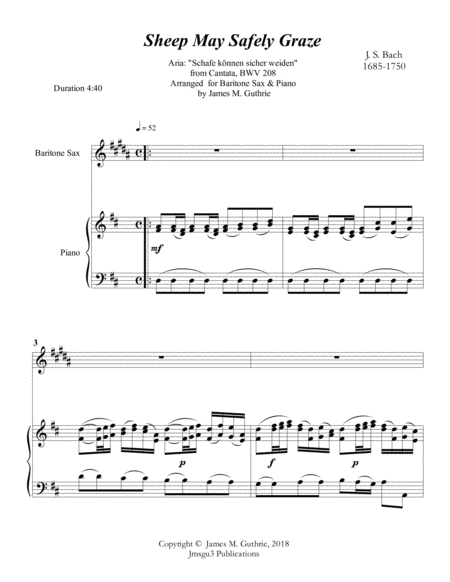
Bach: Sheep May Safely Graze for Baritone Sax & Piano
Saxophone Baryton, Piano

$32.95 28.35 € Saxophone Baryton, Piano PDF SheetMusicPlus

Alto Saxophone,Piano - Level 2 - Digital Download SKU: A0.548976 Composed by Johann Sebastian Bach. Arranged by James M. Guthrie, ASCAP. Baroque,Holiday,Standards,Wedding. Score and part. 11 pages. Jmsgu3 #3444569. Published by jmsgu3 (A0.548976). Was mir behagt, ist nur die muntre Jagd (The lively hunt is all my heart's desire), BWV 208 is the earliest secular cantata by Bach composed in 1713 for the birthday of the Duke of Weissenfels. It is also called the Hunting Cantata, and/or the Birthday Cantata. The most famous piece from this collection is the soprano aria Sheep may safely graze. Duration: 5:50, Score - 6 pg. Solo part - 2 pg. Piano part - 3 pg. 41 ms. Melodic range: M10 Sheep May Safely Graze Sheep may safely graze (Schafe können sicher weiden) is an aria from the Cantata BWV 208. The title of the Cantata, Was mir behagt, ist nur die muntre Jagd (nicknamed the Hunting Cantata) translates as The lively hunt is all my heart's desire. Programming Similar to Bach’s Jesu, Joy of Man's Desiring, or I Stand at the Threshold, it is an all-time favorite and frequently requested at weddings. Originally, Bach composed this aria for a royal birthday celebration, that of the Duke of Saxe-Weissenfels. Lyrics Sheep may safely graze and pasture In a watchful Shepherd’s sight. Those who rule with wisdom guiding Bring to hearts a peace abiding Bless a land with joy made bright.   Bach Overview First of all, Johann Sebastian Bach is maybe the greatest composer in music history. Indeed, he was prolific. As a result, everyone has heard of his works. Furthermore, these works number well over a thousand. People are probably most familiar with instrumental works such as the Brandenburg Concertos, and the Goldberg Variations. But, similarly famous are such noteworthy works as the Well-Tempered Clavier, the Musical Offering, and the Art of Fugue. Seems like his most famous vocal works include the most noteworthy Mass in B Minor. Also, most noteworthy, though, are the St. John Passion, and certainly the Christmas Oratorio.  History Bach came from a long line of musicians and above all, composers. Consequently, he, first of all, pursued a career as a church organist. So as a result, he gained employment in various Protestant churches in Germany. For a while, he worked as a court musician in Weimar and Köthen. Here he probably developed his organ style and likewise his chamber music style. Eventually, he, therefore, gained an appointment as Cantor of St. Thomas in Leipzig. Here he worked until difficulties with his employer ultimately drove him away. The King of Poland finally appointed him as court composer.  Style It seems like Bach created a fascinating new international style. He synthesized elements of the most noteworthy European music ideas into his new style. Even more, this new style was probably his synthesis of European musical rhythm and form. Furthermore, he demonstrated a complete mastery of counterpoint and motivic development. His sense of harmonic organization probably propelled him to the top. Revival               Mendelssohn conducted a Bach revival in the nineteenth century. His effort probably helped to re-familiarize the public with the magnitude of Bach’s works. During this period, scholars published many noteworthy Bach biographies. Moreover, Wolfgang Schmieder published the BWV (Bach Werke Verzeichnis). As a result, this is now the official catalog of his entire artistic output. The BWV number allows us to locate a work in the catalog. Sometimes scholars will simply use an S (Schmieder) as an abbreviation for BWV.
Bach: Sheep May Safely Graze for Alto Sax & Piano
Saxophone Alto et Piano

$32.95 28.35 € Saxophone Alto et Piano PDF SheetMusicPlus

Percussion Ensemble - Digital Download SKU: A0.935390 Arranged by Dan Heslink. Christian,Christmas. Score and parts. 16 pages. Pharaoh Publications #6117165. Published by Pharaoh Publications (A0.935390). Christmas Calypso for Marimba Quartet . . . . . . . . . . . . . . arr. Dan HeslinkThe calypso style referenced in the title is not the calypso of Afro-Caribbean music from Trinidad and Tobago. Rather, it is the especially toned-down but still rhythmic commercial variant popularized by folk singers. Couched in this style, the arrangement offers Christmas favorites Deck the Halls, Angels We Have Heard On High, God Rest Ye Merry Gentlemen and Good Christian Men, Rejoice.  This if one of two versions of the calypso arrangement by Dan Heslink, both of which are available through Sheet Music Plus. The other arrangement, for percussion sextet, follows similar musical contours and is available separately. Both versions are intended to elicit one primary response from both performers and audience – fun. It does not tax the players technically, but delivers a satisfying sound with carols that the performers likely know and love. General audiences will be enchanted by the familiar melodies delivered in percussion, especially at Christmas time.  The introduction opens with a brisk and rhythmic introduction based on Deck the Halls, and establishes the fun calypso rhythm immediately. Deck the Halls is the much-loved welsh air that was arranged by Haydn, Nos galan (Hob. XXXIb:29, 1803). Then, Angels We Have Heard on High breaks out in double-stops with a continuation of the rhythmic impetus. The birth of Jesus Christ as narrated in the Gospel of Luke is the subject of Angels We Have Heard on High, a traditional French song of unknown origin. The gloria section provides some flowing contrast, portraying the shepherds’ impressions as they encounter a multitude of angels singing and praising. The performers are encouraged to use a relaxed stroke to glide through these passages. Following is God Rest Ye Merry Gentlemen, a 16th century English traditional Christmas carol also known under the title, The old Christmas Carol. It provides a contrast in tonality (minor mode) and texture. The xylophone part likely will lay most comfortably when executed with four mallets, although there are no three or four mallet chords in these passages. Good Christian Men, Rejoice is the closing selection in this Christmas medley. It’s title is an English translation of In dulci jubilo  (Latin for In sweet rejoicing). The work ends happily with a summation of the calypso rhythm.  This medley will be especially effective programmed on a winter holiday concert. Duration is 2:30. The arranger, Dan Heslink, assigned a difficulty level of medium easy, and can be contacted at dan@dheslink.com.  
Christmas Calypso for Marimba Quartet
Ensemble de Percussions

$4.99 4.29 € Ensemble de Percussions PDF SheetMusicPlus

Percussion Ensemble - Level 2 - Digital Download SKU: A0.935389 Arranged by Dan Heslink. Christian,Christmas. Score and parts. 18 pages. Pharaoh Publications #6117159. Published by Pharaoh Publications (A0.935389). Christmas Calypso for Percussion Sextet . . . . . . . . . . . . . . arr. Dan Heslink  The calypso style referenced in the title is not the calypso of Afro-Caribbean music from Trinidad and Tobago. Rather, it is the especially toned-down but still rhythmic commercial variant popularized by folk singers. Couched in this style, the arrangement offers Christmas favorites Deck the Halls, Angels We Have Heard On High, God Rest Ye Merry Gentlemen and Good Christian Men, Rejoice.  This if one of two versions of the calypso arrangement by Dan Heslink, both of which are available through Sheet Music Plus. The other arrangement, percussion sextet, follows similar musical contours and is available separately. Both versions are intended to elicit one primary response from both performers and audience – fun. It does not tax the players technically, but delivers a satisfying sound with carols that the performers likely know and love. General audiences will be enchanted by the familiar melodies delivered in percussion, especially at Christmas time. The introduction opens with a brisk and rhythmic introduction based on Deck the Halls, and establishes the fun calypso rhythm immediately. Deck the Halls is the much-loved welsh air that was arranged by Haydn, Nos galan (Hob. XXXIb:29, 1803). Then, Angels We Have Heard on High breaks out in double-stops with a continuation of the rhythmic impetus. The birth of Jesus Christ as narrated in the Gospel of Luke is the subject of Angels We Have Heard on High, a traditional French song of unknown origin. The gloria section provides some flowing contrast, portraying the shepherds’ impressions as they encounter a multitude of angels singing and praising. The performers are encouraged to use a relaxed stroke to glide through these passages. Following is God Rest Ye Merry Gentlemen, a 16th century English traditional Christmas carol also known under the title, The old Christmas Carol. It provides a contrast in tonality (minor mode) and texture. The xylophone part likely will lay most comfortably when executed with four mallets, although there are no three or four mallet chords in these passages. Good Christian Men, Rejoice is the closing selection in this Christmas medley. It’s title is an English translation of In dulci jubilo  (Latin for In sweet rejoicing). The work ends happily with a summation of the calypso rhythm.  This medley will be especially effective programmed on a winter holiday concert. Duration is 2:30. The arranger, Dan Heslink, assigned a difficulty level of medium easy, and can be contacted at dan@dheslink.com.
Christmas Calypso for Percussion Sextet
Ensemble de Percussions

$4.99 4.29 € Ensemble de Percussions PDF SheetMusicPlus

Small Ensemble Flute,Piano,Voice - Level 3 - Digital Download SKU: A0.889815 Composed by Ginny Saltzman (Bethlehem Angel) and The First Noel - Traditional. Christmas. Score and parts. 9 pages. Ginny's House of Music #4362443. Published by Ginny's House of Music (A0.889815). *Bethlehem Angel and The First Noel This is a very beautifully flowing presentation which includes both an original work by this composer entitled Bethlehem Angel and an arrangement of The First Noel. It includes scriptures and lyrics. It was written for flute, guitar, voice, and piano accompaniment  on Intermediate Level.  It is based on the scriptures Luke 2: 8-11 --- And there were in the same country shepherds abiding in the field, keeping watch over their flock by night. And, lo, the angel of the Lord came upon them, and the glory of the Lord shone round about them: and they were sore afraid. And the angel said unto them, Fear not: for, behold, I bring you good tidings of great joy, which shall be to all people. For unto you is born this day in the city of David a Saviour, which is Christ the Lord and Matthew 2:1-10 ----  Now when Jesus was born in Bethlehem of Judaea in the days of Herod the king, behold, there came wise men from the east to Jerusalem, Saying, Where is he that is born King of the Jews? for we have seen his star in the east, and are come to worship him. When Herod the king had heard these things, he was troubled, and all Jerusalem with him. And when he had gathered all the chief priests and scribes of the people together, he demanded of them where Christ should be born. And they said unto him, In Bethlehem of Judaea: for thus it is written by the prophet, And thou Bethlehem, in the land of Judea, art not the least among the princes of Judea: for out of thee shall come a Governor, that shall rule my people Israel. Then Herod, when he had privily called the wise men, enquired of them diligently what time the star appeared. And he sent them to Bethlehem, and said, Go and search diligently for the young child; and when ye have found him, bring me word again, that I may come and worship him also. When they had heard the king, they departed; and, lo, the star, which they saw in the east, went before them, till it came and stood over where the young child was. When they saw the star, they rejoiced with exceeding great joy. 
Bethlehem Angel and The First Noel

$4.99 4.29 € PDF SheetMusicPlus

Vocal, Solo Solo Voice - Digital Download SKU: H1.804DP Arranged by Don Doig, Jack Schrader, and John F. Wilson. General Worship. Collection. 392 pages. Hope Publishing - Digital #804DP. Published by Hope Publishing - Digital (H1.804DP). By Various Writers.140 Christian songs by Various Writers Contains over 140 songs including: Because He Lives, Communion Song, Great Is Thy Faithfulness, the Holy City, I Wonder as I Wander, Learning to Lean, Malotte's Lord's Prayer, Wedding Song, and The Palms. Contains over 140 songs including: Because He Lives, Communion Song, Great Is Thy Faithfulness, the Holy City, I Wonder as I Wander, Learning to Lean, Malotte's Lord's Prayer, Wedding Song, and The Palms.
Everything for the Church Soloist-Digital Download
Various Writers

140 Christian songs by Various Writers Contains over 140 songs including: Because He Lives, Communion Song, Great Is Thy Faithfulness, the Holy City, I Wonder as I Wander, Learning to Lean, Malotte's Lord's Prayer, Wedding Song, and The Palms
$79.95 68.78 € PDF SheetMusicPlus

Bells,Handbell,Handchime,Piano Accompaniment - Level 1 - Digital Download SKU: A0.1358777 By Sharon Wilson. By African-American Spiritual, Chester G. Allen, Elisha Albright Hoffman, Fanny J. Crosby, Henri F. Hemy, John Bacchus Dykes, Reginald Heber, Robert Lowry, William H. Doane, and William J. Kirkpatrick. Arranged by Sharon Wilson. Children,Christian,Easter,Sacred,Traditional. 96 pages. Sharon Wilson #943238. Published by Sharon Wilson (A0.1358777). This collection contains 10 hymns and praise choruses arranged for a one octave, 13-note chromatic scale Handbell choir with Piano accompaniment. For each song, the Piano provides an introduction then the Handbells play the melody and occasional 2-part harmony. Most songs include an optional repeat and second ending in case a longer song is desired. For each song, there is a combined score with both instruments (Handbells and Piano) on a grand staff plus two separate scores for the Handbells (one in standard format with black and white notes and the second with color-coded notes). If the combined score is more than three pages, a separate Piano only score is also provided.A color-coded note chart is also provided for each song which shows the Handbell notes used as well as the number of times each note is played.  The note distribution is helpful when assigning notes to ringers. You may want to assign fewer notes to beginners or evenly distribute the bells between all ringers. On the color-coded score, only filled noteheads (quarter and eighth notes) are used so the notes are full color and easier to distinguish (this does not indicate the bells need to be silenced immediately before the next beat). Also, only quarter rests are used to help visualize the number of beats per measure. As a reminder for beginning ringers, all sharps and flats are displayed (shown in the key of C) on the color-coded score. As noted above, one of the Handbell scores for each song is color-coded for easier note reading for beginning ringers.  These separate color-coded scores use the Chroma-Notes™ Colored Music System.  If you have a set of Handbells with a different color scheme, Chroma-Notes Stick Ons can be purchased and applied so the Handbells match this color scheme. The number of ringers needed will vary depending on the skill level of the participants. For more advanced players, each person could be assigned two or three notes. For beginners, it is best to assign one or two notes to each person. Note assignment suggestions are included for each song and range from 4 to 8 ringers. These familiar hymns and choruses are perfect for small groups and especially beginning ringers. Most songs can be performed with as few as 5 people (4 ringers and 1 piano player). The Piano accompaniment is written for an intermediate player.Permission is granted to make as many copies as needed for one family, church, school, or other performing group. Please purchase additional copies for multiple groups or organizations.Each song is also available separately with accompanying preview pages and audio samples. Song titles included in this collection:   Be Still and KnowFaith of Our FathersHoly, Holy, HolyKum Ba YahPraise Him! Praise Him!Shall We Gather at the RiverThe Lord Is My ShepherdTo God Be the GloryWhat a Wonderful SaviorYou May Have the Joy-bellsVisit Sharon Wilson's website: https://www.SharonWilsonMusic.com/Subscribe to her YouTube Channel: https://youtube.com/@SharonWilsonMusic
Joybells Ringing Songs of Praise (Collection of 10 Hymns for One Octave Handbell Choir with Piano)
Sharon Wilson
$19.99 17.2 € PDF SheetMusicPlus

Acoustic Guitar,Instrumental Solo - Level 3 - Digital Download SKU: A0.1153433 Composed by Traditional/Anonymous. Arranged by Socrates Arvanitakis. Classical,Early Music,Folk,Traditional. Individual part. 44 pages. Socrates Arvanitakis #753694. Published by Socrates Arvanitakis (A0.1153433). This is the fifteenth volume of an extensive collection of folk songs arranged for the classical guitar mostly in two-part counterpoint. The arrangements are of moderate difficulty and the aims of this publication are to familiarise, entertain and educate guitarists (and other musicians) with a melodic repertoire of lasting aesthetic value, under the light of contrapuntal treatment. The thirty five volumes of this collection can certainly be printed on paper if so desired and there are a few pages in each volume, either blank or with photographs of various musicians, which can be inserted at will in any place for the correct ordering of left and right hand pages so that page turns can be avoided. The principle of avoiding page turns has been maintained in all volumes, but this edition is also designed with mobile electronic devices in mind such as tablets etc, using the environment and facilities of a score reading application, towards a paperless world, at least in music. Therefore the size of the staves is bigger than usual for ease of reading on a small screen but not big enough to exceed the limit of a two-page view. Active internal links for navigating from thematic indexes to particular songs and back to indexes have been added, and also external internet links to sites that give further information for the 945 songs of this first collection for classical guitar.Volume 15 (Songs 379-405)Green Grow the Rushes ohGreen mossy banks of the LeaGreen Willow Tree (The)Greenland Fishery (The)GreensleevesGresford Disaster (The)Grey Cock or The Lover’s Ghost (The)Grey Selkie 1 (The)Grigol CridheGround for the FloorGuise O’ ToughGuy Fawkes (Drum March For)Gypsy DaveyHampshire Mummers’ Christmas CarolHandsome Butcher (the)Hard Times of Old EnglandHark, hark, let us behold (Russell)Hark, Shepherds Hark, The Angels SingHarvest Song (Wiltshire)He Called for a CandleHe That Will Not Merry Merry BeHeavenly Child (The)Help Me O LordHenry MartinHenry, My SonHere Come the NavviesHere we come a-wassailing
Folk Songs For Classical Guitar - Volume 15 (Songs 379-405)

$25.00 21.51 € PDF SheetMusicPlus

Acoustic Guitar,Instrumental Solo - Level 3 - Digital Download SKU: A0.1165267 Composed by Traditional/Anonymous. Arranged by Socrates Arvanitakis. Classical,Early Music,Folk,Traditional. Individual part. 44 pages. Socrates Arvanitakis #765624. Published by Socrates Arvanitakis (A0.1165267). This is the thirtieth-first of an extensive collection of folk songs arranged for the classical guitar mostly in two-part counterpoint. The arrangements are of moderate difficulty and the aims of this publication are to familiarise, entertain and educate guitarists (and other musicians) with a melodic repertoire of lasting aesthetic value, under the light of contrapuntal treatment. The thirty five volumes of this collection can certainly be printed on paper if so desired and there are a few pages in each volume, either blank or with photographs of various musicians, which can be inserted at will in any place for the correct ordering of left and right hand pages so that page turns can be avoided. The principle of avoiding page turns has been maintained in all  volumes, but this edition is also designed with mobile electronic devices in mind such as tablets etc, using the environment and facilities of a score reading application, towards a paperless world, at least in music. Therefore the size of the staves is bigger than usual for ease of reading on a small screen but not big enough to exceed the limit of a two-page view.Active internal links for navigating from thematic indexes to particular songs and back to indexes have been added, and also external internet links to sites that give further information for the 945 songs of this first collection for classical guitar.Volume 31 (Songs 811-837)St AthanStar of Belle Isle (the)Star of County Down 1 (the)Star of County Down 2 (the)Stately Southerner (the)Still Still, StillStranger in Cork (a)Streets of LaredoStrike the BellSussex Mummer’s CarolSwan Swims So Bonny (the)Swansea TownSweet Chiming Bells (While Shepherds Watched)Sweet KittySweet MarySweet Nightingale 1 (the)Sweet Nightingale 2 (the)Sweet Nightingale 3 (the)Sweet Nightingale 4 (the)Sweet Nightingale 5 (the)Sweet Nightingale 6 (the)Sweet Primeroses (the)Sweet WilliamSword Dance 1Sword Dance 2 (prologue to dance)SylviaTailor and the Carrion Crow (the).
Folk Songs For Classical Guitar - Volume 31 (Songs 811-837)

$25.00 21.51 € PDF SheetMusicPlus

Soprano voice solo, SATB choir, flute and piano (ad lib.) - Moderately Difficult - Digital Download SKU: MQ.7542-E Composed by Derek Healey. Instrument part. 13 pages. E. C. Schirmer Music Company - Digital #7542-E. Published by E. C. Schirmer Music Company - Digital (MQ.7542-E). English.These songs are dedicated to William Osborne. The title Three Sacred Songs: was given to these pieces rather than the more usual terms anthem or motet because of the strongly secular presence in the texts. The songs were written over a period of some eighteen months. The Shepherd Lad was finished on February 29, 2008. The Round Day and Magdalene’s Song were completed in Brooklyn on June 11, 2009, the music having been originally sketched-out on Christmas Day and Boxing Day 2008, at Putnam Valley, New York. In the first song, The Round Day, the singer hears the voice of the Blessed Virgin Mary as she sings to the glory of God throughout the day. The text was written on June 7, 2008. In The Shepherd Lad, the Spanish mystic Saint John of the Cross describes a shepherd lad’s (Jesus’s) love for a shepherdess (the Church) and how another (the Devil) tempted his love away. Heartbroken, the shepherd climbed a tree, “And threw wide his arms in sweetest charity, Since by His Shepherdess He was forsaken.†The original Spanish text was translated and adapted into Villanelle form by the composer in early December 2004. The text of Magdalene’s Song describes the feelings of a mystic, or a devotee of Jesus, inspired by the fresh beauty, grace and power of the Lord of creation. The main body of the text is given to a soprano solo. The text was written on April 27, 2008. These sacred songs were conceived as being performed either as a set or individually. The composer had secular ensembles in mind, such as college or concert choruses, but these songs may, of course, also be performed in a liturgical setting. The accompanying flute provides introductions, interludes and codas throughout the set and, on a few occasions, plays with the voices. The piano part is ad lib. (optional).
Three Sacred Songs: 3. Magdalene (Downloadable)

$2.25 1.94 € PDF SheetMusicPlus


Partitions Gratuites
Acheter des Partitions Musicales
Acheter des Partitions Digitales à Imprimer
Acheter des Instruments de Musique

© 2000 - 2026

Accueil - Version intégrale





