EUROPE
3136 articles
USA
2310 articles
DIGITAL
64889 articles (à imprimer)
Partitions Digitales
Partitions à imprimer
64889 partitions trouvées


Choral Choir (Unison) - Level 1 - Digital Download SKU: A0.781347 Composed by Joanna Mills. Blues,Children,Christmas,Holiday,Sacred. Octavo. 6 pages. Joanna Mills Music #4836581. Published by Joanna Mills Music (A0.781347). This fun, bluesy children's Christmas anthem is arranged for unison choir (with an optional counterpoint harmony at the end) and is perfect for children's choirs-- use it in your Advent service, Christmas Pageant, or your Lessons & Carols service! It tells the story of the Angel Gabriel's visit to Mary, and is pitched in an accessible key for most young voices. The simple blues melody is easy to learn, even for very young children, and the piano score is easy to learn. Guitar chords included. Approximate performance time: 2:00. This is one song from the complete children's musical That's How The Story Goes - also available here.
Nothing Is Impossible With God (An Original Children's Christmas Anthem) for Unison Choir
Chorale Unison

$1.99 1.7 € Chorale Unison PDF SheetMusicPlus

Hohe Stimmen (Fl. · Ob. · Vl. 1) - mittlere Stimmen in C oder B (Klar. · Trp. · Vl. 2) - tiefe Stimmen in Violin- und Bassschlüssel (Fg. · Vl. 3 · Vc.) - Sopran-, Alt- und Tenor-Blockflöten - S. (Trgl. oder Tamb. · Trommel) - Klav. children's choir (SMez), melody instruments and percussion - very easy - Digital Download SKU: S9.Q22789 Spiel für Kinder nach einem Text von Robert Seitz. Composed by Paul Hindemith. This edition: score. Downloadable, Score. Duration 30 minutes. Schott Music - Digital #Q22789. Published by Schott Music - Digital (S9.Q22789). German.CONTENT How does a town intended for children evolve, who lives in it, what forms of transport can be used to get around and how it is also possible that unpleasant moments occur in an urban community? These are all questions which Wir bauen eine Stadt answers in a playful and child-oriented mode. COMMENTARY Since 1926, Hindemith had been pursuing the objective of attracting children and amateur musicians to contemporary music through the composition of especially suitable musical works. In 1927, his musical-educational ambitions led among other projects to the involvement of the youth music movement in his plans for the Baden- Baden chamber music festival in which he was deeply involved in his capacity as member of the programme committee. Neue Musik Berlin 1930, a supplementary event following the Baden-Baden music festival, was to be devoted not only to radio plays, amateur choirs and electric music, but also to the field of ‘plays and songs for children’. The play for children Wir bauen eine Stadt was created in collaboration with the Berlin author Robert Seitz who provided the text and was premièred on 21 June 1930 by children aged between eight and twelve years old providing the final work in the concert Neue Musik Berlin 1930. The work swiftly achieved widespread dissemination and was available in a number of different languages within two years of its completion. Hindemith explained his pedagogical concept behind Wir bauen eine Stadt in a preface to the score as follows: ‘A play for children: this means that this work was more intended as a lesson and exercise for children themselves rather than for the entertainment of adult audiences. The form of the work can be altered according to the appropriate needs of the group of children involved: songs can be omitted and other musical pieces, dances or scenes inserted. An infinite number of children can participate in this work; apart from the minimum of three players for the “orchestraâ€, no specific instrumentation is specified. If numerous musicians are available (perhaps also those with instruments which are played in other registers than the pitches indicated in this work), these can be employed doubling at the octave of the two outer parts to achieve a more interesting texture. The music can additionally be livened up by tambourines, drums and other easily playable percussion. […]’ Alongside three instrumental movements, Hindemith’s play for children primarily consists of choral songs in verse form for one- and two-voice choir with a few simple individual solo parts. This classic children’s theatre composition has up to the present day retained its prominent place within the (school) theatre repertoire. Six pieces from this work were issued in a piano version for children in 1931 under the title: Wir bauen eine Stadt. Klavierstücke für Kinder. (S. Sch.-G.) EDITOR’S NOTE A documentation of national premieres is not possible with Wir bauen eine Stadt. The performance material is on sale at music dealers and performance right is included by purchasing the material, without further involvement of the publisher.
Wir bauen eine Stadt

$15.99 13.7 € PDF SheetMusicPlus

Chamber Orchestra - Level 4 - Digital Download SKU: A0.1308171 Composed by Stanley M Hoffman. 21st Century,Classical. Score and Parts. 207 pages. Stanleymhoffman.com #897424. Published by stanleymhoffman.com (A0.1308171). I have long wanted to compose an homage to Jean Sibelius. However, his music is copyright protected in the EU for another five years or so. Thus, I struggled with how to compose a work without any direct musical quotations, and yet which in some way captures the essence of his symphonic music. I had a breakthrough in recent weeks, and the result is an eleven-minute orchestral composition which manages to invoke his music without directly quoting it. The opening passage on which the piece is based invokes the opening of Symphony No. 6 without quoting it; also, my homage is in the key of A Minor whereas the symphony is in the key of D minor. The piece also invokes the orchestral colors of one of my other favorite pieces of Sibelius, The Swan of Tuonela. My composition is scored very closely to that one, but I ended up using two oboes; I never needed an English Horn, and I added two flutes to that scoring. Thus, the instrumentation is as follows: 2fl-2ob-1cl/bcl-2bn-4hn-3tbn-timp-bd-str; the duration is ca. 11:30. My homage also invokes the more youthful compositions of the great master, and of course features his biggest personal influence, the sounds of nature. Sibelius was a master of musical forms. He managed to create entirely original forms such as the one for Symphony No. 7. While I do not pretend to be in his league in any way, I did manage to compose a work in a four-part form, which is unusual, and not the least of which for me. The piece contains all kinds of indirect references to the music of Sibelius through the use of motifs, melodies, harmonies, ornamentation, and orchestration.While not the most original piece of music I have ever composed (that would be The City In the Sea: Choral Tone Poem), my Homage to Sibelius is among the most subtle of my works in that it contains a good deal of variation technique, and a lot of attention to detail. Like my Homage to Vaughan Williams for string orchestra, the idea was not to break new stylistic ground, but rather to pay homage to the ground broken by the master. More so than anything, my Homage to Sibelius invokes how the symphonic music of Sibelius makes me feel when I am listening to it. I hope you enjoy it.---HOMAGE TO SIBELIUS for Chamber OrchestraMusic by  Stanley M. Hoffman (b. 1959 [BMI]) Inspired by the Music of Jean Sibelius (1865–1957)NotePerformer 4 Audio and Scrolling Score Video Seeking Live PerformancesMusic:© Copyright 2023 by Stanley M. Hoffman. www(dot)stanleymhoffman(dot)comAll rights reserved.  The sheet music is available from the composer and from Sheet Music Plus.
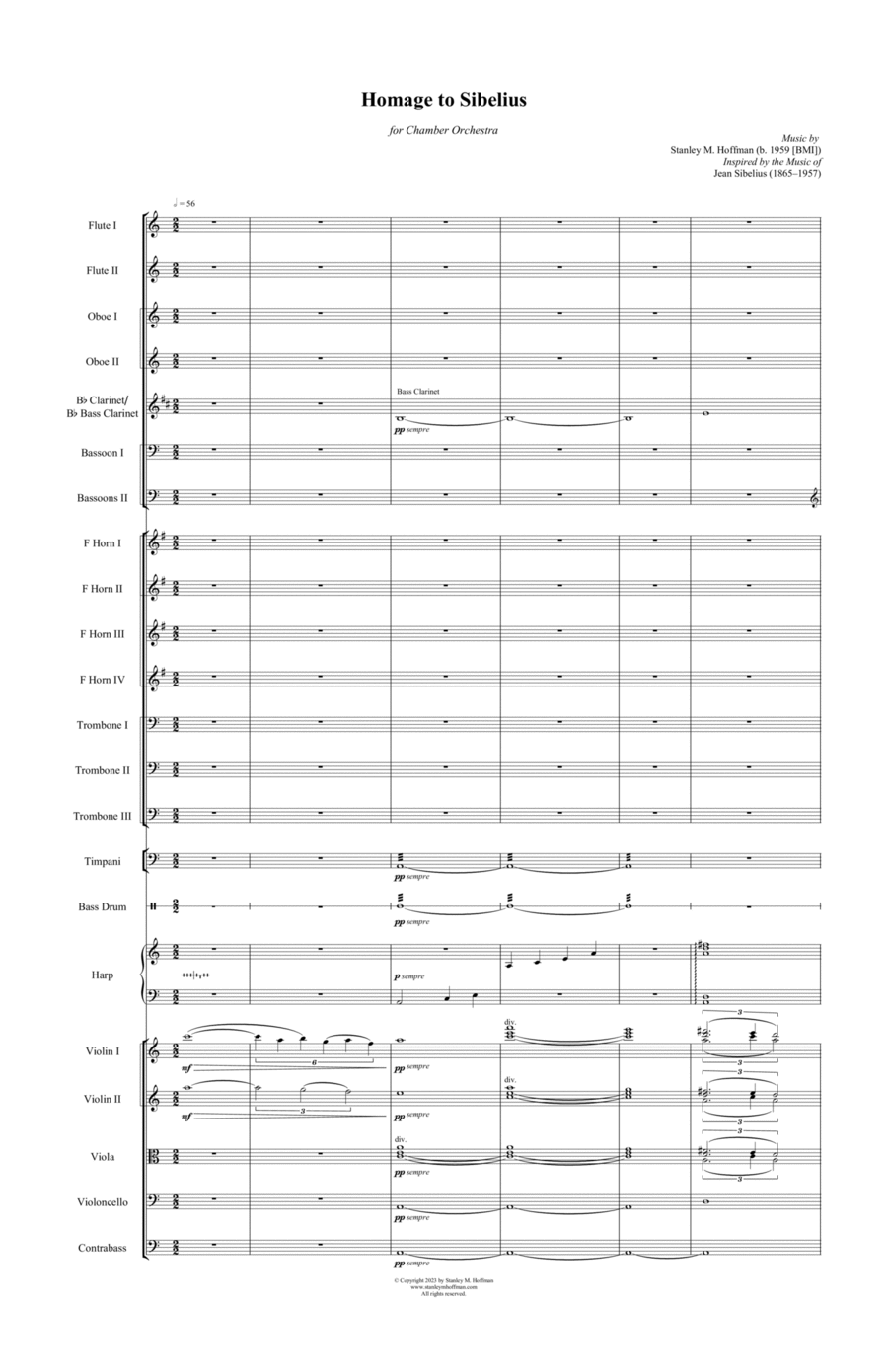
Homage to Sibelius
Orchestre de chambre

$103.50 88.67 € Orchestre de chambre PDF SheetMusicPlus


Partitions Gratuites
Acheter des Partitions Musicales
Acheter des Partitions Digitales à Imprimer
Acheter des Instruments de Musique

© 2000 - 2025

Accueil - Version intégrale





