EUROPE
7873 articles
USA
0 articles
DIGITAL
35636 articles (à imprimer)
Partitions Digitales
Partitions à imprimer
35636 partitions trouvées


Bassoon,Clarinet,Double Bass,Flute,Mallet Percussion,Multi-Percussion,Oboe/English Horn - Level 4 - Digital Download SKU: A0.1296860 Composed by Erik Satie. Arranged by Ray Thompson. 20th Century,Chamber,Comedy. 40 pages. RayThompsonMusic #887010. Published by RayThompsonMusic (A0.1296860). Arranged double wind quintet/bass and optional percussion.Background info:Parade is a ballet choreographed by Leonide Massine, with music by Erik Satie and a one-act scenario by Jean Cocteau. The ballet was composed in 1916–17 for Sergei Diaghilev's Ballets Russes. The ballet premiered on Friday, May 18, 1917, at the Théâtre du Châtelet in Paris, with costumes and sets designed by Pablo Picasso, choreography by Léonide Massine (who danced), and the orchestra conducted by Ernest Ansermet.The ballet was remarkable for several reasons. It was the first collaboration between Satie and Picasso, and also the first time either of them had worked on a ballet, thus making it the first time either collaborated with Diaghilev and the Ballets Russes.The plot of Parade incorporated and was inspired by popular entertainments of the period, such as Parisian music-halls and American silent-films.Much of the settings used in Parade's plot occurred outside of the formal Parisian theater, depicting the streets of Paris.The plot reproduces various elements of everyday life such as the music hall and fairground.Before Parade, the use of popular entertainment materials was considered unsuitable for the elite world of the ballet.The plot of Parade composed by Cocteau includes the failed attempt of a troupe of performers to attract audience members to view their show.Some of Picasso's Cubist costumes were in solid cardboard, allowing the dancers only a minimum of movement.The score contained several noise-making instruments (typewriter, foghorn, an assortment of bottles, pistol, and so on), which had been added by Cocteau (somewhat to the dismay of Satie).It is supposedthat such additions by Cocteau showed his eagerness to create a succès de scandale, comparable to that of Igor Stravinsky's Le Sacre du Printemps which had been premiered by the Ballets Russes some years before, and caused no less scandal.Although Parade was quite revolutionary, bringing common street entertainments to the elite, being scorned by audiences and being praised by critics,nonetheless many years later Stravinsky could still pride himself in never having been topped in the matter of succès de scandale.The ragtime contained in Parade would later be adapted for piano solo and attained considerable success as a separate piano piece.The finale is a rapid ragtime dance in which the whole cast [makes] a last desperate attempt to lure the audience in to see their showThe premiere of the ballet resulted in a number of scandals. One faction of the audience booed, hissed, and was very unruly, nearly causing a riot before they were drowned out by enthusiastic applause.Many of their objections were focused on Picasso's cubist design, which was met with cries of sale boche.Acrobates (Acrobats) is no 3 in the ballet, and includes some of the odd percussion : sirens and a bottle phone, in addition to normal orchestral perc.The piece can be performed without percussion....but the percussion gives it an extra something!!
Satie: Parade III.Acrobates (Acrobats) - wind dectet/bass (with optional percussion)

$19.95 17.19 € PDF SheetMusicPlus

Bassoon,Clarinet,Double Bass,Flute,Horn,Oboe,Percussion - Level 4 - Digital Download SKU: A0.1353773 Composed by Erik Satie. Arranged by Ray Thompson. 20th Century. 27 pages. RayThompsonMusic #938540. Published by RayThompsonMusic (A0.1353773). Arranged double wind quintet/bass and optional percussion.Background info:Parade is a ballet choreographed by Leonide Massine, with music by Erik Satie and a one-act scenario by Jean Cocteau. The ballet was composed in 1916–17 for Sergei Diaghilev's Ballets Russes. The ballet premiered on Friday, May 18, 1917, at the Théâtre du Châtelet in Paris, with costumes and sets designed by Pablo Picasso, choreography by Léonide Massine (who danced), and the orchestra conducted by Ernest Ansermet.The ballet was remarkable for several reasons. It was the first collaboration between Satie and Picasso, and also the first time either of them had worked on a ballet, thus making it the first time either collaborated with Diaghilev and the Ballets Russes.The plot of Parade incorporated and was inspired by popular entertainments of the period, such as Parisian music-halls and American silent-films.Much of the settings used in Parade's plot occurred outside of the formal Parisian theater, depicting the streets of Paris.The plot reproduces various elements of everyday life such as the music hall and fairground.Before Parade, the use of popular entertainment materials was considered unsuitable for the elite world of the ballet.The plot of Parade composed by Cocteau includes the failed attempt of a troupe of performers to attract audience members to view their show.Some of Picasso's Cubist costumes were in solid cardboard, allowing the dancers only a minimum of movement.The score contained several noise-making instruments (typewriter, foghorn, an assortment of bottles, pistol, and so on), which had been added by Cocteau (somewhat to the dismay of Satie).It is supposedthat such additions by Cocteau showed his eagerness to create a succès de scandale, comparable to that of Igor Stravinsky's Le Sacre du Printemps which had been premiered by the Ballets Russes some years before, and caused no less scandal.Although Parade was quite revolutionary, bringing common street entertainments to the elite, being scorned by audiences and being praised by critics,nonetheless many years later Stravinsky could still pride himself in never having been topped in the matter of succès de scandale.The ragtime contained in Parade would later be adapted for piano solo and attained considerable success as a separate piano piece.The finale is a rapid ragtime dance in which the whole cast [makes] a last desperate attempt to lure the audience in to see their showThe premiere of the ballet resulted in a number of scandals. One faction of the audience booed, hissed, and was very unruly, nearly causing a riot before they were drowned out by enthusiastic applause.Many of their objections were focused on Picasso's cubist design, which was met with cries of sale boche. Petite Fille Americaine  (Young American Girl) is no 2 in the ballet, and includes some of the odd percussion : typewriter and gunshots, in addition to normal orchestral perc.It also includes the Ragtime Dance which became very popular in it's own right.The piece can be performed without percussion....but the percussion gives it an extra something!!
Satie: Parade - II. Petite Fille Americaine - wind dectet

$14.95 12.88 € PDF SheetMusicPlus

A Clarinet,Bassoon,Double Bass,Flute,Oboe/English Horn,Percussion,Timpani,Tuba - Level 4 - Digital Download SKU: A0.1300657 Composed by Erik Satie. Arranged by Ray Thompson. 20th Century,Chamber. 27 pages. RayThompsonMusic #890400. Published by RayThompsonMusic (A0.1300657). Arranged double wind quintet/bass and optional percussion.Background info:Parade is a ballet choreographed by Leonide Massine, with music by Erik Satie and a one-act scenario by Jean Cocteau. The ballet was composed in 1916–17 for Sergei Diaghilev's Ballets Russes. The ballet premiered on Friday, May 18, 1917, at the Théâtre du Châtelet in Paris, with costumes and sets designed by Pablo Picasso, choreography by Léonide Massine (who danced), and the orchestra conducted by Ernest Ansermet.The ballet was remarkable for several reasons. It was the first collaboration between Satie and Picasso, and also the first time either of them had worked on a ballet, thus making it the first time either collaborated with Diaghilev and the Ballets Russes.The plot of Parade incorporated and was inspired by popular entertainments of the period, such as Parisian music-halls and American silent-films.Much of the settings used in Parade's plot occurred outside of the formal Parisian theater, depicting the streets of Paris.The plot reproduces various elements of everyday life such as the music hall and fairground.Before Parade, the use of popular entertainment materials was considered unsuitable for the elite world of the ballet.The plot of Parade composed by Cocteau includes the failed attempt of a troupe of performers to attract audience members to view their show.Some of Picasso's Cubist costumes were in solid cardboard, allowing the dancers only a minimum of movement.The score contained several noise-making instruments (typewriter, foghorn, an assortment of bottles, pistol, and so on), which had been added by Cocteau (somewhat to the dismay of Satie).It is supposedthat such additions by Cocteau showed his eagerness to create a succès de scandale, comparable to that of Igor Stravinsky's Le Sacre du Printemps which had been premiered by the Ballets Russes some years before, and caused no less scandal.Although Parade was quite revolutionary, bringing common street entertainments to the elite, being scorned by audiences and being praised by critics,nonetheless many years later Stravinsky could still pride himself in never having been topped in the matter of succès de scandale.The ragtime contained in Parade would later be adapted for piano solo and attained considerable success as a separate piano piece.The finale is a rapid ragtime dance in which the whole cast [makes] a last desperate attempt to lure the audience in to see their showThe premiere of the ballet resulted in a number of scandals. One faction of the audience booed, hissed, and was very unruly, nearly causing a riot before they were drowned out by enthusiastic applause.Many of their objections were focused on Picasso's cubist design, which was met with cries of sale boche.Prestidigitateur chinois (Chinese Conjuror) is no 1 in the ballet, and includes some of the odd percussion : sirens in addition to normal orchestral perc.The piece can be performed without percussion....but the percussion gives it an extra something!!
Satie: Parade I. Prestidigitateur chinois - wind dectet/bass (with optional percussion)

$19.95 17.19 € PDF SheetMusicPlus

Bassoon,Clarinet,Double Bass,Flute,Horn,Oboe - Level 4 - Digital Download SKU: A0.1335055 Composed by Erik Satie. Arranged by Ray Thompson. 20th Century,Chamber. 22 pages. RayThompsonMusic #920917. Published by RayThompsonMusic (A0.1335055). Satie: Parade - Final & Suite au Prélude de rideau rougeArranged wind dectet/bass (double wind quintet)The concluding music for Erik Satie's Ballet Parade.Other movements from Parade are available.Background info:Parade is a ballet choreographed by Leonide Massine, with music by Erik Satie and a one-act scenario by Jean Cocteau. The ballet was composed in 1916–17 for Sergei Diaghilev's Ballets Russes. The ballet premiered on Friday, May 18, 1917, at the Théâtre du Châtelet in Paris, with costumes and sets designed by Pablo Picasso, choreography by Léonide Massine (who danced), and the orchestra conducted by Ernest Ansermet.The ballet was remarkable for several reasons. It was the first collaboration between Satie and Picasso, and also the first time either of them had worked on a ballet, thus making it the first time either collaborated with Diaghilev and the Ballets Russes.The plot of Parade incorporated and was inspired by popular entertainments of the period, such as Parisian music-halls and American silent-films.Much of the settings used in Parade's plot occurred outside of the formal Parisian theater, depicting the streets of Paris.The plot reproduces various elements of everyday life such as the music hall and fairground.Before Parade, the use of popular entertainment materials was considered unsuitable for the elite world of the ballet.The plot of Parade composed by Cocteau includes the failed attempt of a troupe of performers to attract audience members to view their show.Some of Picasso's Cubist costumes were in solid cardboard, allowing the dancers only a minimum of movement.The score contained several noise-making instruments (typewriter, foghorn, an assortment of milk bottles, pistol, and so on), which had been added by Cocteau (somewhat to the dismay of Satie).It is supposedthat such additions by Cocteau showed his eagerness to create a succès de scandale, comparable to that of Igor Stravinsky's Le Sacre du Printemps which had been premiered by the Ballets Russes some years before, and caused no less scandal.Although Parade was quite revolutionary, bringing common street entertainments to the elite, being scorned by audiences and being praised by critics,nonetheless many years later Stravinsky could still pride himself in never having been topped in the matter of succès de scandale.The ragtime contained in Parade would later be adapted for piano solo and attained considerable success as a separate piano piece.The finale is a rapid ragtime dance in which the whole cast [makes] a last desperate attempt to lure the audience in to see their showI have omitted the  percussion in my arrangement of the finale.The premiere of the ballet resulted in a number of scandals. One faction of the audience booed, hissed, and was very unruly, nearly causing a riot before they were drowned out by enthusiastic applause.Many of their objections were focused on Picasso's cubist design, which was met with cries of sale boche.Arranged wind dectet/bass (double wind quintet).
Satie: Parade - Final & Suite au Prélude de rideau rouge - wind dectet

$14.95 12.88 € PDF SheetMusicPlus

Full Orchestra - Level 5 - Digital Download SKU: A0.1258828 Composed by Jerry Goldsmith. Arranged by Chris Siddall. Film/TV,Patriotic. 12 pages. Chris Siddall Music Publishing #852089. Published by Chris Siddall Music Publishing (A0.1258828). 1997’s Air Force One saw Harrison Ford’s president of the United States face off against Gary Oldman’s sinister Russian-rebel hijacker. With a plot that required a liberal suspension of disbelief, a serious action score was required. Composer Randy Newman was employed to provide his trademark essence of Americana, however after recording an hour of material for the movie, director Wolfgang Peterson felt Newman’s score carried the wrong tone for the picture and dropped him from the project. The release date was fast approaching, but veteran composer Jerry Goldsmith pledged to make an attempt to save the movie. With only twelve days in which to record a replacement score, he knew he couldn’t accomplish the task alone, and initially asked his son Joel to assist him.  Being unavailable, Jerry turned to rising composer Joel McNeely and the resulting score was exactly what Peterson was looking for.Created from the original manuscript, this release offers a rare opportunity to study film music in its authentic, original orchestration and arrangement. An opportunity not to be missed!
The Parachutes - Score Only
Orchestre

$9.99 8.61 € Orchestre PDF SheetMusicPlus

Choral Choir (SATB) - Level 4 - Digital Download SKU: A0.701439 Composed by Kevin G. Pace, Mark R. Fotheringham. Christian,Praise & Worship,Sacred. Octavo. 2 pages. Kevin G. Pace #3111093. Published by Kevin G. Pace (A0.701439). An original hymn. SATB. 3 verses. The text by Mark Fotheringham below beautifully teaches the importance of seeking the spirit.YouTube video: https://youtu.be/KuA5ro5NGUM1. Kneeling in darkness, searching for answers, pondering questions, and looking for light.Seek for the Spirit. He will reveal to you, leading you onto the path of the right. There in the silence, softly He whispers, reaching inside to inspire the heart, He will uncover wisdom and mercy, silently speaking, all truth to impart.   2. In pain or anguish, suffering sorrow, longing for comfort, in search of relief. Jesus, our Savior, sent forth a Comforter, giving you strength to endure every grief. Staying beside you, He'll never leave you, even when all men far from you have flown. Whispering softly, Christ knows your suff'ring, helping you know you are never alone.   3. Living the gospel, praying for guidance, searching the scriptures, preparing to teach. Ask for the Spirit. He'll testify to all, truth ever piercing each heart as you preach. One with The Father, one with our Savior, true revelation cannot be denied. Seek for the Spirit. Each day He'll point you back to our Father, with Him to reside.
Seek the Spirit - an original hymn
Chorale SATB

$1.99 1.71 € Chorale SATB PDF SheetMusicPlus

String Orchestra - Level 3 - Digital Download SKU: A0.835578 Composed by Johann Sebastian Bach. Arranged by Vincent Vitale. Baroque. Score and parts. 11 pages. Vincent Vitale #5988125. Published by Vincent Vitale (A0.835578). AIR from Bach’s Suite No.3 is geared toward Intermediate students on a medium difficulty level. More commonly known as Air on the G string, you will find that half way through this arrangement a different approach from normal is taken. Air is considered one of the more famous pieces from the Baroque era. If this composition appeals to you please consider the many others in this string series by typing VINCENT VITALE in the search bar located on the home page. I hope you and your students enjoy performing this piece. As always I thank you very much for your consideration and wish you and your students much musical success. …Copyright 2020 .
AIR (on the G String)
Orchestre à Cordes

$22.00 18.96 € Orchestre à Cordes PDF SheetMusicPlus

Full Orchestra - Level 4 - Digital Download SKU: A0.1077397 Composed by Jerry Goldsmith. Arranged by Chris Siddall. Film/TV. Score and parts. 8 pages. Chris Siddall Music Publishing #681583. Published by Chris Siddall Music Publishing (A0.1077397). After Phillip Lambro’s original score for Chinatown was rejected at the last minute, composer Jerry Goldsmith was brought in to “save the dayâ€. It’s amazing to think that what is now considered a classic score, and a template for the film noir sound, was written in only ten days. In a meeting with producer Robert Evans, it was suggested that they wanted a contemporary 1930s feel to the music, but Jerry pushed back on this idea saying that this was already displayed on the screen, and that the underscore should enhance the emotion, and emotions are timeless. Jerry hadn’t yet considered what he was going to write, when asked what he envisiged in terms of orchestration, so he quickly replied “four pianos, four harps, strings, solo trumpet and two percussion†which Evans liked the idea of. Having spoken himself into this “trapâ€, Jerry then had to go home and write it, and it turned out to be an interesting combination of instruments to write for Created from the original manuscript, this release offers a rare opportunity to study film music in its authentic, original orchestration and arrangement. An opportunity not to be missed!
Chinatown - Score Only
Orchestre

$4.99 4.3 € Orchestre PDF SheetMusicPlus

Brass Quintet Baritone Horn TC,Cornet,Euphonium,Flugelhorn,Trombone,Trumpet,Tuba - Level 3 - Digital Download SKU: A0.1385762 Composed by Kenneth J. Alford. Arranged by Keith Terrett. 20th Century,Film/TV,Instructional,Standards,Traditional. 48 pages. Keith Terrett #969699. Published by Keith Terrett (A0.1385762). Colonel Bogey transcribed for Brass & Brass Band Quintet.The Colonel Bogey March is a British march that was composed in 1914 by Lieutenant F. J. Ricketts (1881–1945) (pen name Kenneth J. Alford), a British Army bandmaster who later became the director of music for the Royal Marines at Plymouth. The march is often whistled. Featuring in films since it first appeared in The Lady Vanishes in 1938, Empire magazine included the tune in its list of 25 of Cinema's Catchiest Earworms.Since service personnel were, at that time, not encouraged to have professional lives outside the armed forces, British Army bandmaster F. J. Ricketts published Colonel Bogey and his other compositions under the pseudonym Kenneth J. Alford in 1914. One supposition is that the tune was inspired by a British military officer who preferred to whistle a descending minor third rather than shout Fore! when playing golf. It is this descending interval that begins each line of the melody. The name Colonel Bogey began in the late 19th century as an imaginary standard opponent in assessing a player's performance, and by Edwardian times the Colonel had been adopted by the golfing world as the presiding spirit of the course. Edwardian golfers on both sides of the Atlantic often played matches against Colonel Bogey. Bogey is now a golfing term meaning one over par.
Colonel Bogey March for Classical Brass & Brass Band Quintet with Percussion

$12.99 11.19 € PDF SheetMusicPlus

String Quartet Cello,String Quartet,Viola,Violin - Level 3 - Digital Download SKU: A0.1425189 By Coldplay. By Avicii, Chris Martin, Guy Berryman, Jon Buckland, and Will Champion. Arranged by Inacio Saldanha. Pop,Singer/Songwriter. 17 pages. Inacio Saldanha #1006007. Published by Inacio Saldanha (A0.1425189). A Sky Full of Stars is a song by the British rock band Coldplay. It was released in May 2014 as the second single from their sixth album, Ghost Stories (2014). An exclusive digital EP version of it, with the B-sides All Your Friends, Ghost Story and O (Reprise), came out in the following weeks, being considered the band's eleventh extended play.The band co-wrote and co-produced the song with Avicii and received production assistance from Paul Epworth, Daniel Green and Rik Simpson. It was recorded at the Bakery and the Beehive in North London, England. Upon its release, A Sky Full of Stars garnered mostly positive reviews from music critics and charted inside the top 10 in over 16 countries such as Australia, Canada, Ireland, Japan, Mexico, New Zealand, the United Kingdom and United States.A music video for the song was directed by Mat Whitecross and was released on 19 June 2014. The single peaked at number one in Italy, Israel, Luxembourg, Portugal, Lebanon, and the Walloon region of Belgium. It also topped the Billboard Hot Dance Club Songs chart. It was nominated for Best Pop Duo/Group Performance at the 57th Grammy Awards. (Wikipedia)Key of F. Arranged for String Quartet.
A Sky Full Of Stars
Quatuor à cordes: 2 violons, alto, violoncelle
Coldplay
$14.99 12.92 € Quatuor à cordes: 2 violons, alto, violoncelle PDF SheetMusicPlus

Concert Band - Level 3 - Digital Download SKU: A0.1423779 By Coldplay. By Avicii, Chris Martin, Guy Berryman, Jon Buckland, and Will Champion. Arranged by Simone Orsini. 21st Century,Pop. 79 pages. Simone Orsini #1005018. Published by Simone Orsini (A0.1423779). A SKY FULL OF STARS performed by ColdplayFor Concert Band - Performance Time 4:02 - Digital DownloadComposed by T. Bergling, J. Buckland, W. Champion, C. Martin,G. BerrymanArranged by Simone OrsiniInstrumentation:Full Score, Flute 1, 2, Oboe, Bassoon, Eb Clarinet, Bb Clarinet 1, 2, 3, Bb Bass Clarinet, Eb Alto Saxophone 1, 2, Bb Tenor Saxophone, Eb Baritone Saxophone, Bb Trumpet 1, 2, 3, F Horn 1, 2, 3, 4, Trombone 1, 2, Bass Trombone, Euphonium, Tuba, El. Bass, Drum Set, Percussion (Tamb., Shaker), El. Guitar, keyboard.Additional Parts:Bb Soprano Saxophone, Eb Horn 1, 2, 3, 4, Bb Trombone 1, 2 T.C., Bb Bass Trombone T.C., Bb Euphonium T.C., Bb Bass T.C.A Sky Full of Stars is a song by the British rock band Coldplay. It was released in May 2014 as the second single from their sixth album, Ghost Stories (2014). An exclusive digital EP version of it, with the B-sides All Your Friends, Ghost Story and O (Reprise), came out in the following weeks, being considered the band's eleventh extended play.The band co-wrote and co-produced the song with Avicii and received production assistance from Paul Epworth, Daniel Green and Rik Simpson. It was recorded at the Bakery and the Beehive in North London, England. Upon its release, A Sky Full of Stars garnered mostly positive reviews from music critics and charted inside the top 10 in over 16 countries such as Australia, Canada, Ireland, Japan, Mexico, New Zealand, the United Kingdom and United States.A music video for the song was directed by Mat Whitecross and was released on 19 June 2014. The single peaked at number one in Italy, Israel, Luxembourg, Portugal, Lebanon, and the Walloon region of Belgium. It also topped the Billboard Hot Dance Club Songs chart. It was nominated for Best Pop Duo/Group Performance at the 57th Grammy Awards.
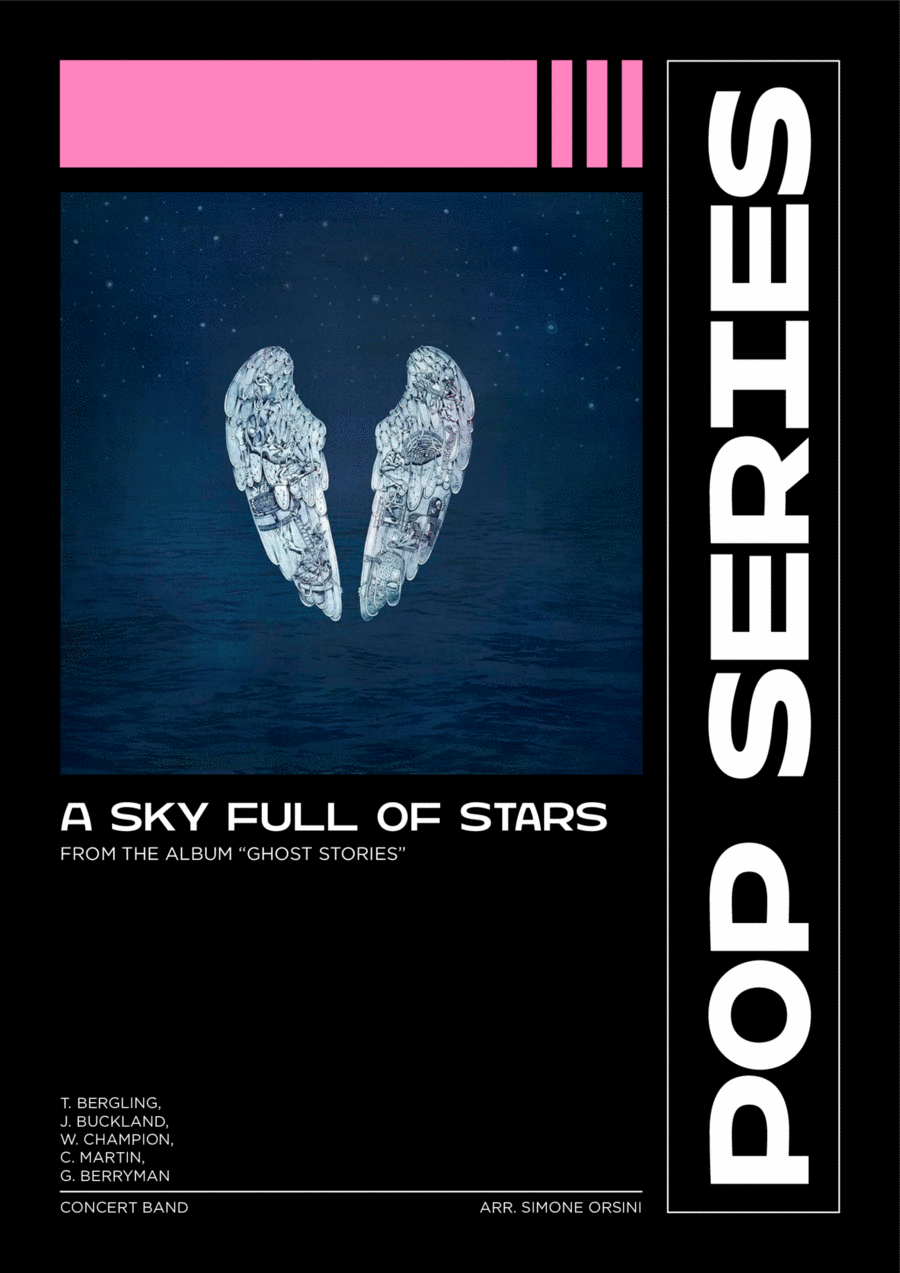
A Sky Full Of Stars
Orchestre d'harmonie
Coldplay
$68.00 58.6 € Orchestre d'harmonie PDF SheetMusicPlus

Concert Band - Level 2 - Digital Download SKU: A0.1492841 By Keen'V. By Curtis Inseque, Jordan Houyez, Julio Masidi, and Kevin Bonnet. Arranged by Kirk Kiernander. Contemporary,Multicultural,Pop,World. 34 pages. Kirk Kiernander #1069527. Published by Kirk Kiernander (A0.1492841). Outété, performed by Keen'V, was the runner-up song for the 2023 Manie Musicale song competition. This high energy piece has been arranged for concert band where each Part 1 is levelled near grade 1.5, Part 2 near grade .75. When Part 2 has a more complicated part, support is given with Part 1. For levelled percussion, the Drums part has been extracted to Snare Drum and Bass Drum parts.Ensembles can play Part 1 by itself, or just Part 2, but there are impressive rhythmic complications when both parts are played together. This piece can be played as a side-by-side for 2 different levelled bands (e.x., Junior/Senior Bands) or in class to allow students to work within their own abilities. Lastly, this piece can be played as the backing track for a vocalist to sing along with.It is encouraged to play Outété alongside the song to help with student engagement, rhythmic accuracy, and tuning as it is in the same key of Bb Concert.Audio for Outété found here: https://www.youtube.com/watch?v=U8CTuHNh3zUMeasure 36 in the Drums part, the cymbal should be rolled into the repeat and measure 37.
Outete
Orchestre d'harmonie
Keen'V
$55.00 47.39 € Orchestre d'harmonie PDF SheetMusicPlus

String Ensemble,String Quintet - Level 3 - Digital Download SKU: A0.808435 Composed by Vince Guaraldi. Arranged by Mark W. Huxhold. Jazz. Score and parts. 11 pages. Mark Wayne Music, LLC #3688811. Published by Mark Wayne Music, LLC (A0.808435). 2018 Holiday Contest Entry Performance Considerations This arrangement retains the same form and key as the original soundtrack recording and is very flexible. On an ad hoc basis, choir, jazz piano, and/or snare with brushes can easily be added. A lead sheet is also included in the set of parts and is available separately from Mark Wayne Music  Educational Considerations 1. Minimum Proficiency/Curricular Assumption - The student has studied the key of F, but the key of Bb may be currently under study. Fingerings that are unique to the key of Bb are provided as listed by instrument below. Positions are indicated for cello and bass 2. Harmony and Enharmonics - This piece provides an excellent opportunity to discuss how the oddly spelled note illustrates its’ function within the chord. Notes that may be new to the student or enharmonic spellings the player will encounter are listed below. Chord symbols are indicated in the score as an aid. Violin: L4 on D string, new note Ab  Viola:  L4 on G string, new note Db, Enharmonics- Cb, Fb Violin III included Cello: 2 measures extended first position (repeated).  Second position on D string Bass: New notes: Eb on D string, Db on A string, Ab on E string,            Enharmonic- Gb           Jazz Pizzicato (optional) - Place the inside of the right hand on the string and pluck with the entire side of the index finger, letting it come to rest on the lower string. This has two effects, more sustain, and a more resonant tone. The technique works great for a single bass but may cause an ensemble problem with multiple basses
Christmas Time Is Here

$12.99 11.19 € PDF SheetMusicPlus

String Ensemble,String Quintet - Level 3 - Digital Download SKU: A0.808437 Composed by Vince Guaraldi. Arranged by Mark W. Huxhold. Jazz. Score and parts. 7 pages. Mark Wayne Music, LLC #3688827. Published by Mark Wayne Music, LLC (A0.808437). 2018 Holiday Contest Entry Performance Considerations This arrangement retains the same form and key as the original soundtrack recording and is very flexible. On an ad hoc basis, choir, jazz piano, and/or snare with brushes can easily be added. A lead sheet is also included in the set of parts and is available separately from Mark Wayne Music  Educational Considerations 1. Minimum Proficiency/Curricular Assumption - The student has studied the key of F, but the key of Bb may be currently under study. Fingerings that are unique to the key of Bb are provided as listed by instrument below. Positions are indicated for cello and bass 2. Harmony and Enharmonics - This piece provides an excellent opportunity to discuss how the oddly spelled note illustrates its’ function within the chord. Notes that may be new to the student or enharmonic spellings the player will encounter are listed below. Chord symbols are indicated in the score as an aid. Violin: L4 on D string, new note Ab  Viola:  L4 on G string, new note Db,     Enharmonics- Cb, Fb     Violin III included Cello: 2 measures extended first position (repeated).      Second position on D string Bass: New notes: Eb on D string, Db on A string, Ab on E string,            Enharmonic- Gb           Jazz Pizzicato (optional) - Place the inside of the right hand on the string and pluck with the entire side of the index finger, letting it come to rest on the lower string. This has two effects, more sustain and a more resonant tone. The technique works great for a single bass but may cause an ensemble problem with multiple basses.
Christmas Time Is Here

$6.99 6.02 € PDF SheetMusicPlus

Instrumental Duet Instrumental Duet,Viola,Violin - Level 3 - Digital Download SKU: A0.808440 Composed by Vince Guaraldi. Arranged by Mark W. Huxhold. Jazz. Score and parts. 2 pages. Mark Wayne Music, LLC #3688833. Published by Mark Wayne Music, LLC (A0.808440). 2018 Holiday Contest Entry Performance Considerations This arrangement retains the same form and key as the original soundtrack recording and is very flexible. On an ad hoc basis, choir, jazz piano, and/or snare with brushes can easily be added. A lead sheet is also included in the set of parts and is available separately from Mark Wayne Music  Educational Considerations 1. Minimum Proficiency/Curricular Assumption - The student has studied the key of F, but the key of Bb may be currently under study. Fingerings that are unique to the key of Bb are provided as listed by instrument below. Positions are indicated for cello and bass 2. Harmony and Enharmonics - This piece provides an excellent opportunity to discuss how the oddly spelled note illustrates its’ function within the chord. Notes that may be new to the student or enharmonic spellings the player will encounter are listed below. Chord symbols are indicated in the score as an aid. Violin: L4 on D string, new note Ab  Viola:  L4 on G string, new note Db, Enharmonics- Cb, Fb Violin III included Cello: 2 measures extended first position (repeated).  Second position on D string Bass: New notes: Eb on D string, Db on A string, Ab on E string,            Enharmonic- Gb           Jazz Pizzicato (optional) - Place the inside of the right hand on the string and pluck with the entire side of the index finger, letting it come to rest on the lower string. This has two effects, more sustain, and a more resonant tone. The technique works great for a single bass but may cause an ensemble problem with multiple basses.
Christmas Time Is Here
Violon, Alto (duo)

$4.99 4.3 € Violon, Alto (duo) PDF SheetMusicPlus


Partitions Gratuites
Acheter des Partitions Musicales
Acheter des Partitions Digitales à Imprimer
Acheter des Instruments de Musique

© 2000 - 2026

Accueil - Version intégrale





