EUROPE
7873 articles
USA
0 articles
DIGITAL
35643 articles (à imprimer)
Partitions Digitales
Partitions à imprimer
35643 partitions trouvées


String quartet - easy - Digital Download SKU: S9.Q19532 8 Twentieth-Century Pieces. The Schott String Quartet Series. Downloadable, Score and parts. Schott Music - Digital #Q19532. Published by Schott Music - Digital (S9.Q19532). Having touched on the romantic era in 'To a Wild Rose' and the classical era in 'An die Musik', Kember moves forward to the twentieth-century with this thoughtfully chosen collection for string quartet. The Schott String Quartet Series With the first books in the series focusing on baroque, classical and romantic styles, The Schott String Quartet Series has expanded to cover music ranging from traditional pieces through to Eastern-influenced works. Aside from 'Indian Summer', which features original compositions, each book contains original arrangements of well known themes, which have often never been arranged for string quartet before. An important characteristic of these arrangements is that they allow all four instruments to demand the attention throughout the music. The pieces are suitable for amateur musicians or school students and are ideal for public performance.
Chanson de nuit
Quatuor à cordes: 2 violons, alto, violoncelle

$18.99 16.49 € Quatuor à cordes: 2 violons, alto, violoncelle PDF SheetMusicPlus

Unison/Two-part chorus - Digital Download SKU: C7.CGA1175 Composed by Becki Slagle Mayo and Paul Adams. General, Lent. Sacred Anthem. Octavo. 8 pages. Chorister's Guild - Digital #CGA1175. Published by Chorister's Guild - Digital (C7.CGA1175). UPC: 749193014592.Appropriate for both older children's choirs and youth choirs, this unique, jazz style anthem reinforces valuable lessons taught during the Lenten season and other times of year. The forty days and forty nights theme underscores the importance of setting aside time to reflect and pray, just as Jesus did in the wilderness. Also drawing from Old Testament stories about Noah and Moses, the composers emphasize the importance of waiting, trusting, and following God's leadership.
Forty Days and Forty Nights
Chorale Unison

$1.95 1.69 € Chorale Unison PDF SheetMusicPlus

Piano Solo - Level 5 - Digital Download SKU: A0.992000 Composed by Barry Michael Wehrli. 20th Century,Contemporary,Standards. Score. 5 pages. Wehrli Publications #3397395. Published by Wehrli Publications (A0.992000). Recording duration: 4:54. Recording excerpt begins at measure 7. Prelude 14 is the fourteenth of 15 works available in the Book of Preludes: 1-15 for Piano, a collection of character pieces by keyboardist, author, educator, and Wehrli Publications founder, Barry Michael Wehrli. These evocative preludes resemble the short, expressive pieces of Beethoven, Chopin and Debussy, but possess elements of later styles such as 20th century, new-age, jazz and more. Aside from their value as outstanding new performance repertoire, advanced students and professionals are discovering the pedagogical value of the Preludes as they make their way into state teaching organizations across the country such as CAPMT (California) and UMTA (Utah). Teachers often search for new and appealing serious music for their piano students. Yet such music is hard to find. The complete Book of Preludes offers nearly an hour of diverse music, each prelude creating its own unique sense of musical journey. All preludes contain damper and sostenuto pedal indications, bar numbers, suggested fingering, and tempo and dynamic marks reflecting the composer’s recorded performance.  Reviews are available at the locations below. The Complete Book of Preludes: 1-15 for Piano - In Print: wehrlipubs.com/shop/book-of-preludes. The Complete Book of Preludes: 1-15 for Piano - Studio Recordings: wehrlipubs.com/shop/book-of-preludes-cd. Purchased Books or CDs will be autographed by the composer upon request. Social media and contact information is available at Wehrli Publications: wehrlipubs.com. Barry is a member of the Music Teachers Association of California (MTAC), the California Association of Professional Music Teacher (CAPMT), and ASCAP. He welcomes your thoughts on the Preludes and is happy to answer any questions regarding the Wehrli Publications catalog of piano instruction materials.
Prelude 14 from "Book of Preludes: 1-15 for Piano"
Piano seul

$2.99 2.6 € Piano seul PDF SheetMusicPlus

Piano Trio - Level 1 - Digital Download SKU: A0.548647 Composed by Wade. Arranged by James M. Guthrie, ASCAP. Christmas. 7 pages. Jmsgu3 #3407487. Published by jmsgu3 (A0.548647). O Come, All Ye Faithful O Come, All Ye Faithful arranged for piano trio ( piano, violin & cello) featuring a thought-provoking re-harmonization of the final verse. O Come, All Ye Faithful is an English translation of the Latin Christmas carol Adeste Fideles. No one knows exactly who wrote it. One theory holds that King John IV of Portugal (1604–1656) wrote it. Another view says John F. Wade or John Reading wrote it. Nowadays, we usually attribute it to John Wade. It seems like Stonyhurst College in Lancashire owns the oldest manuscript. It is from the year 1751. Lyrics Frederick Oakeley, a Catholic priest in 1841, wrote the English translation. This translation is probably the most common in English-speaking states. To begin with, the hymn had only four verses. Later, the verses grew to eight. Music directors often cut various verses because otherwise, the song goes too long. Some believe that St. Bonaventure wrote the first Latin lyrics. Others hold that King John IV of Portugal is responsible. Yet even others think the Cistercian monks wrote them. King John IV His subjects called King John IV of Portugal The Musician King. He became king in 1640. In addition to performing the duties of a king, he composed and wrote as a music journalist. King John built an extensive music library. Unfortunately, the massive earthquake in Lisbon ruined the library in 1755. In addition to making his library, the king started a Music School that produced many accomplished musicians. The king also worked diligently to get instrumental music approved by the Vatican for use in his churches. Aside from his authorship of Adeste Fideles, he is famous for another popular choral setting of the Crux Fidelis, a prevalent Lenten hymn. Performance in Context Verses are sometimes left out because all eight verses would take too long to perform. More to the point, though, some of the poems may be unsuitable for whatever church calendar they are intended. The eighth verse deals with the Epiphany, so it makes sense to sing this on Epiphany Sunday but not on other Sundays. Similarly, other poems are used for whether the event is Midnight Mass or regular daytime Mass.  
O Come All Ye Faithful for Piano Trio
Piano Trio: piano, violon, violoncelle

$24.95 21.66 € Piano Trio: piano, violon, violoncelle PDF SheetMusicPlus

B-Flat Trumpet,Piano - Level 1 - Digital Download SKU: A0.548515 Composed by Wade. Arranged by James M. Guthrie, ASCAP. Christian,Christmas. Score and part. 4 pages. Jmsgu3 #3388127. Published by jmsgu3 (A0.548515). O Come All Ye Faithful arranged with new harmony for the final verse. Score: 3 pages, part: 1 page. Trumpet in Bb O Come, All Ye Faithful O Come, All Ye Faithful is an English translation of the Latin Christmas carol Adeste Fideles. No one knows exactly who wrote it. One theory holds that King John IV of Portugal (1604–1656) wrote it. Another theory says John F. Wade or John Reading wrote it. Nowadays, we usually attribute it to John Wade. Seems like Stonyhurst College in Lancashire owns the oldest manuscript. It is from the year 1751. Lyrics Frederick Oakeley, a Catholic priest in 1841 wrote the English translation. This translation is probably the most common in the English-speaking states. To begin with, the hymn had only four verses. Later, the verses grew to eight. Music directors often cut various verses because otherwise, the song goes too long. Some believe that St. Bonaventure wrote the first Latin lyrics. Others hold that King John IV of Portugal is responsible. Yet even others think the Cistercian monks wrote them. King John IV His subjects called King John IV of Portugal The Musician King. He became king in 1640. In addition to performing the duties of a king, he composed and wrote as a music journalist. King John built a very large music library. Unfortunately, the massive earthquake of Lisbon ruined the library in 1755. In addition to building his library, the king started a Music School that produced many accomplished musicians. The king also worked diligently to get instrumental music approved by the Vatican for use in his churches. Aside from his authorship of Adeste Fideles, he is famous for another popular choral setting of the Crux Fidelis, a prevalent Lenten hymn. Performance in Context Verses are sometimes left out because all eight verses would take too long to perform. More to the point though, some of the verses may be unsuitable for whatever of the church calendar they are intended. The eighth verse deals with the Epiphany, so it makes sense to sing this on Epiphany Sunday, but not other Sundays. Similarly, other verses are used according to whether the event is Midnight Mass or regular daytime Mass.  Register for free lifetime updates and revisions at www.jamesguthrie.com
O Come All Ye Faithful for Trumpet & Piano
Trompette

$24.95 21.66 € Trompette PDF SheetMusicPlus

String Ensemble,String Trio Cello,Viola,Violin - Level 3 - Digital Download SKU: A0.732748 Composed by Traditional. Arranged by Dave Prudon. Christmas,Classical,Sacred. Score and parts. 6 pages. Prudon String Ensembles #6622093. Published by Prudon String Ensembles (A0.732748). All of the beauty and reverance of this Christmastime favorite can be found in this lovely arrangement for String Trio.  Filled with gorgeous suspensions and tasteful passing tones, this arrangement will tug at your heartstrings.  And aside from that, Trios will like the fact that each musician gets a chance to play the melody.To view a huge selection of nicely-written arrangements for strings, take a peek at: Prudon String Ensembles Sheet Music.
Coventry Carol for String Trio
Trio à Cordes: violon, alto, violoncelle

$9.99 8.67 € Trio à Cordes: violon, alto, violoncelle PDF SheetMusicPlus

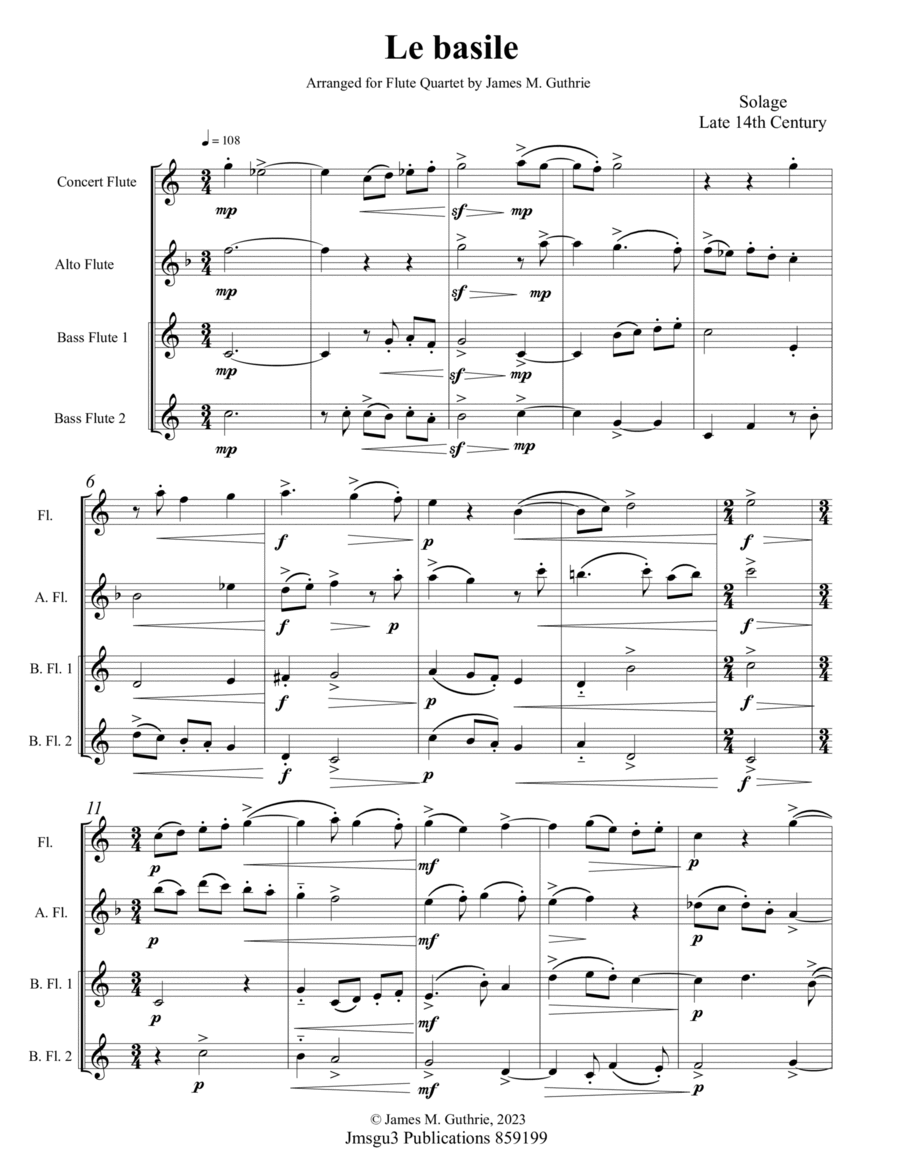
Flute Quartet,Woodwind Ensemble Alto Flute,Bass Flute - Level 2 - Digital Download SKU: A0.1266468 Composed by Solage. Arranged by James M. Guthrie. Chamber,Contest,Early Music,Festival,Historic,Medieval. 8 pages. Jmsgu3 #859199. Published by jmsgu3 (A0.1266468). Solage's ballade Le basile de sa propre nature is a significant work in the history of medieval music. Here are some of its historical significances:1. It is one of the twelve surviving works attributed to Solage, a French composer who lived in the late 14th century. Solage's works are known for their complex rhythms, intricate harmonies, and expressive melodies.2. Le basile de sa propre nature is a four-voice ballade that features a text about the mythical creature known as the basilisk. The lyrics describe the basilisk as a monster that kills everything it sees with its deadly venom. The music is characterized by its intricate rhythms and harmonies, which reflect the text's vivid imagery.3. The ballade is preserved in the Chantilly Codex, a manuscript that contains a collection of French secular music from the late 14th century. The Chantilly Codex is one of the most important sources of medieval music, and it provides valuable insights into the musical practices of the time.4. Le basile de sa propre nature is an example of the Ars subtilior style, which was a highly experimental and complex musical style that emerged in the late 14th century. This style was characterized by its use of intricate rhythms, complex harmonies, and unusual notational practices. The Ars subtilior style was highly influential in the development of later musical styles, and it remains an important part of the medieval musical canon.Overall, Solage's ballade Le basile de sa propre nature is a significant work that reflects the complex and experimental musical practices of the late 14th century. Its vivid imagery, intricate rhythms, and complex harmonies make it a valuable contribution to the medieval musical canon.Lyrics:All those he sees he kills suddenly,For his venom is deadly.He is a basilisk by his own nature,And he has no other way of being. He is a monster of great power,And he is feared by all who know him.He is a creature of the earth,And he is a master of death. He is a basilisk by his own nature,And he has no other way of being.All those he sees he kills suddenly,For his venom is deadly. He is a creature of the night,And he is a master of the dark.He is a monster of great might,And he is feared by all who hear his name. He is a basilisk by his own nature,And he has no other way of being.All those he sees he kills suddenly,For his venom is deadly.Solage was a French composer and probably also a poet who lived in the late 14th century. He composed the most pieces in the Chantilly Codex, which is the principal source of music of the ars subtilior, a manneristic compositional school centered on Avignon at the end of the century. Solage is an obscure composer, and aside from what can be deduced from the pieces attributed to him in the Chantilly Codex, nothing else is known about him. There are several interpretations of his name, and it is not clear whether his first name was Jean or Charles.  The ars subtilior was a manneristic compositional school centered on Avignon at the end of the 14th century. It was characterized by complex rhythms and pitch, and it was a transitional period between the late medieval and Renaissance periods. Solage was one of the composers who fit into this school, and he composed the most pieces in the Chantilly Codex, which is the principal source of music of the ars subtilior. Stylistically, Solage's works exhibit two distinctly different characters: a relatively simple one usually associated with his great predecessor and elder contemporary Guillaume de Machaut, and a more recherché one, complex in the areas of both pitch and rhythm, characteristic of the ars subtilior. 
Solage: Le basile for Flute Quartet
Quatuor de Flûtes : 4 flûtes

$32.95 28.61 € Quatuor de Flûtes : 4 flûtes PDF SheetMusicPlus

Choral Choir (SATB) - Level 3 - Digital Download SKU: A0.928967 Composed by Composer and Lyricist unknown. Arranged by Donald A. Mills, 2018. A Cappella,Folk,Praise & Worship,Sacred,Spiritual. Octavo. 3 pages. Donald A Mills #3458791. Published by Donald A Mills (A0.928967). This is one of the most beloved hymns in America. Aside from the religious aspects of the message, the music is very old and beautiful, the composer and lyricist are lost to time. The song originated from slaves during the time of slavery in the United States, the song's message and beauty bringing comfort to the oppressed.This new arrangement is sure to be enjoyed by your congregation or concert audience. This arrangement would make a wonderful addition to any concert or for a choral singing competition. It is an SATB a cappella arrangement with occasional divisions of voice (divisi). The arragement is appropriate for intermediate to advanced singers.
There Is A Balm In Gilead SATB
Chorale SATB

$2.99 2.6 € Chorale SATB PDF SheetMusicPlus

Piano,Violin - Level 1 - Digital Download SKU: A0.548518 Composed by Wade. Arranged by James M. Guthrie, ASCAP. Christmas. 4 pages. Jmsgu3 #3388143. Published by jmsgu3 (A0.548518). O Come All Ye Faithful arranged with new harmony for the final verse. Score: 3 pages, part: 1 page.O Come, All Ye Faithful O Come, All Ye Faithful is an English translation of the Latin Christmas carol Adeste Fideles. No one knows exactly who wrote it. One theory holds that King John IV of Portugal (1604–1656) wrote it. Another theory says John F. Wade or John Reading wrote it. Nowadays, we usually attribute it to John Wade. Seems like Stonyhurst College in Lancashire owns the oldest manuscript. It is from the year 1751. Lyrics Frederick Oakeley, a Catholic priest in 1841 wrote the English translation. This translation is probably the most common in the English-speaking states. To begin with, the hymn had only four verses. Later, the verses grew to eight. Music directors often cut various verses because otherwise, the song goes too long. Some believe that St. Bonaventure wrote the first Latin lyrics. Others hold that King John IV of Portugal is responsible. Yet even others think the Cistercian monks wrote them. King John IV His subjects called King John IV of Portugal The Musician King. He became king in 1640. In addition to performing the duties of a king, he composed and wrote as a music journalist. King John built a very large music library. Unfortunately, the massive earthquake of Lisbon ruined the library in 1755. In addition to building his library, the king started a Music School that produced many accomplished musicians. The king also worked diligently to get instrumental music approved by the Vatican for use in his churches. Aside from his authorship of Adeste Fideles, he is famous for another popular choral setting of the Crux Fidelis, a prevalent Lenten hymn. Performance in Context Verses are sometimes left out because all eight verses would take too long to perform. More to the point though, some of the verses may be unsuitable for whatever of the church calendar they are intended. The eighth verse deals with the Epiphany, so it makes sense to sing this on Epiphany Sunday, but not other Sundays. Similarly, other verses are used according to whether the event is Midnight Mass or regular daytime Mass.
O Come All Ye Faithful for Violin & Piano
Violon et Piano

$26.95 23.4 € Violon et Piano PDF SheetMusicPlus

String Orchestra - Level 2 - Digital Download SKU: A0.1194811 Composed by James Pierpoint (1850). Arranged by Ron Flintjer. Christmas,Holiday,Traditional. Score and parts. 11 pages. Ron Flintjer #794019. Published by Ron Flintjer (A0.1194811). Ah, Jingle Bells!  Another Christmas staple from long ago and a perfect addition to your December concert!  Written in 1850 by James Pierpoint, this always catchy holiday tune reflected the actual sounds of transportation back in the day.  Many of us still go to Grandma's house for Christmas dinner, but today, Mr. Pierpoint might have to write a song entitled, Silent Electric Vehicles!.  All kidding aside, everyone knows Jingle Bells, but get ready for a surprise, as this arrangement closes with an unexpected and unmistakable mod to the minuet!  Written for elementary or middle school string orchestra.EASY INTERMEDIATE LEVEL, Elementary to Middle School level.
JINGLE BELLS
Orchestre à Cordes

$15.00 13.02 € Orchestre à Cordes PDF SheetMusicPlus

Piano,Violin - Level 3 - Digital Download SKU: A0.732737 Composed by Traditional. Arranged by Dave Prudon. Christmas,Romantic Period. 3 pages. Prudon String Ensembles #6195521. Published by Prudon String Ensembles (A0.732737). An unusually nice arrangement for Violin (with Piano Accompaniment), this one will definitely please any audience.  Aside from the festive melody, the violin also plays a charming descant part that adds a new twist to this Christmas favorite.   Private violin teachers can add this to their collection of seasonal pieces since it is a very nice way for students to practice playing in upper positions.Take a look at:  Prudon String Ensembles Sheet Music and you'll see a multitude of other fine string arrangements.
Joy To The World for Violin & Piano
Violon et Piano

$7.99 6.94 € Violon et Piano PDF SheetMusicPlus


Partitions Gratuites
Acheter des Partitions Musicales
Acheter des Partitions Digitales à Imprimer
Acheter des Instruments de Musique

© 2000 - 2026

Accueil - Version intégrale