EUROPE
4433 articles
USA
15435 articles
DIGITAL
30104 articles (à imprimer)
Partitions Digitales
Partitions à imprimer
30104 partitions trouvées


String Orchestra - Level 2 - Digital Download SKU: A0.1292762 Composed by Dr. John Bull. Arranged by James M. Guthrie. Contest,Early Music,Festival,Historic,Renaissance,Traditional. 5 pages. Jmsgu3 #883325. Published by jmsgu3 (A0.1292762). John Bull was an English composer, organist, virginalist, and organ builder who lived from 1562/63 to 1628. He was educated as a chorister of the Chapel Royal in London and later became a Doctor of Music at both Oxford and Cambridge Universities. Bull was one of the most famous composers of keyboard music of the early 17th century, and most of his compositions were written for the virginal, a keyboard instrument popular in the Renaissance period. He was known for his outstanding technical ability and keyboard virtuosity, and his music is distinguished by unfailing resourcefulness in devising new musical ideas. Bull's reputation rests on his extensive compositions for virginals and organ, some 150 extant pieces published in Musica Britannica. He was also one of the contributors to Parthenia, a collection of keyboard music published in 1611. Bull wrote an anthem, God the Father, God the Son, for the 1613 wedding of the princess and the Elector Palatine, in addition to his keyboard compositions, verse anthems, canons, and other works. Bull's music ranked among the foremost composers along with Byrd, Gibbons, and Tomkins.John Bull had several contemporaries who were also prominent composers during the Renaissance period. Some of these composers include:William Byrd: Byrd was an English composer and one of the most influential figures in English Renaissance music. He was a contemporary of John Bull and is considered one of the greatest composers of his time. Byrd's compositions include sacred choral music, keyboard works, and consort music.Orlando Gibbons: Gibbons was an English composer and organist who lived during the same period as John Bull. He was known for his sacred choral music, particularly his anthems and verse anthems. Gibbons' compositions are characterized by their expressive harmonies and intricate counterpoint.Thomas Tomkins: Tomkins was another English composer who was active during the same time as John Bull. He was known for his sacred choral music, including anthems and services. Tomkins' compositions are notable for their rich harmonies and expressive melodies.Jan Pieterszoon Sweelinck: Sweelinck was a Dutch composer and organist who was highly regarded during the Renaissance period. He was known for his keyboard music, particularly his variations and fantasias. Sweelinck's compositions had a significant influence on Bull and other composers of the time.These composers, along with John Bull, were influential figures in the development of Renaissance music and significantly contributed to the repertoire of keyboard and choral music during that era.
Bull: A Gigge - Doctor Bull's my selfe for String Orchestra - Score Only
Orchestre à Cordes

$32.95 27.64 € Orchestre à Cordes PDF SheetMusicPlus

String Trio Cello,Viola,Violin - Level 3 - Digital Download SKU: A0.1282833 Composed by Dr. John Bull. Arranged by James M. Guthrie. Chamber,Contest,Early Music,Festival,Historic,Renaissance. 11 pages. Jmsgu3 #874076. Published by jmsgu3 (A0.1282833). John Bull was an English composer, organist, virginalist, and organ builder who lived from 1562/63 to 1628. He was educated as a chorister of the Chapel Royal in London and later became a doctor of music at the universities of both Oxford and Cambridge. Bull was one of the most famous composers of keyboard music of the early 17th century, and most of his compositions were written for the virginal, a keyboard instrument popular in the Renaissance period. He was known for his outstanding technical ability and keyboard virtuosity, and his music is distinguished by unfailing resourcefulness in devising new musical ideas. Bull's reputation rests on his extensive compositions for virginals and organ, some 150 extant pieces published in Musica Britannica. He was also one of the contributors to Parthenia, a collection of keyboard music published in 1611. Bull wrote an anthem, God the Father, God the Son, for the 1613 wedding of the princess and the Elector Palatine, in addition to his keyboard compositions, verse anthems, canons, and other works. Bull's music ranked among the foremost composers along with Byrd, Gibbons, and Tomkins.John Bull had several contemporaries who were also prominent composers during the Renaissance period. Some of these composers include:William Byrd: Byrd was an English composer and one of the most influential figures in English Renaissance music. He was a contemporary of John Bull and is considered one of the greatest composers of his time. Byrd's compositions include sacred choral music, keyboard works, and consort music.Orlando Gibbons: Gibbons was an English composer and organist who lived during the same period as John Bull. He was known for his sacred choral music, particularly his anthems and verse anthems. Gibbons' compositions are characterized by their expressive harmonies and intricate counterpoint.Thomas Tomkins: Tomkins was another English composer who was active during the same time as John Bull. He was known for his sacred choral music, including anthems and services. Tomkins' compositions are notable for their rich harmonies and expressive melodies.Jan Pieterszoon Sweelinck: Sweelinck was a Dutch composer and organist who was highly regarded during the Renaissance period. He was known for his keyboard music, particularly his variations and fantasias. Sweelinck's compositions had a significant influence on Bull and other composers of the time.These composers, along with John Bull, were influential figures in the development of Renaissance music and significantly contributed to the repertoire of keyboard and choral music during that era.
Bull: Galliard for String Trio
Trio à Cordes: violon, alto, violoncelle

$24.95 20.93 € Trio à Cordes: violon, alto, violoncelle PDF SheetMusicPlus

Solo Guitar - Level 3 - Digital Download SKU: A0.1444500 By Keith Terrett. By Isaac Manuel Francisco Albéniz y Pascual. Arranged by Keith Terrett. 19th Century,Classical,Contest,Festival,Instructional,Multicultural,World. Individual part. 3 pages. Keith Terrett #1024393. Published by Keith Terrett (A0.1444500). Isaac Manuel Francisco Albéniz y Pascual (Spanish pronunciation: [i?sak al??eni?]; 29 May 1860 – 18 May 1909) was a Spanish virtuoso pianist, composer, and conductor. He is one of the foremost composers of the Post-Romantic era who also had a significant influence on his contemporaries and younger composers. He is best known for his piano works based on Spanish folk music idioms. Isaac Albéniz was close to the Generation of '98.Transcriptions of many of his pieces, such as Asturias (Leyenda), Granada, Sevilla, Cadiz, Córdoba, Cataluña, Mallorca, and Tango in D, are important pieces for classical guitar, though he never composed for the guitar. Some of Albéniz's personal papers are held in the Library of Catalonia.As one of the leading composers of his era, Albéniz's influences on both contemporary composers and on the future of Spanish music are profound. As a result of his extended stay in France and the friendship he formed with numerous composers there, his composition technique and harmonic language influenced aspiring younger composers such as Claude Debussy and Maurice Ravel. His activities as conductor, performer and composer significantly raised the profile of Spanish music abroad and encouraged Spanish music and musicians in his own country.Albéniz's works have become an important part of the repertoire of the classical guitar, many of which have been transcribed by Francisco Tárrega, Miguel Llobet and others. Asturias (Leyenda) in particular is heard most often on the guitar, as are Granada, Sevilla, Cadiz, Cataluña, Córdoba, Mallorca, and Tango in D. Gordon Crosskey and Cuban-born guitarist Manuel Barrueco have both made solo guitar arrangements of all the eight-movements in Suite española. Selections from Iberia have rarely been attempted on solo guitar but have been very effectively performed by guitar ensembles, such as the performance by John Williams and Julian Bream of Iberia's opening Evocation. The Doors incorporated Asturias into their song Spanish Caravan; also, Iron Maiden's To Tame a Land uses the introduction of the piece for the song bridge. More recently, a guitar version of Granada functions as something of a love theme in Woody Allen's 2008 film Vicky Cristina Barcelona.The theme from Asturias was incorporated or adapted in several soundtracks including the 2008 horror film Mirrors, composed by Javier Navarrete, and the Netflix TV show Godless, composed by Carlos Rafael Rivera.In 1997 the Fundación Isaac Albéniz was founded to promote Spanish music and musicians and to act as a research centre for Albéniz and Spanish music in general.A street in Quito, Ecuador, is named after him.
Spanish Guitar Study
Guitare
Keith Terrett
$1.99 1.67 € Guitare PDF SheetMusicPlus

Instrumental Duet Harp,Instrumental Duet,Soprano Saxophone - Level 2 - Digital Download SKU: A0.1098478 Composed by Johann Pachelbel. Arranged by James M. Guthrie. Baroque,Classical,Standards,Traditional,Wedding. Score and parts. 11 pages. Jmsgu3 #702335. Published by jmsgu3 (A0.1098478). Score: 6 pages. Duration: ca. 2:30. The famous Pachelbel Canon arranged for Soprano Sax & Harp. A great choice for weddings & receptions! Pachelbel's Canon Pachelbel's Canon is, in fact, the traditional title for a composition by the German composer Johann Pachelbel. Other names for the work include namely: Canon and Gigue for 3 violins and basso continuo, Canon and Gigue in D, and of course Canon in D. We do not know when or why in particular it was written. The oldest copy is surprisingly from the 19th century. It is important to realize that it was a common routine for organists to practice improvisation on the chord progression underlying the canon. Pachelbel originally scored the Canon notably for three violins and continuo. He also in fact paired the Canon with a gigue. The movements are homotonal, to clarify, both are in the key of D major. History In due time, Pachelbel's Canon went out of style and remained in virtual oblivion for centuries. The Jean-François Paillard chamber orchestra, however, recorded an arrangement of it in 1968. As a result, it gained approval. Many ensembles began likewise to record the piece in the 1970s and by the 1980s became ubiquitous as background music. From the 1970s to the early 2000s, pop songs correspondingly used elements of the piece. The chord progression, in particular, was used this way. Also, since the 1980s, it has been not only wildly popular for weddings, but also for funeral ceremonies in the USA and Europe. Pachelbel Background Johann Pachelbel (1653 –1706) was a German composer, as well as an organist. He was furthermore instrumental in bringing the south German organ school to its apex. He wrote a large body of music, both sacred and, equally important, secular. In particular, he uniquely helped develop the chorale prelude and fugue. For this, he has, in fact, earned a rightful place in the company of the most significant composers of the mid-Baroque period. Works Pachelbel's music was certainly popular. With this in mind, he also consequently had many pupils. His music expressly developed into a model for south German composers. Nowadays, Pachelbel is most famous, particularly for the Canon in D, as well as the F minor Chaconne, the Toccata in E minor, and of course the Hexachordum Apollinis, a set of variations for the keyboard. Influences Johann Jakob Froberger and Johann Caspar Kerll were south German composers who significantly influenced Pachelbel. Furthermore, he was especially influenced by Italians such as Frescobaldi and Poglietti. He frequently preferred an articulate, simple contrapuntal style that highlighted clarity. His music is markedly less extravagant and harmonically adventurous than that of Dieterich Buxtehude. However, as a point often overlooked, like Buxtehude, Pachelbel experimented with different instrumental combinations in his chamber music. Legacy All in all, Pachelbel was most famous as a composer for the keyboard. He composed over two hundred pieces specifically for the instrument. Pachelbel was also surprisingly a prolific composer of vocal music. All in all, about a hundred vocal works survive, including 40 or so large-scale works.
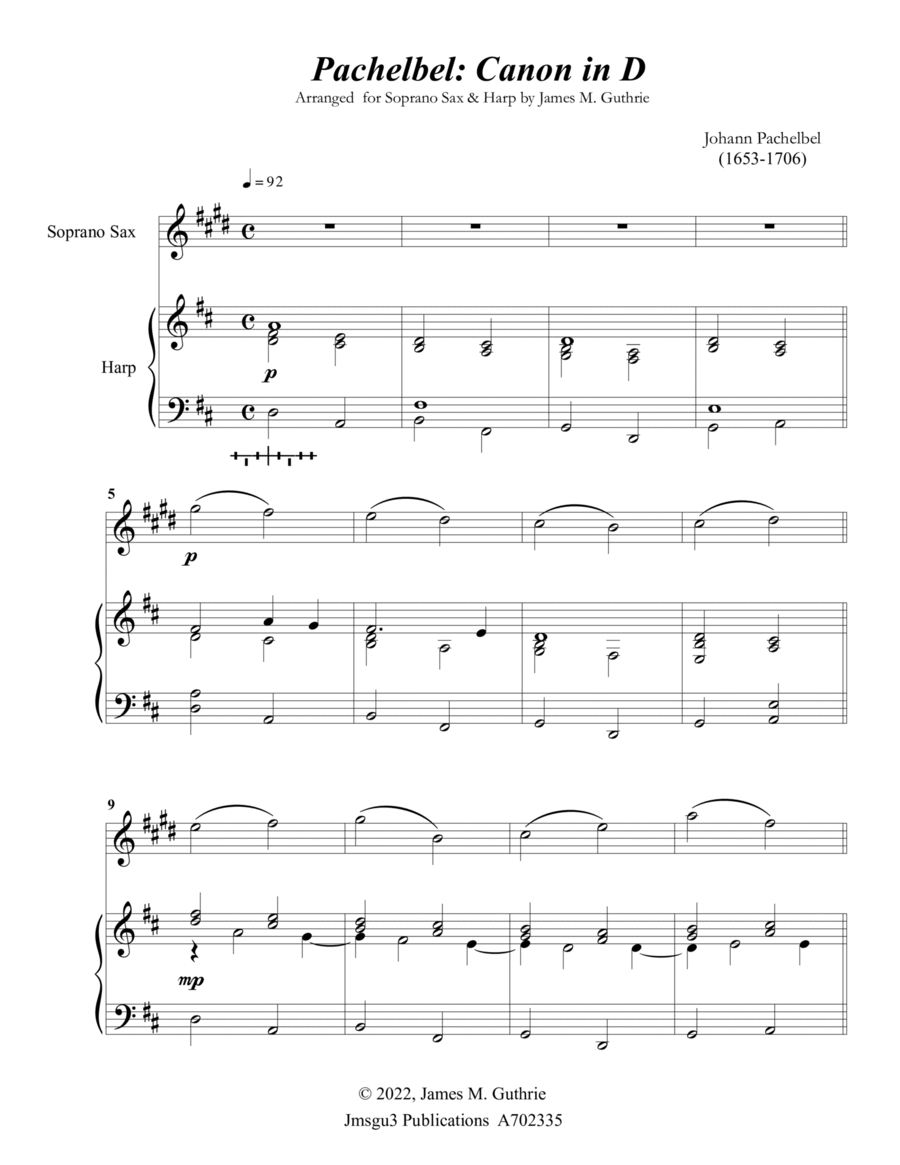
Pachelbel: Canon in D for Soprano Sax & Harp

$32.95 27.64 € PDF SheetMusicPlus

String Orchestra - Level 2 - Digital Download SKU: A0.1292216 Composed by John Bull. Arranged by James M. Guthrie. Contest,Early Music,Festival,Historic,Religious,Renaissance. 20 pages. Jmsgu3 #882823. Published by jmsgu3 (A0.1292216). John Bull was an English composer, organist, virginalist, and organ builder who lived from 1562/63 to 1628. He was educated as a chorister of the Chapel Royal in London and later became a Doctor of Music at both Oxford and Cambridge Universities. Bull was one of the most famous composers of keyboard music of the early 17th century, and most of his compositions were written for the virginal, a keyboard instrument popular in the Renaissance period. He was known for his outstanding technical ability and keyboard virtuosity, and his music is distinguished by unfailing resourcefulness in devising new musical ideas. Bull's reputation rests on his extensive compositions for virginals and organ, some 150 extant pieces published in Musica Britannica. He was also one of the contributors to Parthenia, a collection of keyboard music published in 1611. Bull wrote an anthem, God the Father, God the Son, for the 1613 wedding of the princess and the Elector Palatine, in addition to his keyboard compositions, verse anthems, canons, and other works. Bull's music ranked among the foremost composers along with Byrd, Gibbons, and Tomkins.John Bull had several contemporaries who were also prominent composers during the Renaissance period. Some of these composers include:William Byrd: Byrd was an English composer and one of the most influential figures in English Renaissance music. He was a contemporary of John Bull and is considered one of the greatest composers of his time. Byrd's compositions include sacred choral music, keyboard works, and consort music.Orlando Gibbons: Gibbons was an English composer and organist who lived during the same period as John Bull. He was known for his sacred choral music, particularly his anthems and verse anthems. Gibbons' compositions are characterized by their expressive harmonies and intricate counterpoint.Thomas Tomkins: Tomkins was another English composer who was active during the same time as John Bull. He was known for his sacred choral music, including anthems and services. Tomkins' compositions are notable for their rich harmonies and expressive melodies.Jan Pieterszoon Sweelinck: Sweelinck was a Dutch composer and organist who was highly regarded during the Renaissance period. He was known for his keyboard music, particularly his variations and fantasias. Sweelinck's compositions had a significant influence on Bull and other composers of the time.These composers, along with John Bull, were influential figures in the development of Renaissance music and significantly contributed to the repertoire of keyboard and choral music during that era.
Bull: In Nomine CXIX for String Orchestra - Score Only
Orchestre à Cordes

$32.95 27.64 € Orchestre à Cordes PDF SheetMusicPlus

String Trio Cello,Viola,Violin - Level 2 - Digital Download SKU: A0.1283915 Composed by Dr. John Bull. Arranged by James M. Guthrie. Chamber,Early Music,Historic,Renaissance,Wedding. 10 pages. Jmsgu3 #875096. Published by jmsgu3 (A0.1283915). Fitzwilliam Virginal Book CXXXVIII.John Bull was an English composer, organist, virginalist, and organ builder who lived from 1562/63 to 1628. He was educated as a chorister of the Chapel Royal in London and later became a Doctor of Music at both Oxford and Cambridge Universities. Bull was one of the most famous composers of keyboard music of the early 17th century, and most of his compositions were written for the virginal, a keyboard instrument popular in the Renaissance period. He was known for his outstanding technical ability and keyboard virtuosity, and his music is distinguished by unfailing resourcefulness in devising new musical ideas. Bull's reputation rests on his extensive compositions for virginals and organ, some 150 extant pieces published in Musica Britannica. He was also one of the contributors to Parthenia, a collection of keyboard music published in 1611. Bull wrote an anthem, God the Father, God the Son, for the 1613 wedding of the princess and the Elector Palatine, in addition to his keyboard compositions, verse anthems, canons, and other works. Bull's music ranked among the foremost composers along with Byrd, Gibbons, and Tomkins.John Bull had several contemporaries who were also prominent composers during the Renaissance period. Some of these composers include:William Byrd: Byrd was an English composer and one of the most influential figures in English Renaissance music. He was a contemporary of John Bull and is considered one of the greatest composers of his time. Byrd's compositions include sacred choral music, keyboard works, and consort music.Orlando Gibbons: Gibbons was an English composer and organist who lived during the same period as John Bull. He was known for his sacred choral music, particularly his anthems and verse anthems. Gibbons' compositions are characterized by their expressive harmonies and intricate counterpoint.Thomas Tomkins: Tomkins was another English composer who was active during the same time as John Bull. He was known for his sacred choral music, including anthems and services. Tomkins' compositions are notable for their rich harmonies and expressive melodies.Jan Pieterszoon Sweelinck: Sweelinck was a Dutch composer and organist who was highly regarded during the Renaissance period. He was known for his keyboard music, particularly his variations and fantasias. Sweelinck's compositions had a significant influence on Bull and other composers of the time.These composers, along with John Bull, were influential figures in the development of Renaissance music and significantly contributed to the repertoire of keyboard and choral music during that era.
Bull: Dr. Bull's Juell for String Trio
Trio à Cordes: violon, alto, violoncelle

$24.95 20.93 € Trio à Cordes: violon, alto, violoncelle PDF SheetMusicPlus

Piano Quartet,String Ensemble - Level 3 - Digital Download SKU: A0.552062 Composed by Johann Pachelbel. Arranged by James M. Guthrie. Baroque,Instructional,Standards,Wedding. Score and parts. 17 pages. Jmsgu3 #6104333. Published by jmsgu3 (A0.552062). Score: 9 pages.Duration: ca. 4:40. The famous Pachelbel Canon arranged for Piano Quartet. A great choice for weddings & receptions! Pachelbel's Canon Pachelbel's Canon is, in fact, the traditional title for a composition by the German composer Johann Pachelbel. Other names for the work include namely: Canon and Gigue for 3 violins and basso continuo, Canon and Gigue in D, and of course Canon in D. We do not know when or why in particular it was written. The oldest copy is surprisingly from the 19th century. It is important to realize that it was a common routine for organists to practice improvisation on the chord progression underlying the canon. Pachelbel originally scored the Canon notably for three violins and continuo. He also in fact paired the Canon with a gigue. The movements are homotonal, to clarify, both are in the key of D major. History In due time, Pachelbel's Canon went out of style and remained in virtual oblivion for centuries. The Jean-François Paillard chamber orchestra, however, recorded an arrangement of it in 1968. As a result, it gained approval. Many ensembles began likewise to record the piece in the 1970s and by the 1980s became ubiquitous as background music. From the 1970s to the early 2000s, pop songs correspondingly used elements of the piece. The chord progression, in particular, was used this way. Also, since the 1980s, it has been not only wildly popular for weddings, but also for funeral ceremonies in the USA and Europe. Pachelbel Background Johann Pachelbel (1653 –1706) was a German composer, as well as an organist. He was furthermore instrumental in bringing the south German organ school to its apex. He wrote a large body of music, both sacred and, equally important, secular. In particular, he uniquely helped develop the chorale prelude and fugue. For this, he has, in fact, earned a rightful place in the company of the most significant composers of the mid-Baroque period. Works Pachelbel's music was certainly popular. With this in mind, he also consequently had many pupils. His music expressly developed into a model for south German composers. Nowadays, Pachelbel is most famous, particularly for the Canon in D, as well as the F minor Chaconne, the Toccata in E minor, and of course the Hexachordum Apollinis, a set of variations for the keyboard. Influences Johann Jakob Froberger and Johann Caspar Kerll were south German composers who significantly influenced Pachelbel. Furthermore, he was especially influenced by Italians such as Frescobaldi and Poglietti. He frequently preferred an articulate, simple contrapuntal style that highlighted clarity. His music is markedly less extravagant and harmonically adventurous than that of Dieterich Buxtehude. However, as a point often overlooked, like Buxtehude, Pachelbel experimented with different instrumental combinations in his chamber music. Legacy All in all, Pachelbel was most famous as a composer for the keyboard. He composed over two hundred pieces specifically for the instrument. Pachelbel was also surprisingly a prolific composer of vocal music. All in all, about a hundred vocal works survive, including 40 or so large-scale works.
Pachelbel: Canon in D for Piano Quartet
Piano Quatuor: piano, violon, alto, violoncelle

$46.95 39.39 € Piano Quatuor: piano, violon, alto, violoncelle PDF SheetMusicPlus

Euphonium,Piano - Level 2 - Digital Download SKU: A0.549899 Composed by Johann Pachelbel. Arranged by James M. Guthrie, ASCAP. Baroque,Standards,Wedding. Score and part. 7 pages. Jmsgu3 #3627117. Published by jmsgu3 (A0.549899). BARITONE HORN (T.C.) and PIANO. The famous Pachelbel Canon arranged for Baritone Horn & Piano. Great choice for weddings & receptions! Pachelbel's Canon Pachelbel's Canon is, in fact, the traditional title for a composition by the German composer Johann Pachelbel. Other names for the work include namely: Canon and Gigue for 3 violins and basso continuo, Canon and Gigue in D, and of course Canon in D. We do not know when or why in particular it was written. The oldest copy is surprisingly from the 19th century. It is important to realize that it was a common routine for organists to practice improvisation on the chord progression underlying the canon. Pachelbel originally scored the Canon notably for three violins and continuo. He also in fact paired the Canon with a gigue. The movements are homotonal, to clarify, both are in the key of D major. History In due time, Pachelbel's Canon went out of style and remained in virtual oblivion for centuries. The Jean-François Paillard chamber orchestra, however, recorded an arrangement of it in 1968. As a result, it gained approval.  Many ensembles began likewise to record the piece in the 1970s and by the 1980s became ubiquitous as background music. From the 1970s to the early 2000s, pop songs correspondingly used elements of the piece. The chord progression, in particular, was used this way. Also, since the 1980s, it has been not only wildly popular for weddings, but also for funeral ceremonies in the USA and Europe. Pachelbel Background Johann Pachelbel (1653 –1706) was a German composer, as well as an organist. He was furthermore instrumental in bringing the south German organ school to its apex. He wrote a large body of music, both sacred and, equally important, secular. In particular, he uniquely helped develop the chorale prelude and fugue. For this, he has, in fact, earned a rightful place in the company of the most significant composers of the mid-Baroque period. Works Pachelbel's music was certainly popular. With this in mind, he also consequently had many pupils. His music expressly developed into a model for the south German composers. Nowadays, Pachelbel is most famous particularly for the Canon in D, as well as the F minor Chaconne, the Toccata in E minor, and of course the Hexachordum Apollinis, a set of variations for the keyboard. Influences Johann Jakob Froberger and Johann Caspar Kerll were south German composers who significantly influenced Pachelbel. Furthermore, he was especially influenced by Italians such as Frescobaldi and Poglietti. He frequently preferred an articulate, simple contrapuntal style that highlighted clarity. His music is markedly less extravagant and harmonically adventurous than that of Dieterich Buxtehude. However, as a point often overlooked, like Buxtehude, Pachelbel experimented with different instrumental combinations in his chamber music. LegacyAll in all, Pachelbel was most famous as a composer for the keyboard. He composed over two hundred pieces specifically for the instrument. Pachelbel was also surprisingly a prolific composer of vocal music. All in all, about a hundred vocal works survive, including 40 or so large-scale works.

Pachelbel: Canon for Baritone Horn & Piano
Euphonium, Piano (duo)

$28.95 24.29 € Euphonium, Piano (duo) PDF SheetMusicPlus

Piano,Viola - Level 3 - Digital Download SKU: A0.548460 Composed by Johann Pachelbel. Arranged by James M. Guthrie, ASCAP. Baroque,Instructional,Standards,Wedding. Score and part. 8 pages. Jmsgu3 #3385399. Published by jmsgu3 (A0.548460). The famous Pachelbel Canon arranged for viola & piano. Great for weddings & receptions. Pachelbel's Canon Pachelbel's Canon is, in fact, the traditional title for a composition by the German composer Johann Pachelbel. Other names for the work include namely: Canon and Gigue for 3 violins and basso continuo, Canon and Gigue in D, and of course Canon in D. We do not know when or why in particular it was written. The oldest copy is surprisingly from the 19th century. It is important to realize that it was a common routine for organists to practice improvisation on the chord progression underlying the canon. Pachelbel originally scored the Canon notably for three violins and continuo. He also in fact paired the Canon with a gigue. The movements are homotonal, to clarify, both are in the key of D major. History In due time, Pachelbel's Canon went out of style and remained in virtual oblivion for centuries. The Jean-François Paillard chamber orchestra, however, recorded an arrangement of it in 1968. As a result, it gained approval.  Many ensembles began likewise to record the piece in the 1970s and by the 1980s became ubiquitous as background music. From the 1970s to the early 2000s, pop songs correspondingly used elements of the piece. The chord progression, in particular, was used this way. Also, since the 1980s, it has been not only wildly popular for weddings, but also for funeral ceremonies in the USA and Europe. Pachelbel Background Johann Pachelbel (1653 –1706) was a German composer, as well as an organist. He was furthermore instrumental in bringing the south German organ school to its apex. He wrote a large body of music, both sacred and, equally important, secular. In particular, he uniquely helped develop the chorale prelude and fugue. For this, he has, in fact, earned a rightful place in the company of the most significant composers of the mid-Baroque period. Works Pachelbel's music was certainly popular. With this in mind, he also consequently had many pupils. His music expressly developed into a model for the south German composers. Nowadays, Pachelbel is most famous particularly for the Canon in D, as well as the F minor Chaconne, the Toccata in E minor, and of course the Hexachordum Apollinis, a set of variations for the keyboard. Influences Johann Jakob Froberger and Johann Caspar Kerll were south German composers who significantly influenced Pachelbel. Furthermore, he was especially influenced by Italians such as Frescobaldi and Poglietti. He frequently preferred an articulate, simple contrapuntal style that highlighted clarity. His music is markedly less extravagant and harmonically adventurous than that of Dieterich Buxtehude. However, as a point often overlooked, like Buxtehude, Pachelbel experimented with different instrumental combinations in his chamber music. Legacy All in all, Pachelbel was most famous as a composer for the keyboard. He composed over two hundred pieces specifically for the instrument. Pachelbel was also surprisingly a prolific composer of vocal music. All in all, about a hundred vocal works survive, including 40 or so large-scale works. 

Pachelbel: Canon for Viola & Piano
Alto, Piano

$32.95 27.64 € Alto, Piano PDF SheetMusicPlus

Piano Solo - Level 5 - Digital Download SKU: A0.1201265 Composed by Valery Aralov. Arranged by Yury Chugunov and Zellev. 20th Century,Blues,Broadway,Jazz,Musical/Show,Video Game. Score. 6 pages. Zellev Music #799915. Published by Zellev Music (A0.1201265). Key Signature: NaturalTime Signature: 3/4Tempo: Con moto (with movement (as lively as possible/ vivace))Difficulty: Advancednot much known about the composer, the piece originally comes from jazz compilation by Yury Chugunov.from the excerpt: The publication is dedicated to the waltz - not quite an ordinary genre in jazz, where the quadruple meter reigned supreme. The waltz was established in many respects thanks to the creativity in the fifty of the musicians kula (the so-called cool jazz - cool jazz). Interest in the waltz was shown by several major musicians of this direction, such as Miles Davis, Bill Evans, Dave Brubeck. One of the first waltz themes to penetrate jazz was Frank Churchill's most popular melody from the movie Snow White and the Seven Dwarfs. Soon waltzes written by jazz musicians began to appear.The jazz waltz represents the lyrical side of jazz along with the jazz ballad and bossa nova. The collection includes works by Soviet and foreign authors.The latter are represented by the names of R. Rogers, B. Evans, D. Brubeck, P. Desmond with his famous Take Five waltz and others. Dave Brubeck (in whose ensemble alto saxophonist Paul Desmond played) was perhaps the first to experiment with five-, six-, seven-quarter time signatures, widely using variable time signatures, polyrhythm; a typical example of a waltz of variable size belongs to the young Moscow pianist Daniil Kramer (Caprice). Recall, by the way, that an example of a five-quarter waltz in symphonic music is found in Tchaikovsky (second movement of the Sixth Symphony).We hope that the collection will be of interest not only to jazz musicians, but also to a wider circle of music lovers.-Yuri Chugunov.
Purple Horse
Piano seul

$5.00 4.19 € Piano seul PDF SheetMusicPlus

Piano Solo - Level 3 - Digital Download SKU: A0.1198473 Composed by Yury Markin. Arranged by Yury Chugunov and Zellev. 20th Century,Contemporary,Film/TV,Jazz,Wedding. Score. 4 pages. Zellev Music #797617. Published by Zellev Music (A0.1198473). Key Signature: Bâ™­ MajTime Signature: 3/4Tempo: Adagio Rubato (Slowly as the performer feels like)Difficulty: Intermediatenot much known about the composer, the piece originally comes from jazz compilation by Yury Chugunov.from the excerpt: The publication is dedicated to the waltz - not quite an ordinary genre in jazz, where the quadruple meter reigned supreme. The waltz was established in many respects thanks to the creativity in the fifty of the musicians kula (the so-called cool jazz - cool jazz). Interest in the waltz was shown by several major musicians of this direction, such as Miles Davis, Bill Evans, Dave Brubeck. One of the first waltz themes to penetrate jazz was Frank Churchill's most popular melody from the movie Snow White and the Seven Dwarfs. Soon waltzes written by jazz musicians began to appear.The jazz waltz represents the lyrical side of jazz along with the jazz ballad and bossa nova. The collection includes works by Soviet and foreign authors.The latter are represented by the names of R. Rogers, B. Evans, D. Brubeck, P. Desmond with his famous Take Five waltz and others. Dave Brubeck (in whose ensemble alto saxophonist Paul Desmond played) was perhaps the first to experiment with five-, six-, seven-quarter time signatures, widely using variable time signatures, polyrhythm; a typical example of a waltz of variable size belongs to the young Moscow pianist Daniil Kramer (Caprice). Recall, by the way, that an example of a five-quarter waltz in symphonic music is found in Tchaikovsky (second movement of the Sixth Symphony).We hope that the collection will be of interest not only to jazz musicians, but also to a wider circle of music lovers.-Yuri Chugunov.
Dedication to Bill Evans
Piano seul

$4.50 3.78 € Piano seul PDF SheetMusicPlus

String Quartet Cello,String Quartet - Level 2 - Digital Download SKU: A0.1266472 Composed by Solage. Arranged by James M. Guthrie. Chamber,Contest,Early Music,Festival,Historic,Medieval. 8 pages. Jmsgu3 #859203. Published by jmsgu3 (A0.1266472). Solage's ballade Le basile de sa propre nature is a significant work in the history of medieval music. Here are some of its historical significances:1. It is one of the twelve surviving works attributed to Solage, a French composer who lived in the late 14th century. Solage's works are known for their complex rhythms, intricate harmonies, and expressive melodies.2. Le basile de sa propre nature is a four-voice ballade that features a text about the mythical creature known as the basilisk. The lyrics describe the basilisk as a monster that kills everything it sees with its deadly venom. The music is characterized by its intricate rhythms and harmonies, which reflect the text's vivid imagery.3. The ballade is preserved in the Chantilly Codex, a manuscript that contains a collection of French secular music from the late 14th century. The Chantilly Codex is one of the most important sources of medieval music, and it provides valuable insights into the musical practices of the time.4.Le basile de sa propre nature is an example of the Ars subtilior style, which was a highly experimental and complex musical style that emerged in the late 14th century. This style was characterized by its use of intricate rhythms, complex harmonies, and unusual notational practices. The Ars subtilior style was highly influential in the development of later musical styles, and it remains an important part of the medieval musical canon.Overall, Solage's ballade Le basile de sa propre nature is a significant work that reflects the complex and experimental musical practices of the late 14th century. Its vivid imagery, intricate rhythms, and complex harmonies make it a valuable contribution to the medieval musical canon.Lyrics:All those he sees he kills suddenly,For his venom is deadly.He is a basilisk by his own nature,And he has no other way of being. He is a monster of great power,And he is feared by all who know him.He is a creature of the earth,And he is a master of death. He is a basilisk by his own nature,And he has no other way of being.All those he sees he kills suddenly,For his venom is deadly. He is a creature of the night,And he is a master of the dark.He is a monster of great might,And he is feared by all who hear his name. He is a basilisk by his own nature,And he has no other way of being.All those he sees he kills suddenly,For his venom is deadly.Solage was a French composer and probably also a poet who lived in the late 14th century. He composed the most pieces in the Chantilly Codex, which is the principal source of music of the ars subtilior, a manneristic compositional school centered on Avignon at the end of the century. Solage is an obscure composer, and aside from what can be deduced from the pieces attributed to him in the Chantilly Codex, nothing else is known about him. There are several interpretations of his name, and it is not clear whether his first name was Jean or Charles. The ars subtilior was a manneristic compositional school centered on Avignon at the end of the 14th century. It was characterized by complex rhythms and pitch, and it was a transitional period between the late medieval and Renaissance periods. Solage was one of the composers who fit into this school, and he composed the most pieces in the Chantilly Codex, which is the principal source of music of the ars subtilior. Stylistically, Solage's works exhibit two distinctly different characters: a relatively simple one usually associated with his great predecessor and elder contemporary Guillaume de Machaut, and a more recherché one, complex in the areas of both pitch and rhythm, characteristic of the ars subtilior. 
Solage: Le basile for Cello Quartet
4 Violoncelles

$32.95 27.64 € 4 Violoncelles PDF SheetMusicPlus

Woodwind Ensemble Bassoon,Double Reed Quartet,English Horn - Level 2 - Digital Download SKU: A0.1266448 Composed by Solage. Arranged by James M. Guthrie. Chamber,Contest,Early Music,Festival,Historic,Holiday. 8 pages. Jmsgu3 #859185. Published by jmsgu3 (A0.1266448). Solage's ballade Le basile de sa propre nature is a significant work in the history of medieval music. Here are some of its historical significances:1. It is one of the twelve surviving works attributed to Solage, a French composer who lived in the late 14th century. Solage's works are known for their complex rhythms, intricate harmonies, and expressive melodies.2. Le basile de sa propre nature is a four-voice ballade that features a text about the mythical creature known as the basilisk. The lyrics describe the basilisk as a monster that kills everything it sees with its deadly venom. The music is characterized by its intricate rhythms and harmonies, which reflect the text's vivid imagery.3. The ballade is preserved in the Chantilly Codex, a manuscript that contains a collection of French secular music from the late 14th century. The Chantilly Codex is one of the most important sources of medieval music, and it provides valuable insights into the musical practices of the time.4. Le basile de sa propre nature is an example of the Ars subtilior style, which was a highly experimental and complex musical style that emerged in the late 14th century. This style was characterized by its use of intricate rhythms, complex harmonies, and unusual notational practices. The Ars subtilior style was highly influential in the development of later musical styles, and it remains an important part of the medieval musical canon.Overall, Solage's ballade Le basile de sa propre nature is a significant work that reflects the complex and experimental musical practices of the late 14th century. Its vivid imagery, intricate rhythms, and complex harmonies make it a valuable contribution to the medieval musical canon.Lyrics:All those he sees he kills suddenly,For his venom is deadly.He is a basilisk by his own nature,And he has no other way of being. He is a monster of great power,And he is feared by all who know him.He is a creature of the earth,And he is a master of death. He is a basilisk by his own nature,And he has no other way of being.All those he sees he kills suddenly,For his venom is deadly. He is a creature of the night,And he is a master of the dark.He is a monster of great might,And he is feared by all who hear his name. He is a basilisk by his own nature,And he has no other way of being.All those he sees he kills suddenly,For his venom is deadly.Solage was a French composer and probably also a poet who lived in the late 14th century. He composed the most pieces in the Chantilly Codex, which is the principal source of music of the ars subtilior, a manneristic compositional school centered on Avignon at the end of the century. Solage is an obscure composer, and aside from what can be deduced from the pieces attributed to him in the Chantilly Codex, nothing else is known about him. There are several interpretations of his name, and it is not clear whether his first name was Jean or Charles.  The ars subtilior was a manneristic compositional school centered on Avignon at the end of the 14th century. It was characterized by complex rhythms and pitch, and it was a transitional period between the late medieval and Renaissance periods. Solage was one of the composers who fit into this school, and he composed the most pieces in the Chantilly Codex, which is the principal source of music of the ars subtilior. Stylistically, Solage's works exhibit two distinctly different characters: a relatively simple one usually associated with his great predecessor and elder contemporary Guillaume de Machaut, and a more recherché one, complex in the areas of both pitch and rhythm, characteristic of the ars subtilior. 
Solage: Le basile for Double Reed Quartet

$32.95 27.64 € PDF SheetMusicPlus

Clarinet Quartet,Woodwind Ensemble Bass Clarinet,E-Flat Clarinet - Level 3 - Digital Download SKU: A0.1266048 Composed by Solage. Arranged by James M. Guthrie. Chamber,Contest,Early Music,Festival,Medieval,Traditional. 8 pages. Jmsgu3 #858782. Published by jmsgu3 (A0.1266048). Solage's ballade Le basile de sa propre nature is a significant work in the history of medieval music. Here are some of its historical significances:It is one of the twelve surviving works attributed to Solage, a French composer who lived in the late 14th century. Solage's works are known for their complex rhythms, intricate harmonies, and expressive melodies.Le basile de sa propre nature is a four-voice ballade that features a text about the mythical creature known as the basilisk. The lyrics describe the basilisk as a monster that kills everything it sees with its deadly venom. The music is characterized by its intricate rhythms and harmonies, which reflect the text's vivid imagery.The ballade is preserved in the Chantilly Codex, a manuscript that contains a collection of French secular music from the late 14th century. The Chantilly Codex is one of the most important sources of medieval music, and it provides valuable insights into the musical practices of the time.Le basile de sa propre nature is an example of the Ars subtilior style, which was a highly experimental and complex musical style that emerged in the late 14th century. This style was characterized by its use of intricate rhythms, complex harmonies, and unusual notational practices. The Ars subtilior style was highly influential in the development of later musical styles, and it remains an important part of the medieval musical canon.Overall, Solage's ballade Le basile de sa propre nature is a significant work that reflects the complex and experimental musical practices of the late 14th century. Its vivid imagery, intricate rhythms, and complex harmonies make it a valuable contribution to the medieval musical canon.Lyrics:All those he sees he kills suddenly,For his venom is deadly.He is a basilisk by his own nature,And he has no other way of being. He is a monster of great power,And he is feared by all who know him.He is a creature of the earth,And he is a master of death. He is a basilisk by his own nature,And he has no other way of being.All those he sees he kills suddenly,For his venom is deadly. He is a creature of the night,And he is a master of the dark.He is a monster of great might,And he is feared by all who hear his name. He is a basilisk by his own nature,And he has no other way of being.All those he sees he kills suddenly,For his venom is deadly.Solage was a French composer and probably also a poet who lived in the late 14th century. He composed the most pieces in the Chantilly Codex, which is the principal source of music of the ars subtilior, a manneristic compositional school centered on Avignon at the end of the century. Solage is an obscure composer, and aside from what can be deduced from the pieces attributed to him in the Chantilly Codex, nothing else is known about him. There are several interpretations of his name, and it is not clear whether his first name was Jean or Charles.  The ars subtilior was a manneristic compositional school centered on Avignon at the end of the 14th century. It was characterized by complex rhythms and pitch, and it was a transitional period between the late medieval and Renaissance periods. Solage was one of the composers who fit into this school, and he composed the most pieces in the Chantilly Codex, which is the principal source of music of the ars subtilior. Stylistically, Solage's works exhibit two distinctly different characters: a relatively simple one usually associated with his great predecessor and elder contemporary Guillaume de Machaut, and a more recherché one, complex in the areas of both pitch and rhythm, characteristic of the ars subtilior.
Solage: Le basile for Clarinet Quartet
Quatuor de Clarinettes: 4 clarinettes

$32.95 27.64 € Quatuor de Clarinettes: 4 clarinettes PDF SheetMusicPlus

Trombone Quartet Trombone - Level 2 - Digital Download SKU: A0.1266548 Composed by Solage. Arranged by James M. Guthrie. Chamber,Contest,Early Music,Festival,Historic,Medieval. 8 pages. Jmsgu3 #859221. Published by jmsgu3 (A0.1266548). Solage's ballade Le basile de sa propre nature is a significant work in the history of medieval music. Here are some of its historical significances:1. It is one of the twelve surviving works attributed to Solage, a French composer who lived in the late 14th century. Solage's works are known for their complex rhythms, intricate harmonies, and expressive melodies.2. Le basile de sa propre nature is a four-voice ballade that features a text about the mythical creature known as the basilisk. The lyrics describe the basilisk as a monster that kills everything it sees with its deadly venom. The music is characterized by its intricate rhythms and harmonies, which reflect the text's vivid imagery.3. The ballade is preserved in the Chantilly Codex, a manuscript that contains a collection of French secular music from the late 14th century. The Chantilly Codex is one of the most important sources of medieval music, and it provides valuable insights into the musical practices of the time.4. Le basile de sa propre nature is an example of the Ars subtilior style, which was a highly experimental and complex musical style that emerged in the late 14th century. This style was characterized by its use of intricate rhythms, complex harmonies, and unusual notational practices. The Ars subtilior style was highly influential in the development of later musical styles, and it remains an important part of the medieval musical canon.Overall, Solage's ballade Le basile de sa propre nature is a significant work that reflects the complex and experimental musical practices of the late 14th century. Its vivid imagery, intricate rhythms, and complex harmonies make it a valuable contribution to the medieval musical canon.Lyrics:All those he sees he kills suddenly,For his venom is deadly.He is a basilisk by his own nature,And he has no other way of being. He is a monster of great power,And he is feared by all who know him.He is a creature of the earth,And he is a master of death. He is a basilisk by his own nature,And he has no other way of being.All those he sees he kills suddenly,For his venom is deadly. He is a creature of the night,And he is a master of the dark.He is a monster of great might,And he is feared by all who hear his name. He is a basilisk by his own nature,And he has no other way of being.All those he sees he kills suddenly,For his venom is deadly.Solage was a French composer and probably also a poet who lived in the late 14th century. He composed the most pieces in the Chantilly Codex, which is the principal source of music of the ars subtilior, a manneristic compositional school centered on Avignon at the end of the century. Solage is an obscure composer, and aside from what can be deduced from the pieces attributed to him in the Chantilly Codex, nothing else is known about him. There are several interpretations of his name, and it is not clear whether his first name was Jean or Charles. The ars subtilior was a manneristic compositional school centered on Avignon at the end of the 14th century. It was characterized by complex rhythms and pitch, and it was a transitional period between the late medieval and Renaissance periods. Solage was one of the composers who fit into this school, and he composed the most pieces in the Chantilly Codex, which is the principal source of music of the ars subtilior. Stylistically, Solage's works exhibit two distinctly different characters: a relatively simple one usually associated with his great predecessor and elder contemporary Guillaume de Machaut, and a more recherché one, complex in the areas of both pitch and rhythm, characteristic of the ars subtilior. 
Solage: Le basile for Trombone Quartet
Quatuor de cuivres: 4 trombones

$32.95 27.64 € Quatuor de cuivres: 4 trombones PDF SheetMusicPlus


Partitions Gratuites
Acheter des Partitions Musicales
Acheter des Partitions Digitales à Imprimer
Acheter des Instruments de Musique

© 2000 - 2026

Accueil - Version intégrale



