EUROPE
4433 articles
USA
15435 articles
DIGITAL
30104 articles (à imprimer)
Partitions Digitales
Partitions à imprimer
30104 partitions trouvées


Woodwind Ensemble,Woodwind Quartet - Level 2 - Digital Download SKU: A0.1259372 Composed by Guillaume de Machaut, 1300-1377. Arranged by James M. Guthrie. Chamber,Contest,Early Music,Festival,Historic,Medieval. 38 pages. Jmsgu3 #852647. Published by jmsgu3 (A0.1259372). INSTRUMENTATION: 2 Clarinets in Bb, 1 Alto Clarinet, 1 Bass Clarinet1. Kyrie2. Gloria3. Credo4. Sanctus5. Agnus dei6. Ite missa estGuillaume de Machaut composed the Messe de Nostre Dame, also known as the Mass of Our Lady, in the early 1360s. He wrote the mass for the Cathedral at Reims, where he served as a canon, a permanent clergy member. According to a rubric found at the Cathedral, it would have likely been performed for the Saturday Lady Mass. Guillaume de Machaut's Messe de Nostre Dame is significant in the history of music for several reasons:1. It is the first complete setting of the Ordinary of the Mass by a single composer that has survived.2. It is a unified mass, meaning that the composer selected relevant chants for each section as the borrowed tenor.3. It was composed in four voices, which was unusual at the time.4. The texts of both Gloria and Credo are quite lengthy, and therefore Machaut set these movements in a style reminiscent of the earlier discant style, having short phrases, similar rhythmic motion in all parts, and a low ratio of notes per syllable of text, both ending with long, rhapsodic sections for the final word, Amen.Machaut's Messe de Nostre Dame is a landmark in musical history, but it is far from being avant-garde merely for the sake of uniqueness. It is considered to be a culmination of the musical style of the Ars Nova period, which was characterized by complex polyphonic textures and rhythmic innovations. The mass is also significant because it was composed during a time of great political and social upheaval in Europe, and it reflects the changing attitudes towards religion and music during this period. Overall, Machaut's Messe de Nostre Dame is a significant work that represents a culmination of the musical style of the Ars Nova period and reflects the changing attitudes towards religion and music during the 14th century. The mass consists of five movements: Kyrie, Gloria, Credo, Sanctus, and Agnus Dei, followed by the dismissal Ite, missa est. The tenor of the Kyrie is based on Vatican Kyrie IV, the Sanctus, and Agnus correspond to Vatican Mass XVII, and the Ite is on Sanctus VIII. The Gloria and Credo have no apparent chant basis, although they are stylistically related to one another. The mass is a unified mass, meaning that the composer selected relevant chants for each section as the borrowed tenor. The Messe de Nostre Dame is significant in the history of music because it is the first complete setting of the Ordinary of the Mass by a single composer that has survived. It is also significant because it was composed during a time of great political and social upheaval in Europe, and it reflects the changing attitudes towards religion and music during this period. Overall, the Messe de Nostre Dame was an important part of the liturgical practices of the time, and it is still regarded as a masterpiece of medieval music and of all religious music.
Machaut: La Messe de Nostre Dame for Clarinet Quartet - Score Only
Quatuor de Clarinettes: 4 clarinettes

$49.95 41.91 € Quatuor de Clarinettes: 4 clarinettes PDF SheetMusicPlus

Woodwind Ensemble,Woodwind Quartet - Level 2 - Digital Download SKU: A0.1258034 Composed by Guillaume de Machaut, 1300-1377. Arranged by James M. Guthrie. Chamber,Contest,Early Music,Festival,Historic,Medieval. 38 pages. Jmsgu3 #851272. Published by jmsgu3 (A0.1258034). Instrumentation: English Horn Duo & Bassoon Duo.1. Kyrie2. Gloria3. Credo4. Sanctus5. Agnus dei6. Ite missa estGuillaume de Machaut composed the Messe de Nostre Dame, also known as the Mass of Our Lady, in the early 1360s. He wrote the mass for the Cathedral at Reims, where he served as a canon, a permanent clergy member. According to a rubric found at the Cathedral, it would have likely been performed for the Saturday Lady Mass. Guillaume de Machaut's Messe de Nostre Dame is significant in the history of music for several reasons: It is the first complete setting of the Ordinary of the Mass by a single composer that has survived. It is a unified mass, meaning that the composer selected relevant chants for each section as the borrowed tenor. It was composed in four voices, which was unusual at the time. The texts of both Gloria and Credo are quite lengthy, and therefore Machaut set these movements in a style reminiscent of the earlier discant style, having short phrases, similar rhythmic motion in all parts, and a low ratio of notes per syllable of text, both ending with long, rhapsodic sections for the final word, Amen. Machaut's Messe de Nostre Dame is a landmark in musical history, but it is far from being avant-garde merely for the sake of uniqueness. It is considered to be a culmination of the musical style of the Ars Nova period, which was characterized by complex polyphonic textures and rhythmic innovations. The mass is also significant because it was composed during a time of great political and social upheaval in Europe, and it reflects the changing attitudes towards religion and music during this period. Overall, Machaut's Messe de Nostre Dame is a significant work that represents a culmination of the musical style of the Ars Nova period and reflects the changing attitudes towards religion and music during the 14th century. The mass consists of five movements: Kyrie, Gloria, Credo, Sanctus, and Agnus Dei, followed by the dismissal Ite, missa est. The tenor of the Kyrie is based on Vatican Kyrie IV, the Sanctus, and Agnus correspond to Vatican Mass XVII, and the Ite is on Sanctus VIII. The Gloria and Credo have no apparent chant basis, although they are stylistically related to one another. The mass is a unified mass, meaning that the composer selected relevant chants for each section as the borrowed tenor. The Messe de Nostre Dame is significant in the history of music because it is the first complete setting of the Ordinary of the Mass by a single composer that has survived. It is also significant because it was composed during a time of great political and social upheaval in Europe, and it reflects the changing attitudes towards religion and music during this period. Overall, the Messe de Nostre Dame was an important part of the liturgical practices of the time, and it is still regarded as a masterpiece of medieval music and of all religious music.
Machaut: La Messe de Nostre Dame for 2 English Horns & 2 Bassoons - Score Only
Flûte, Hautbois, Clarinette, Basson

$49.95 41.91 € Flûte, Hautbois, Clarinette, Basson PDF SheetMusicPlus

Brass Quartet - Level 2 - Digital Download SKU: A0.1258043 Composed by Guillaume de Machaut, 1300-1377. Arranged by James M. Guthrie. Chamber,Contest,Early Music,Festival,Historic,Medieval. 38 pages. Jmsgu3 #851281. Published by jmsgu3 (A0.1258043). 1. Kyrie2. Gloria3. Credo4. Sanctus5. Agnus dei6. Ite missa estGuillaume de Machaut composed the Messe de Nostre Dame, also known as the Mass of Our Lady, in the early 1360s. He wrote the mass for the Cathedral at Reims, where he served as a canon, a permanent clergy member. According to a rubric found at the Cathedral, it would have likely been performed for the Saturday Lady Mass. Guillaume de Machaut's Messe de Nostre Dame is significant in the history of music for several reasons: It is the first complete setting of the Ordinary of the Mass by a single composer that has survived. It is a unified mass, meaning that the composer selected relevant chants for each section as the borrowed tenor. It was composed in four voices, which was unusual at the time. The texts of both Gloria and Credo are quite lengthy, and therefore Machaut set these movements in a style reminiscent of the earlier discant style, having short phrases, similar rhythmic motion in all parts, and a low ratio of notes per syllable of text, both ending with long, rhapsodic sections for the final word, Amen. Machaut's Messe de Nostre Dame is a landmark in musical history, but it is far from being avant-garde merely for the sake of uniqueness. It is considered to be a culmination of the musical style of the Ars Nova period, which was characterized by complex polyphonic textures and rhythmic innovations. The mass is also significant because it was composed during a time of great political and social upheaval in Europe, and it reflects the changing attitudes towards religion and music during this period. Overall, Machaut's Messe de Nostre Dame is a significant work that represents a culmination of the musical style of the Ars Nova period and reflects the changing attitudes towards religion and music during the 14th century. The mass consists of five movements: Kyrie, Gloria, Credo, Sanctus, and Agnus Dei, followed by the dismissal Ite, missa est. The tenor of the Kyrie is based on Vatican Kyrie IV, the Sanctus, and Agnus correspond to Vatican Mass XVII, and the Ite is on Sanctus VIII. The Gloria and Credo have no apparent chant basis, although they are stylistically related to one another. The mass is a unified mass, meaning that the composer selected relevant chants for each section as the borrowed tenor. The Messe de Nostre Dame is significant in the history of music because it is the first complete setting of the Ordinary of the Mass by a single composer that has survived. It is also significant because it was composed during a time of great political and social upheaval in Europe, and it reflects the changing attitudes towards religion and music during this period. Overall, the Messe de Nostre Dame was an important part of the liturgical practices of the time, and it is still regarded as a masterpiece of medieval music and of all religious music.

Machaut: Le Messe de Nostre Dame for 2 Horns & 2 Trombones - Score Only
Quatuor de Cuivres : 2 trompettes, trombone, tuba

$49.95 41.91 € Quatuor de Cuivres : 2 trompettes, trombone, tuba PDF SheetMusicPlus

Instrumental Solo,Organ - Level 4 - Digital Download SKU: A0.1471905 Composed by Guillaume de Machaut. Arranged by James M. Guthrie. Christian,Early Music,Historic,Medieval,Religious. Individual part. 23 pages. Jmsgu3 #1049538. Published by jmsgu3 (A0.1471905). 1. Kyrie 2. Gloria 3. Credo 4. Sanctus 5. Agnus dei 6. Ite missa est Guillaume de Machaut composed the Messe de Nostre Dame, also known as the Mass of Our Lady, in the early 1360s. He wrote the mass for the Cathedral at Reims, where he served as a canon and a permanent clergy member. According to a rubric at the Cathedral, it would have likely been performed for the Saturday Lady Mass. Machaut's Messe de Nostre Dame is significant in the history of music for several reasons: It is the first complete setting of the Ordinary of the Mass by a single composer that has survived. It is a unified mass, meaning the composer selected relevant chants for each section as the borrowed tenor. It was composed in four voices, which was unusual at the time. The texts of both Gloria and Credo are pretty lengthy. Therefore, Machaut set these movements in a style reminiscent of the earlier discant style, having short phrases, similar rhythmic motion in all parts, and a low ratio of notes per syllable of text, ending with long, rhapsodic sections for the final word, Amen. Machaut's Messe de Nostre Dame is a landmark in musical history, but it is far from being avant-garde merely for its uniqueness. It is considered to be a culmination of the musical style of the Ars Nova period, which was characterized by complex polyphonic textures and rhythmic innovations. The mass is also significant because it was composed during a time of great political and social upheaval in Europe, and it reflects the changing attitudes towards religion and music during this period. Overall, Machaut's Messe de Nostre Dame is a significant work that represents a culmination of the musical style of the Ars Nova period and reflects the changing attitudes towards religion and music during the 14th century. The mass consists of five movements: Kyrie, Gloria, Credo, Sanctus, and Agnus Dei, followed by the dismissal Ite, missa est. The tenor of the Kyrie is based on Vatican Kyrie IV, the Sanctus, and Agnus correspond to Vatican Mass XVII, and the Ite is on Sanctus VIII. Although the Gloria and Credo have no apparent chant basis, they are stylistically related. The mass is unified, meaning the composer selected relevant chants as the borrowed tenor for each section. The Messe de Nostre Dame is significant in the history of music because it is the first complete setting of the Ordinary of the Mass by a single composer that has survived. It is also significant because it was composed during a time of great political and social upheaval in Europe, and it reflects the changing attitudes towards religion and music during this period. Overall, the Messe de Nostre Dame was a vital part of the liturgical practices of the time, and it is still regarded as a masterpiece of medieval and religious music.
Machaut: La Messe de Nostre Dame for Organ
Orgue

$39.95 33.52 € Orgue PDF SheetMusicPlus

Woodwind Ensemble,Woodwind Quartet Alto Flute,Bass Flute - Level 2 - Digital Download SKU: A0.1260536 Composed by Guillaume de Machaut, 1300-1377. Arranged by James M. Guthrie. Chamber,Contest,Early Music,Festival,Historic,Medieval. 86 pages. Jmsgu3 #853678. Published by jmsgu3 (A0.1260536). INSTRUMENTATION: 2 ALTO FLUTES, 2 BASS FLUTES1. Kyrie2. Gloria3. Credo4. Sanctus5. Agnus dei6. Ite missa estGuillaume de Machaut composed the Messe de Nostre Dame, also known as the Mass of Our Lady, in the early 1360s. He wrote the mass for the Cathedral at Reims, where he served as a canon, a permanent clergy member. According to a rubric found at the Cathedral, it would have likely been performed for the Saturday Lady Mass. Guillaume de Machaut's Messe de Nostre Dame is significant in the history of music for several reasons:1. It is the first complete setting of the Ordinary of the Mass by a single composer that has survived.2. It is a unified mass, meaning that the composer selected relevant chants for each section as the borrowed tenor.3. It was composed in four voices, which was unusual at the time.4. The texts of both Gloria and Credo are quite lengthy, and therefore Machaut set these movements in a style reminiscent of the earlier discant style, having short phrases, similar rhythmic motion in all parts, and a low ratio of notes per syllable of text, both ending with long, rhapsodic sections for the final word, Amen.Machaut's Messe de Nostre Dame is a landmark in musical history, but it is far from being avant-garde merely for the sake of uniqueness. It is considered to be a culmination of the musical style of the Ars Nova period, which was characterized by complex polyphonic textures and rhythmic innovations. The mass is also significant because it was composed during a time of great political and social upheaval in Europe, and it reflects the changing attitudes towards religion and music during this period. Overall, Machaut's Messe de Nostre Dame is a significant work that represents a culmination of the musical style of the Ars Nova period and reflects the changing attitudes towards religion and music during the 14th century. The mass consists of five movements: Kyrie, Gloria, Credo, Sanctus, and Agnus Dei, followed by the dismissal Ite, missa est. The tenor of the Kyrie is based on Vatican Kyrie IV, the Sanctus, and Agnus correspond to Vatican Mass XVII, and the Ite is on Sanctus VIII. The Gloria and Credo have no apparent chant basis, although they are stylistically related to one another. The mass is a unified mass, meaning that the composer selected relevant chants for each section as the borrowed tenor. The Messe de Nostre Dame is significant in the history of music because it is the first complete setting of the Ordinary of the Mass by a single composer that has survived. It is also significant because it was composed during a time of great political and social upheaval in Europe, and it reflects the changing attitudes towards religion and music during this period. Overall, the Messe de Nostre Dame was an important part of the liturgical practices of the time, and it is still regarded as a masterpiece of medieval music and of all religious music.

Machaut: La Messe de Nostre Dame for Flute Quartet
Quatuor de Flûtes : 4 flûtes

$74.95 62.88 € Quatuor de Flûtes : 4 flûtes PDF SheetMusicPlus

String Quartet Cello,String Quartet,Viola,Violin - Level 2 - Digital Download SKU: A0.1257127 Composed by Guillaume de Machaut, 1300-1377. Arranged by James M. Guthrie, ASCAP. Chamber,Contest,Early Music,Festival,Historic,Medieval. 84 pages. Jmsgu3 #850426. Published by jmsgu3 (A0.1257127). 1. Kyrie2. Gloria3. Credo4. Sanctus5. Agnus dei6. Ite missa estGuillaume de Machaut composed the Messe de Nostre Dame, also known as the Mass of Our Lady, in the early 1360s. He wrote the mass for the Cathedral at Reims, where he served as a canon, a permanent clergy member. According to a rubric found at the Cathedral, it would have likely been performed for the Saturday Lady Mass. Guillaume de Machaut's Messe de Nostre Dame is significant in the history of music for several reasons: It is the first complete setting of the Ordinary of the Mass by a single composer that has survived. It is a unified mass, meaning that the composer selected relevant chants for each section as the borrowed tenor. It was composed in four voices, which was unusual at the time. The texts of both Gloria and Credo are quite lengthy, and therefore Machaut set these movements in a style reminiscent of the earlier discant style, having short phrases, similar rhythmic motion in all parts, and a low ratio of notes per syllable of text, both ending with long, rhapsodic sections for the final word, Amen. Machaut's Messe de Nostre Dame is a landmark in musical history, but it is far from being avant-garde merely for the sake of uniqueness. It is considered to be a culmination of the musical style of the Ars Nova period, which was characterized by complex polyphonic textures and rhythmic innovations. The mass is also significant because it was composed during a time of great political and social upheaval in Europe, and it reflects the changing attitudes towards religion and music during this period. Overall, Machaut's Messe de Nostre Dame is a significant work that represents a culmination of the musical style of the Ars Nova period and reflects the changing attitudes towards religion and music during the 14th century. The mass consists of five movements: Kyrie, Gloria, Credo, Sanctus, and Agnus Dei, followed by the dismissal Ite, missa est. The tenor of the Kyrie is based on Vatican Kyrie IV, the Sanctus, and Agnus correspond to Vatican Mass XVII, and the Ite is on Sanctus VIII. The Gloria and Credo have no apparent chant basis, although they are stylistically related to one another. The mass is a unified mass, meaning that the composer selected relevant chants for each section as the borrowed tenor. The Messe de Nostre Dame is significant in the history of music because it is the first complete setting of the Ordinary of the Mass by a single composer that has survived. It is also significant because it was composed during a time of great political and social upheaval in Europe, and it reflects the changing attitudes towards religion and music during this period. Overall, the Messe de Nostre Dame was an important part of the liturgical practices of the time, and it is still regarded as a masterpiece of medieval music and of all religious music.

Machaut: La Messe de Nostre Dame for String Quartet
Quatuor à cordes: 2 violons, alto, violoncelle

$74.95 62.88 € Quatuor à cordes: 2 violons, alto, violoncelle PDF SheetMusicPlus

Instrumental Solo,Organ - Level 4 - Digital Download SKU: A0.1472149 Composed by Guillaume de Machaut. Arranged by James M. Guthrie. Christian,Early Music,Historic,Medieval,Sacred. Individual part. 24 pages. Jmsgu3 #1049849. Published by jmsgu3 (A0.1472149). While the study score edition preserves the cross-voicing of the original four-voice score, the performance edition streamlines the cross-voicing to produce a far more accessible version for the organ. 1. Kyrie 2. Gloria 3. Credo 4. Sanctus 5. Agnus dei 6. Ite missa est Guillaume de Machaut composed the Messe de Nostre Dame, also known as the Mass of Our Lady, in the early 1360s. He wrote the mass for the Cathedral at Reims, where he served as a canon and a permanent clergy member. According to a rubric at the Cathedral, it would have likely been performed for the Saturday Lady Mass. Machaut's Messe de Nostre Dame is significant in the history of music for several reasons: It is the first complete setting of the Ordinary of the Mass by a single composer that has survived. It is a unified mass, meaning the composer selected relevant chants for each section as the borrowed tenor. It was composed in four voices, which was unusual at the time. The texts of both Gloria and Credo are pretty lengthy. Therefore, Machaut set these movements in a style reminiscent of the earlier discant style, having short phrases, similar rhythmic motion in all parts, and a low ratio of notes per syllable of text, ending with long, rhapsodic sections for the final word, Amen. Machaut's Messe de Nostre Dame is a landmark in musical history, but it is far from being avant-garde merely for its uniqueness. It is considered to be a culmination of the musical style of the Ars Nova period, which was characterized by complex polyphonic textures and rhythmic innovations. The mass is also significant because it was composed during a time of great political and social upheaval in Europe, and it reflects the changing attitudes towards religion and music during this period. Overall, Machaut's Messe de Nostre Dame is a significant work that represents a culmination of the musical style of the Ars Nova period and reflects the changing attitudes towards religion and music during the 14th century. The mass consists of five movements: Kyrie, Gloria, Credo, Sanctus, and Agnus Dei, followed by the dismissal Ite, missa est. The tenor of the Kyrie is based on Vatican Kyrie IV, the Sanctus, and Agnus correspond to Vatican Mass XVII, and the Ite is on Sanctus VIII. Although the Gloria and Credo have no apparent chant basis, they are stylistically related. The mass is unified, meaning the composer selected relevant chants as the borrowed tenor for each section. The Messe de Nostre Dame is significant in the history of music because it is the first complete setting of the Ordinary of the Mass by a single composer that has survived. It is also significant because it was composed during a time of great political and social upheaval in Europe, and it reflects the changing attitudes towards religion and music during this period. Overall, the Messe de Nostre Dame was a vital part of the liturgical practices of the time, and it is still regarded as a masterpiece of medieval and religious music.
Machaut: La Messe de Nostre Dame for Organ - Performance Edition
Orgue

$49.95 41.91 € Orgue PDF SheetMusicPlus

Woodwind Ensemble,Woodwind Quartet Bassoon,English Horn - Level 2 - Digital Download SKU: A0.1258422 Composed by Guillaume de Machaut, 1300-1377. Arranged by James M. Guthrie. Chamber,Contest,Early Music,Festival,Historic,Medieval. 84 pages. Jmsgu3 #851675. Published by jmsgu3 (A0.1258422). INSTRUMENTATION: 2 ENGLISH HORNS and 2 BASSOONS1. Kyrie2. Gloria3. Credo4. Sanctus5. Agnus dei6. Ite missa estGuillaume de Machaut composed the Messe de Nostre Dame, also known as the Mass of Our Lady, in the early 1360s. He wrote the mass for the Cathedral at Reims, where he served as a canon, a permanent clergy member. According to a rubric found at the Cathedral, it would have likely been performed for the Saturday Lady Mass. Guillaume de Machaut's Messe de Nostre Dame is significant in the history of music for several reasons:1. It is the first complete setting of the Ordinary of the Mass by a single composer that has survived.2. It is a unified mass, meaning that the composer selected relevant chants for each section as the borrowed tenor.3. It was composed in four voices, which was unusual at the time.4. The texts of both Gloria and Credo are quite lengthy, and therefore Machaut set these movements in a style reminiscent of the earlier discant style, having short phrases, similar rhythmic motion in all parts, and a low ratio of notes per syllable of text, both ending with long, rhapsodic sections for the final word, Amen.Machaut's Messe de Nostre Dame is a landmark in musical history, but it is far from being avant-garde merely for the sake of uniqueness. It is considered to be a culmination of the musical style of the Ars Nova period, which was characterized by complex polyphonic textures and rhythmic innovations. The mass is also significant because it was composed during a time of great political and social upheaval in Europe, and it reflects the changing attitudes towards religion and music during this period. Overall, Machaut's Messe de Nostre Dame is a significant work that represents a culmination of the musical style of the Ars Nova period and reflects the changing attitudes towards religion and music during the 14th century. The mass consists of five movements: Kyrie, Gloria, Credo, Sanctus, and Agnus Dei, followed by the dismissal Ite, missa est. The tenor of the Kyrie is based on Vatican Kyrie IV, the Sanctus, and Agnus correspond to Vatican Mass XVII, and the Ite is on Sanctus VIII. The Gloria and Credo have no apparent chant basis, although they are stylistically related to one another. The mass is a unified mass, meaning that the composer selected relevant chants for each section as the borrowed tenor. The Messe de Nostre Dame is significant in the history of music because it is the first complete setting of the Ordinary of the Mass by a single composer that has survived. It is also significant because it was composed during a time of great political and social upheaval in Europe, and it reflects the changing attitudes towards religion and music during this period. Overall, the Messe de Nostre Dame was an important part of the liturgical practices of the time, and it is still regarded as a masterpiece of medieval music and of all religious music.

Machaut: La Messe de Nostre Dame for Double Reed Quartet

$74.95 62.88 € PDF SheetMusicPlus

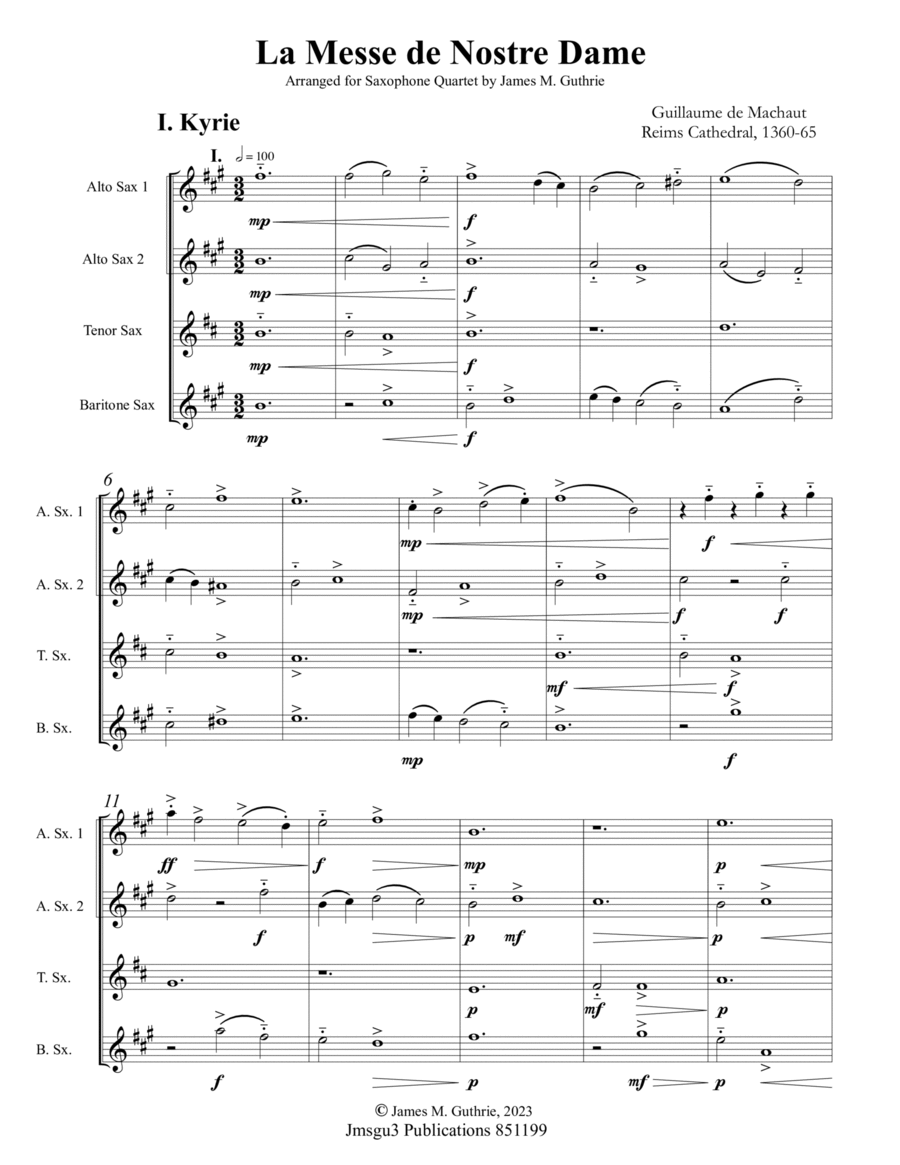
Saxophone Quartet,Woodwind Ensemble Alto Saxophone,Baritone Saxophone,Tenor Saxophone - Level 2 - Digital Download SKU: A0.1257962 Composed by Guillaume de Machaut, 1300-1377. Arranged by James M. Guthrie, ASCAP. Chamber,Contest,Early Music,Festival,Historic,Medieval. 85 pages. Jmsgu3 #851199. Published by jmsgu3 (A0.1257962). 1. Kyrie2. Gloria3. Credo4. Sanctus5. Agnus dei6. Ite missa estGuillaume de Machaut composed the Messe de Nostre Dame, also known as the Mass of Our Lady, in the early 1360s. He wrote the mass for the Cathedral at Reims, where he served as a canon, a permanent clergy member. According to a rubric found at the Cathedral, it would have likely been performed for the Saturday Lady Mass. Guillaume de Machaut's Messe de Nostre Dame is significant in the history of music for several reasons: It is the first complete setting of the Ordinary of the Mass by a single composer that has survived. It is a unified mass, meaning that the composer selected relevant chants for each section as the borrowed tenor. It was composed in four voices, which was unusual at the time. The texts of both Gloria and Credo are quite lengthy, and therefore Machaut set these movements in a style reminiscent of the earlier discant style, having short phrases, similar rhythmic motion in all parts, and a low ratio of notes per syllable of text, both ending with long, rhapsodic sections for the final word, Amen. Machaut's Messe de Nostre Dame is a landmark in musical history, but it is far from being avant-garde merely for the sake of uniqueness. It is considered to be a culmination of the musical style of the Ars Nova period, which was characterized by complex polyphonic textures and rhythmic innovations. The mass is also significant because it was composed during a time of great political and social upheaval in Europe, and it reflects the changing attitudes towards religion and music during this period. Overall, Machaut's Messe de Nostre Dame is a significant work that represents a culmination of the musical style of the Ars Nova period and reflects the changing attitudes towards religion and music during the 14th century. The mass consists of five movements: Kyrie, Gloria, Credo, Sanctus, and Agnus Dei, followed by the dismissal Ite, missa est. The tenor of the Kyrie is based on Vatican Kyrie IV, the Sanctus, and Agnus correspond to Vatican Mass XVII, and the Ite is on Sanctus VIII. The Gloria and Credo have no apparent chant basis, although they are stylistically related to one another. The mass is a unified mass, meaning that the composer selected relevant chants for each section as the borrowed tenor. The Messe de Nostre Dame is significant in the history of music because it is the first complete setting of the Ordinary of the Mass by a single composer that has survived. It is also significant because it was composed during a time of great political and social upheaval in Europe, and it reflects the changing attitudes towards religion and music during this period. Overall, the Messe de Nostre Dame was an important part of the liturgical practices of the time, and it is still regarded as a masterpiece of medieval music and of all religious music.

Machaut: La Messe de Nostre Dame for Saxophone Quartet
Quatuor de Saxophones: 4 saxophones

$74.95 62.88 € Quatuor de Saxophones: 4 saxophones PDF SheetMusicPlus

Choral Choir (SA) - Level 2 - Digital Download SKU: A0.879821 Composed by Alan Bullard. Classical,Contemporary. Octavo. 8 pages. Colne Edition / BullardMusic #486230. Published by Colne Edition / BullardMusic (A0.879821). The rainbow: sign of peace, sign of caring, sign of life, sign of the future. During the COVID lockdown in Spring 2020, UK residents placed pictures of rainbows in their windows, and, every Thursday, came out to their doorsteps and applauded those in the medical profession who were working so hard to keep them safe. Written at that time, this song, to the composer's own words, reflects on the healing powers of the rainbow, symbol of the caring professions. This version is for SA (or unison voices) with piano - another version for SATB and piano is also available from this site. The recording and the YouTube link are of the SATB version. Alan Bullard’s choral works are performed worldwide, and many have been recorded and broadcast. He has a growing reputation for music that choirs enjoy performing, and which speaks directly to audiences. The Colne Choral Series contains a range of Bullard’s pieces for adult and youth choirs of all types, including cantatas and choral suites as well as individual movements. For full details please visit www.colneedition.co.uk or www.alanbullard.co.uk.
Rainbow (SA, or unison voices, and piano)
Chorale 2 parties

$1.99 1.67 € Chorale 2 parties PDF SheetMusicPlus

Choral Choir (SATB) - Level 2 - Digital Download SKU: A0.879819 Composed by Alan Bullard. Classical,Contemporary. Octavo. 9 pages. Colne Edition / BullardMusic #486229. Published by Colne Edition / BullardMusic (A0.879819). The rainbow: sign of peace, sign of caring, sign of life, sign of the future. During the COVID lockdown in Spring 2020, UK residents placed pictures of rainbows in their windows, and, every Thursday, came out to their doorsteps and applauded those in the medical profession who were working so hard to keep them safe. Written at that time, this song, to the composer's own words, reflects on the healing powers of the rainbow, symbol of the caring professions. This version is for SATB with piano - another version for SA (or unison voices) and piano is also available from this site. Alan Bullard’s choral works are performed worldwide, and many have been recorded and broadcast. He has a growing reputation for music that choirs enjoy performing, and which speaks directly to audiences. The Colne Choral Series contains a range of Bullard’s pieces for adult and youth choirs of all types, including cantatas and choral suites as well as individual movements. For full details please visit www.colneedition.co.uk or www.alanbullard.co.uk.
Rainbow (SATB and piano)
Chorale SATB

$1.99 1.67 € Chorale SATB PDF SheetMusicPlus

Horn,Trombone,Trumpet,Tuba - Level 4 - Digital Download SKU: A0.1158678 Composed by Dr. Daniel N. Thrower. 20th Century,Chamber,Classical,Historic. 30 pages. Https://gildedmusicpress.com/ #758696. Published by https://gildedmusicpress.com/ (A0.1158678). The opening of this 4-minute piece is dance-like, intimating a celebratory mood up front—alone at first, but shared with the ensemble throughout the piece. After much celebration, the piece ends solemnly, as if giving each other final hugs and good-byes. Every Airman has a story to tell. “Farewell Celebration†is part of my story as an Airman musician. It is a fitting farewell to the Heartland of America Band stationed at Offutt Air Force Base in Bellevue, Nebraska, and to the entire American Midwest, as my family and I finalized our plans to uproot for an extraordinary three-year adventure in Asia. Work on this composition began toward the end of July and beginning of August 2021 as a melody with instructions to be the opening of a brass quintet piece, beginning with trumpet alone. It remained in that state until January 2022 when I entered this sketch into the computer to be worked on sporadically along with several other works in progress. When I contracted Covid-19 in July 2022, all of these works and other incipient pieces received attention, but this one more than most others. In the fall, I felt an urgency to complete it as a sentimental gesture of enthusiastic good-byes due to many life changes taking place. In particular, my fourth son, Paul, was departing for two years for Brazil. I was compelled to complete this work before he left on October 17, 2022, which I accomplished the day prior to his departure. In addition to Paul’s farewell, two co-workers with whom I had worked closely in the Air Force brass quintet called “Offutt Brass,†were also moving on with new exciting chapters in their lives. MSgt Ben Kadow, our fantastic trombonist, had received an assignment to move to Germany, leaving us on November 8. And MSgt Ryan Heseltine, our unparalleled French horn player, retired at the end of the year. On top of all that, in September I was given an assignment to move to Japan the following summer. Some farewells are more difficult to endure than others, though all seem to have varied brands of profound emotion. In contrast to saying good-bye to a loved one who passes away, all of these farewells were joyful, albeit poignant. “Farewell Celebration†is dedicated to my son Paul, to my outstanding professional colleagues, Ben Kadow and Ryan Heseltine, and to all our friends and family members who we left behind as we moved to Japan.
Farewell Celebration (for Brass Quintet)
Quintette de Cuivres: 2 trompettes, Cor, trombone, tuba

$24.95 20.93 € Quintette de Cuivres: 2 trompettes, Cor, trombone, tuba PDF SheetMusicPlus

Tenor voice solo with string quartet or piano - Moderately Easy - Digital Download SKU: MQ.8329-E Composed by Gwyneth W. Walker. Instrument part. 23 pages. Duration 10 minutes, 10 seconds. E. C. Schirmer Music Company - Digital #8329-E. Published by E. C. Schirmer Music Company - Digital (MQ.8329-E). English.The poetry of Dylan Thomas (1914–1953) is characteristically Welsh and dark. Death is a common topic in his writings. Yet despite the somber imagery, there is often a strength and resilience. The journey of death is described, but not taken. Death is the adversary, not the ruler. The Hand that Signed the Paper speaks of the often cruel and deadly power of a signed document- a document of taxation, of treaty or of counting casualties. The five fingers mark the dead, but do not soothe. “Hands have no tears to flow.†And Death Shall Have No Dominion expresses the triumph of the human spirit over death. “Though lovers be lost love shall not.†Do Not Go Gentle into that Good Night represents the fight against death. “Rage, rage against the dying of the light.†The musical expression of these poems places the voice in the low (dark) range. Tempi are slow, and minor keys are prevalent. Only occasionally are major tonalities presented. These passages combine with particularly uplifting phrases such as “Though they sink through the sea, they shall rise again†and “Wild men, who caught and sang the sun in flight…†Near the end of the last song, the poet addresses his deceased father: “And you, my father, there on the sad height...†The voice stays on a constant pitch while the harmony lifts beneath (to the heights), in the Lydian (raised) mode. [One might hear the voice as “perched atop†the rising chords.] This is one of the most personal lines of Dylan Thomas' poetry. As the poet speaks to his father, the climax of the song comes with the rising phrases of “Rage, rage against the dying of the light.†The final chords are dissonant, marked “with determination and triumph.†Duration: 10:10.
The Dying of the Light : Musical Settings of the Poetry of Dylan Thomas (Downloadable Piano/Vocal Score)

$12.00 10.07 € PDF SheetMusicPlus


Partitions Gratuites
Acheter des Partitions Musicales
Acheter des Partitions Digitales à Imprimer
Acheter des Instruments de Musique

© 2000 - 2026

Accueil - Version intégrale
