EUROPE
27133 articles
USA
86158 articles
DIGITAL
224169 articles (à imprimer)
Partitions Digitales
Partitions à imprimer
224169 partitions trouvées


Bach,Händel,Rossini,Schubert,Vivaldi : Les plus beaux airs d'opéra à chanter, Alto, Vol. 2
Voix seule
Téléchargez la partition Chant Les plus beaux airs d'opéra &agra…
19.99 € Voix seule PDF Tomplay

Elgar,Massenet,Rossini,Wagner,Tosti : Les plus beaux airs romantiques à chanter, Soprano, Vol. 2
Voix seule
Téléchargez la partition Chant Les plus beaux airs romantiques à chan…
19.99 € Voix seule PDF Tomplay

Bach,Händel,Rossini,Schubert,Vivaldi : Les plus beaux airs d'opéra à chanter, Ténor, Vol.2
Voix seule
Téléchargez la partition Chant Les plus beaux airs d'opéra &agra…
19.99 € Voix seule PDF Tomplay

Bach,Händel,Rossini,Schubert,Vivaldi : Les plus beaux airs d'opéra à chanter, Soprano, Vol.2
Voix seule
Téléchargez la partition Chant Les plus beaux airs d'opéra &agra…
19.99 € Voix seule PDF Tomplay

Elgar,Massenet,Rossini,Wagner,Tosti : Les plus beaux airs romantiques à chanter, Mezzo-soprano, Vol. 2
Voix seule
Téléchargez la partition Chant Les plus beaux airs romantiques à chan…
19.99 € Voix seule PDF Tomplay

Piano,Vocal,Voice - Level 5 - Digital Download SKU: A0.1315461 Composed by Francis Poulenc and Guillaume Apollinaire. Arranged by Nicole Elyse DiPaolo. 20th Century,Classical. Score. 11 pages. Nicole Elyse DiPaolo #904195. Published by Nicole Elyse DiPaolo (A0.1315461). The first of its kind, this is a genuinely playable piano/vocal reduction of Non Monsieur mon mari from Poulenc and Apollinaire's Les mamelles de Tiresias. Sopranos who love this aria no longer need to fear bringing it in for auditions, last-minute performing engagements, or other situations in which the pianist may have to sight-read from the chaotic, poorly notated, and technically demanding vocal score devoid of needed key signatures. Pianists may now enjoy playing this aria comfortably, without risking strain/injury by trying to play reams of excessive 16ths spread out in ways designed for Poulenc's obviously large hands. A few enharmonic respellings in this edition will also provide greater musical understanding for both singers and pianists. This collectionâ??s reductions boast several unique features: 1. No reduction ever requires stretches of over an octave, not including bass notes meant to be held or â??fudgedâ? with the pedal (though octaves may also contain chord tones within them). This reduces the amount of rearranging that smaller-handed pianists must already do. Obviously, further reworkings are to be expected and pianists should feel free to add to or modify what Iâ??ve provided.2. Iâ??ve included less essential, but potentially desirable additional voices/passages in cue-size noteheads so that pianists can easily see them, but know that they are not necessary in a â??sink or swimâ? accompanying situation. Presenting less essential material in cue-size noteheads also reduces visual clutter on the page.3. In addition to the composerâ??s markings, when needed, I have included hints on particular notes to bring out when the singer is likely to need them as a pitch anchor or when it is not obvious which line should be brought out within the texture.4. All page turns have been carefully selected, when possible, so as to result in the least possible disruption to the pianist. When an inevitable page turn precedes a potentially surprising note or chord, Iâ??ve included the next downbeatâ??s notes in cue-size stemless noteheads at the end of the preceding measure.5. I have preserved beams in 8th and smaller note values within the vocal parts so that pianists, some of whom might not be accustomed to syllabic beaming conventions, will find it easier to follow the singerâ??s rhythms while reading potentially unfamiliar arias.6. When known, Iâ??ve noted alternate cuts that singers might like to take within certain arias.7. In some cases Iâ??ve modernized spelling conventions for easier readability (for example, by replacing â??Ã?â? with â??ssâ? in German arias) and enharmonically respelled brief passages or added key signatures for greater clarity.
Quatre Poemes De Guillaume Apollinaire
Piano, Voix

$8.95 7.56 € Piano, Voix PDF SheetMusicPlus

Piano Solo - Level 5 - Digital Download SKU: A0.1081474 By Al Martino. By Bert Kaempfert, Charles Singleton, and Eddie Snyder. Arranged by Timothy Stapay/Liberace. Broadway,Film/TV,Multicultural,Musical/Show,Pop,Standards,World. Score. 6 pages. Timothy Stapay #685607. Published by Timothy Stapay (A0.1081474). This arrangement of Spanish Eyes is as performed by the famous piano artist, Liberace. This was one of Liberace's signature arrangements; and was played by him in concerts around the world. Now for the first time, you can learn to play it with the same style and ornamentation as this legendary pianist! Released in late 1965 in the United States, this recording reached number 15 on the Billboard Hot 100 and spent four weeks atop the Billboard Easy Listening chart in early 1966. This vocal version was also a hit in Europe, where it sold an estimated 800,000 copies in Germany and made the UK Singles Chart twice, peaking at number 49 in 1970 and then reaching number five in August 1973. Władziu Valentino Liberace (May 16, 1919 – February 4, 1987) was an American pianist, singer, and actor. A child prodigy born in Wisconsin to parents of Italian and Polish origin, he enjoyed a career spanning four decades of concerts, recordings, television, motion pictures, and endorsements. At the height of his fame from the 1950s to 1970s, he was the highest-paid entertainer in the world.
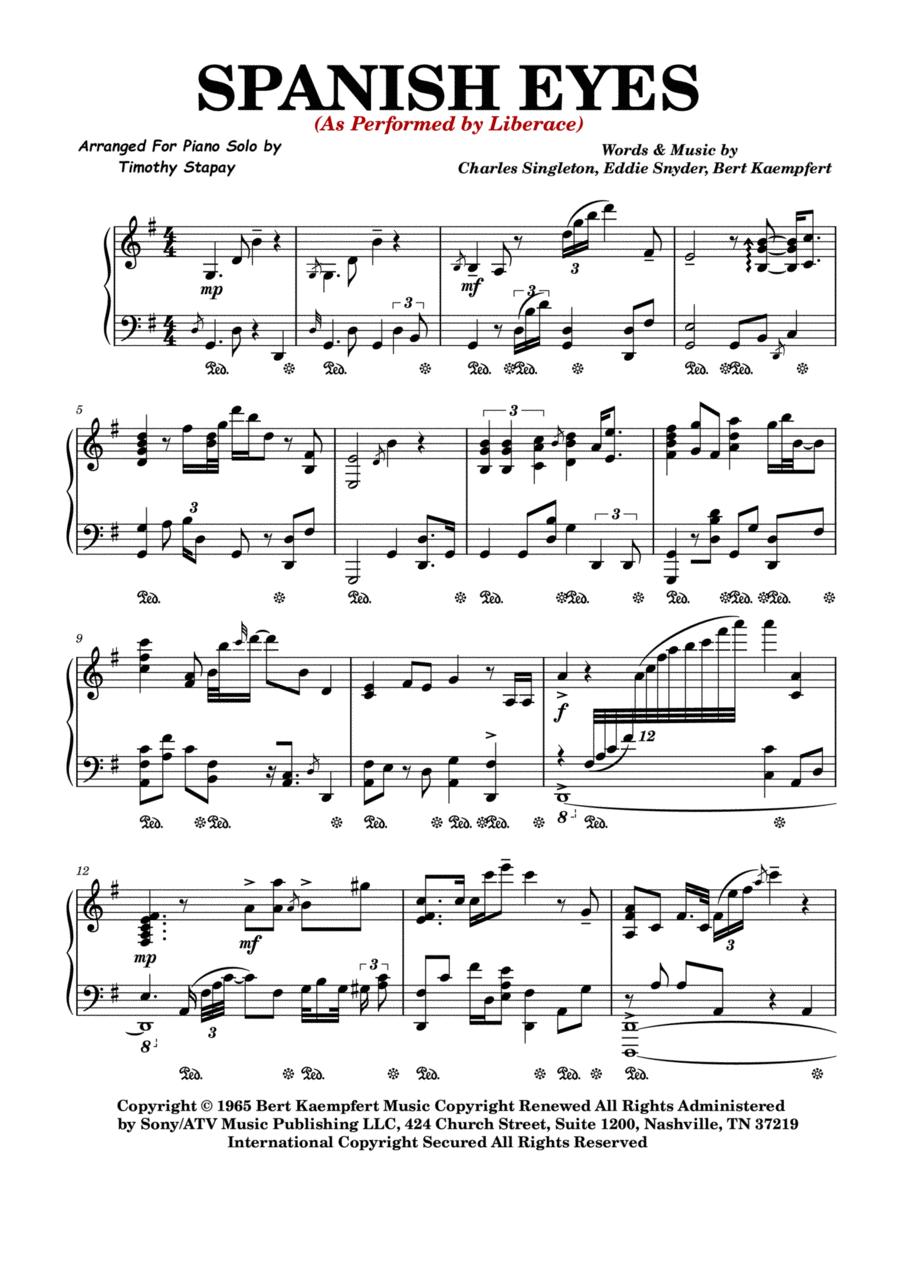
Spanish Eyes
Piano seul
Al Martino
$8.99 7.59 € Piano seul PDF SheetMusicPlus

Piano Solo - Level 4 - Digital Download SKU: A0.1216196 By Brian Golden. By Brian Golden. Arranged by Brian Golden. Classical,Contemporary. Score. 11 pages. Brian Golden #812807. Published by Brian Golden (A0.1216196). Prelude 11 in Db Major Lydian from 24 Preludes for the Piano in Major and Minor Modes by composer Brian Golden   The creative concept in writing these preludes is to provide a link to past preludes written for the keyboard, and in particular to the works of J.S. Bach and Frederic Chopin, whose works stand as essential repertoire for any student of the piano.  Using Bach’s and Chopin’s examples, my goal was to compose in all twenty-four keys, yet offer my own variation on the progression of key signatures – Bach’s being a pattern of major to parallel minor progressing chromatically through all keys, and Chopin’s a pattern of major to relative minor keys progressing clockwise through the circle of fifths.  In order to expand my harmonic and melodic possibilities, I have included the modal keys rather than only the major and harmonic minor keys, and have chosen to work counterclockwise through the circle of fifths, which is a more natural harmonic progression.  Therefore, all major preludes resolve from one to another V-I, as well as do all the minor preludes.    While there are seven modal scales, I decided to leave out the locrian modes for the following reasons.  First, due to the diminished fifth, the locrian mode cannot be thought of as either major nor minor.  Second, the locrian mode did not have a relative key to pair with, since there were no other keys with the identical characteristic notes.    In creating the key architecture, I determined that there was only one solution to pairing major and relative minor scales based on a shared parent key and characteristic note - ionian/aolian, mixolydian/phrygian and lydian/dorian.  This specific order of modal scales is the only order that would enable composing in all twelve key signatures.  Finally, the inspiration for each prelude came from playing through several other preludes in the same keys - mostly by Bach and Chopin - and letting their themes and styles influence me in the writing of my own.YouTube Link https://youtu.be/xb4E0I-vJek.
Prelude 11 in Db Major Lydian
Piano seul
Brian Golden
$5.99 5.06 € Piano seul PDF SheetMusicPlus


Partitions Gratuites
Acheter des Partitions Musicales
Acheter des Partitions Digitales à Imprimer
Acheter des Instruments de Musique

© 2000 - 2026

Accueil - Version intégrale





