EUROPE
27133 articles
USA
86158 articles
DIGITAL
224190 articles (à imprimer)
Partitions Digitales
Partitions à imprimer
224190 partitions trouvées


Piano Solo - Level 5 - Digital Download SKU: A0.1248571 By Brian Golden. By Brian Golden. Arranged by Brian Golden. Classical,Contemporary. Score. 3 pages. Brian Golden #843062. Published by Brian Golden (A0.1248571). Prelude 13 in F# Major Ionian from 24 Preludes for the Piano in Major and Minor Modes by composer Brian Golden   The creative concept in writing these preludes is to provide a link to past preludes written for the keyboard, and in particular to the works of J.S. Bach and Frederic Chopin, whose works stand as essential repertoire for any student of the piano.  Using Bach’s and Chopin’s examples, my goal was to compose in all twenty-four keys, yet offer my own variation on the progression of key signatures – Bach’s being a pattern of major to parallel minor progressing chromatically through all keys, and Chopin’s a pattern of major to relative minor keys progressing clockwise through the circle of fifths.  In order to expand my harmonic and melodic possibilities, I have included the modal keys rather than only the major and harmonic minor keys, and have chosen to work counterclockwise through the circle of fifths, which is a more natural harmonic progression.  Therefore, all major preludes resolve from one to another V-I, as well as do all the minor preludes.    While there are seven modal scales, I decided to leave out the locrian modes for the following reasons.  First, due to the diminished fifth, the locrian mode cannot be thought of as either major nor minor.  Second, the locrian mode did not have a relative key to pair with, since there were no other keys with the identical characteristic notes.    In creating the key architecture, I determined that there was only one solution to pairing major and relative minor scales based on a shared parent key and characteristic note - ionian/aolian, mixolydian/phrygian and lydian/dorian.  This specific order of modal scales is the only order that would enable composing in all twelve key signatures.  Finally, the inspiration for each prelude came from playing through several other preludes in the same keys - mostly by Bach and Chopin - and letting their themes and styles influence me in the writing of my own.
Prelude 13 in F# Major Ionian
Piano seul
Brian Golden
$5.99 5.03 € Piano seul PDF SheetMusicPlus

Piano Solo - Level 4 - Digital Download SKU: A0.1216178 By Brian Golden. By Brian Golden. Arranged by Brian Golden. Classical,Contemporary. Score. 2 pages. Brian Golden #812790. Published by Brian Golden (A0.1216178). Prelude 7 in Eb Ionian from 24 Preludes for the Piano in Major and Minor Modes by composer Brian Golden   The creative concept in writing these preludes is to provide a link to past preludes written for the keyboard, and in particular to the works of J.S. Bach and Frederic Chopin, whose works stand as essential repertoire for any student of the piano.  Using Bach’s and Chopin’s examples, my goal was to compose in all twenty-four keys, yet offer my own variation on the progression of key signatures – Bach’s being a pattern of major to parallel minor progressing chromatically through all keys, and Chopin’s a pattern of major to relative minor keys progressing clockwise through the circle of fifths.  In order to expand my harmonic and melodic possibilities, I have included the modal keys rather than only the major and harmonic minor keys, and have chosen to work counterclockwise through the circle of fifths, which is a more natural harmonic progression.  Therefore, all major preludes resolve from one to another V-I, as well as do all the minor preludes.    While there are seven modal scales, I decided to leave out the locrian modes for the following reasons.  First, due to the diminished fifth, the locrian mode cannot be thought of as either major nor minor.  Second, the locrian mode did not have a relative key to pair with, since there were no other keys with the identical characteristic notes.    In creating the key architecture, I determined that there was only one solution to pairing major and relative minor scales based on a shared parent key and characteristic note - ionian/aolian, mixolydian/phrygian and lydian/dorian.  This specific order of modal scales is the only order that would enable composing in all twelve key signatures.  Finally, the inspiration for each prelude came from playing through several other preludes in the same keys - mostly by Bach and Chopin - and letting their themes and styles influence me in the writing of my own.YouTube.
Prelude 7 in Eb Ionian
Piano seul
Brian Golden
$5.99 5.03 € Piano seul PDF SheetMusicPlus

Piano Solo - Level 4 - Digital Download SKU: A0.1292438 By Brian Golden. By Brian Golden. Arranged by Brian Golden. Classical,Contemporary. Score. 3 pages. Brian Golden #883008. Published by Brian Golden (A0.1292438). Prelude 20 in F# Minor Aolian from 24 Preludes for the Piano in Major and Minor Modes by composer Brian Golden   The creative concept in writing these preludes is to provide a link to past preludes written for the keyboard, and in particular to the works of J.S. Bach and Frederic Chopin, whose works stand as essential repertoire for any student of the piano.  Using Bach’s and Chopin’s examples, my goal was to compose in all twenty-four keys, yet offer my own variation on the progression of key signatures – Bach’s being a pattern of major to parallel minor progressing chromatically through all keys, and Chopin’s a pattern of major to relative minor keys progressing clockwise through the circle of fifths.  In order to expand my harmonic and melodic possibilities, I have included the modal keys rather than only the major and harmonic minor keys, and have chosen to work counterclockwise through the circle of fifths, which is a more natural harmonic progression.  Therefore, all major preludes resolve from one to another V-I, as well as do all the minor preludes.    While there are seven modal scales, I decided to leave out the locrian modes for the following reasons.  First, due to the diminished fifth, the locrian mode cannot be thought of as either major nor minor.  Second, the locrian mode did not have a relative key to pair with, since there were no other keys with the identical characteristic notes.    In creating the key architecture, I determined that there was only one solution to pairing major and relative minor scales based on a shared parent key and characteristic note - ionian/aolian, mixolydian/phrygian and lydian/dorian.  This specific order of modal scales is the only order that would enable composing in all twelve key signatures.  Finally, the inspiration for each prelude came from playing through several other preludes in the same keys - mostly by Bach and Chopin - and letting their themes and styles influence me in the writing of my own.
Prelude 20 in F# MInor Aolian
Piano seul
Brian Golden
$5.99 5.03 € Piano seul PDF SheetMusicPlus

Piano Solo - Level 4 - Digital Download SKU: A0.1248575 By Brian Golden. By Brian Golden. Arranged by Brian Golden. Classical,Contemporary. Score. 8 pages. Brian Golden #843067. Published by Brian Golden (A0.1248575). Prelude 16 in G# Minor Phrygian from 24 Preludes for the Piano in Major and Minor Modes by composer Brian Golden   The creative concept in writing these preludes is to provide a link to past preludes written for the keyboard, and in particular to the works of J.S. Bach and Frederic Chopin, whose works stand as essential repertoire for any student of the piano.  Using Bach’s and Chopin’s examples, my goal was to compose in all twenty-four keys, yet offer my own variation on the progression of key signatures – Bach’s being a pattern of major to parallel minor progressing chromatically through all keys, and Chopin’s a pattern of major to relative minor keys progressing clockwise through the circle of fifths.  In order to expand my harmonic and melodic possibilities, I have included the modal keys rather than only the major and harmonic minor keys, and have chosen to work counterclockwise through the circle of fifths, which is a more natural harmonic progression.  Therefore, all major preludes resolve from one to another V-I, as well as do all the minor preludes.    While there are seven modal scales, I decided to leave out the locrian modes for the following reasons.  First, due to the diminished fifth, the locrian mode cannot be thought of as either major nor minor.  Second, the locrian mode did not have a relative key to pair with, since there were no other keys with the identical characteristic notes.    In creating the key architecture, I determined that there was only one solution to pairing major and relative minor scales based on a shared parent key and characteristic note - ionian/aolian, mixolydian/phrygian and lydian/dorian.  This specific order of modal scales is the only order that would enable composing in all twelve key signatures.  Finally, the inspiration for each prelude came from playing through several other preludes in the same keys - mostly by Bach and Chopin - and letting their themes and styles influence me in the writing of my own.
Prelude 16 in G# Minor Phrygian
Piano seul
Brian Golden
$5.99 5.03 € Piano seul PDF SheetMusicPlus

Piano Solo - Level 4 - Digital Download SKU: A0.1248570 By Brian Golden. By Brian Golden. Arranged by Brian Golden. Classical,Contemporary. Score. 4 pages. Brian Golden #843063. Published by Brian Golden (A0.1248570). Prelude 14 in D# Minor Dorian from 24 Preludes for the Piano in Major and Minor Modes by composer Brian Golden   The creative concept in writing these preludes is to provide a link to past preludes written for the keyboard, and in particular to the works of J.S. Bach and Frederic Chopin, whose works stand as essential repertoire for any student of the piano.  Using Bach’s and Chopin’s examples, my goal was to compose in all twenty-four keys, yet offer my own variation on the progression of key signatures – Bach’s being a pattern of major to parallel minor progressing chromatically through all keys, and Chopin’s a pattern of major to relative minor keys progressing clockwise through the circle of fifths.  In order to expand my harmonic and melodic possibilities, I have included the modal keys rather than only the major and harmonic minor keys, and have chosen to work counterclockwise through the circle of fifths, which is a more natural harmonic progression.  Therefore, all major preludes resolve from one to another V-I, as well as do all the minor preludes.    While there are seven modal scales, I decided to leave out the locrian modes for the following reasons.  First, due to the diminished fifth, the locrian mode cannot be thought of as either major nor minor.  Second, the locrian mode did not have a relative key to pair with, since there were no other keys with the identical characteristic notes.    In creating the key architecture, I determined that there was only one solution to pairing major and relative minor scales based on a shared parent key and characteristic note - ionian/aolian, mixolydian/phrygian and lydian/dorian.  This specific order of modal scales is the only order that would enable composing in all twelve key signatures.  Finally, the inspiration for each prelude came from playing through several other preludes in the same keys - mostly by Bach and Chopin - and letting their themes and styles influence me in the writing of my own.
Prelude 14 in D# Minor Dorian
Piano seul
Brian Golden
$5.99 5.03 € Piano seul PDF SheetMusicPlus

Piano Solo - Level 5 - Digital Download SKU: A0.1191080 By Brian Golden. By Brian Golden. Arranged by Brian Golden. Classical,Contemporary. Score. 9 pages. Brian Golden #790596. Published by Brian Golden (A0.1191080). Prelude 4 in D Minor Phrygian from 24 Preludes for the Piano in Major and Minor Modes by composer Brian Golden   The creative concept in writing these preludes is to provide a link to past preludes written for the keyboard, and in particular to the works of J.S. Bach and Frederic Chopin, whose works stand as essential repertoire for any student of the piano.  Using Bach’s and Chopin’s examples, my goal was to compose in all twenty-four keys, yet offer my own variation on the progression of key signatures – Bach’s being a pattern of major to parallel minor progressing chromatically through all keys, and Chopin’s a pattern of major to relative minor keys progressing clockwise through the circle of fifths.  In order to expand my harmonic and melodic possibilities, I have included the modal keys rather than only the major and harmonic minor keys, and have chosen to work counterclockwise through the circle of fifths, which is a more natural harmonic progression.  Therefore, all major preludes resolve from one to another V-I, as well as do all the minor preludes.    While there are seven modal scales, I decided to leave out the locrian modes for the following reasons.  First, due to the diminished fifth, the locrian mode cannot be thought of as either major nor minor.  Second, the locrian mode did not have a relative key to pair with, since there were no other keys with the identical characteristic notes.    In creating the key architecture, I determined that there was only one solution to pairing major and relative minor scales based on a shared parent key and characteristic note - ionian/aolian, mixolydian/phrygian and lydian/dorian.  This specific order of modal scales is the only order that would enable composing in all twelve key signatures.  Finally, the inspiration for each prelude came from playing through several other preludes in the same keys - mostly by Bach and Chopin - and letting their themes and styles influence me in the writing of my own.
Prelude 4 in D Minor Phrygian
Piano seul
Brian Golden
$5.99 5.03 € Piano seul PDF SheetMusicPlus

Piano Solo - Level 4 - Digital Download SKU: A0.1248572 By Brian Golden. By Brian Golden. Arranged by Brian Golden. Classical,Contemporary. Score. 4 pages. Brian Golden #843064. Published by Brian Golden (A0.1248572). Prelude 15 in B Major Mixolydian from 24 Preludes for the Piano in Major and Minor Modes by composer Brian Golden   The creative concept in writing these preludes is to provide a link to past preludes written for the keyboard, and in particular to the works of J.S. Bach and Frederic Chopin, whose works stand as essential repertoire for any student of the piano.  Using Bach’s and Chopin’s examples, my goal was to compose in all twenty-four keys, yet offer my own variation on the progression of key signatures – Bach’s being a pattern of major to parallel minor progressing chromatically through all keys, and Chopin’s a pattern of major to relative minor keys progressing clockwise through the circle of fifths.  In order to expand my harmonic and melodic possibilities, I have included the modal keys rather than only the major and harmonic minor keys, and have chosen to work counterclockwise through the circle of fifths, which is a more natural harmonic progression.  Therefore, all major preludes resolve from one to another V-I, as well as do all the minor preludes.    While there are seven modal scales, I decided to leave out the locrian modes for the following reasons.  First, due to the diminished fifth, the locrian mode cannot be thought of as either major nor minor.  Second, the locrian mode did not have a relative key to pair with, since there were no other keys with the identical characteristic notes.    In creating the key architecture, I determined that there was only one solution to pairing major and relative minor scales based on a shared parent key and characteristic note - ionian/aolian, mixolydian/phrygian and lydian/dorian.  This specific order of modal scales is the only order that would enable composing in all twelve key signatures.  Finally, the inspiration for each prelude came from playing through several other preludes in the same keys - mostly by Bach and Chopin - and letting their themes and styles influence me in the writing of my own.
Prelude 15 in B Major Mixolydian
Piano seul
Brian Golden
$5.99 5.03 € Piano seul PDF SheetMusicPlus

Piano Solo - Level 5 - Digital Download SKU: A0.1191533 By Brian Golden. By Brian Golden. Arranged by Brian Golden. Classical,Contemporary. Score. 5 pages. Brian Golden #791032. Published by Brian Golden (A0.1191533). Prelude 5 in Bb Major Lydian from 24 Preludes for the Piano in Major and Minor Modes by composer Brian Golden   The creative concept in writing these preludes is to provide a link to past preludes written for the keyboard, and in particular to the works of J.S. Bach and Frederic Chopin, whose works stand as essential repertoire for any student of the piano.  Using Bach’s and Chopin’s examples, my goal was to compose in all twenty-four keys, yet offer my own variation on the progression of key signatures – Bach’s being a pattern of major to parallel minor progressing chromatically through all keys, and Chopin’s a pattern of major to relative minor keys progressing clockwise through the circle of fifths.  In order to expand my harmonic and melodic possibilities, I have included the modal keys rather than only the major and harmonic minor keys, and have chosen to work counterclockwise through the circle of fifths, which is a more natural harmonic progression.  Therefore, all major preludes resolve from one to another V-I, as well as do all the minor preludes.    While there are seven modal scales, I decided to leave out the locrian modes for the following reasons.  First, due to the diminished fifth, the locrian mode cannot be thought of as either major nor minor.  Second, the locrian mode did not have a relative key to pair with, since there were no other keys with the identical characteristic notes.    In creating the key architecture, I determined that there was only one solution to pairing major and relative minor scales based on a shared parent key and characteristic note - ionian/aolian, mixolydian/phrygian and lydian/dorian.  This specific order of modal scales is the only order that would enable composing in all twelve key signatures.  Finally, the inspiration for each prelude came from playing through several other preludes in the same keys - mostly by Bach and Chopin - and letting their themes and styles influence me in the writing of my own.
Prelude 5 in Bb Major Lydian
Piano seul
Brian Golden
$5.99 5.03 € Piano seul PDF SheetMusicPlus

Piano Solo - Level 5 - Digital Download SKU: A0.1216197 By Brian Golden. By Brian Golden. Arranged by Brian Golden. Classical,Contemporary. Score. 4 pages. Brian Golden #812808. Published by Brian Golden (A0.1216197). Prelude 12 in Bb Minor Dorian from 24 Preludes for the Piano in Major and Minor Modes by composer Brian Golden   The creative concept in writing these preludes is to provide a link to past preludes written for the keyboard, and in particular to the works of J.S. Bach and Frederic Chopin, whose works stand as essential repertoire for any student of the piano.  Using Bach’s and Chopin’s examples, my goal was to compose in all twenty-four keys, yet offer my own variation on the progression of key signatures – Bach’s being a pattern of major to parallel minor progressing chromatically through all keys, and Chopin’s a pattern of major to relative minor keys progressing clockwise through the circle of fifths.  In order to expand my harmonic and melodic possibilities, I have included the modal keys rather than only the major and harmonic minor keys, and have chosen to work counterclockwise through the circle of fifths, which is a more natural harmonic progression.  Therefore, all major preludes resolve from one to another V-I, as well as do all the minor preludes.    While there are seven modal scales, I decided to leave out the locrian modes for the following reasons.  First, due to the diminished fifth, the locrian mode cannot be thought of as either major nor minor.  Second, the locrian mode did not have a relative key to pair with, since there were no other keys with the identical characteristic notes.    In creating the key architecture, I determined that there was only one solution to pairing major and relative minor scales based on a shared parent key and characteristic note - ionian/aolian, mixolydian/phrygian and lydian/dorian.  This specific order of modal scales is the only order that would enable composing in all twelve key signatures.  Finally, the inspiration for each prelude came from playing through several other preludes in the same keys - mostly by Bach and Chopin - and letting their themes and styles influence me in the writing of my own.YouTube Link https://youtu.be/xb4E0I-vJek.
Prelude 12 in Bb Minor Dorian
Piano seul
Brian Golden
$5.99 5.03 € Piano seul PDF SheetMusicPlus

Woodwind Ensemble,Woodwind Quartet Flute - Level 1 - Digital Download SKU: A0.877931 Composed by Gioachino Rossini. Arranged by Rebecca Bogardus. Classical,Film/TV,Romantic Period,Standards. 61 pages. Lillwy Publishing #4776267. Published by Lillwy Publishing (A0.877931). The two movements of Rossini's famous opera overture included here are familiar the world over. Whether your students can name them or not, they've certainly heard them! There are two versions of this arrangement included. Version A is easier and is correlated with popular method books, and Version B is for a more intermediate-level group, although Version B's Parts 3 and 4 are still within the reach of a second-year student. For Version A, if a student has mastered the lesson listed in the score, they can play the part! About Ensembles by the BookBeginners will have a blast with these ensemble arrangements leveled to correlate with popular flute method books! Each part is correlated with a specific lesson in the Flute 101 and Blocki Methods. Creating an ensemble for your beginning flute students is one of the best things you can do for them; intonation, phrasing, and dynamics are all more effectively taught when reinforced through ensemble work. Since these are multi-level ensembles, your students will quickly find role models within your studio who are playing at a higher level, increasing motivation to practice so they can play the harder parts the next time!  *Please note that these arrangements correlate with method books meant for private lessons, which typically begin with the notes B, A, and G, rather than band methods, which start students with less beginner-friendly flute notes.
William Tell Overture
Quatuor de Flûtes : 4 flûtes

$7.99 6.7 € Quatuor de Flûtes : 4 flûtes PDF SheetMusicPlus

Piano,Vocal,Voice - Level 3 - Digital Download SKU: A0.942058 Composed by Apostolos Paraskevas. 20th Century,Jazz,Opera,World. Score. 10 pages. Silver Sickle Publications #4729017. Published by Silver Sickle Publications (A0.942058). This witty and extremely fun work to perform by composer Apostolos Paraskevas was conceived after real events. There is a version for Soprano/tenor and Piano and one for guitar as well. Easy to perform and the text was inspired of the following narrative. I Slaughtered an Orange over the Sink... ...and it just sat there…It didn't say a word, not a sound of anguish, not even when my teeth started to tear apart it's flesh little by little... I knew it was a special orange but I couldn't fathom the magnitude of its character…Even when gentle I took it away from its friends there at the top of the kitchen counter, it looked at me almost with a sense of gratitude. Yes, gratitude.! As if it was saying: Thank you! Thank you for helping me to fulfill the purpose of my life…Since I was a little seed I knew I would serve a higher purpose. My sacrifice will help a human to become a healthier mother, doctor, composer, a better scientist. Yes, I think I felt it said…a better composer as well. ...and there I was, sinking my teeth deep inside its flesh and taking all of what it had to offer. It's life, it's substance, it's gratitude for serving a higher purpose. I slaughtered it over the sink, to avoid any evidence of what had happen there. The remaining outer sell, I placed it on the stove top and lighted up with fire, as my mother use to do, to release the heavenly smell and there it was. Evaporated everywhere! I inhale it, It became totally a part of me. Today, I slaughtered an orange over the sink and I didn’t say thank you!   Apostolos Paraskevas is a classical guitarist and composer as well as an award-winning film director and producer. He has received multiple international awards for his compositions and was nominated for a Grammy Award. He is the only guitarist ever to have a major orchestral piece performed at Carnegie Hall under the direction of Lukas Foss––and the only musician who has performed there in a Grim Reaper outfit. He was the founder and served for 16 years as the artistic director of the International Guitar Congress-Festival of Corfu, Greece.  He is a voting member of the Recording Academy (Grammys).   After his undergraduate music studies in Volos he pursued advanced studies in classical guitar with Costas Cotsiolis (diploma, 1990) and Leo Brouwer (Havana 1984, 1988), as well as postgraduate studies in composition with Lukas Foss and Theodore Antoniou (DMA in composition, Boston University, 1998). Paraskevas embarked on a successful career as a guitar soloist and contemporary composer, achieving distinctions in both disciplines: Grammy nomination for Chase Dance (Bridge Records, 1999); first prize for Night Wanderings (Lukas Foss Composition Competition, 2000); first prize for Phygein Adynaton (National Composers Conference, 1997); and numerous prestigious commissions, performances, and publications. Following teaching posts at Northeastern and Boston Universities, Paraskevas has taught since 2001 at the Berklee College of Music in Boston (professor of composition and classical guitar). His eclectic compositional style arises as an idiosyncratic integration of seemingly conflicting influences – from avant-garde approaches to harmonic structure, form, and timbre, to pop-folk modal and rhythmical concepts – amalgamated into a personal evocative musical language, characterized by rhythmic verve, melodic grace, dramatic (and sometimes unexpectedly humorous) gestures, and ritualistic or theatrical elements. The latter feature has also led Paraskevas to the creation of films, notably the acclaimed I Finally Did It (Gold award, California Film Awards 2010), dealing wittily with Death, a recurring extra-musical theme in his music. The Groves Dictionary of Music Costas.
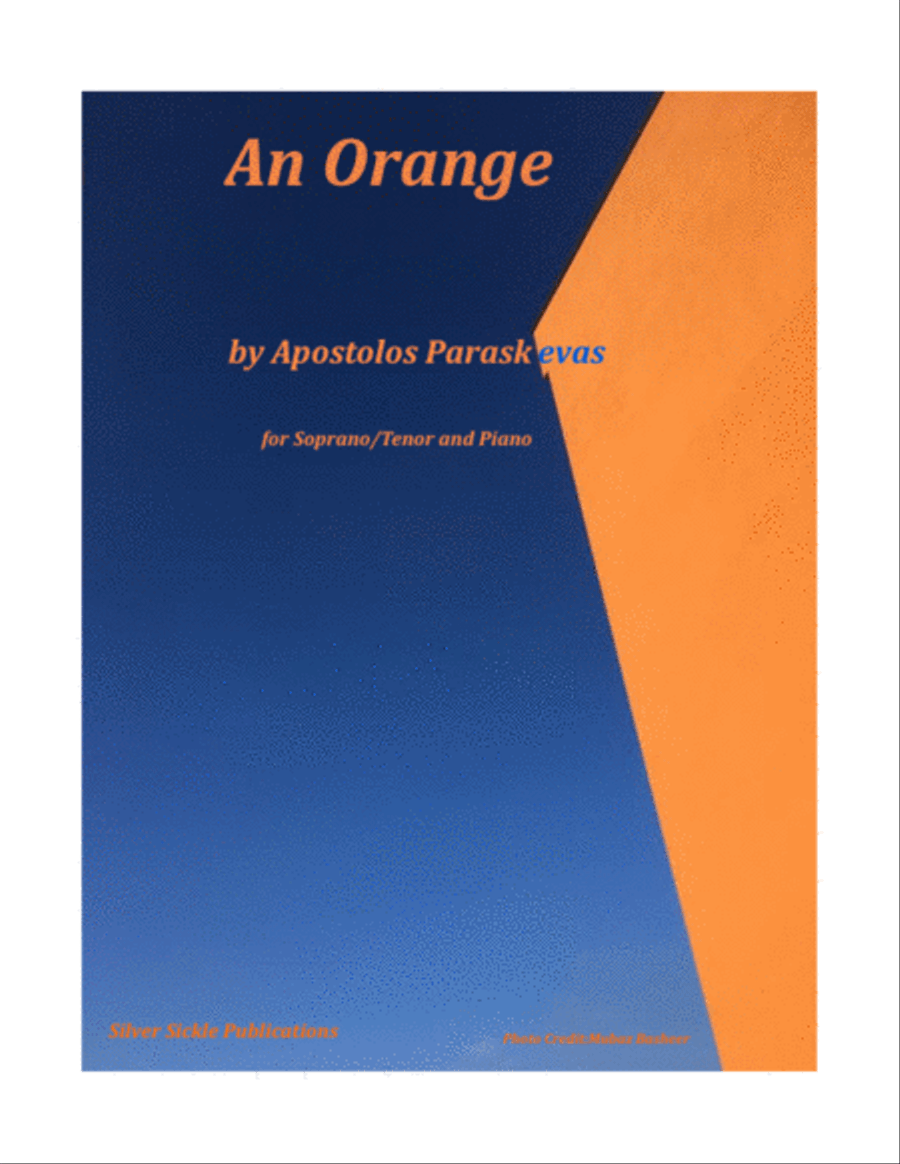
An Orange for Soprano/Tenor and Piano
Piano, Voix

$8.99 7.54 € Piano, Voix PDF SheetMusicPlus

Piano,Soprano Flute - Level 3 - Digital Download SKU: A0.1437015 By Milva. By Carlo Carunchio, Ennio Morricone, and Giuseppe Patroni Griffi. Arranged by Eileen Gilligan. 21st Century,Classical,Film/TV,Instructional,Traditional. Score and part. 9 pages. The Flautist #1017083. Published by The Flautist (A0.1437015). D'Amore Si Muore is an excellent way to practice words, expression and phrasing. In this case variations on “love you ” all the way through.Relates brilliantly to Melodious Studies number 11, 13, 14 and also 8.I am a big fan of playing slowly and having absolute control of everything I do down to the last detail and a melody like this is a great tool to practice this. I don’t believe one can play fast before control over slow playing and expression is mastered.Our most natural instrument is our voice . Singing and playing this melody is a terrific way to bridge the gap between the metal flute and one’s voice. The outcome is an amazing resonance ,musical quality in the tone and natural phrasing.Moyse was asked what he thought the French School of flute playing was and he answered” being able to sound like other instruments”. We have to start with the first port of call – our voice.The words you can use for phrasing are ” love you , love you , love you , love you, love you so.” “I really love you so much” ” I really love you so” etc all the way through . You can make up your own.It is worth singing and playing this through. By that I mean play 2 notes, sing 2 and play 2 all the way through without interrupting the musical flow, resonance and tone quality. Great for practising going between singing and playing quickly.Love was a favourite word of Moyse and Wibb. I see why!. It innately has so much expression, warmth, opens up the mouth and in Moyse’s words “scoops the last spoonful of mayonnaise from the jar. ” You definitely can’t say it with “an ugly nasal voice”- Moyse quote.The tone has to have life and expression. I hear so often soft playing as the player blowing softly but that gives such a dull lifeless outcome.
D'amore Si Muore (Milva Version)
Flûte traversière et Piano
Milva
$6.95 5.83 € Flûte traversière et Piano PDF SheetMusicPlus

Piano Solo - Level 3 - Digital Download SKU: A0.1418608 By Johann Sebastian Bach. By Johann Sebastian Bach. Arranged by Masakazu YAMAMOTO. Baroque,Classical,Contest,Festival,Instructional,Religious. Score. 33 pages. Motch Music #1000182. Published by Motch Music (A0.1418608). Music analysis of all fifteen Sinfonias composed by J.S. Bach. In this edition, composer Masakazu Yamamoto provides a detailed analysis of various aspects such as each phrase, harmony, and cadence, and analytical notes based on this analysis are written in various colors on the musical score. It is hoped that these annotations will be helpful for learning, whether in performance or composition.Analyses of Two-Part Inventions and Sinfonias series is available for purchase. 15 Inventions[Sheet Music Plus / Sheet Music Direct] All Inventions (15 pieces)[Sheet Music Plus / Sheet Music Direct] 15 Sinfonias[Sheet Music Plus / Sheet Music Direct] All Sinfonias (15 pieces)[Sheet Music Plus / Sheet Music Direct] All Inventions and Sinfonias (30 pieces)[Sheet Music Plus / Sheet Music Direct] Note:In this edition, Japanese-style harmony marks are used.Other Music Analyses(Sheet Music Plus / Sheet Music Direct)-----------------------------------------------------Motch Music All Sheet Music (Sheet Music Plus / Sheet Music Direct)I have a wide selection of sheet music for various instruments such as piano, ensemble, and concert band. From light and enjoyable pieces to concert-level compositions, we cover a wide range of repertoire. I also provide a rich collection of audio preview.In addition to original compositions and unique arrangements, a lot of text on music analysis is well-received. Please take a look below for more information!Motch Music Web Pagehttps://www.masakazuyamamoto.com/english
Bach: 15 Sinfonias BWV 787-801 (music analysis)
Piano seul
Johann Sebastian Bach
$22.00 18.46 € Piano seul PDF SheetMusicPlus


Partitions Gratuites
Acheter des Partitions Musicales
Acheter des Partitions Digitales à Imprimer
Acheter des Instruments de Musique

© 2000 - 2026

Accueil - Version intégrale





