EUROPE
3930 articles
USA
9199 articles
DIGITAL
149539 articles (à imprimer)
Partitions Digitales
Partitions à imprimer
149539 partitions trouvées


Piano,Trombone - Level 5 - Digital Download SKU: A0.810983 Composed by Cherry Classics Music. Arranged by John, W., and Ware. 20th Century,Contemporary. Score and part. 63 pages. Gordon Cherry #4601711. Published by Gordon Cherry (A0.810983). This fine work has sat dormant for many years and has now come to light thanks to the efforts of Charlie Vernon, Bass Trombonist of the Chicago Symphony, who performed this virtuoso work as a young performer. The concerto is in the standard three movement form: Fast, slow, fast. This publication is a reduction from the original orchestral version (to be released at some point in the future). Here is a description of the Concerto by the composer, John W. Ware. I started on the trombone concerto in my junior year studying composition at Indiana University.  While working on it, I learned of an opportunity to make it sort of a thesis piece (though students didn't write a thesis in composition while an undergrad).  The original version was for trombone with string orchestra, and it was performed by the IU String Orchestra, conducted by Dr. Arthur Corra, with Robert Priez, trombone, as part of my senior composition recital.  I thought the performance was quite good (Priez played extraordinarily well), and the piece received a newspaper review in the Indiana Daily Student, in which the reviewer wrote that the work was almost too exciting.  I thought at the time that he had given me and my music a fine compliment.  I made a piano version of the accompaniment, shortening and tightening the first movement, for performances in 1966; I made a second revision in 1967 for a performance by E. J. Eaton, trombonist at the University of Tennessee at Martin, arriving at the form in which the work exists now. The first movement is in fairly normal sonata-allegro form, in the key of A minor.  It alternates between assertive and more thoughtful moods.   There is no introduction; the soloist enters immediately and dominates much of the movement. The main theme is--by some manipulation--a source for most of the other themes, and all of the themes are used in close proximity to each other, including contrapuntal combinations, especially near the end.  Originally the movement included a lengthy fugato, now much shortened and including a stretto that builds and subsides before a cadenza leading to a coda based on both the principal and secondary themes.  Key relations in this movement, as in the other two, are quite free and often chromatic, with frequent third-relations; but returns to the tonic at the end are emphatic.  The writing is challenging for both soloist and accompanist; the piece is substantial, requiring technique and stamina. The second movement is in F minor and is also built on both contrast and close relationships between the main and secondary themes.  The main theme is heard in the piano part before the soloist enters.  The mood is more lyric than in the first movement, but with dramatic episodes also.  In this movement are some definite derivations from themes in the first movement.  The ending is a sort of lengthened shadow of the opening. The finale returns to A minor, with themes slightly related to polonaise rhythms, but with strong echoes of first-movement themes.  Here, too, dramatic and lyric episodes alternate, with dotted rhythms frequently propelling the music forward.  The introduction is a brief and simple preparation for the solo entry.  Later in the movement, a very brief, slightly slower section is soon overtaken by the original tempo.  Toward the end, there is a second cadenza, again leading to a swift and energetic coda. The work is about 20 minutes in length and is appropriate for advanced performers.
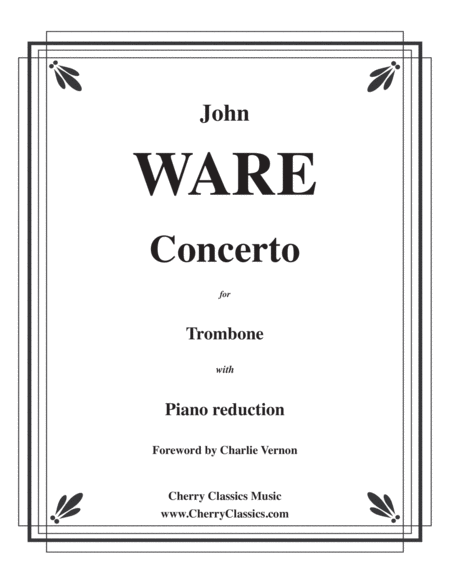
Concerto for Trombone and Piano accompaniment (piano reduction)
Trombone et Piano

$35.00 29.56 € Trombone et Piano PDF SheetMusicPlus

Instrumental Duet,Piano Instrumental Duet,Piano,Violin - Level 1 - Digital Download SKU: A0.1233154 Composed by John Newton. Arranged by Benzaiten Editions. Christian,Early Music,Praise & Worship,Religious,Sacred. 6 pages. Benzaiten Editions #828719. Published by Benzaiten Editions (A0.1233154). The Benzaiten Editions Arrangement If you're looking for an easy violin duo with piano accompaniment music sheet of the classic hymn Amazing Grace, look no further! I have created a simple yet beautiful version of this beloved song that is perfect for beginner violin and violoncello players or those who are just starting to learn how to play. With this arrangement of Amazing Grace, you'll be able to play this timeless melody with ease and grace. The simplified chords and melody make it easy to learn, while still retaining the emotional depth and spiritual resonance of the original hymn. So whether you're looking to add a new piece to your repertoire or share the gift of music with others, our easy/beginner violin duet music sheet of Amazing Grace is sure to inspire and uplift. About the song Amazing Grace is a beloved hymn written by English poet and clergyman John Newton in the late 18th century. It reflects on his personal journey from a life of sin to one of faith and redemption. The melody's origin is unclear, but it's believed to have originated from an old Scottish folk tune. The hymn has been recorded and performed by countless musicians and artists over the years and has become a source of comfort and hope for people around the world in times of struggle and hardship.
Amazing Grace • super easy violin duet sheet music with intermediate piano accompaniment
Violon et Piano

$2.99 2.53 € Violon et Piano PDF SheetMusicPlus

Flute Duet Flute - Level 4 - Digital Download SKU: A0.1179563 By Helene Schulthess. By Helene Schulthess. Arranged by Helene Schulthess. Contest,Country,Festival,Folk,Patriotic,Traditional. Score. 5 pages. Helene Schulthess #779544. Published by Helene Schulthess (A0.1179563). You can purchase all 26 folkdances for 30 $ under this link: https://www.sheetmusicplus.com/title/26-swiss-folk-dances-for-2-flutes-and-accompaniment-digital-sheet-music/21673528The document contents 26 folk dances for two flutes (49 pages) and a score (52 pages)Swiss folk music is very lively. Its diversity reflects the small regional and cultural spaces of Switzerland. Influences from other European countries have also shaped this kind of music since the early 19th century. Polka and Mazurka have their roots in Poland, the Scottish in Scotland. The music has been passed on by word of mouth or has been written down in musicians’ notebooks.Between 1940 and 1960, the ethnomusicologist Hanny Christen travelled through Switzerland and collected thousands of melodies from the period between 1800 and 1960. The musicians played or sang in front of her. Some permitted her to write off their own hand-written dance booklets in full. In 1956, Hanny Christen began to record this music with a tape recorder. It is thanks to her that over 12,000 instrumental dance movements of Switzerland and many other pieces of tradition (costumes, biographies, musical instruments etc.) were saved from being forgotten.The instruments used in traditional folk music vary depending on the type of dance and region. Flutes are more or less non-existent. The author would like to fill a gap with this publication. She has therefore adapted one folk dance per canton from the Hanny Christen-collection* for two flutes. The pieces from the cantons of Basel City, Thurgau and Geneva do not come from this source, though.The melodies from the other 23 cantons are taken unchanged from the collection. The second voice was not always composed quite traditional. The melody follows - if possible - a contrapuntal melody of its own and is directed to the flute (difficulty grade 3 +).The editor, Helene Schulthess, is a flutist with a wide repertoire. She lives in Switzerland. She performs as a soloist, makes chamber music and is active as a music teacher. She is involved in various musical projects (www.helene-schulthess.ch).* Swiss Folk Music Collection. The dance music of Switzerland of the 19th and first half of the 20th century. From the estate of Hanny Christen. Edited by Fabian Müller under the auspices of the Society for Folk Music in Switzerland (GVS/SMPS). Music print. Mülirad, Zürich 2002.
Swiss Folk Dance for two flutes and piano – 4 Canton Uri – Mazurka
2 Flûtes traversières, Piano
Helene Schulthess
$6.00 5.07 € 2 Flûtes traversières, Piano PDF SheetMusicPlus


Partitions Gratuites
Acheter des Partitions Musicales
Acheter des Partitions Digitales à Imprimer
Acheter des Instruments de Musique

© 2000 - 2026

Accueil - Version intégrale





